2.1 – Daily Sheet 3


How does the Supreme Court interpret 1st
Amendment Rights







Rights: Powers or privileges granted to people
either by an agreement among themselves or by
law.
Affirmative Action: A policy in educational
admissions or job hiring that gives special
attention or compensatory treatment to
traditionally disadvantaged groups in an effort
to overcome present effects of past
discrimination.
Unjust: not fair, wrong
Obligated: legally or morally bound


Establishment clause: “Congress shall make
no law respecting an establishment of
religion.”
 Separation of Church and State (government

doesn’t pick a religion)
▪
▪
▪
▪

Funding to private schools okay
Release time for students okay
Prayer in public schools-students only
Evolution not Creationism


Free exercise clause: prohibits government
from unduly interfering with the free exercise
of religion
 Can’t stop people from believing what they want
▪ Unless they violate laws protecting health, safety, or
morals of country.
▪ Flag Salute


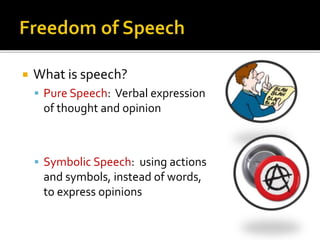
What is speech?
 Pure Speech: Verbal expression

of thought and opinion

 Symbolic Speech: using actions

and symbols, instead of words,
to express opinions


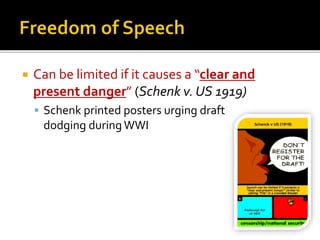
Can be limited if it causes a “clear and
present danger” (Schenk v. US 1919)
 Schenk printed posters urging draft

dodging during WWI


Speech not Protected:
 Defamatory speech (false speech that

damages a person’s good name)
▪ Slander-Spoken
▪ Libel-Written

 Fighting Words (so insulting that they

provoke immediate violence)
 Student Speech (lewd or indecent
speech, school newspapers)


Prior restraint: censorship of information before
it is published (not allowed in the states)
 Some limits on press and fair trials

 Radio and television
▪ US v. Playboy 2000 - Cable operators should be allowed to
show sexually oriented programs
▪ Reno v. American Civil Liberties Union 1997 - Internet is
speech
▪ Obscenity - determined by community
▪ Advertising is commercial speech-less protection


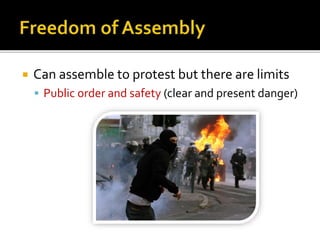
Can assemble to protest but there are limits
 Public order and safety (clear and present danger)


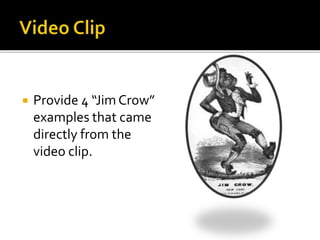
Provide 4 “Jim Crow”
examples that came
directly from the
video clip.

2.1 day 3 ppt

  • 1.
  • 2.
     How does theSupreme Court interpret 1st Amendment Rights
  • 3.
        Rights: Powers orprivileges granted to people either by an agreement among themselves or by law. Affirmative Action: A policy in educational admissions or job hiring that gives special attention or compensatory treatment to traditionally disadvantaged groups in an effort to overcome present effects of past discrimination. Unjust: not fair, wrong Obligated: legally or morally bound
  • 4.
     Establishment clause: “Congressshall make no law respecting an establishment of religion.”  Separation of Church and State (government doesn’t pick a religion) ▪ ▪ ▪ ▪ Funding to private schools okay Release time for students okay Prayer in public schools-students only Evolution not Creationism
  • 5.
     Free exercise clause:prohibits government from unduly interfering with the free exercise of religion  Can’t stop people from believing what they want ▪ Unless they violate laws protecting health, safety, or morals of country. ▪ Flag Salute
  • 6.
     What is speech? Pure Speech: Verbal expression of thought and opinion  Symbolic Speech: using actions and symbols, instead of words, to express opinions
  • 7.
     Can be limitedif it causes a “clear and present danger” (Schenk v. US 1919)  Schenk printed posters urging draft dodging during WWI
  • 8.
     Speech not Protected: Defamatory speech (false speech that damages a person’s good name) ▪ Slander-Spoken ▪ Libel-Written  Fighting Words (so insulting that they provoke immediate violence)  Student Speech (lewd or indecent speech, school newspapers)
  • 9.
     Prior restraint: censorshipof information before it is published (not allowed in the states)  Some limits on press and fair trials  Radio and television ▪ US v. Playboy 2000 - Cable operators should be allowed to show sexually oriented programs ▪ Reno v. American Civil Liberties Union 1997 - Internet is speech ▪ Obscenity - determined by community ▪ Advertising is commercial speech-less protection
  • 10.
     Can assemble toprotest but there are limits  Public order and safety (clear and present danger)
  • 11.
     Provide 4 “JimCrow” examples that came directly from the video clip.