Computer Form Factor

Computer Form Factor




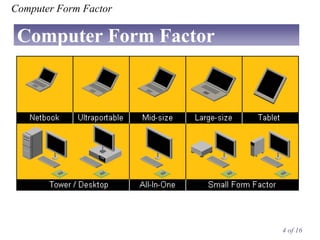
In computing, a form factor specifies the physical
dimensions of major system components.
Specifically, in the IBM PC compatible industry,
standard form factors ensure that parts are
interchangeable across competing vendors and
generations of technology, while in enterprise
computing, form factors ensure that server modules
fit into existing Rackmount systems.

1 of 16
Computer Form Factor

Computer Form Factor

2 of 16
Computer Form Factor

Computer Form Factor




Traditionally, the most significant specification is
the motherboard, which generally dictates the
overall size of the case.
Small form factors have been developed and
implemented, but further reduction in overall size is
hampered by current power supply technology.

3 of 16
Computer Form Factor

Computer Form Factor

4 of 16
Computer Form Factor

Computer Case


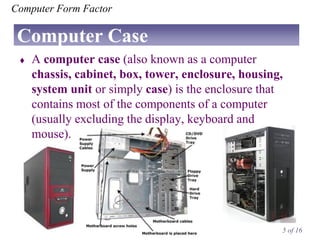
A computer case (also known as a computer
chassis, cabinet, box, tower, enclosure, housing,
system unit or simply case) is the enclosure that
contains most of the components of a computer
(usually excluding the display, keyboard and
mouse).

5 of 16
Computer Form Factor

Computer Case






A computer case is sometimes incorrectly
referred to as a CPU.
Cases are usually constructed from steel or
Aluminium.
Plastic and wood are sometimes used.

6 of 16
Computer Form Factor

Computer Case: Sizes







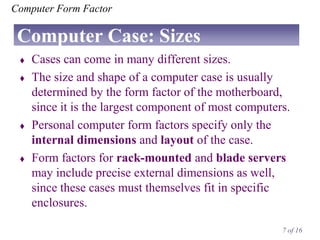
Cases can come in many different sizes.
The size and shape of a computer case is usually
determined by the form factor of the motherboard,
since it is the largest component of most computers.
Personal computer form factors specify only the
internal dimensions and layout of the case.
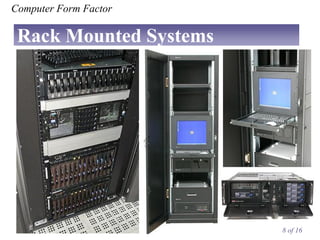
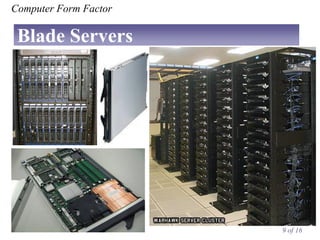
Form factors for rack-mounted and blade servers
may include precise external dimensions as well,
since these cases must themselves fit in specific
enclosures.
7 of 16
Computer Form Factor

Rack Mounted Systems

8 of 16
Computer Form Factor

Blade Servers

9 of 16
Computer Form Factor

Computer Case: Sizes







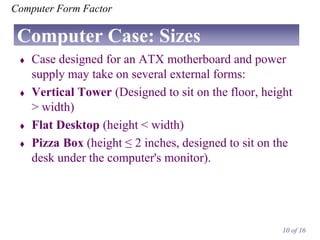
Case designed for an ATX motherboard and power
supply may take on several external forms:
Vertical Tower (Designed to sit on the floor, height
> width)
Flat Desktop (height < width)
Pizza Box (height ≤ 2 inches, designed to sit on the
desk under the computer's monitor).

10 of 16
Computer Form Factor

Computer Case: Sizes

11 of 16
Computer Form Factor

Computer Case: Sizes






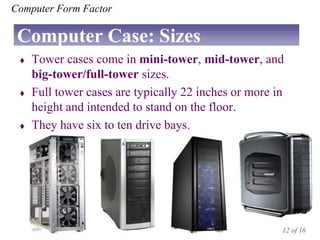
Tower cases come in mini-tower, mid-tower, and
big-tower/full-tower sizes.
Full tower cases are typically 22 inches or more in
height and intended to stand on the floor.
They have six to ten drive bays.

12 of 16
Computer Form Factor

Computer Case: Sizes




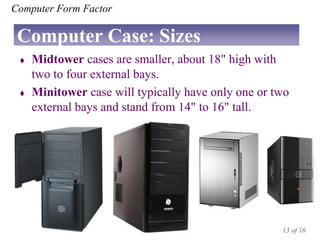
Midtower cases are smaller, about 18" high with
two to four external bays.
Minitower case will typically have only one or two
external bays and stand from 14" to 16" tall.

13 of 16
Computer Form Factor

Computer Case: Layout




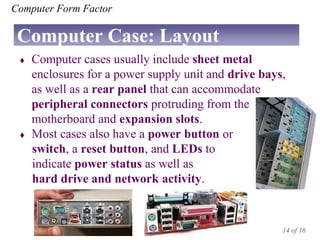
Computer cases usually include sheet metal
enclosures for a power supply unit and drive bays,
as well as a rear panel that can accommodate
peripheral connectors protruding from the
motherboard and expansion slots.
Most cases also have a power button or
switch, a reset button, and LEDs to
indicate power status as well as
hard drive and network activity.

14 of 16
Computer Form Factor

Computer Case: Layout




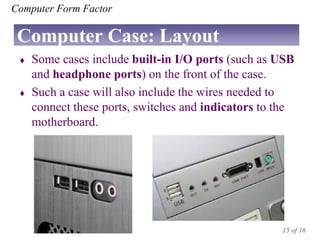
Some cases include built-in I/O ports (such as USB
and headphone ports) on the front of the case.
Such a case will also include the wires needed to
connect these ports, switches and indicators to the
motherboard.

15 of 16
Computer Form Factor

Computer Case


Major Component Locations:
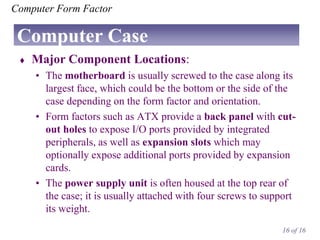
• The motherboard is usually screwed to the case along its
largest face, which could be the bottom or the side of the
case depending on the form factor and orientation.
• Form factors such as ATX provide a back panel with cutout holes to expose I/O ports provided by integrated
peripherals, as well as expansion slots which may
optionally expose additional ports provided by expansion
cards.
• The power supply unit is often housed at the top rear of
the case; it is usually attached with four screws to support
its weight.
16 of 16
Computer Form Factor

Computer Case


Major Component Locations:
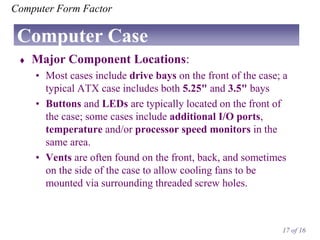
• Most cases include drive bays on the front of the case; a
typical ATX case includes both 5.25" and 3.5" bays
• Buttons and LEDs are typically located on the front of
the case; some cases include additional I/O ports,
temperature and/or processor speed monitors in the
same area.
• Vents are often found on the front, back, and sometimes
on the side of the case to allow cooling fans to be
mounted via surrounding threaded screw holes.

17 of 16
Computer Form Factor

Computer Case


Internal access
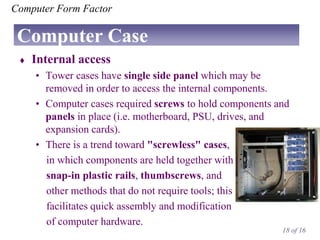
• Tower cases have single side panel which may be
removed in order to access the internal components.
• Computer cases required screws to hold components and
panels in place (i.e. motherboard, PSU, drives, and
expansion cards).
• There is a trend toward "screwless" cases,
in which components are held together with
snap-in plastic rails, thumbscrews, and
other methods that do not require tools; this
facilitates quick assembly and modification
of computer hardware.
18 of 16
Computer Form Factor

Computer Case


Intrusion detection
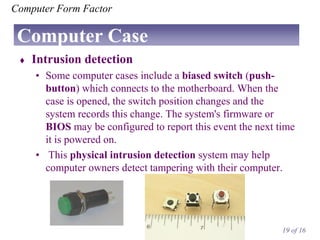
• Some computer cases include a biased switch (pushbutton) which connects to the motherboard. When the
case is opened, the switch position changes and the
system records this change. The system's firmware or
BIOS may be configured to report this event the next time
it is powered on.
• This physical intrusion detection system may help
computer owners detect tampering with their computer.

19 of 16

computer form factor

  • 1.
    Computer Form Factor ComputerForm Factor   In computing, a form factor specifies the physical dimensions of major system components. Specifically, in the IBM PC compatible industry, standard form factors ensure that parts are interchangeable across competing vendors and generations of technology, while in enterprise computing, form factors ensure that server modules fit into existing Rackmount systems. 1 of 16
  • 2.
    Computer Form Factor ComputerForm Factor 2 of 16
  • 3.
    Computer Form Factor ComputerForm Factor   Traditionally, the most significant specification is the motherboard, which generally dictates the overall size of the case. Small form factors have been developed and implemented, but further reduction in overall size is hampered by current power supply technology. 3 of 16
  • 4.
    Computer Form Factor ComputerForm Factor 4 of 16
  • 5.
    Computer Form Factor ComputerCase  A computer case (also known as a computer chassis, cabinet, box, tower, enclosure, housing, system unit or simply case) is the enclosure that contains most of the components of a computer (usually excluding the display, keyboard and mouse). 5 of 16
  • 6.
    Computer Form Factor ComputerCase    A computer case is sometimes incorrectly referred to as a CPU. Cases are usually constructed from steel or Aluminium. Plastic and wood are sometimes used. 6 of 16
  • 7.
    Computer Form Factor ComputerCase: Sizes     Cases can come in many different sizes. The size and shape of a computer case is usually determined by the form factor of the motherboard, since it is the largest component of most computers. Personal computer form factors specify only the internal dimensions and layout of the case. Form factors for rack-mounted and blade servers may include precise external dimensions as well, since these cases must themselves fit in specific enclosures. 7 of 16
  • 8.
    Computer Form Factor RackMounted Systems 8 of 16
  • 9.
  • 10.
    Computer Form Factor ComputerCase: Sizes     Case designed for an ATX motherboard and power supply may take on several external forms: Vertical Tower (Designed to sit on the floor, height > width) Flat Desktop (height < width) Pizza Box (height ≤ 2 inches, designed to sit on the desk under the computer's monitor). 10 of 16
  • 11.
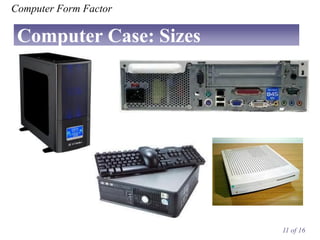
    Computer Form Factor ComputerCase: Sizes 11 of 16
  • 12.
    Computer Form Factor ComputerCase: Sizes    Tower cases come in mini-tower, mid-tower, and big-tower/full-tower sizes. Full tower cases are typically 22 inches or more in height and intended to stand on the floor. They have six to ten drive bays. 12 of 16
  • 13.
    Computer Form Factor ComputerCase: Sizes   Midtower cases are smaller, about 18" high with two to four external bays. Minitower case will typically have only one or two external bays and stand from 14" to 16" tall. 13 of 16
  • 14.
    Computer Form Factor ComputerCase: Layout   Computer cases usually include sheet metal enclosures for a power supply unit and drive bays, as well as a rear panel that can accommodate peripheral connectors protruding from the motherboard and expansion slots. Most cases also have a power button or switch, a reset button, and LEDs to indicate power status as well as hard drive and network activity. 14 of 16
  • 15.
    Computer Form Factor ComputerCase: Layout   Some cases include built-in I/O ports (such as USB and headphone ports) on the front of the case. Such a case will also include the wires needed to connect these ports, switches and indicators to the motherboard. 15 of 16
  • 16.
    Computer Form Factor ComputerCase  Major Component Locations: • The motherboard is usually screwed to the case along its largest face, which could be the bottom or the side of the case depending on the form factor and orientation. • Form factors such as ATX provide a back panel with cutout holes to expose I/O ports provided by integrated peripherals, as well as expansion slots which may optionally expose additional ports provided by expansion cards. • The power supply unit is often housed at the top rear of the case; it is usually attached with four screws to support its weight. 16 of 16
  • 17.
    Computer Form Factor ComputerCase  Major Component Locations: • Most cases include drive bays on the front of the case; a typical ATX case includes both 5.25" and 3.5" bays • Buttons and LEDs are typically located on the front of the case; some cases include additional I/O ports, temperature and/or processor speed monitors in the same area. • Vents are often found on the front, back, and sometimes on the side of the case to allow cooling fans to be mounted via surrounding threaded screw holes. 17 of 16
  • 18.
    Computer Form Factor ComputerCase  Internal access • Tower cases have single side panel which may be removed in order to access the internal components. • Computer cases required screws to hold components and panels in place (i.e. motherboard, PSU, drives, and expansion cards). • There is a trend toward "screwless" cases, in which components are held together with snap-in plastic rails, thumbscrews, and other methods that do not require tools; this facilitates quick assembly and modification of computer hardware. 18 of 16
  • 19.
    Computer Form Factor ComputerCase  Intrusion detection • Some computer cases include a biased switch (pushbutton) which connects to the motherboard. When the case is opened, the switch position changes and the system records this change. The system's firmware or BIOS may be configured to report this event the next time it is powered on. • This physical intrusion detection system may help computer owners detect tampering with their computer. 19 of 16