Communication Skills
Ms. Shital S. Patil
Shital S. Patil
Barriers to communication
Shital S. Patil
“Whatever words we utter should be chosen
with care for people will hear them and be
influenced by them for good or ill.” Buddha
CONTENTS
• Introduction
• Types of barriers
1. Psychological Barriers
2. Physical Barriers
3. Physiological Barriers
4. Language barriers
5. Cultural Barriers
6. Gender Barriers
7. Emotional Barriers
8. Interpersonal Barriers
Shital S. Patil
Communication Barriers
• Miscommunication: when there is no perfect
Communication
Shital S. Patil
• Miscommunication occurs at three different levels,
 At the level of sender
 The medium
 At the level of receiver.
Communication Barriers
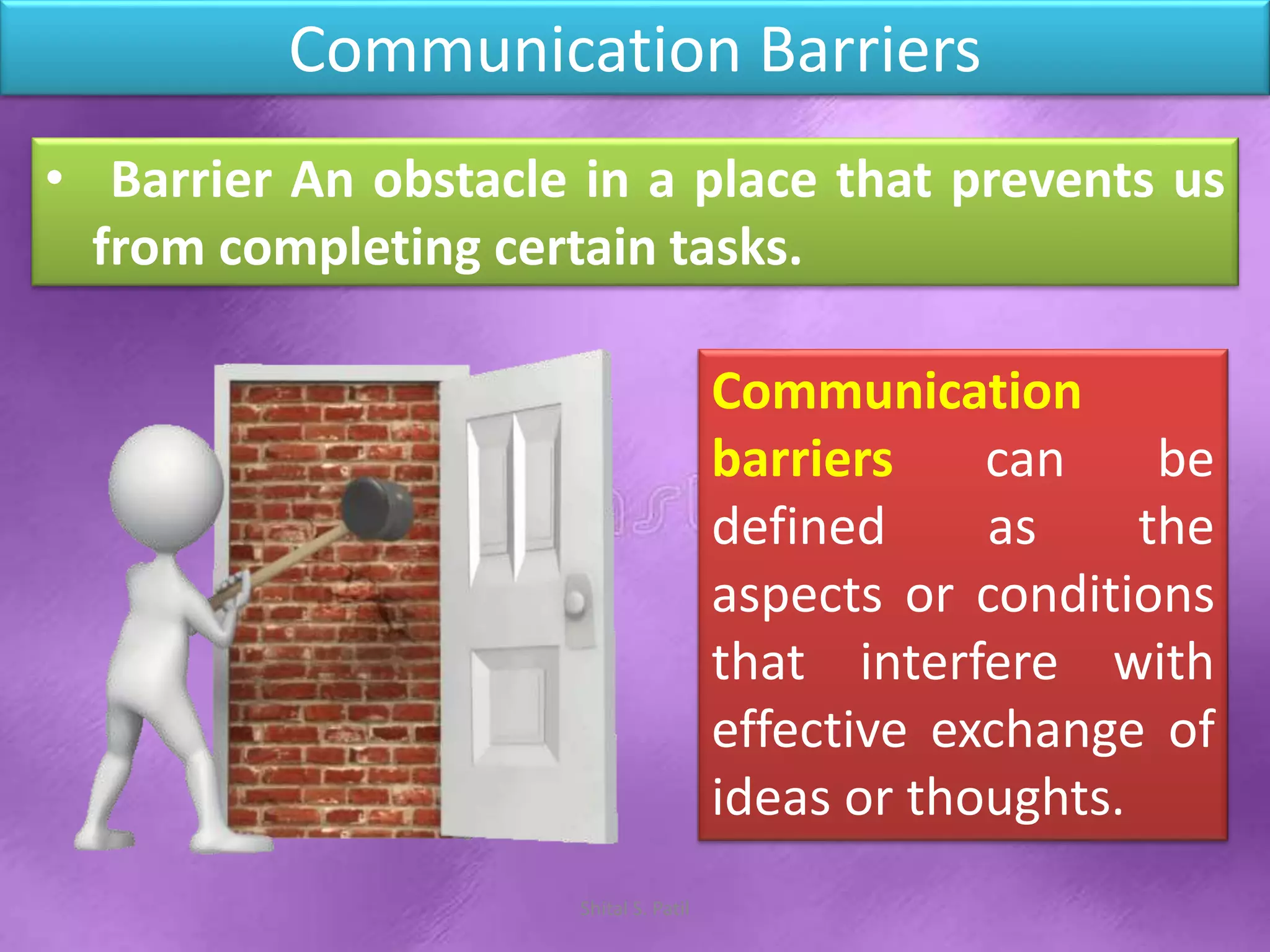
• Barrier An obstacle in a place that prevents us
from completing certain tasks.
Shital S. Patil
Communication
barriers can be
defined as the
aspects or conditions
that interfere with
effective exchange of
ideas or thoughts.
Types of Communication Barriers
Shital S. Patil
1. Psychological Barriers
2. Physical Barriers
3. Physiological Barriers
4. Language barriers
5. Cultural Barriers
6. Gender Barriers
7. Emotional Barriers
8. Interpersonal Barriers
1. Psychological barriers
• It is the influence of psychological state of
sender and receiver which creates problem in
effective communication.
Shital S. Patil
Reasons to Psychological Barriers
Shital S. Patil
Psychological
Barriers
Lack of
attention
Poor
retention
Emotions
Premature
evaluation
Closed mind
and filtering
Distrust and
defensiveness
2. Physical barriers
• Physical barriers includes the
environmental and natural
condition which act as a barriers
in communication in sending
message from sender to
receiver.
Physical Barriers
Noise Space
Shital S. Patil
Causes of Physical Barriers
a. Distraction in Environment
b. Time and distance
c. Information overflow
d. Defects in media
e. Ignorance of medium
Shital S. Patil
How to overcome???
• To be updated with latest technologies.
• Choosing a suitable environment.
• Removing obstacle.
• Making signs easier to read, example, you
could supplement written signs with pictures
and visual signs.
• Self Motivation.
Shital S. Patil
Physiological Barriers
• Physiological barriers of communication
occurs due to the physical condition of
sender or receiver which might be physical
disabilities like sensory dysfunction and
other physical dysfunction.
• Effective communication requires proper
functioning of senses in both sender and
receiver.
• Example: Person with short term memory
loss.
Shital S. Patil
Causes of Physiological Barriers
Shital S. Patil
Hearing impairment
Vision impairment
Speech disorders
Physical condition
Alertness
• Hearing impairment
 A receiver with hearing loss can not receive message.
 If the hearing problem is not very severe, a person
might hear some words and is unable to get intended
meaning.
 If same problem is in sender, he can not able to get
feedback.
Shital S. Patil
Causes of Physiological Barriers
• Vision impairment
 Vision impairment like myopia (short- sightness),
hypermetropia (long sightness) blur vision also
create barrier to communication.
Shital S. Patil
Causes of Physiological Barriers
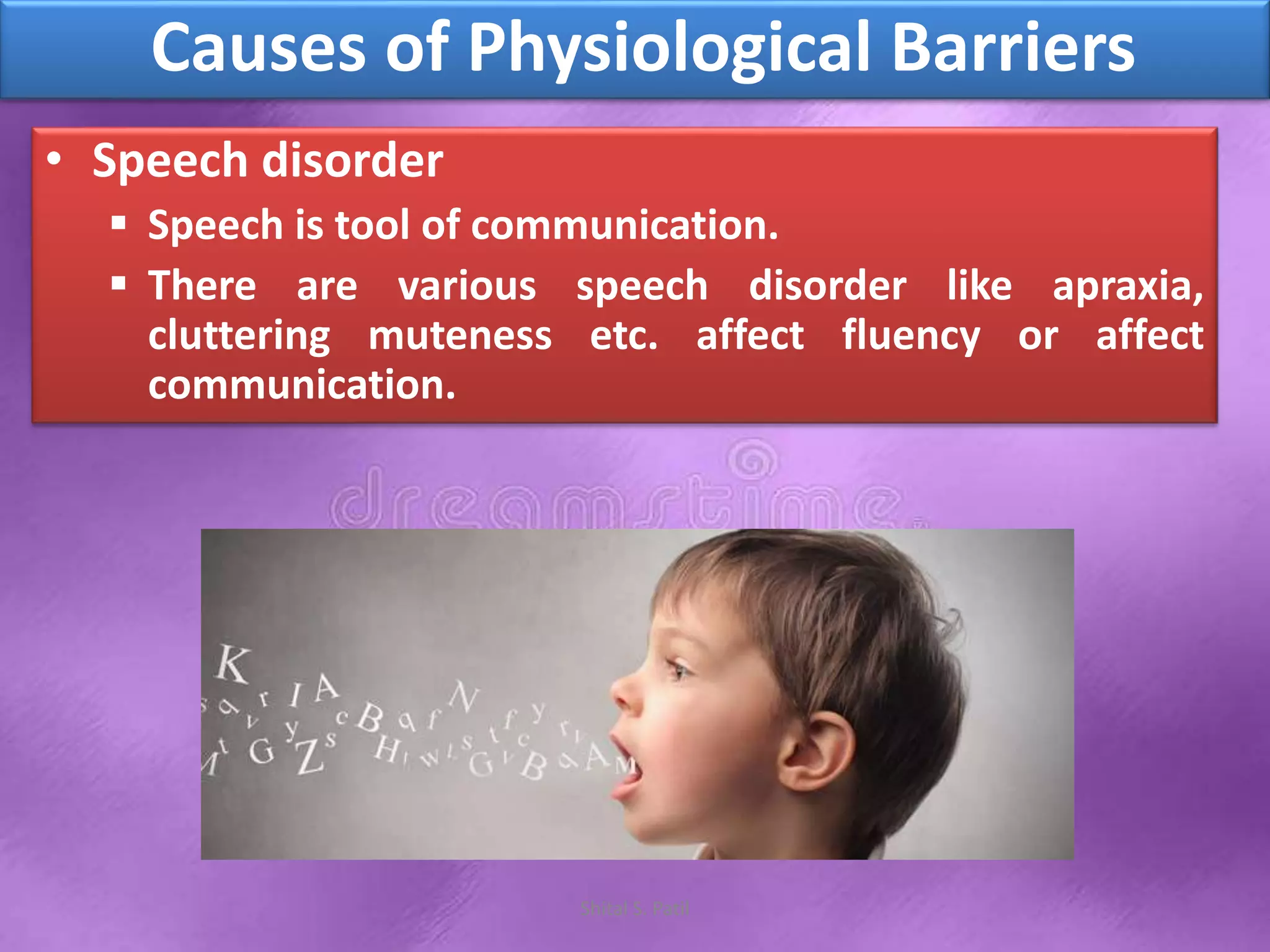
• Speech disorder
 Speech is tool of communication.
 There are various speech disorder like apraxia,
cluttering muteness etc. affect fluency or affect
communication.
Shital S. Patil
Causes of Physiological Barriers
• Physical Condition
 Physical condition of body and mind such as pain,
disease and sickness changes contents of
communication, fatigue and stress are also
physiological conditions which affect communication
and act as barrier.
Shital S. Patil
Causes of Physiological Barriers
• Alertness
 In emotional trauma, shock and mental situation prevent
brain from perceiving many things during that time.
 In such condition perception and alertness towards
message become very low.
 When physiological condition of body is not good , people
do not want to talk about anything.
Shital S. Patil
Causes of Physiological Barriers

1.2 barriers to communication

  • 1.
    Communication Skills Ms. ShitalS. Patil Shital S. Patil Barriers to communication
  • 2.
    Shital S. Patil “Whateverwords we utter should be chosen with care for people will hear them and be influenced by them for good or ill.” Buddha
  • 3.
    CONTENTS • Introduction • Typesof barriers 1. Psychological Barriers 2. Physical Barriers 3. Physiological Barriers 4. Language barriers 5. Cultural Barriers 6. Gender Barriers 7. Emotional Barriers 8. Interpersonal Barriers Shital S. Patil
  • 4.
    Communication Barriers • Miscommunication:when there is no perfect Communication Shital S. Patil • Miscommunication occurs at three different levels,  At the level of sender  The medium  At the level of receiver.
  • 5.
    Communication Barriers • BarrierAn obstacle in a place that prevents us from completing certain tasks. Shital S. Patil Communication barriers can be defined as the aspects or conditions that interfere with effective exchange of ideas or thoughts.
  • 6.
    Types of CommunicationBarriers Shital S. Patil 1. Psychological Barriers 2. Physical Barriers 3. Physiological Barriers 4. Language barriers 5. Cultural Barriers 6. Gender Barriers 7. Emotional Barriers 8. Interpersonal Barriers
  • 7.
    1. Psychological barriers •It is the influence of psychological state of sender and receiver which creates problem in effective communication. Shital S. Patil
  • 8.
    Reasons to PsychologicalBarriers Shital S. Patil Psychological Barriers Lack of attention Poor retention Emotions Premature evaluation Closed mind and filtering Distrust and defensiveness
  • 9.
    2. Physical barriers •Physical barriers includes the environmental and natural condition which act as a barriers in communication in sending message from sender to receiver. Physical Barriers Noise Space Shital S. Patil
  • 10.
    Causes of PhysicalBarriers a. Distraction in Environment b. Time and distance c. Information overflow d. Defects in media e. Ignorance of medium Shital S. Patil
  • 11.
    How to overcome??? •To be updated with latest technologies. • Choosing a suitable environment. • Removing obstacle. • Making signs easier to read, example, you could supplement written signs with pictures and visual signs. • Self Motivation. Shital S. Patil
  • 12.
    Physiological Barriers • Physiologicalbarriers of communication occurs due to the physical condition of sender or receiver which might be physical disabilities like sensory dysfunction and other physical dysfunction. • Effective communication requires proper functioning of senses in both sender and receiver. • Example: Person with short term memory loss. Shital S. Patil
  • 13.
    Causes of PhysiologicalBarriers Shital S. Patil Hearing impairment Vision impairment Speech disorders Physical condition Alertness
  • 14.
    • Hearing impairment A receiver with hearing loss can not receive message.  If the hearing problem is not very severe, a person might hear some words and is unable to get intended meaning.  If same problem is in sender, he can not able to get feedback. Shital S. Patil Causes of Physiological Barriers
  • 15.
    • Vision impairment Vision impairment like myopia (short- sightness), hypermetropia (long sightness) blur vision also create barrier to communication. Shital S. Patil Causes of Physiological Barriers
  • 16.
    • Speech disorder Speech is tool of communication.  There are various speech disorder like apraxia, cluttering muteness etc. affect fluency or affect communication. Shital S. Patil Causes of Physiological Barriers
  • 17.
    • Physical Condition Physical condition of body and mind such as pain, disease and sickness changes contents of communication, fatigue and stress are also physiological conditions which affect communication and act as barrier. Shital S. Patil Causes of Physiological Barriers
  • 18.
    • Alertness  Inemotional trauma, shock and mental situation prevent brain from perceiving many things during that time.  In such condition perception and alertness towards message become very low.  When physiological condition of body is not good , people do not want to talk about anything. Shital S. Patil Causes of Physiological Barriers