NATIONAL CONFERENCE

Stepping and Stretching in Lean Times
Developing Self and Others in the Current Economic Climate


Baljinder Johal and Sarah Troy-Brown
15:00-15:35:
 1. Context
 2. Presentation of Tools 1-4:
          1. Induction Process
          2. Training Matrix
          3. Development Sessions
          4. Personal Reflection and Planning Toolkit
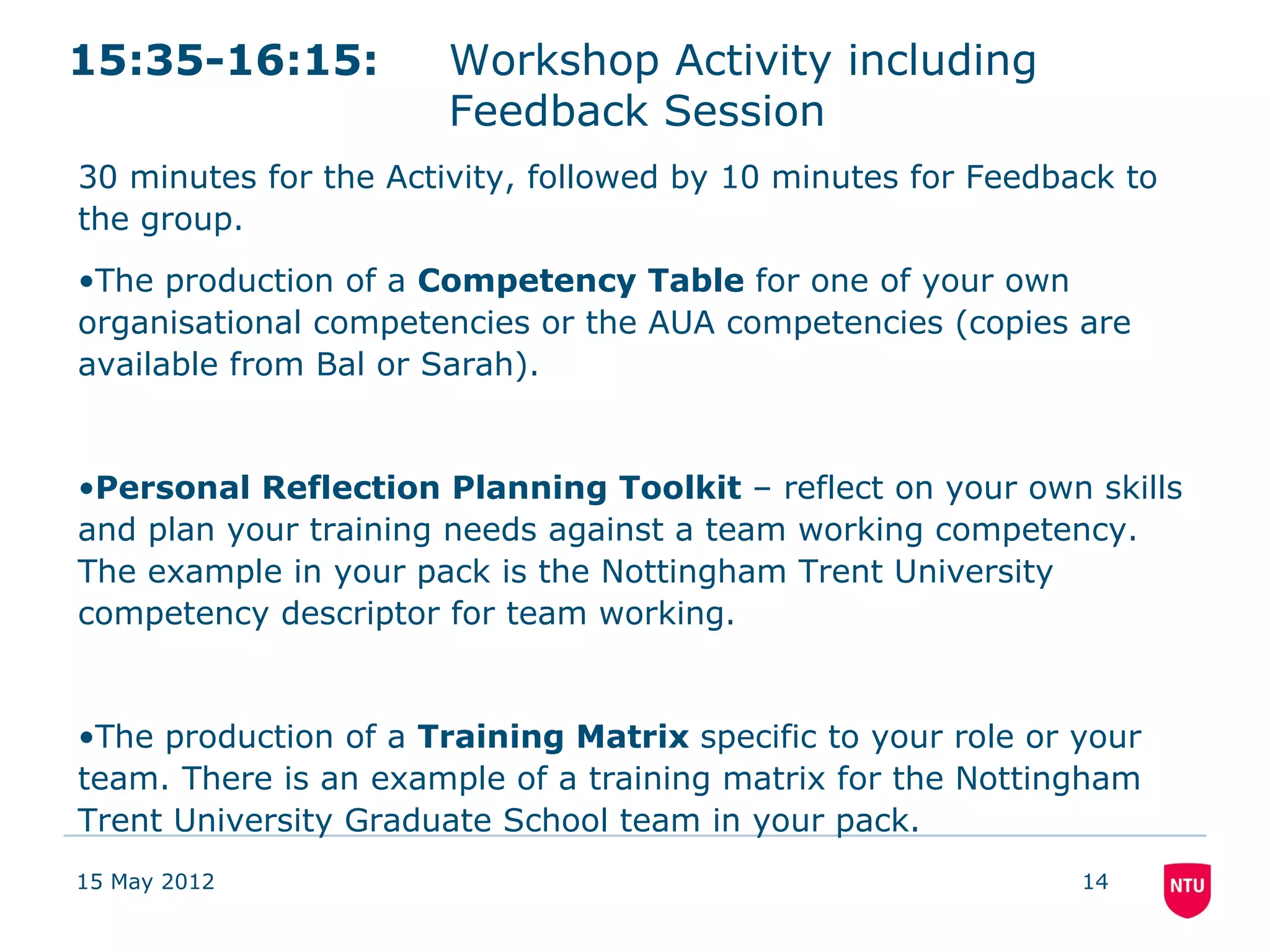
15:35-16:15:
 1. Workshop Activity including Feedback Session
16:15-16:35:
 1. Presentation of Tools 5 & 6:
          1. Step Up
          2. Shadowing
16:35-16:45:
 1. Question and Answer Session

15 May 2012                                             2
AUA Continuing Professional Development
Framework
Developing Self and Others - Showing commitment to own
 development and supporting and encouraging others to develop
 their knowledge, skills and behaviours to enable them to reach their
 full potential for the wider benefit of the organisation.
Managing Self and Personal Skills - Willing and able to assess
 and apply own skills, abilities and experience. Being aware of own
 behaviour and how it impacts on others.
Finding Innovative Solutions - Taking a holistic view and working
 enthusiastically and with creativity to analyse problems and develop
 innovative and workable solutions. Identifying opportunities for
 innovation.
Using Resources - Making effective use of available resources
 including people, information, networks and budgets. Being aware
 of the financial and commercial aspects of the organisation.
15 May 2012                                                    3
Learning Outcomes

Able to assess and reflect on own skills, abilities and experience.


Able to support others to develop their knowledge, skills and
 behaviours to enable them to reach their full potential for the wider
 benefit of the organisation.


Make effective use of available resources in respect of training and
 development.


Able to plan effective development with limited, or no impact on
 resources.


15 May 2012                                                       4
Context – Why do we need to step and
stretch in lean times?
What’s happening to HE?
   Cost Reductions


   Constant Change


   New World

What does these mean for staff?
   Efficiency, Effectiveness and Value Add - Do more with less


   Changing needs and demands - Be ready for anything and
    everything


   Professionalise Administration and Management – Re-ordering of
    staff skills and competencies
15 May 2012                                                       5
How?

Professional Development via practical, effective, efficient and
innovative tools to develop staff in lean times:


   Gain New Skills & Knowledge


   Improve Competencies & Behaviours


   No or Little Cost to the Organisation


   Significant Benefits to All


15 May 2012                                                        6
What?
Best Practice Practical Tools and Techniques:
         1. Induction Process


         3. Training Matrix


         5. Development Sessions


         7. Personal Reflection and Planning Toolkit


         9. Step Ups


         11.Shadowing
15 May 2012                                            7
1. Induction Process


  Induction and Development Process – extension of the NTU
  resource:


  http://www.ntu.ac.uk/cpld/our_services/staff_induction/index.html


  Learning Agreement – objective setting, learning, reviewing.
  Supports the PDR process.


  Competency Tables – expansion of corporate competencies to
  clarify to staff how these competencies can be developed and
  demonstrated – links to our PDR Process


15 May 2012                                                   8
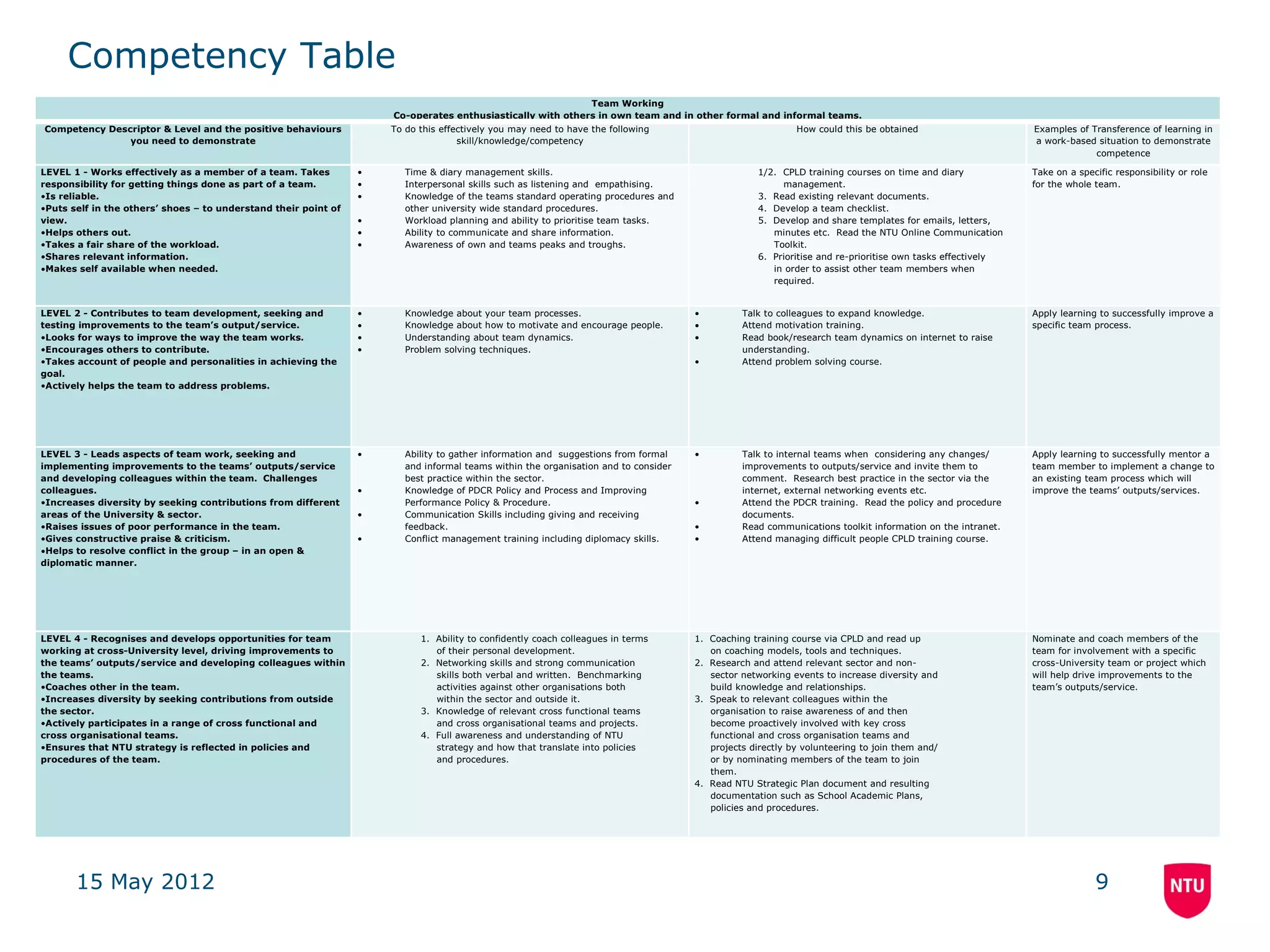
Competency Table
                                                                                                            Team Working
                                                                     Co-operates enthusiastically with others in own team and in other formal and informal teams.
Competency Descriptor & Level and the positive behaviours            To do this effectively you may need to have the following                             How could this be obtained                      Examples of Transference of learning in
               you need to demonstrate                                              skill/knowledge/competency                                                                                             a work-based situation to demonstrate
                                                                                                                                                                                                                        competence

LEVEL 1 - Works effectively as a member of a team. Takes         •      Time & diary management skills.                                            1/2. CPLD training courses on time and diary            Take on a specific responsibility or role
responsibility for getting things done as part of a team.        •      Interpersonal skills such as listening and empathising.                         management.                                        for the whole team.
•Is reliable.                                                    •      Knowledge of the teams standard operating procedures and                   3. Read existing relevant documents.
•Puts self in the others’ shoes – to understand their point of          other university wide standard procedures.                                 4. Develop a team checklist.
view.                                                            •      Workload planning and ability to prioritise team tasks.                    5. Develop and share templates for emails, letters,
•Helps others out.                                               •      Ability to communicate and share information.                                 minutes etc. Read the NTU Online Communication
•Takes a fair share of the workload.                             •      Awareness of own and teams peaks and troughs.                                 Toolkit.
•Shares relevant information.                                                                                                                      6. Prioritise and re-prioritise own tasks effectively
•Makes self available when needed.                                                                                                                    in order to assist other team members when
                                                                                                                                                      required.


LEVEL 2 - Contributes to team development, seeking and           •      Knowledge about your team processes.                         •         Talk to colleagues to expand knowledge.                     Apply learning to successfully improve a
testing improvements to the team’s output/service.               •      Knowledge about how to motivate and encourage people.        •         Attend motivation training.                                 specific team process.
•Looks for ways to improve the way the team works.               •      Understanding about team dynamics.                           •         Read book/research team dynamics on internet to raise
•Encourages others to contribute.                                •      Problem solving techniques.                                            understanding.
•Takes account of people and personalities in achieving the                                                                          •         Attend problem solving course.
goal.
•Actively helps the team to address problems.


LEVEL 3 - Leads aspects of team work, seeking and                •      Ability to gather information and suggestions from formal    •         Talk to internal teams when considering any changes/        Apply learning to successfully mentor a
implementing improvements to the teams’ outputs/service                 and informal teams within the organisation and to consider             improvements to outputs/service and invite them to          team member to implement a change to
and developing colleagues within the team. Challenges                   best practice within the sector.                                       comment. Research best practice in the sector via the       an existing team process which will
colleagues.                                                      •      Knowledge of PDCR Policy and Process and Improving                     internet, external networking events etc.                   improve the teams’ outputs/services.
•Increases diversity by seeking contributions from different            Performance Policy & Procedure.                              •         Attend the PDCR training. Read the policy and procedure
areas of the University & sector.                                •      Communication Skills including giving and receiving                    documents.
•Raises issues of poor performance in the team.                         feedback.                                                    •         Read communications toolkit information on the intranet.
•Gives constructive praise & criticism.                          •      Conflict management training including diplomacy skills.     •         Attend managing difficult people CPLD training course.
•Helps to resolve conflict in the group – in an open &
diplomatic manner.


LEVEL 4 - Recognises and develops opportunities for team                   1. Ability to confidently coach colleagues in terms       1. Coaching training course via CPLD and read up                      Nominate and coach members of the
working at cross-University level, driving improvements to                    of their personal development.                            on coaching models, tools and techniques.                          team for involvement with a specific
the teams’ outputs/service and developing colleagues within                2. Networking skills and strong communication             2. Research and attend relevant sector and non-                       cross-University team or project which
the teams.                                                                    skills both verbal and written. Benchmarking              sector networking events to increase diversity and                 will help drive improvements to the
•Coaches other in the team.                                                   activities against other organisations both               build knowledge and relationships.                                 team’s outputs/service.
•Increases diversity by seeking contributions from outside                    within the sector and outside it.                      3. Speak to relevant colleagues within the
the sector.                                                                3. Knowledge of relevant cross functional teams              organisation to raise awareness of and then
•Actively participates in a range of cross functional and                     and cross organisational teams and projects.              become proactively involved with key cross
cross organisational teams.                                                4. Full awareness and understanding of NTU                   functional and cross organisation teams and
•Ensures that NTU strategy is reflected in policies and                       strategy and how that translate into policies             projects directly by volunteering to join them and/
procedures of the team.                                                       and procedures.                                           or by nominating members of the team to join
                                                                                                                                        them.
                                                                                                                                     4. Read NTU Strategic Plan document and resulting
                                                                                                                                        documentation such as School Academic Plans,
                                                                                                                                        policies and procedures.


       15 May 2012                                                                                                                                                                                                       9
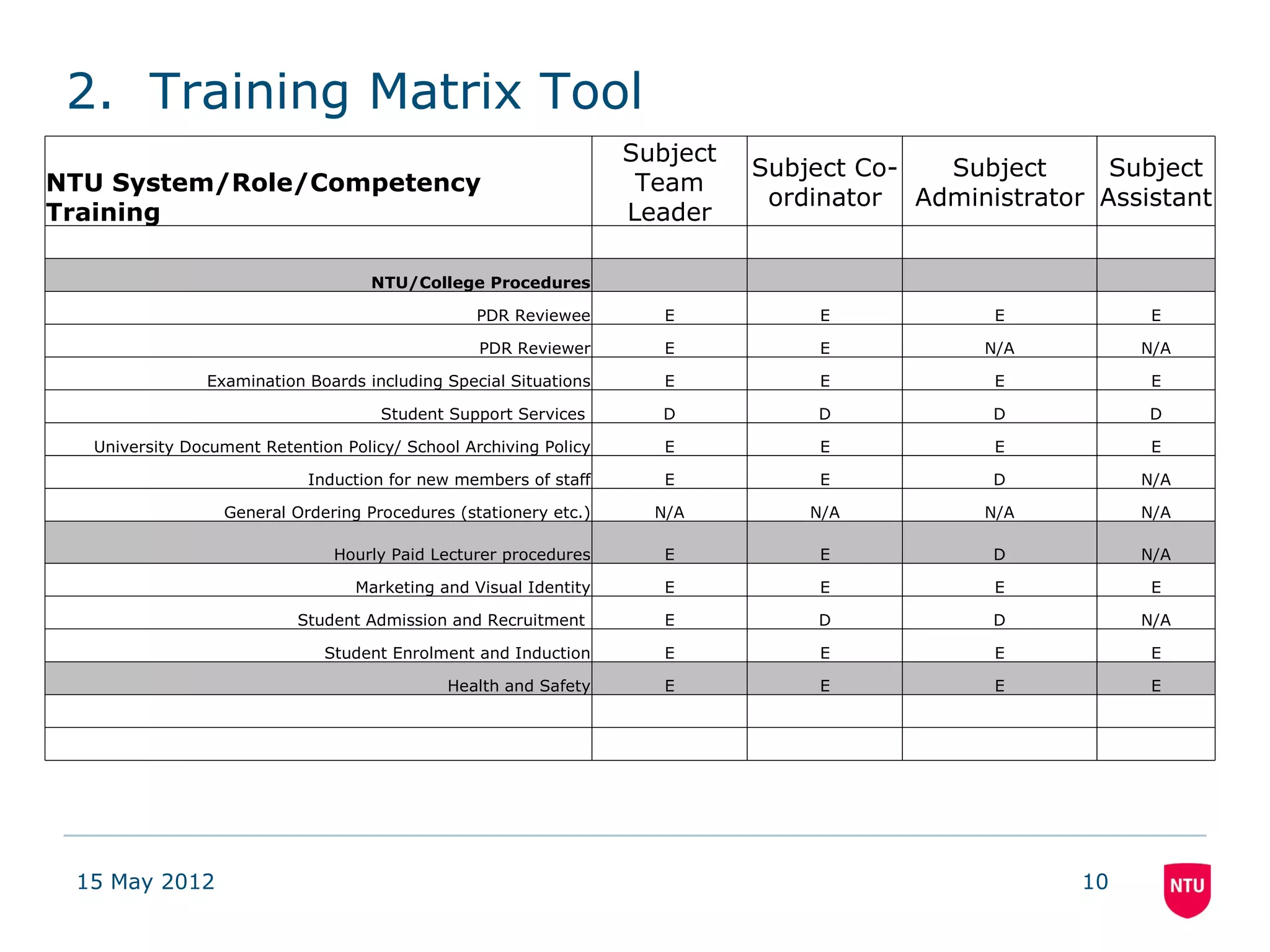
2. Training Matrix Tool
                                                                  Subject
                                                                            Subject Co-  Subject      Subject
NTU System/Role/Competency                                         Team
                                                                             ordinator Administrator Assistant
Training                                                          Leader

                                    NTU/College Procedures

                                                PDR Reviewee         E           E            E           E

                                                 PDR Reviewer        E           E           N/A         N/A

               Examination Boards including Special Situations       E           E            E           E

                                     Student Support Services        D          D            D           D

  University Document Retention Policy/ School Archiving Policy      E           E            E           E

                            Induction for new members of staff       E           E           D           N/A

                 General Ordering Procedures (stationery etc.)      N/A         N/A          N/A         N/A

                               Hourly Paid Lecturer procedures       E           E           D           N/A

                                  Marketing and Visual Identity      E           E            E           E

                           Student Admission and Recruitment         E          D            D           N/A

                              Student Enrolment and Induction        E           E            E           E

                                             Health and Safety       E           E            E           E


 15 May 2012                                                                                        10
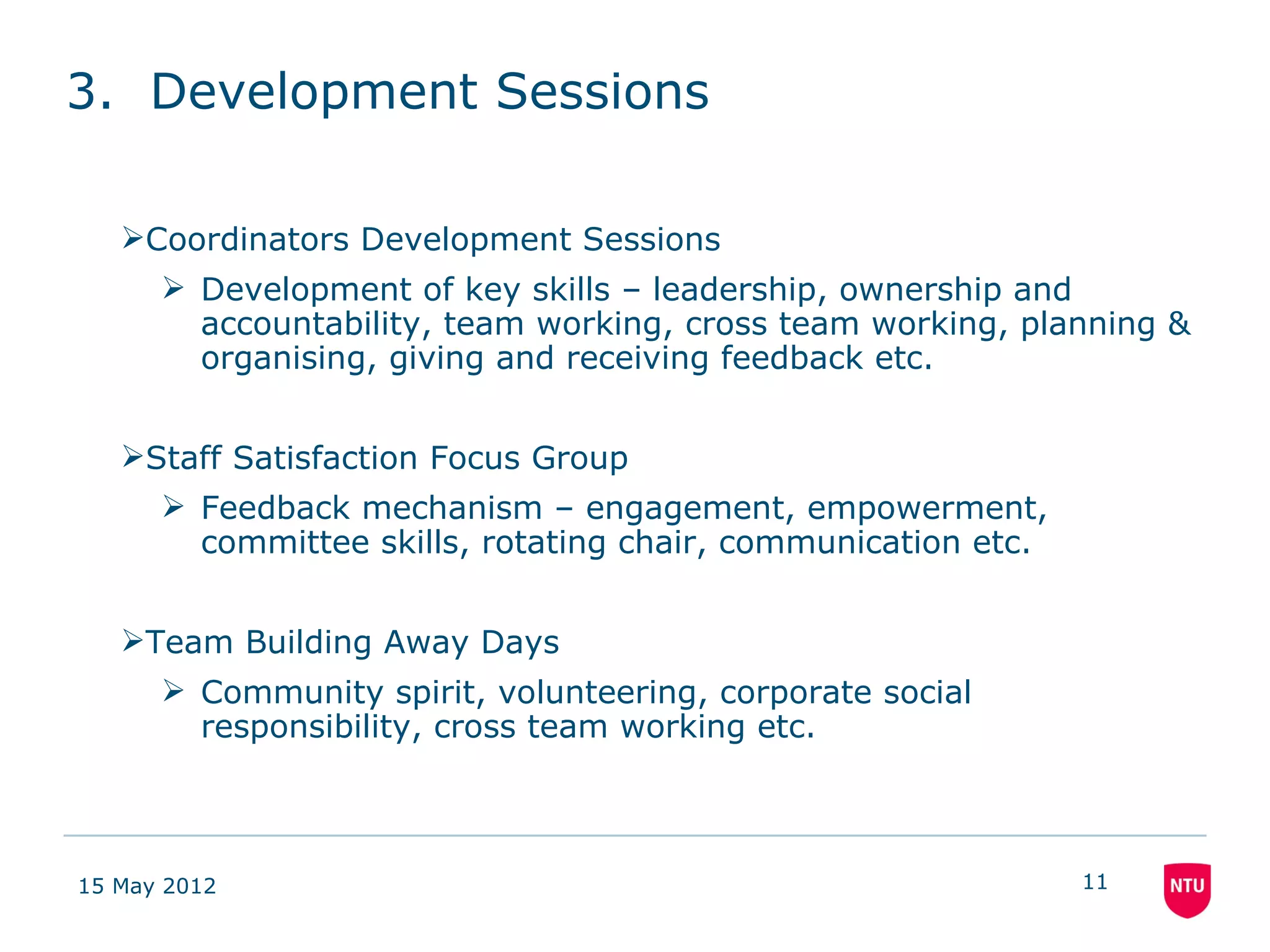
3. Development Sessions

   Coordinators Development Sessions
       Development of key skills – leadership, ownership and
        accountability, team working, cross team working, planning &
        organising, giving and receiving feedback etc.


   Staff Satisfaction Focus Group
       Feedback mechanism – engagement, empowerment,
        committee skills, rotating chair, communication etc.


   Team Building Away Days
       Community spirit, volunteering, corporate social
        responsibility, cross team working etc.


15 May 2012                                                    11
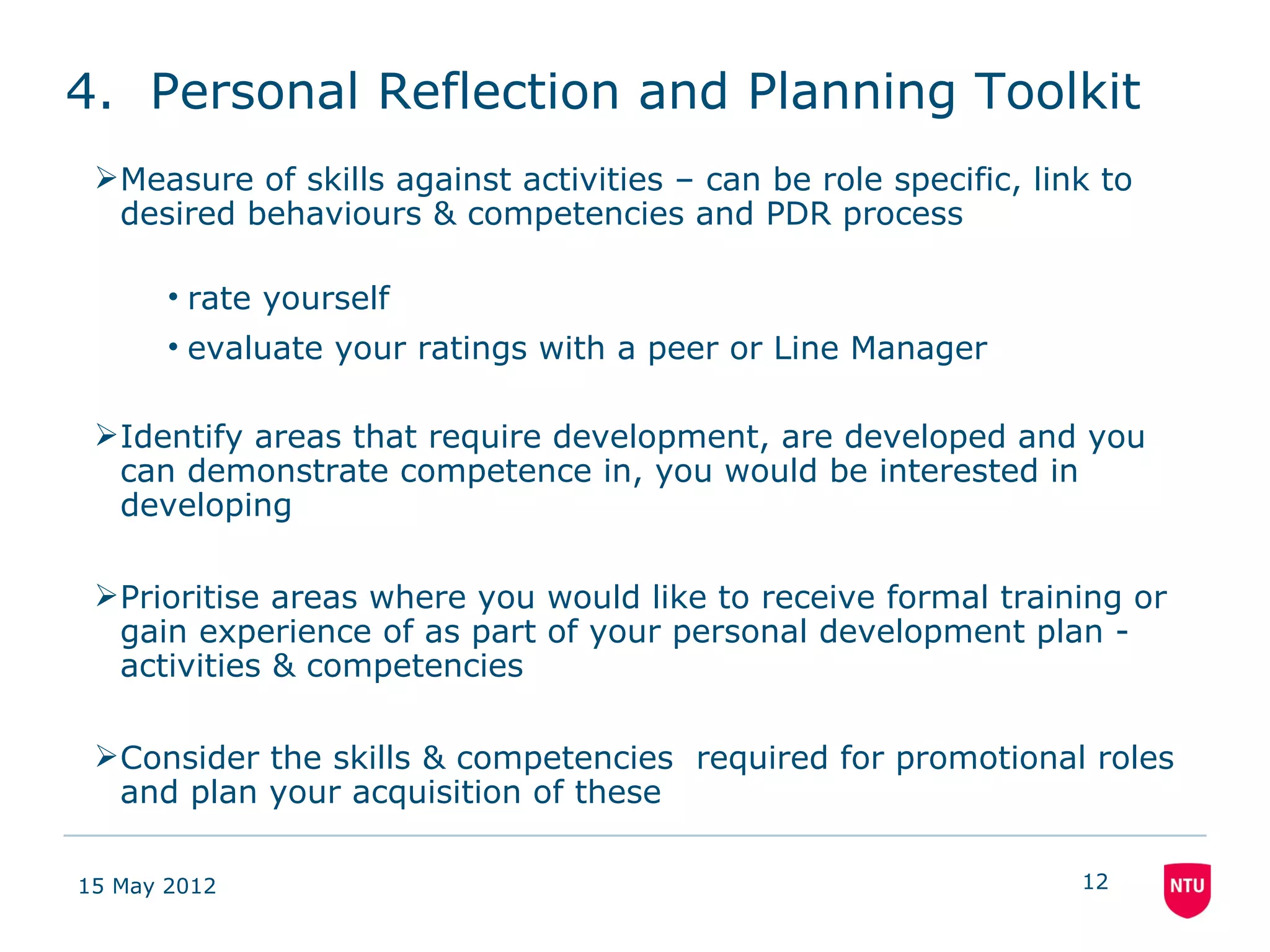
4. Personal Reflection and Planning Toolkit
 Measure of skills against activities – can be role specific, link to
  desired behaviours & competencies and PDR process

       • rate yourself
       • evaluate your ratings with a peer or Line Manager

 Identify areas that require development, are developed and you
  can demonstrate competence in, you would be interested in
  developing

 Prioritise areas where you would like to receive formal training or
  gain experience of as part of your personal development plan -
  activities & competencies

 Consider the skills & competencies required for promotional roles
  and plan your acquisition of these

15 May 2012                                                       12
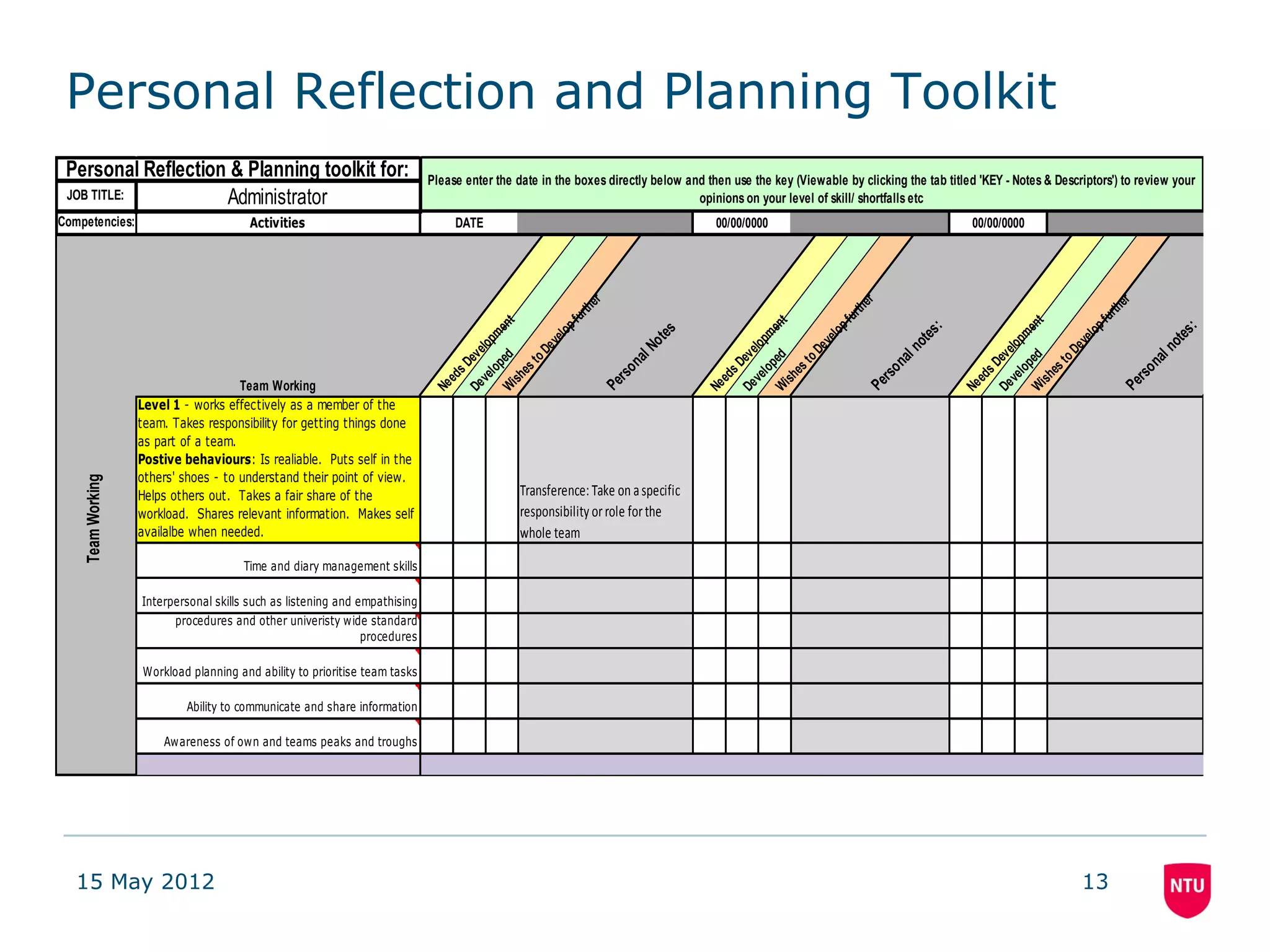
Personal Reflection and Planning Toolkit
 Personal Reflection & Planning toolkit for:                                Please enter the date in the boxes directly below and then use the key (Viewable by clicking the tab titled 'KEY - Notes & Descriptors') to review your
 JOB TITLE:         Administrator                                                                                               opinions on your level of skill/ shortfalls etc
Competencies:                           Activities                               DATE                                               00/00/0000                                         00/00/0000


                                                                                                         r


                                                                                                                                                              r


                                                                                                                                                                                                                 er
                                                                                                      the


                                                                                                                                                           the


                                                                                                                                                                                                              th
                                                                                                    ur


                                                                                                                                                         ur


                                                                                                                                                                                                            ur
                                                                                                                                                                                                           t
                                                                                                   t


                                                                                                                                                        t
                                                                                                 pf


                                                                                                                                                      pf


                                                                                                                                                                                                         pf
                                                                                                                                                                                                        en
                                                                                                en


                                                                                                                                                     en


                                                                                                                                                                             s:


                                                                                                                                                                                                                               s:
                                                                                                                         tes
                                                                                              lo


                                                                                                                                                   lo


                                                                                                                                                                                                      lo
                                                                                  l o opm


                                                                                                                                       l o opm


                                                                                                                                                                                          l op opm
                                                                                                                                                                          ote


                                                                                                                                                                                                                            ote
                                                                                            ve


                                                                                                                                                 ve


                                                                                                                                                                                                    ve
                                                                                                                      No


                                                                                                                                                                                                 De
                                                                                         De


                                                                                                                                              De


                                                                                                                                                                        ln


                                                                                                                                                                                                                          ln
                                                                                          l


                                                                                                                                               l


                                                                                                                                                                                                  l
                                                                            De ev e


                                                                                                                                  De ev e


                                                                                                                                                                                    De ev e
                                                                                       d


                                                                                                                                  Wi ed


                                                                                                                                                                                              ed
                                                                                                                   al
                                                                                      to


                                                                                                                                           to


                                                                                                                                                                                              to
                                                                                                                                                                      na


                                                                                                                                                                                                                        na
                                                                                     pe


                                                                                                                 on
                                                                                  sD


                                                                                                                                        sD


                                                                                                                                                                                          sD
                                                                                                                                          p
                                                                                  es


                                                                                                                                       es


                                                                                                                                                                                          es
                                                                                                                                                                     o


                                                                                                                                                                                                                       o
                                                                                                               rs


                                                                                                                                                                  ers


                                                                                                                                                                                                                    ers
                                                                               ed


                                                                                                                                     ed


                                                                                                                                                                                       ed
                                                                               ve


                                                                                                                                     ve


                                                                                                                                                                                       ve

                                                                                                                                                                                      ish
                                                                               sh


                                                                                                                                    sh
                                      Team Working


                                                                                                             Pe


                                                                                                                                                                                    Ne
                                                                            Ne


                                                                                                                                  Ne
                                                                            Wi


                                                                                                                                                                                    W
                                                                                                                                  P


                                                                                                                                                                                    P
                   Level 1 - works effectively as a member of the
                   team. Takes responsibility for getting things done
                   as part of a team.
                   Postive behaviours: Is realiable. Puts self in the
                   others' shoes - to understand their point of view.
    Team Working


                   Helps others out. Takes a fair share of the                                Transference: Take on a specific
                   workload. Shares relevant information. Makes self                          responsibility or role for the
                   availalbe when needed.                                                     whole team

                                      Time and diary management skills

                   Interpersonal skills such as teams standard operating
                            Knowledge of the listening and empathising
                         procedures and other univeristy wide standard
                                                             procedures

                   Workload planning and ability to prioritise team tasks

                           Ability to communicate and share information

                       Awareness of own and teams peaks and troughs


   15 May 2012                                                                                                                                                                                              13
15:35-16:15:           Workshop Activity including
                       Feedback Session
30 minutes for the Activity, followed by 10 minutes for Feedback to
the group.
•The production of a Competency Table for one of your own
organisational competencies or the AUA competencies (copies are
available from Bal or Sarah).


•Personal Reflection Planning Toolkit – reflect on your own skills
and plan your training needs against a team working competency.
The example in your pack is the Nottingham Trent University
competency descriptor for team working.


•The production of a Training Matrix specific to your role or your
team. There is an example of a training matrix for the Nottingham
Trent University Graduate School team in your pack.
15 May 2012                                                   14
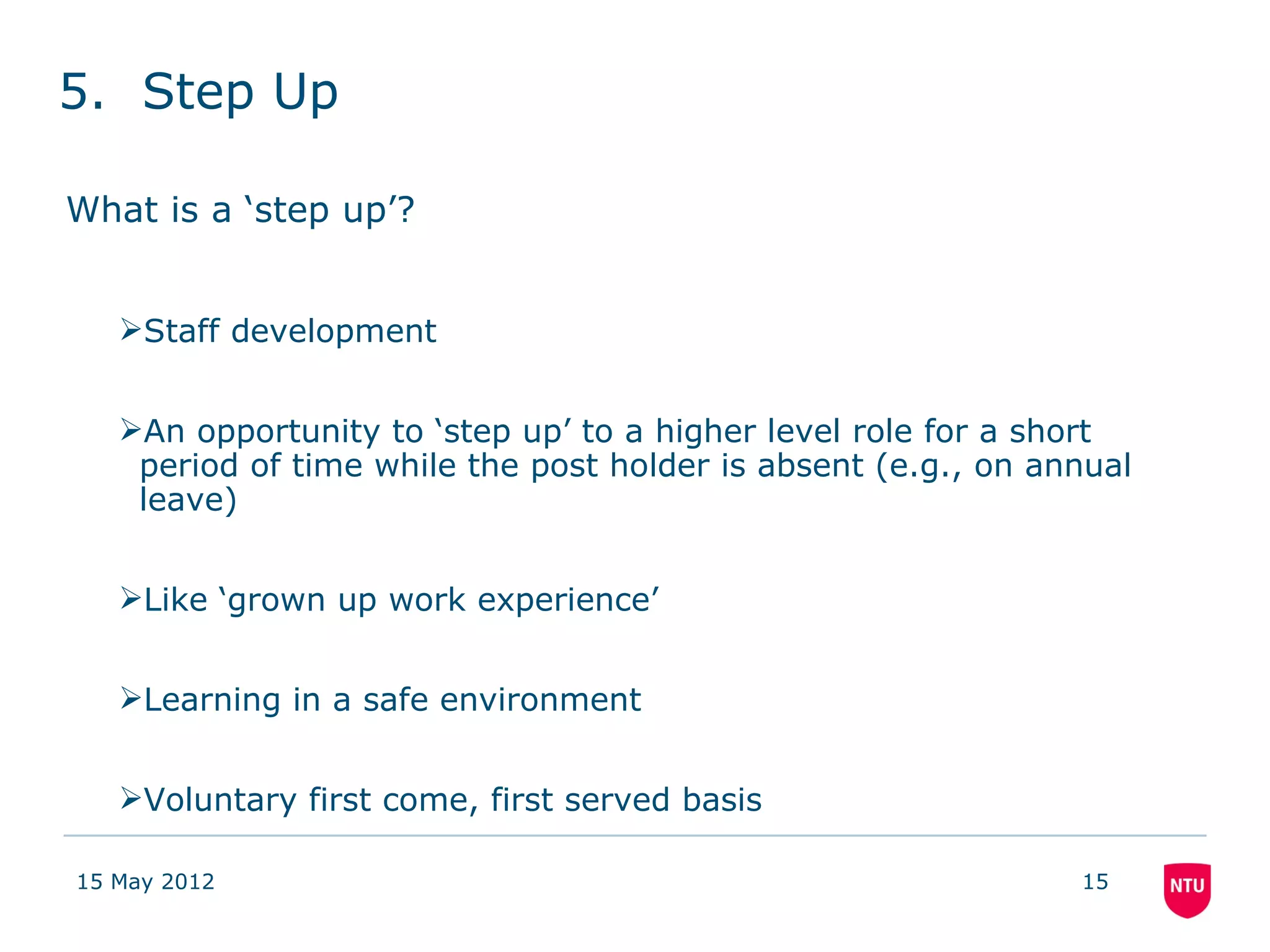
5. Step Up

What is a ‘step up’?


   Staff development


   An opportunity to ‘step up’ to a higher level role for a short
    period of time while the post holder is absent (e.g., on annual
    leave)


   Like ‘grown up work experience’


   Learning in a safe environment


   Voluntary first come, first served basis

15 May 2012                                                    15
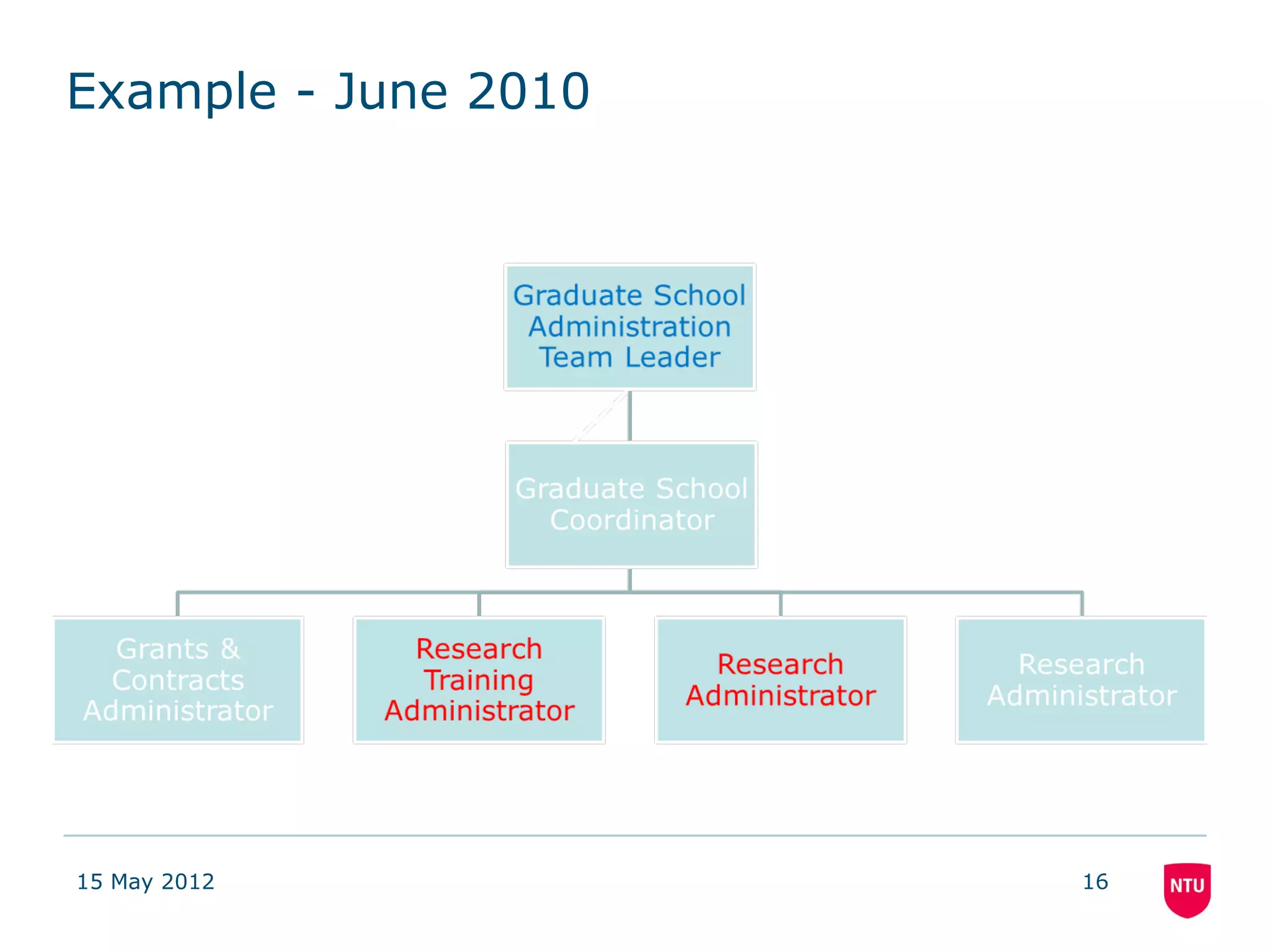
Example - June 2010


15 May 2012           16
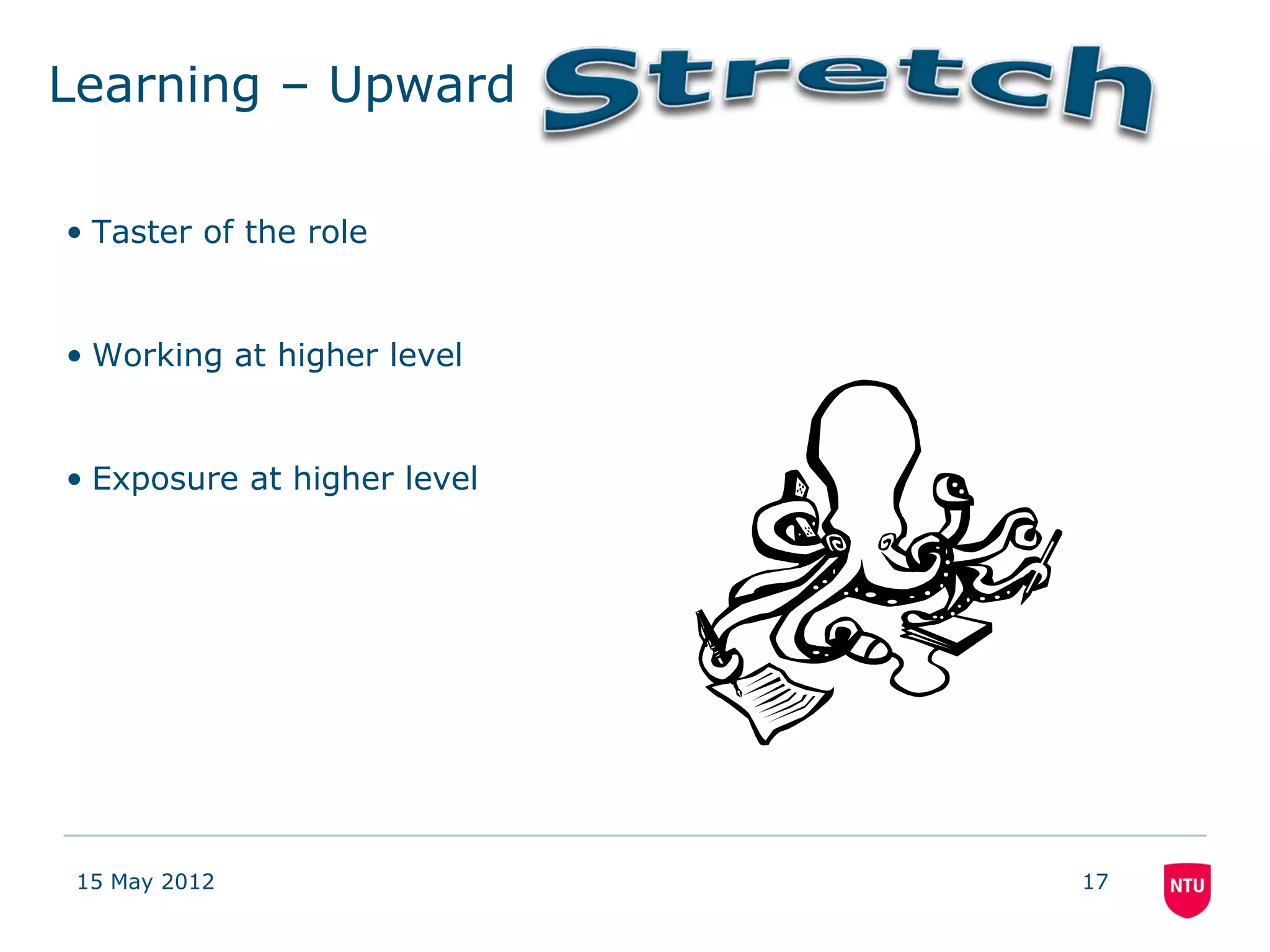
Learning – Upward

• Taster of the role


• Working at higher level


• Exposure at higher level


 15 May 2012                 17
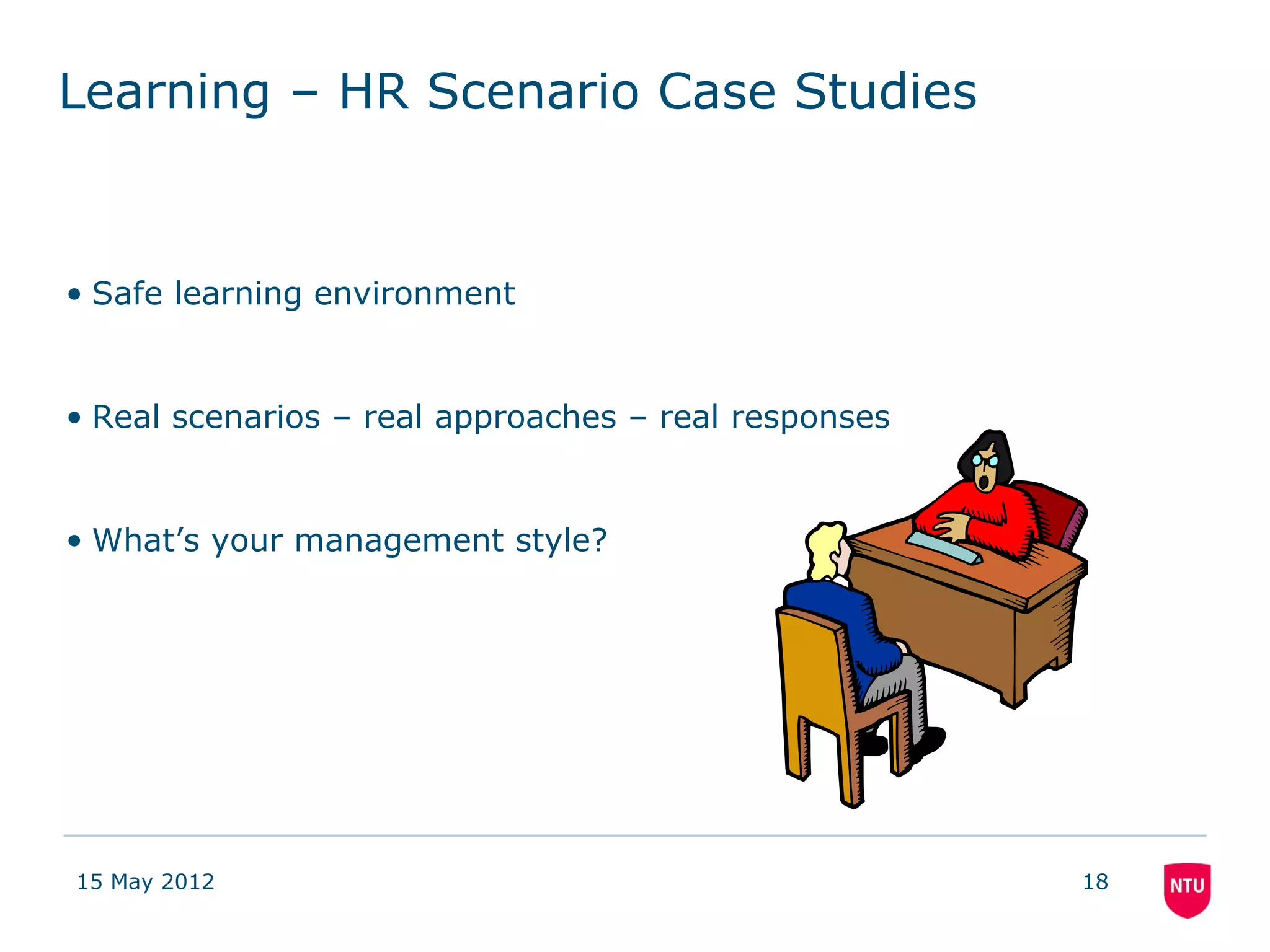
Learning – HR Scenario Case Studies


• Safe learning environment


• Real scenarios – real approaches – real responses


• What’s your management style?


15 May 2012                                           18
Making it work


• Communication
• Enthusiasm – it’s infectious!
• Ensure support is in place
• Managing expectations
• Plan work and tasks ahead
• Be realistic
• Debrief


15 May 2012                       19
Benefits
 • Improved communication
 • Improved understanding of roles and responsibilities
 • Shared best practice and improve ways of working
 • Stretches beyond role competencies (and exposes how people
   work)
 • Enables staff to make links from higher level role with their own role
 • Experience of working at a higher level and breadth of higher level roles
 • Grown up work experience
 • Experience of coaching
 • Staff retention
 • Succession planning
 • Developing self and others
 • Staff satisfaction/morale and motivation – NTU as Employer of
   Choice
 • No budget required

15 May 2012                                                                    20
Drawbacks

• Perception of unnecessary time away from ‘day job’?


• Perception of offloading work?


• Lack of support?


• Time intensive


• Timing


15 May 2012                                             21
6. Shadowing
Can be used to:
•Develop within role
  • Similar roles (same level)
  • Specific Tasks and Project
  • Improve existing skills


•Stretch beyond role
  • Shadow those in senior roles
  • Specific Tasks and Projects
  • Raise awareness of wider organisation


•Develop communication skills
  • Let others shadow you

15 May 2012                                 22
Shadowing is an Essential Developmental
Tool
 • Train new staff

 • Enhance Good Performance

 • Tackle Underperformance

 • Motivate the Stagnaters!

 • Enhances team communication
 and understanding of roles

 • Better service delivery

15 May 2012                           23
Any questions?


15 May 2012      24

111 - Stepping and stretching in lean times: Developing self and others in the current economic climate

  • 1.
    NATIONAL CONFERENCE Stepping andStretching in Lean Times Developing Self and Others in the Current Economic Climate Baljinder Johal and Sarah Troy-Brown
  • 2.
    15:00-15:35: 1. Context 2. Presentation of Tools 1-4: 1. Induction Process 2. Training Matrix 3. Development Sessions 4. Personal Reflection and Planning Toolkit 15:35-16:15: 1. Workshop Activity including Feedback Session 16:15-16:35: 1. Presentation of Tools 5 & 6: 1. Step Up 2. Shadowing 16:35-16:45: 1. Question and Answer Session 15 May 2012 2
  • 3.
    AUA Continuing ProfessionalDevelopment Framework Developing Self and Others - Showing commitment to own development and supporting and encouraging others to develop their knowledge, skills and behaviours to enable them to reach their full potential for the wider benefit of the organisation. Managing Self and Personal Skills - Willing and able to assess and apply own skills, abilities and experience. Being aware of own behaviour and how it impacts on others. Finding Innovative Solutions - Taking a holistic view and working enthusiastically and with creativity to analyse problems and develop innovative and workable solutions. Identifying opportunities for innovation. Using Resources - Making effective use of available resources including people, information, networks and budgets. Being aware of the financial and commercial aspects of the organisation. 15 May 2012 3
  • 4.
    Learning Outcomes Able toassess and reflect on own skills, abilities and experience. Able to support others to develop their knowledge, skills and behaviours to enable them to reach their full potential for the wider benefit of the organisation. Make effective use of available resources in respect of training and development. Able to plan effective development with limited, or no impact on resources. 15 May 2012 4
  • 5.
    Context – Whydo we need to step and stretch in lean times? What’s happening to HE? Cost Reductions Constant Change New World What does these mean for staff? Efficiency, Effectiveness and Value Add - Do more with less Changing needs and demands - Be ready for anything and everything Professionalise Administration and Management – Re-ordering of staff skills and competencies 15 May 2012 5
  • 6.
    How? Professional Development viapractical, effective, efficient and innovative tools to develop staff in lean times: Gain New Skills & Knowledge Improve Competencies & Behaviours No or Little Cost to the Organisation Significant Benefits to All 15 May 2012 6
  • 7.
    What? Best Practice PracticalTools and Techniques: 1. Induction Process 3. Training Matrix 5. Development Sessions 7. Personal Reflection and Planning Toolkit 9. Step Ups 11.Shadowing 15 May 2012 7
  • 8.
    1. Induction Process Induction and Development Process – extension of the NTU resource: http://www.ntu.ac.uk/cpld/our_services/staff_induction/index.html Learning Agreement – objective setting, learning, reviewing. Supports the PDR process. Competency Tables – expansion of corporate competencies to clarify to staff how these competencies can be developed and demonstrated – links to our PDR Process 15 May 2012 8
  • 9.
    Competency Table Team Working Co-operates enthusiastically with others in own team and in other formal and informal teams. Competency Descriptor & Level and the positive behaviours To do this effectively you may need to have the following How could this be obtained Examples of Transference of learning in you need to demonstrate skill/knowledge/competency a work-based situation to demonstrate competence LEVEL 1 - Works effectively as a member of a team. Takes • Time & diary management skills. 1/2. CPLD training courses on time and diary Take on a specific responsibility or role responsibility for getting things done as part of a team. • Interpersonal skills such as listening and empathising. management. for the whole team. •Is reliable. • Knowledge of the teams standard operating procedures and 3. Read existing relevant documents. •Puts self in the others’ shoes – to understand their point of other university wide standard procedures. 4. Develop a team checklist. view. • Workload planning and ability to prioritise team tasks. 5. Develop and share templates for emails, letters, •Helps others out. • Ability to communicate and share information. minutes etc. Read the NTU Online Communication •Takes a fair share of the workload. • Awareness of own and teams peaks and troughs. Toolkit. •Shares relevant information. 6. Prioritise and re-prioritise own tasks effectively •Makes self available when needed. in order to assist other team members when required. LEVEL 2 - Contributes to team development, seeking and • Knowledge about your team processes. • Talk to colleagues to expand knowledge. Apply learning to successfully improve a testing improvements to the team’s output/service. • Knowledge about how to motivate and encourage people. • Attend motivation training. specific team process. •Looks for ways to improve the way the team works. • Understanding about team dynamics. • Read book/research team dynamics on internet to raise •Encourages others to contribute. • Problem solving techniques. understanding. •Takes account of people and personalities in achieving the • Attend problem solving course. goal. •Actively helps the team to address problems. LEVEL 3 - Leads aspects of team work, seeking and • Ability to gather information and suggestions from formal • Talk to internal teams when considering any changes/ Apply learning to successfully mentor a implementing improvements to the teams’ outputs/service and informal teams within the organisation and to consider improvements to outputs/service and invite them to team member to implement a change to and developing colleagues within the team. Challenges best practice within the sector. comment. Research best practice in the sector via the an existing team process which will colleagues. • Knowledge of PDCR Policy and Process and Improving internet, external networking events etc. improve the teams’ outputs/services. •Increases diversity by seeking contributions from different Performance Policy & Procedure. • Attend the PDCR training. Read the policy and procedure areas of the University & sector. • Communication Skills including giving and receiving documents. •Raises issues of poor performance in the team. feedback. • Read communications toolkit information on the intranet. •Gives constructive praise & criticism. • Conflict management training including diplomacy skills. • Attend managing difficult people CPLD training course. •Helps to resolve conflict in the group – in an open & diplomatic manner. LEVEL 4 - Recognises and develops opportunities for team 1. Ability to confidently coach colleagues in terms 1. Coaching training course via CPLD and read up Nominate and coach members of the working at cross-University level, driving improvements to of their personal development. on coaching models, tools and techniques. team for involvement with a specific the teams’ outputs/service and developing colleagues within 2. Networking skills and strong communication 2. Research and attend relevant sector and non- cross-University team or project which the teams. skills both verbal and written. Benchmarking sector networking events to increase diversity and will help drive improvements to the •Coaches other in the team. activities against other organisations both build knowledge and relationships. team’s outputs/service. •Increases diversity by seeking contributions from outside within the sector and outside it. 3. Speak to relevant colleagues within the the sector. 3. Knowledge of relevant cross functional teams organisation to raise awareness of and then •Actively participates in a range of cross functional and and cross organisational teams and projects. become proactively involved with key cross cross organisational teams. 4. Full awareness and understanding of NTU functional and cross organisation teams and •Ensures that NTU strategy is reflected in policies and strategy and how that translate into policies projects directly by volunteering to join them and/ procedures of the team. and procedures. or by nominating members of the team to join them. 4. Read NTU Strategic Plan document and resulting documentation such as School Academic Plans, policies and procedures. 15 May 2012 9
  • 10.
    2. Training MatrixTool Subject Subject Co- Subject Subject NTU System/Role/Competency Team ordinator Administrator Assistant Training Leader NTU/College Procedures PDR Reviewee E E E E PDR Reviewer E E N/A N/A Examination Boards including Special Situations E E E E Student Support Services D D D D University Document Retention Policy/ School Archiving Policy E E E E Induction for new members of staff E E D N/A General Ordering Procedures (stationery etc.) N/A N/A N/A N/A Hourly Paid Lecturer procedures E E D N/A Marketing and Visual Identity E E E E Student Admission and Recruitment E D D N/A Student Enrolment and Induction E E E E Health and Safety E E E E 15 May 2012 10
  • 11.
    3. Development Sessions Coordinators Development Sessions  Development of key skills – leadership, ownership and accountability, team working, cross team working, planning & organising, giving and receiving feedback etc. Staff Satisfaction Focus Group  Feedback mechanism – engagement, empowerment, committee skills, rotating chair, communication etc. Team Building Away Days  Community spirit, volunteering, corporate social responsibility, cross team working etc. 15 May 2012 11
  • 12.
    4. Personal Reflectionand Planning Toolkit Measure of skills against activities – can be role specific, link to desired behaviours & competencies and PDR process • rate yourself • evaluate your ratings with a peer or Line Manager Identify areas that require development, are developed and you can demonstrate competence in, you would be interested in developing Prioritise areas where you would like to receive formal training or gain experience of as part of your personal development plan - activities & competencies Consider the skills & competencies required for promotional roles and plan your acquisition of these 15 May 2012 12
  • 13.
    Personal Reflection andPlanning Toolkit Personal Reflection & Planning toolkit for: Please enter the date in the boxes directly below and then use the key (Viewable by clicking the tab titled 'KEY - Notes & Descriptors') to review your JOB TITLE: Administrator opinions on your level of skill/ shortfalls etc Competencies: Activities DATE 00/00/0000 00/00/0000 r r er the the th ur ur ur t t t pf pf pf en en en s: s: tes lo lo lo l o opm l o opm l op opm ote ote ve ve ve No De De De ln ln l l l De ev e De ev e De ev e d Wi ed ed al to to to na na pe on sD sD sD p es es es o o rs ers ers ed ed ed ve ve ve ish sh sh Team Working Pe Ne Ne Ne Wi W P P Level 1 - works effectively as a member of the team. Takes responsibility for getting things done as part of a team. Postive behaviours: Is realiable. Puts self in the others' shoes - to understand their point of view. Team Working Helps others out. Takes a fair share of the Transference: Take on a specific workload. Shares relevant information. Makes self responsibility or role for the availalbe when needed. whole team Time and diary management skills Interpersonal skills such as teams standard operating Knowledge of the listening and empathising procedures and other univeristy wide standard procedures Workload planning and ability to prioritise team tasks Ability to communicate and share information Awareness of own and teams peaks and troughs 15 May 2012 13
  • 14.
    15:35-16:15: Workshop Activity including Feedback Session 30 minutes for the Activity, followed by 10 minutes for Feedback to the group. •The production of a Competency Table for one of your own organisational competencies or the AUA competencies (copies are available from Bal or Sarah). •Personal Reflection Planning Toolkit – reflect on your own skills and plan your training needs against a team working competency. The example in your pack is the Nottingham Trent University competency descriptor for team working. •The production of a Training Matrix specific to your role or your team. There is an example of a training matrix for the Nottingham Trent University Graduate School team in your pack. 15 May 2012 14
  • 15.
    5. Step Up Whatis a ‘step up’? Staff development An opportunity to ‘step up’ to a higher level role for a short period of time while the post holder is absent (e.g., on annual leave) Like ‘grown up work experience’ Learning in a safe environment Voluntary first come, first served basis 15 May 2012 15
  • 16.
    Example - June2010 15 May 2012 16
  • 17.
    Learning – Upward •Taster of the role • Working at higher level • Exposure at higher level 15 May 2012 17
  • 18.
    Learning – HRScenario Case Studies • Safe learning environment • Real scenarios – real approaches – real responses • What’s your management style? 15 May 2012 18
  • 19.
    Making it work •Communication • Enthusiasm – it’s infectious! • Ensure support is in place • Managing expectations • Plan work and tasks ahead • Be realistic • Debrief 15 May 2012 19
  • 20.
    Benefits • Improvedcommunication • Improved understanding of roles and responsibilities • Shared best practice and improve ways of working • Stretches beyond role competencies (and exposes how people work) • Enables staff to make links from higher level role with their own role • Experience of working at a higher level and breadth of higher level roles • Grown up work experience • Experience of coaching • Staff retention • Succession planning • Developing self and others • Staff satisfaction/morale and motivation – NTU as Employer of Choice • No budget required 15 May 2012 20
  • 21.
    Drawbacks • Perception ofunnecessary time away from ‘day job’? • Perception of offloading work? • Lack of support? • Time intensive • Timing 15 May 2012 21
  • 22.
    6. Shadowing Can beused to: •Develop within role • Similar roles (same level) • Specific Tasks and Project • Improve existing skills •Stretch beyond role • Shadow those in senior roles • Specific Tasks and Projects • Raise awareness of wider organisation •Develop communication skills • Let others shadow you 15 May 2012 22
  • 23.
    Shadowing is anEssential Developmental Tool • Train new staff • Enhance Good Performance • Tackle Underperformance • Motivate the Stagnaters! • Enhances team communication and understanding of roles • Better service delivery 15 May 2012 23
  • 24.