FACTORS OF
POLYNOMIALS
Factoring the Difference
of Two Squares
Jessebel G. Bautista
Antonio J. Villegas Voc’l High School
My
Profile
OBJECTIVES
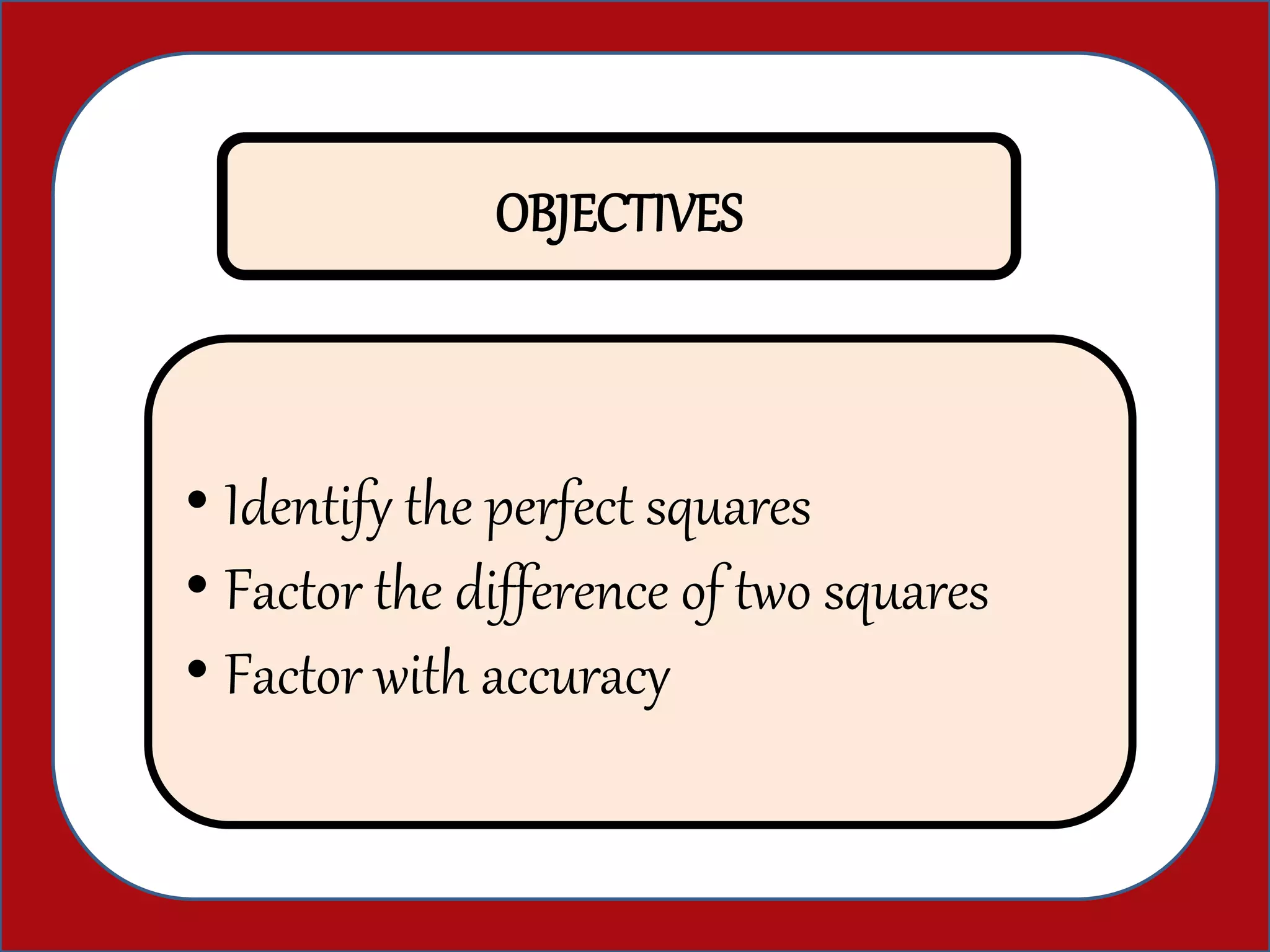
• Identify the perfect squares
• Factor the difference of two squares
• Factor with accuracy
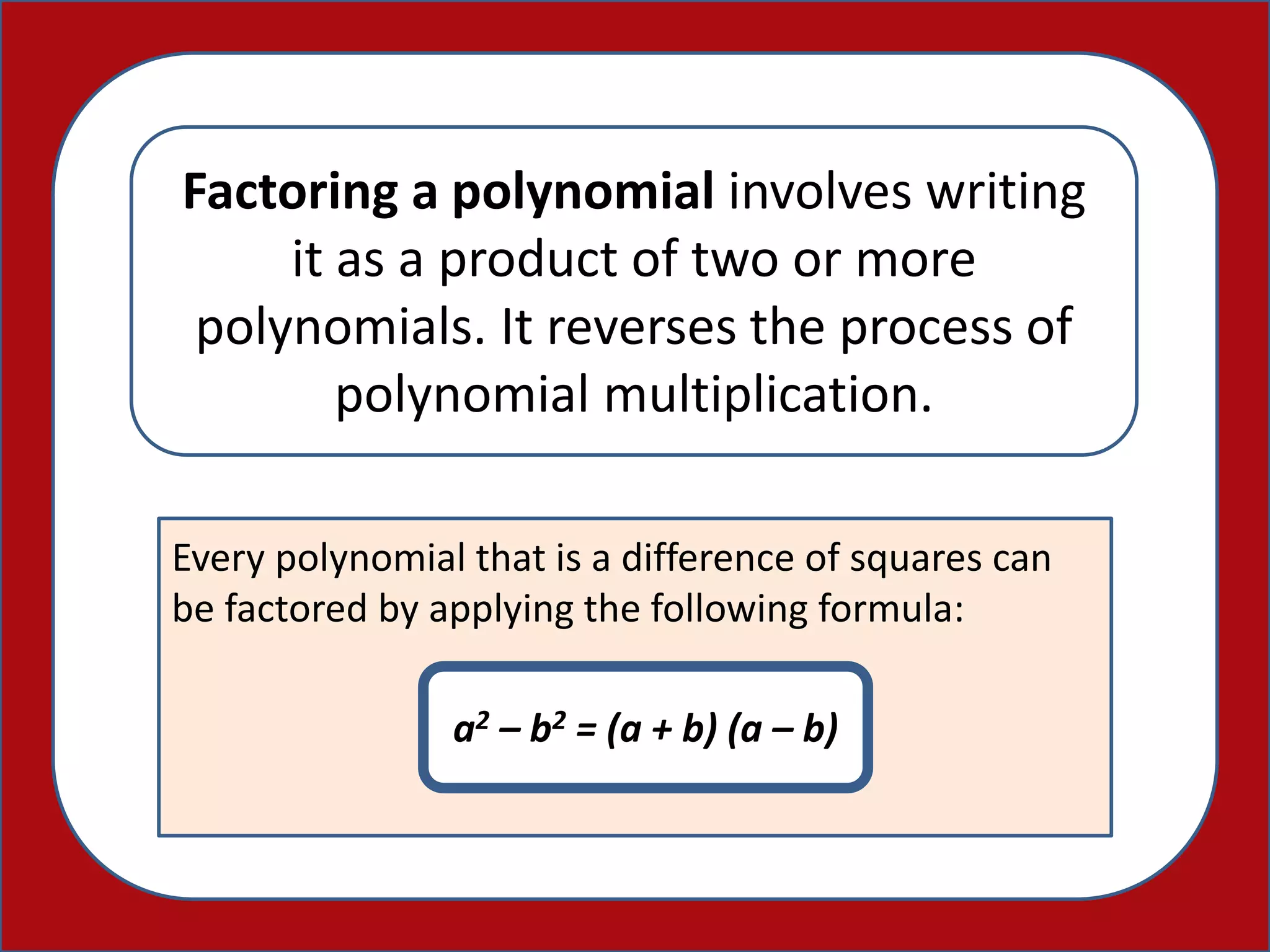
Factoring a polynomial involves writing
it as a product of two or more
polynomials. It reverses the process of
polynomial multiplication.
Every polynomial that is a difference of squares can
be factored by applying the following formula:
a2 – b2 = (a + b) (a – b)
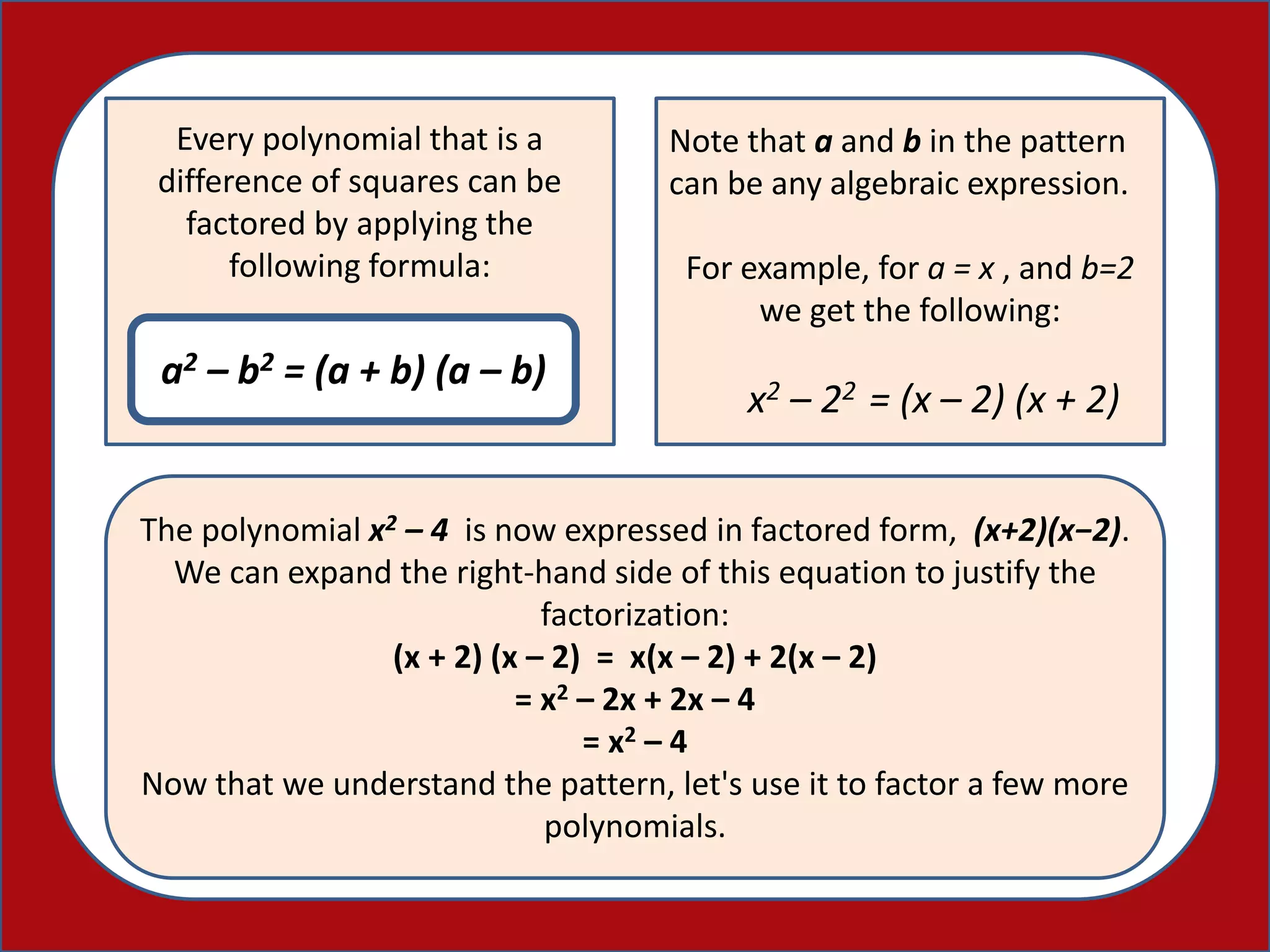
Every polynomial that is a
difference of squares can be
factored by applying the
following formula:
a2 – b2 = (a + b) (a – b)
Note that a and b in the pattern
can be any algebraic expression.
For example, for a = x , and b=2
we get the following:
x2 – 22 = (x – 2) (x + 2)
The polynomial x2 – 4 is now expressed in factored form, (x+2)(x−2).
We can expand the right-hand side of this equation to justify the
factorization:
(x + 2) (x – 2) = x(x – 2) + 2(x – 2)
= x2 – 2x + 2x – 4
= x2 – 4
Now that we understand the pattern, let's use it to factor a few more
polynomials.
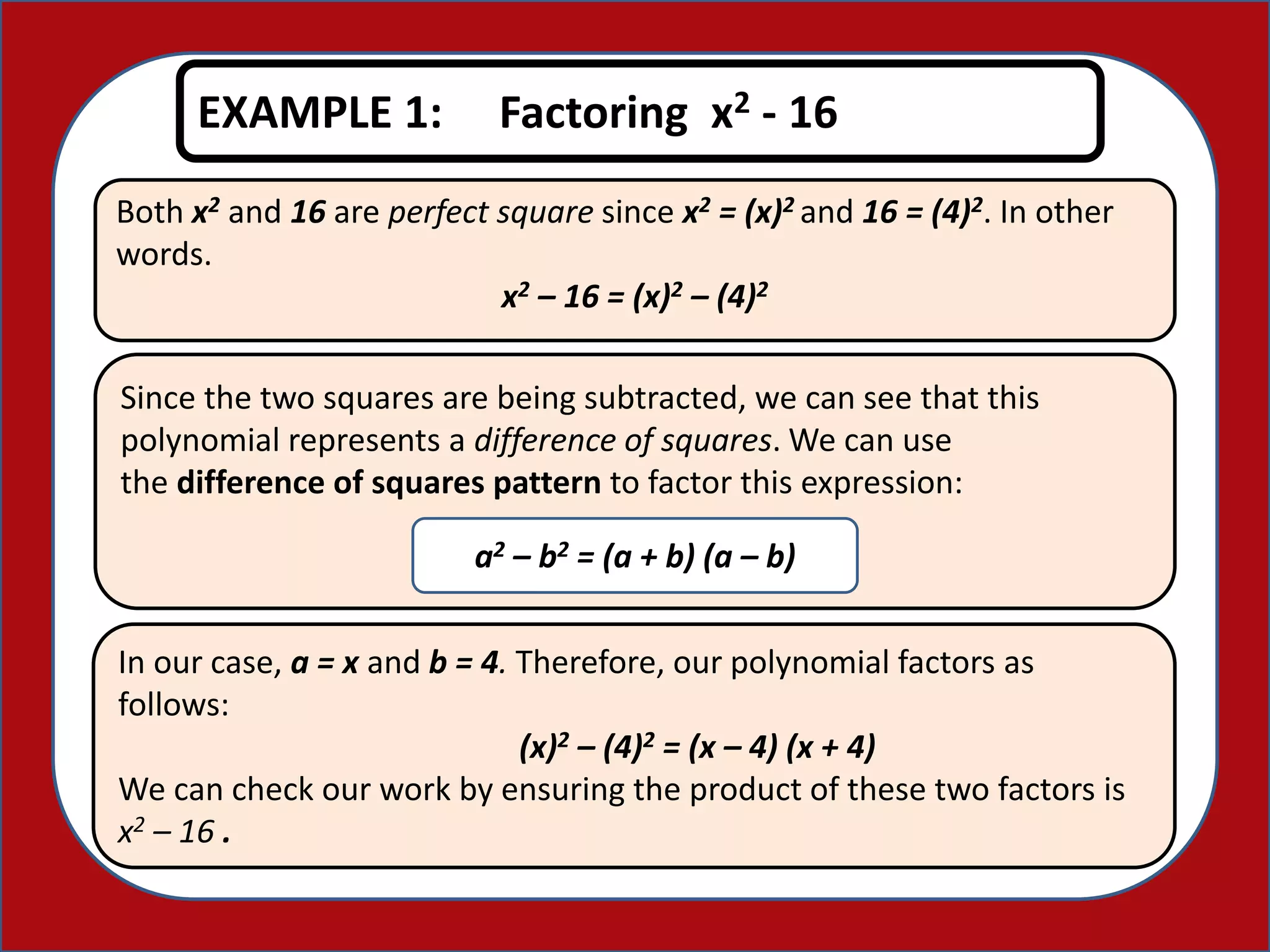
Both x2 and 16 are perfect square since x2 = (x)2 and 16 = (4)2. In other
words.
x2 – 16 = (x)2 – (4)2
EXAMPLE 1: Factoring x2 - 16
Since the two squares are being subtracted, we can see that this
polynomial represents a difference of squares. We can use
the difference of squares pattern to factor this expression:
a2 – b2 = (a + b) (a – b)
In our case, a = x and b = 4. Therefore, our polynomial factors as
follows:
(x)2 – (4)2 = (x – 4) (x + 4)
We can check our work by ensuring the product of these two factors is
x2 – 16 .
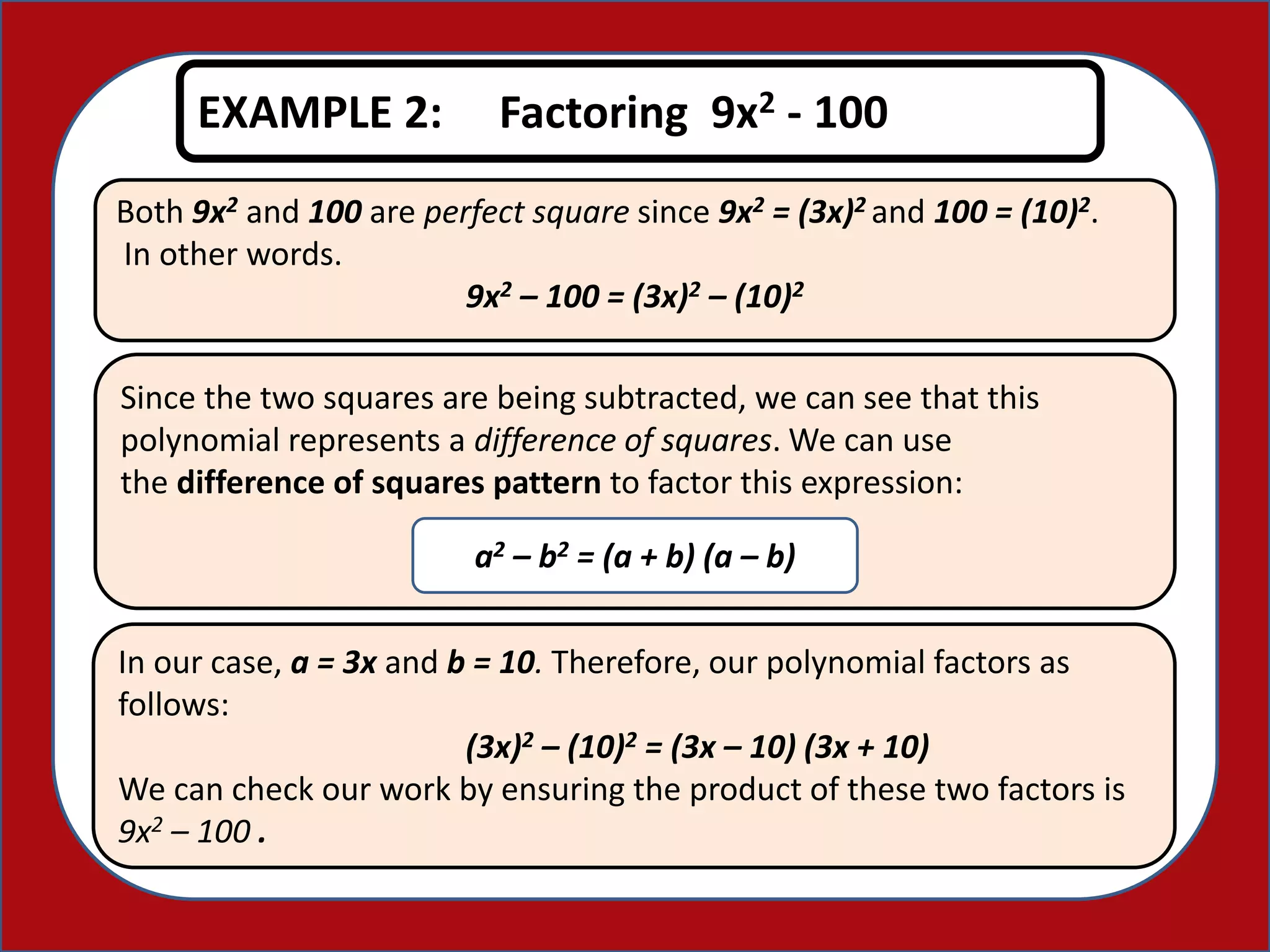
Both 9x2 and 100 are perfect square since 9x2 = (3x)2 and 100 = (10)2.
In other words.
9x2 – 100 = (3x)2 – (10)2
EXAMPLE 2: Factoring 9x2 - 100
Since the two squares are being subtracted, we can see that this
polynomial represents a difference of squares. We can use
the difference of squares pattern to factor this expression:
a2 – b2 = (a + b) (a – b)
In our case, a = 3x and b = 10. Therefore, our polynomial factors as
follows:
(3x)2 – (10)2 = (3x – 10) (3x + 10)
We can check our work by ensuring the product of these two factors is
9x2 – 100 .
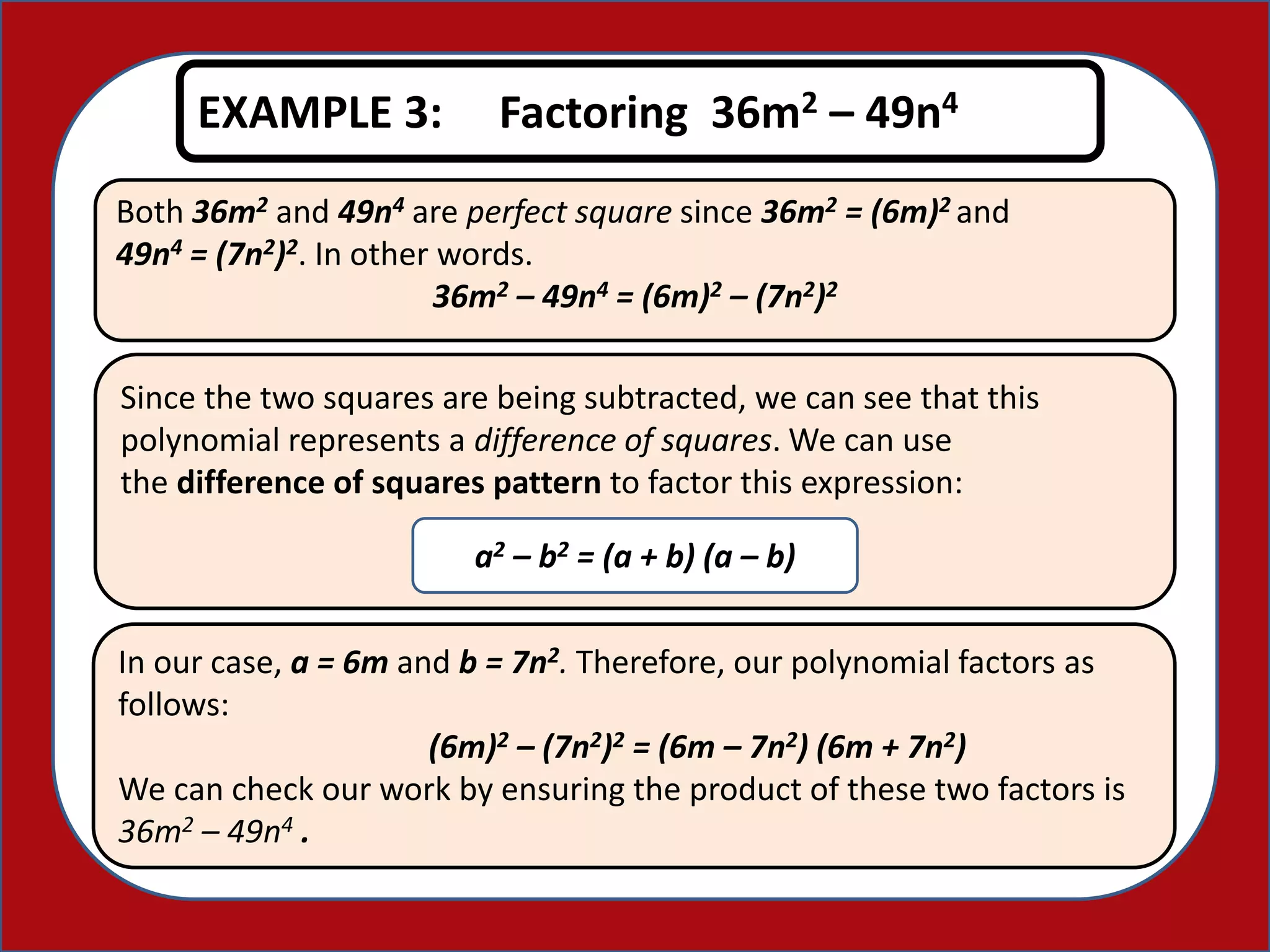
Both 36m2 and 49n4 are perfect square since 36m2 = (6m)2 and
49n4 = (7n2)2. In other words.
36m2 – 49n4 = (6m)2 – (7n2)2
EXAMPLE 3: Factoring 36m2 – 49n4
Since the two squares are being subtracted, we can see that this
polynomial represents a difference of squares. We can use
the difference of squares pattern to factor this expression:
a2 – b2 = (a + b) (a – b)
In our case, a = 6m and b = 7n2. Therefore, our polynomial factors as
follows:
(6m)2 – (7n2)2 = (6m – 7n2) (6m + 7n2)
We can check our work by ensuring the product of these two factors is
36m2 – 49n4 .
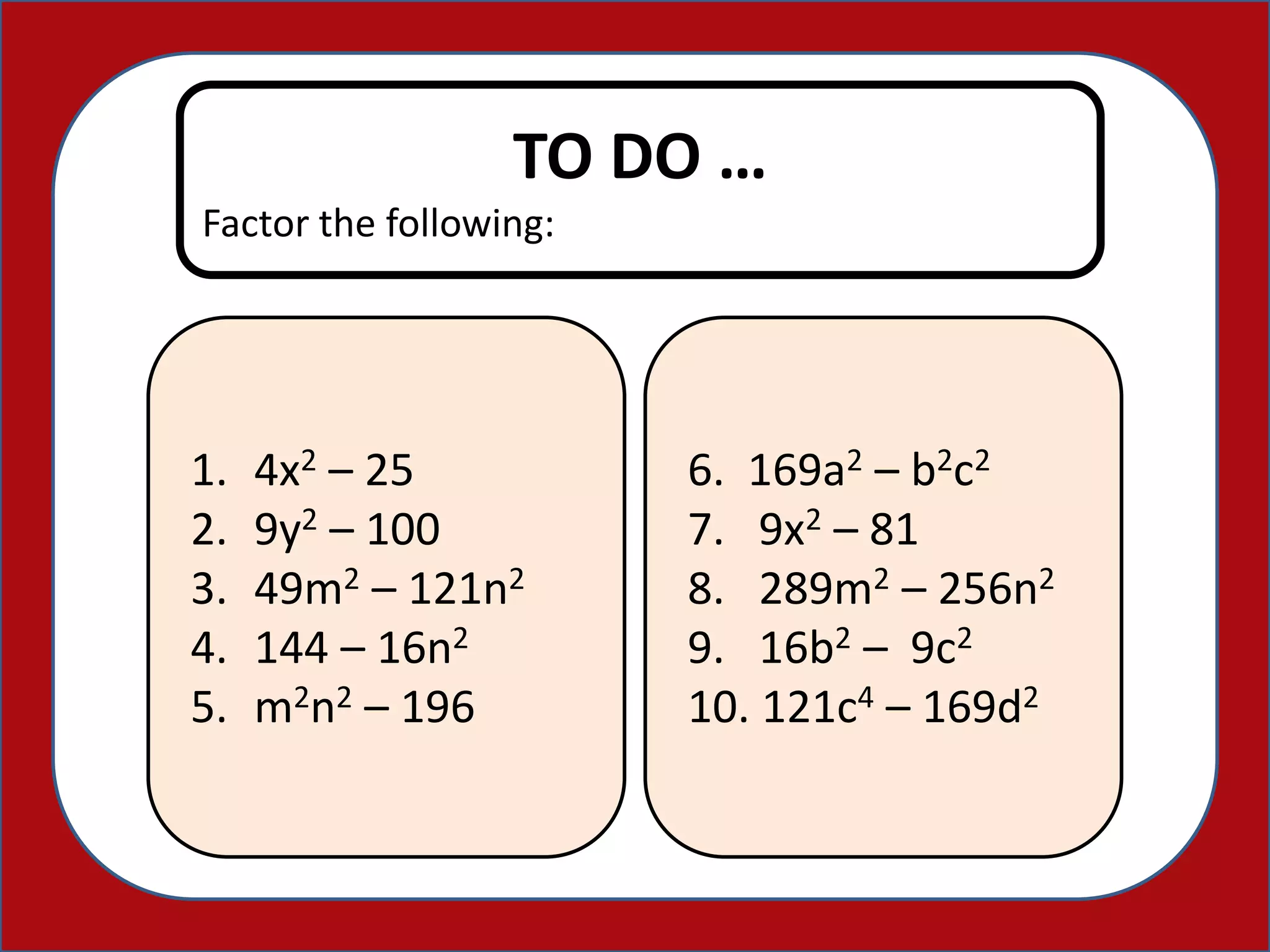
1. 4x2 – 25
2. 9y2 – 100
3. 49m2 – 121n2
4. 144 – 16n2
5. m2n2 – 196
TO DO …
Factor the following:
6. 169a2 – b2c2
7. 9x2 – 81
8. 289m2 – 256n2
9. 16b2 – 9c2
10. 121c4 – 169d2
REFERENCES:
https://www.khanacademy.org/math/algebra/x2f8bb11
595b61c86:quadratics-multiplying-
factoring/x2f8bb11595b61c86:factor-difference-
squares/a/factoring-quadratics-difference-of-squares
Grade 8 Math Time
k-to-12-grade-8-math-learner-module

1.1 ss factoring the difference of two squares

  • 1.
    FACTORS OF POLYNOMIALS Factoring theDifference of Two Squares
  • 2.
    Jessebel G. Bautista AntonioJ. Villegas Voc’l High School My Profile
  • 3.
    OBJECTIVES • Identify theperfect squares • Factor the difference of two squares • Factor with accuracy
  • 4.
    Factoring a polynomialinvolves writing it as a product of two or more polynomials. It reverses the process of polynomial multiplication. Every polynomial that is a difference of squares can be factored by applying the following formula: a2 – b2 = (a + b) (a – b)
  • 5.
    Every polynomial thatis a difference of squares can be factored by applying the following formula: a2 – b2 = (a + b) (a – b) Note that a and b in the pattern can be any algebraic expression. For example, for a = x , and b=2 we get the following: x2 – 22 = (x – 2) (x + 2) The polynomial x2 – 4 is now expressed in factored form, (x+2)(x−2). We can expand the right-hand side of this equation to justify the factorization: (x + 2) (x – 2) = x(x – 2) + 2(x – 2) = x2 – 2x + 2x – 4 = x2 – 4 Now that we understand the pattern, let's use it to factor a few more polynomials.
  • 6.
    Both x2 and16 are perfect square since x2 = (x)2 and 16 = (4)2. In other words. x2 – 16 = (x)2 – (4)2 EXAMPLE 1: Factoring x2 - 16 Since the two squares are being subtracted, we can see that this polynomial represents a difference of squares. We can use the difference of squares pattern to factor this expression: a2 – b2 = (a + b) (a – b) In our case, a = x and b = 4. Therefore, our polynomial factors as follows: (x)2 – (4)2 = (x – 4) (x + 4) We can check our work by ensuring the product of these two factors is x2 – 16 .
  • 7.
    Both 9x2 and100 are perfect square since 9x2 = (3x)2 and 100 = (10)2. In other words. 9x2 – 100 = (3x)2 – (10)2 EXAMPLE 2: Factoring 9x2 - 100 Since the two squares are being subtracted, we can see that this polynomial represents a difference of squares. We can use the difference of squares pattern to factor this expression: a2 – b2 = (a + b) (a – b) In our case, a = 3x and b = 10. Therefore, our polynomial factors as follows: (3x)2 – (10)2 = (3x – 10) (3x + 10) We can check our work by ensuring the product of these two factors is 9x2 – 100 .
  • 8.
    Both 36m2 and49n4 are perfect square since 36m2 = (6m)2 and 49n4 = (7n2)2. In other words. 36m2 – 49n4 = (6m)2 – (7n2)2 EXAMPLE 3: Factoring 36m2 – 49n4 Since the two squares are being subtracted, we can see that this polynomial represents a difference of squares. We can use the difference of squares pattern to factor this expression: a2 – b2 = (a + b) (a – b) In our case, a = 6m and b = 7n2. Therefore, our polynomial factors as follows: (6m)2 – (7n2)2 = (6m – 7n2) (6m + 7n2) We can check our work by ensuring the product of these two factors is 36m2 – 49n4 .

  • 9.
    1. 4x2 –25 2. 9y2 – 100 3. 49m2 – 121n2 4. 144 – 16n2 5. m2n2 – 196 TO DO … Factor the following: 6. 169a2 – b2c2 7. 9x2 – 81 8. 289m2 – 256n2 9. 16b2 – 9c2 10. 121c4 – 169d2
  • 10.