MATHEMATICS 8
FACTORING THE
DIFFERENCE OF TWO
SQUARES
Ma’am Ehlmz
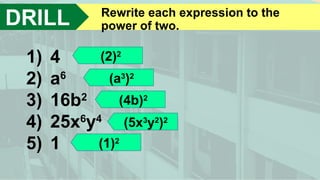
DRILL Rewrite each expression to the
power of two.
1) 4
2) a6
3) 16b2
4) 25x6
y4
5) 1
(2)2
(a3
)2
(4b)2
(5x3
y2
)2
(1)2
DRILL
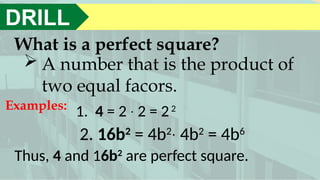
What is a perfect square?
 A number that is the product of
two equal facors.
Examples:
1. 4 = 2 2 = 2
∙ 2
2. 16b2
= 4b2
4b
∙ 2
= 4b6
Thus, 4 and 16b2
are perfect square.
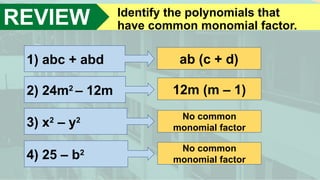
REVIEW Identify the polynomials that
have common monomial factor.
1) abc + abd
2) 24m2
– 12m
3) x2
– y2
4) 25 – b2
ab (c + d)
12m (m – 1)
No common
monomial factor
No common
monomial factor
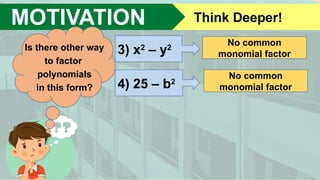
MOTIVATION Think Deeper!
3) x2
– y2
4) 25 – b2
No common
monomial factor
No common
monomial factor
Is there other way
to factor
polynomials
in this form?
LESSON Factoring The Difference Of Two
Squares
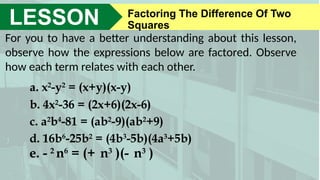
For you to have a better understanding about this lesson,
observe how the expressions below are factored. Observe
how each term relates with each other.
a. x2
-y2
= (x+y)(x-y)
b. 4x2
-36 = (2x+6)(2x-6)
c. a2
b4
-81 = (ab2
-9)(ab2
+9)
d. 16b6
-25b2
= (4b3
-5b)(4a3
+5b)
e. - 2
n6
= (+ n3
)(- n3
)
ANALYSIS Factoring The Difference Of
Two Squares
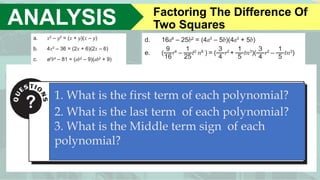
1. What is the first term of each polynomial?
2. What is the last term of each polynomial?
3. What is the Middle term sign of each
polynomial?
ANALYSIS Factoring The Difference Of
Two Squares
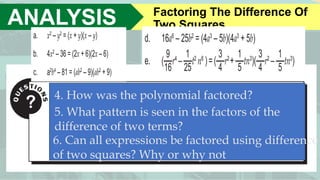
4. How was the polynomial factored?
5. What pattern is seen in the factors of the
difference of two terms?
6. Can all expressions be factored using difference
of two squares? Why or why not
ANALYSIS Factoring The Difference Of
Two Squares
7. When can yu factor expressions using
difference of two squares?
ANALYSIS Factoring The Difference Of
Two Squares
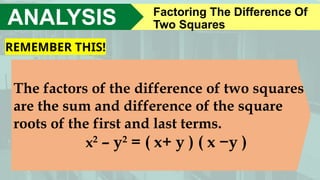
The factors of the difference of two squares
are the sum and difference of the square
roots of the first and last terms.
x2
– y2
= ( x+ y ) ( x −y )
REMEMBER THIS!
ANALYSIS Factoring The Difference Of
Two Squares
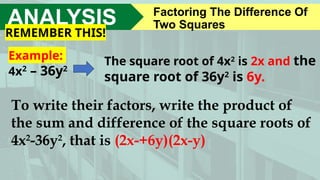
REMEMBER THIS!
Example:
4x2
– 36y2
The square root of 4x2
is 2x and the
square root of 36y2
is 6y.
To write their factors, write the product of
the sum and difference of the square roots of
4x2
-36y2
, that is (2x-+6y)(2x-y)
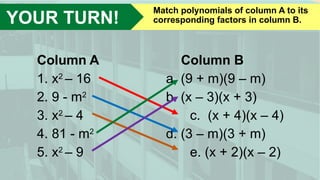
YOUR TURN!
Match polynomials of column A to its
corresponding factors in column B.
Column A Column B
1. x2
– 16 a. (9 + m)(9 – m)
2. 9 - m2
b. (x – 3)(x + 3)
3. x2
– 4 c. (x + 4)(x – 4)
4. 81 - m2
d. (3 – m)(3 + m)
5. x2
– 9 e. (x + 2)(x – 2)
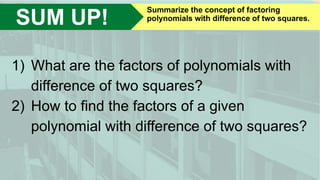
SUM UP!
Summarize the concept of factoring
polynomials with difference of two squares.
1) What are the factors of polynomials with
difference of two squares?
2) How to find the factors of a given
polynomial with difference of two squares?
ACTIVITY Write it in your activity
notebook.
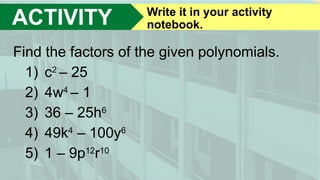
Find the factors of the given polynomials.
1) c2
– 25
2) 4w4
– 1
3) 36 – 25h6
4) 49k4
– 100y6
5) 1 – 9p12
r10
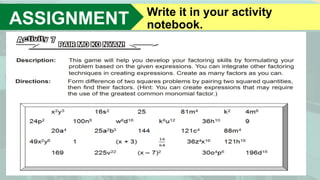
ASSIGNMENT Write it in your activity
notebook.

2. Factoring Difference of Two Squares.pptx

  • 1.
    MATHEMATICS 8 FACTORING THE DIFFERENCEOF TWO SQUARES Ma’am Ehlmz
  • 2.
    DRILL Rewrite eachexpression to the power of two. 1) 4 2) a6 3) 16b2 4) 25x6 y4 5) 1 (2)2 (a3 )2 (4b)2 (5x3 y2 )2 (1)2
  • 3.
    DRILL What is aperfect square?  A number that is the product of two equal facors. Examples: 1. 4 = 2 2 = 2 ∙ 2 2. 16b2 = 4b2 4b ∙ 2 = 4b6 Thus, 4 and 16b2 are perfect square.
  • 4.
    REVIEW Identify thepolynomials that have common monomial factor. 1) abc + abd 2) 24m2 – 12m 3) x2 – y2 4) 25 – b2 ab (c + d) 12m (m – 1) No common monomial factor No common monomial factor
  • 5.
    MOTIVATION Think Deeper! 3)x2 – y2 4) 25 – b2 No common monomial factor No common monomial factor Is there other way to factor polynomials in this form?
  • 6.
    LESSON Factoring TheDifference Of Two Squares For you to have a better understanding about this lesson, observe how the expressions below are factored. Observe how each term relates with each other. a. x2 -y2 = (x+y)(x-y) b. 4x2 -36 = (2x+6)(2x-6) c. a2 b4 -81 = (ab2 -9)(ab2 +9) d. 16b6 -25b2 = (4b3 -5b)(4a3 +5b) e. - 2 n6 = (+ n3 )(- n3 )
  • 7.
    ANALYSIS Factoring TheDifference Of Two Squares 1. What is the first term of each polynomial? 2. What is the last term of each polynomial? 3. What is the Middle term sign of each polynomial?
  • 8.
    ANALYSIS Factoring TheDifference Of Two Squares 4. How was the polynomial factored? 5. What pattern is seen in the factors of the difference of two terms? 6. Can all expressions be factored using difference of two squares? Why or why not
  • 9.
    ANALYSIS Factoring TheDifference Of Two Squares 7. When can yu factor expressions using difference of two squares?
  • 10.
    ANALYSIS Factoring TheDifference Of Two Squares The factors of the difference of two squares are the sum and difference of the square roots of the first and last terms. x2 – y2 = ( x+ y ) ( x −y ) REMEMBER THIS!
  • 11.
    ANALYSIS Factoring TheDifference Of Two Squares REMEMBER THIS! Example: 4x2 – 36y2 The square root of 4x2 is 2x and the square root of 36y2 is 6y. To write their factors, write the product of the sum and difference of the square roots of 4x2 -36y2 , that is (2x-+6y)(2x-y)
  • 12.
    YOUR TURN! Match polynomialsof column A to its corresponding factors in column B. Column A Column B 1. x2 – 16 a. (9 + m)(9 – m) 2. 9 - m2 b. (x – 3)(x + 3) 3. x2 – 4 c. (x + 4)(x – 4) 4. 81 - m2 d. (3 – m)(3 + m) 5. x2 – 9 e. (x + 2)(x – 2)
  • 13.
    SUM UP! Summarize theconcept of factoring polynomials with difference of two squares. 1) What are the factors of polynomials with difference of two squares? 2) How to find the factors of a given polynomial with difference of two squares?
  • 14.
    ACTIVITY Write itin your activity notebook. Find the factors of the given polynomials. 1) c2 – 25 2) 4w4 – 1 3) 36 – 25h6 4) 49k4 – 100y6 5) 1 – 9p12 r10
  • 15.
    ASSIGNMENT Write itin your activity notebook.