Presenters:
Farhan Ahmed Baryaar
Malik Anees Nawazish
 “You think you can win on talent
alone? Gentlemen, YOU DON'T
HAVE ENOUGH TALENT TO WIN
ON TALENT ALONE!” Herb
Brooks, Coach, 1980 USA
Olympics Hockey Team
 Preparing for an exam is much
like an athlete training for a
sporting event . . . It involves
exercising, eating the right
foods, and getting a good night's
sleep! And yes, you also have
to study!
 Learn preparation and test taking techniques
for various types of exams
 Understand the keys to successful exam
preparation
 Cope with exam anxiety
 When classes begin, exams represent
a distant event . . . “I have plenty of
time to prepare for exams.”
 But beware of that enemy of
preparation . . . Procrastination
 Time is going to advance much faster
than you think and before you know
it, preparing for the exam becomes
less about learning and
understanding the material and more
about cramming . . . And then you’re
in Danger!
 Don’t let procrastination endanger
your academic success
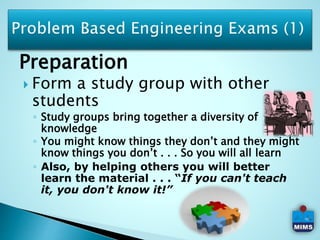
Preparation
 Form a study group with other
students
◦ Study groups bring together a diversity of
knowledge
◦ You might know things they don’t and they might
know things you don’t . . . So you will all learn
◦ Also, by helping others you will better
learn the material . . . “If you can't teach
it, you don't know it!”
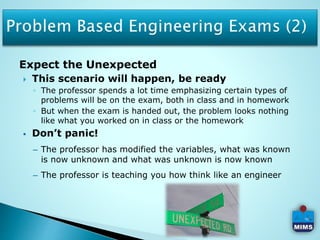
Expect the Unexpected
 This scenario will happen, be ready
◦ The professor spends a lot time emphasizing certain types of
problems will be on the exam, both in class and in homework
◦ But when the exam is handed out, the problem looks nothing
like what you worked on in class or the homework
 Don’t panic!
– The professor has modified the variables, what was known
is now unknown and what was unknown is now known
– The professor is teaching you how think like an engineer
 Taking the Exam
◦ Before starting, scan the exam . . . Get a feel for the types of
questions and problems
◦ Quickly review the number of questions and note your level of
knowledge for each
 Start with the questions that you are confident of and/or for which
you will not need much time using your references
◦ Read the questions carefully to understand what is expected
◦ If you organized your references well, you should be able to
target the right location to assist you with each question
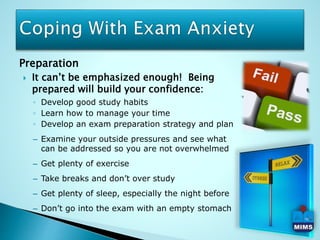
Preparation
 It can’t be emphasized enough! Being
prepared will build your confidence:
◦ Develop good study habits
◦ Learn how to manage your time
◦ Develop an exam preparation strategy and plan
– Examine your outside pressures and see what
can be addressed so you are not overwhelmed
– Get plenty of exercise
– Take breaks and don’t over study
– Get plenty of sleep, especially the night before
– Don’t go into the exam with an empty stomach
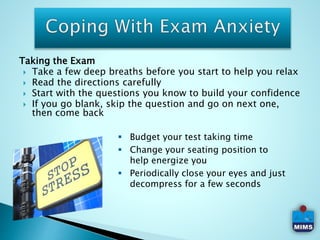
Taking the Exam
 Take a few deep breaths before you start to help you relax
 Read the directions carefully
 Start with the questions you know to build your confidence
 If you go blank, skip the question and go on next one,
then come back
 Budget your test taking time
 Change your seating position to
help energize you
 Periodically close your eyes and just
decompress for a few seconds
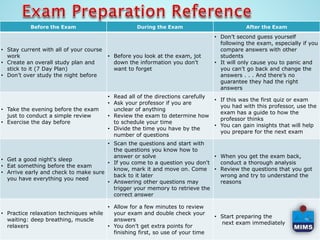
Before the Exam During the Exam After the Exam
• Stay current with all of your course
work
• Create an overall study plan and
stick to it (7 Day Plan)
• Don’t over study the night before
• Before you look at the exam, jot
down the information you don't
want to forget
• Don’t second guess yourself
following the exam, especially if you
compare answers with other
students
• It will only cause you to panic and
you can’t go back and change the
answers . . . And there’s no
guarantee they had the right
answers
• Take the evening before the exam
just to conduct a simple review
• Exercise the day before
• Read all of the directions carefully
• Ask your professor if you are
unclear of anything
• Review the exam to determine how
to schedule your time
• Divide the time you have by the
number of questions
• If this was the first quiz or exam
you had with this professor, use the
exam has a guide to how the
professor thinks
• You can gain insights that will help
you prepare for the next exam
• Get a good night's sleep
• Eat something before the exam
• Arrive early and check to make sure
you have everything you need
• Scan the questions and start with
the questions you know how to
answer or solve
• If you come to a question you don't
know, mark it and move on. Come
back to it later
• Answering other questions may
trigger your memory to retrieve the
correct answer
• When you get the exam back,
conduct a thorough analysis
• Review the questions that you got
wrong and try to understand the
reasons
• Practice relaxation techniques while
waiting: deep breathing, muscle
relaxers
• Allow for a few minutes to review
your exam and double check your
answers
• You don’t get extra points for
finishing first, so use of your time
• Start preparing the
next exam immediately
Preparing for exams A survival guide.

Preparing for exams A survival guide.

  • 3.
  • 4.
     “You thinkyou can win on talent alone? Gentlemen, YOU DON'T HAVE ENOUGH TALENT TO WIN ON TALENT ALONE!” Herb Brooks, Coach, 1980 USA Olympics Hockey Team  Preparing for an exam is much like an athlete training for a sporting event . . . It involves exercising, eating the right foods, and getting a good night's sleep! And yes, you also have to study!
  • 5.
     Learn preparationand test taking techniques for various types of exams  Understand the keys to successful exam preparation  Cope with exam anxiety
  • 6.
     When classesbegin, exams represent a distant event . . . “I have plenty of time to prepare for exams.”  But beware of that enemy of preparation . . . Procrastination  Time is going to advance much faster than you think and before you know it, preparing for the exam becomes less about learning and understanding the material and more about cramming . . . And then you’re in Danger!  Don’t let procrastination endanger your academic success
  • 7.
    Preparation  Form astudy group with other students ◦ Study groups bring together a diversity of knowledge ◦ You might know things they don’t and they might know things you don’t . . . So you will all learn ◦ Also, by helping others you will better learn the material . . . “If you can't teach it, you don't know it!”
  • 8.
    Expect the Unexpected This scenario will happen, be ready ◦ The professor spends a lot time emphasizing certain types of problems will be on the exam, both in class and in homework ◦ But when the exam is handed out, the problem looks nothing like what you worked on in class or the homework  Don’t panic! – The professor has modified the variables, what was known is now unknown and what was unknown is now known – The professor is teaching you how think like an engineer
  • 9.
     Taking theExam ◦ Before starting, scan the exam . . . Get a feel for the types of questions and problems ◦ Quickly review the number of questions and note your level of knowledge for each  Start with the questions that you are confident of and/or for which you will not need much time using your references ◦ Read the questions carefully to understand what is expected ◦ If you organized your references well, you should be able to target the right location to assist you with each question
  • 10.
    Preparation  It can’tbe emphasized enough! Being prepared will build your confidence: ◦ Develop good study habits ◦ Learn how to manage your time ◦ Develop an exam preparation strategy and plan – Examine your outside pressures and see what can be addressed so you are not overwhelmed – Get plenty of exercise – Take breaks and don’t over study – Get plenty of sleep, especially the night before – Don’t go into the exam with an empty stomach
  • 11.
    Taking the Exam Take a few deep breaths before you start to help you relax  Read the directions carefully  Start with the questions you know to build your confidence  If you go blank, skip the question and go on next one, then come back  Budget your test taking time  Change your seating position to help energize you  Periodically close your eyes and just decompress for a few seconds
  • 12.
    Before the ExamDuring the Exam After the Exam • Stay current with all of your course work • Create an overall study plan and stick to it (7 Day Plan) • Don’t over study the night before • Before you look at the exam, jot down the information you don't want to forget • Don’t second guess yourself following the exam, especially if you compare answers with other students • It will only cause you to panic and you can’t go back and change the answers . . . And there’s no guarantee they had the right answers • Take the evening before the exam just to conduct a simple review • Exercise the day before • Read all of the directions carefully • Ask your professor if you are unclear of anything • Review the exam to determine how to schedule your time • Divide the time you have by the number of questions • If this was the first quiz or exam you had with this professor, use the exam has a guide to how the professor thinks • You can gain insights that will help you prepare for the next exam • Get a good night's sleep • Eat something before the exam • Arrive early and check to make sure you have everything you need • Scan the questions and start with the questions you know how to answer or solve • If you come to a question you don't know, mark it and move on. Come back to it later • Answering other questions may trigger your memory to retrieve the correct answer • When you get the exam back, conduct a thorough analysis • Review the questions that you got wrong and try to understand the reasons • Practice relaxation techniques while waiting: deep breathing, muscle relaxers • Allow for a few minutes to review your exam and double check your answers • You don’t get extra points for finishing first, so use of your time • Start preparing the next exam immediately