The Occasional Teacher – EDUC 8Y55
Culminating Project – Bag of Tricks
March 28, 2014
Rachel Brodie
Pictures of Bag of Tricks all spread out
Bag Of Tricks - Table Of Contents
Item Page Number
Physical Supplies In Bag of Tricks:
Health Needs
Writing Utensils
Paper
Additional Tools For Activities
5
5
5
5
Daily Occasional Teacher Checklists:
Preparation At Home Before Entering the School
To Do Upon Arrival
Prepare Before the Lesson
What To Do Throughout The Day
Daily Special Cases:
Group Work
Supervising a Test
Taking the Class to the Library
Library Work Completion Sheet
Leaving the Room
Sign-Out Sheet
Dismissal of the Class
End of the Day Tasks
Note to Classroom Teacher Template
6
7
8
9
10
11
11
12
13
14
15
15
16
Strategies:
Classroom Management Teaching Strategies
Classroom Management – Special Cases
Safe Schools Incident Reporting Form Information
Reporting and Responding to Incidents - Guide
Behaviour Contract Sheet
Student Behaviour Observation Sheet
Strategies for working with Special Populations
17
18
19
20-21
22
23
24
Activities:
Science Resources Overview Chart
Grade 9
Grade 10
Grade 11
Grade 11 or 12
Math Resources Overview Charts
Any Grade
Grade 9
Grade 11 Overview Chart
MEL 3E
MBF 3C
MCF 3M
Grade 12 Overview Chart
Any Course Activity
MCT 4C
MCV 4U
MHF 4U
Drama Resources
Additional Teaching Resource Books
25
26-35
36-42
43-45
46-55
56-57
58-64
65-82
83
84-88
89-99
100-108
109
110-111
112-114
115-117
118-124
125-131
132
Additional Items:
Description and Justification of each item included
References
133-136
137
Physical Items to Include in Bag of Tricks
Health Needs:
Item
Tissue
Band-Aids
Advil
Halls Throat Lozenges
Lipsole
Writing Utensils:
Item
Pencils
Erasers
Sharpener
Pens
Highlighters
Markers – Sharpies and WhiteBoard
Paper:
Item
Post-it Notes
Lined Paper
Blank Paper
Cue Cards
Graphing Paper
Half sheet Paper
Coloured Paper
Additional Tools for Activities:
Item Activity
Rulers Gr. 11 Math MCF3M
‘Constructing A Parabola’
Calculators Math Activities
Toothpicks Any Grade - Math
‘Mental Math with Squares and Toothpicks’
‘Mental Math with Triangles and Toothpicks’
Envelopes
Paper Money
Grocery Store Flyers
Gr. 11 Math MEL3E
'Let's Go Shopping'
Scissors
Tape
Glue Stick
Gr. 10 – Science
‘A few of the many kinds of Specialized Cells found in Animals’
Coins
Dice (could be used as a
substitute instead of coins)
Gr. 9 Biology
‘The Great Carbon Atom Race’
Gr. 12 Genetics
‘Making Babies’
Stickers For Completion of Activities when needed. May be used for Quizes:
Gr. 9 Math `Quiz – Variation`
Gr. 12 Math `Factoring Quiz`
Gr. 9 Science `Matter, Properties and Desntiy Quiz`
Gr. 11 Biology `Digestive System Quiz`
Daily Occasional Teacher Checklists
Preparation At Home Before Entering the School
Preparation:
 Notebook and pencil by the phone to write down details of assignment
Complete the Following Chart During A Call:
Information to Collect Details
School Name
Teacher Name
Grade and Subject
Start and End Time
Job Number
 After visiting a school prepare a file and include the following information:
Information to Collect Details
School Name
Principal and Vice Principal Name
School Timetable
Directions and Map
Contacts and Phone Numbers
 Have professional clothing set out ready for morning
 Get up early enough to accept an assignment for 8am in a school
 Have lunch and “bag of tricks” all packed for the morning
To Do Upon Arrival
Main Office:
 Arrive 15 minutes EARLY
 Introduce Self in the Main Office
 Sign OT record book
 Obtain:
o Keys
o Bell Schedule
o School Map
Teacher Mailbox:
 Check Teacher Mailbox for:
o Lesson plans
o Attendance list (may be in classroom)
Find Locations:
 Classroom
 Restrooms
 Staffroom
 Workroom
 Cafeteria
 Gym
 Library
 Auditorium
Prepare Before the Lesson
Become Familiar with Routines:
 Attendance
 Seating Plans
 Have students make name tags
 Safety Routines and Emergency Plans
 Classroom rules/expectations
 Behaviour/Reward systems
 Washroom Sign-In and Out sheets
 School Intercom and Internal Phone System
School Policies to Become Familiar with:
 School Code of Conduct
 Accident Reports
 Food and Snacks permitted in class
 Use of electronic devices
 Dress Code
 Supervision
 Planning/Prep
Preparation For the Lesson:
 Study the lesson plan provided by the teacher
 Do tasks to execute the lesson
o Photocopy
o Test audiovisual equipment
o Start-up SMART Board or Projector
 Write Name and Agenda for the Day on the board
 Identify students with special needs
What To Do Throughout The Day
Before the Bell:
 Possibly take out and prepare your subject-related “beginning of class filler activities”
 Greet students at the door
 Get attendance site up and ready to be filled out once students are started on a task
Introduction:
 Explain where the regular teacher is and when he or she will be back
 Introduce self by name and teachable
 Go over the daily agenda
Lesson:
 Follow teacher’s plans as closely as possible *inform teacher of any changes in note
 Ensure you know when students are leaving the classroom, purpose, how long
 Never leave students unattended or dismiss class early
 Do not dismiss any student without notification from office or note from home
Strategies:
 Give timelines, divide up work (ask students to complete certain questions by specified time to
ensure focus)
 Break up material into 2 or 3 parts with other activities in between to keep attention
Daily Special Cases
Case Suggestions
1) Group Work - keep groups small, spread out
- assign roles for each student
- ask for oral report of progress after ½ hour to help discussion stay on topic
- to make groups, carry numbered cards in bag of tricks
- letting students choose groups may work, but be aware of students who are left out
Roles for
Students in
Group Work:
1. Recorder
(records important notes that come from group discussion)
2. Task Manager
(ensure work gets done and group stays on task)
3. Discussion Director
(ensures opinions from all members are discussed)
4. Consensus Seeker
(ensures all members agree with a decision that has to be made as a group)
5. Summarizer
(summarizes key points that have been made in the discussion and shares
information with the class if needed)
Cards for
Students:
1. Consider making cards that have an image on them – groups up to 5 members.
2. If you want to make groups of 3 for a class of maximum 30, have different cards
separated by paper clips or Ziploc bags and hand out only 3 of each image
Case Suggestions
2) Supervising
a Test
- space students out
- books under desks
- instructions:
NO talking, ask teacher question if stuck, test will be removed if talk or
looking on neighbors paper, when done check over work then hand in test
and work on other homework
*during test walk around or watch class from back of room
Case Suggestions
3) Taking the
Class to the
Library
- travel together as group
- ask students to wait just inside door for further instructions
- if working with senior class, ask them to find you 5 minutes before end of period and
add signature to list which also includes short summary of what they worked on
during class
Library Work Completion Sheet
Class: ______________________________ Date: ____________________________________
Time Spent in Library: _________________
Student Name and Signature Summary of Work Completed
Case Suggestions
4) Leaving
the Room
Washroom
- follow washroom procedure of classroom teacher, if has one
- take attendance + explain assignment before anyone leaves
- ask to see work accomplished
- allow only 1 student to leave at a time
- a “sign-out” sheet is essential: name, class, destination, time out, time in
- remind students you expect them back in a reasonable time, you will call the office if
they do not return
Sign-Out Sheet
Class: ________________________________ Date: ___________________________________
Name Destination Time Out Time In
Dismissal of the Class
Remind students:
 To put names on sheets they hand in, select students to collect them for you
 To copy assignment from board
 To clean up garbage
End of the Day Tasks
Leave Note for Teacher
For Each Class Report on the Following:
 Attendance
 Students leaving the classroom
 What was covered
 Any behaviour issues
 What needs to be reviewed or problems with the material
Additional Tasks:
 Ensure room is tidy
 Collect own teaching resources
 Thank staff who assisted throughout the day
 Check-in at office:
 Return keys
 Ask if you will be needed in the future
 Visit the Principal or Vice Principal to let them know you look forward to another day of work at
their school
Note to Classroom Teacher Template
Dear _____________________________,
Thank you for the opportunity to teach your students today. Here are some details from the day I
thought you would want to know:
Period _____
Attendance: Late students include
Absent students include
Material Covered:
Behavioural Issues:
Problems students
had with the
material:
Topics that might need some reviewing include
(Note: Repeat the same information for as many periods covered at the school)
I enjoyed working with your students and look forward to teaching them again in the future. If you have
any questions feel free to contact me at ________________ (email).
Best Regards,
Rachel Brodie
Strategies
Classroom Management Teaching Strategies
Introductions:
1. Clearly outline expectations and consistently apply them to all students
2. Begin instruction immediately – review the agenda and special activities, have students
create nametages, share information left by the regular teacher
Daily Strategies:
3. Proximity Control
4. Eye contact
5. Wait-time
Expectations and Consequences:
6. Expectations – explain to student what is expected and WHY
7. Choice – give student a choice between meeting expectation or receiving consequences
8. Time – provide student with time to adjust to new expectations
9. Consequence – if misbehav continues, impose consequences
Classroom Management Teaching Strategies
Special Cases:
Case Strategy
When students have
nothing to do
- sit with student, go over work finished, suggest student helps other students
Responding to
Refusal to do work
- recognize students who are on-task
- give positive encouragement for the noncompliant student
“You can’t make me”
- acknowledge that the student is correct, then restate your expectations and
consequences if they are not met
- perhaps the work is too difficult for them – consider re-teaching a concept in a
different way
- be positive about what student has already accomplished
Working with
disruptive students
General Guidelines to Follow:
- Never threaten a consequence you would not impose
- May be best to ignore the student if they are the confrontational type
Additional Strategies:
- Check teacher’s day plans for student behav contracts, if one is not available –
make one with the student about how much to accomplish by the end of the
period
- Set smaller goals for the student
- Find ways for him/her to take a break
When a situation
gets out of control
1. Send student into the hall to diffuse the situation
2. Send student to office (know student's name, tell them where to report and
you will be contacting the office to let them know the student is on his/her way
3. Call administrator to classroom if student safety becomes an issue (know
where and how to use the intercom)
When to send a
student to the office
- if behaviour is keeping the teacher from teaching and peers from learning
- if you have attempted several techniques (non-verbal, warnings), but failure,
principal or VP should be involved
- if after going to office, student returns to class and continues to demonstrate
unacceptable behaviour, send student back to office
Safe Schools Incident Reporting Form, must be completed if student:
- utters threat to inflict serious bodily harm to another person
- has/under influence alcohol or illegal drugs
- swearing at teacher or another person in position of authority
- committing vandalism causing extensive damage to school property at school or property on
premise
- bullying
- any other activity for which a principal may suspend a pupil under a policy of the board
Reporting and Responding to Incidents – A Resource for Occasional Teachers
Source: http://www.edu.gov.on.ca/eng/safeschools/Occasional_TeacherBill157_En.pdf
What am I required to do?
A new law (Keeping our Kids Safe at School Act) requires you to report serious student
incidentsto the principal, and to respond to all inappropriate and disrespectful behaviour at
school or at school-related activities, or in situations where the activity will have a negative
impact on the school climate.
What types of incidents am I required to report?
You must report any incidents for which the principal must consider either suspension or
expulsion (serious student incidents).
Incidents which a principal must consider for suspension include:
• Uttering a threat to inflict serious bodily harm on another person
• Possessing alcohol or illegal drugs
• Being under the influence of alcohol
• Swearing at a teacher or at another person in a position of authority
• Committing an act of vandalism that causes extensive damage to school property
at the pupil’s school or to property located on the premises of the pupil’s school
• Bullying
• Any other activities identified in school board policy (ask the principal what these are).
Incidents which a principal must consider for expulsion include:
• Possessing a weapon, including possessing a firearm
• Using a weapon to cause or to threaten bodily harm to another person
• Committing physical assault on another person that causes bodily harm requiring
treatment by a medical practitioner
• Committing sexual assault
• Trafficking in weapons or in illegal drugs
• Committing robbery
• Giving alcohol to a minor
• Any other activities identified in school board policy (ask the principal what these are).
These activities include incidents that occur while at school, at a school-related activity or in
situations where the activity will have a negative impact on the school climate.
How do I report?
• You must consider the safety of others and the urgency of the situation in reporting the
incident, but, in any case, you must report it to the principal by the end of the school day.
• Your report must be confirmed in writing in a timely manner, using the Safe Schools Incident
Reporting form – Part I (ask the principal for this form).
* Note: reporting does not replace conversations between the employee and the principal. The
principal and the employee are encouraged to talk about the incident, regardless of action
taken.
What happens when I report an incident to the principal?
• The principal will provide a written acknowledgement (Safe Schools Incident Reporting form –
Part II) that your report was received and whether he or she has taken any action regarding the
incident you reported.
Who else has to report?
• Vice principals
• Teachers and educational assistants
• All non-teaching staff, such as those involved in social work, child and youth work, psychology
and other related disciplines
• Administrative and custodial staff
• Bus drivers
What am I required to respond to?
• You must respond to any student behaviour that is likely to have a negative impact on the
school climate, if in your opinion, responding would not cause immediate physical harm to you,
a student or another person.
• Such behaviour includes all inappropriate and disrespectful behaviour (e.g., swearing,
homophobic or racial slurs, sexist comments or jokes, graffiti), as well as those incidents that
must be considered for suspension or expulsion.
• For incidents where suspension or expulsion would not be considered, but you feel it is not
safe to respond, you are expected to tell the principal as soon as possible.
How do I respond?
• Responding may include asking a student to stop the inappropriate behaviour, naming the
type of behaviour and asking for a change in the future.
* Note: if the behaviour is not one that must be considered for suspension or expulsion, a
response is sufficient – it does not have to be reported to the principal.
Who else has to respond?
• Other board employees who work directly with students (e.g., teachers, staff in social work,
child and youth work, psychology and related areas, and educational assistants).
Where can I find additional information about Keeping our Kids Safe at School Act (Bill 157)?
• The Ministry of Education website:
www.edu.gov.on.ca/eng/teachers/safeschools.html
• Bill 157 online training module:
www.bill157.apandrose.com/
Who do I contact if I have questions?
• The school principal
Behaviour Contract Sheet
Source: http://www.dailyteachingtools.com/classroom-behavior-management.html#15
Student Behaviour Contract
I, ______________________________, hereby declare on this date, _________________________, that
I agree to do the following:
1. ___________________________________________________________________________________
2. __________________________________________________________________________________
3. __________________________________________________________________________________
My efforts at meeting these goals will be considered acceptable and complete when:
1. ___________________________________________________________________________________
2. __________________________________________________________________________________
3. __________________________________________________________________________________
I understand that the consequences of not meeting these goals will include:
1. ___________________________________________________________________________________
2. __________________________________________________________________________________
3. __________________________________________________________________________________
I further understand that the priviledges for meeting these goals will include:
1. ___________________________________________________________________________________
2. __________________________________________________________________________________
3. __________________________________________________________________________________
_________________________________ _________________________________
Ending Date of Contract Student’s Signature
_________________________________ _________________________________
Teacher’s Signature Parent’s Signature
Student Behaviour Observation Sheet
Source: http://www.dailyteachingtools.com/classroom-behavior-management.html#13
Student Observation Sheet
Teacher: _________________ Class Period: _____ Student’s Name: __________________________
Behaviour Incident
Observed #1
Incident
Observed #2
Incident
Observed #3
Incident
Observed #4
Incident
Observed #5
Incident Observed
More than 5 times
Date in Class
Refusal to
Cooperate
Off Task
Not
Prepared for
Class
Excessive
Talking
Disrespectful
to Teacher
Disrespectful
to Others
Won’t
follow
Directions
Disrupts
Lesson
Other
Offense
Strategies for working with Special Populations
Strategies for working with Students with Exceptionalities:
1. Structured learning activities
2. Clear, concise directions using as few words as possible
3. Break tasks into smaller parts of sequenced steps
4. Repetition to build skills with frequent corrections and encouragement
5. Many chances to succeed, with immediate formative feedback
Accomodations:
Do not alter the provincial curriculum expectations
Types: instructional, environmental, assessment
Example: more time, technology, human supports
Modifications:
Changes made in expectations in order to meet a student’s learning needs
Example: increasing or decreasing the complexity of the regular grade-level curriculum
expectations
Strategies for working with Gifted Students:
1. Enrich and extend activities
2. Provide alternate projects
3. Have them develop their own extension on a topic
4. Encourage them to support the learning of their peers where possible
Strategies for working with English Language Learners (ELL):
*Be aware of cultural differences
Examples:
1. Eye’s downcast a sign of respect
2. Differences in comfort levels with amount of personal space and physical contact
3. Some students unaccustomed to eating with individuals other than their own family
4. Having trouble working in groups because this strategy is not used in some cultures
5. Physical activity or extra-curriculars may be contrary to a student’s religion or cultural
outlook
6. Some cultures learn through observing and doing
7. Equal gender opportunities not present in some student’s cultural conditioning
8. Considered inappropriate to openly challenge another’s point of view, especially an
individual with authority (ie. the teacher)
9. Uncomfortable receiving individual praise, as some cultures consider the group more
important than the individual
Science Resources – Activities, Brain Teasers, and Quizzes
Science Activities: Grade 9
Resource Activity Name Strand Pages
1 Particle Theory Brain Teasing Challenge! Chemistry 1
2 Matter, Properties and Density Quiz Chemistry 2
3 The Great Carbon Atom Race Biology 6
Science Activities: Grade 10
Resource Activity Name Strand Pages
1 Animal Cell and Organelles Biology 2
2 The Cell: A Review Biology 2
3 A few of the many kinds of Specialized Cells
found in Animals
Biology 2
Science Activities: Grade 11 Biology
Resource Activity Name Pages
1 Digestive System – Word Sort Activity 1
2 Digestive System Quiz 1
Science Activities: Grade 11 or 12 Genetics
Resource Activity Name Pages
1 Making Babies 5
2 Monohybrid Cross Problem 2
3 Ethical Issue in Genetics 1
4 Genetic Phenotype Survey 1
Science Activities: Grade 9
Resource Activity Name Strand Pages
1 Particle Theory Brain Teasing Challenge! Chemistry 1
2 Matter, Properties and Density Quiz Chemistry 2
3 The Great Carbon Atom Race Biology 6
Grade 9 – Chemistry Strand
Source – Adapted from Mrs. Casella, Science Teacher at Welland Centennial Secondary School
Particle Theory Brain Teasing Challenge!!
In your groups, discuss the answers to the following questions. Answer
on the sheet of chart paper.
Explaining States of Matter
1. Gases have no definite shape or volume but can be compressed
(squeezed into a smaller space). Explain this using the particle
theory.
2. One cubic centimeter of water and one cubic centimeter of lead
have about the same number of particles, but the lead weighs
about ten times more! Explain this!
Explaining Changes of State
1. Wet clothes dry quickly when they are warmed up. Explain this in
terms of particles!!
2. When the temperature gets very cold outside the tires on
Hondas get flat. Explain why this happens!!
Other Situations
1. Apple cider is a mixture of water, sugar plus other things. If it is
frozen solid and slowly warmed up some of it will melt at –10
degrees, more at –5 degrees and some at 0 degrees. Explain why.
2. Watch the demonstration of sugar and water. Use the particle
theory to explain where the sugar went!
Grade 9 – Biology
Source – Adapted from Mrs. Casella, Science Teacher at Welland Centennial Secondary School
SNC1D BIOLOGY: THE GREAT CARBON ATOM RACE
THE GREAT CARBON ATOM RACE
OBJECTIVES:
* To understand the carbon cycle.
* To trace various pathways of a carbon atom from the atmosphere through various
organisms and back to the atmosphere.
BACKGROUND
You are about to enter a world you have, until now, only dreamed about. You have
been shrunk and stuffed inside a single carbon atom and tossed up into the atmosphere
where you immediately form a carbon dioxide molecule. Your job is to record your
adventures as you travel through the carbon cycle. Where you will end up is anyone’s
guess - will you become part of:
A) a sugar molecule in a plant due to photosynthesis? Trapped for 100's of
years?
B) detritus after you were left to rot in a dead tree trunk or gopher carcass?
C) the tissues of some wild third order consumer (hawk, cheetah, human)?
INSTRUCTIONS
1. Play the game in groups of three. Players take one turn at a time, unless otherwise
instructed.
2. Follow the instructions below, starting at #1, making coin tosses along the way.
3. Record each move you make on a blank piece of paper, indicating each organism or
environment you encounter.
4. If the carbon atom in which you are riding gets spewed back into the atmosphere,
simply start a new cycle (like real life!)
5. Declaring a winner. There are two ways you can declare a winner, the group must
decide before beginning which criterion you will use. The winner may be:
(a) the player whose carbon atom passes through the most organisms in 1
complete cycle
OR
(b) the player whose carbon atom passes through the most different organisms
in total during the game.
6. The teacher will determine the game length.
7. At the end of the game answer the follow-up questions below (for marks).
FOLLOW-UP QUESTIONS:
1. In the course of the carbon cycle, are carbon atoms themselves made? Destroyed?
Explain how new organisms are created.
2. According to your game results, what seems to be the most common method of
returning carbon atoms to the atmosphere?
3. According to your game results, what appears to be the 2 largest storage areas of
carbon atoms? What is/are the main keys to removing carbon atoms “stuck” in the soil?
4. Name the phenomenon whereby the storage of carbon atoms in the atmosphere is
becoming too great?
START THE GAME!1. YOUR CARBON ATOM IS NOW IN A MOLECULE OF CO IN THE ATMOSPHERE.
Flip two coins:
TT The CO2 molecule with your carbon atom is not absorbed. Your carbon atom remains in the
atmosphere for another turn.
TH/HH The CO2 molecule with your carbon atom is absorbed into a leaf of a plant. Go to #2.
2. THE MOLECULE OF CO WITH YOUR CARBON ATOM IS NOW IN A LEAF OF A PLANT.
Flip two coins:
TT NO SUNLIGHT! NO PHOTOSYNTHESIS! The CO2 molecule with your carbon atom returns to the
atmosphere. Go to #1.
TH/HH SUNLIGHT! PHOTOSYNTHESIS! The CO2 molecule with your carbon atom is incorporated into a
sugar molecule by photosynthesis. Go to #3.
3. YOUR CARBON ATOM IS NOW IN A MOLECULE OF SUGAR IN A PLANT.
Flip two coins:
TT The sugar molecule with your carbon atom is oxidized in cell respiration to provide energy for plant
growth. Your carbon atom is released in a molecule of CO2. Go to #1.
TH/HH The sugar molecule with your carbon atom is incorporated into a molecule making up the tissue of
a plant. Go to #4.
4. YOUR CARBON ATOM IS NOW IN A MOLECULE MAKING UP A PLANT TISSUE.
Flip two coins:
TT The tissue is eaten by an consumer. Go to #5 and take another turn to determine which one.
TH/HH The plant part dies. Its dead organic matter is now detritus. Go to #6.
5. THE PLANT TISSUE WITH YOUR CARBON ATOM IS EATEN BY A PRIMARY CONSUMER.
Flip one coin twice:
T,T The organism is a mammal/herbivore. Go to #8.
T,H The organism is a bird. Go to #8.
H,T The organism is an insect. Go to #8.
H,H The organism is human. Go to #9.
6. YOUR CARBON ATOM IS NOW IN A MOLECULE OF DEAD ORGANIC MATTER OR DETRITUS.
Flip two coins:
TT/TH The molecule containing your carbon atom is consumed by a detritus feeder or decomposer. Go to
#10 and take another turn to determine which one.
HH FIRE! Go to #7.
7. THE MOLECULE WITH YOUR CARBON ATOM IS NOW BEING OXIDIZED (BURNED) IN A
FIRE. OXYGEN IS COMBINING WITH YOUR CARBON ATOM AND IT IS BEING RELEASED IN A
MOLECULE OF CARBON DIOXIDE.
Go immediately back to #1 without taking another turn.
8. THE PLANT TISSUE WITH YOUR CARBON ATOM IS NOW BEING INGESTED BY A PRIMARY
CONSUMER AS PART OF ITS FOOD.
Flip two coins.
TT The molecule with your carbon atom is metabolized into a molecule making up a tissue of the
consumer’s body. Go to #12.
TH CELL RESPIRATION! Go to #15.
HH The molecule with your carbon atom is not digested. It passes through the intestinal tract and out
as fecal waste. Go to #6.
9. THE PLANT TISSUE WITH YOUR CARBON ATOM IS NOW BEING INGESTED BY A HUMAN AS
PART OF FOOD.
Flip two coins:
TT The molecule with your carbon atom is metabolized into a molecule making up a tissue of the
human body. Go to #11.
TH CELL RESPIRATION! Go to #15.
HH The molecule with your carbon atom is not digested. It passes through the intestinal tract and out
as fecal waste. Go to #6.
10. THE MOLECULE CONTAINING YOUR CARBON ATOM IS NOW BEING INGESTED BY A
PRIMARY DETRITUS FEEDER OR DECOMPOSER.
Flip one coin twice:
T,T The organism is an earthworm. Go to #19.
T,H The organism is a decomposer - fungus (mushroom). Go to #20.
H,T The organism is a decomposer - bacteria. Go to #18.
H,H The organism is an insect. Go to #21.
11. YOUR CARBON ATOM IS NOW IN A MOLECULE MAKING UP A TISSUE OF A HUMAN BODY.
Flip one coin:
T The molecule with your carbon atom is broken down and metabolized in cell respiration. Go to
#15.
H The human dies of injury and/or disease and the body is cremated. Go to #7.
12. YOUR CARBON ATOM IS NOW IN A MOLECULE MAKING UP A TISSUE OF A PRIMARY
CONSUMER OR HERBIVORE.
Flip two coins:
TT The molecule with your carbon atom is broken down and metabolized in cell respiration. Go to
#15.
TH The primary consumer is eaten by a secondary consumer. Go to #16.
HH The primary consumer dies of injury and/or disease. Go to #6.
13. YOUR CARBON ATOM IS NOW IN A MOLECULE MAKING UP A TISSUE OF A SECONDARY
CONSUMER OR CARNIVORE.
Flip two coins:
TT The molecule with your carbon atom is broken down and metabolized in cell respiration. Go to
#15.
TH The secondary consumer is eaten by a third order consumer. Go to #17.
HH The secondary consumer dies of injury and/or disease. Go to #6.
14. YOUR CARBON ATOM IS NOW IN A MOLECULE MAKING UP A TISSUE OF A THIRD ORDER
CONSUMER OR CARNIVORE.
Flip two coins:
TT The molecule with your carbon atom is broken down and metabolized in cell respiration. Go to
#15.
TH The third order consumer is eaten by another third order consumer. Go to #17.
HH The third order consumer dies of injury and/or disease. Go to #6.
15. THE MOLECULE CONTAINING YOUR CARBON ATOM IS NOW BEING BROKEN DOWN IN
CELL RESPIRATION TO PROVIDE ENERGY FOR THE CONSUMER’S MOVEMENTS AND
FUNCTIONS. IN THIS PROCESS, YOUR CARBON ATOM IS COMBINED WITH OXYGEN ATOMS
AND RELEASED AS CARBON DIOXIDE.
Go immediately back to #1 without taking another turn.
16. THE MOLECULE WITH YOUR CARBON ATOM IS NOW BEING INGESTED BY A SECONDARY
CONSUMER.
Flip two coins:
TT The molecule with your carbon atom is metabolized into a molecule making up a tissue of the
consumer’s body. Go to #13.
TH CELL RESPIRATION! Go to #15.
HH The molecule with your carbon atom is not digested. It passes through the intestinal tract and out
as fecal waste. Go to #6.
17. THE MOLECULE WITH YOUR CARBON ATOM IS NOW BEING INGESTED BY A THIRD
ORDER CONSUMER.
Flip two coins:
TT The molecule with your carbon atom is metabolized into a molecule making up a tissue of the
consumer’s body. Go to #14.
TH CELL RESPIRATION! Go to #15.
HH The molecule with your carbon atom is not digested. It passes through the intestinal tract and out
as fecal waste. Go to #6.
18. THE MOLECULE WITH YOUR CARBON ATOM IS NOW BEING ABSORBED BY A BACTERIA.
Flip one coin:
T The molecule with your carbon atom gets incorporated into a molecule of the bacteria. Go to #22.
H The molecule with your carbon atom is broken down and metabolized in cell respiration. Go to
#15.
19. THE MOLECULE WITH YOUR CARBON ATOM IS NOW BEING INGESTED BY AN
EARTHWORM.
Flip two coins:
TT The molecule with your carbon atom gets incorporated into a molecule of the worm’s body. Go to
#23.
TH The molecule with your carbon atom is broken down and metabolized in cell respiration. Go to
#15.
HH The molecule with your carbon atom is not digested. It passes through the intestinal tract and out
as fecal waste. Go to #6.
20. THE MOLECULE WITH YOUR CARBON ATOM IS NOW BEING ABSORBED BY A FUNGUS
(MUSHROOM).
Flip one coin:
T The molecule with your carbon atom gets incorporated into a molecule of the fungus. Go to #24.
H The molecule with your carbon atom is broken down and metabolized in cell respiration. Go to
#15.
21. THE MOLECULE WITH YOUR CARBON ATOM IS NOW BEING INGESTED BY AN INSECT
GRUB.
Flip two coins:
TT The molecule with your carbon atom gets incorporated into a molecule of the insect’s body. Go to
#25.
TH The molecule with your carbon atom is broken down and metabolized in cell respiration. Go to
#15.
HH The molecule with your carbon atom is not digested. It passes through the intestinal tract and out
as fecal waste. Go to #6.
22. YOUR CARBON ATOM IS NOW IN A MOLECULE MAKING UP A BACTERIA’S BODY.
Flip two coins:
TT The molecule with your carbon atom is broken down and metabolized in cell respiration. Go to
#15.
TH The bacteria is eaten by an earthworm. Go to #19.
HH The bacteria dies. Go to #6.
23. YOUR CARBON ATOM IS NOW IN A MOLECULE MAKING UP AN EARTHWORM’S BODY.
Flip two coins:
TT The molecule with your carbon atom is broken down and metabolized in cell respiration. Go to
#15.
TH The worm is eaten by a bird. Go to #8.
HH The worm dies of injury or disease. Go to #6.
24. YOUR CARBON ATOM IS NOW IN A MOLECULE MAKING UP A MUSHROOM.
Flip two coins:
TT The molecule with your carbon atom is broken down and metabolized in cell respiration. Go to
#15.
TH The mushroom is eaten by an insect. Go to #21.
HH The mushroom matures and dies. Go to #6.
25. YOUR CARBON ATOM IS NOW IN A MOLECULE MAKING UP AN INSECT.
Flip two coins:
TT The molecule with your carbon atom is broken down and metabolized in cell respiration. Go to
#15.
TH The insect is eaten by a small mammal. Go to #8.
HH The insect dies of injury or disease. Go to #6.
Science Activities: Grade 10
Resource Activity Name Strand Pages
1 Animal Cell and Organelles Biology 2
2 The Cell: A Review Biology 2
3 A few of the many kinds of Specialized Cells
found in Animals
Biology 2
Grade 10 - Cell Organelles – Diagnostic
Source – Adapted from Mrs. Casella, Science Teacher at Welland Centennial Secondary School
Name: _____________________________________ Date: ______________________________________
ANIMAL CELL and ORGANELLES
Organelle-
Animal Cell Diagram
Plant Cell Diagram
ORGANELLE NAME ORGANELLE FUNCTION (Job) PLANT and/or ANIMAL CELL
A
B
C
D
E
F
G
H
I
J
K
Name: ________________________
The Cell: A Review
SNC2D
On the diagram below, label the:
Cell membrane Centriole Cytoplasm Golgi apparatus Lysosome
Mitochondrion Nuclear envelope Nuclear pore Nucleolus Ribosome
Rough endoplasmic reticulum Smooth endoplasmic reticulum
Match each of the parts to a description of its function:
_____ Cell membrane A. where digestion takes place
_____ Centriole B. small dense area in the cell's control centre
_____ Cytoplasm C. converts sugar's chemical energy into energy the cell can use
_____ Golgi apparatus D. contains nutrients for cell processes
_____ Lysosome E. tubes that carry material, associated with making proteins
_____ Mitochondrion F. involved in the process of mitosis
_____ Nuclear envelope G. protective barrier around the cell
_____ Nuclear pore H. modifies, sorts, and packages proteins for delivery
_____ Nucleolus I. allows the transport of material in and out of the nucleus
_____ Ribosome J. site where proteins are assembled
_____ Rough endoplasmic reticulum K. tubes that carry material, associated with making fats
_____ Smooth endoplasmic reticulum L. separates the nucleus from the rest of the cell
Circle the best answer for each of the following multiple-choice questions.
1. The parts of the cell such as the mitochondria and ribosomes are called:
A. chromosomes B. organelles C. tissues D. all of the above
2. The cell membrane is made of a double layer of fat-like molecules called:
A. DNA B. lipids C. proteins D. vesicles
3. Most of the cell's DNA (genetic material) is contained in the:
A. cytoplasm B. Golgi apparatus C. nucleus D. vacuole
4. Most of the time the DNA is bound to proteins and appears as a granular substance known as:
A. chlorophyll B. chromatin C. the cytoskeleton D. thylakoid
5. A membrane-bound organelle that stores nutrients, wastes, and other cell substances is the:
A. cell wall B. vacuole C. vesicle D. both B and C
6. Which organelle breaks down invading bacteria and damaged cell organelles?
A. lysosome B. mitochondrion C. ribosome D. vacuole
7. The internal network of protein fibres that helps the cell maintain its shape is called the:
A. cell wall B. cytoplasm C. cytoskeleton D. endoplasmic reticulum
8. What organelle do plant cells have that animal cells lack?
A. cell wall B. chloroplast C. Golgi apparatus D. both A and B
9. What organelle do animal cells have that most higher plants and fungi lack?
A. cell membrane B. centriole C. vesicles D. both A and B
10. The process by which substances are moved across the cell wall is called:
A. apoptosis B. condensation C. diffusion D. mitosis
In the space below, draw a labelled diagram to illustrate how this process works (ref. p. 12):
SNC2D BIOLOGY: A FEW OF THE MANY KINDS OF SPECIALIZED CELLS FOUND IN ANIMALS WS#6
The cell theory states that every cell comes from a previously existing cell. You started life as a single fertilized egg. A towering maple tree also started as a single cell. The
many cells in a complex organism are not all identical, however. Look at your best friend or any other living thing around you: they are made up of cells with different structures
and different functions.
1. Use the terms to the right to label each type of cell described below: C bone cells C fat cells C muscle cells
2. Cut out the pictures from the second page and then paste them C nerve cells C photophore cells C red blood cells
in the appropriate space below. C skin cells C sperm cells C white blood cells
• contain hemoglobin
that carries oxygen
in blood
• are smooth so that
they can easily pass
through the blood
vessels
• fit together tightly
to cover the
outside of the body
• protect the cells
inside & reduces
water loss
• collect calcium
from food
• allow the growth &
repair of bones
• are arranged in
bundles called
muscle fibres
• can contract which
makes the fibres
shorter and causes
bones to move
• can move like an
amoeba to engulf
bacteria & fight
infection
• are able to move
independently
• carry DNA from
the male parent to
join an egg from
the female parent
• have a large vacuole
in which to store fat
molecules
• how cells store
chemical energy
• are long, thin and
have many branches
• conduct electrical
impulses to
coordinate body
activity
• can emit light
• are used by animals
that are active at
night or live deep in
the ocean
SNC2D BIOLOGY: PICTURES OF SPECIALIZED CELLS WS#6
NOTE: There are two sets of cards on this sheet. Share with a friend to help eliminate waste!
Science Activities: Grade 11 Biology
Resource Activity Name Pages
1 Digestive System – Word Sort Activity 1
2 Digestive System Quiz 1
Grade 11
Source – Personal Resource Creation
Digestive System
Name: ____________________________________ Date: ___________________________
SBI 3U - Word Sort Activity
Below are key terms for the digestive system. Please review the words and decide which method of
organizing the words will help you learn best.
Choose to organize the words in 1 of 3 ways:
a) Into a table – you can create the rows and column headings. Think about the best way to organize
the terms and start making your table! You can create more than 1 table if it helps you organize the
terms!
b) Into a concept map – choose the main words and create branches off that main word with other
related words. This approach may help you make connections between the key terms. You can cut and
tape the key terms to chart paper once you are happy with the concept map you have arranged.
c) Into a diagram of the digestive system – place key terms into groups based on the location they are
found in the digestive system. Group key terms together and illustrate where they act using arrows.
Ask the teacher for a sheet with a diagram of the digestive system on it OR you can draw it yourself!
Cut the key terms out. Decide how you want to organize them. Use tape once you are happy with the
placement of each key term.
Key Words to Organize:
MOUTH STOMACH HCl LIPASE
DUODENUM SALIVARY AMYLASE VILLI EREPSIN
TEETH PEPSIN RECTUM PANCREATIC AMYLASE
MUCUS SMALL INTESTINE PANCREAS DISACCHARIDASES
MICROVILLI GALL BLADDER BILE SALTS LARGE INTESTINE
COLON SALIVA LIVER ESOPHAGUS
TRYPSIN ANUS PERISTALSIS LACTEALS
Name: ___________________________________ Date: _____________________________
SBI 3U – Digestive System Quiz
1. What is the function of the digestive system?
_____________________________________________________________________________________
_____________________________________________________________________________________
2. Match the following main concepts with their correct description.
_____ Absorption 1. The taking in of nutrients
_____ Egestion 2. The breakdown of complex organic molecules into smaller
components by enzymes
_____ Digestion 3. The transport of digested nutrients to the tissues of the body
_____ Ingestion 4. The removal of waste food materials from the body
3. Fill in the blanks.
a) Digestion of carbohydrates begins in the _______________________.
b) Digestion of proteins begins in the ____________________________.
c) Digestion of lipids (fats) begins in the __________________________.
4. Label the diagram using the box of words below. Only label parts A, B, C, D, and E.
Word Bank:
Mouth
Salivary Glands
Esophagus
Stomach
Pancreas
Liver
Gall Bladder
Duodenum
Small Intestine
Large Intestine
Rectum
Anus
A
B
D
C
E
Science Activities: Grade 11 or 12 Genetics
Resource Activity Name Pages
1 Making Babies 5
2 Monohybrid Cross Problem 2
3 Ethical Issue in Genetics 1
4 Genetic Phenotype Survey 1
Grade 12 – Genetics Source – Mrs. Wilding, Science Teacher at Welland Centennial Secondary School
Making Babies
So far we have been talking about your phenotype – your observable traits. For every characteristic (like
eye color) there are different forms or varieties of that characteristic that you could actually have (blue,
green, hazel or brown eyes).
All of these traits are caused by variations in your genes. Every gene comes in one of two different
forms. We represent those forms by a letter, either as a capital letter or a lower case letter. For
example, eye color has a gene that can come in the B form (brown) or the b form (non-brown). These
different forms are called alleles.
Every individual has 2 copies of each gene, one from mom, the other from dad. Thus, for eye color, you
could be:
BB – two brown alleles
Bb – one brown allele, one non-brown allele
bb – two non-brown alleles
One allele is dominant. The other allele is recessive. The dominant allele masks or covers up the other
gene. Brown eyes are dominant over blue eyes. If you have a brown allele, your eyes will be brown no
matter whether the other allele is. Thus, if a person is Bb with one brown allele and one non-brown
allele, then they will have brown eyes, not a mixture of brown and blue.
If you are BB, your eyes will be ___________________.
If you are Bb, your eyes will be ___________________.
If you are bb, your eyes will be ___________________.
Every gene has two alleles or forms, one that is dominant and one that is recessive. For each of the traits
we looked at, there is a dominant and a recessive form.
Trait Dominant Recessive
Brown eyes Brown (BB or Bb) Non brown (bb)
Freckles Freckles (FF or Ff) No freckles (ff)
Tongue rolling Can roll (RR or Rr) Can’t roll (rr)
Dimples Dimples (DD or Dd) No dimples (dd)
Earlobe attachment Unattached (EE or Ee) Attached (ee)
Widow’s peak Widow’s peak (WW or Ww) Straight hairline (ww)
Cleft chin Cleft chin (CC or Cc) Smooth chin (cc)
Hair color Dark (HH or Hh) Light (hh)
Hair texture is a little more complicated because curly textured hair (T) is not completely
dominant over straight hair (t). If you have one curly allele and one straight allele (Tt)
then you end up with wavy hair. This is called incomplete dominance.
Step 1 – Figure out your genotype
So… what’s your genotype? Remember, you have two copies of every gene! One gene
comes from each parent.
If your phenotype (your observable traits like eye color) is recessive (b), then your
genotype (which forms of the gene you have) has to be two recessive alleles (bb).
If your phenotype is dominant (B), then your genotype could be EITHER two dominant
alleles (BB) or one dominant and one recessive allele (Bb). In this exercise, if you have
the dominant phenotype, assume that you have one dominant and one recessive allele
(Bb) unless you know for SURE that NO relative (grandparent, aunt, uncle, parent or
sibling) has the recessive trait. Only if NO relative is recessive should you put down two
dominant alleles (BB)
Trait Dominant Recessive Phenotype Genotype
Brown eyes Brown (BB or Bb) Non brown (bb)
Freckles Freckles (FF or Ff) No freckles (ff)
Tongue rolling Can roll (RR or Rr) Can’t roll (rr)
Dimples Dimples (DD or Dd) No dimples (dd)
Earlobes Unattached (EE or Ee) Attached (ee)
Widow’s peak Widow’s peak (WW or
Ww)
Straight hairline (ww)
Cleft chin Cleft chin (CC or Cc) Smooth chin (cc)
Hair color Dark (HH or Hh) Light (hh)
Hair texture Curly (TT) Wavy (Tt) Straight (tt)
Step 2 – Make eggs and sperm
You are going to make babies with a partner (hypothetically speaking…). To begin, each
person will need to make two gametes (sperm and/or eggs). Sperm and eggs are special
because while every other cell in our bodies has two copies of our genes (one from mom
and one from dad), sperm and eggs have only one copy of each gene.
Sperm and eggs are created through a process called meiosis. Meiosis is a special form
of cell division in which you start with a parent cell with 2 copies of every gene and end
up with a daughter cell that has only one copy of every gene. The two alleles for any
given gene are randomly divided into our gametes. Thus, if your genotype is Bb, some
gametes will have the dominant B allele and some gametes will have the recessive b
allele.
In this lab, you will flip a coin for each trait to determine which allele is in each gamete.
With your partner, decide which person will make sperm and which person will make
eggs. Each person will make 2 gametes.
Look closely at your genotype. Toss the coin for each gene (each trait).
Heads  the gamete will have the first allele
Tails  the gamete will have the second allele
For example, let’s say your genotype is Bb for eye color. If you flip heads, then give
sperm #1 the B allele. Flip again for the second gamete. If you flip tails, then give sperm
#2 the b allele.
Fill in the sperm and eggs below for you and your partner.
___________’s Egg #1 ___________’s Egg #2
Trait Allele Trait Allele
Brown eyes Brown eyes
Freckles Freckles
Tongue rolling Tongue rolling
Dimples Dimples
Earlobe attachment Earlobe attachment
Widow’s peak Widow’s peak
Cleft chin Cleft chin
Hair color Hair color
Hair texture Hair texture
___________’s Sperm #1 ___________’s Sperm #2
Trait Allele Trait Allele
Brown eyes Brown eyes
Freckles Freckles
Tongue rolling Tongue rolling
Dimples Dimples
Earlobe attachment Earlobe attachment
Widow’s peak Widow’s peak
Cleft chin Cleft chin
Hair color Hair color
Hair texture Hair texture
Gender Gender
Notice, there is an extra line for gender under the sperm. That is because sperm pass on
the information that determines whether the child will be a boy or a girl. The sperm
providing partner should flip their coin one extra time.
Head  girl
Tails  boy
Step 3 – Making Babies
You and your partner are now ready to have kids! You will make two kids. Sperm #1 will
fertilize egg #1 to create baby #1. They combine their genes to make a baby. That baby
now has two copies of each gene – one copy from mom, and one from dad.
In the chart below, fill in each baby’s genotype and phenotype. Then, draw a picture in
color of what that child will look like in middle school.
Baby #1 - Name __________________________ Draw a picture here:
Trait Genotype Phenotype
Brown eyes
Freckles
Tongue rolling
Dimples
Earlobe attachment
Widow’s peak
Cleft chin
Hair color
Hair texture
Gender
Baby #2 - Name __________________________ Draw a picture here:
Trait Genotype Phenotype
Brown eyes
Freckles
Tongue rolling
Dimples
Earlobe attachment
Widow’s peak
Cleft chin
Hair color
Hair texture
Gender
Conclusion Questions
1. How many copies of each gene do you have? _________
Where do they come from?
2. What’s the difference between your phenotype and your genotype?
3. What does it mean for an allele to be dominant?
4. For the freckles trait, having freckles (F) is dominant while no freckles (f) is
recessive. What will someone that is Ff look like? _____________________
5. If someone does not have freckles, what do you know about their genotype?
Explain how you know.
6. What are gametes? ____________________________________________
7. How many copies of each gene do gametes have? _________
8. Look at the gametes you made. Are they exactly the same? _________
Explain why or why not.
9. Did either of your children look exactly like you? _________
How likely is it for you to have kids that look exactly like you? __________
Explain why.
Math Resources: Activities, Problems, and Assessment Tasks
Math Activities: Any Grade
Resource Activity Name Pages
1 Mental Math with Squares and Toothpicks 1
2 Mental Math with Triangles and Toothpicks 1
3 Three Chickens Weighed Themselves in Different Groupings 1
4 Finding the Total Value of the Symbols in the First Column 1
5 The Painted Cube Problem 2
Math Activities: Grade 9 (Academic or Applied)
Resource Activity Name Pages
1 Pattern Practice 2
2 Patterns to Graphing 3
3 Trend Lines 1
4 Tables and Chairs Problem 1
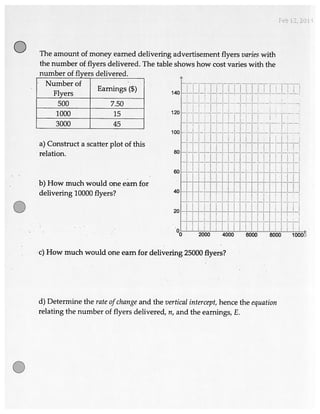
5 Word Problem: The amount of money earned delivering
advertisement flyers
1
6 Problem – cost and repair time at an appliance store 1
7 Sample Multiple Choice – Linear Relations 1
8 Hot New Wheels 1
9 Quiz - Variation 1
10 Stretch a Penny – Group Activity with Assessment Rubric 5
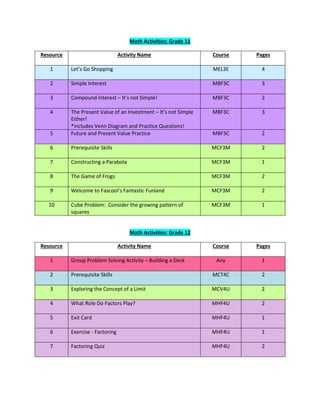
Math Activities: Grade 11
Resource Activity Name Course Pages
1 Let’s Go Shopping MEL3E 4
2 Simple Interest MBF3C 3
3 Compound Interest – It’s not Simple! MBF3C 2
4 The Present Value of an Investment – It’s not Simple
Either!
*includes Venn Diagram and Practice Questions!
MBF3C 3
5 Future and Present Value Practice MBF3C 2
6 Prerequisite Skills MCF3M 2
7 Constructing a Parabola MCF3M 1
8 The Game of Frogs MCF3M 2
9 Welcome to Fascool’s Fantastic Funland MCF3M 2
10 Cube Problem: Consider the growing pattern of
squares
MCF3M 1
Math Activities: Grade 12
Resource Activity Name Course Pages
1 Group Problem Solving Activity – Building a Deck Any 1
2 Prerequisite Skills MCT4C 2
3 Exploring the Concept of a Limit MCV4U 2
4 What Role Do Factors Play? MHF4U 2
5 Exit Card MHF4U 1
6 Exercise - Factoring MHF4U 1
7 Factoring Quiz MHF4U 2
Math Activities: Any Grade
Resource Activity Name Pages
1 Mental Math with Squares and Toothpicks 1
2 Mental Math with Triangles and Toothpicks 1
3 Three Chickens Weighed Themselves in Different Groupings 1
4 Finding the Total Value of the Symbols in the First Column 1
5 The Painted Cube Problem 2
Math Activities - Any Grade
Mental Math with Squares and Toothpicks
Source: Adapted from EDUC 8P81 Handout – from Professor Joyce Mgombelo, Brock University
Forming Squares from a 12-toothpick arrangement.
Arrange 12 toothpicks to form four squares as diagrammed below.
Try to Accomplish the following:
a) Remove four toothpicks to form one square.
b) Remove two toothpicks to form two squares of different sizes.
c) Remove four toothpicks to form two squares of equal size.
d) Rearrange three toothpicks to form three squares of equal size.
e) Rearrange four toothpicks to form three squares of equal size.
Math Activities - Any Grade
Mental Math with Triangles and Toothpicks
Source: Adapted from EDUC 8P81 Handout – from Professor Joyce Mgombelo, Brock University
Forming Triangles from a 7 – toothpick arrangement.
Arrange seven toothpicks to form two squares as diagrammed below.
Try to Accomplish the following:
a) Remove two toothpicks to form three triangles of equal size.
b) Add two toothpicks to form four triangles of equal size.
c) Add one toothpick and rearrange four toothpicks to form two triangles of equal size.
Math Activities: Grade 9 (Academic or Applied)
Resource Activity Name Pages
1 Pattern Practice 2
2 Patterns to Graphing 3
3 Trend Lines 1
4 Tables and Chairs Problem 1
5 Word Problem: The amount of money earned delivering
advertisement flyers
1
6 Problem – cost and repair time at an appliance store 1
7 Sample Multiple Choice – Linear Relations 1
8 Hot New Wheels 1
9 Quiz – Variation 1
10 Stretch a Penny – Group Activity with Assessment Rubric 5
Math Activities: Grade 11
Resource Activity Name Course Pages
1 Let’s Go Shopping MEL 3E 4
2 Simple Interest MBF3C 3
3 Compound Interest – It’s not Simple! MBF3C 2
4 The Present Value of an Investment – It’s not Simple
Either!
*includes Venn Diagram and Practice Questions!
MBF3C 3
5 Future & Present Value Practice MBF3C 2
6 Prerequisite Skills MCF3M 2
7 Constructing a Parabola MCF3M 1
8 The Game of Frogs MCF3M 2
9 Welcome to Fasool’s Fantastic Funland MCF3M 2
10 Cube Problem: Consider this growing pattern of
squares
MCF3M 1
Math Activities: Grade 11
Resource Activity Name Course Pages
1 Let’s Go Shopping MEL 3E 4
Grade 11 – MEL 3E
Source – Adapted from Handout in EDUC 8P81 Provided by Kristina Wamboldt
Strand – A. Earning and Purchasing
Expectations – overall: 3, specific: 3.3, 3.4, 3.6, 3.7, 3.8, 3.10
Activity: Let's Go Shopping!
Materials: grocery store flyers, money manipulatives and envelopes to hold money, student worksheets
Instructions:
1. Have students get into groups of 2-3 (or hand out number cards to randomly place students
into groups)
2. Provide each group with a grocery store flyer
3. Each group will choose a pre-made envelop with an undisclosed amount of money in it (each
premade envelop can have a different budget enclosed or the same)
4. After counting their money, each group will determine what they can afford to buy and
create a shopping list (following the directions on the student worksheet)
5. Each group will share their shopping list with the class and explain their choices
6. The class will discuss the pros and cons of shopping lists that each group developed (this
discussion could include topics such as food groups, brand names vs. store brand, needs vs.
wants, etc)
Name: ________________________ Date: __________________________
Student Handout Let's Go Shopping!
You look around your kitchen and realize that it is time to buy groceries, but you have a strict budget
that you have to follow. It is important to follow your budget so you can pay all of your other bills too!
You turb to the grocery store flyer that came in the mail to find all of the great deals!
Budget: $ _________
Shopping List:
Item Quantity Price Before Tax Price After Tax
Total
Change
1. Were you able to stay within your budget? If not, what changes could you make to your shopping
list?
2. Can you survive with only the food on your list? Why or why not?
Math Activities: Grade 11
Resource Activity Name Course Pages
2 Simple Interest MBF3C 3
3 Compound Interest – It’s not Simple! MBF3C 2
4 The Present Value of an Investment – It’s not Simple
Either!
*includes Venn Diagram and Practice Questions!
MBF3C 3
5 Future & Present Value Practice MBF3C 2
Math Activities: Grade 11
Resource Activity Name Course Pages
6 Prerequisite Skills MCF3M 2
7 Constructing a Parabola MCF3M 1
8 The Game of Frogs MCF3M 2
9 Welcome to Fasool’s Fantastic Funland MCF3M 2
10 Cube Problem: Consider this growing pattern of
squares
MCF3M 1
Math Activities: Grade 12
Resource Activity Name Course Pages
1 Group Problem Solving Activity – Building a Deck Any 1
2 Prerequisite Skills MCT4C 2
3 Exploring the Concept of a Limit MCV4U 2
4 What Role Do Factors Play? MHF4U 2
5 Exit Card MHF4U 1
6 Exercise - Factoring MHF4U 1
7 Factoring Quiz MHF4U 2
Math Activities: Grade 12
Resource Activity Name Course Pages
1 Group Problem Solving Activity – Building a Deck Any 1
Grade 12
Group Problem Solving Activity – Building a Deck
Source: Adapted from EDUC 8P81 Handout – from Professor Joyce Mgombelo, Brock University
You have been hired to build a deck attached to the second floor of a cottage using exactly 30m of deck
railing (note: the entire outside of the edge will have railing).
In pairs or a small group, work together to determine the dimensions of the deck that follow the
specifications in the diagram and maximize the area of the deck.
y
COTTAGE
DECK
x
x
y
Math Activities: Grade 12
Resource Activity Name Course Pages
2 Prerequisite Skills MCT4C 2
Math Activities: Grade 12
Resource Activity Name Course Pages
3 Exploring the Concept of a Limit MCV4U 2
Math Activities: Grade 12
Resource Activity Name Course Pages
4 What Role Do Factors Play? MHF4U 2
5 Exit Card MHF4U 1
6 Exercise - Factoring MHF4U 1
7 Factoring Quiz MHF4U 2
Drama Activities – Grade 9 to 12
Resource Activity Name Type Pages
1 Moving Name Getting to Know a New Group 1
2 Me to You Focus Games 1
3 Word Association with Clicks Focus Games 1
4 Space Jump Improvisation Games 1
5 DVD Game Physical Exercises 1
6 Four Corners Physical Exercises 1
Getting to Know a New Group – From: http://www.stagemilk.com/acting-games/#new
Moving Name
Difficulty: easy
Age Range: all ages
So this, in my opinion, is the best game to start with when working with a new group. I’ve seen it work
with university students as well as with six year olds.
1. Get your group into a circle.
2. Say your name with a matching gesture and vocalisation. Samuel for instance could be signalled
with two punches and spoken in a high pitched voice.
3. Once you have performed your name, the whole group mimics you. They must try to copy the way
you said your name as well as the physical movement.
4. Continue this around the circle till each person has said their name.
Tip: the more whacky you set the standard the better result you’ll get from the students.
Tip: encourage the students not to think too much, but to jump straight it – looking stupid is mandatory.
Focus Games - From: http://www.stagemilk.com/acting-games/#focus
Me to You
Difficulty: easy
Age Range: all ages
This is a really simple exercise for a large group which encourages connection and focus. It requires
students to be hyperaware and really focus.
1. Get your group into a circle.
2. The person starting must make eye contact with someone else in the circle (working across the
circle is best).
3. They then must gesture to themselves and say “me” followed by a gesture at the other person in
which they say: “to you”. It should seamless.
4. If you are targeted you then accept the offer and continue in the same way to a new person in the
circle.
5. Once this has gone around the circle a few times, lose the words and get your students to simply
use gesture and eye contact.
6. If they are successful at this then drop the gesture and simply use eye contact.
Tip: encourage your students to be clear and direct. Also make sure that all the students get a turn.
Focus Games - From: http://www.stagemilk.com/acting-games/#focus
Word Association with Clicks
Difficulty: medium
Age Range: late primary/high school
This game is played by professional theatre companies, and can also work really well with late primary
and high school kids.
1. Get your group into a circle.
2. Firstly, teach your students the rhythm which they will make with their bodies: thigh slap, clap, then
click (right hand), click (left hand)
3. Get the group comfortable with this rhythm.
4. When clicking with the right hand the student whose turn it is must say the persons before them’s
word and then a new word that associates with that word when clicking with the left hand.
5. The next person in the circle (work in a clockwise motion) must do the same. They must repeat the
last persons word with the right click and then think of a new word when they click with the left
hand.
6. The thigh slap and clap gives the game a steady rhythm and stops students panicking.
7. Continue this until you have done a few successful laps around the circle.
Tip: Stress the importance of keeping the rhythm steady. Groups tend to naturally speed up quite
quickly. Students often find this game particularly funny, so try to keep them focused.
Tip: If the rhythm is too confusing, try a simple game of word association around the circle instead.
Improvisation Games – From: http://www.stagemilk.com/acting-games/#impro
Space Jump
Difficulty: medium
Age Range: all ages (8+ recommended)
This is arguably the most famous of all improvisation games, and is played slightly different all over the
world. Here is my version:
1. Four students go up on stage.
2. Number the students 1-4
3. The student who is number 1 comes onto the stage. The audience thinks of a scenario for student 1.
For example he/she may be in a zoo.
4. Student number 1 then begins an improvisation about the given scenario. When you feel it has gone
on enough, usually about 20 seconds you call Space Jump!
5. Student 1 then freezes and student 2 comes on stage. They use the pose student 1 is frozen in to
inspire a new scene.
6. The two actors then continue on until again you feel it has been long enough and again call Space
Jump!
7. This same process happens for students 3 and 4.
8. Once the final scene, which should have all 4 students in, has been going for enough time you again
call Space Jump! Student 4 then leaves the scene and the scene reverts to what the 3 students were
doing before.
9. This reversal continues until there is only student 1 alone on stage improvising in their first scenario.
Tip: Try to encourage a diverse range of scenarios. You often see the same stuff over and over.
Physical Exercises – From: http://www.stagemilk.com/acting-games/#body
DVD Game
Difficulty: easy
Age Range: all ages
I have seen this game work really well with all ages. With large groups, getting students to go away and
create something and then come back and perform is really effective. This game encourages creativity
and physical expression.
1. Split your group up into three. It doesn’t matter the size of each group.
2. Instruct each group to come up with three poses or “statues” which portray a story.
3. The three poses should represent a beginning, middle and end of a story.
4. Give each group around 5 minutes to prepare.
5. Get the class to reform and let each group perform.
6. Then get the rest of the class to explain what the story (DVD) was about.
Tip: give both the group performing and those guessing positive feedback if they are successful.
Physical Exercises – From: http://www.stagemilk.com/acting-games/#body
Four Corners
Difficulty: easy
Age Range: all ages
This is a really easy physical game for all ages. I often use it to start a lesson as it’s simple to explain and
gets the students moving.
1. Name or number the four corners of the room. If you have a themed lesson you can name each
corner something that suits the theme.
2. Choose a student to stand in the middle of the room. You then make the student close their eyes
whilst you count down from 10. They can either spin on the spot and stop when you reach zero, or
they can stay still and then pick a corner on zero. The latter is my preferred choice as it is more
about listening to the students moving around the room, rather than merely luck.
3. The students who are in the corner that the student in the middle picks are then out.
4. The game continues until there is a winner.
5. The winner then becomes the one in the centre.
Tip: Think of some really fun name of the corner. Kids, and adults for that matter, love being involved in
decisions!
Additional Teaching Resource Books:
Science:
Science Links – McGraw-Hill Ryerson (2009)
Practice and Homework Book
Activities and Assessment Tools aligned with Grade 9 Science curriculum
Math:
Money and Youth – A Guide to Financial Literacy (2012)
Author: Gary Rabbior
Discussion/Opinion Questions
'Take Action' Activities - designed to get students thinking about financial literacy and steps
they can take to become more knowledgeable
Minds On Activities:
Brain Games – SUDOKU
Publications International, Ltd. (2010)
Puzzles to get student thinking before class
Ranging difficulty to accommodate beginners (Level 1 to Level 5)
Description and Justification of each item included:
Item Page # Description Justification
Health
Needs
5 Personal items – Kleenex, lipsole,
advil, Halls, and Band-Aids
Anything that I may need during the day that may not be
present in the classroom teacher's room I have included.
Dry lips, headaches, runny nose, or having a sore throat are
all things I want to be prepared for.
Working in a science classroom, the most common accident
is cuts, so I have also included Band-Aids.
Writing
Utensils
5 15 pencils
6 erasers
2 sharpeners
10 highlighters
15 Sharpies
4 WhiteBoard Markers and Eraser
I have basic writing supplies for students who do not come
prepared to class. I have choosen to assume the class I am
covering for has 30 students.
To supply students when working in pairs, I have 15 pencils,
15 pens, and 15 sharpies so they can share. To supply
students when working in groups of 3, I have 10
highlighters. I have 2 sharpeners just in case I cannot locate
the classroom sharpener and students need to use one. I
have 6 erasers to disperse them around the room, 1 for
every 5 students in the class if needed.
The 4 WhiteBoard Markers and Eraser are for me to use on
a WhiteBoard if none can be found in the classroom.
Paper 5 Blank Paper, Lined Paper, Coloured
Paper, Graphing, Paper, Half-Sheet
Paper, Cue Cards, Post-it Notes
I have selected a variety of paper options to suit different
activities I may do with students. Post-it Notes can be used
for students to put initial thoughts down to brain-teasers or
minds-on quick activities, or used to label the 4 corners of
the room for the Four Corners Drama Activity (see page
131).
Additional
Tools for
Activities
5 Rulers, calulators, toothpicks,
envelopes, paper money, grocery
store flyers, scissors, tape, glue
stick, coins, dice, stickers
All of these items have been included to provide resources
enough for a class with 30 students to complete specific
activites, or support a lesson the regular classroom teacher
has left in his/her lesson plan.
See the chart on page 5 for which activity requires which
items.
Daily
Checklists
6-9
15
Checklists that provide tips on how
to prepare before coming to the
school, what to do upon arrival,
preparing before the lesson, tips to
keep in mind throughout the day,
reminders when dismissing the
class, and what to do at the end of
the day.
These checklists will help ensure that I do not forget to do
an important step because I am overwhelmed by the new
environment. It will help me stay focused, know exactly
what I need to do, and ensure I make a good impression
with staff and administration by being prepared for the day.
Daily
Special
Cases
10-14 Tips on how to deal with special
cases, such as group work,
supervising a test, taking the class
to the library, and how to handle
students leaving the room.
I have included roles for students
when working in groups, cards to
hand out to students to form them
into groups, a Library Work
Completion Sheet, and a Sign-Out
Sheet.
I have included tips on special daily cases because if I see
that the regular teacher has included one of these cases, I
can read some tips on how to make the lesson run
smoothly.
The group roles I decided to make up so that the students
can work in groups effectively, knowing exactly what their
job is for the task. I have created 5 roles because I think the
maximum size for group work with a class of 30 students
should be about 5 students, or else it may becomes difficult
to collaborate and stay focused.
I have created cards that I can hand out to quickly form
groups. Often if teachers number off students, they quickly
forget what they were assigned. This tool ensures the group
work gets started efficiently.
I included a Library Work Completion Sheet because I think
it would be a great tool to let students know you will be
checking in with how much they accomplish during the
period. Students may be more focused if they know their
progress will be checked and recorded.
The Sign-Out Sheet was included as a way to keep a record
of students who need to go to the washroom or leave for
any other reason. They sign their name so that if they fail to
return after some time I can buzz the office to indicate the
student has not returned to the class.
Note to
Classroom
Teacher
Template
16 Template for a note that I would
leave for the regular classroom
teacher. Includes a simple layout
to outline the key items a teacher
may want to be updated about for
their class.
I have included this letter template to make writing a letter
at the end of the day much easier.
I kept it simple and choose to highlight main items the
teacher may want to know such as attendance issues (late
or absent students, material covered, and problems
students had with the material.
For the behavioural issues that I comment about, I can
attach a Behaviour Contract (page 22) that I had to make
with the student during the class period or my notes
recorded in a Student Observation Sheet (page 23).
Strategies 16-17
24
Classroom management strategies
to use in general and special cases
when dealing with certain types of
students.
Strategies for working with special
populations such as student with
exceptionalities, gifted students,
If the classroom teacher notifies me that a particular
students has special needs (exceptionalities, gifted, ELL) I
can quickly refresh on some strategies to support them in
the best way throughout the class.
and ELL students.
Safe
Schools
Incident
Reporting
Information
19
20-21
Page 19: A list of student actions
that would lead to me having to fill
out a Incident Reporting Form.
Page 20-21: A resource answering
all my questions about when to
report, how to report, and other
important details.
These resources were included to ensure that I know how
react to situations in the classroom in the appropriate way.
If I observe a student doing any of the actions on page 19, I
will have the steps directly in my book to handle the
situation properly.
Behaviour
Contract
Sheet
22 A behaviour contract that outline
what behaviours the student
agrees to, consequences of not
meeting these expectations, and
priviledges if they are met.
I have included a Student Behaviour Contract to handle
students who are disrupting the class with inappropriate
behaviour. As part of my preparation before the lesson, I
will have review the school and classroom rules and be able
to fill out this form with the student to ensure the rest of
class runs more smoothly. Also this contract can be left
behind for the regular classroom teacher to see evidence
that I took action when a student was behaving
inappropriately.
Student
Observation
Sheet
23 The Student Observation Sheet
includes a number of disruptive
behaviours in a chart, and the
number of times I observe the
behaviour can also be recorded.
This was included to serve as evidence for the classroom
teacher to the type of behaviour that a student did to
disrupt the lesson. This sheet would supplement my note to
the classroom teacher so he/she could discuss the
observations with the student when they return.
Science
Resources
25-55 I have compiled brain teasers,
activites, handouts for students to
complete individually, in pairs or in
groups, quizzes, and exit cards.
The resources are pulled from
grade 9-12 material and all content
connect with curriculum
expectations.
I wanted to include a wide variety and types of resources so
that if nothing was left by the classroom teacher, I could do
many different activities with the class throughout the
period. I have resources for all grade levels to be prepared
to teach any class. I have included activities and the
materials in my bag of tricks support the activities so
students can complete fun and engaging tasks during the
lesson. I have also choosen materials that require little or
no prep work. If the class is not cooperating, I have included
a few quizzes to get them back on track.
Math
Resources
56-124 I have collected problems that will
get students thinking about math,
which can be used in any grade
level. I also have a worksheets,
activities, word problems, and
quizzes for 7 different courses.
I choose to include a wide variety of resources for various
courses because the content is quite different between the
math courses offered. The activities I have included are not
too difficult, so that students can complete them
individually or in groups and then feel comfortable to
present their answers to the class.
Drama
Resources
125-
131
Various games to do with students
that fall under 4 categories:
getting to know a new group, focus
games, improvisation games, and
physical exercises.
I have choosen to include drama activities because if I were
given a drama class to cover and the teacher did not leave
me with anything, I would have no idea what to do! I
choose they fun activities because they provide a nice
variety and focus on various skills that connect to the
curriculum. They are also applicable to any grade level so
they can be modified to be more difficult for more senior
students if needed.
Additional
Teaching
Resources
Books
132 I have three additional books for
three different areas: science,
math (financial literacy skills), and
brain games (Sudoku).
I have collected materials for the grade 9 biology and
chemistry strands of the curriculum. However, if I were to
be assigned to teach a gr. 9 class that is working on Space
and Exploration I could use this resource book. It has
activities, charts, questions, diagrams, and other useful
pages that can be photocopied and used in the class. There
are also assessment checklists and rubrics to go along with
the handouts so I can provide that information to the
regular classroom teacher.
The financial literacy book could be useful in a math class
during the introduction to the class. It has lots of Minds On
Activities, Disussion Questions, and quick Take Action
Activities where students could work in pair or small groups
to generate answers and share them with the class.
The Brain Games book was included as a way to start a
lesson, or provide a challenge to students who have already
completed their work and want something else to do. There
are different levels of difficulty, which allows it to be
modified to fit the abilities of the student.
References
Page
Number
Source
20 http://www.edu.gov.on.ca/eng/safeschools/Occasional_TeacherBill157_En.pdf
22 http://www.dailyteachingtools.com/classroom-behavior-management.html#15
23 http://www.dailyteachingtools.com/classroom-behavior-management.html#13
27 Adapted from Mrs. Casella, Science Teacher at Welland Centennial Secondary
School
28-29 Adapted from E.L Crossley Science Department Resources
30 Adapted from Mrs. Casella, Science Teacher at Welland Centennial Secondary
School
37 Adapted from Mrs. Casella, Science Teacher at Welland Centennial Secondary
School
38-42 Adapted from Mr. Brendzy, Science Teacher at Governor Simcoe S.S
44-45 Personal Resource Creation
47-51 Mrs. Wilding, Science Teacher at Welland Centennial Secondary School
52-55 EDUC 8P86 Class Handout from Professor Xiaver, Brock University
59-60 Adapted from EDUC 8P81 Handout – from Professor Joyce Mgombelo, Brock
University
61-62 Adapted from Mrs. Fee, Math Department Head at E.L. Crossley S.S
63-64 Adapted from EDUC 8P81 Handout – from Professor Joyce Mgombelo, Brock
University
66-77 From Mr. Minor, Math Teacher at E.L. Crossley S.S.
78-82 From EDUC 8P81 Handout – from Professor Joyce Mgombelo, Brock University
85-88 Adapted from Handout in EDUC 8P81 Provided by Kristina Wamboldt
90-99 From Mr. Minor, Math Teacher at E.L. Crossley S.S.
100-108 Adapted from Mrs. Fee, Math Department Head at E.L. Crossley S.S
111 Adapted from EDUC 8P81 Handout – from Professor Joyce Mgombelo, Brock
University
113-114 Adapted from Mrs. Fee, Math Department Head at E.L. Crossley S.S
116-117 From EDUC 8P81 Handout, Created by Brittany Jackson, Brock University
119-124 From Mr. Minor, Math Teacher at E.L. Crossley S.S.
126 http://www.stagemilk.com/acting-games/#new
127-128 http://www.stagemilk.com/acting-games/#focus
129 ttp://www.stagemilk.com/acting-games/#impro#
130 http://www.stagemilk.com/acting-games/#body
131 http://www.stagemilk.com/acting-games/#body
132 McGraw-Hill Ryerson (2009). Science Links 9. Whitby, Ontario.
Gary Rabbior. (2012). Money and Youth: A guide to financial literacy. Toronto, Ontario.
Brain Games: SUDOKU. (2010). Publications International, Ltd. Lincolnwood, Illinois.

Good Copy Complete!

  • 1.
    The Occasional Teacher– EDUC 8Y55 Culminating Project – Bag of Tricks March 28, 2014 Rachel Brodie
  • 2.
    Pictures of Bagof Tricks all spread out
  • 3.
    Bag Of Tricks- Table Of Contents Item Page Number Physical Supplies In Bag of Tricks: Health Needs Writing Utensils Paper Additional Tools For Activities 5 5 5 5 Daily Occasional Teacher Checklists: Preparation At Home Before Entering the School To Do Upon Arrival Prepare Before the Lesson What To Do Throughout The Day Daily Special Cases: Group Work Supervising a Test Taking the Class to the Library Library Work Completion Sheet Leaving the Room Sign-Out Sheet Dismissal of the Class End of the Day Tasks Note to Classroom Teacher Template 6 7 8 9 10 11 11 12 13 14 15 15 16
  • 4.
    Strategies: Classroom Management TeachingStrategies Classroom Management – Special Cases Safe Schools Incident Reporting Form Information Reporting and Responding to Incidents - Guide Behaviour Contract Sheet Student Behaviour Observation Sheet Strategies for working with Special Populations 17 18 19 20-21 22 23 24 Activities: Science Resources Overview Chart Grade 9 Grade 10 Grade 11 Grade 11 or 12 Math Resources Overview Charts Any Grade Grade 9 Grade 11 Overview Chart MEL 3E MBF 3C MCF 3M Grade 12 Overview Chart Any Course Activity MCT 4C MCV 4U MHF 4U Drama Resources Additional Teaching Resource Books 25 26-35 36-42 43-45 46-55 56-57 58-64 65-82 83 84-88 89-99 100-108 109 110-111 112-114 115-117 118-124 125-131 132 Additional Items: Description and Justification of each item included References 133-136 137
  • 5.
    Physical Items toInclude in Bag of Tricks Health Needs: Item Tissue Band-Aids Advil Halls Throat Lozenges Lipsole Writing Utensils: Item Pencils Erasers Sharpener Pens Highlighters Markers – Sharpies and WhiteBoard Paper: Item Post-it Notes Lined Paper Blank Paper Cue Cards Graphing Paper Half sheet Paper Coloured Paper Additional Tools for Activities: Item Activity Rulers Gr. 11 Math MCF3M ‘Constructing A Parabola’ Calculators Math Activities Toothpicks Any Grade - Math ‘Mental Math with Squares and Toothpicks’ ‘Mental Math with Triangles and Toothpicks’ Envelopes Paper Money Grocery Store Flyers Gr. 11 Math MEL3E 'Let's Go Shopping' Scissors Tape Glue Stick Gr. 10 – Science ‘A few of the many kinds of Specialized Cells found in Animals’ Coins Dice (could be used as a substitute instead of coins) Gr. 9 Biology ‘The Great Carbon Atom Race’ Gr. 12 Genetics ‘Making Babies’ Stickers For Completion of Activities when needed. May be used for Quizes: Gr. 9 Math `Quiz – Variation` Gr. 12 Math `Factoring Quiz` Gr. 9 Science `Matter, Properties and Desntiy Quiz` Gr. 11 Biology `Digestive System Quiz`
  • 6.
    Daily Occasional TeacherChecklists Preparation At Home Before Entering the School Preparation:  Notebook and pencil by the phone to write down details of assignment Complete the Following Chart During A Call: Information to Collect Details School Name Teacher Name Grade and Subject Start and End Time Job Number  After visiting a school prepare a file and include the following information: Information to Collect Details School Name Principal and Vice Principal Name School Timetable Directions and Map Contacts and Phone Numbers  Have professional clothing set out ready for morning  Get up early enough to accept an assignment for 8am in a school  Have lunch and “bag of tricks” all packed for the morning
  • 7.
    To Do UponArrival Main Office:  Arrive 15 minutes EARLY  Introduce Self in the Main Office  Sign OT record book  Obtain: o Keys o Bell Schedule o School Map Teacher Mailbox:  Check Teacher Mailbox for: o Lesson plans o Attendance list (may be in classroom) Find Locations:  Classroom  Restrooms  Staffroom  Workroom  Cafeteria  Gym  Library  Auditorium
  • 8.
    Prepare Before theLesson Become Familiar with Routines:  Attendance  Seating Plans  Have students make name tags  Safety Routines and Emergency Plans  Classroom rules/expectations  Behaviour/Reward systems  Washroom Sign-In and Out sheets  School Intercom and Internal Phone System School Policies to Become Familiar with:  School Code of Conduct  Accident Reports  Food and Snacks permitted in class  Use of electronic devices  Dress Code  Supervision  Planning/Prep Preparation For the Lesson:  Study the lesson plan provided by the teacher  Do tasks to execute the lesson o Photocopy o Test audiovisual equipment o Start-up SMART Board or Projector  Write Name and Agenda for the Day on the board  Identify students with special needs
  • 9.
    What To DoThroughout The Day Before the Bell:  Possibly take out and prepare your subject-related “beginning of class filler activities”  Greet students at the door  Get attendance site up and ready to be filled out once students are started on a task Introduction:  Explain where the regular teacher is and when he or she will be back  Introduce self by name and teachable  Go over the daily agenda Lesson:  Follow teacher’s plans as closely as possible *inform teacher of any changes in note  Ensure you know when students are leaving the classroom, purpose, how long  Never leave students unattended or dismiss class early  Do not dismiss any student without notification from office or note from home Strategies:  Give timelines, divide up work (ask students to complete certain questions by specified time to ensure focus)  Break up material into 2 or 3 parts with other activities in between to keep attention
  • 10.
    Daily Special Cases CaseSuggestions 1) Group Work - keep groups small, spread out - assign roles for each student - ask for oral report of progress after ½ hour to help discussion stay on topic - to make groups, carry numbered cards in bag of tricks - letting students choose groups may work, but be aware of students who are left out Roles for Students in Group Work: 1. Recorder (records important notes that come from group discussion) 2. Task Manager (ensure work gets done and group stays on task) 3. Discussion Director (ensures opinions from all members are discussed) 4. Consensus Seeker (ensures all members agree with a decision that has to be made as a group) 5. Summarizer (summarizes key points that have been made in the discussion and shares information with the class if needed) Cards for Students: 1. Consider making cards that have an image on them – groups up to 5 members. 2. If you want to make groups of 3 for a class of maximum 30, have different cards separated by paper clips or Ziploc bags and hand out only 3 of each image
  • 11.
    Case Suggestions 2) Supervising aTest - space students out - books under desks - instructions: NO talking, ask teacher question if stuck, test will be removed if talk or looking on neighbors paper, when done check over work then hand in test and work on other homework *during test walk around or watch class from back of room Case Suggestions 3) Taking the Class to the Library - travel together as group - ask students to wait just inside door for further instructions - if working with senior class, ask them to find you 5 minutes before end of period and add signature to list which also includes short summary of what they worked on during class
  • 12.
    Library Work CompletionSheet Class: ______________________________ Date: ____________________________________ Time Spent in Library: _________________ Student Name and Signature Summary of Work Completed
  • 13.
    Case Suggestions 4) Leaving theRoom Washroom - follow washroom procedure of classroom teacher, if has one - take attendance + explain assignment before anyone leaves - ask to see work accomplished - allow only 1 student to leave at a time - a “sign-out” sheet is essential: name, class, destination, time out, time in - remind students you expect them back in a reasonable time, you will call the office if they do not return
  • 14.
    Sign-Out Sheet Class: ________________________________Date: ___________________________________ Name Destination Time Out Time In
  • 15.
    Dismissal of theClass Remind students:  To put names on sheets they hand in, select students to collect them for you  To copy assignment from board  To clean up garbage End of the Day Tasks Leave Note for Teacher For Each Class Report on the Following:  Attendance  Students leaving the classroom  What was covered  Any behaviour issues  What needs to be reviewed or problems with the material Additional Tasks:  Ensure room is tidy  Collect own teaching resources  Thank staff who assisted throughout the day  Check-in at office:  Return keys  Ask if you will be needed in the future  Visit the Principal or Vice Principal to let them know you look forward to another day of work at their school
  • 16.
    Note to ClassroomTeacher Template Dear _____________________________, Thank you for the opportunity to teach your students today. Here are some details from the day I thought you would want to know: Period _____ Attendance: Late students include Absent students include Material Covered: Behavioural Issues: Problems students had with the material: Topics that might need some reviewing include (Note: Repeat the same information for as many periods covered at the school) I enjoyed working with your students and look forward to teaching them again in the future. If you have any questions feel free to contact me at ________________ (email). Best Regards, Rachel Brodie
  • 17.
    Strategies Classroom Management TeachingStrategies Introductions: 1. Clearly outline expectations and consistently apply them to all students 2. Begin instruction immediately – review the agenda and special activities, have students create nametages, share information left by the regular teacher Daily Strategies: 3. Proximity Control 4. Eye contact 5. Wait-time Expectations and Consequences: 6. Expectations – explain to student what is expected and WHY 7. Choice – give student a choice between meeting expectation or receiving consequences 8. Time – provide student with time to adjust to new expectations 9. Consequence – if misbehav continues, impose consequences
  • 18.
    Classroom Management TeachingStrategies Special Cases: Case Strategy When students have nothing to do - sit with student, go over work finished, suggest student helps other students Responding to Refusal to do work - recognize students who are on-task - give positive encouragement for the noncompliant student “You can’t make me” - acknowledge that the student is correct, then restate your expectations and consequences if they are not met - perhaps the work is too difficult for them – consider re-teaching a concept in a different way - be positive about what student has already accomplished Working with disruptive students General Guidelines to Follow: - Never threaten a consequence you would not impose - May be best to ignore the student if they are the confrontational type Additional Strategies: - Check teacher’s day plans for student behav contracts, if one is not available – make one with the student about how much to accomplish by the end of the period - Set smaller goals for the student - Find ways for him/her to take a break When a situation gets out of control 1. Send student into the hall to diffuse the situation 2. Send student to office (know student's name, tell them where to report and you will be contacting the office to let them know the student is on his/her way 3. Call administrator to classroom if student safety becomes an issue (know where and how to use the intercom) When to send a student to the office - if behaviour is keeping the teacher from teaching and peers from learning - if you have attempted several techniques (non-verbal, warnings), but failure, principal or VP should be involved - if after going to office, student returns to class and continues to demonstrate unacceptable behaviour, send student back to office
  • 19.
    Safe Schools IncidentReporting Form, must be completed if student: - utters threat to inflict serious bodily harm to another person - has/under influence alcohol or illegal drugs - swearing at teacher or another person in position of authority - committing vandalism causing extensive damage to school property at school or property on premise - bullying - any other activity for which a principal may suspend a pupil under a policy of the board
  • 20.
    Reporting and Respondingto Incidents – A Resource for Occasional Teachers Source: http://www.edu.gov.on.ca/eng/safeschools/Occasional_TeacherBill157_En.pdf What am I required to do? A new law (Keeping our Kids Safe at School Act) requires you to report serious student incidentsto the principal, and to respond to all inappropriate and disrespectful behaviour at school or at school-related activities, or in situations where the activity will have a negative impact on the school climate. What types of incidents am I required to report? You must report any incidents for which the principal must consider either suspension or expulsion (serious student incidents). Incidents which a principal must consider for suspension include: • Uttering a threat to inflict serious bodily harm on another person • Possessing alcohol or illegal drugs • Being under the influence of alcohol • Swearing at a teacher or at another person in a position of authority • Committing an act of vandalism that causes extensive damage to school property at the pupil’s school or to property located on the premises of the pupil’s school • Bullying • Any other activities identified in school board policy (ask the principal what these are). Incidents which a principal must consider for expulsion include: • Possessing a weapon, including possessing a firearm • Using a weapon to cause or to threaten bodily harm to another person • Committing physical assault on another person that causes bodily harm requiring treatment by a medical practitioner • Committing sexual assault • Trafficking in weapons or in illegal drugs • Committing robbery • Giving alcohol to a minor • Any other activities identified in school board policy (ask the principal what these are). These activities include incidents that occur while at school, at a school-related activity or in situations where the activity will have a negative impact on the school climate. How do I report? • You must consider the safety of others and the urgency of the situation in reporting the incident, but, in any case, you must report it to the principal by the end of the school day. • Your report must be confirmed in writing in a timely manner, using the Safe Schools Incident Reporting form – Part I (ask the principal for this form). * Note: reporting does not replace conversations between the employee and the principal. The principal and the employee are encouraged to talk about the incident, regardless of action taken.
  • 21.
    What happens whenI report an incident to the principal? • The principal will provide a written acknowledgement (Safe Schools Incident Reporting form – Part II) that your report was received and whether he or she has taken any action regarding the incident you reported. Who else has to report? • Vice principals • Teachers and educational assistants • All non-teaching staff, such as those involved in social work, child and youth work, psychology and other related disciplines • Administrative and custodial staff • Bus drivers What am I required to respond to? • You must respond to any student behaviour that is likely to have a negative impact on the school climate, if in your opinion, responding would not cause immediate physical harm to you, a student or another person. • Such behaviour includes all inappropriate and disrespectful behaviour (e.g., swearing, homophobic or racial slurs, sexist comments or jokes, graffiti), as well as those incidents that must be considered for suspension or expulsion. • For incidents where suspension or expulsion would not be considered, but you feel it is not safe to respond, you are expected to tell the principal as soon as possible. How do I respond? • Responding may include asking a student to stop the inappropriate behaviour, naming the type of behaviour and asking for a change in the future. * Note: if the behaviour is not one that must be considered for suspension or expulsion, a response is sufficient – it does not have to be reported to the principal. Who else has to respond? • Other board employees who work directly with students (e.g., teachers, staff in social work, child and youth work, psychology and related areas, and educational assistants). Where can I find additional information about Keeping our Kids Safe at School Act (Bill 157)? • The Ministry of Education website: www.edu.gov.on.ca/eng/teachers/safeschools.html • Bill 157 online training module: www.bill157.apandrose.com/ Who do I contact if I have questions? • The school principal
  • 22.
    Behaviour Contract Sheet Source:http://www.dailyteachingtools.com/classroom-behavior-management.html#15 Student Behaviour Contract I, ______________________________, hereby declare on this date, _________________________, that I agree to do the following: 1. ___________________________________________________________________________________ 2. __________________________________________________________________________________ 3. __________________________________________________________________________________ My efforts at meeting these goals will be considered acceptable and complete when: 1. ___________________________________________________________________________________ 2. __________________________________________________________________________________ 3. __________________________________________________________________________________ I understand that the consequences of not meeting these goals will include: 1. ___________________________________________________________________________________ 2. __________________________________________________________________________________ 3. __________________________________________________________________________________ I further understand that the priviledges for meeting these goals will include: 1. ___________________________________________________________________________________ 2. __________________________________________________________________________________ 3. __________________________________________________________________________________ _________________________________ _________________________________ Ending Date of Contract Student’s Signature _________________________________ _________________________________ Teacher’s Signature Parent’s Signature
  • 23.
    Student Behaviour ObservationSheet Source: http://www.dailyteachingtools.com/classroom-behavior-management.html#13 Student Observation Sheet Teacher: _________________ Class Period: _____ Student’s Name: __________________________ Behaviour Incident Observed #1 Incident Observed #2 Incident Observed #3 Incident Observed #4 Incident Observed #5 Incident Observed More than 5 times Date in Class Refusal to Cooperate Off Task Not Prepared for Class Excessive Talking Disrespectful to Teacher Disrespectful to Others Won’t follow Directions Disrupts Lesson Other Offense
  • 24.
    Strategies for workingwith Special Populations Strategies for working with Students with Exceptionalities: 1. Structured learning activities 2. Clear, concise directions using as few words as possible 3. Break tasks into smaller parts of sequenced steps 4. Repetition to build skills with frequent corrections and encouragement 5. Many chances to succeed, with immediate formative feedback Accomodations: Do not alter the provincial curriculum expectations Types: instructional, environmental, assessment Example: more time, technology, human supports Modifications: Changes made in expectations in order to meet a student’s learning needs Example: increasing or decreasing the complexity of the regular grade-level curriculum expectations Strategies for working with Gifted Students: 1. Enrich and extend activities 2. Provide alternate projects 3. Have them develop their own extension on a topic 4. Encourage them to support the learning of their peers where possible Strategies for working with English Language Learners (ELL): *Be aware of cultural differences Examples: 1. Eye’s downcast a sign of respect 2. Differences in comfort levels with amount of personal space and physical contact 3. Some students unaccustomed to eating with individuals other than their own family 4. Having trouble working in groups because this strategy is not used in some cultures 5. Physical activity or extra-curriculars may be contrary to a student’s religion or cultural outlook 6. Some cultures learn through observing and doing 7. Equal gender opportunities not present in some student’s cultural conditioning 8. Considered inappropriate to openly challenge another’s point of view, especially an individual with authority (ie. the teacher) 9. Uncomfortable receiving individual praise, as some cultures consider the group more important than the individual
  • 25.
    Science Resources –Activities, Brain Teasers, and Quizzes Science Activities: Grade 9 Resource Activity Name Strand Pages 1 Particle Theory Brain Teasing Challenge! Chemistry 1 2 Matter, Properties and Density Quiz Chemistry 2 3 The Great Carbon Atom Race Biology 6 Science Activities: Grade 10 Resource Activity Name Strand Pages 1 Animal Cell and Organelles Biology 2 2 The Cell: A Review Biology 2 3 A few of the many kinds of Specialized Cells found in Animals Biology 2 Science Activities: Grade 11 Biology Resource Activity Name Pages 1 Digestive System – Word Sort Activity 1 2 Digestive System Quiz 1 Science Activities: Grade 11 or 12 Genetics Resource Activity Name Pages 1 Making Babies 5 2 Monohybrid Cross Problem 2 3 Ethical Issue in Genetics 1 4 Genetic Phenotype Survey 1
  • 26.
    Science Activities: Grade9 Resource Activity Name Strand Pages 1 Particle Theory Brain Teasing Challenge! Chemistry 1 2 Matter, Properties and Density Quiz Chemistry 2 3 The Great Carbon Atom Race Biology 6
  • 27.
    Grade 9 –Chemistry Strand Source – Adapted from Mrs. Casella, Science Teacher at Welland Centennial Secondary School Particle Theory Brain Teasing Challenge!! In your groups, discuss the answers to the following questions. Answer on the sheet of chart paper. Explaining States of Matter 1. Gases have no definite shape or volume but can be compressed (squeezed into a smaller space). Explain this using the particle theory. 2. One cubic centimeter of water and one cubic centimeter of lead have about the same number of particles, but the lead weighs about ten times more! Explain this! Explaining Changes of State 1. Wet clothes dry quickly when they are warmed up. Explain this in terms of particles!! 2. When the temperature gets very cold outside the tires on Hondas get flat. Explain why this happens!! Other Situations 1. Apple cider is a mixture of water, sugar plus other things. If it is frozen solid and slowly warmed up some of it will melt at –10 degrees, more at –5 degrees and some at 0 degrees. Explain why. 2. Watch the demonstration of sugar and water. Use the particle theory to explain where the sugar went!
  • 30.
    Grade 9 –Biology Source – Adapted from Mrs. Casella, Science Teacher at Welland Centennial Secondary School SNC1D BIOLOGY: THE GREAT CARBON ATOM RACE THE GREAT CARBON ATOM RACE OBJECTIVES: * To understand the carbon cycle. * To trace various pathways of a carbon atom from the atmosphere through various organisms and back to the atmosphere. BACKGROUND You are about to enter a world you have, until now, only dreamed about. You have been shrunk and stuffed inside a single carbon atom and tossed up into the atmosphere where you immediately form a carbon dioxide molecule. Your job is to record your adventures as you travel through the carbon cycle. Where you will end up is anyone’s guess - will you become part of: A) a sugar molecule in a plant due to photosynthesis? Trapped for 100's of years? B) detritus after you were left to rot in a dead tree trunk or gopher carcass? C) the tissues of some wild third order consumer (hawk, cheetah, human)? INSTRUCTIONS 1. Play the game in groups of three. Players take one turn at a time, unless otherwise instructed. 2. Follow the instructions below, starting at #1, making coin tosses along the way. 3. Record each move you make on a blank piece of paper, indicating each organism or environment you encounter.
  • 31.
    4. If thecarbon atom in which you are riding gets spewed back into the atmosphere, simply start a new cycle (like real life!) 5. Declaring a winner. There are two ways you can declare a winner, the group must decide before beginning which criterion you will use. The winner may be: (a) the player whose carbon atom passes through the most organisms in 1 complete cycle OR (b) the player whose carbon atom passes through the most different organisms in total during the game. 6. The teacher will determine the game length. 7. At the end of the game answer the follow-up questions below (for marks). FOLLOW-UP QUESTIONS: 1. In the course of the carbon cycle, are carbon atoms themselves made? Destroyed? Explain how new organisms are created. 2. According to your game results, what seems to be the most common method of returning carbon atoms to the atmosphere? 3. According to your game results, what appears to be the 2 largest storage areas of carbon atoms? What is/are the main keys to removing carbon atoms “stuck” in the soil? 4. Name the phenomenon whereby the storage of carbon atoms in the atmosphere is becoming too great?
  • 32.
    START THE GAME!1.YOUR CARBON ATOM IS NOW IN A MOLECULE OF CO IN THE ATMOSPHERE. Flip two coins: TT The CO2 molecule with your carbon atom is not absorbed. Your carbon atom remains in the atmosphere for another turn. TH/HH The CO2 molecule with your carbon atom is absorbed into a leaf of a plant. Go to #2. 2. THE MOLECULE OF CO WITH YOUR CARBON ATOM IS NOW IN A LEAF OF A PLANT. Flip two coins: TT NO SUNLIGHT! NO PHOTOSYNTHESIS! The CO2 molecule with your carbon atom returns to the atmosphere. Go to #1. TH/HH SUNLIGHT! PHOTOSYNTHESIS! The CO2 molecule with your carbon atom is incorporated into a sugar molecule by photosynthesis. Go to #3. 3. YOUR CARBON ATOM IS NOW IN A MOLECULE OF SUGAR IN A PLANT. Flip two coins: TT The sugar molecule with your carbon atom is oxidized in cell respiration to provide energy for plant growth. Your carbon atom is released in a molecule of CO2. Go to #1. TH/HH The sugar molecule with your carbon atom is incorporated into a molecule making up the tissue of a plant. Go to #4. 4. YOUR CARBON ATOM IS NOW IN A MOLECULE MAKING UP A PLANT TISSUE. Flip two coins: TT The tissue is eaten by an consumer. Go to #5 and take another turn to determine which one. TH/HH The plant part dies. Its dead organic matter is now detritus. Go to #6. 5. THE PLANT TISSUE WITH YOUR CARBON ATOM IS EATEN BY A PRIMARY CONSUMER. Flip one coin twice: T,T The organism is a mammal/herbivore. Go to #8. T,H The organism is a bird. Go to #8. H,T The organism is an insect. Go to #8. H,H The organism is human. Go to #9. 6. YOUR CARBON ATOM IS NOW IN A MOLECULE OF DEAD ORGANIC MATTER OR DETRITUS. Flip two coins: TT/TH The molecule containing your carbon atom is consumed by a detritus feeder or decomposer. Go to #10 and take another turn to determine which one. HH FIRE! Go to #7. 7. THE MOLECULE WITH YOUR CARBON ATOM IS NOW BEING OXIDIZED (BURNED) IN A FIRE. OXYGEN IS COMBINING WITH YOUR CARBON ATOM AND IT IS BEING RELEASED IN A MOLECULE OF CARBON DIOXIDE. Go immediately back to #1 without taking another turn. 8. THE PLANT TISSUE WITH YOUR CARBON ATOM IS NOW BEING INGESTED BY A PRIMARY CONSUMER AS PART OF ITS FOOD. Flip two coins. TT The molecule with your carbon atom is metabolized into a molecule making up a tissue of the consumer’s body. Go to #12. TH CELL RESPIRATION! Go to #15. HH The molecule with your carbon atom is not digested. It passes through the intestinal tract and out as fecal waste. Go to #6.
  • 33.
    9. THE PLANTTISSUE WITH YOUR CARBON ATOM IS NOW BEING INGESTED BY A HUMAN AS PART OF FOOD. Flip two coins: TT The molecule with your carbon atom is metabolized into a molecule making up a tissue of the human body. Go to #11. TH CELL RESPIRATION! Go to #15. HH The molecule with your carbon atom is not digested. It passes through the intestinal tract and out as fecal waste. Go to #6. 10. THE MOLECULE CONTAINING YOUR CARBON ATOM IS NOW BEING INGESTED BY A PRIMARY DETRITUS FEEDER OR DECOMPOSER. Flip one coin twice: T,T The organism is an earthworm. Go to #19. T,H The organism is a decomposer - fungus (mushroom). Go to #20. H,T The organism is a decomposer - bacteria. Go to #18. H,H The organism is an insect. Go to #21. 11. YOUR CARBON ATOM IS NOW IN A MOLECULE MAKING UP A TISSUE OF A HUMAN BODY. Flip one coin: T The molecule with your carbon atom is broken down and metabolized in cell respiration. Go to #15. H The human dies of injury and/or disease and the body is cremated. Go to #7. 12. YOUR CARBON ATOM IS NOW IN A MOLECULE MAKING UP A TISSUE OF A PRIMARY CONSUMER OR HERBIVORE. Flip two coins: TT The molecule with your carbon atom is broken down and metabolized in cell respiration. Go to #15. TH The primary consumer is eaten by a secondary consumer. Go to #16. HH The primary consumer dies of injury and/or disease. Go to #6. 13. YOUR CARBON ATOM IS NOW IN A MOLECULE MAKING UP A TISSUE OF A SECONDARY CONSUMER OR CARNIVORE. Flip two coins: TT The molecule with your carbon atom is broken down and metabolized in cell respiration. Go to #15. TH The secondary consumer is eaten by a third order consumer. Go to #17. HH The secondary consumer dies of injury and/or disease. Go to #6. 14. YOUR CARBON ATOM IS NOW IN A MOLECULE MAKING UP A TISSUE OF A THIRD ORDER CONSUMER OR CARNIVORE. Flip two coins: TT The molecule with your carbon atom is broken down and metabolized in cell respiration. Go to #15. TH The third order consumer is eaten by another third order consumer. Go to #17. HH The third order consumer dies of injury and/or disease. Go to #6. 15. THE MOLECULE CONTAINING YOUR CARBON ATOM IS NOW BEING BROKEN DOWN IN CELL RESPIRATION TO PROVIDE ENERGY FOR THE CONSUMER’S MOVEMENTS AND FUNCTIONS. IN THIS PROCESS, YOUR CARBON ATOM IS COMBINED WITH OXYGEN ATOMS AND RELEASED AS CARBON DIOXIDE. Go immediately back to #1 without taking another turn.
  • 34.
    16. THE MOLECULEWITH YOUR CARBON ATOM IS NOW BEING INGESTED BY A SECONDARY CONSUMER. Flip two coins: TT The molecule with your carbon atom is metabolized into a molecule making up a tissue of the consumer’s body. Go to #13. TH CELL RESPIRATION! Go to #15. HH The molecule with your carbon atom is not digested. It passes through the intestinal tract and out as fecal waste. Go to #6. 17. THE MOLECULE WITH YOUR CARBON ATOM IS NOW BEING INGESTED BY A THIRD ORDER CONSUMER. Flip two coins: TT The molecule with your carbon atom is metabolized into a molecule making up a tissue of the consumer’s body. Go to #14. TH CELL RESPIRATION! Go to #15. HH The molecule with your carbon atom is not digested. It passes through the intestinal tract and out as fecal waste. Go to #6. 18. THE MOLECULE WITH YOUR CARBON ATOM IS NOW BEING ABSORBED BY A BACTERIA. Flip one coin: T The molecule with your carbon atom gets incorporated into a molecule of the bacteria. Go to #22. H The molecule with your carbon atom is broken down and metabolized in cell respiration. Go to #15. 19. THE MOLECULE WITH YOUR CARBON ATOM IS NOW BEING INGESTED BY AN EARTHWORM. Flip two coins: TT The molecule with your carbon atom gets incorporated into a molecule of the worm’s body. Go to #23. TH The molecule with your carbon atom is broken down and metabolized in cell respiration. Go to #15. HH The molecule with your carbon atom is not digested. It passes through the intestinal tract and out as fecal waste. Go to #6. 20. THE MOLECULE WITH YOUR CARBON ATOM IS NOW BEING ABSORBED BY A FUNGUS (MUSHROOM). Flip one coin: T The molecule with your carbon atom gets incorporated into a molecule of the fungus. Go to #24. H The molecule with your carbon atom is broken down and metabolized in cell respiration. Go to #15. 21. THE MOLECULE WITH YOUR CARBON ATOM IS NOW BEING INGESTED BY AN INSECT GRUB. Flip two coins: TT The molecule with your carbon atom gets incorporated into a molecule of the insect’s body. Go to #25. TH The molecule with your carbon atom is broken down and metabolized in cell respiration. Go to #15. HH The molecule with your carbon atom is not digested. It passes through the intestinal tract and out as fecal waste. Go to #6. 22. YOUR CARBON ATOM IS NOW IN A MOLECULE MAKING UP A BACTERIA’S BODY. Flip two coins: TT The molecule with your carbon atom is broken down and metabolized in cell respiration. Go to #15.
  • 35.
    TH The bacteriais eaten by an earthworm. Go to #19. HH The bacteria dies. Go to #6. 23. YOUR CARBON ATOM IS NOW IN A MOLECULE MAKING UP AN EARTHWORM’S BODY. Flip two coins: TT The molecule with your carbon atom is broken down and metabolized in cell respiration. Go to #15. TH The worm is eaten by a bird. Go to #8. HH The worm dies of injury or disease. Go to #6. 24. YOUR CARBON ATOM IS NOW IN A MOLECULE MAKING UP A MUSHROOM. Flip two coins: TT The molecule with your carbon atom is broken down and metabolized in cell respiration. Go to #15. TH The mushroom is eaten by an insect. Go to #21. HH The mushroom matures and dies. Go to #6. 25. YOUR CARBON ATOM IS NOW IN A MOLECULE MAKING UP AN INSECT. Flip two coins: TT The molecule with your carbon atom is broken down and metabolized in cell respiration. Go to #15. TH The insect is eaten by a small mammal. Go to #8. HH The insect dies of injury or disease. Go to #6.
  • 36.
    Science Activities: Grade10 Resource Activity Name Strand Pages 1 Animal Cell and Organelles Biology 2 2 The Cell: A Review Biology 2 3 A few of the many kinds of Specialized Cells found in Animals Biology 2
  • 37.
    Grade 10 -Cell Organelles – Diagnostic Source – Adapted from Mrs. Casella, Science Teacher at Welland Centennial Secondary School Name: _____________________________________ Date: ______________________________________ ANIMAL CELL and ORGANELLES Organelle- Animal Cell Diagram Plant Cell Diagram
  • 38.
    ORGANELLE NAME ORGANELLEFUNCTION (Job) PLANT and/or ANIMAL CELL A B C D E F G H I J K
  • 39.
    Name: ________________________ The Cell:A Review SNC2D On the diagram below, label the: Cell membrane Centriole Cytoplasm Golgi apparatus Lysosome Mitochondrion Nuclear envelope Nuclear pore Nucleolus Ribosome Rough endoplasmic reticulum Smooth endoplasmic reticulum Match each of the parts to a description of its function: _____ Cell membrane A. where digestion takes place _____ Centriole B. small dense area in the cell's control centre _____ Cytoplasm C. converts sugar's chemical energy into energy the cell can use _____ Golgi apparatus D. contains nutrients for cell processes _____ Lysosome E. tubes that carry material, associated with making proteins _____ Mitochondrion F. involved in the process of mitosis _____ Nuclear envelope G. protective barrier around the cell _____ Nuclear pore H. modifies, sorts, and packages proteins for delivery _____ Nucleolus I. allows the transport of material in and out of the nucleus _____ Ribosome J. site where proteins are assembled _____ Rough endoplasmic reticulum K. tubes that carry material, associated with making fats _____ Smooth endoplasmic reticulum L. separates the nucleus from the rest of the cell
  • 40.
    Circle the bestanswer for each of the following multiple-choice questions. 1. The parts of the cell such as the mitochondria and ribosomes are called: A. chromosomes B. organelles C. tissues D. all of the above 2. The cell membrane is made of a double layer of fat-like molecules called: A. DNA B. lipids C. proteins D. vesicles 3. Most of the cell's DNA (genetic material) is contained in the: A. cytoplasm B. Golgi apparatus C. nucleus D. vacuole 4. Most of the time the DNA is bound to proteins and appears as a granular substance known as: A. chlorophyll B. chromatin C. the cytoskeleton D. thylakoid 5. A membrane-bound organelle that stores nutrients, wastes, and other cell substances is the: A. cell wall B. vacuole C. vesicle D. both B and C 6. Which organelle breaks down invading bacteria and damaged cell organelles? A. lysosome B. mitochondrion C. ribosome D. vacuole 7. The internal network of protein fibres that helps the cell maintain its shape is called the: A. cell wall B. cytoplasm C. cytoskeleton D. endoplasmic reticulum 8. What organelle do plant cells have that animal cells lack? A. cell wall B. chloroplast C. Golgi apparatus D. both A and B 9. What organelle do animal cells have that most higher plants and fungi lack? A. cell membrane B. centriole C. vesicles D. both A and B 10. The process by which substances are moved across the cell wall is called: A. apoptosis B. condensation C. diffusion D. mitosis In the space below, draw a labelled diagram to illustrate how this process works (ref. p. 12):
  • 41.
    SNC2D BIOLOGY: AFEW OF THE MANY KINDS OF SPECIALIZED CELLS FOUND IN ANIMALS WS#6 The cell theory states that every cell comes from a previously existing cell. You started life as a single fertilized egg. A towering maple tree also started as a single cell. The many cells in a complex organism are not all identical, however. Look at your best friend or any other living thing around you: they are made up of cells with different structures and different functions. 1. Use the terms to the right to label each type of cell described below: C bone cells C fat cells C muscle cells 2. Cut out the pictures from the second page and then paste them C nerve cells C photophore cells C red blood cells in the appropriate space below. C skin cells C sperm cells C white blood cells • contain hemoglobin that carries oxygen in blood • are smooth so that they can easily pass through the blood vessels • fit together tightly to cover the outside of the body • protect the cells inside & reduces water loss • collect calcium from food • allow the growth & repair of bones • are arranged in bundles called muscle fibres • can contract which makes the fibres shorter and causes bones to move • can move like an amoeba to engulf bacteria & fight infection • are able to move independently • carry DNA from the male parent to join an egg from the female parent • have a large vacuole in which to store fat molecules • how cells store chemical energy • are long, thin and have many branches • conduct electrical impulses to coordinate body activity • can emit light • are used by animals that are active at night or live deep in the ocean
  • 42.
    SNC2D BIOLOGY: PICTURESOF SPECIALIZED CELLS WS#6 NOTE: There are two sets of cards on this sheet. Share with a friend to help eliminate waste!
  • 43.
    Science Activities: Grade11 Biology Resource Activity Name Pages 1 Digestive System – Word Sort Activity 1 2 Digestive System Quiz 1
  • 44.
    Grade 11 Source –Personal Resource Creation Digestive System Name: ____________________________________ Date: ___________________________ SBI 3U - Word Sort Activity Below are key terms for the digestive system. Please review the words and decide which method of organizing the words will help you learn best. Choose to organize the words in 1 of 3 ways: a) Into a table – you can create the rows and column headings. Think about the best way to organize the terms and start making your table! You can create more than 1 table if it helps you organize the terms! b) Into a concept map – choose the main words and create branches off that main word with other related words. This approach may help you make connections between the key terms. You can cut and tape the key terms to chart paper once you are happy with the concept map you have arranged. c) Into a diagram of the digestive system – place key terms into groups based on the location they are found in the digestive system. Group key terms together and illustrate where they act using arrows. Ask the teacher for a sheet with a diagram of the digestive system on it OR you can draw it yourself! Cut the key terms out. Decide how you want to organize them. Use tape once you are happy with the placement of each key term. Key Words to Organize: MOUTH STOMACH HCl LIPASE DUODENUM SALIVARY AMYLASE VILLI EREPSIN TEETH PEPSIN RECTUM PANCREATIC AMYLASE MUCUS SMALL INTESTINE PANCREAS DISACCHARIDASES MICROVILLI GALL BLADDER BILE SALTS LARGE INTESTINE COLON SALIVA LIVER ESOPHAGUS TRYPSIN ANUS PERISTALSIS LACTEALS
  • 45.
    Name: ___________________________________ Date:_____________________________ SBI 3U – Digestive System Quiz 1. What is the function of the digestive system? _____________________________________________________________________________________ _____________________________________________________________________________________ 2. Match the following main concepts with their correct description. _____ Absorption 1. The taking in of nutrients _____ Egestion 2. The breakdown of complex organic molecules into smaller components by enzymes _____ Digestion 3. The transport of digested nutrients to the tissues of the body _____ Ingestion 4. The removal of waste food materials from the body 3. Fill in the blanks. a) Digestion of carbohydrates begins in the _______________________. b) Digestion of proteins begins in the ____________________________. c) Digestion of lipids (fats) begins in the __________________________. 4. Label the diagram using the box of words below. Only label parts A, B, C, D, and E. Word Bank: Mouth Salivary Glands Esophagus Stomach Pancreas Liver Gall Bladder Duodenum Small Intestine Large Intestine Rectum Anus A B D C E
  • 46.
    Science Activities: Grade11 or 12 Genetics Resource Activity Name Pages 1 Making Babies 5 2 Monohybrid Cross Problem 2 3 Ethical Issue in Genetics 1 4 Genetic Phenotype Survey 1
  • 47.
    Grade 12 –Genetics Source – Mrs. Wilding, Science Teacher at Welland Centennial Secondary School Making Babies So far we have been talking about your phenotype – your observable traits. For every characteristic (like eye color) there are different forms or varieties of that characteristic that you could actually have (blue, green, hazel or brown eyes). All of these traits are caused by variations in your genes. Every gene comes in one of two different forms. We represent those forms by a letter, either as a capital letter or a lower case letter. For example, eye color has a gene that can come in the B form (brown) or the b form (non-brown). These different forms are called alleles. Every individual has 2 copies of each gene, one from mom, the other from dad. Thus, for eye color, you could be: BB – two brown alleles Bb – one brown allele, one non-brown allele bb – two non-brown alleles One allele is dominant. The other allele is recessive. The dominant allele masks or covers up the other gene. Brown eyes are dominant over blue eyes. If you have a brown allele, your eyes will be brown no matter whether the other allele is. Thus, if a person is Bb with one brown allele and one non-brown allele, then they will have brown eyes, not a mixture of brown and blue. If you are BB, your eyes will be ___________________. If you are Bb, your eyes will be ___________________. If you are bb, your eyes will be ___________________. Every gene has two alleles or forms, one that is dominant and one that is recessive. For each of the traits we looked at, there is a dominant and a recessive form. Trait Dominant Recessive Brown eyes Brown (BB or Bb) Non brown (bb) Freckles Freckles (FF or Ff) No freckles (ff) Tongue rolling Can roll (RR or Rr) Can’t roll (rr) Dimples Dimples (DD or Dd) No dimples (dd) Earlobe attachment Unattached (EE or Ee) Attached (ee) Widow’s peak Widow’s peak (WW or Ww) Straight hairline (ww) Cleft chin Cleft chin (CC or Cc) Smooth chin (cc) Hair color Dark (HH or Hh) Light (hh) Hair texture is a little more complicated because curly textured hair (T) is not completely dominant over straight hair (t). If you have one curly allele and one straight allele (Tt) then you end up with wavy hair. This is called incomplete dominance.
  • 48.
    Step 1 –Figure out your genotype So… what’s your genotype? Remember, you have two copies of every gene! One gene comes from each parent. If your phenotype (your observable traits like eye color) is recessive (b), then your genotype (which forms of the gene you have) has to be two recessive alleles (bb). If your phenotype is dominant (B), then your genotype could be EITHER two dominant alleles (BB) or one dominant and one recessive allele (Bb). In this exercise, if you have the dominant phenotype, assume that you have one dominant and one recessive allele (Bb) unless you know for SURE that NO relative (grandparent, aunt, uncle, parent or sibling) has the recessive trait. Only if NO relative is recessive should you put down two dominant alleles (BB) Trait Dominant Recessive Phenotype Genotype Brown eyes Brown (BB or Bb) Non brown (bb) Freckles Freckles (FF or Ff) No freckles (ff) Tongue rolling Can roll (RR or Rr) Can’t roll (rr) Dimples Dimples (DD or Dd) No dimples (dd) Earlobes Unattached (EE or Ee) Attached (ee) Widow’s peak Widow’s peak (WW or Ww) Straight hairline (ww) Cleft chin Cleft chin (CC or Cc) Smooth chin (cc) Hair color Dark (HH or Hh) Light (hh) Hair texture Curly (TT) Wavy (Tt) Straight (tt) Step 2 – Make eggs and sperm You are going to make babies with a partner (hypothetically speaking…). To begin, each person will need to make two gametes (sperm and/or eggs). Sperm and eggs are special because while every other cell in our bodies has two copies of our genes (one from mom and one from dad), sperm and eggs have only one copy of each gene. Sperm and eggs are created through a process called meiosis. Meiosis is a special form of cell division in which you start with a parent cell with 2 copies of every gene and end up with a daughter cell that has only one copy of every gene. The two alleles for any given gene are randomly divided into our gametes. Thus, if your genotype is Bb, some gametes will have the dominant B allele and some gametes will have the recessive b allele. In this lab, you will flip a coin for each trait to determine which allele is in each gamete.
  • 49.
    With your partner,decide which person will make sperm and which person will make eggs. Each person will make 2 gametes. Look closely at your genotype. Toss the coin for each gene (each trait). Heads  the gamete will have the first allele Tails  the gamete will have the second allele For example, let’s say your genotype is Bb for eye color. If you flip heads, then give sperm #1 the B allele. Flip again for the second gamete. If you flip tails, then give sperm #2 the b allele. Fill in the sperm and eggs below for you and your partner. ___________’s Egg #1 ___________’s Egg #2 Trait Allele Trait Allele Brown eyes Brown eyes Freckles Freckles Tongue rolling Tongue rolling Dimples Dimples Earlobe attachment Earlobe attachment Widow’s peak Widow’s peak Cleft chin Cleft chin Hair color Hair color Hair texture Hair texture ___________’s Sperm #1 ___________’s Sperm #2 Trait Allele Trait Allele Brown eyes Brown eyes Freckles Freckles Tongue rolling Tongue rolling Dimples Dimples Earlobe attachment Earlobe attachment Widow’s peak Widow’s peak Cleft chin Cleft chin Hair color Hair color Hair texture Hair texture Gender Gender Notice, there is an extra line for gender under the sperm. That is because sperm pass on the information that determines whether the child will be a boy or a girl. The sperm providing partner should flip their coin one extra time. Head  girl Tails  boy
  • 50.
    Step 3 –Making Babies You and your partner are now ready to have kids! You will make two kids. Sperm #1 will fertilize egg #1 to create baby #1. They combine their genes to make a baby. That baby now has two copies of each gene – one copy from mom, and one from dad. In the chart below, fill in each baby’s genotype and phenotype. Then, draw a picture in color of what that child will look like in middle school. Baby #1 - Name __________________________ Draw a picture here: Trait Genotype Phenotype Brown eyes Freckles Tongue rolling Dimples Earlobe attachment Widow’s peak Cleft chin Hair color Hair texture Gender Baby #2 - Name __________________________ Draw a picture here: Trait Genotype Phenotype Brown eyes Freckles Tongue rolling Dimples Earlobe attachment Widow’s peak Cleft chin Hair color Hair texture Gender
  • 51.
    Conclusion Questions 1. Howmany copies of each gene do you have? _________ Where do they come from? 2. What’s the difference between your phenotype and your genotype? 3. What does it mean for an allele to be dominant? 4. For the freckles trait, having freckles (F) is dominant while no freckles (f) is recessive. What will someone that is Ff look like? _____________________ 5. If someone does not have freckles, what do you know about their genotype? Explain how you know. 6. What are gametes? ____________________________________________ 7. How many copies of each gene do gametes have? _________ 8. Look at the gametes you made. Are they exactly the same? _________ Explain why or why not. 9. Did either of your children look exactly like you? _________ How likely is it for you to have kids that look exactly like you? __________ Explain why.
  • 56.
    Math Resources: Activities,Problems, and Assessment Tasks Math Activities: Any Grade Resource Activity Name Pages 1 Mental Math with Squares and Toothpicks 1 2 Mental Math with Triangles and Toothpicks 1 3 Three Chickens Weighed Themselves in Different Groupings 1 4 Finding the Total Value of the Symbols in the First Column 1 5 The Painted Cube Problem 2 Math Activities: Grade 9 (Academic or Applied) Resource Activity Name Pages 1 Pattern Practice 2 2 Patterns to Graphing 3 3 Trend Lines 1 4 Tables and Chairs Problem 1 5 Word Problem: The amount of money earned delivering advertisement flyers 1 6 Problem – cost and repair time at an appliance store 1 7 Sample Multiple Choice – Linear Relations 1 8 Hot New Wheels 1 9 Quiz - Variation 1 10 Stretch a Penny – Group Activity with Assessment Rubric 5
  • 57.
    Math Activities: Grade11 Resource Activity Name Course Pages 1 Let’s Go Shopping MEL3E 4 2 Simple Interest MBF3C 3 3 Compound Interest – It’s not Simple! MBF3C 2 4 The Present Value of an Investment – It’s not Simple Either! *includes Venn Diagram and Practice Questions! MBF3C 3 5 Future and Present Value Practice MBF3C 2 6 Prerequisite Skills MCF3M 2 7 Constructing a Parabola MCF3M 1 8 The Game of Frogs MCF3M 2 9 Welcome to Fascool’s Fantastic Funland MCF3M 2 10 Cube Problem: Consider the growing pattern of squares MCF3M 1 Math Activities: Grade 12 Resource Activity Name Course Pages 1 Group Problem Solving Activity – Building a Deck Any 1 2 Prerequisite Skills MCT4C 2 3 Exploring the Concept of a Limit MCV4U 2 4 What Role Do Factors Play? MHF4U 2 5 Exit Card MHF4U 1 6 Exercise - Factoring MHF4U 1 7 Factoring Quiz MHF4U 2
  • 58.
    Math Activities: AnyGrade Resource Activity Name Pages 1 Mental Math with Squares and Toothpicks 1 2 Mental Math with Triangles and Toothpicks 1 3 Three Chickens Weighed Themselves in Different Groupings 1 4 Finding the Total Value of the Symbols in the First Column 1 5 The Painted Cube Problem 2
  • 59.
    Math Activities -Any Grade Mental Math with Squares and Toothpicks Source: Adapted from EDUC 8P81 Handout – from Professor Joyce Mgombelo, Brock University Forming Squares from a 12-toothpick arrangement. Arrange 12 toothpicks to form four squares as diagrammed below. Try to Accomplish the following: a) Remove four toothpicks to form one square. b) Remove two toothpicks to form two squares of different sizes. c) Remove four toothpicks to form two squares of equal size. d) Rearrange three toothpicks to form three squares of equal size. e) Rearrange four toothpicks to form three squares of equal size.
  • 60.
    Math Activities -Any Grade Mental Math with Triangles and Toothpicks Source: Adapted from EDUC 8P81 Handout – from Professor Joyce Mgombelo, Brock University Forming Triangles from a 7 – toothpick arrangement. Arrange seven toothpicks to form two squares as diagrammed below. Try to Accomplish the following: a) Remove two toothpicks to form three triangles of equal size. b) Add two toothpicks to form four triangles of equal size. c) Add one toothpick and rearrange four toothpicks to form two triangles of equal size.
  • 65.
    Math Activities: Grade9 (Academic or Applied) Resource Activity Name Pages 1 Pattern Practice 2 2 Patterns to Graphing 3 3 Trend Lines 1 4 Tables and Chairs Problem 1 5 Word Problem: The amount of money earned delivering advertisement flyers 1 6 Problem – cost and repair time at an appliance store 1 7 Sample Multiple Choice – Linear Relations 1 8 Hot New Wheels 1 9 Quiz – Variation 1 10 Stretch a Penny – Group Activity with Assessment Rubric 5
  • 83.
    Math Activities: Grade11 Resource Activity Name Course Pages 1 Let’s Go Shopping MEL 3E 4 2 Simple Interest MBF3C 3 3 Compound Interest – It’s not Simple! MBF3C 2 4 The Present Value of an Investment – It’s not Simple Either! *includes Venn Diagram and Practice Questions! MBF3C 3 5 Future & Present Value Practice MBF3C 2 6 Prerequisite Skills MCF3M 2 7 Constructing a Parabola MCF3M 1 8 The Game of Frogs MCF3M 2 9 Welcome to Fasool’s Fantastic Funland MCF3M 2 10 Cube Problem: Consider this growing pattern of squares MCF3M 1
  • 84.
    Math Activities: Grade11 Resource Activity Name Course Pages 1 Let’s Go Shopping MEL 3E 4
  • 85.
    Grade 11 –MEL 3E Source – Adapted from Handout in EDUC 8P81 Provided by Kristina Wamboldt Strand – A. Earning and Purchasing Expectations – overall: 3, specific: 3.3, 3.4, 3.6, 3.7, 3.8, 3.10 Activity: Let's Go Shopping! Materials: grocery store flyers, money manipulatives and envelopes to hold money, student worksheets Instructions: 1. Have students get into groups of 2-3 (or hand out number cards to randomly place students into groups) 2. Provide each group with a grocery store flyer 3. Each group will choose a pre-made envelop with an undisclosed amount of money in it (each premade envelop can have a different budget enclosed or the same) 4. After counting their money, each group will determine what they can afford to buy and create a shopping list (following the directions on the student worksheet) 5. Each group will share their shopping list with the class and explain their choices 6. The class will discuss the pros and cons of shopping lists that each group developed (this discussion could include topics such as food groups, brand names vs. store brand, needs vs. wants, etc)
  • 86.
    Name: ________________________ Date:__________________________ Student Handout Let's Go Shopping! You look around your kitchen and realize that it is time to buy groceries, but you have a strict budget that you have to follow. It is important to follow your budget so you can pay all of your other bills too! You turb to the grocery store flyer that came in the mail to find all of the great deals! Budget: $ _________ Shopping List: Item Quantity Price Before Tax Price After Tax
  • 87.
    Item Quantity PriceBefore Tax Price After Tax Total Change
  • 88.
    1. Were youable to stay within your budget? If not, what changes could you make to your shopping list? 2. Can you survive with only the food on your list? Why or why not?
  • 89.
    Math Activities: Grade11 Resource Activity Name Course Pages 2 Simple Interest MBF3C 3 3 Compound Interest – It’s not Simple! MBF3C 2 4 The Present Value of an Investment – It’s not Simple Either! *includes Venn Diagram and Practice Questions! MBF3C 3 5 Future & Present Value Practice MBF3C 2
  • 100.
    Math Activities: Grade11 Resource Activity Name Course Pages 6 Prerequisite Skills MCF3M 2 7 Constructing a Parabola MCF3M 1 8 The Game of Frogs MCF3M 2 9 Welcome to Fasool’s Fantastic Funland MCF3M 2 10 Cube Problem: Consider this growing pattern of squares MCF3M 1
  • 109.
    Math Activities: Grade12 Resource Activity Name Course Pages 1 Group Problem Solving Activity – Building a Deck Any 1 2 Prerequisite Skills MCT4C 2 3 Exploring the Concept of a Limit MCV4U 2 4 What Role Do Factors Play? MHF4U 2 5 Exit Card MHF4U 1 6 Exercise - Factoring MHF4U 1 7 Factoring Quiz MHF4U 2
  • 110.
    Math Activities: Grade12 Resource Activity Name Course Pages 1 Group Problem Solving Activity – Building a Deck Any 1
  • 111.
    Grade 12 Group ProblemSolving Activity – Building a Deck Source: Adapted from EDUC 8P81 Handout – from Professor Joyce Mgombelo, Brock University You have been hired to build a deck attached to the second floor of a cottage using exactly 30m of deck railing (note: the entire outside of the edge will have railing). In pairs or a small group, work together to determine the dimensions of the deck that follow the specifications in the diagram and maximize the area of the deck. y COTTAGE DECK x x y
  • 112.
    Math Activities: Grade12 Resource Activity Name Course Pages 2 Prerequisite Skills MCT4C 2
  • 115.
    Math Activities: Grade12 Resource Activity Name Course Pages 3 Exploring the Concept of a Limit MCV4U 2
  • 118.
    Math Activities: Grade12 Resource Activity Name Course Pages 4 What Role Do Factors Play? MHF4U 2 5 Exit Card MHF4U 1 6 Exercise - Factoring MHF4U 1 7 Factoring Quiz MHF4U 2
  • 125.
    Drama Activities –Grade 9 to 12 Resource Activity Name Type Pages 1 Moving Name Getting to Know a New Group 1 2 Me to You Focus Games 1 3 Word Association with Clicks Focus Games 1 4 Space Jump Improvisation Games 1 5 DVD Game Physical Exercises 1 6 Four Corners Physical Exercises 1
  • 126.
    Getting to Knowa New Group – From: http://www.stagemilk.com/acting-games/#new Moving Name Difficulty: easy Age Range: all ages So this, in my opinion, is the best game to start with when working with a new group. I’ve seen it work with university students as well as with six year olds. 1. Get your group into a circle. 2. Say your name with a matching gesture and vocalisation. Samuel for instance could be signalled with two punches and spoken in a high pitched voice. 3. Once you have performed your name, the whole group mimics you. They must try to copy the way you said your name as well as the physical movement. 4. Continue this around the circle till each person has said their name. Tip: the more whacky you set the standard the better result you’ll get from the students. Tip: encourage the students not to think too much, but to jump straight it – looking stupid is mandatory.
  • 127.
    Focus Games -From: http://www.stagemilk.com/acting-games/#focus Me to You Difficulty: easy Age Range: all ages This is a really simple exercise for a large group which encourages connection and focus. It requires students to be hyperaware and really focus. 1. Get your group into a circle. 2. The person starting must make eye contact with someone else in the circle (working across the circle is best). 3. They then must gesture to themselves and say “me” followed by a gesture at the other person in which they say: “to you”. It should seamless. 4. If you are targeted you then accept the offer and continue in the same way to a new person in the circle. 5. Once this has gone around the circle a few times, lose the words and get your students to simply use gesture and eye contact. 6. If they are successful at this then drop the gesture and simply use eye contact. Tip: encourage your students to be clear and direct. Also make sure that all the students get a turn.
  • 128.
    Focus Games -From: http://www.stagemilk.com/acting-games/#focus Word Association with Clicks Difficulty: medium Age Range: late primary/high school This game is played by professional theatre companies, and can also work really well with late primary and high school kids. 1. Get your group into a circle. 2. Firstly, teach your students the rhythm which they will make with their bodies: thigh slap, clap, then click (right hand), click (left hand) 3. Get the group comfortable with this rhythm. 4. When clicking with the right hand the student whose turn it is must say the persons before them’s word and then a new word that associates with that word when clicking with the left hand. 5. The next person in the circle (work in a clockwise motion) must do the same. They must repeat the last persons word with the right click and then think of a new word when they click with the left hand. 6. The thigh slap and clap gives the game a steady rhythm and stops students panicking. 7. Continue this until you have done a few successful laps around the circle. Tip: Stress the importance of keeping the rhythm steady. Groups tend to naturally speed up quite quickly. Students often find this game particularly funny, so try to keep them focused. Tip: If the rhythm is too confusing, try a simple game of word association around the circle instead.
  • 129.
    Improvisation Games –From: http://www.stagemilk.com/acting-games/#impro Space Jump Difficulty: medium Age Range: all ages (8+ recommended) This is arguably the most famous of all improvisation games, and is played slightly different all over the world. Here is my version: 1. Four students go up on stage. 2. Number the students 1-4 3. The student who is number 1 comes onto the stage. The audience thinks of a scenario for student 1. For example he/she may be in a zoo. 4. Student number 1 then begins an improvisation about the given scenario. When you feel it has gone on enough, usually about 20 seconds you call Space Jump! 5. Student 1 then freezes and student 2 comes on stage. They use the pose student 1 is frozen in to inspire a new scene. 6. The two actors then continue on until again you feel it has been long enough and again call Space Jump! 7. This same process happens for students 3 and 4. 8. Once the final scene, which should have all 4 students in, has been going for enough time you again call Space Jump! Student 4 then leaves the scene and the scene reverts to what the 3 students were doing before. 9. This reversal continues until there is only student 1 alone on stage improvising in their first scenario. Tip: Try to encourage a diverse range of scenarios. You often see the same stuff over and over.
  • 130.
    Physical Exercises –From: http://www.stagemilk.com/acting-games/#body DVD Game Difficulty: easy Age Range: all ages I have seen this game work really well with all ages. With large groups, getting students to go away and create something and then come back and perform is really effective. This game encourages creativity and physical expression. 1. Split your group up into three. It doesn’t matter the size of each group. 2. Instruct each group to come up with three poses or “statues” which portray a story. 3. The three poses should represent a beginning, middle and end of a story. 4. Give each group around 5 minutes to prepare. 5. Get the class to reform and let each group perform. 6. Then get the rest of the class to explain what the story (DVD) was about. Tip: give both the group performing and those guessing positive feedback if they are successful.
  • 131.
    Physical Exercises –From: http://www.stagemilk.com/acting-games/#body Four Corners Difficulty: easy Age Range: all ages This is a really easy physical game for all ages. I often use it to start a lesson as it’s simple to explain and gets the students moving. 1. Name or number the four corners of the room. If you have a themed lesson you can name each corner something that suits the theme. 2. Choose a student to stand in the middle of the room. You then make the student close their eyes whilst you count down from 10. They can either spin on the spot and stop when you reach zero, or they can stay still and then pick a corner on zero. The latter is my preferred choice as it is more about listening to the students moving around the room, rather than merely luck. 3. The students who are in the corner that the student in the middle picks are then out. 4. The game continues until there is a winner. 5. The winner then becomes the one in the centre. Tip: Think of some really fun name of the corner. Kids, and adults for that matter, love being involved in decisions!
  • 132.
    Additional Teaching ResourceBooks: Science: Science Links – McGraw-Hill Ryerson (2009) Practice and Homework Book Activities and Assessment Tools aligned with Grade 9 Science curriculum Math: Money and Youth – A Guide to Financial Literacy (2012) Author: Gary Rabbior Discussion/Opinion Questions 'Take Action' Activities - designed to get students thinking about financial literacy and steps they can take to become more knowledgeable Minds On Activities: Brain Games – SUDOKU Publications International, Ltd. (2010) Puzzles to get student thinking before class Ranging difficulty to accommodate beginners (Level 1 to Level 5)
  • 133.
    Description and Justificationof each item included: Item Page # Description Justification Health Needs 5 Personal items – Kleenex, lipsole, advil, Halls, and Band-Aids Anything that I may need during the day that may not be present in the classroom teacher's room I have included. Dry lips, headaches, runny nose, or having a sore throat are all things I want to be prepared for. Working in a science classroom, the most common accident is cuts, so I have also included Band-Aids. Writing Utensils 5 15 pencils 6 erasers 2 sharpeners 10 highlighters 15 Sharpies 4 WhiteBoard Markers and Eraser I have basic writing supplies for students who do not come prepared to class. I have choosen to assume the class I am covering for has 30 students. To supply students when working in pairs, I have 15 pencils, 15 pens, and 15 sharpies so they can share. To supply students when working in groups of 3, I have 10 highlighters. I have 2 sharpeners just in case I cannot locate the classroom sharpener and students need to use one. I have 6 erasers to disperse them around the room, 1 for every 5 students in the class if needed. The 4 WhiteBoard Markers and Eraser are for me to use on a WhiteBoard if none can be found in the classroom. Paper 5 Blank Paper, Lined Paper, Coloured Paper, Graphing, Paper, Half-Sheet Paper, Cue Cards, Post-it Notes I have selected a variety of paper options to suit different activities I may do with students. Post-it Notes can be used for students to put initial thoughts down to brain-teasers or minds-on quick activities, or used to label the 4 corners of the room for the Four Corners Drama Activity (see page 131). Additional Tools for Activities 5 Rulers, calulators, toothpicks, envelopes, paper money, grocery store flyers, scissors, tape, glue stick, coins, dice, stickers All of these items have been included to provide resources enough for a class with 30 students to complete specific activites, or support a lesson the regular classroom teacher has left in his/her lesson plan. See the chart on page 5 for which activity requires which items. Daily Checklists 6-9 15 Checklists that provide tips on how to prepare before coming to the school, what to do upon arrival, preparing before the lesson, tips to keep in mind throughout the day, reminders when dismissing the class, and what to do at the end of the day. These checklists will help ensure that I do not forget to do an important step because I am overwhelmed by the new environment. It will help me stay focused, know exactly what I need to do, and ensure I make a good impression with staff and administration by being prepared for the day.
  • 134.
    Daily Special Cases 10-14 Tips onhow to deal with special cases, such as group work, supervising a test, taking the class to the library, and how to handle students leaving the room. I have included roles for students when working in groups, cards to hand out to students to form them into groups, a Library Work Completion Sheet, and a Sign-Out Sheet. I have included tips on special daily cases because if I see that the regular teacher has included one of these cases, I can read some tips on how to make the lesson run smoothly. The group roles I decided to make up so that the students can work in groups effectively, knowing exactly what their job is for the task. I have created 5 roles because I think the maximum size for group work with a class of 30 students should be about 5 students, or else it may becomes difficult to collaborate and stay focused. I have created cards that I can hand out to quickly form groups. Often if teachers number off students, they quickly forget what they were assigned. This tool ensures the group work gets started efficiently. I included a Library Work Completion Sheet because I think it would be a great tool to let students know you will be checking in with how much they accomplish during the period. Students may be more focused if they know their progress will be checked and recorded. The Sign-Out Sheet was included as a way to keep a record of students who need to go to the washroom or leave for any other reason. They sign their name so that if they fail to return after some time I can buzz the office to indicate the student has not returned to the class. Note to Classroom Teacher Template 16 Template for a note that I would leave for the regular classroom teacher. Includes a simple layout to outline the key items a teacher may want to be updated about for their class. I have included this letter template to make writing a letter at the end of the day much easier. I kept it simple and choose to highlight main items the teacher may want to know such as attendance issues (late or absent students, material covered, and problems students had with the material. For the behavioural issues that I comment about, I can attach a Behaviour Contract (page 22) that I had to make with the student during the class period or my notes recorded in a Student Observation Sheet (page 23). Strategies 16-17 24 Classroom management strategies to use in general and special cases when dealing with certain types of students. Strategies for working with special populations such as student with exceptionalities, gifted students, If the classroom teacher notifies me that a particular students has special needs (exceptionalities, gifted, ELL) I can quickly refresh on some strategies to support them in the best way throughout the class.
  • 135.
    and ELL students. Safe Schools Incident Reporting Information 19 20-21 Page19: A list of student actions that would lead to me having to fill out a Incident Reporting Form. Page 20-21: A resource answering all my questions about when to report, how to report, and other important details. These resources were included to ensure that I know how react to situations in the classroom in the appropriate way. If I observe a student doing any of the actions on page 19, I will have the steps directly in my book to handle the situation properly. Behaviour Contract Sheet 22 A behaviour contract that outline what behaviours the student agrees to, consequences of not meeting these expectations, and priviledges if they are met. I have included a Student Behaviour Contract to handle students who are disrupting the class with inappropriate behaviour. As part of my preparation before the lesson, I will have review the school and classroom rules and be able to fill out this form with the student to ensure the rest of class runs more smoothly. Also this contract can be left behind for the regular classroom teacher to see evidence that I took action when a student was behaving inappropriately. Student Observation Sheet 23 The Student Observation Sheet includes a number of disruptive behaviours in a chart, and the number of times I observe the behaviour can also be recorded. This was included to serve as evidence for the classroom teacher to the type of behaviour that a student did to disrupt the lesson. This sheet would supplement my note to the classroom teacher so he/she could discuss the observations with the student when they return. Science Resources 25-55 I have compiled brain teasers, activites, handouts for students to complete individually, in pairs or in groups, quizzes, and exit cards. The resources are pulled from grade 9-12 material and all content connect with curriculum expectations. I wanted to include a wide variety and types of resources so that if nothing was left by the classroom teacher, I could do many different activities with the class throughout the period. I have resources for all grade levels to be prepared to teach any class. I have included activities and the materials in my bag of tricks support the activities so students can complete fun and engaging tasks during the lesson. I have also choosen materials that require little or no prep work. If the class is not cooperating, I have included a few quizzes to get them back on track. Math Resources 56-124 I have collected problems that will get students thinking about math, which can be used in any grade level. I also have a worksheets, activities, word problems, and quizzes for 7 different courses. I choose to include a wide variety of resources for various courses because the content is quite different between the math courses offered. The activities I have included are not too difficult, so that students can complete them individually or in groups and then feel comfortable to present their answers to the class. Drama Resources 125- 131 Various games to do with students that fall under 4 categories: getting to know a new group, focus games, improvisation games, and physical exercises. I have choosen to include drama activities because if I were given a drama class to cover and the teacher did not leave me with anything, I would have no idea what to do! I choose they fun activities because they provide a nice variety and focus on various skills that connect to the curriculum. They are also applicable to any grade level so they can be modified to be more difficult for more senior students if needed.
  • 136.
    Additional Teaching Resources Books 132 I havethree additional books for three different areas: science, math (financial literacy skills), and brain games (Sudoku). I have collected materials for the grade 9 biology and chemistry strands of the curriculum. However, if I were to be assigned to teach a gr. 9 class that is working on Space and Exploration I could use this resource book. It has activities, charts, questions, diagrams, and other useful pages that can be photocopied and used in the class. There are also assessment checklists and rubrics to go along with the handouts so I can provide that information to the regular classroom teacher. The financial literacy book could be useful in a math class during the introduction to the class. It has lots of Minds On Activities, Disussion Questions, and quick Take Action Activities where students could work in pair or small groups to generate answers and share them with the class. The Brain Games book was included as a way to start a lesson, or provide a challenge to students who have already completed their work and want something else to do. There are different levels of difficulty, which allows it to be modified to fit the abilities of the student.
  • 137.
    References Page Number Source 20 http://www.edu.gov.on.ca/eng/safeschools/Occasional_TeacherBill157_En.pdf 22 http://www.dailyteachingtools.com/classroom-behavior-management.html#15 23http://www.dailyteachingtools.com/classroom-behavior-management.html#13 27 Adapted from Mrs. Casella, Science Teacher at Welland Centennial Secondary School 28-29 Adapted from E.L Crossley Science Department Resources 30 Adapted from Mrs. Casella, Science Teacher at Welland Centennial Secondary School 37 Adapted from Mrs. Casella, Science Teacher at Welland Centennial Secondary School 38-42 Adapted from Mr. Brendzy, Science Teacher at Governor Simcoe S.S 44-45 Personal Resource Creation 47-51 Mrs. Wilding, Science Teacher at Welland Centennial Secondary School 52-55 EDUC 8P86 Class Handout from Professor Xiaver, Brock University 59-60 Adapted from EDUC 8P81 Handout – from Professor Joyce Mgombelo, Brock University 61-62 Adapted from Mrs. Fee, Math Department Head at E.L. Crossley S.S 63-64 Adapted from EDUC 8P81 Handout – from Professor Joyce Mgombelo, Brock University 66-77 From Mr. Minor, Math Teacher at E.L. Crossley S.S. 78-82 From EDUC 8P81 Handout – from Professor Joyce Mgombelo, Brock University 85-88 Adapted from Handout in EDUC 8P81 Provided by Kristina Wamboldt 90-99 From Mr. Minor, Math Teacher at E.L. Crossley S.S. 100-108 Adapted from Mrs. Fee, Math Department Head at E.L. Crossley S.S 111 Adapted from EDUC 8P81 Handout – from Professor Joyce Mgombelo, Brock University 113-114 Adapted from Mrs. Fee, Math Department Head at E.L. Crossley S.S 116-117 From EDUC 8P81 Handout, Created by Brittany Jackson, Brock University 119-124 From Mr. Minor, Math Teacher at E.L. Crossley S.S. 126 http://www.stagemilk.com/acting-games/#new 127-128 http://www.stagemilk.com/acting-games/#focus 129 ttp://www.stagemilk.com/acting-games/#impro# 130 http://www.stagemilk.com/acting-games/#body 131 http://www.stagemilk.com/acting-games/#body 132 McGraw-Hill Ryerson (2009). Science Links 9. Whitby, Ontario. Gary Rabbior. (2012). Money and Youth: A guide to financial literacy. Toronto, Ontario. Brain Games: SUDOKU. (2010). Publications International, Ltd. Lincolnwood, Illinois.