


Asking Better Questions
Why should you focus on developing
your questioning?
• Differentiation without lots of extra effort
• A variety of techniques enhances lessons
• Creates a culture of participation and enquiry
• Encourages students to take risks
• Promotes deeper thinking
Planning Questioning
• Planning WHAT questions to ask
• Planning WHO to ask them to
• Planning HOW to ask them
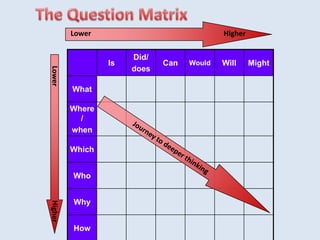
Is
Did/
does
Can Would Will Might
What
Where
/
when
Which
Who
Why
How
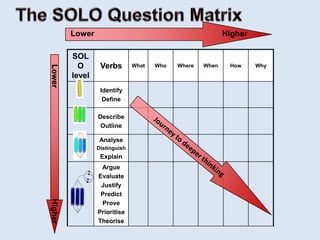
HigherLower
HigherLower
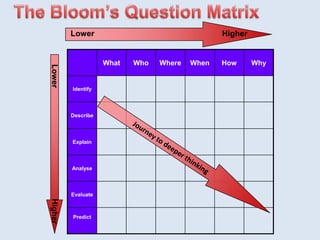
What Who Where When How Why
Identify
Describe
Explain
Analyse
Evaluate
Predict
HigherLower
HigherLower
SOL
O
level
Verbs What Who Where When How Why
Identify
Define
Describe
Outline
Analyse
Distinguish
Explain
Argue
Evaluate
Justify
Predict
Prove
Prioritise
Theorise
HigherLower
HigherLower
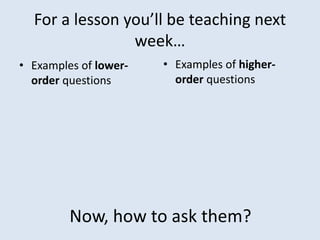
For a lesson you’ll be teaching next
week…
• Examples of lower-
order questions
• Examples of higher-
order questions
Now, how to ask them?
Why is PPPB useful?
• Encourages teachers to take risks and tease
out deeper learning in class.
• Useful for differentiating objectives and
learning experiences by varying our
questioning techniques.
• NO more closed questions in our classrooms.
• No donkeys!
Thinking time…
What do you think of Donkey’s response to
Shrek in the clip?
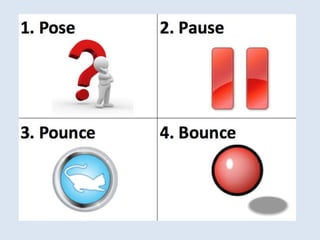
1. POSE
a. Give the context of your PPPB approach to the class. It is
important they know what is happening before it becomes
common-place…
b. Insist on hands down before the question is delivered.
c. Provide a question or a series of questions, ensuring that
you ask the students to remain reflective.
d. Pose the question to the class; not an individual.
e. WAIT…
2. PAUSE...
a. This is the difficult part. To stop talking…
b. Ask the class to hold the thought... think... and think again...
c. If students are captivated and engaged, try holding the
silence for a little while longer (a calculated risk) and...
d. Still push the boundaries. Keep the reflection for as long as
possible….before you,
e. Pounce!
3. POUNCE!
a. Insist that a response to the question comes from student A , directly and as
fast as possible!
b. Of course plan in your mind who you are going to ask, before speaking to the class.
c. Name student A to respond and don't move from the student…
d. Possibly don't speak and nip any comments, grunts or noises in the bud! Its
magic when you can hear, see and feel a captivated learning audience. We've
all seen it.
e. Wait for an answer... pause... decipher the support needed, especially if no
response is evidently on its way. (Of course, at this stage, you can instigate
various strategies for peers to support the questionable student A).
f. If student A does manage to answer, the fun part starts here...
What’s your
question?
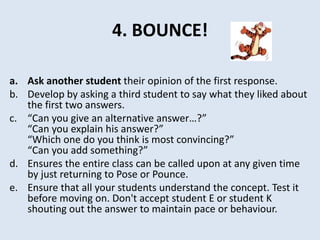
4. BOUNCE!
a. Ask another student their opinion of the first response.
b. Develop by asking a third student to say what they liked about
the first two answers.
c. “Can you give an alternative answer…?”
“Can you explain his answer?”
“Which one do you think is most convincing?”
“Can you add something?”
d. Ensures the entire class can be called upon at any given time
by just returning to Pose or Pounce.
e. Ensure that all your students understand the concept. Test it
before moving on. Don't accept student E or student K
shouting out the answer to maintain pace or behaviour.
PPPB in action
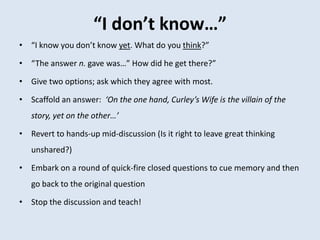
“I don’t know…”
• “I know you don’t know yet. What do you think?”
• “The answer n. gave was…” How did he get there?”
• Give two options; ask which they agree with most.
• Scaffold an answer: ‘On the one hand, Curley’s Wife is the villain of the
story, yet on the other…’
• Revert to hands-up mid-discussion (Is it right to leave great thinking
unshared?)
• Embark on a round of quick-fire closed questions to cue memory and then
go back to the original question
• Stop the discussion and teach!
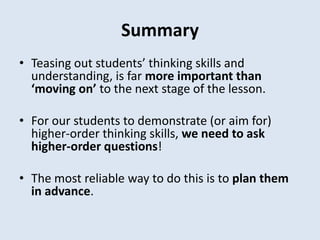
Summary
• Teasing out students’ thinking skills and
understanding, is far more important than
‘moving on’ to the next stage of the lesson.
• For our students to demonstrate (or aim for)
higher-order thinking skills, we need to ask
higher-order questions!
• The most reliable way to do this is to plan them
in advance.

Asking better questions 15.05.14 BH

  • 1.
  • 2.
    Why should youfocus on developing your questioning? • Differentiation without lots of extra effort • A variety of techniques enhances lessons • Creates a culture of participation and enquiry • Encourages students to take risks • Promotes deeper thinking
  • 3.
    Planning Questioning • PlanningWHAT questions to ask • Planning WHO to ask them to • Planning HOW to ask them
  • 4.
    Is Did/ does Can Would WillMight What Where / when Which Who Why How HigherLower HigherLower
  • 5.
    What Who WhereWhen How Why Identify Describe Explain Analyse Evaluate Predict HigherLower HigherLower
  • 6.
    SOL O level Verbs What WhoWhere When How Why Identify Define Describe Outline Analyse Distinguish Explain Argue Evaluate Justify Predict Prove Prioritise Theorise HigherLower HigherLower
  • 7.
    For a lessonyou’ll be teaching next week… • Examples of lower- order questions • Examples of higher- order questions Now, how to ask them?
  • 9.
    Why is PPPBuseful? • Encourages teachers to take risks and tease out deeper learning in class. • Useful for differentiating objectives and learning experiences by varying our questioning techniques. • NO more closed questions in our classrooms. • No donkeys!
  • 11.
    Thinking time… What doyou think of Donkey’s response to Shrek in the clip?
  • 12.
    1. POSE a. Givethe context of your PPPB approach to the class. It is important they know what is happening before it becomes common-place… b. Insist on hands down before the question is delivered. c. Provide a question or a series of questions, ensuring that you ask the students to remain reflective. d. Pose the question to the class; not an individual. e. WAIT…
  • 13.
    2. PAUSE... a. Thisis the difficult part. To stop talking… b. Ask the class to hold the thought... think... and think again... c. If students are captivated and engaged, try holding the silence for a little while longer (a calculated risk) and... d. Still push the boundaries. Keep the reflection for as long as possible….before you, e. Pounce!
  • 14.
    3. POUNCE! a. Insistthat a response to the question comes from student A , directly and as fast as possible! b. Of course plan in your mind who you are going to ask, before speaking to the class. c. Name student A to respond and don't move from the student… d. Possibly don't speak and nip any comments, grunts or noises in the bud! Its magic when you can hear, see and feel a captivated learning audience. We've all seen it. e. Wait for an answer... pause... decipher the support needed, especially if no response is evidently on its way. (Of course, at this stage, you can instigate various strategies for peers to support the questionable student A). f. If student A does manage to answer, the fun part starts here... What’s your question?
  • 15.
    4. BOUNCE! a. Askanother student their opinion of the first response. b. Develop by asking a third student to say what they liked about the first two answers. c. “Can you give an alternative answer…?” “Can you explain his answer?” “Which one do you think is most convincing?” “Can you add something?” d. Ensures the entire class can be called upon at any given time by just returning to Pose or Pounce. e. Ensure that all your students understand the concept. Test it before moving on. Don't accept student E or student K shouting out the answer to maintain pace or behaviour.
  • 16.
  • 17.
    “I don’t know…” •“I know you don’t know yet. What do you think?” • “The answer n. gave was…” How did he get there?” • Give two options; ask which they agree with most. • Scaffold an answer: ‘On the one hand, Curley’s Wife is the villain of the story, yet on the other…’ • Revert to hands-up mid-discussion (Is it right to leave great thinking unshared?) • Embark on a round of quick-fire closed questions to cue memory and then go back to the original question • Stop the discussion and teach!
  • 18.
    Summary • Teasing outstudents’ thinking skills and understanding, is far more important than ‘moving on’ to the next stage of the lesson. • For our students to demonstrate (or aim for) higher-order thinking skills, we need to ask higher-order questions! • The most reliable way to do this is to plan them in advance.