
Shaina Nasir 
Roll no 1028 
Bs(hons) botany (M) 
3rd Smester 
University of Education 
Renala Campus
OIntroduction 
OHistory 
OGene plugin 
ODevelopment 
OUsage 
OFeatures 
OAnalysis 
OConclusion
Introduction 
OCytoscape 
OIt is an open 
source bioinformatics software platform 
for visualizing molecular interaction 
networks and integrating with gene 
expression profiles and other state data. 
OCytoscape also has a JavaScript-centric 
sister project named Cytoscape.js that can 
be used to analyse and visualise graphs in 
JavaScript environments, like a browser.
History 
O Cytoscape was originally created at the Institute of 
Systems Biology in Seattle in 2002. 
O Now, it is developed by an international consortium of 
open source developers. 
O Cytoscape was initially made public in July, 2002 
(v0.8); the second release (v0.9) was in November, 
2002 and v1.0 was released in March 2003. 
O Version 1.1.1 is the last stable release for the 1.0 series. 
Version 2.0 was initially released in 2004; Cytoscape 
2.83, the final 2.xx version, was released in May 2012. 
Version 3.0 was released Feb. 1st, 2013, and the latest 
version, 3.0.2, was released in August 2013.
Gene plugin 
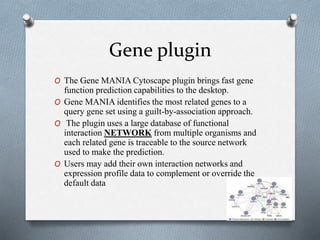
O The Gene MANIA Cytoscape plugin brings fast gene 
function prediction capabilities to the desktop. 
O Gene MANIA identifies the most related genes to a 
query gene set using a guilt-by-association approach. 
O The plugin uses a large database of functional 
interaction NETWORK from multiple organisms and 
each related gene is traceable to the source network 
used to make the prediction. 
O Users may add their own interaction networks and 
expression profile data to complement or override the 
default data
Development 
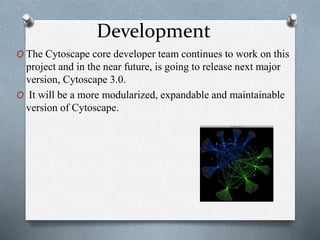
O The Cytoscape core developer team continues to work on this 
project and in the near future, is going to release next major 
version, Cytoscape 3.0. 
O It will be a more modularized, expandable and maintainable 
version of Cytoscape.
Usage 
• While Cytoscape is most commonly used for 
biological research applications, it is agnostic in 
terms of usage. 
• Cytoscape can be used to visualize and analyze 
network graphs of any kind involving nodes and 
edges (e.g., social networks). 
• A key aspect of the software architecture of 
Cytoscape is the use of plugins for specialized 
features. Plugins are developed by core developers 
and the greater user community.
Features 
O Load and save previous constructed interaction neworks 
in GML format. 
O Load and save networks and node attributesn in XML 
document format called XGMML. 
O Input mRNA expression profiles from tab- or space-delimited 
text files. 
O Load and save arbitrary attributes on nodes and edges. 
For example, input a set of custom annotation terms for 
your proteins, create a set of confidence values for your 
protein-protein interactions. 
O Import gene functional annotations from the Gene 
Ontology (GO) and KEGG databases. 
O Directly import GO Terms and annotations from OBO 
and Gene Association files
Analysis 
O Plugins available for network and molecular profile 
analysis. 
For example: 
O Filter the network to select subsets of nodes based on 
the current data. For instance, users may select nodes 
involved in a threshold number of interactions, nodes 
that share a particular GO annotation, or nodes whose 
gene expression levels change significantly in one or 
more conditions according to p-values loaded with the 
gene expression data.
Find active sub networks modules. The 
network is screened against gene expression 
data to identify connected sets of interactions, 
i.e. interaction sub networks, whose genes 
show particularly high levels of differential 
expression. 
The interactions contained in each sub 
network provide hypotheses for the regulatory 
and signaling interactions in control of the 
observed expression changes.
OCytoscape is an important software to 
visualise graphs in Java script like a 
browser and molecuar interaction 
OIt also has an importance in the usage of 
biological research sciences. 
OInshort it help in the analysis of node 
and edges in th network.

CytoScape

  • 1.
    Shaina Nasir Rollno 1028 Bs(hons) botany (M) 3rd Smester University of Education Renala Campus
  • 2.
    OIntroduction OHistory OGeneplugin ODevelopment OUsage OFeatures OAnalysis OConclusion
  • 3.
    Introduction OCytoscape OItis an open source bioinformatics software platform for visualizing molecular interaction networks and integrating with gene expression profiles and other state data. OCytoscape also has a JavaScript-centric sister project named Cytoscape.js that can be used to analyse and visualise graphs in JavaScript environments, like a browser.
  • 4.
    History O Cytoscapewas originally created at the Institute of Systems Biology in Seattle in 2002. O Now, it is developed by an international consortium of open source developers. O Cytoscape was initially made public in July, 2002 (v0.8); the second release (v0.9) was in November, 2002 and v1.0 was released in March 2003. O Version 1.1.1 is the last stable release for the 1.0 series. Version 2.0 was initially released in 2004; Cytoscape 2.83, the final 2.xx version, was released in May 2012. Version 3.0 was released Feb. 1st, 2013, and the latest version, 3.0.2, was released in August 2013.
  • 5.
    Gene plugin OThe Gene MANIA Cytoscape plugin brings fast gene function prediction capabilities to the desktop. O Gene MANIA identifies the most related genes to a query gene set using a guilt-by-association approach. O The plugin uses a large database of functional interaction NETWORK from multiple organisms and each related gene is traceable to the source network used to make the prediction. O Users may add their own interaction networks and expression profile data to complement or override the default data
  • 6.
    Development O TheCytoscape core developer team continues to work on this project and in the near future, is going to release next major version, Cytoscape 3.0. O It will be a more modularized, expandable and maintainable version of Cytoscape.
  • 7.
    Usage • WhileCytoscape is most commonly used for biological research applications, it is agnostic in terms of usage. • Cytoscape can be used to visualize and analyze network graphs of any kind involving nodes and edges (e.g., social networks). • A key aspect of the software architecture of Cytoscape is the use of plugins for specialized features. Plugins are developed by core developers and the greater user community.
  • 8.
    Features O Loadand save previous constructed interaction neworks in GML format. O Load and save networks and node attributesn in XML document format called XGMML. O Input mRNA expression profiles from tab- or space-delimited text files. O Load and save arbitrary attributes on nodes and edges. For example, input a set of custom annotation terms for your proteins, create a set of confidence values for your protein-protein interactions. O Import gene functional annotations from the Gene Ontology (GO) and KEGG databases. O Directly import GO Terms and annotations from OBO and Gene Association files
  • 9.
    Analysis O Pluginsavailable for network and molecular profile analysis. For example: O Filter the network to select subsets of nodes based on the current data. For instance, users may select nodes involved in a threshold number of interactions, nodes that share a particular GO annotation, or nodes whose gene expression levels change significantly in one or more conditions according to p-values loaded with the gene expression data.
  • 10.
    Find active subnetworks modules. The network is screened against gene expression data to identify connected sets of interactions, i.e. interaction sub networks, whose genes show particularly high levels of differential expression. The interactions contained in each sub network provide hypotheses for the regulatory and signaling interactions in control of the observed expression changes.
  • 11.
    OCytoscape is animportant software to visualise graphs in Java script like a browser and molecuar interaction OIt also has an importance in the usage of biological research sciences. OInshort it help in the analysis of node and edges in th network.