PowerPoint®
Lecture Slide Presentation
by Patty Bostwick-Taylor,
Florence-Darlington Technical College
Copyright © 2009 Pearson Education, Inc., publishing as Benjamin Cummings
PART B
6
The Muscular
System
Copyright © 2009 Pearson Education, Inc., publishing as Benjamin Cummings
The Nerve Stimulus and Action Potential
 Skeletal muscles must be stimulated by a motor
neuron (nerve cell) to contract
 Motor unit—one motor neuron and all the skeletal
muscle cells stimulated by that neuron
Copyright © 2009 Pearson Education, Inc., publishing as Benjamin Cummings
The Nerve Stimulus and Action Potential
 Neuromuscular junction
 Association site of axon terminal of the motor
neuron and muscle
Copyright © 2009 Pearson Education, Inc., publishing as Benjamin Cummings
The Nerve Stimulus and Action Potential
Figure 6.5a
Copyright © 2009 Pearson Education, Inc., publishing as Benjamin Cummings
The Nerve Stimulus and Action Potential
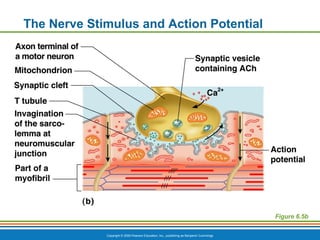
 Synaptic cleft
 Gap between nerve and muscle
 Nerve and muscle do not make contact
 Area between nerve and muscle is filled with
interstitial fluid
Copyright © 2009 Pearson Education, Inc., publishing as Benjamin Cummings
The Nerve Stimulus and Action Potential
Figure 6.5b
Copyright © 2009 Pearson Education, Inc., publishing as Benjamin Cummings
Transmission of Nerve Impulse to Muscle
 Neurotransmitter—chemical released by nerve
upon arrival of nerve impulse
 The neurotransmitter for skeletal muscle is
acetylcholine (ACh)
 Acetylcholine attaches to receptors on the
sarcolemma
 Sarcolemma becomes permeable to sodium (Na+)
Copyright © 2009 Pearson Education, Inc., publishing as Benjamin Cummings
Transmission of Nerve Impulse to Muscle
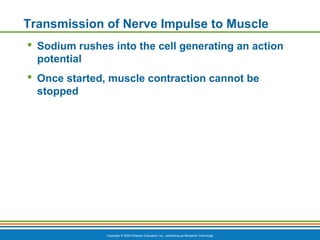
 Sodium rushes into the cell generating an action
potential
 Once started, muscle contraction cannot be
stopped
Copyright © 2009 Pearson Education, Inc., publishing as Benjamin Cummings
The Sliding Filament Theory
of Muscle Contraction
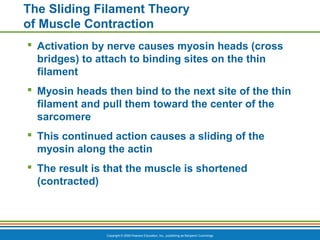
 Activation by nerve causes myosin heads (cross
bridges) to attach to binding sites on the thin
filament
 Myosin heads then bind to the next site of the thin
filament and pull them toward the center of the
sarcomere
 This continued action causes a sliding of the
myosin along the actin
 The result is that the muscle is shortened
(contracted)
Copyright © 2009 Pearson Education, Inc., publishing as Benjamin Cummings
The Sliding Filament Theory
of Muscle Contraction
Figure 6.7a–b
Copyright © 2009 Pearson Education, Inc., publishing as Benjamin Cummings
Effect of Exercise on Muscles
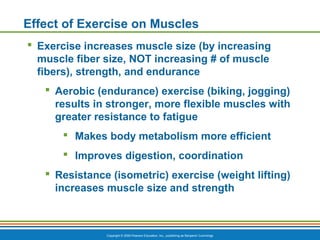
 Exercise increases muscle size (by increasing
muscle fiber size, NOT increasing # of muscle
fibers), strength, and endurance
 Aerobic (endurance) exercise (biking, jogging)
results in stronger, more flexible muscles with
greater resistance to fatigue
 Makes body metabolism more efficient
 Improves digestion, coordination
 Resistance (isometric) exercise (weight lifting)
increases muscle size and strength
Copyright © 2009 Pearson Education, Inc., publishing as Benjamin Cummings
Effect of Exercise on Muscles
Figure 6.11

CVA A&P - Chapter 6b: Muscle Contraction

  • 1.
    PowerPoint® Lecture Slide Presentation byPatty Bostwick-Taylor, Florence-Darlington Technical College Copyright © 2009 Pearson Education, Inc., publishing as Benjamin Cummings PART B 6 The Muscular System
  • 2.
    Copyright © 2009Pearson Education, Inc., publishing as Benjamin Cummings The Nerve Stimulus and Action Potential  Skeletal muscles must be stimulated by a motor neuron (nerve cell) to contract  Motor unit—one motor neuron and all the skeletal muscle cells stimulated by that neuron
  • 3.
    Copyright © 2009Pearson Education, Inc., publishing as Benjamin Cummings The Nerve Stimulus and Action Potential  Neuromuscular junction  Association site of axon terminal of the motor neuron and muscle
  • 4.
    Copyright © 2009Pearson Education, Inc., publishing as Benjamin Cummings The Nerve Stimulus and Action Potential Figure 6.5a
  • 5.
    Copyright © 2009Pearson Education, Inc., publishing as Benjamin Cummings The Nerve Stimulus and Action Potential  Synaptic cleft  Gap between nerve and muscle  Nerve and muscle do not make contact  Area between nerve and muscle is filled with interstitial fluid
  • 6.
    Copyright © 2009Pearson Education, Inc., publishing as Benjamin Cummings The Nerve Stimulus and Action Potential Figure 6.5b
  • 7.
    Copyright © 2009Pearson Education, Inc., publishing as Benjamin Cummings Transmission of Nerve Impulse to Muscle  Neurotransmitter—chemical released by nerve upon arrival of nerve impulse  The neurotransmitter for skeletal muscle is acetylcholine (ACh)  Acetylcholine attaches to receptors on the sarcolemma  Sarcolemma becomes permeable to sodium (Na+)
  • 8.
    Copyright © 2009Pearson Education, Inc., publishing as Benjamin Cummings Transmission of Nerve Impulse to Muscle  Sodium rushes into the cell generating an action potential  Once started, muscle contraction cannot be stopped
  • 9.
    Copyright © 2009Pearson Education, Inc., publishing as Benjamin Cummings The Sliding Filament Theory of Muscle Contraction  Activation by nerve causes myosin heads (cross bridges) to attach to binding sites on the thin filament  Myosin heads then bind to the next site of the thin filament and pull them toward the center of the sarcomere  This continued action causes a sliding of the myosin along the actin  The result is that the muscle is shortened (contracted)
  • 10.
    Copyright © 2009Pearson Education, Inc., publishing as Benjamin Cummings The Sliding Filament Theory of Muscle Contraction Figure 6.7a–b
  • 11.
    Copyright © 2009Pearson Education, Inc., publishing as Benjamin Cummings Effect of Exercise on Muscles  Exercise increases muscle size (by increasing muscle fiber size, NOT increasing # of muscle fibers), strength, and endurance  Aerobic (endurance) exercise (biking, jogging) results in stronger, more flexible muscles with greater resistance to fatigue  Makes body metabolism more efficient  Improves digestion, coordination  Resistance (isometric) exercise (weight lifting) increases muscle size and strength
  • 12.
    Copyright © 2009Pearson Education, Inc., publishing as Benjamin Cummings Effect of Exercise on Muscles Figure 6.11