Geologic Processes
and Hazards
GEOLOGY
- the study of the Earth and its history.
It involves studying the materials that
make up the earth, the features and
structures found on Earth, as well as the
processes that act upon them. It also deals
with the study of the history of all life
living on the earth now.
GEOLOGIC HAZARDS are extremely natural event that
are naturally occuring events in the crust of the Earth
that poses threat to life and property.
-earthquakes, volcanic eruptions, tsunami or
tidal waves, and landslides.
GEOLOGICAL PROCESSES are naturally occuring events
that directly or indirectly impact the geology of the
Earth.
-Plate tectonics, weathering, earthquakes,
volcanic eruptions, mountain formation, deposition,
erosion, drought, flooding, landslide.
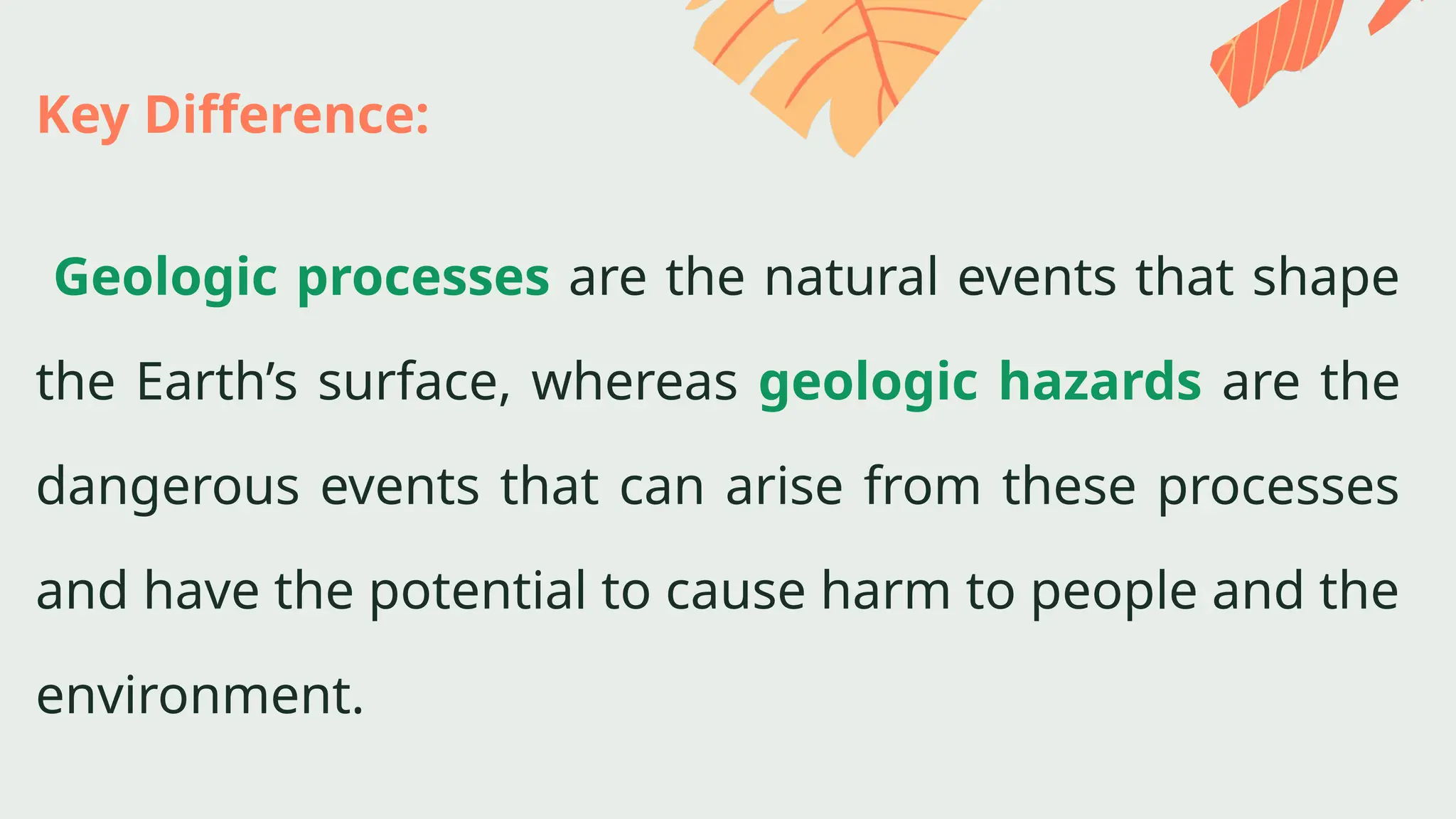
Key Difference:
Geologic processes are the natural events that shape
the Earth’s surface, whereas geologic hazards are the
dangerous events that can arise from these processes
and have the potential to cause harm to people and the
environment.
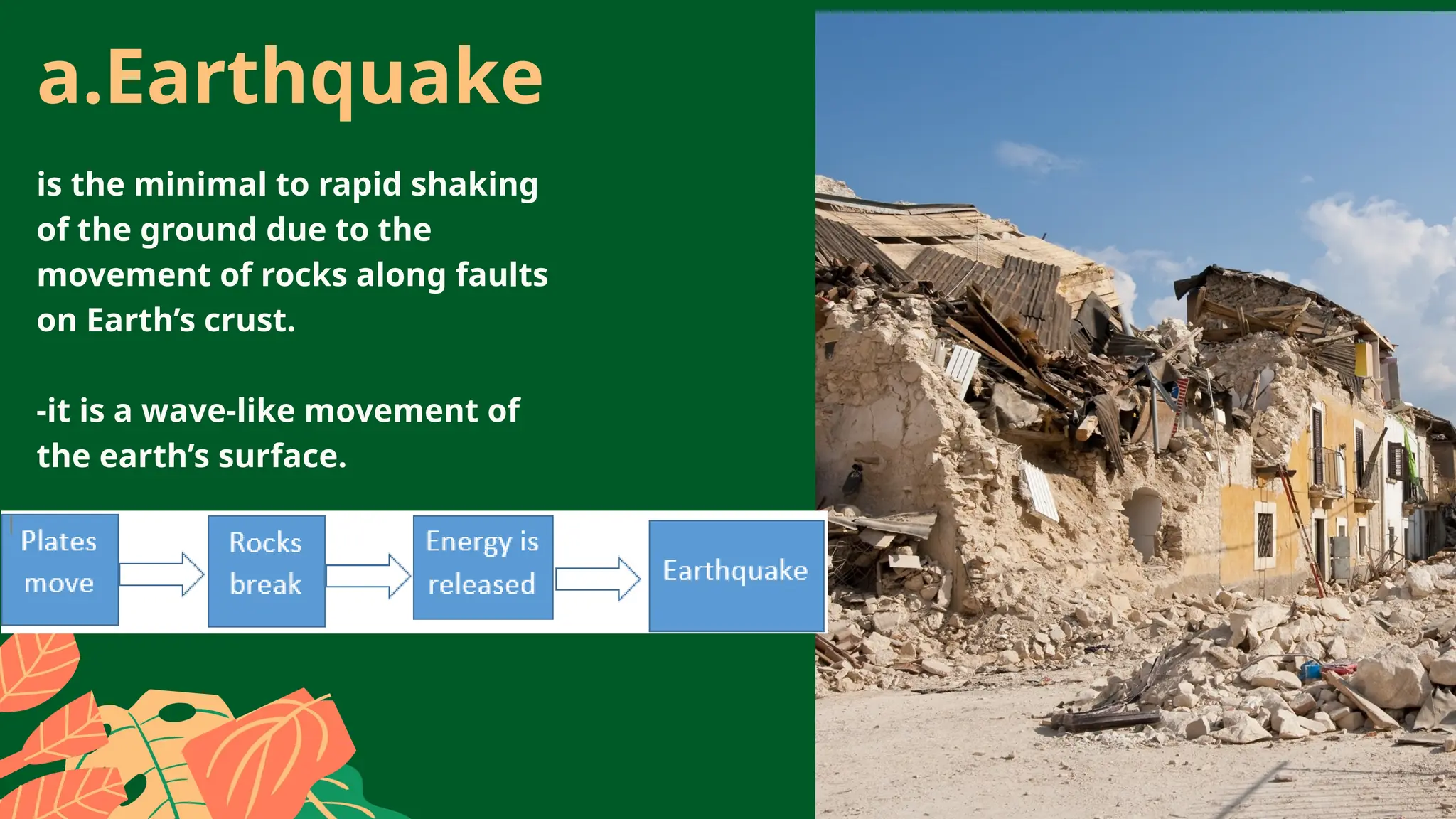
is the minimal to rapid shaking
of the ground due to the
movement of rocks along faults
on Earth’s crust.
-it is a wave-like movement of
the earth’s surface.
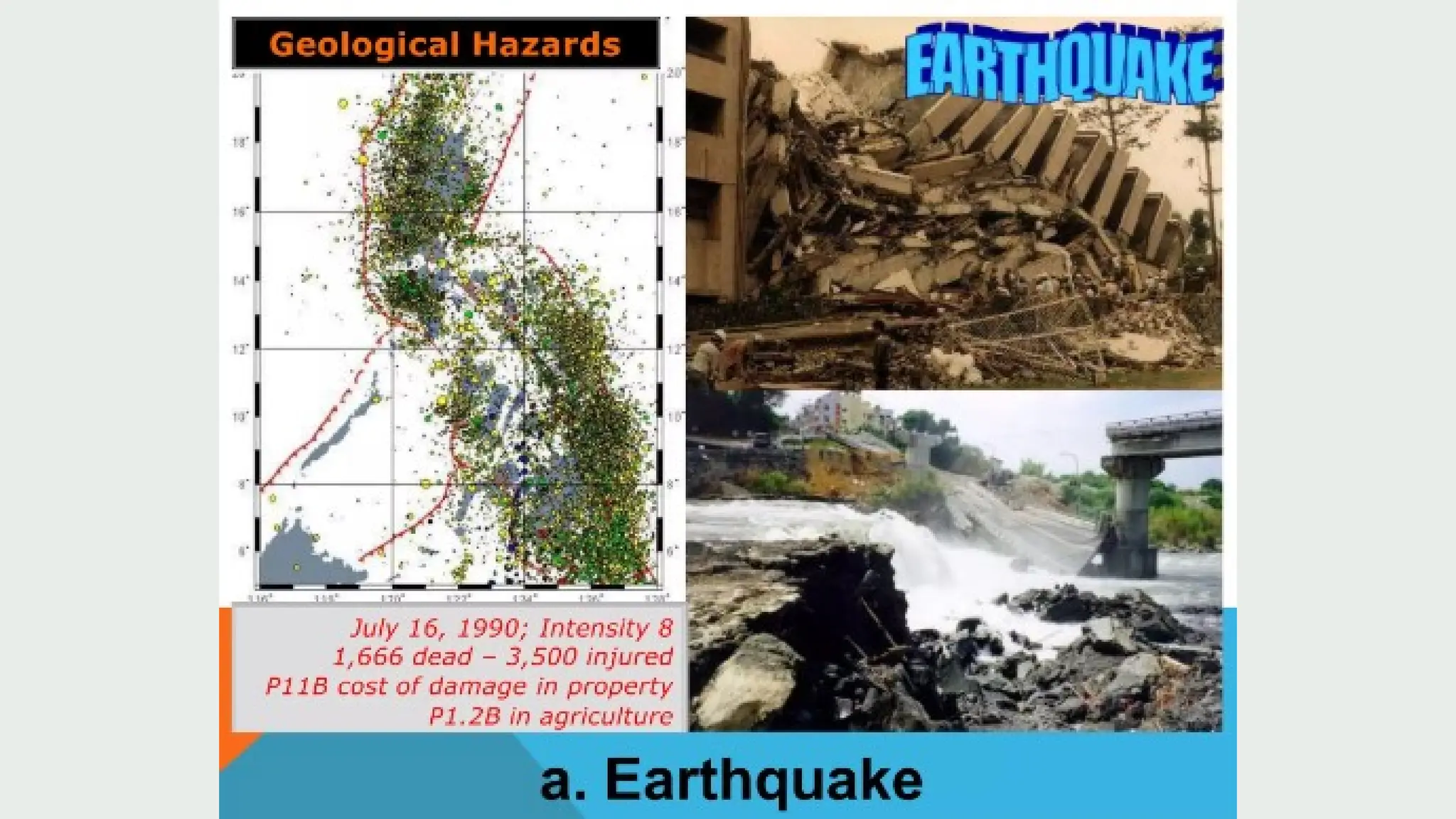
a.Earthquake
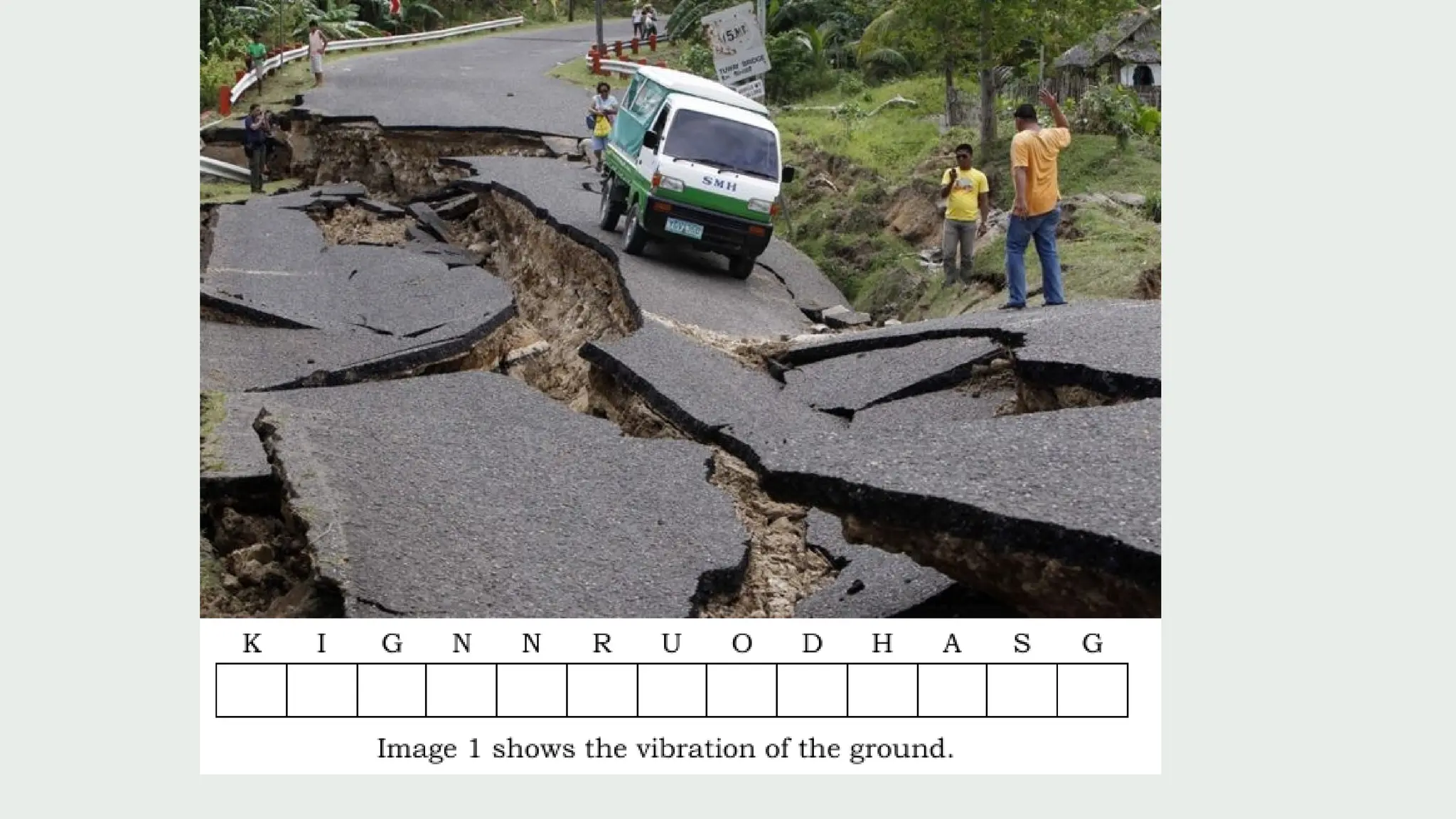
A. Ground Shaking- vibration of the ground during
earthquake. Most obvious hazard earthquake cause.
B. Surface Faulting- displacement that reaches the
-breaking of the ground
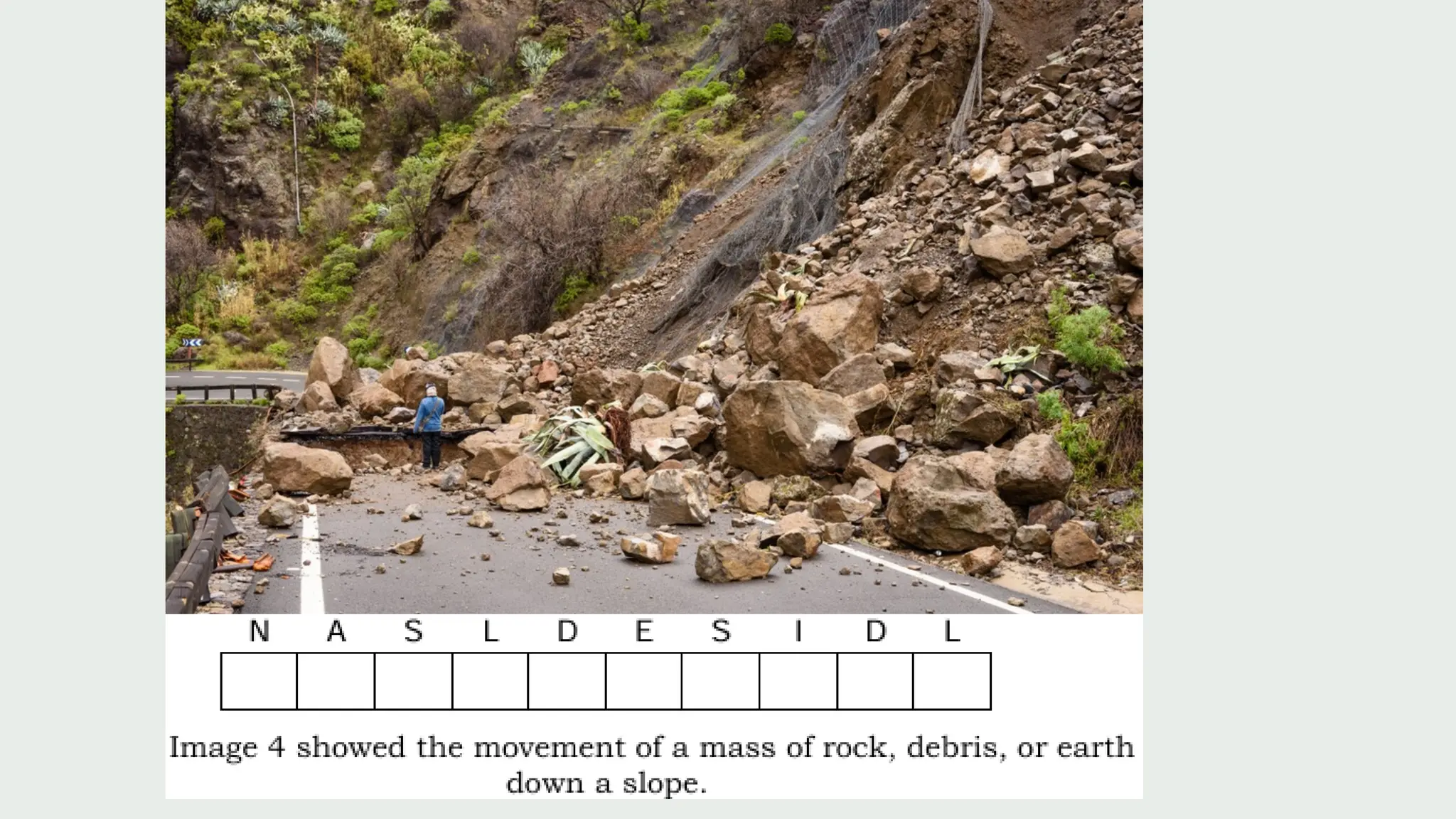
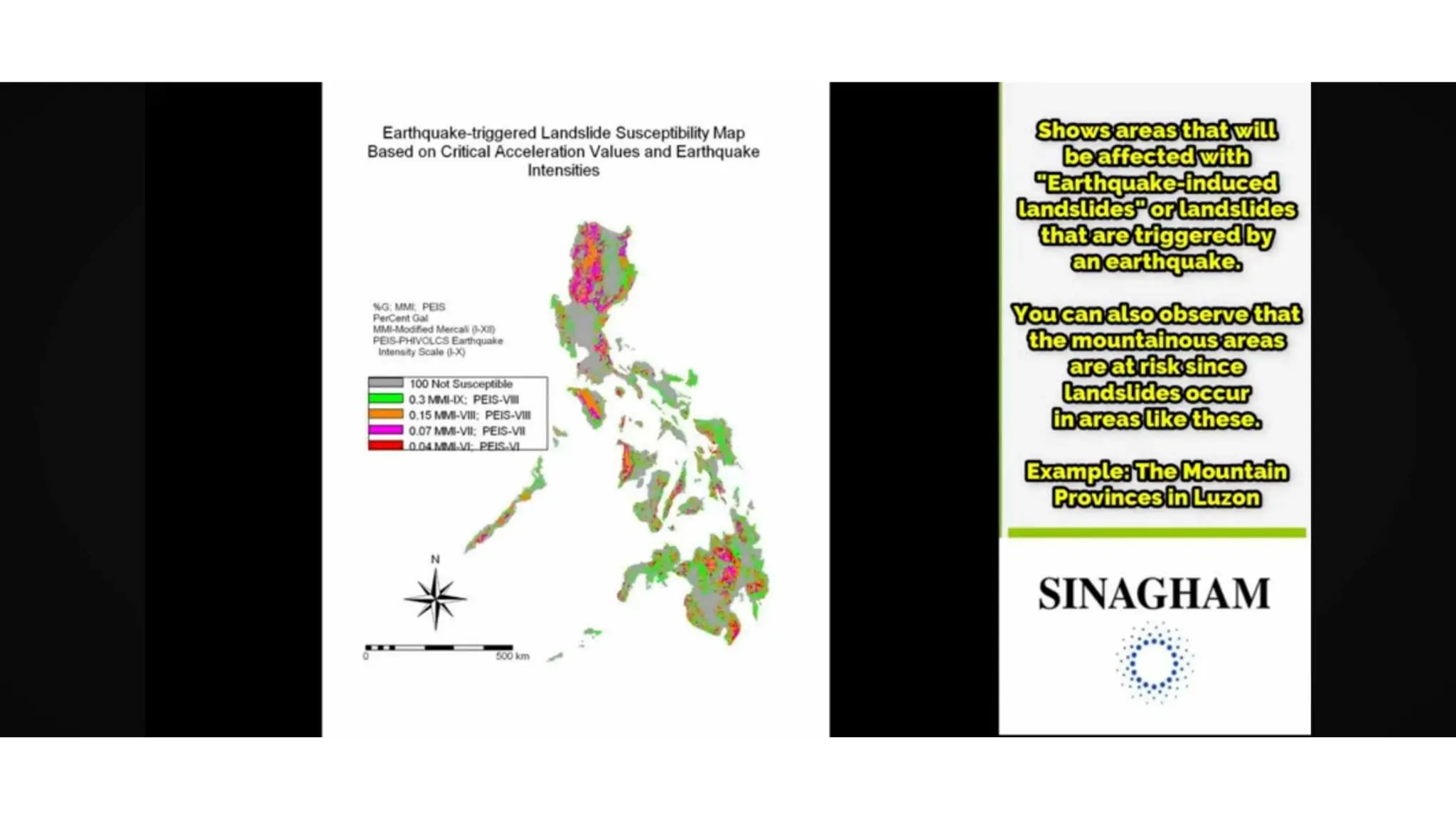
C. Landslide-movement of a mass of rock, debris, or earth
down a slope. downward movement of the soil
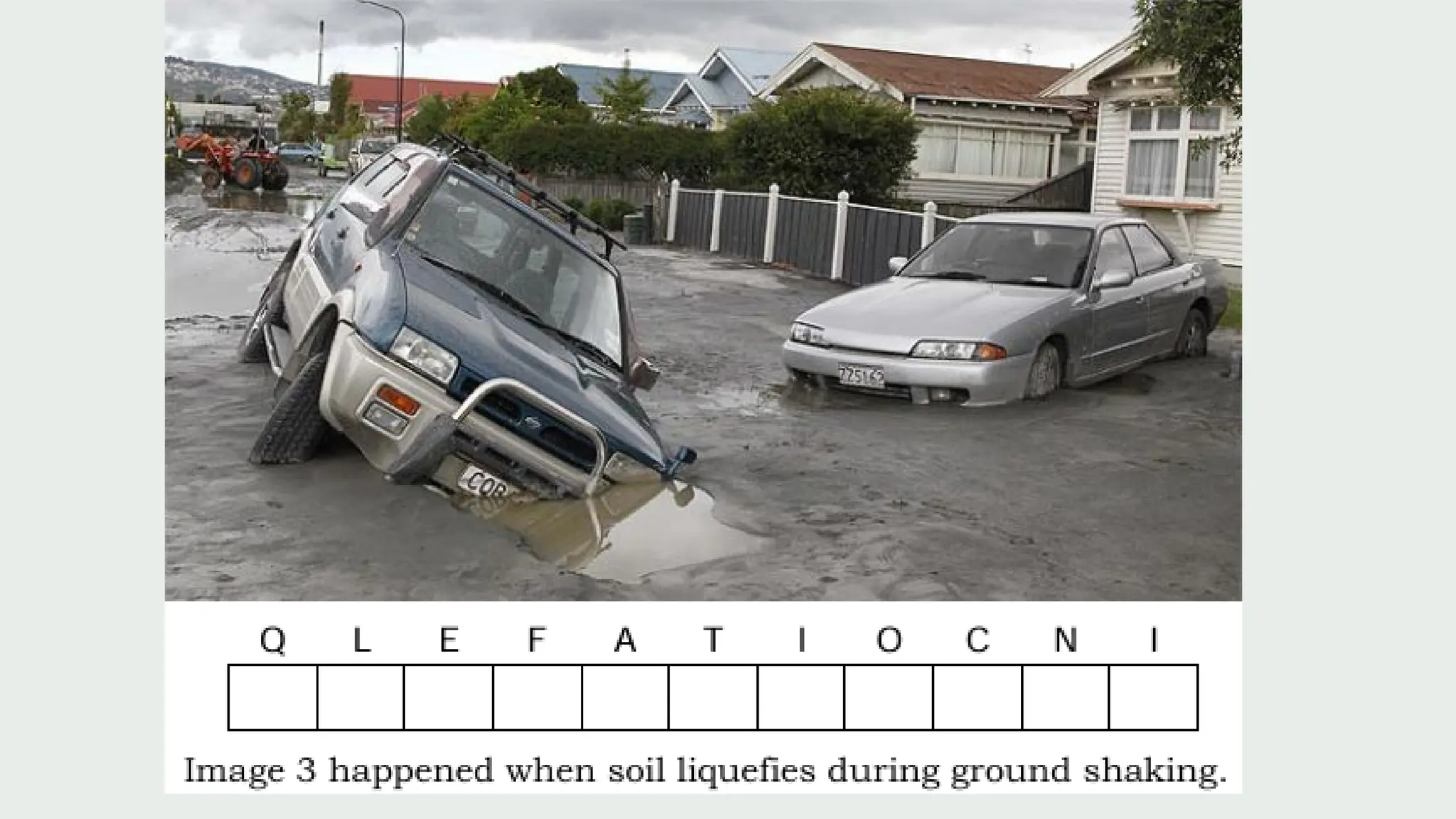
D. Liquefaction- saturation of soil with water
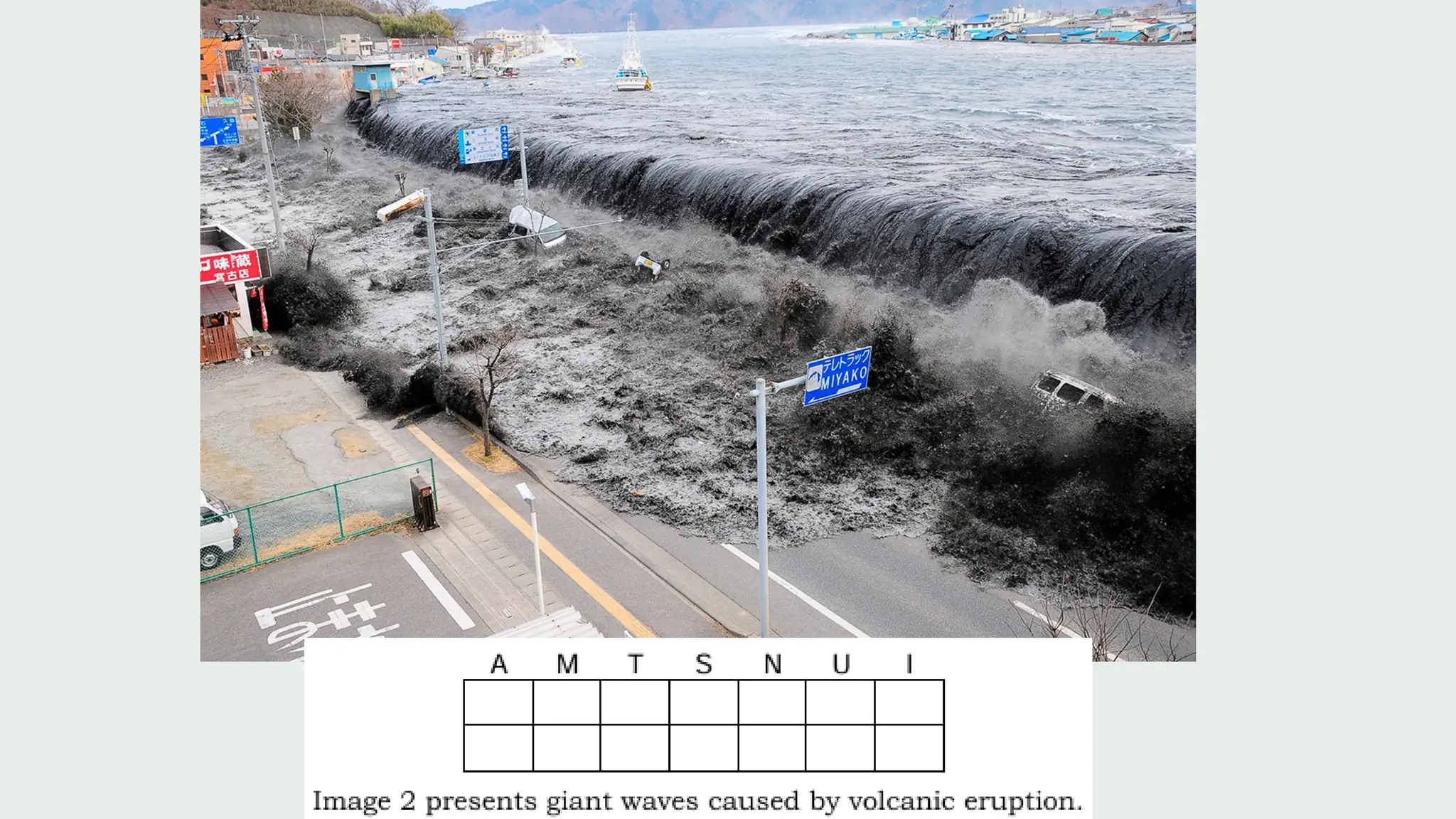
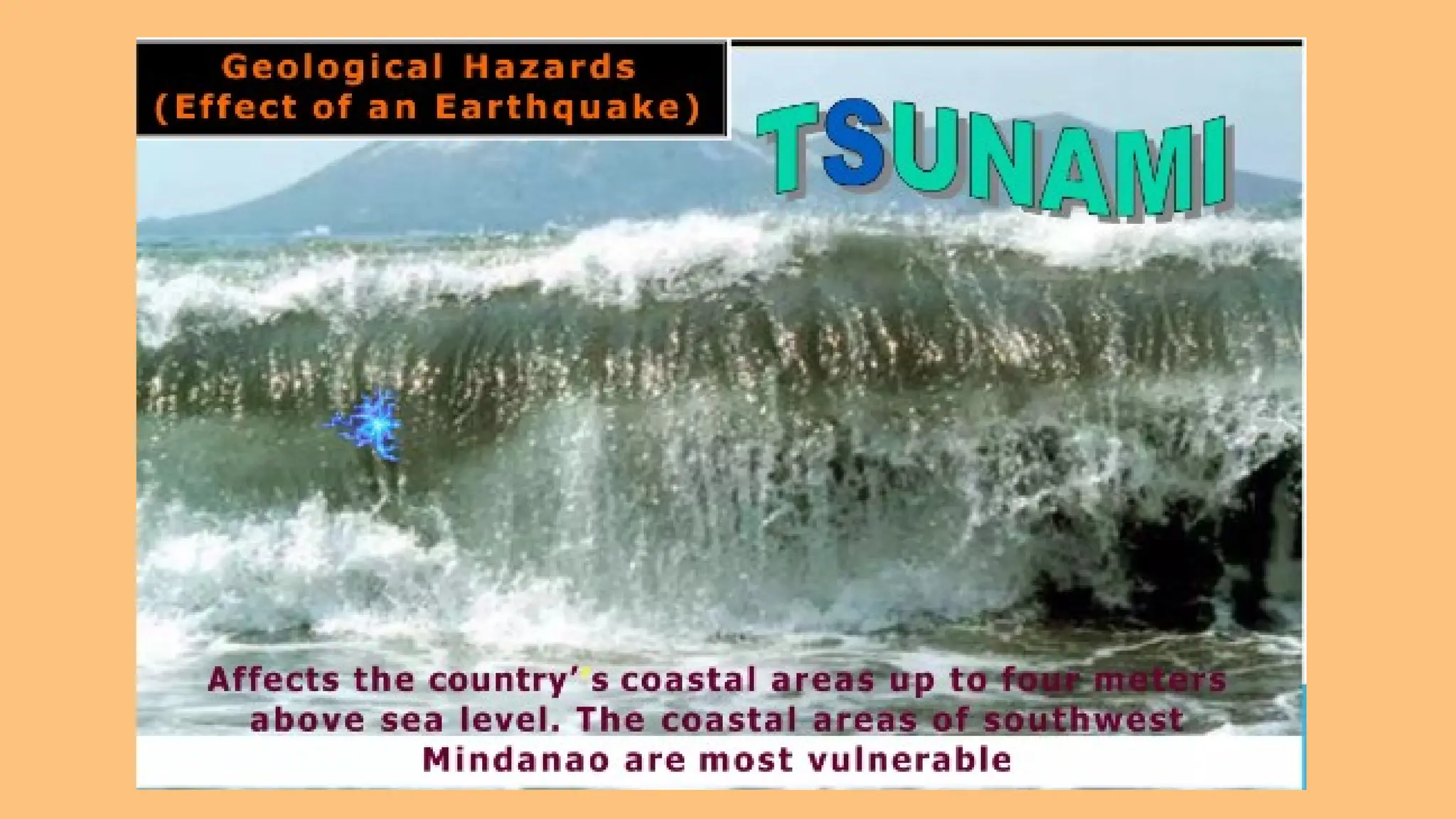
E. Tsunamis-when shaking happens on the seafloor
Earthquake Hazards
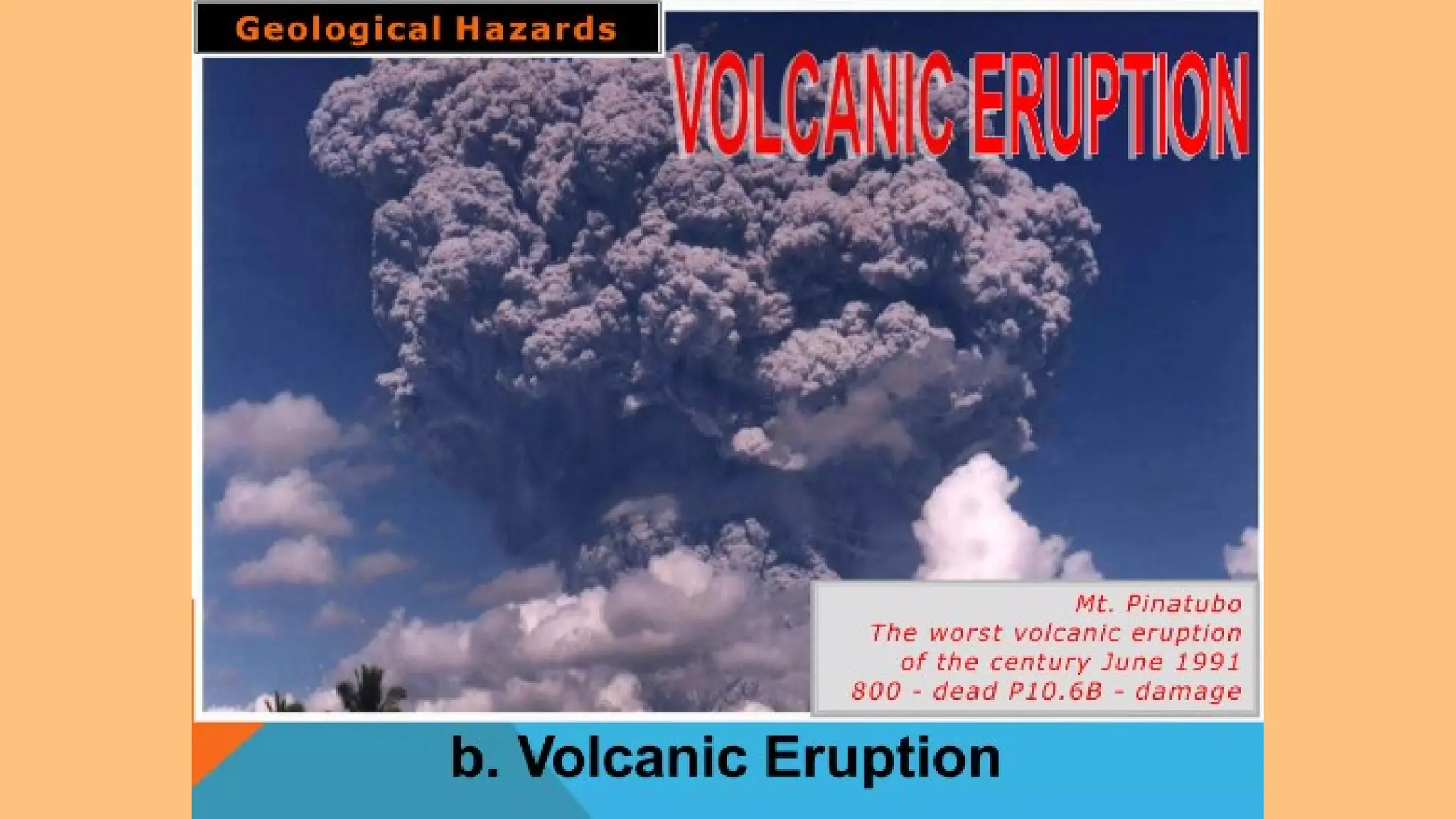
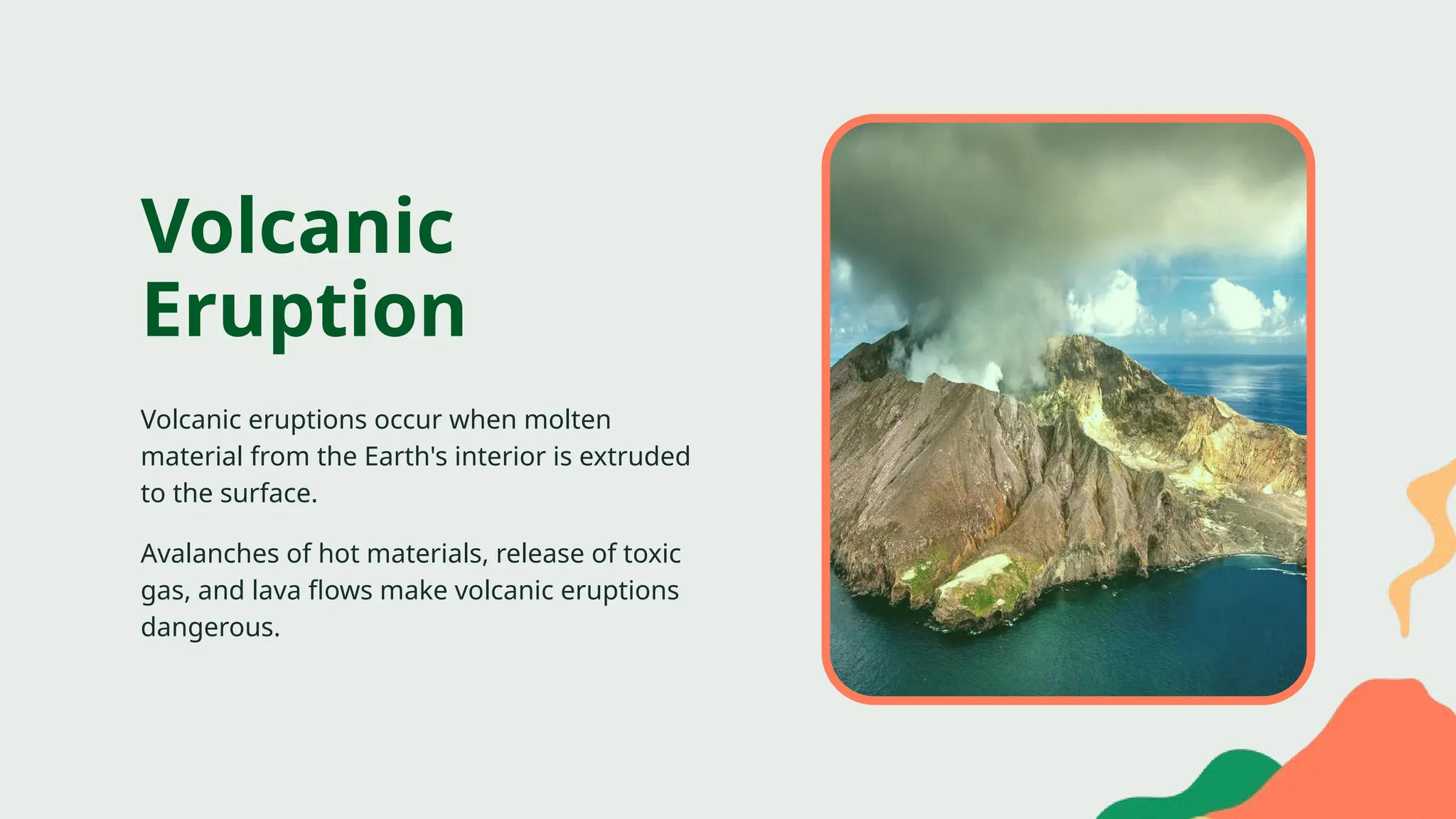
Volcanic eruptions occur when molten
material from the Earth's interior is extruded
to the surface.
Volcanic
Eruption
Avalanches of hot materials, release of toxic
gas, and lava flows make volcanic eruptions
dangerous.
Volcanic Hazards
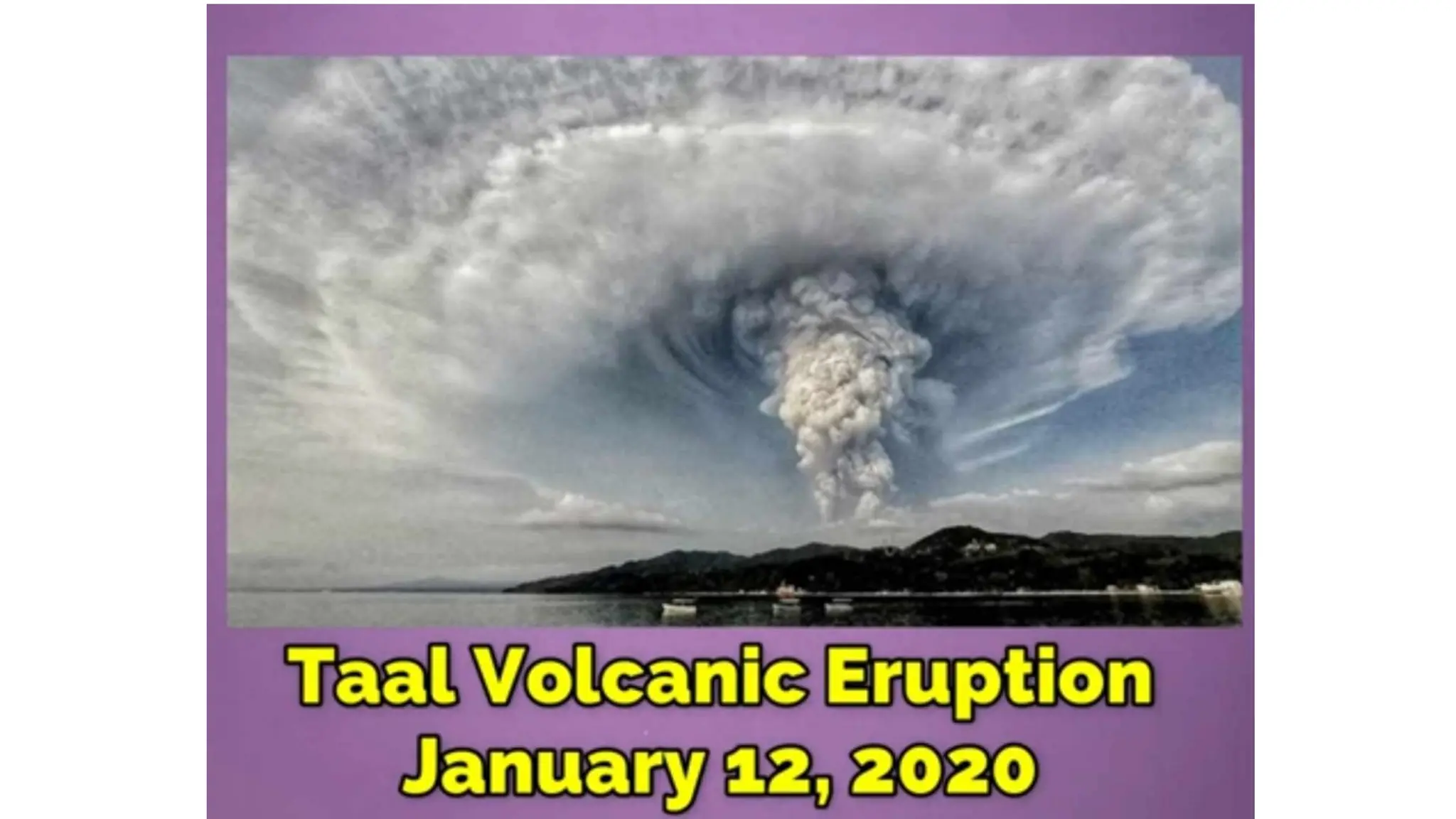
Volcanic Eruption occurs
when magma is released
from a volcano
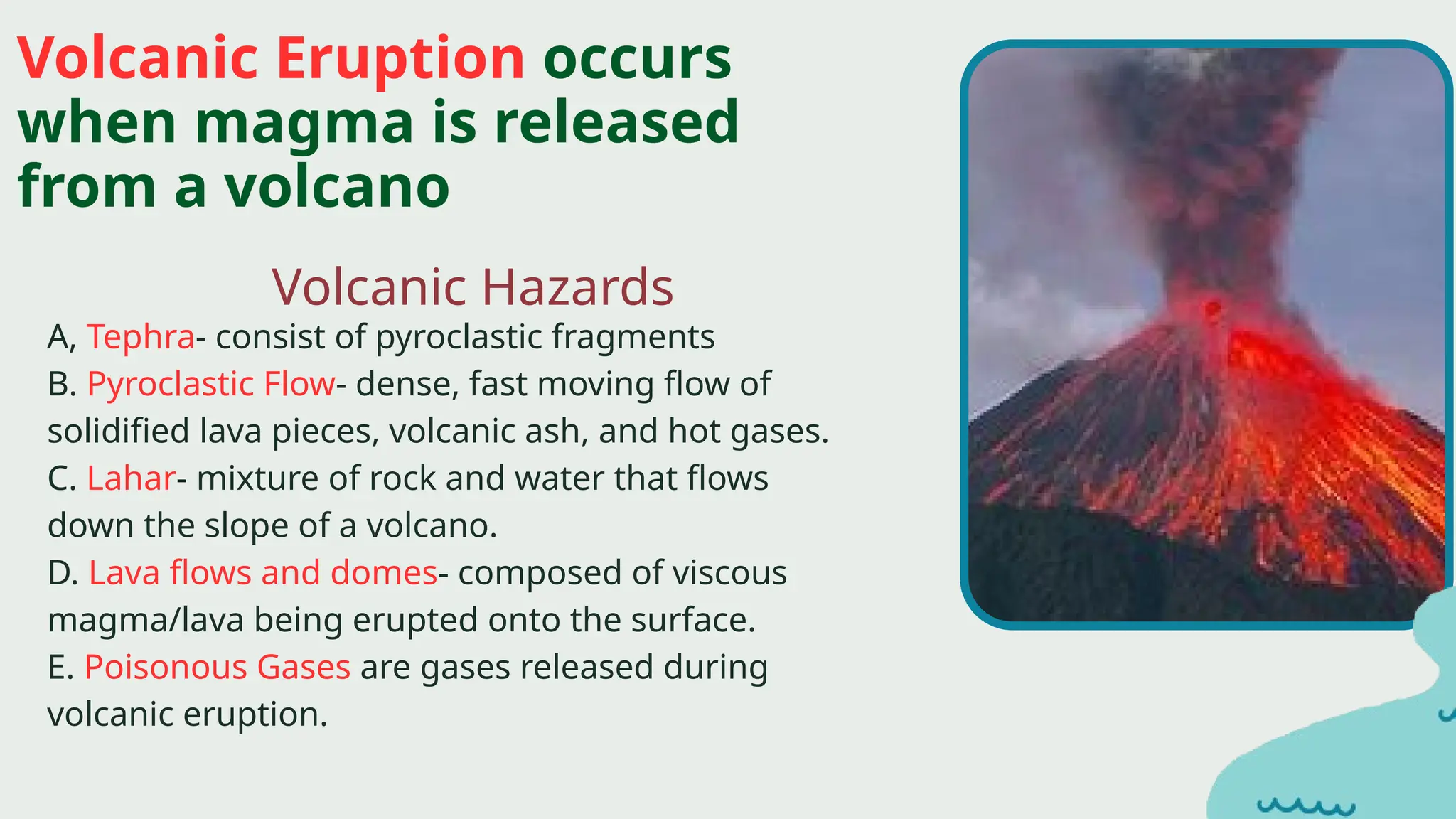
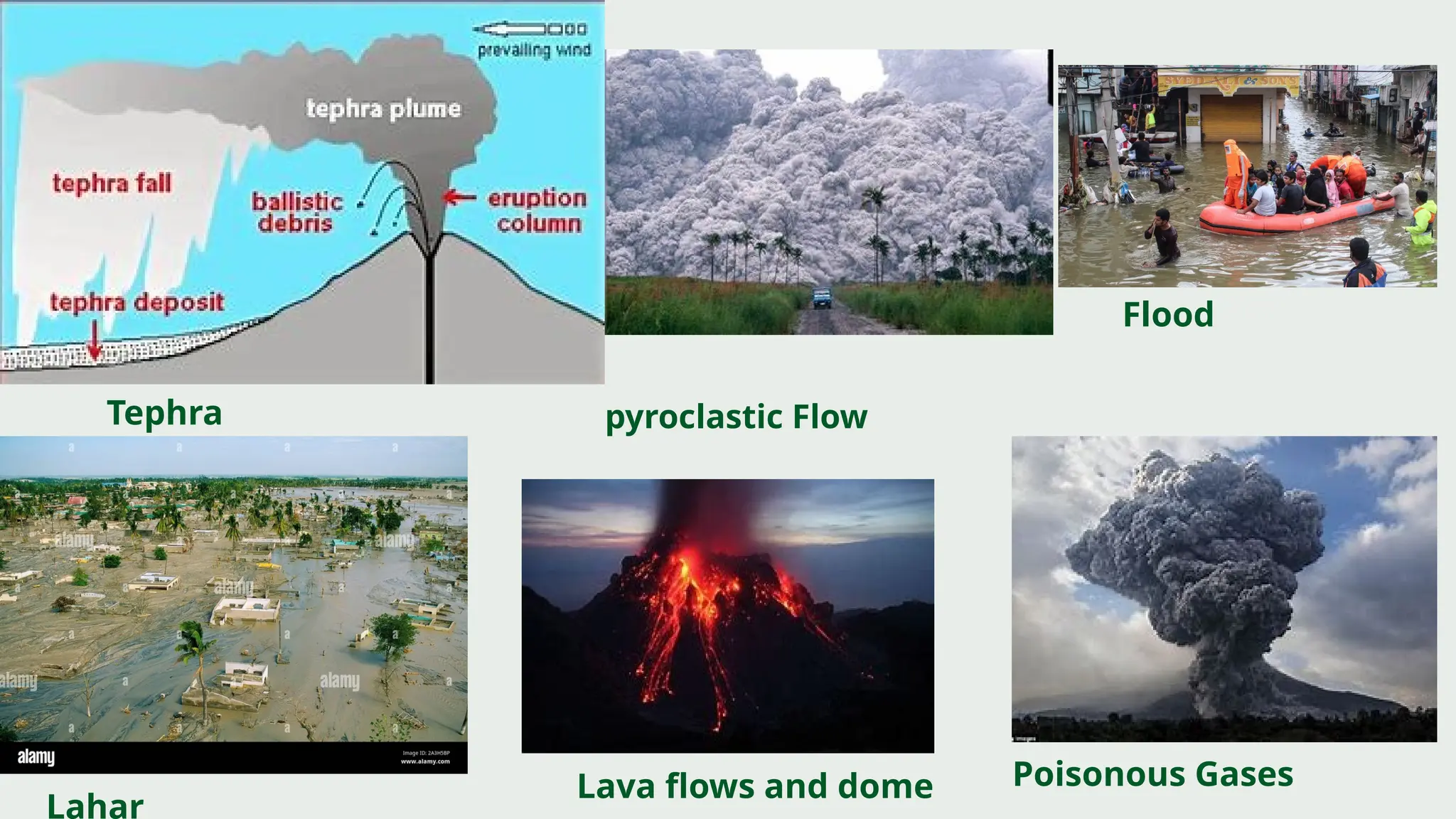
A, Tephra- consist of pyroclastic fragments
B. Pyroclastic Flow- dense, fast moving flow of
solidified lava pieces, volcanic ash, and hot gases.
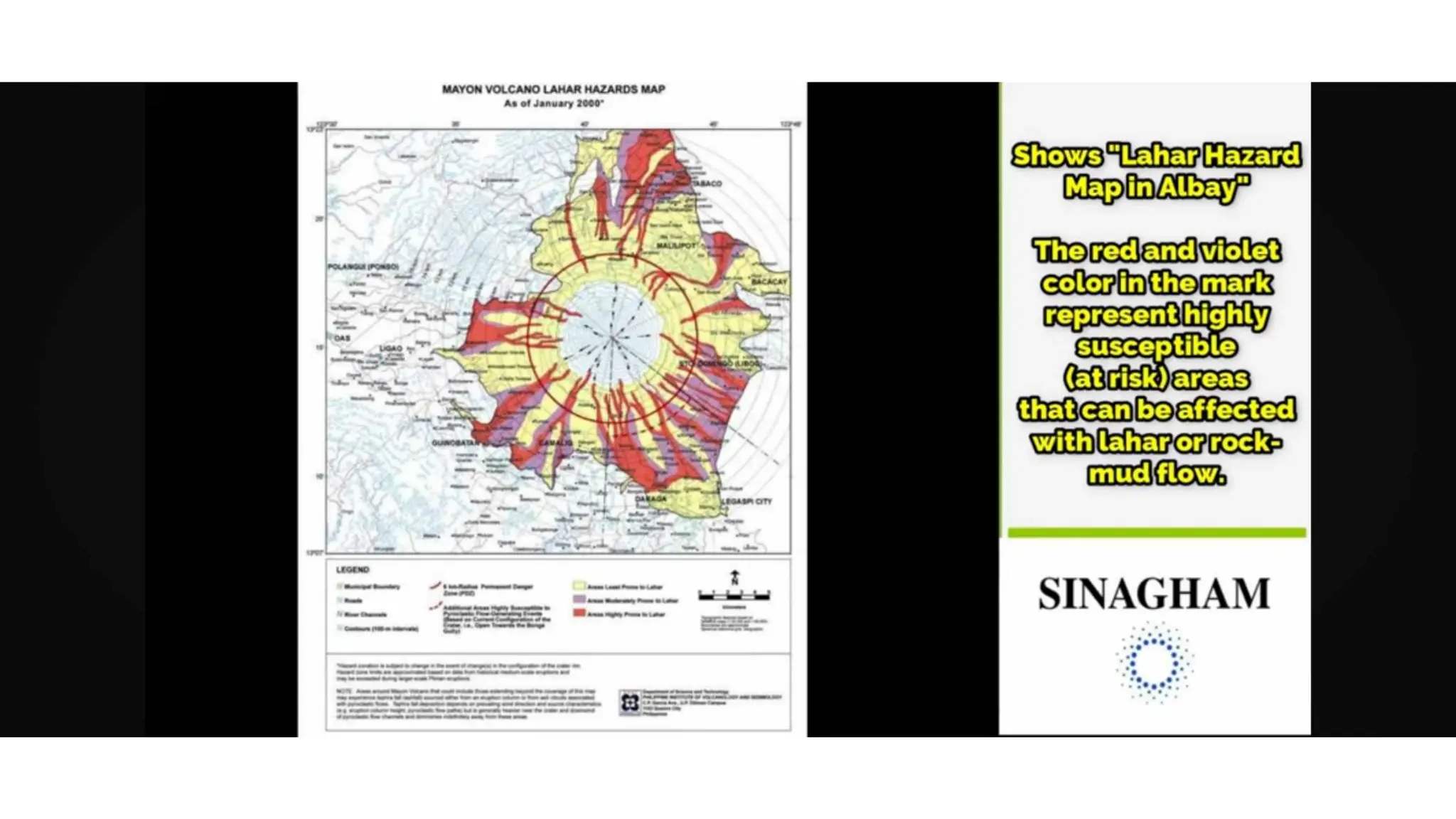
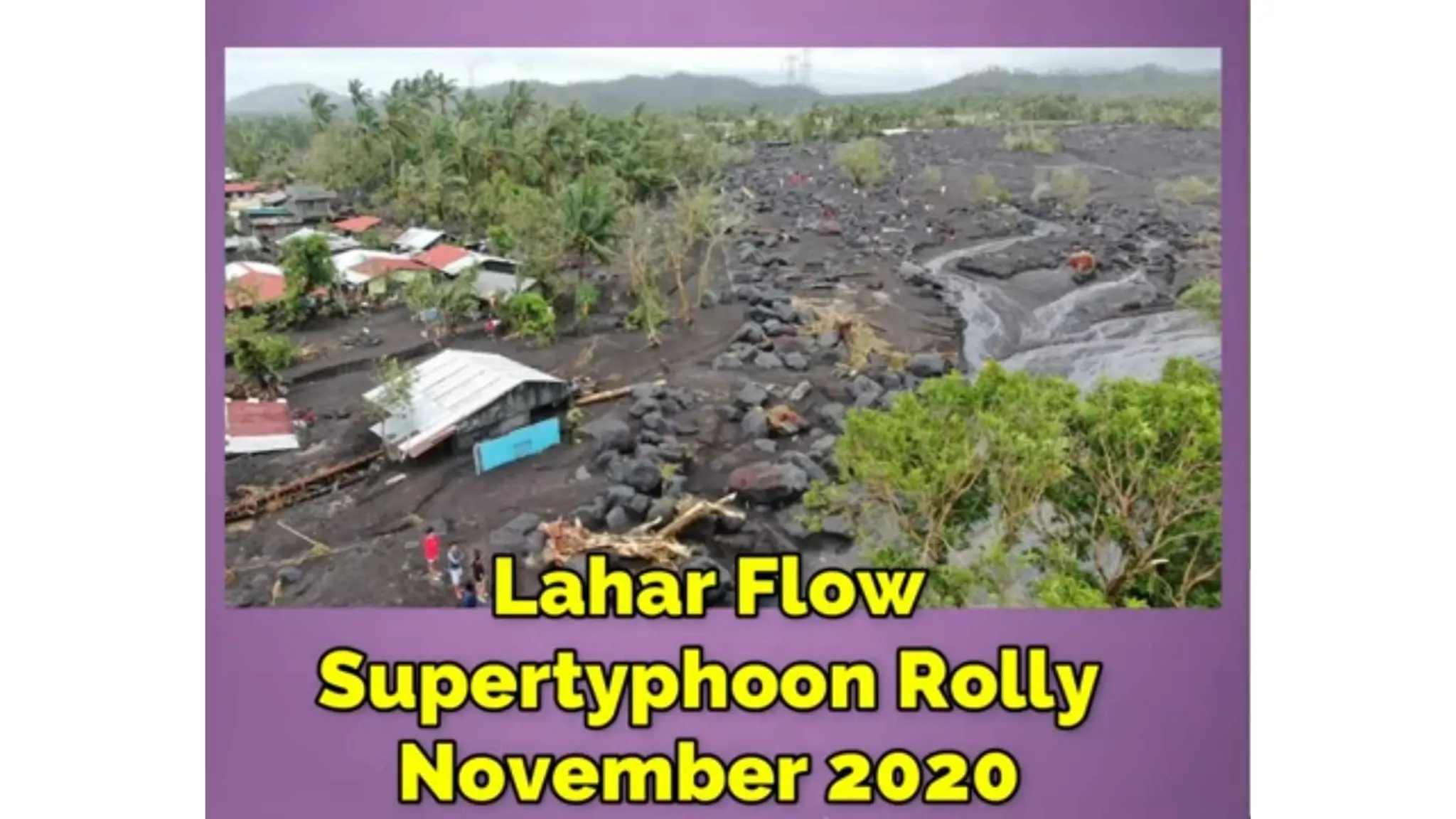
C. Lahar- mixture of rock and water that flows
down the slope of a volcano.
D. Lava flows and domes- composed of viscous
magma/lava being erupted onto the surface.
E. Poisonous Gases are gases released during
volcanic eruption.
Tephra pyroclastic Flow
Poisonous Gases
Lahar
Lava flows and dome
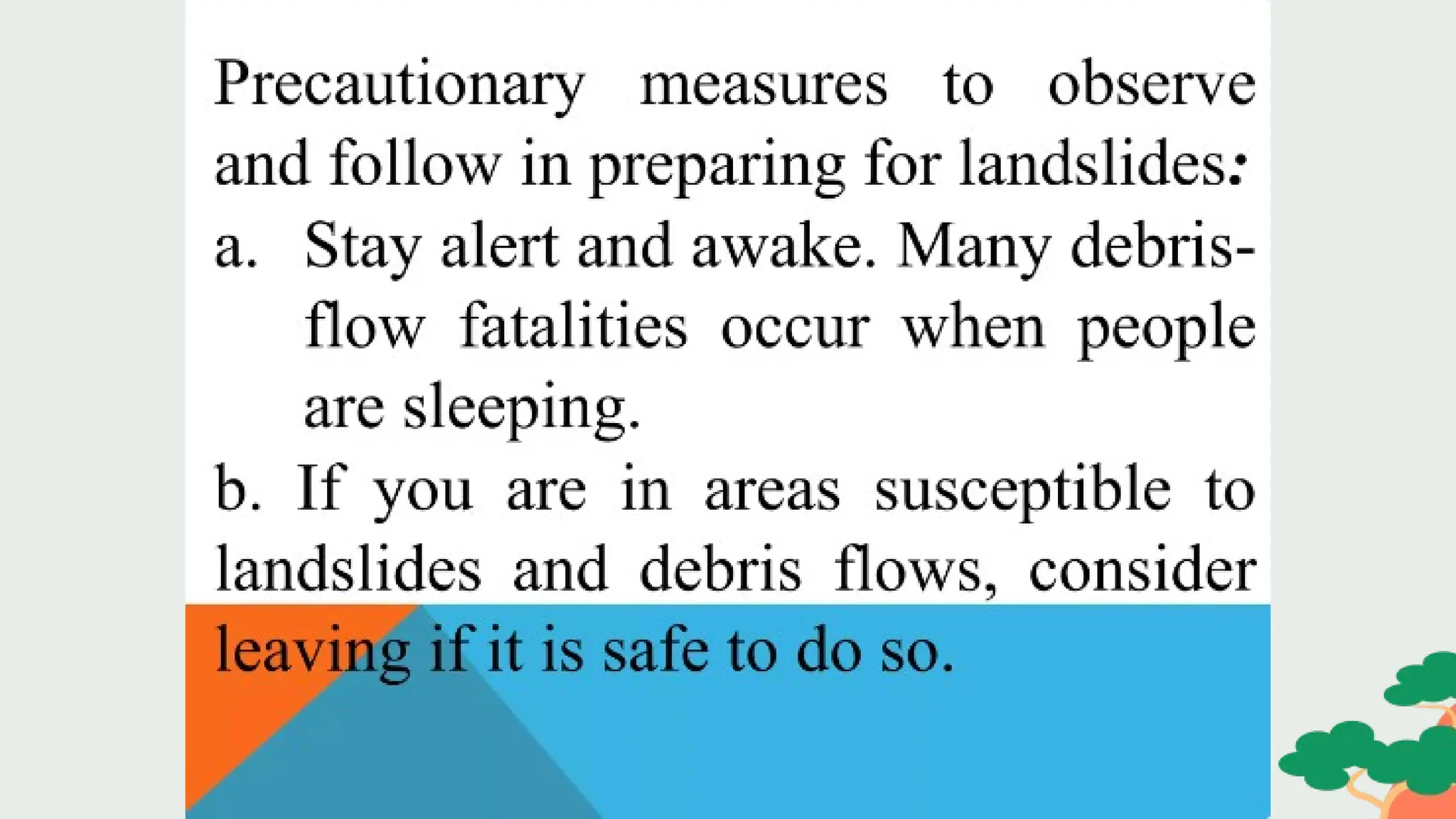
Flood
Hazards
are phenomena (natural or
man-made) which poses threat
to humans, animals, properties
and environment
• Natural
• Earthquakes
• Volcanic eruptions
• Landslides
• Tsunamis
• Climate/Weather hazards
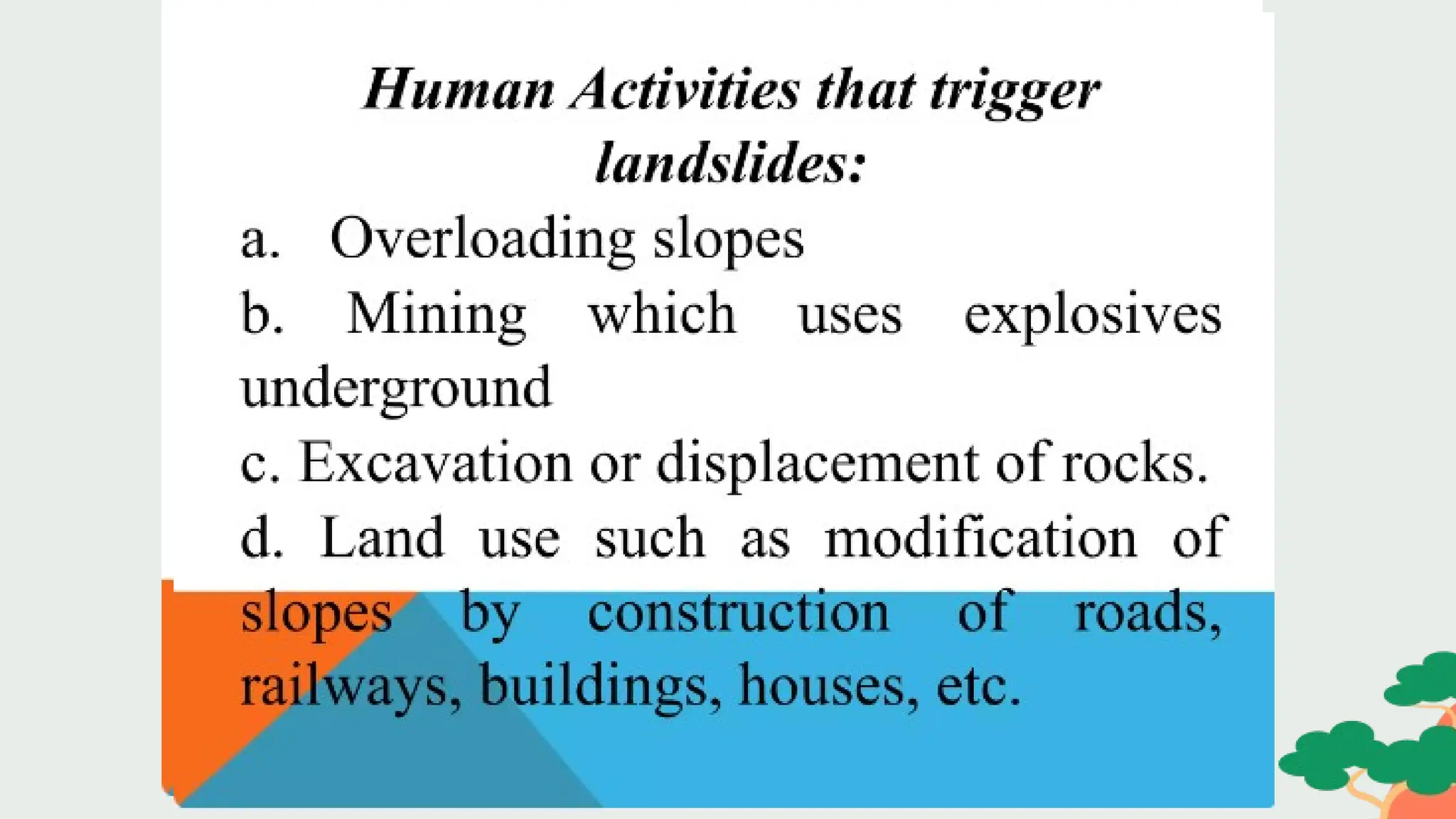
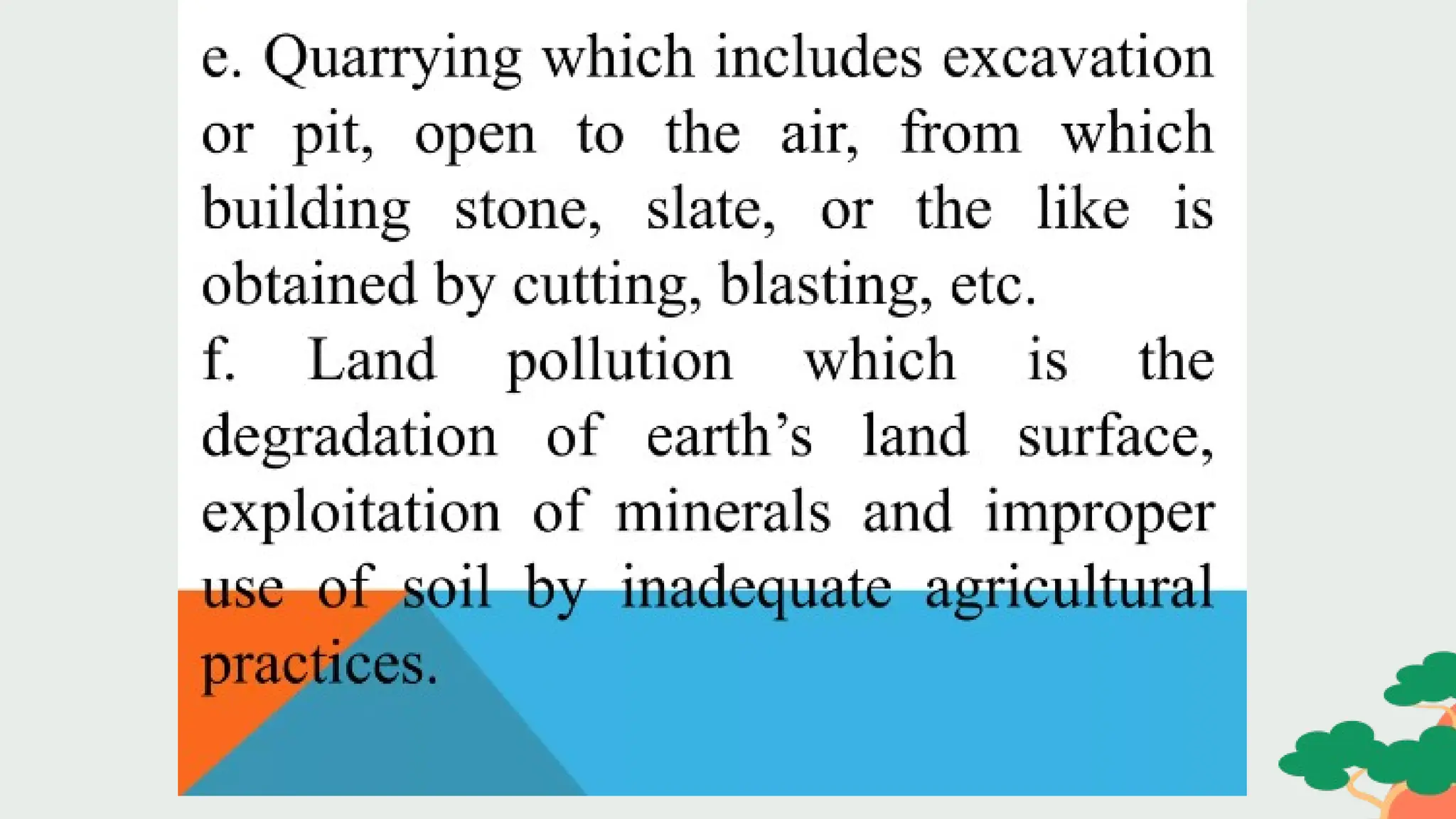
Anthropogenic
• Deforestation
• Mining
• Landslides
Classification of
Hazards
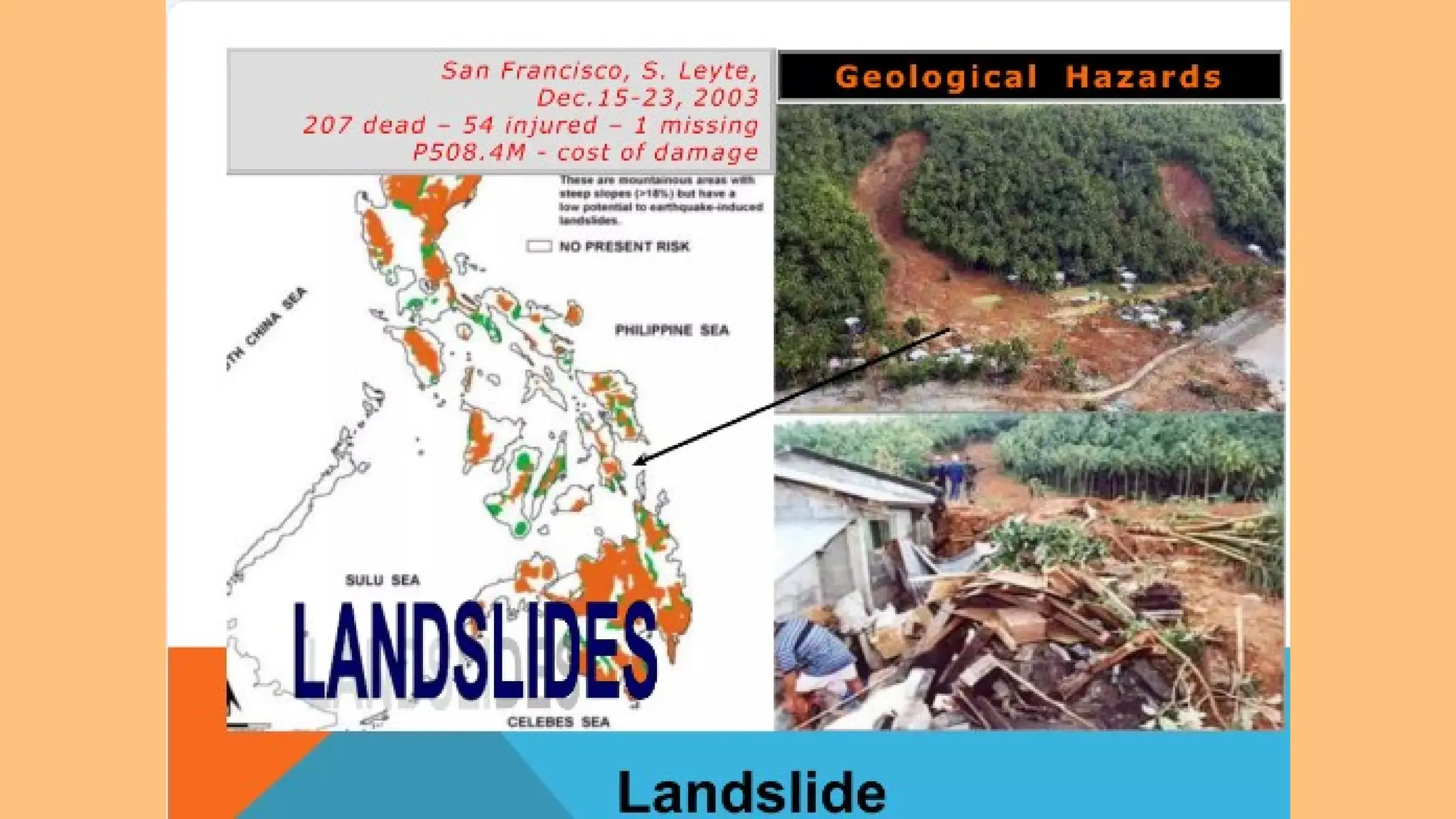
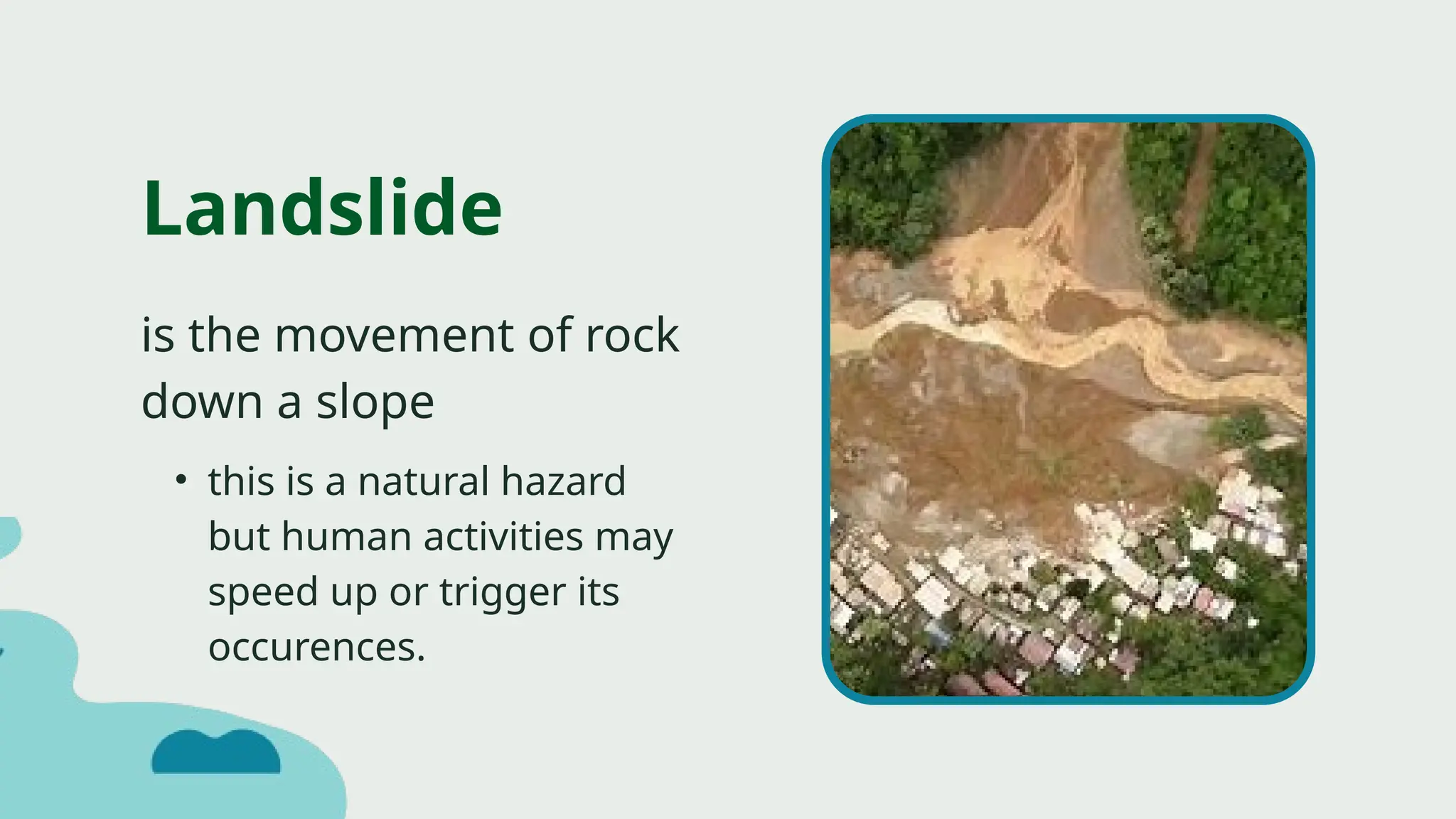
is the movement of rock
down a slope
Landslide
• this is a natural hazard
but human activities may
speed up or trigger its
occurences.
• property damage, injury & death
• Affects- water supplies, fisheries, sewage
disposal systems, forests, dams roadways
• Negative Economic Effects- cost to repair
structures, loss of property value, disruption
of transpo routes, medical cost, indirect cost
(lost of timber and lost of fish stock)
Effects of Landslides
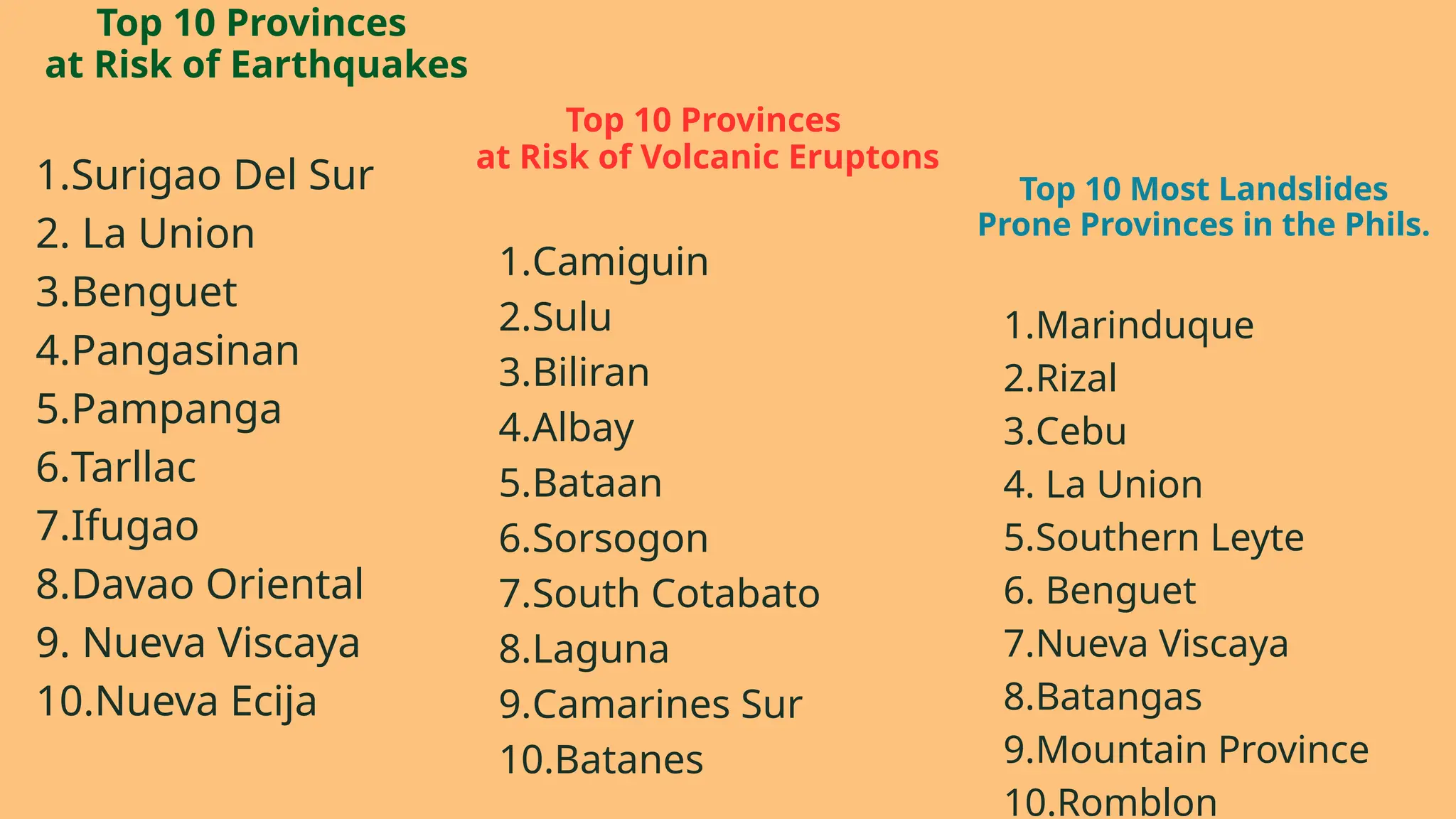
1.Surigao Del Sur
2. La Union
3.Benguet
4.Pangasinan
5.Pampanga
6.Tarllac
7.Ifugao
8.Davao Oriental
9. Nueva Viscaya
10.Nueva Ecija
Top 10 Provinces
at Risk of Earthquakes
1.Camiguin
2.Sulu
3.Biliran
4.Albay
5.Bataan
6.Sorsogon
7.South Cotabato
8.Laguna
9.Camarines Sur
10.Batanes
Top 10 Provinces
at Risk of Volcanic Eruptons
1.Marinduque
2.Rizal
3.Cebu
4. La Union
5.Southern Leyte
6. Benguet
7.Nueva Viscaya
8.Batangas
9.Mountain Province
10.Romblon
Top 10 Most Landslides
Prone Provinces in the Phils.
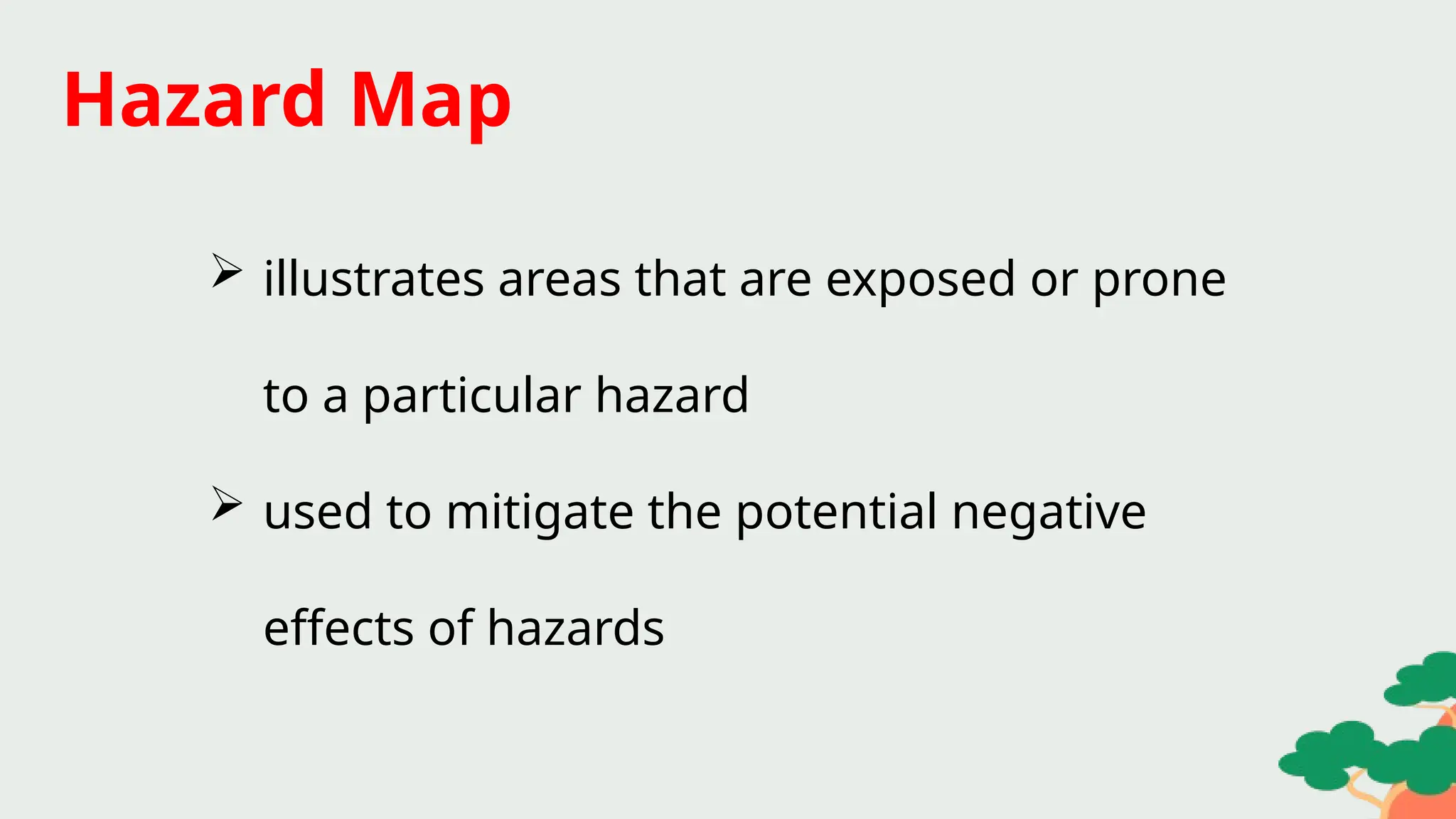
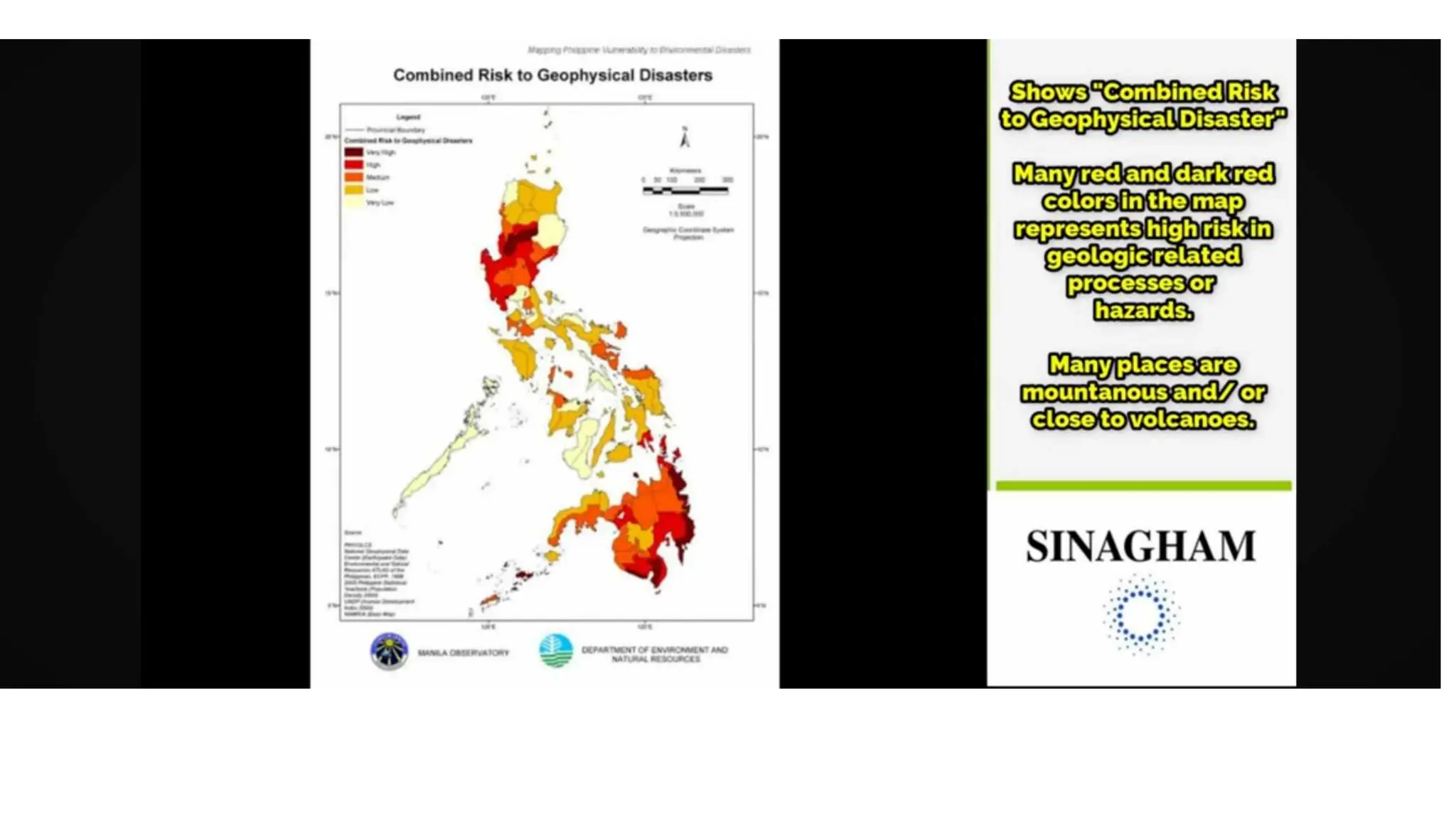
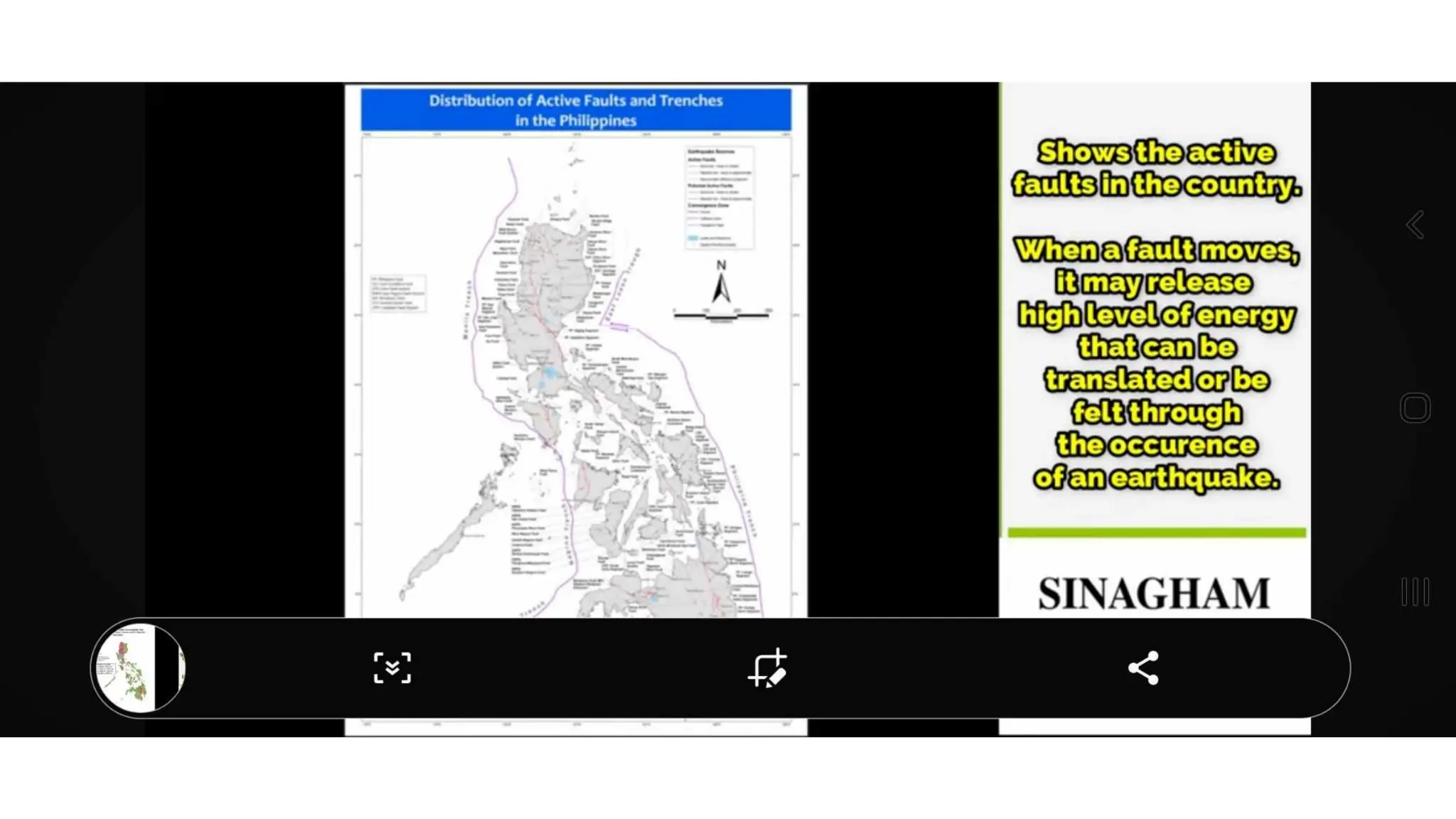
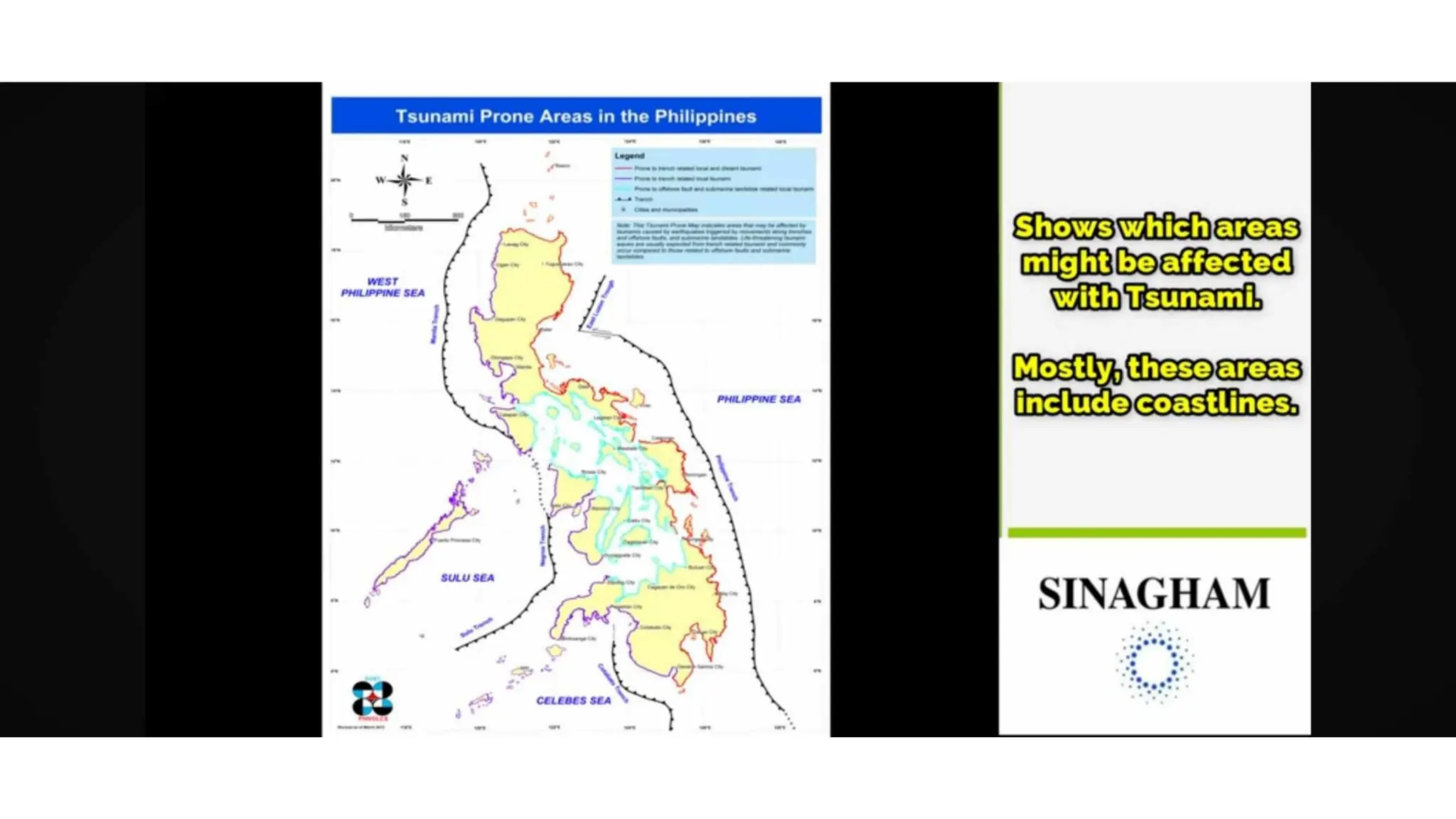
 illustrates areas that are exposed or prone
to a particular hazard
 used to mitigate the potential negative
effects of hazards
Hazard Map
Thank You!
Activity: Tsunami Awareness Campaign
-Make a public awareness campaign aimed
at a coastal community about tsunamis. Create
a slogan on how you educate them.
Rubric:
Content: 10pts
Creativity-5pts
Presentation-5pts
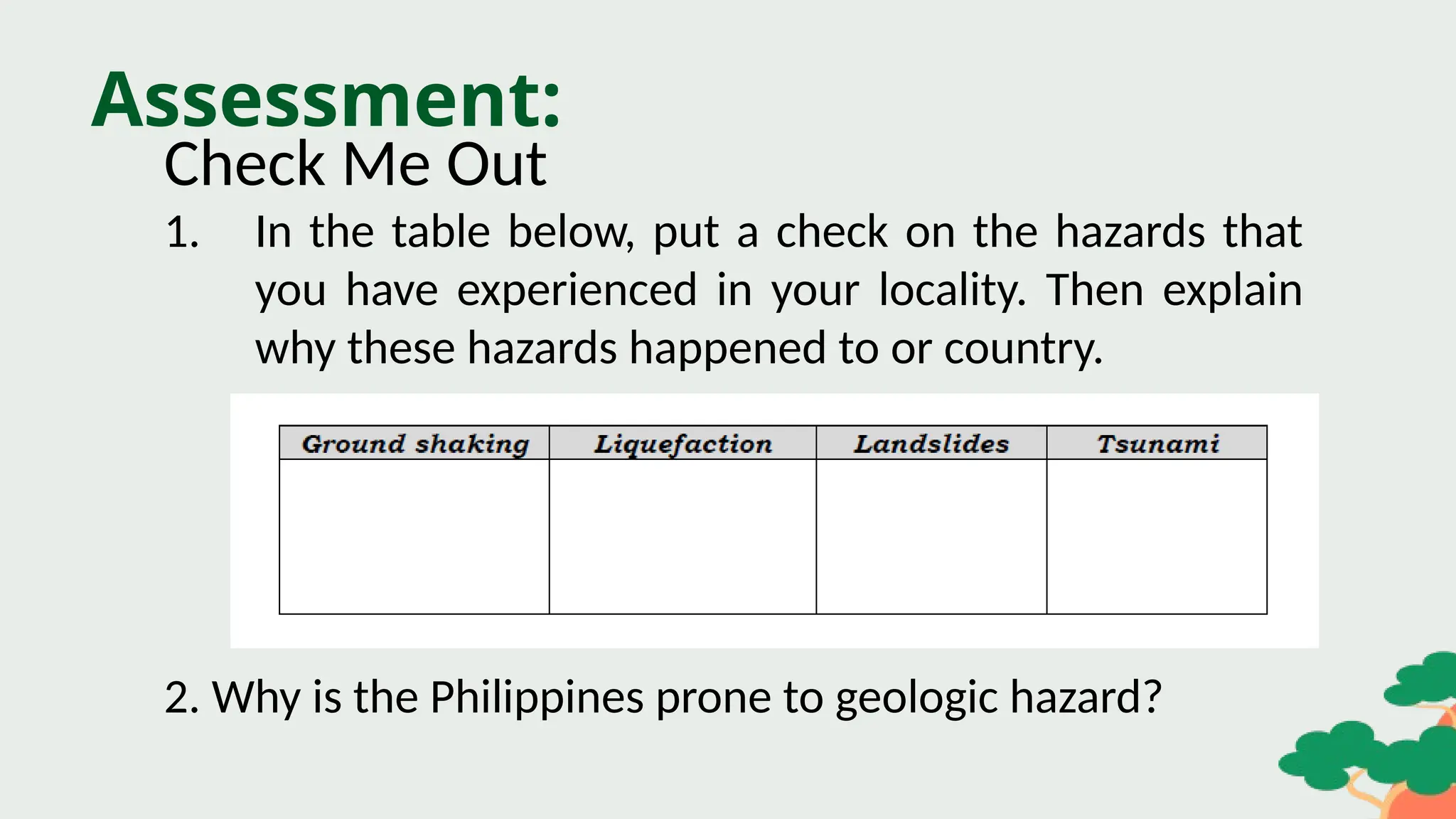
Assessment:
Check Me Out
1. In the table below, put a check on the hazards that
you have experienced in your locality. Then explain
why these hazards happened to or country.
2. Why is the Philippines prone to geologic hazard?
Assignments
List down the several geologic
hazards that happened in our
country and explain how these
affect the people and the
environment.
1
2
3
Does your area
experience any natural
hazards?
What are the damages
incurred when a natural
hazard hits the area?
Identify what time of the
year is the area at the
greatest risk.
Try It!

Geologic Processes and Geologic Hazards.pptx

  • 2.
  • 7.
    GEOLOGY - the studyof the Earth and its history. It involves studying the materials that make up the earth, the features and structures found on Earth, as well as the processes that act upon them. It also deals with the study of the history of all life living on the earth now.
  • 8.
    GEOLOGIC HAZARDS areextremely natural event that are naturally occuring events in the crust of the Earth that poses threat to life and property. -earthquakes, volcanic eruptions, tsunami or tidal waves, and landslides. GEOLOGICAL PROCESSES are naturally occuring events that directly or indirectly impact the geology of the Earth. -Plate tectonics, weathering, earthquakes, volcanic eruptions, mountain formation, deposition, erosion, drought, flooding, landslide.
  • 9.
    Key Difference: Geologic processesare the natural events that shape the Earth’s surface, whereas geologic hazards are the dangerous events that can arise from these processes and have the potential to cause harm to people and the environment.
  • 11.
    is the minimalto rapid shaking of the ground due to the movement of rocks along faults on Earth’s crust. -it is a wave-like movement of the earth’s surface. a.Earthquake
  • 12.
    A. Ground Shaking-vibration of the ground during earthquake. Most obvious hazard earthquake cause. B. Surface Faulting- displacement that reaches the -breaking of the ground C. Landslide-movement of a mass of rock, debris, or earth down a slope. downward movement of the soil D. Liquefaction- saturation of soil with water E. Tsunamis-when shaking happens on the seafloor Earthquake Hazards
  • 16.
    Volcanic eruptions occurwhen molten material from the Earth's interior is extruded to the surface. Volcanic Eruption Avalanches of hot materials, release of toxic gas, and lava flows make volcanic eruptions dangerous.
  • 17.
    Volcanic Hazards Volcanic Eruptionoccurs when magma is released from a volcano A, Tephra- consist of pyroclastic fragments B. Pyroclastic Flow- dense, fast moving flow of solidified lava pieces, volcanic ash, and hot gases. C. Lahar- mixture of rock and water that flows down the slope of a volcano. D. Lava flows and domes- composed of viscous magma/lava being erupted onto the surface. E. Poisonous Gases are gases released during volcanic eruption.
  • 18.
    Tephra pyroclastic Flow PoisonousGases Lahar Lava flows and dome Flood
  • 19.
    Hazards are phenomena (naturalor man-made) which poses threat to humans, animals, properties and environment
  • 20.
    • Natural • Earthquakes •Volcanic eruptions • Landslides • Tsunamis • Climate/Weather hazards Anthropogenic • Deforestation • Mining • Landslides Classification of Hazards
  • 22.
    is the movementof rock down a slope Landslide • this is a natural hazard but human activities may speed up or trigger its occurences.
  • 26.
    • property damage,injury & death • Affects- water supplies, fisheries, sewage disposal systems, forests, dams roadways • Negative Economic Effects- cost to repair structures, loss of property value, disruption of transpo routes, medical cost, indirect cost (lost of timber and lost of fish stock) Effects of Landslides
  • 28.
    1.Surigao Del Sur 2.La Union 3.Benguet 4.Pangasinan 5.Pampanga 6.Tarllac 7.Ifugao 8.Davao Oriental 9. Nueva Viscaya 10.Nueva Ecija Top 10 Provinces at Risk of Earthquakes 1.Camiguin 2.Sulu 3.Biliran 4.Albay 5.Bataan 6.Sorsogon 7.South Cotabato 8.Laguna 9.Camarines Sur 10.Batanes Top 10 Provinces at Risk of Volcanic Eruptons 1.Marinduque 2.Rizal 3.Cebu 4. La Union 5.Southern Leyte 6. Benguet 7.Nueva Viscaya 8.Batangas 9.Mountain Province 10.Romblon Top 10 Most Landslides Prone Provinces in the Phils.
  • 29.
     illustrates areasthat are exposed or prone to a particular hazard  used to mitigate the potential negative effects of hazards Hazard Map
  • 40.
  • 41.
    Activity: Tsunami AwarenessCampaign -Make a public awareness campaign aimed at a coastal community about tsunamis. Create a slogan on how you educate them. Rubric: Content: 10pts Creativity-5pts Presentation-5pts
  • 42.
    Assessment: Check Me Out 1.In the table below, put a check on the hazards that you have experienced in your locality. Then explain why these hazards happened to or country. 2. Why is the Philippines prone to geologic hazard?
  • 43.
    Assignments List down theseveral geologic hazards that happened in our country and explain how these affect the people and the environment.
  • 44.
    1 2 3 Does your area experienceany natural hazards? What are the damages incurred when a natural hazard hits the area? Identify what time of the year is the area at the greatest risk. Try It!

Editor's Notes

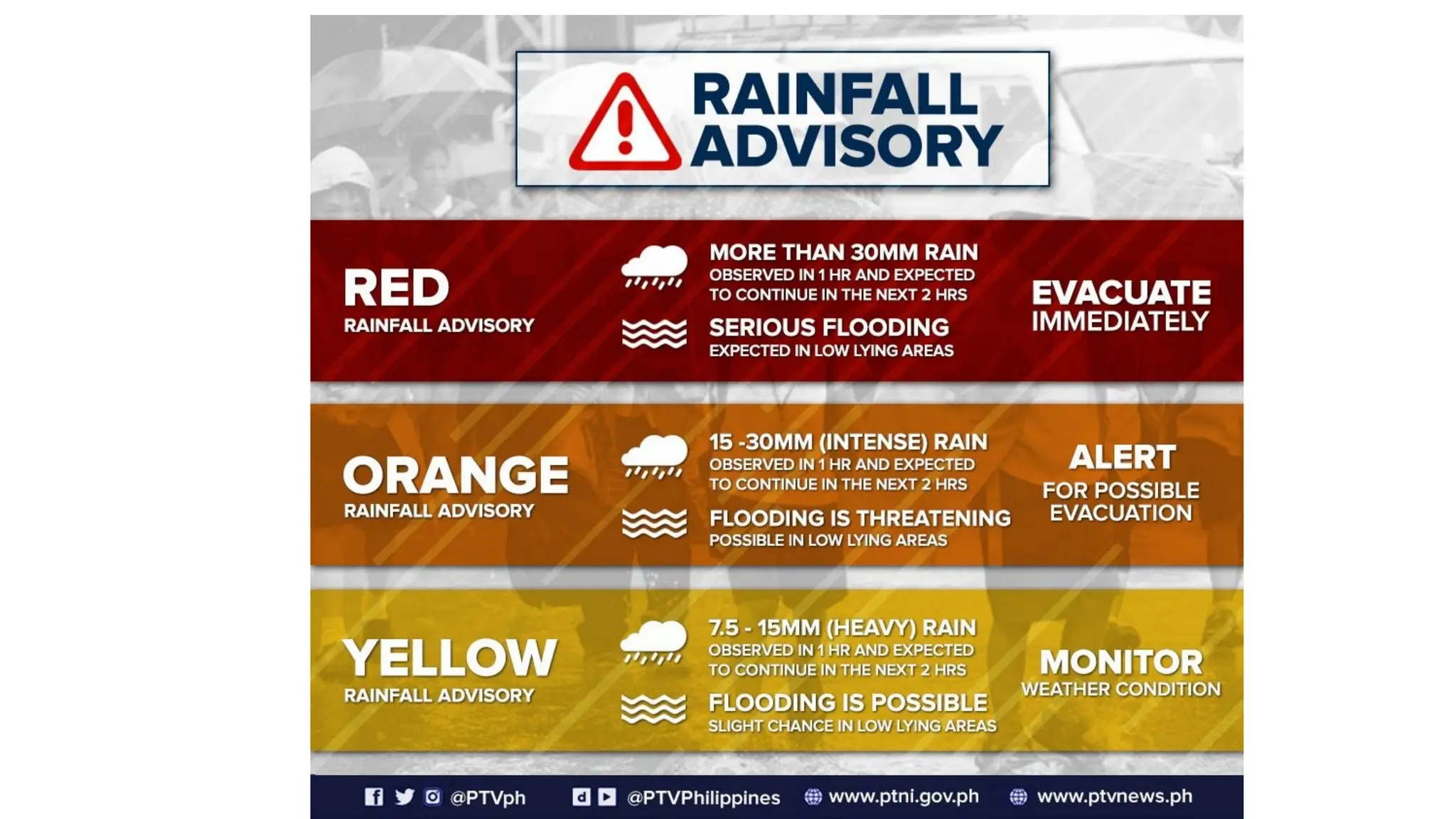
  • #1 So, why do classes were suspended yesterday? it’s due to heavy rainfall which placed IN under a yellow warning due to the Southwest Monsoon. So flooding and landslides were possible esp in vulnerable areas like the Is yellow warning hazardous? Yes., although it is generally considered the lowest level, it signifies that there could be some disruption due to weather, such as heavy rain, strong winds, or floods but the impact is usually limited and not widespread. It serves as a warning to be cautious and to monitor for updates in case conditions worsen
  • #2 So all of these images are in relation to our lesson for today
  • #3 So before we go on further with our topic, I have here images with rumbled letters for you to re-arerange to come up with the correct word. So who can guess for #1? Another clue, This is a two word- GROUND SHAKING…VERY GOOD.
  • #4 Who wants to try #2?....TSUNAMI…very ggod.
  • #5 3rd image… you can answer?......LIQUEFACTION
  • #6 And the last image?....LANDSLIDES So all these images are what we call hazards brought about by geological processes.
  • #7 How do geological processes occur?
  • #8 Examples of geological processes include events such as plate tectonics, weathering, earthquakes, volcanic eruptions, mountain formation, deposition, erosion, droughts, flooding, and landslides. Geological processes affect every human on the Earth all of the time, but are most noticeable when they cause loss of life or property. These threatening processes are called natural disasters. …*1……………..What about GEOLOGIC HAZARD? How about Geologic Hazards? A geologic hazard is an extreme natural event in the crust of the earth that poses a threat to life and property, for example, earthquakes, volcanic eruptions, tsunamis (tidal waves) and landslides. It is a large-scale, complex natural events that happen on land. These hazards can cause immense damage, loss of property, and sometimes life.
  • #9 So generally GP are somehow beneficial. They don't pose an immediate threat to human life but rather create the natural environment just like the formation of mountain, valleys and rivers. GH can have destructive effects, often leading to loss of life and property damage. Geologic hazards represent the potentially harmful outcomes of geologic processes.
  • #12 LIQUEFACTION- PAGKATUNAW. SATURATED-PUSPOS
  • #16 We afre all familiar with VE…..(read)
  • #17 Volcanic eruptions are major natural hazards on Earth. They can have a devastating effect on people and the environment. Hazards caused by Volcanic Eruption
  • #18 So ito yung pictures ng mga VH
  • #19 REFERS TO POTENTIALLY DAMAGING physical event, phenomenon or human activity that may cause the loss of life or injur, property damage, social and economic disruption or environmental degradation. Hazards are extreme natural events with a certain degree of probability of having adverse consequences.
  • #28 So we must be thankful that we are not included here. We are not highly at risk for these 3 kinds of geologic hazards.