EARTH AND
LIFE SCIENCE
Short video clips
Processed Questions
• What do you see from the video?
• What do you think are these phenomena
natural or man-made?
Learning Objectives:
During or after the discussion the students will
be able to:
1. identify the two major geologic events;
2. explain the hazards may cause by these
geologic events;
3. make a slogan on the effect of geologic
hazards to the people and the environment; and
4.share the importance of preparing and
protecting ourselves in time of geologic hazards.
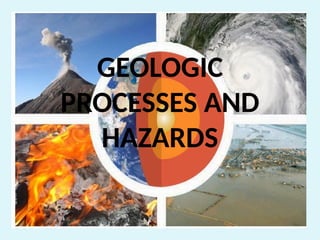
GEOLOGIC
PROCESSES AND
HAZARDS
Geology
• is the study of the Earth and its history.
It involves studying the materials that
make up the earth, the features and
structures found on Earth, as well as the
processes that act upon them.
How do geological processes occur?
• Geological processes are naturally occurring
events that directly or indirectly impact the
geology of the Earth.
• plate tectonics, weathering, earthquakes,
volcanic eruptions, mountain formation,
deposition, erosion, droughts, flooding, and
landslides.
How about Geologic Hazards?
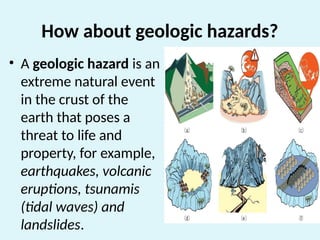
• A geologic hazard is an extreme natural
event in the crust of the earth that poses
a threat to life and property, for
example, earthquakes, volcanic
eruptions, tsunamis (tidal waves) and
landslides.
Group Activity 1
Activity #1. ARRANGE ME
Direction: I will be showing series of
pictures for you to identify. Each
picture is rumbled letters for you to
rearrange correctly forming into a
word. (2pts each)
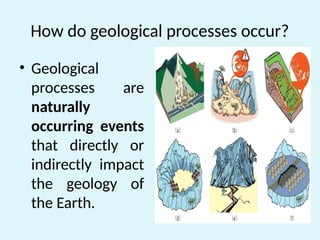
How do geological processes occur?
• Geological
processes are
naturally
occurring events
that directly or
indirectly impact
the geology of
the Earth.
How about geologic hazards?
• A geologic hazard is an
extreme natural event
in the crust of the
earth that poses a
threat to life and
property, for example,
earthquakes, volcanic
eruptions, tsunamis
(tidal waves) and
landslides.
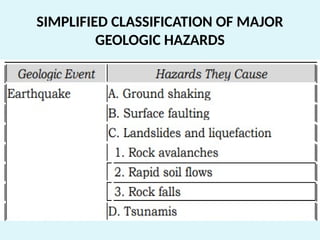
SIMPLIFIED CLASSIFICATION OF MAJOR
GEOLOGIC HAZARDS
SIMPLIFIED CLASSIFICATION OF MAJOR
GEOLOGIC HAZARDS
Earthquake
Earthquake
• is one of the most violent natural phenomena.
• According to the number of victims and
destructive force, it exceeds all other natural
disasters.
• Earthquakes also happen under the ocean and
can cause tsunamis.
• Earthquakes and volcanic eruption can trigger
landslides
• Philippine earthquakes -noticeably strong
such as magnitude 6.9 in October 2019
which hit southern Philippines.
• Another one was 6.1 magnitude that
struck the Island of Luzon in April of
2019.
• Recently, multiple earthquakes were felt
when Taal Volcano erupted early in
2020.
Have you experienced an earthquake?
What did you feel?
How about the earthquake we have
experienced 7 years ago, here in our city?
2017 Earthquake in Surigao City
Listed below are the hazards caused by an
earthquake:
Ground shaking
• is one of the hazards
resulting from
earthquake, volcanic
eruption, and
landslides.
• Ground shaking
describes the vibration
of the ground during
an earthquake.
Listed below are the hazards caused by an
earthquake:
• is displacement that
reaches the earth's
surface during slip along a
fault.
• It commonly occurs with
shallow earthquakes;
• Surface faulting also may
accompany aseismic creep
or natural or man-induced
subsidence.
Surface faulting
Listed below are the hazards caused by an
earthquake:
• the movement of a mass
of rock, debris, or earth
down a slope.
• Landslides are a type of
"mass wasting,“
• The term "landslide"
encompasses five modes
of slope movement: falls,
topples, slides, spreads,
and flows
Landslide
Listed below are the hazards caused by an
earthquake:
• describes the way in
which soil liquefies
during ground shaking.
• Liquefaction can
undermine the
foundations and supports
of buildings, bridges,
pipelines, and roads,
causing them to sink into
the ground, collapse, or
dissolve.
Liquefaction
Listed below are the hazards caused by an
earthquake:
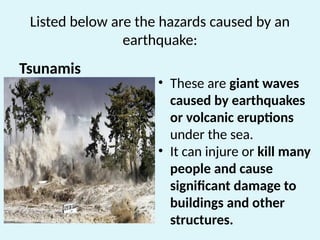
Tsunamis
• These are giant waves
caused by earthquakes
or volcanic eruptions
under the sea.
• It can injure or kill many
people and cause
significant damage to
buildings and other
structures.
Listed below are the hazards caused by an
earthquake:
Tsunamis • The speed of tsunami
waves depends on
ocean depth rather than
the distance from the
source of the wave.
• Tsunami waves may
travel as fast as jet
planes over deep waters,
only slowing down when
reaching shallow waters.
What are volcanoes?
Volcanoes
• A volcano on Earth is
a vent or fissure in the
planet's crust through
which lava, ash, rock
and gases erupt.
• Volcanoes are natural
systems and always
have some element of
unpredictability.
What about volcanic eruption?
• A volcanic eruption occurs when magma is
released from a volcano.
• Volcanic eruptions are major natural hazards
on Earth.
• Volcanic eruptions can have a devastating
effect on people and the environment.
These are the hazards caused by volcanic
eruption:
Tephra pyroclastic flow
These are the hazards caused by volcanic
eruption:
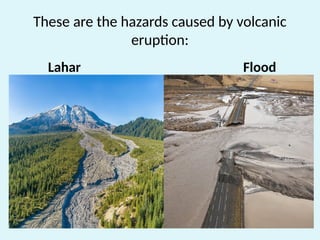
Lahar Flood
These are the hazards caused by volcanic
eruption:
Lava domes Poisonous Gases
Activity #2
Direction: Each group will be given a Manila
Paper, containing metacards where you are
going to write your answers in every question
that I am going to throw. Paste your metacards
with your answer in the manila paper. Once
done, post your Manila papers in the Board.
No changing of answers this time, for we will
check it by then.
Guide Questions:
1. What are the two Major geologic events?
2. How many hazards may cause by
Earthquake? How about Volcanic Eruption?
3. What are the possible hazards caused by
Earthquake? Explain each.
4. What are the possible hazards caused by
Volcanic Eruption? Explain each.
Activity # 3. “My Geologic Hazards Experience”
• Cite at least four (4) hazards you have
experienced in your locality. Then make
a slogan on how these hazards affect
the people as well as the environment.
RUBRIC
et bond paper.
Suggested rubric in scoring the collage.
5 4 3 2 1
90-100%
completenes
s of content
demonstratin
g illustrative
strong
development
of ideas
80-89%
completenes
s of content
with an
adequate
explanation
of ideas
70-79%
completenes
s of content
with an
inadequate
explanation
of ideas
60-69%
completenes
s of content
with minimal
explanation
of ideas
59% and
below
completenes
s and
Irrelevant
explanation
of the
content
• Hazards may pose danger to our lives. Let
us be prepared and protect ourselves. As
students, how are you going to protect your
lives in times of hazards?
• In the table below, write a step by step
procedure of preparing and protecting
yourselves in times of geologic hazards.
Additional Activities
• List down the several geologic hazards
that happened in our country and
explain how these affect the people and
the environment.
ASSIGNMENT
Evaluate of Learning
1. identify the two major geologic events;
2. explain the hazards may cause by these
geologic events;
3. make a slogan on the effect of geologic
hazards to the people and the environment; and
4. share the importance of preparing and
protecting ourselves in time of geologic hazards.

Different Geologic Processes and hazards.pptx

  • 1.
  • 2.
  • 3.
    Processed Questions • Whatdo you see from the video? • What do you think are these phenomena natural or man-made?
  • 4.
    Learning Objectives: During orafter the discussion the students will be able to: 1. identify the two major geologic events; 2. explain the hazards may cause by these geologic events; 3. make a slogan on the effect of geologic hazards to the people and the environment; and 4.share the importance of preparing and protecting ourselves in time of geologic hazards.
  • 5.
  • 6.
    Geology • is thestudy of the Earth and its history. It involves studying the materials that make up the earth, the features and structures found on Earth, as well as the processes that act upon them.
  • 7.
    How do geologicalprocesses occur? • Geological processes are naturally occurring events that directly or indirectly impact the geology of the Earth. • plate tectonics, weathering, earthquakes, volcanic eruptions, mountain formation, deposition, erosion, droughts, flooding, and landslides.
  • 8.
    How about GeologicHazards? • A geologic hazard is an extreme natural event in the crust of the earth that poses a threat to life and property, for example, earthquakes, volcanic eruptions, tsunamis (tidal waves) and landslides.
  • 9.
  • 10.
    Activity #1. ARRANGEME Direction: I will be showing series of pictures for you to identify. Each picture is rumbled letters for you to rearrange correctly forming into a word. (2pts each)
  • 15.
    How do geologicalprocesses occur? • Geological processes are naturally occurring events that directly or indirectly impact the geology of the Earth.
  • 16.
    How about geologichazards? • A geologic hazard is an extreme natural event in the crust of the earth that poses a threat to life and property, for example, earthquakes, volcanic eruptions, tsunamis (tidal waves) and landslides.
  • 17.
    SIMPLIFIED CLASSIFICATION OFMAJOR GEOLOGIC HAZARDS
  • 18.
    SIMPLIFIED CLASSIFICATION OFMAJOR GEOLOGIC HAZARDS
  • 19.
  • 20.
    Earthquake • is oneof the most violent natural phenomena. • According to the number of victims and destructive force, it exceeds all other natural disasters. • Earthquakes also happen under the ocean and can cause tsunamis. • Earthquakes and volcanic eruption can trigger landslides
  • 21.
    • Philippine earthquakes-noticeably strong such as magnitude 6.9 in October 2019 which hit southern Philippines. • Another one was 6.1 magnitude that struck the Island of Luzon in April of 2019. • Recently, multiple earthquakes were felt when Taal Volcano erupted early in 2020.
  • 22.
    Have you experiencedan earthquake? What did you feel? How about the earthquake we have experienced 7 years ago, here in our city?
  • 23.
    2017 Earthquake inSurigao City
  • 24.
    Listed below arethe hazards caused by an earthquake: Ground shaking • is one of the hazards resulting from earthquake, volcanic eruption, and landslides. • Ground shaking describes the vibration of the ground during an earthquake.
  • 25.
    Listed below arethe hazards caused by an earthquake: • is displacement that reaches the earth's surface during slip along a fault. • It commonly occurs with shallow earthquakes; • Surface faulting also may accompany aseismic creep or natural or man-induced subsidence. Surface faulting
  • 26.
    Listed below arethe hazards caused by an earthquake: • the movement of a mass of rock, debris, or earth down a slope. • Landslides are a type of "mass wasting,“ • The term "landslide" encompasses five modes of slope movement: falls, topples, slides, spreads, and flows Landslide
  • 27.
    Listed below arethe hazards caused by an earthquake: • describes the way in which soil liquefies during ground shaking. • Liquefaction can undermine the foundations and supports of buildings, bridges, pipelines, and roads, causing them to sink into the ground, collapse, or dissolve. Liquefaction
  • 28.
    Listed below arethe hazards caused by an earthquake: Tsunamis • These are giant waves caused by earthquakes or volcanic eruptions under the sea. • It can injure or kill many people and cause significant damage to buildings and other structures.
  • 29.
    Listed below arethe hazards caused by an earthquake: Tsunamis • The speed of tsunami waves depends on ocean depth rather than the distance from the source of the wave. • Tsunami waves may travel as fast as jet planes over deep waters, only slowing down when reaching shallow waters.
  • 30.
  • 31.
    Volcanoes • A volcanoon Earth is a vent or fissure in the planet's crust through which lava, ash, rock and gases erupt. • Volcanoes are natural systems and always have some element of unpredictability.
  • 32.
    What about volcaniceruption? • A volcanic eruption occurs when magma is released from a volcano. • Volcanic eruptions are major natural hazards on Earth. • Volcanic eruptions can have a devastating effect on people and the environment.
  • 33.
    These are thehazards caused by volcanic eruption: Tephra pyroclastic flow
  • 34.
    These are thehazards caused by volcanic eruption: Lahar Flood
  • 35.
    These are thehazards caused by volcanic eruption: Lava domes Poisonous Gases
  • 36.
    Activity #2 Direction: Eachgroup will be given a Manila Paper, containing metacards where you are going to write your answers in every question that I am going to throw. Paste your metacards with your answer in the manila paper. Once done, post your Manila papers in the Board. No changing of answers this time, for we will check it by then.
  • 37.
    Guide Questions: 1. Whatare the two Major geologic events? 2. How many hazards may cause by Earthquake? How about Volcanic Eruption? 3. What are the possible hazards caused by Earthquake? Explain each. 4. What are the possible hazards caused by Volcanic Eruption? Explain each.
  • 38.
    Activity # 3.“My Geologic Hazards Experience” • Cite at least four (4) hazards you have experienced in your locality. Then make a slogan on how these hazards affect the people as well as the environment.
  • 39.
    RUBRIC et bond paper. Suggestedrubric in scoring the collage. 5 4 3 2 1 90-100% completenes s of content demonstratin g illustrative strong development of ideas 80-89% completenes s of content with an adequate explanation of ideas 70-79% completenes s of content with an inadequate explanation of ideas 60-69% completenes s of content with minimal explanation of ideas 59% and below completenes s and Irrelevant explanation of the content
  • 40.
    • Hazards maypose danger to our lives. Let us be prepared and protect ourselves. As students, how are you going to protect your lives in times of hazards? • In the table below, write a step by step procedure of preparing and protecting yourselves in times of geologic hazards.
  • 42.
    Additional Activities • Listdown the several geologic hazards that happened in our country and explain how these affect the people and the environment.
  • 43.
  • 44.
    Evaluate of Learning 1.identify the two major geologic events; 2. explain the hazards may cause by these geologic events; 3. make a slogan on the effect of geologic hazards to the people and the environment; and 4. share the importance of preparing and protecting ourselves in time of geologic hazards.