CAMPBELL
BIOLOGY
Reece • Urry • Cain • Wasserman • Minorsky • Jackson
© 2014 Pearson Education, Inc.
TENTH
EDITION
CAMPBELL
BIOLOGY
Reece • Urry • Cain • Wasserman • Minorsky • Jackson
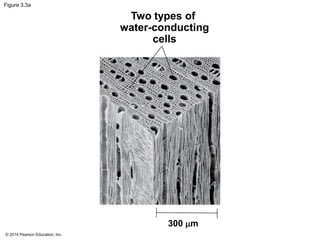
TENTH
EDITION
3
Water
and Life
Lecture Presentation by
Nicole Tunbridge and
Kathleen Fitzpatrick
© 2014 Pearson Education, Inc.
The Molecule That Supports All of Life
 Water is the biological medium on Earth
 Water is the only common substance to exist in
the natural environment in all three physical states
of matter
 The structure of the water molecule allows it to
interact with other molecules
 Water’s unique emergent properties help make
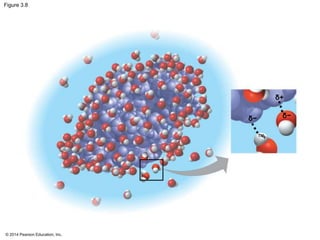
Earth suitable for life
© 2014 Pearson Education, Inc.
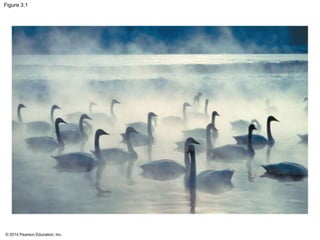
Figure 3.1
© 2014 Pearson Education, Inc.
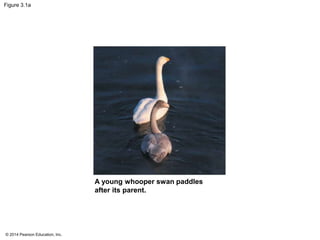
Figure 3.1a
A young whooper swan paddles
after its parent.
© 2014 Pearson Education, Inc.
Concept 3.1: Polar covalent bonds in water
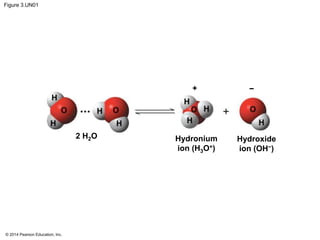
molecules result in hydrogen bonding
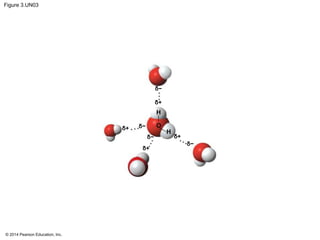
 In the water molecule, the electrons of the polar
covalent bonds spend more time near the
oxygen than the hydrogen
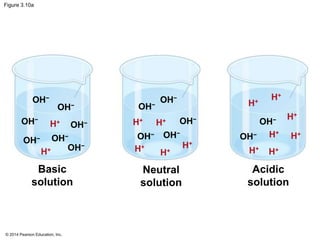
 The water molecule is thus a polar molecule:
the overall charge is unevenly distributed
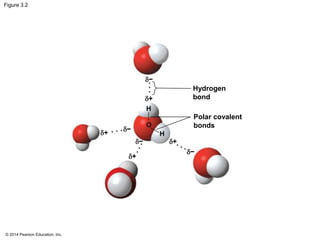
 Polarity allows water molecules to form hydrogen
bonds with each other
© 2014 Pearson Education, Inc.
Figure 3.2
−
−
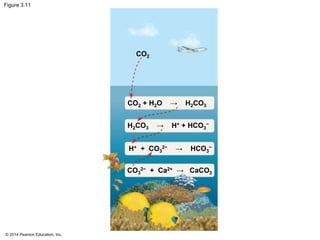
−
−
+
+
+
+
Hydrogen
bond
Polar covalent
bonds
© 2014 Pearson Education, Inc.
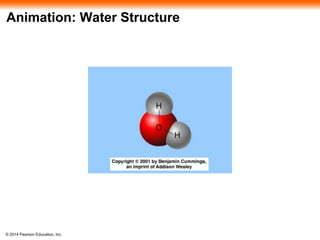
Animation: Water Structure
© 2014 Pearson Education, Inc.
Concept 3.2: Four emergent properties of water
contribute to Earth’s suitability for life
 Four of water’s properties that facilitate an
environment for life are
 Cohesive behavior
 Ability to moderate temperature
 Expansion upon freezing
 Versatility as a solvent
© 2014 Pearson Education, Inc.
Cohesion of Water Molecules
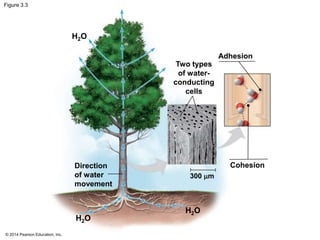
 Collectively, hydrogen bonds hold water molecules
together, a phenomenon called cohesion
 Cohesion helps the transport of water against
gravity in plants
 Adhesion is an attraction between different
substances, for example, between water and plant
cell walls
© 2014 Pearson Education, Inc.
Figure 3.3
300 m
H2O
Direction
of water
movement
H2O
H2O
Two types
of water-
conducting
cells
Adhesion
Cohesion
© 2014 Pearson Education, Inc.
BioFlix: Water Transport in Plants
© 2014 Pearson Education, Inc.
Animation: Water Transport
© 2014 Pearson Education, Inc.
Figure 3.3a
300 m
Two types of
water-conducting
cells
© 2014 Pearson Education, Inc.
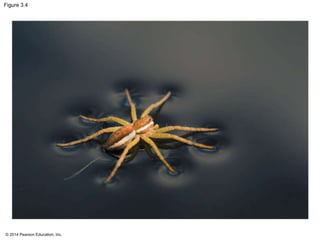
 Surface tension is a measure of how hard it is to
break the surface of a liquid
 Water has an unusually high surface tension due
to hydrogen bonding between the molecules at the
air-water interface and to the water below
© 2014 Pearson Education, Inc.
Figure 3.4
© 2014 Pearson Education, Inc.
Moderation of Temperature by Water
 Water absorbs heat from warmer air and releases
stored heat to cooler air
 Water can absorb or release a large amount of
heat with only a slight change in its own
temperature
© 2014 Pearson Education, Inc.
Temperature and Heat
 Kinetic energy is the energy of motion
 The kinetic energy associated with random motion
of atoms or molecules is called thermal energy
 Temperature is a measure of energy that
represents the average kinetic energy of the
molecules in a body of matter
 Thermal energy in transfer from one body of
matter to another is defined as heat
© 2014 Pearson Education, Inc.
 A calorie (cal) is the amount of heat required to
raise the temperature of 1 g of water by 1°C
 The “calories” on food packages are actually
kilocalories (kcal), where 1 kcal = 1,000 cal
 The joule (J) is another unit of energy where
1 J = 0.239 cal, or 1 cal = 4.184 J
© 2014 Pearson Education, Inc.
Water’s High Specific Heat
 The specific heat of a substance is the amount of
heat that must be absorbed or lost for 1 g of that
substance to change its temperature by 1°C
 The specific heat of water is 1 cal/g/°C
 Water resists changing its temperature because of
its high specific heat
© 2014 Pearson Education, Inc.
 Water’s high specific heat can be traced to
hydrogen bonding
 Heat is absorbed when hydrogen bonds break
 Heat is released when hydrogen bonds form
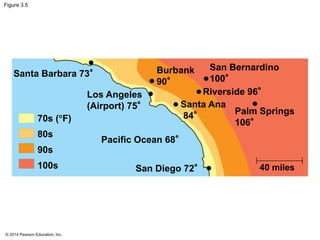
 The high specific heat of water minimizes
temperature fluctuations to within limits that
permit life
© 2014 Pearson Education, Inc.
Figure 3.5
40 miles
Santa Barbara 73°
Los Angeles
(Airport) 75°
Burbank
90°
San Bernardino
100°
Riverside 96°
Santa Ana
84°
Pacific Ocean 68°
San Diego 72°
Palm Springs
106°70s (F)
80s
90s
100s
© 2014 Pearson Education, Inc.
Evaporative Cooling
 Evaporation is transformation of a substance from
liquid to gas
 Heat of vaporization is the heat a liquid must
absorb for 1 g to be converted to gas
 As a liquid evaporates, its remaining surface
cools, a process called evaporative cooling
 Evaporative cooling of water helps stabilize
temperatures in organisms and bodies of water
© 2014 Pearson Education, Inc.
Floating of Ice on Liquid Water
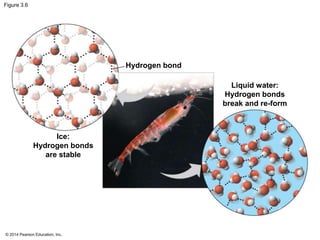
 Ice floats in liquid water because hydrogen bonds
in ice are more “ordered,” making ice less dense
than water
 Water reaches its greatest density at 4°C
 If ice sank, all bodies of water would eventually
freeze solid, making life impossible on Earth
© 2014 Pearson Education, Inc.
Figure 3.6
Hydrogen bond
Liquid water:
Hydrogen bonds
break and re-form
Ice:
Hydrogen bonds
are stable
© 2014 Pearson Education, Inc.
Water: The Solvent of Life
 A solution is a liquid that is a completely
homogeneous mixture of substances
 A solvent is the dissolving agent of a solution
 The solute is the substance that is dissolved
 An aqueous solution is one in which water is the
solvent
© 2014 Pearson Education, Inc.
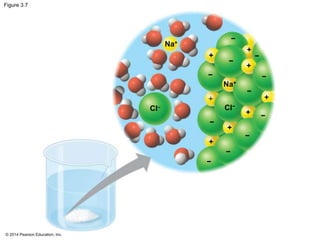
 Water is a versatile solvent due to its polarity
 When an ionic compound is dissolved in water,
each ion is surrounded by a sphere of water
molecules called a hydration shell
© 2014 Pearson Education, Inc.
Figure 3.7
Na+
Na+
Cl– Cl−
+
+
+
+ +
+
+
+
−
−
−
− −
−
−
−
−
−
−
© 2014 Pearson Education, Inc.
 Water can also dissolve compounds made of
nonionic polar molecules
 Even large polar molecules such as proteins
can dissolve in water if they have ionic and
polar regions
© 2014 Pearson Education, Inc.
Figure 3.8
δ−
δ+
δ−
+
© 2014 Pearson Education, Inc.
Hydrophilic and Hydrophobic Substances
 A hydrophilic substance is one that has an
affinity for water
 A hydrophobic substance is one that does not
have an affinity for water
 Oil molecules are hydrophobic because they
have relatively nonpolar bonds
 Hydrophobic molecules related to oils are the
major ingredients of cell membranes
© 2014 Pearson Education, Inc.
Solute Concentration in Aqueous Solutions
 Most chemical reactions in organisms involve
solutes dissolved in water
 When carrying out experiments, we use mass to
calculate the number of solute molecules in an
aqueous solution
© 2014 Pearson Education, Inc.
 Molecular mass is the sum of all masses of all
atoms in a molecule
 Numbers of molecules are usually measured in
moles, where 1 mole (mol) = 6.02  1023
molecules
 Avogadro’s number and the unit dalton were
defined such that 6.02  1023 daltons = 1 g
 Molarity (M) is the number of moles of solute
per liter of solution
© 2014 Pearson Education, Inc.
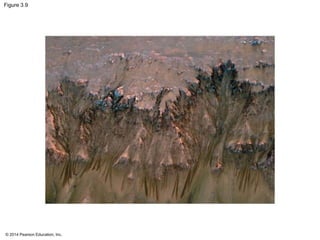
Possible Evolution of Life on Other Planets
 Biologists seeking life on other planets have
concentrated their search on planets with water
 To date, more than 200 planets have been found
outside our solar system; there is evidence that a
few of them have water vapor
 In our solar system, Mars has been found to
have water
© 2014 Pearson Education, Inc.
Figure 3.9
© 2014 Pearson Education, Inc.
Concept 3.3: Acidic and basic conditions affect
living organisms
 A hydrogen atom in a hydrogen bond between two
water molecules can shift from one to the other
 The hydrogen atom leaves its electron behind and
is transferred as a proton, or hydrogen ion (H+)
 The molecule that lost the proton is now a
hydroxide ion (OH−)
 The molecule with the extra proton is now a
hydronium ion (H3O+), though it is often
represented as H+
© 2014 Pearson Education, Inc.
 Water is in a state of dynamic equilibrium in which
water molecules dissociate at the same rate at
which they are being reformed
© 2014 Pearson Education, Inc.
Figure 3.UN01
2 H2O Hydronium
ion (H3O+)
Hydroxide
ion (OH−)
+ −
© 2014 Pearson Education, Inc.
 Though statistically rare, the dissociation of water
molecules has a great effect on organisms
 Changes in concentrations of H+ and OH− can
drastically affect the chemistry of a cell
© 2014 Pearson Education, Inc.
 Concentrations of H+ and OH− are equal in
pure water
 Adding certain solutes, called acids and bases,
modifies the concentrations of H+ and OH−
 Biologists use something called the pH scale to
describe whether a solution is acidic or basic
(the opposite of acidic)
© 2014 Pearson Education, Inc.
Acids and Bases
 An acid is any substance that increases the H+
concentration of a solution
 A base is any substance that reduces the H+
concentration of a solution
 Strong acids and bases dissociate completely
in water
 Weak acids and bases reversibly release and
accept back hydrogen ions, but can still shift the
balance of H+ and OH− away from neutrality
© 2014 Pearson Education, Inc.
The pH Scale
 In any aqueous solution at 25°C the product of H+
and OH− is constant and can be written as
 The pH of a solution is defined by the negative
logarithm of H+ concentration, written as
 For a neutral aqueous solution, [H+] is 10−7, so
[H+][OH−] = 10− 14
pH = − log [H+]
pH = −(− 7) = 7
© 2014 Pearson Education, Inc.
 Acidic solutions have pH values less than 7
 Basic solutions have pH values greater than 7
 Most biological fluids have pH values in the range
of 6 to 8
© 2014 Pearson Education, Inc.
Figure 3.10
H+
H+
H+
H+
H+
H+
H+H+
H+OH–
OH–
OH–
OH–
OH–
OH–
OH–
OH–
H+
H+
H+
H+
H+
H+
OH–
OH–
OH–
OH–
OH–
OH–
Basic
solution
Neutral
solution
Acidic
solution
IncreasinglyAcidic
[H+]>[OH−]
Neutral
[H+] = [OH−]
pH Scale
IncreasinglyBasic
[H+]<[OH−]
Battery acid
Gastric juice, lemon juice
Vinegar, wine,
cola
Tomato juice
Beer
Black coffee
Rainwater
Pure water
Human blood, tears
Seawater
Inside of small intestine
Urine
Saliva
Milk of magnesia
Household ammonia
Household
bleach
Oven cleaner
0
1
2
3
4
5
6
7
8
9
10
11
12
13
14
© 2014 Pearson Education, Inc.
Figure 3.10a
H+
H+
H+
H+
H+
H+H+
OH−
OH−
Acidic
solution
OH−
OH−
OH−
OH−
OH−
H+
H+
H+ H+
H+
Neutral
solution
H+
OH−
H+
OH−
OH−
OH−OH−
OH−
OH−
Basic
solution
© 2014 Pearson Education, Inc.
Buffers
 The internal pH of most living cells must remain
close to pH 7
 Buffers are substances that minimize changes in
concentrations of H+ and OH− in a solution
 Most buffer solutions contain a weak acid and its
corresponding base, which combine reversibly
with H+ ions
© 2014 Pearson Education, Inc.
Acidification: A Threat to Water Quality
 Human activities such as burning fossil fuels
threaten water quality
 CO2 is the main product of fossil fuel combustion
 About 25% of human-generated CO2 is absorbed
by the oceans
 CO2 dissolved in sea water forms carbonic acid;
this process is called ocean acidification
© 2014 Pearson Education, Inc.
Figure 3.11
CO2
CO2 + H2O → H2CO3
H2CO3 → H+ + HCO3
−
H+ + CO3
2− → HCO3
−
CO3
2− + Ca2+ → CaCO3
© 2014 Pearson Education, Inc.
 As seawater acidifies, H+ ions combine with
carbonate ions to produce bicarbonate
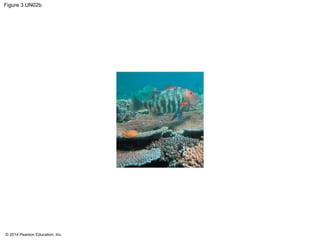
 Carbonate is required for calcification (production
of calcium carbonate) by many marine organisms,
including reef-building corals
 We have made progress in learning about the
delicate chemical balances in oceans, lakes,
and rivers
© 2014 Pearson Education, Inc.
Figure 3.UN02a
Calcificationrate
(mmolCaCO3/m2⋅day)
[CO3
2−] (μmol/kg of seawater)
20
10
0
220 240 260 280
© 2014 Pearson Education, Inc.
Figure 3.UN02b
© 2014 Pearson Education, Inc.
Figure 3.UN03
δ−
δ−
δ−
δ−
δ+
δ+
δ+
δ+
© 2014 Pearson Education, Inc.
Figure 3.UN04
Acidic
[H+] > [OH−]
Neutral
[H+] = [OH−]
Basic
[H+] < [OH−]
Acids donate H+ in
aqueous solutions.
Bases donate OH−
or accept H+ in
aqueous solutions.
0
7
14
© 2014 Pearson Education, Inc.
Figure 3.UN05

03 Lecture BIOL 1010-30 Gillette College

  • 1.
    CAMPBELL BIOLOGY Reece • Urry• Cain • Wasserman • Minorsky • Jackson © 2014 Pearson Education, Inc. TENTH EDITION CAMPBELL BIOLOGY Reece • Urry • Cain • Wasserman • Minorsky • Jackson TENTH EDITION 3 Water and Life Lecture Presentation by Nicole Tunbridge and Kathleen Fitzpatrick
  • 2.
    © 2014 PearsonEducation, Inc. The Molecule That Supports All of Life  Water is the biological medium on Earth  Water is the only common substance to exist in the natural environment in all three physical states of matter  The structure of the water molecule allows it to interact with other molecules  Water’s unique emergent properties help make Earth suitable for life
  • 3.
    © 2014 PearsonEducation, Inc. Figure 3.1
  • 4.
    © 2014 PearsonEducation, Inc. Figure 3.1a A young whooper swan paddles after its parent.
  • 5.
    © 2014 PearsonEducation, Inc. Concept 3.1: Polar covalent bonds in water molecules result in hydrogen bonding  In the water molecule, the electrons of the polar covalent bonds spend more time near the oxygen than the hydrogen  The water molecule is thus a polar molecule: the overall charge is unevenly distributed  Polarity allows water molecules to form hydrogen bonds with each other
  • 6.
    © 2014 PearsonEducation, Inc. Figure 3.2 − − − − + + + + Hydrogen bond Polar covalent bonds
  • 7.
    © 2014 PearsonEducation, Inc. Animation: Water Structure
  • 8.
    © 2014 PearsonEducation, Inc. Concept 3.2: Four emergent properties of water contribute to Earth’s suitability for life  Four of water’s properties that facilitate an environment for life are  Cohesive behavior  Ability to moderate temperature  Expansion upon freezing  Versatility as a solvent
  • 9.
    © 2014 PearsonEducation, Inc. Cohesion of Water Molecules  Collectively, hydrogen bonds hold water molecules together, a phenomenon called cohesion  Cohesion helps the transport of water against gravity in plants  Adhesion is an attraction between different substances, for example, between water and plant cell walls
  • 10.
    © 2014 PearsonEducation, Inc. Figure 3.3 300 m H2O Direction of water movement H2O H2O Two types of water- conducting cells Adhesion Cohesion
  • 11.
    © 2014 PearsonEducation, Inc. BioFlix: Water Transport in Plants
  • 12.
    © 2014 PearsonEducation, Inc. Animation: Water Transport
  • 13.
    © 2014 PearsonEducation, Inc. Figure 3.3a 300 m Two types of water-conducting cells
  • 14.
    © 2014 PearsonEducation, Inc.  Surface tension is a measure of how hard it is to break the surface of a liquid  Water has an unusually high surface tension due to hydrogen bonding between the molecules at the air-water interface and to the water below
  • 15.
    © 2014 PearsonEducation, Inc. Figure 3.4
  • 16.
    © 2014 PearsonEducation, Inc. Moderation of Temperature by Water  Water absorbs heat from warmer air and releases stored heat to cooler air  Water can absorb or release a large amount of heat with only a slight change in its own temperature
  • 17.
    © 2014 PearsonEducation, Inc. Temperature and Heat  Kinetic energy is the energy of motion  The kinetic energy associated with random motion of atoms or molecules is called thermal energy  Temperature is a measure of energy that represents the average kinetic energy of the molecules in a body of matter  Thermal energy in transfer from one body of matter to another is defined as heat
  • 18.
    © 2014 PearsonEducation, Inc.  A calorie (cal) is the amount of heat required to raise the temperature of 1 g of water by 1°C  The “calories” on food packages are actually kilocalories (kcal), where 1 kcal = 1,000 cal  The joule (J) is another unit of energy where 1 J = 0.239 cal, or 1 cal = 4.184 J
  • 19.
    © 2014 PearsonEducation, Inc. Water’s High Specific Heat  The specific heat of a substance is the amount of heat that must be absorbed or lost for 1 g of that substance to change its temperature by 1°C  The specific heat of water is 1 cal/g/°C  Water resists changing its temperature because of its high specific heat
  • 20.
    © 2014 PearsonEducation, Inc.  Water’s high specific heat can be traced to hydrogen bonding  Heat is absorbed when hydrogen bonds break  Heat is released when hydrogen bonds form  The high specific heat of water minimizes temperature fluctuations to within limits that permit life
  • 21.
    © 2014 PearsonEducation, Inc. Figure 3.5 40 miles Santa Barbara 73° Los Angeles (Airport) 75° Burbank 90° San Bernardino 100° Riverside 96° Santa Ana 84° Pacific Ocean 68° San Diego 72° Palm Springs 106°70s (F) 80s 90s 100s
  • 22.
    © 2014 PearsonEducation, Inc. Evaporative Cooling  Evaporation is transformation of a substance from liquid to gas  Heat of vaporization is the heat a liquid must absorb for 1 g to be converted to gas  As a liquid evaporates, its remaining surface cools, a process called evaporative cooling  Evaporative cooling of water helps stabilize temperatures in organisms and bodies of water
  • 23.
    © 2014 PearsonEducation, Inc. Floating of Ice on Liquid Water  Ice floats in liquid water because hydrogen bonds in ice are more “ordered,” making ice less dense than water  Water reaches its greatest density at 4°C  If ice sank, all bodies of water would eventually freeze solid, making life impossible on Earth
  • 24.
    © 2014 PearsonEducation, Inc. Figure 3.6 Hydrogen bond Liquid water: Hydrogen bonds break and re-form Ice: Hydrogen bonds are stable
  • 25.
    © 2014 PearsonEducation, Inc. Water: The Solvent of Life  A solution is a liquid that is a completely homogeneous mixture of substances  A solvent is the dissolving agent of a solution  The solute is the substance that is dissolved  An aqueous solution is one in which water is the solvent
  • 26.
    © 2014 PearsonEducation, Inc.  Water is a versatile solvent due to its polarity  When an ionic compound is dissolved in water, each ion is surrounded by a sphere of water molecules called a hydration shell
  • 27.
    © 2014 PearsonEducation, Inc. Figure 3.7 Na+ Na+ Cl– Cl− + + + + + + + + − − − − − − − − − − −
  • 28.
    © 2014 PearsonEducation, Inc.  Water can also dissolve compounds made of nonionic polar molecules  Even large polar molecules such as proteins can dissolve in water if they have ionic and polar regions
  • 29.
    © 2014 PearsonEducation, Inc. Figure 3.8 δ− δ+ δ− +
  • 30.
    © 2014 PearsonEducation, Inc. Hydrophilic and Hydrophobic Substances  A hydrophilic substance is one that has an affinity for water  A hydrophobic substance is one that does not have an affinity for water  Oil molecules are hydrophobic because they have relatively nonpolar bonds  Hydrophobic molecules related to oils are the major ingredients of cell membranes
  • 31.
    © 2014 PearsonEducation, Inc. Solute Concentration in Aqueous Solutions  Most chemical reactions in organisms involve solutes dissolved in water  When carrying out experiments, we use mass to calculate the number of solute molecules in an aqueous solution
  • 32.
    © 2014 PearsonEducation, Inc.  Molecular mass is the sum of all masses of all atoms in a molecule  Numbers of molecules are usually measured in moles, where 1 mole (mol) = 6.02  1023 molecules  Avogadro’s number and the unit dalton were defined such that 6.02  1023 daltons = 1 g  Molarity (M) is the number of moles of solute per liter of solution
  • 33.
    © 2014 PearsonEducation, Inc. Possible Evolution of Life on Other Planets  Biologists seeking life on other planets have concentrated their search on planets with water  To date, more than 200 planets have been found outside our solar system; there is evidence that a few of them have water vapor  In our solar system, Mars has been found to have water
  • 34.
    © 2014 PearsonEducation, Inc. Figure 3.9
  • 35.
    © 2014 PearsonEducation, Inc. Concept 3.3: Acidic and basic conditions affect living organisms  A hydrogen atom in a hydrogen bond between two water molecules can shift from one to the other  The hydrogen atom leaves its electron behind and is transferred as a proton, or hydrogen ion (H+)  The molecule that lost the proton is now a hydroxide ion (OH−)  The molecule with the extra proton is now a hydronium ion (H3O+), though it is often represented as H+
  • 36.
    © 2014 PearsonEducation, Inc.  Water is in a state of dynamic equilibrium in which water molecules dissociate at the same rate at which they are being reformed
  • 37.
    © 2014 PearsonEducation, Inc. Figure 3.UN01 2 H2O Hydronium ion (H3O+) Hydroxide ion (OH−) + −
  • 38.
    © 2014 PearsonEducation, Inc.  Though statistically rare, the dissociation of water molecules has a great effect on organisms  Changes in concentrations of H+ and OH− can drastically affect the chemistry of a cell
  • 39.
    © 2014 PearsonEducation, Inc.  Concentrations of H+ and OH− are equal in pure water  Adding certain solutes, called acids and bases, modifies the concentrations of H+ and OH−  Biologists use something called the pH scale to describe whether a solution is acidic or basic (the opposite of acidic)
  • 40.
    © 2014 PearsonEducation, Inc. Acids and Bases  An acid is any substance that increases the H+ concentration of a solution  A base is any substance that reduces the H+ concentration of a solution  Strong acids and bases dissociate completely in water  Weak acids and bases reversibly release and accept back hydrogen ions, but can still shift the balance of H+ and OH− away from neutrality
  • 41.
    © 2014 PearsonEducation, Inc. The pH Scale  In any aqueous solution at 25°C the product of H+ and OH− is constant and can be written as  The pH of a solution is defined by the negative logarithm of H+ concentration, written as  For a neutral aqueous solution, [H+] is 10−7, so [H+][OH−] = 10− 14 pH = − log [H+] pH = −(− 7) = 7
  • 42.
    © 2014 PearsonEducation, Inc.  Acidic solutions have pH values less than 7  Basic solutions have pH values greater than 7  Most biological fluids have pH values in the range of 6 to 8
  • 43.
    © 2014 PearsonEducation, Inc. Figure 3.10 H+ H+ H+ H+ H+ H+ H+H+ H+OH– OH– OH– OH– OH– OH– OH– OH– H+ H+ H+ H+ H+ H+ OH– OH– OH– OH– OH– OH– Basic solution Neutral solution Acidic solution IncreasinglyAcidic [H+]>[OH−] Neutral [H+] = [OH−] pH Scale IncreasinglyBasic [H+]<[OH−] Battery acid Gastric juice, lemon juice Vinegar, wine, cola Tomato juice Beer Black coffee Rainwater Pure water Human blood, tears Seawater Inside of small intestine Urine Saliva Milk of magnesia Household ammonia Household bleach Oven cleaner 0 1 2 3 4 5 6 7 8 9 10 11 12 13 14
  • 44.
    © 2014 PearsonEducation, Inc. Figure 3.10a H+ H+ H+ H+ H+ H+H+ OH− OH− Acidic solution OH− OH− OH− OH− OH− H+ H+ H+ H+ H+ Neutral solution H+ OH− H+ OH− OH− OH−OH− OH− OH− Basic solution
  • 45.
    © 2014 PearsonEducation, Inc. Buffers  The internal pH of most living cells must remain close to pH 7  Buffers are substances that minimize changes in concentrations of H+ and OH− in a solution  Most buffer solutions contain a weak acid and its corresponding base, which combine reversibly with H+ ions
  • 46.
    © 2014 PearsonEducation, Inc. Acidification: A Threat to Water Quality  Human activities such as burning fossil fuels threaten water quality  CO2 is the main product of fossil fuel combustion  About 25% of human-generated CO2 is absorbed by the oceans  CO2 dissolved in sea water forms carbonic acid; this process is called ocean acidification
  • 47.
    © 2014 PearsonEducation, Inc. Figure 3.11 CO2 CO2 + H2O → H2CO3 H2CO3 → H+ + HCO3 − H+ + CO3 2− → HCO3 − CO3 2− + Ca2+ → CaCO3
  • 48.
    © 2014 PearsonEducation, Inc.  As seawater acidifies, H+ ions combine with carbonate ions to produce bicarbonate  Carbonate is required for calcification (production of calcium carbonate) by many marine organisms, including reef-building corals  We have made progress in learning about the delicate chemical balances in oceans, lakes, and rivers
  • 49.
    © 2014 PearsonEducation, Inc. Figure 3.UN02a Calcificationrate (mmolCaCO3/m2⋅day) [CO3 2−] (μmol/kg of seawater) 20 10 0 220 240 260 280
  • 50.
    © 2014 PearsonEducation, Inc. Figure 3.UN02b
  • 51.
    © 2014 PearsonEducation, Inc. Figure 3.UN03 δ− δ− δ− δ− δ+ δ+ δ+ δ+
  • 52.
    © 2014 PearsonEducation, Inc. Figure 3.UN04 Acidic [H+] > [OH−] Neutral [H+] = [OH−] Basic [H+] < [OH−] Acids donate H+ in aqueous solutions. Bases donate OH− or accept H+ in aqueous solutions. 0 7 14
  • 53.
    © 2014 PearsonEducation, Inc. Figure 3.UN05