RAILWAY, BRIDGE AND
TUNNEL
CHAPTER – 2
RAILWAY TRACK GAUGE
Prepared By:-
Prof. Gaurav Jagad
Assistant Professor
Civil Engineering Department
B. H. Gardi College of Engineering and Technology
Railway Track Gauge
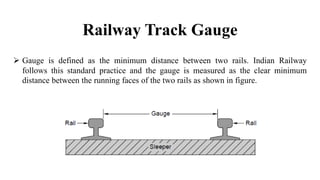
 Gauge is defined as the minimum distance between two rails. Indian Railway
follows this standard practice and the gauge is measured as the clear minimum
distance between the running faces of the two rails as shown in figure.
Problems Caused by Change of Gauge
 The need for uniformity of gauge has been recognized by all the advanced countries of
the world.
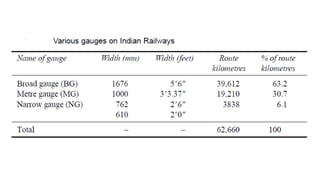
 A number of problems have cropped up in the operation of Indian Railways because of
the use of three gauges. The ill effects of change of gauge(more popularly known as
break of gauge) are numerous; some of these are enumerated here.
Inconvenience to Passengers
 Due to change of gauge, passengers have to change trains mid-journey along with
their luggage, which causes inconvenience such as the following.
(a) Climbing stairs and crossing bridges
(b) Finding seats in the compartments of the later trains
(c) Missing connections with the later trains in case the earlier train is late
(d) Harassment caused by porters
(e) Transporting luggage
(f) Uncertainty and delay in reaching the destination
Difficulty in Trans-shipment of Goods
 Goods have to be trans-shipped at the point where the change of gauge takes place.
This causes the following problems.
(a) Damage to goods during trans-shipment.
(b) Considerable delay in receipt of goods at the destination.
(c) Theft or misplacement of goods during trans-shipment and the subsequent
claims.
(d) Non-availability of adequate and specialized trans-shipment labour and staff,
particularly during strikes.
Inefficient Use of Rolling Stock
 As wagons have to move empty in the direction of the trans-shipment point, they are
not fully utilized. Similarly, idle wagons of one gauge cannot be moved on another
gauge.
Hindrance to Fast Movement of Goods and Passenger
Traffic
 Due to change in the gauge, traffic cannot move fast which becomes a major problem
particularly during emergencies such as war, floods, and accidents.
Additional Facilities at Stations and Yards
• Costly sheds and additional facilities need to be provided for handling the large
volume of goods at trans-shipment points.
• Duplicate equipment and facilities such as yards and platforms need to be provided
for both gauges at trans-shipment points.
Difficulties in Balanced Economic Growth
• The difference in gauge also leads unbalanced economic growth. This happens
because industries set up near MG/NG stations cannot send their goods economically
and efficiently to areas being served by BG stations.
Difficulties in Future Gauge Conversion Projects
• Gauge conversion is quite difficult, as it requires enormous effort to widen existing
tracks.
• Widening the gauge involves heavy civil engineering work such as widening of the
embankment, the bridges and tunnels, as well as the tracks; additionally, a wider
rolling stock is also required.
• During the gauge conversion period, there are operational problems as well since the
traffic has to be slowed down and even suspended for a certain period is order to
execute the work.
Loading Gauge
• The loading gauge represents the maximum width and height to which a
rolling stock, namely, a locomotive, coach, or wagon, can be built or loaded.
• Sometimes, a loading gauge is also used for testing loaded and empty vehicles
as per the maximum moving dimensions prescribed for the section.
• In Indian Railways, the maximum height and width of rolling stock prescribed
as per the loading gauge are given in Table
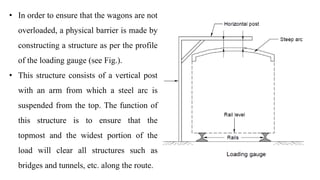
• In order to ensure that the wagons are not
overloaded, a physical barrier is made by
constructing a structure as per the profile
of the loading gauge (see Fig.).
• This structure consists of a vertical post
with an arm from which a steel arc is
suspended from the top. The function of
this structure is to ensure that the
topmost and the widest portion of the
load will clear all structures such as
bridges and tunnels, etc. along the route.
Construction Gauge
• The construction gauge is decided by adding the necessary clearance to the
loading gauge so that vehicles can move safely at the prescribed speed without
any infringement.
• The various fixed structures on railway lines such as bridges, tunnels, and
platform sheds are built in accordance with the construction gauge so that the
sides and top remain clear of the loading gauge.
1. railway track gauge

1. railway track gauge

  • 1.
    RAILWAY, BRIDGE AND TUNNEL CHAPTER– 2 RAILWAY TRACK GAUGE Prepared By:- Prof. Gaurav Jagad Assistant Professor Civil Engineering Department B. H. Gardi College of Engineering and Technology
  • 2.
    Railway Track Gauge Gauge is defined as the minimum distance between two rails. Indian Railway follows this standard practice and the gauge is measured as the clear minimum distance between the running faces of the two rails as shown in figure.
  • 5.
    Problems Caused byChange of Gauge  The need for uniformity of gauge has been recognized by all the advanced countries of the world.  A number of problems have cropped up in the operation of Indian Railways because of the use of three gauges. The ill effects of change of gauge(more popularly known as break of gauge) are numerous; some of these are enumerated here.
  • 6.
    Inconvenience to Passengers Due to change of gauge, passengers have to change trains mid-journey along with their luggage, which causes inconvenience such as the following. (a) Climbing stairs and crossing bridges (b) Finding seats in the compartments of the later trains (c) Missing connections with the later trains in case the earlier train is late (d) Harassment caused by porters (e) Transporting luggage (f) Uncertainty and delay in reaching the destination
  • 7.
    Difficulty in Trans-shipmentof Goods  Goods have to be trans-shipped at the point where the change of gauge takes place. This causes the following problems. (a) Damage to goods during trans-shipment. (b) Considerable delay in receipt of goods at the destination. (c) Theft or misplacement of goods during trans-shipment and the subsequent claims. (d) Non-availability of adequate and specialized trans-shipment labour and staff, particularly during strikes.
  • 8.
    Inefficient Use ofRolling Stock  As wagons have to move empty in the direction of the trans-shipment point, they are not fully utilized. Similarly, idle wagons of one gauge cannot be moved on another gauge. Hindrance to Fast Movement of Goods and Passenger Traffic  Due to change in the gauge, traffic cannot move fast which becomes a major problem particularly during emergencies such as war, floods, and accidents.
  • 9.
    Additional Facilities atStations and Yards • Costly sheds and additional facilities need to be provided for handling the large volume of goods at trans-shipment points. • Duplicate equipment and facilities such as yards and platforms need to be provided for both gauges at trans-shipment points. Difficulties in Balanced Economic Growth • The difference in gauge also leads unbalanced economic growth. This happens because industries set up near MG/NG stations cannot send their goods economically and efficiently to areas being served by BG stations.
  • 10.
    Difficulties in FutureGauge Conversion Projects • Gauge conversion is quite difficult, as it requires enormous effort to widen existing tracks. • Widening the gauge involves heavy civil engineering work such as widening of the embankment, the bridges and tunnels, as well as the tracks; additionally, a wider rolling stock is also required. • During the gauge conversion period, there are operational problems as well since the traffic has to be slowed down and even suspended for a certain period is order to execute the work.
  • 11.
    Loading Gauge • Theloading gauge represents the maximum width and height to which a rolling stock, namely, a locomotive, coach, or wagon, can be built or loaded. • Sometimes, a loading gauge is also used for testing loaded and empty vehicles as per the maximum moving dimensions prescribed for the section. • In Indian Railways, the maximum height and width of rolling stock prescribed as per the loading gauge are given in Table
  • 12.
    • In orderto ensure that the wagons are not overloaded, a physical barrier is made by constructing a structure as per the profile of the loading gauge (see Fig.). • This structure consists of a vertical post with an arm from which a steel arc is suspended from the top. The function of this structure is to ensure that the topmost and the widest portion of the load will clear all structures such as bridges and tunnels, etc. along the route.
  • 13.
    Construction Gauge • Theconstruction gauge is decided by adding the necessary clearance to the loading gauge so that vehicles can move safely at the prescribed speed without any infringement. • The various fixed structures on railway lines such as bridges, tunnels, and platform sheds are built in accordance with the construction gauge so that the sides and top remain clear of the loading gauge.