WELCOME
MALARIA
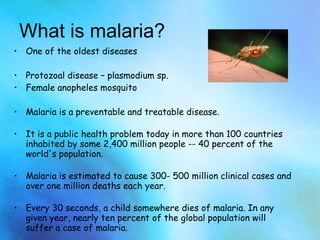
What is malaria? One of the oldest diseases Protozoal disease – plasmodium sp. Female anopheles mosquito Malaria is a preventable and treatable disease. It is a public health problem today in more than 100 countries inhabited by some 2,400 million people -- 40 percent of the world's population. Malaria is estimated to cause 300- 500 million clinical cases and over one million deaths each year. Every 30 seconds, a child somewhere dies of malaria. In any given year, nearly ten percent of the global population will suffer a case of malaria. Most survive after an illness of 10-20 days.
HISTORY OF MALARIA Mal-bad , aria-air----originally thought to be acquired from marshes and stagnant swamps 5th century B.c-  Hippocrates  classified into quotidian , tertian and quartan Roman soldiers too camped away from swamps during war times  Alphonse Laveran  – 1 st  person to try associate malaria to mosquitoes Sir Ronald Ross-  confirmed mosquitoes as hosts for malarial parasite in India
HISTORICAL MILESTONES-I MALARIA PARASITES AND TRANSMISSION 1 ST  defn. by Celsus 1880 –Laveran malarial parasites in blood 1897 –Ronald Ross, P.falciparum and its life cycle in sparrows 1922- P.ovale – Stephens TREATMENT 1600- Juan Lopez peruvian tree bark 1934-chloroquine 1979 -82 chloroquine Resistant sp. 1989 halofantrine ,1991-98 artemisinins established
HISTORICAL MILESTONES-II EPIDEMIOLOGICAL CONTROL 1899- Ross ,antilarval measures in sierra leone 1927 – A.albimanu eradicated in africa 1935-39 India , 1 st  large scale pyrethrum spraying- control rural malaria 1953-National anti-malarial program 1957- concept and practice of malarial eradication –WHO 1998-WHO Roll back malaria
Problem statement WORLD about 109 countries endemic 3.3 billion at risk 247 cases in 2006 97 % from african nations Deaths 8,87,000-  91 % africa!! 85%- children <5 yrs- mainly cerebral malaria Incidence increasing in south Asia Drug resistance – Bhutan,Thailand,myanmar & indonesia
Prevalence map of malaria
Problem statement  INDIA P.falciparum main organism N.E. states,chattisgarh , M.P , A.P ,gujarat are most affected Most of the areas remote and involves tribal population 2005- total—1.80 mn , Pf -0.79 mn 2006- total –1.67 mn , Pf-0.75 mn No of deaths remains same
PROBLEM STATEMENT TAMILNADU Urban more significant Chennai, Erode , salem , dindigul , tuticorin Rural- villupuram , krishnagiri , dharmapuri, areas around saathanur dam , rameswaram  ( chloroquine resistant ) Chennai City contributes 60–70% malaria of Tamil Nadu
Endemic regions of Tamilnadu
Major epidemiological types in india Tribal -limited health infrastructure & lack of drugs  Rural -irrigated areas , moderate health infrastructure Urban -moderate to low endemicity , P.vivax Malaria in project areas-  in areas where there is inflow of people due to construction activities  Border malaria-  along state and international borders, poor administrative control
OTHER TYPES Therapeutic malaria  or malariotherapy-in the 1920s  Julius wagner-jauregg  intentionally induced malaria to treat diseases like neurosyphilis Transfusion malaria  is spread through blood transfusion , onset is early within 3 weeks Imported malaria-  immigrants from endemic areas moving into non-endemic areas spread the disease
WORLD MALARIA DAY 25 th  april Instituted by world health assembly in may,2007 Countries to learn , share and support each other in anti-malarial measures Anti-malarial month- june

1 Malaria Intro

  • 1.
  • 2.
  • 3.
    What is malaria?One of the oldest diseases Protozoal disease – plasmodium sp. Female anopheles mosquito Malaria is a preventable and treatable disease. It is a public health problem today in more than 100 countries inhabited by some 2,400 million people -- 40 percent of the world's population. Malaria is estimated to cause 300- 500 million clinical cases and over one million deaths each year. Every 30 seconds, a child somewhere dies of malaria. In any given year, nearly ten percent of the global population will suffer a case of malaria. Most survive after an illness of 10-20 days.
  • 4.
    HISTORY OF MALARIAMal-bad , aria-air----originally thought to be acquired from marshes and stagnant swamps 5th century B.c- Hippocrates classified into quotidian , tertian and quartan Roman soldiers too camped away from swamps during war times Alphonse Laveran – 1 st person to try associate malaria to mosquitoes Sir Ronald Ross- confirmed mosquitoes as hosts for malarial parasite in India
  • 5.
    HISTORICAL MILESTONES-I MALARIAPARASITES AND TRANSMISSION 1 ST defn. by Celsus 1880 –Laveran malarial parasites in blood 1897 –Ronald Ross, P.falciparum and its life cycle in sparrows 1922- P.ovale – Stephens TREATMENT 1600- Juan Lopez peruvian tree bark 1934-chloroquine 1979 -82 chloroquine Resistant sp. 1989 halofantrine ,1991-98 artemisinins established
  • 6.
    HISTORICAL MILESTONES-II EPIDEMIOLOGICALCONTROL 1899- Ross ,antilarval measures in sierra leone 1927 – A.albimanu eradicated in africa 1935-39 India , 1 st large scale pyrethrum spraying- control rural malaria 1953-National anti-malarial program 1957- concept and practice of malarial eradication –WHO 1998-WHO Roll back malaria
  • 7.
    Problem statement WORLDabout 109 countries endemic 3.3 billion at risk 247 cases in 2006 97 % from african nations Deaths 8,87,000- 91 % africa!! 85%- children <5 yrs- mainly cerebral malaria Incidence increasing in south Asia Drug resistance – Bhutan,Thailand,myanmar & indonesia
  • 8.
  • 9.
    Problem statement INDIA P.falciparum main organism N.E. states,chattisgarh , M.P , A.P ,gujarat are most affected Most of the areas remote and involves tribal population 2005- total—1.80 mn , Pf -0.79 mn 2006- total –1.67 mn , Pf-0.75 mn No of deaths remains same
  • 10.
    PROBLEM STATEMENT TAMILNADUUrban more significant Chennai, Erode , salem , dindigul , tuticorin Rural- villupuram , krishnagiri , dharmapuri, areas around saathanur dam , rameswaram ( chloroquine resistant ) Chennai City contributes 60–70% malaria of Tamil Nadu
  • 11.
  • 12.
    Major epidemiological typesin india Tribal -limited health infrastructure & lack of drugs Rural -irrigated areas , moderate health infrastructure Urban -moderate to low endemicity , P.vivax Malaria in project areas- in areas where there is inflow of people due to construction activities Border malaria- along state and international borders, poor administrative control
  • 13.
    OTHER TYPES Therapeuticmalaria or malariotherapy-in the 1920s Julius wagner-jauregg intentionally induced malaria to treat diseases like neurosyphilis Transfusion malaria is spread through blood transfusion , onset is early within 3 weeks Imported malaria- immigrants from endemic areas moving into non-endemic areas spread the disease
  • 14.
    WORLD MALARIA DAY25 th april Instituted by world health assembly in may,2007 Countries to learn , share and support each other in anti-malarial measures Anti-malarial month- june