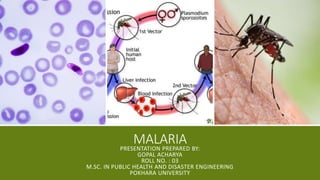
MALARIAPRESENTATION PREPARED BY:
GOPAL ACHARYA
ROLL NO. : 03
M.SC. IN PUBLIC HEALTH AND DISASTER ENGINEERING
POKHARA UNIVERSITY
INTRODUCTION
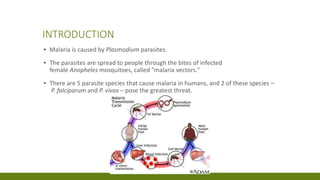
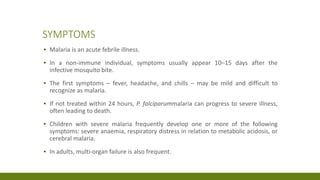
▪ Malaria is caused by Plasmodium parasites.
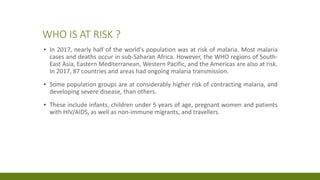
▪ The parasites are spread to people through the bites of infected
female Anopheles mosquitoes, called "malaria vectors."
▪ There are 5 parasite species that cause malaria in humans, and 2 of these species –
P. falciparum and P. vivax – pose the greatest threat.
SYMPTOMS
▪ Malaria is an acute febrile illness.
▪ In a non-immune individual, symptoms usually appear 10–15 days after the
infective mosquito bite.
▪ The first symptoms – fever, headache, and chills – may be mild and difficult to
recognize as malaria.
▪ If not treated within 24 hours, P. falciparummalaria can progress to severe illness,
often leading to death.
▪ Children with severe malaria frequently develop one or more of the following
symptoms: severe anaemia, respiratory distress in relation to metabolic acidosis, or
cerebral malaria.
▪ In adults, multi-organ failure is also frequent.
WHO IS AT RISK ?
▪ In 2017, nearly half of the world's population was at risk of malaria. Most malaria
cases and deaths occur in sub-Saharan Africa. However, the WHO regions of South-
East Asia, Eastern Mediterranean, Western Pacific, and the Americas are also at risk.
In 2017, 87 countries and areas had ongoing malaria transmission.
▪ Some population groups are at considerably higher risk of contracting malaria, and
developing severe disease, than others.
▪ These include infants, children under 5 years of age, pregnant women and patients
with HIV/AIDS, as well as non-immune migrants, and travellers.
DISEASE BURDEN
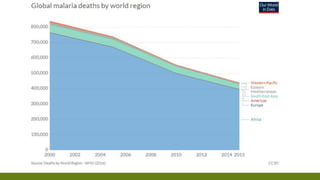
▪ According to the latest World malaria report, released in November 2018, there
were 219 million cases of malaria in 2017, up from 217 million cases in 2016. The
estimated number of malaria deaths stood at 4,35, 000 in 2017, a similar number to
the previous year.
▪ The WHO African Region continues to carry a disproportionately high share of the
global malaria burden. In 2017, the region was home to 92% of malaria cases and
93% of malaria deaths.
▪ In 2017, 5 countries accounted for nearly half of all malaria cases worldwide:
Nigeria (25%), the Democratic Republic of the Congo (11%), Mozambique (5%),
India (4%) and Uganda (4%).
▪ Children under 5 years of age are the most vulnerable group affected by malaria; in
2017, they accounted for 61% (2,66, 000) of all malaria deaths worldwide.
DISEASE BURDEN: NATIONAL
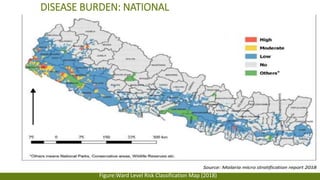
Figure:Ward Level Risk Classification Map (2018)
DISEASE BURDEN : NATIONAL
▪ The wards were designated as high, moderate, low and no risk wards.
▪ High risk wards were identified in 49 wards scattered across 13 districts.
▪ Out of these high-risk wards, 6 wards in Province 2, 1 ward in Province 3, 3 wards in Province 5, 8 wards in
Karnali Province and 31 wards in Sudurpashchim Province while no high-risk ward was detected in Province
1 and Gandaki Province.
▪ Furthermore, moderate risk wards were identified in 153 wards in 19 districts of these moderate risk wards,
1 ward in Province 1, 8 wards in Province 2, 1 ward in Province 3, 1 ward in Gandaki Province, 31 wards in
Province 5, 20 wards in Karnali Province and 91 wards in Sudurpashchim Province.
▪ Malaria transmission is concentrated in the Sudurpashchim and Karnali Province with these two provinces
accounting for approx. 80% high risk burden and around 73% moderate risk burden.
▪ Malaria mortality declined from a peak of 32 deaths reported in 2006 during an outbreak of malaria In
Banke District. The mortality gradually dropped and reached to zero in 2012 and there is no death in 2013 as
well, which is maintained at zero level, till date.
DISEASE BURDEN: NATIONAL
▪ Malaria transmission has reached low level of endemicity in most of the Tarai
regions (plain lands) but malaria infection is increasingly being detected in upper
hilly river valleys, which was traditionally classified as “No Malaria” risk.
▪ incidence is significantly higher in children less than 14 years as compared to
adolescents and adults 15+
MALARIA AND DISASTER
▪ Disasters involving flooding or severe rains can increase mosquito breeding sites.
▪ After a natural disaster a number of behavioral changes can occur that can increase
the impact of malaria.
▪ Loss of housing or fear of collapsing structures can cause people to sleep outside,
where contact with mosquitoes is increased.
DISASTER AND MALARIA
▪ Two to three months following a hurricane, Haiti experienced a severe epidemic of
malaria that caused an estimated 75,000 cases. massive increases in mosquito
breeding sites due to rainfall and flooding.
▪ After an earthquake in Costa Rica in 1991, malaria incidence increased between
1,600 - 4,700 in some affected areas.
▪ These increases were associated with people being afraid to sleep indoors,
disruption of malaria control activities in the area, and environmental changes due
to the earthquake and flooding that allowed explosive growth in mosquito
numbers.
PREVENTIVE MEASURES
▪ Insecticide-treated mosquito nets :Sleeping under an insecticide-treated net (ITN) can reduce contact
between mosquitoes and humans by providing both a physical barrier and an insecticidal effect. In 2017,
about half of all people at risk of malaria in Africa were protected by an insecticide-treated net
▪ Indoor spraying with residual insecticides: Indoor residual spraying (IRS) with insecticides is another
powerful way to rapidly reduce malaria transmission. It involves spraying the inside of housing structures
with an insecticide, typically once or twice per year. Globally, IRS protection declined from a peak of 5%
in 2010 to 3% in 2017
▪ Antimalarial drugs: For travellers, malaria can be prevented through chemoprophylaxis, which
suppresses the blood stage of malaria infections, thereby preventing malaria disease. For pregnant
women living in moderate-to-high transmission areas, WHO recommends intermittent preventive
treatment with sulfadoxine-pyrimethamine, at each scheduled antenatal visit after the first trimester.
▪ Diagnosis and treatment: Early diagnosis and treatment of malaria reduces disease and prevents
deaths. The best available treatment, particularly for P. falciparum malaria, is artemisinin-based
combination therapy (ACT).
▪ Surveillance: Surveillance entails tracking of the disease and programmatic responses, and taking action
based on the data received. Effective surveillance is required at all points on the path to malaria
elimination. In March 2018, WHO released a reference manual on malaria surveillance, monitoring and
evaluation.
▪ Vaccines against malaria : RTS,S/AS01 (RTS,S) is the first and, to date, the only vaccine to show partial
protection against malaria in young children.
GLOBAL TECHNICAL STRATEGY FOR MALARIA 2016-2030
▪ Reducing malaria case incidence by at least 90% by 2030.
▪ Reducing malaria mortality rates by at least 90% by 2030.
▪ Eliminating malaria in at least 35 countries by 2030.
▪ Preventing a resurgence of malaria in all countries that are malaria-free.
INITIATIVES TO FREE MALARIA
“Roll Back Malaria”
Roll Back Malaria is an initiative intended to halve the suffering caused by this disease
by 2010. The initiative is being developed as a social movement.
Action is directed by national authorities backed by a global partnership which
consists of development agencies, banks, private sector groups and researchers.
Roll Back Malaria will encourage and promote malaria research which hopefully will
result in new medicines, vaccines and other tools which will improve the chances of
reducing malaria-related deaths and suffering.
The initiative also supports research and development of new products and tools to
control malaria.
INITIATIVES TO FREE MALARIA
"High burden high impact approach"
A new country-driven response – “High burden to high impact” – was launched in Mozambique in
November 2018.
▪ The approach will be driven by the 11 countries that carry the highest burden of the disease
(Burkina Faso, Cameroon, Democratic Republic of the Congo, Ghana, India, Mali, Mozambique,
Niger, Nigeria, Uganda and United Republic of Tanzania). Key elements include:
▪ Political will to reduce the toll of malaria;
▪ Strategic information to drive impact;
▪ Better guidance, policies and strategies; and
▪ A coordinated national malaria response.
▪ “High burden to high impact” builds on the principle that no one should die from a disease that
can be prevented and diagnosed, and that is entirely curable with available treatments.
ROLE OF NEPAL TO FREE MALARIA
▪ Nepal has surpassed the Millennium Development Goal 6 by reducing malaria
morbidity and mortality rates by more than 50% in 2010 as compared to 2000.
Therefore, Government of Nepal has set a vision of Malaria free Nepal by 2025.
Current National Malaria Strategic Plan (NMSP) 2014-2025 was developed based on
the epidemiology of malaria derived from 2012 micro-stratification. The aim of
NMSP is to attain “Malaria Free Nepal by 2025”.
▪ The proportion of P. falciparum infections is in decreasing trend and reached 7% in
FY 2074/75 as compared to the previous year
REFERENCES
▪ WORLD MALARIA REPORT 2018, WHO
▪ Demographic and Health Survey 2016, Nepal
▪ Nepal Malaria Programme Review 7-16 June 2010
▪ Annual Report, Department of Health Services 2074/2075
THANK YOU

3 malaria ppt

  • 1.
    MALARIAPRESENTATION PREPARED BY: GOPALACHARYA ROLL NO. : 03 M.SC. IN PUBLIC HEALTH AND DISASTER ENGINEERING POKHARA UNIVERSITY
  • 2.
    INTRODUCTION ▪ Malaria iscaused by Plasmodium parasites. ▪ The parasites are spread to people through the bites of infected female Anopheles mosquitoes, called "malaria vectors." ▪ There are 5 parasite species that cause malaria in humans, and 2 of these species – P. falciparum and P. vivax – pose the greatest threat.
  • 3.
    SYMPTOMS ▪ Malaria isan acute febrile illness. ▪ In a non-immune individual, symptoms usually appear 10–15 days after the infective mosquito bite. ▪ The first symptoms – fever, headache, and chills – may be mild and difficult to recognize as malaria. ▪ If not treated within 24 hours, P. falciparummalaria can progress to severe illness, often leading to death. ▪ Children with severe malaria frequently develop one or more of the following symptoms: severe anaemia, respiratory distress in relation to metabolic acidosis, or cerebral malaria. ▪ In adults, multi-organ failure is also frequent.
  • 4.
    WHO IS ATRISK ? ▪ In 2017, nearly half of the world's population was at risk of malaria. Most malaria cases and deaths occur in sub-Saharan Africa. However, the WHO regions of South- East Asia, Eastern Mediterranean, Western Pacific, and the Americas are also at risk. In 2017, 87 countries and areas had ongoing malaria transmission. ▪ Some population groups are at considerably higher risk of contracting malaria, and developing severe disease, than others. ▪ These include infants, children under 5 years of age, pregnant women and patients with HIV/AIDS, as well as non-immune migrants, and travellers.
  • 6.
    DISEASE BURDEN ▪ Accordingto the latest World malaria report, released in November 2018, there were 219 million cases of malaria in 2017, up from 217 million cases in 2016. The estimated number of malaria deaths stood at 4,35, 000 in 2017, a similar number to the previous year. ▪ The WHO African Region continues to carry a disproportionately high share of the global malaria burden. In 2017, the region was home to 92% of malaria cases and 93% of malaria deaths. ▪ In 2017, 5 countries accounted for nearly half of all malaria cases worldwide: Nigeria (25%), the Democratic Republic of the Congo (11%), Mozambique (5%), India (4%) and Uganda (4%). ▪ Children under 5 years of age are the most vulnerable group affected by malaria; in 2017, they accounted for 61% (2,66, 000) of all malaria deaths worldwide.
  • 7.
    DISEASE BURDEN: NATIONAL Figure:WardLevel Risk Classification Map (2018)
  • 8.
    DISEASE BURDEN :NATIONAL ▪ The wards were designated as high, moderate, low and no risk wards. ▪ High risk wards were identified in 49 wards scattered across 13 districts. ▪ Out of these high-risk wards, 6 wards in Province 2, 1 ward in Province 3, 3 wards in Province 5, 8 wards in Karnali Province and 31 wards in Sudurpashchim Province while no high-risk ward was detected in Province 1 and Gandaki Province. ▪ Furthermore, moderate risk wards were identified in 153 wards in 19 districts of these moderate risk wards, 1 ward in Province 1, 8 wards in Province 2, 1 ward in Province 3, 1 ward in Gandaki Province, 31 wards in Province 5, 20 wards in Karnali Province and 91 wards in Sudurpashchim Province. ▪ Malaria transmission is concentrated in the Sudurpashchim and Karnali Province with these two provinces accounting for approx. 80% high risk burden and around 73% moderate risk burden. ▪ Malaria mortality declined from a peak of 32 deaths reported in 2006 during an outbreak of malaria In Banke District. The mortality gradually dropped and reached to zero in 2012 and there is no death in 2013 as well, which is maintained at zero level, till date.
  • 9.
    DISEASE BURDEN: NATIONAL ▪Malaria transmission has reached low level of endemicity in most of the Tarai regions (plain lands) but malaria infection is increasingly being detected in upper hilly river valleys, which was traditionally classified as “No Malaria” risk. ▪ incidence is significantly higher in children less than 14 years as compared to adolescents and adults 15+
  • 10.
    MALARIA AND DISASTER ▪Disasters involving flooding or severe rains can increase mosquito breeding sites. ▪ After a natural disaster a number of behavioral changes can occur that can increase the impact of malaria. ▪ Loss of housing or fear of collapsing structures can cause people to sleep outside, where contact with mosquitoes is increased.
  • 11.
    DISASTER AND MALARIA ▪Two to three months following a hurricane, Haiti experienced a severe epidemic of malaria that caused an estimated 75,000 cases. massive increases in mosquito breeding sites due to rainfall and flooding. ▪ After an earthquake in Costa Rica in 1991, malaria incidence increased between 1,600 - 4,700 in some affected areas. ▪ These increases were associated with people being afraid to sleep indoors, disruption of malaria control activities in the area, and environmental changes due to the earthquake and flooding that allowed explosive growth in mosquito numbers.
  • 12.
    PREVENTIVE MEASURES ▪ Insecticide-treatedmosquito nets :Sleeping under an insecticide-treated net (ITN) can reduce contact between mosquitoes and humans by providing both a physical barrier and an insecticidal effect. In 2017, about half of all people at risk of malaria in Africa were protected by an insecticide-treated net ▪ Indoor spraying with residual insecticides: Indoor residual spraying (IRS) with insecticides is another powerful way to rapidly reduce malaria transmission. It involves spraying the inside of housing structures with an insecticide, typically once or twice per year. Globally, IRS protection declined from a peak of 5% in 2010 to 3% in 2017 ▪ Antimalarial drugs: For travellers, malaria can be prevented through chemoprophylaxis, which suppresses the blood stage of malaria infections, thereby preventing malaria disease. For pregnant women living in moderate-to-high transmission areas, WHO recommends intermittent preventive treatment with sulfadoxine-pyrimethamine, at each scheduled antenatal visit after the first trimester. ▪ Diagnosis and treatment: Early diagnosis and treatment of malaria reduces disease and prevents deaths. The best available treatment, particularly for P. falciparum malaria, is artemisinin-based combination therapy (ACT). ▪ Surveillance: Surveillance entails tracking of the disease and programmatic responses, and taking action based on the data received. Effective surveillance is required at all points on the path to malaria elimination. In March 2018, WHO released a reference manual on malaria surveillance, monitoring and evaluation. ▪ Vaccines against malaria : RTS,S/AS01 (RTS,S) is the first and, to date, the only vaccine to show partial protection against malaria in young children.
  • 13.
    GLOBAL TECHNICAL STRATEGYFOR MALARIA 2016-2030 ▪ Reducing malaria case incidence by at least 90% by 2030. ▪ Reducing malaria mortality rates by at least 90% by 2030. ▪ Eliminating malaria in at least 35 countries by 2030. ▪ Preventing a resurgence of malaria in all countries that are malaria-free.
  • 14.
    INITIATIVES TO FREEMALARIA “Roll Back Malaria” Roll Back Malaria is an initiative intended to halve the suffering caused by this disease by 2010. The initiative is being developed as a social movement. Action is directed by national authorities backed by a global partnership which consists of development agencies, banks, private sector groups and researchers. Roll Back Malaria will encourage and promote malaria research which hopefully will result in new medicines, vaccines and other tools which will improve the chances of reducing malaria-related deaths and suffering. The initiative also supports research and development of new products and tools to control malaria.
  • 15.
    INITIATIVES TO FREEMALARIA "High burden high impact approach" A new country-driven response – “High burden to high impact” – was launched in Mozambique in November 2018. ▪ The approach will be driven by the 11 countries that carry the highest burden of the disease (Burkina Faso, Cameroon, Democratic Republic of the Congo, Ghana, India, Mali, Mozambique, Niger, Nigeria, Uganda and United Republic of Tanzania). Key elements include: ▪ Political will to reduce the toll of malaria; ▪ Strategic information to drive impact; ▪ Better guidance, policies and strategies; and ▪ A coordinated national malaria response. ▪ “High burden to high impact” builds on the principle that no one should die from a disease that can be prevented and diagnosed, and that is entirely curable with available treatments.
  • 16.
    ROLE OF NEPALTO FREE MALARIA ▪ Nepal has surpassed the Millennium Development Goal 6 by reducing malaria morbidity and mortality rates by more than 50% in 2010 as compared to 2000. Therefore, Government of Nepal has set a vision of Malaria free Nepal by 2025. Current National Malaria Strategic Plan (NMSP) 2014-2025 was developed based on the epidemiology of malaria derived from 2012 micro-stratification. The aim of NMSP is to attain “Malaria Free Nepal by 2025”. ▪ The proportion of P. falciparum infections is in decreasing trend and reached 7% in FY 2074/75 as compared to the previous year
  • 17.
    REFERENCES ▪ WORLD MALARIAREPORT 2018, WHO ▪ Demographic and Health Survey 2016, Nepal ▪ Nepal Malaria Programme Review 7-16 June 2010 ▪ Annual Report, Department of Health Services 2074/2075
  • 18.

Editor's Notes

  • #8 Nepal’s malaria control programme began in 1954, mainly in the Tarai belt of central Nepal with support from the United States.
  • #17 Millennium Development Goal 6: Combat HIV/AIDS, malaria and other diseases
  • #18 Millennium Development Goal 6: Combat HIV/AIDS, malaria and other diseases