AXIS BANK
MANIPAL UNIVERSITY
BANGALORE CAMPUS
Trends and
Technology in
Banking
The Technology Revolution
• The impact of technology on the real &
financial world around the central banks
– E-governance
– Choice of Channels , Confidence and
Convenience to the end-user
– Efficiency
– Facilitating growth of products and services
Technology and Banks
So why are banks interested?
– The widespread adoption of technology .
– The impact of technology on every single
core central banking function
– Supervision and Regulation
– Currency Management
– Monetary & Financial Stability

– The potential technology offers to central banks
for more effective processes and functions.
Technology and Banking
The Quintessence Nature of Banking harmonizes
closely with Technology -

Mass transaction & items processing
–
–
–
–

Pervasive branch network
Global Operations
Complex credit calculations
Innovative Risk Management
Regulation and Supervision –
The Challenge
• Technology has …
– opened up new markets, products, services,
delivery channels .
– opened up a market for “risks” – derivatives.
– thrown up the challenge of financing tech firms &
IT innovation.
IT in Banking
• Technology that holds the key to the future
success of Indian Banking. The
significance of technology is greatly felt in
the financial sector in view of the
competitive advantage for banks resulting
in efficient customer service.
IT in Banking
Why there is need for IT in Banking?
•
•
•
•
•

To handle huge volume of transaction with ease.
To introduce innovative new services
To bring cost effectiveness in handling payments
To complete operation with great speed
To provide better customer services by obtaining multi
services from one counter itself.
• To make ease of inter-branch reconciliation.
• To ensure data accuracy and reduce frauds.
Increasing Interconnectivity
• Stand Alone Computer System
Best suited for the decision-making process, which involves processing and analysis of
data.

• Multi-user System
All information is kept and processed at the main central machine and various terminals
are attached to the main computer. Most of the banking system are developed using the
centralized computing concept.

• Branch-level Computerization
The concept of LAN is becoming popular for branch computerization in banks.
Customer interface is at the maximum at the branch level . The emphasis on online
transaction processing at the branch level.

• Total Branch Automation
All the customers and business transactions are done with the help of computers.
Ease of Payments
•
•
•
•
•
•
•
•
•
•
•

Automated Teller Machines(ATMs)
Core Banking Solution(CBS)
Electronic Banking(E-Banking)
Electronic money(E-money)
Electronic Cheque(E-cheque)
Debit Card
Credit Card
Mobile Banking
Tele Banking
Internet Banking
EFT, NEFT, RTGS, ECS
ECS-Electronic Clearance
Service
• an alternative method of effecting bulk payment
Products where you can use it for
transactions
General Concept:
Transaction:
•Facilitates automatic money
Single USER source
transfer from user’s bank
(Banks, companies,
account to a third party.
Govt. Dept(s))

Systematic Investment Plans in mutual Funds
Premium payment of insurance policies
Multiple Destination
Payment of home loan A/c Holders
(Customers/Investors)
Income Tax Refund

•After the ECS is authorized
Utility bill payment
by the user by RBI(15
Managed,the banks pays centres) and other banks
directly to the third party on
RBI(21 by SBI and 29 by others)
his behalf.

Advantages: (1) Timely Payment
(2) Be sure of refund

on behalf of
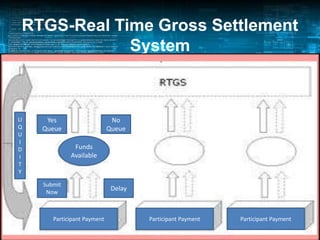
RTGS-Real Time Gross Settlement
System
Payment Request
FEATURES:

RTGS Working
No bundling up of transactions, RTGS
concept
Outward
2. No
Rejection (PI) netting
3. No deferral of final settlement

1.
RTGS
Inward

LI
Yes
Q
Queue
U
Member
I HOST
Bank
D
SYSTEM
I
T
Y

No
Payment Request
Queue
Funds (PI)
Success
Available

PI
Banking Easy CBS

Payment Request

Member
IFTP/RT
Bank
GS

BENEFITS:
Sender 1. full value of individual transaction
Settlement
Sender Settlement
Participant interface (PI) - RTGS Client Notification
for the participating
Notification
Submit
2. Real time immediate value transfer
banks
Delay
Now
RTGS
IFTP - Inter-bank Funds Transfer Processor
IAS - Integrated Accounting System
Inward
CFMS - Centralised Funds ManagementReturn
System
INFINET - Indian FInance NETwork

Participant Payment

Payment
Participant
Enquiry Payment

RTGS
Outward
Return

Participant Payment
E-payment Services: ECheque
Payment Transaction Sequence in E- Cheque System:

• E-cheques are another form of electronic
tokens
•Advantages: (1) eliminates the need for customer education that
To accommodate multiple entities
prefer (2) Electronic on credit or through some
to pay cheques are much faster.
(3) Guarantee that the cheque would be honored.
mechanism other than cash.
--No offline entering of accounts to get account head statements.
--Consumers able to keep track of all their expenses.
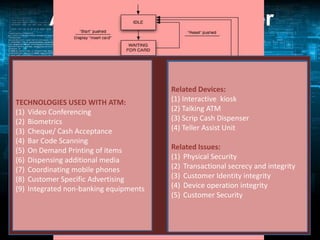
ATM-Automated Teller

Machine
H/W Block Diagram:
• Electronic telecommunications device that
Components involved in an ATM Working
Related Devices:
enables the clients of a financial institution
(1) Interactive kiosk
TECHNOLOGIES USED WITH ATM:
(2) Talking ATM
to Conferencing
(1) Video perform financial transactions without
(3) Scrip Cash Dispenser
(2) Biometrics
the need for a cashier,(4) Teller Assist Unit
human clerk or
(3) Cheque/ Cash Acceptance
bank teller.
(4) Bar Code Scanning

(5)
(6)
(7)
(8)
(9)

On Demand Printing of items
Dispensing additional media
Coordinating mobile phones
Customer Specific Advertising
Integrated non-banking equipments

Related Issues:
(1) Physical Security
(2) Transactional secrecy and integrity
(3) Customer Identity integrity
(4) Device operation integrity
(5) Customer Security

• automated banking machine (ABM),
cash machine, cashpoint,
cashline
POS (Point Of Sale)
POS is a computer terminal for tansaction.

Contains costumer information in a bank
database.
During transaction customer account
debited and retailer credited.
TELE BANKING
 Facilitates customer to do non-cash related
banking on telephone.

 Automatic voice recorder used for simpler
queries and transaction.
 Manned phone terminal for complicated
queries.
 Easy for customer to operate from their
place.
EDI (ELECTRONIC DATA
INTERCHANGE)
EDI is the electronics exchange of
business document.
Universally accepted format between
trading partners.
Transmission of financial information and
payment in electronic format.
EFT (Electronic Fund
Transfer)
Transfer of fund from own account to
receiver account.
Complete details of customer is needed.
RBI is the service provider of EFT.
IMPLICATION OF IT IN
BANKING






ANYWHERE , ANYPLACE AND ANYTIME BANKING
TIMELESS AD PLACELESS BANKING
CONVENIENCE BANKING
DISMANTLING OF PHYSICAL STRUCTURE
GOODBYE TO TRADITIONAL INSTRUMENTS AND INVITATION TO
NEW INSTRUMENTS
 DISAPPEARANCE OF CONVENTIONAL RISK AND ARRIVAL OF NEW
RISKS
 LEADING TO CURRENCY-LESS MONETARY SYSTEM
CHALLENGES IN
IMPLEMENTATION
•
•
•
•
•

Choice of right channel
IT investment on ROI
Penetration of IT in rural areas
Technological Obsolescence
Security concerns
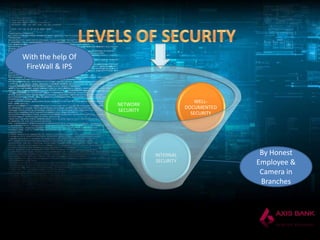
With the help Of
FireWall & IPS

WELLDOCUMENTED
SECURITY

NETWORK
SECURITY

INTERNAL
SECURITY

By Honest
Employee &
Camera in
Branches
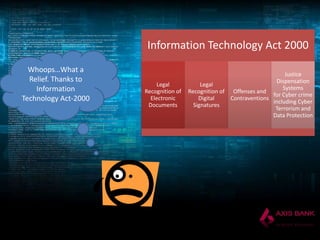
Information Technology Act 2000
Whoops…What a
Relief. Thanks to
Information
Technology Act-2000

Legal
Recognition of
Electronic
Documents

Justice
Dispensation
Legal
Systems
Recognition of Offenses and
for Cyber crime
Digital
Contraventions
including Cyber
Signatures
Terrorism and
Data Protection
BEYOND CORE BANKING
1.Increased adoption of e-payments and
mobile banking.
2.Focus towards systems and processes .
3.Cost and profitability management.
4.Internal effectiveness and efficiency.
5.Vision of a comprehensive infrastructure.
6.Training and techniques.
7.Standards and expectations.
ROLE OF IT AS A
BUSINESS TRANSFORMER
•
•
•
•
•

Defining fundamental infrastructure goals
Chief information officers (CIOs)
IT fits into one of three broad categories:1. UTILITY
2. PROTECTOR

• 3.

PERFORMER
CONCLUSION
• Future for banking sector is going to make
rapid straights in near future.
Trends and technology in banking

Trends and technology in banking

  • 1.
  • 2.
  • 3.
    The Technology Revolution •The impact of technology on the real & financial world around the central banks – E-governance – Choice of Channels , Confidence and Convenience to the end-user – Efficiency – Facilitating growth of products and services
  • 4.
    Technology and Banks Sowhy are banks interested? – The widespread adoption of technology . – The impact of technology on every single core central banking function – Supervision and Regulation – Currency Management – Monetary & Financial Stability – The potential technology offers to central banks for more effective processes and functions.
  • 5.
    Technology and Banking TheQuintessence Nature of Banking harmonizes closely with Technology - Mass transaction & items processing – – – – Pervasive branch network Global Operations Complex credit calculations Innovative Risk Management
  • 6.
    Regulation and Supervision– The Challenge • Technology has … – opened up new markets, products, services, delivery channels . – opened up a market for “risks” – derivatives. – thrown up the challenge of financing tech firms & IT innovation.
  • 7.
    IT in Banking •Technology that holds the key to the future success of Indian Banking. The significance of technology is greatly felt in the financial sector in view of the competitive advantage for banks resulting in efficient customer service.
  • 8.
    IT in Banking Whythere is need for IT in Banking? • • • • • To handle huge volume of transaction with ease. To introduce innovative new services To bring cost effectiveness in handling payments To complete operation with great speed To provide better customer services by obtaining multi services from one counter itself. • To make ease of inter-branch reconciliation. • To ensure data accuracy and reduce frauds.
  • 9.
    Increasing Interconnectivity • StandAlone Computer System Best suited for the decision-making process, which involves processing and analysis of data. • Multi-user System All information is kept and processed at the main central machine and various terminals are attached to the main computer. Most of the banking system are developed using the centralized computing concept. • Branch-level Computerization The concept of LAN is becoming popular for branch computerization in banks. Customer interface is at the maximum at the branch level . The emphasis on online transaction processing at the branch level. • Total Branch Automation All the customers and business transactions are done with the help of computers.
  • 10.
    Ease of Payments • • • • • • • • • • • AutomatedTeller Machines(ATMs) Core Banking Solution(CBS) Electronic Banking(E-Banking) Electronic money(E-money) Electronic Cheque(E-cheque) Debit Card Credit Card Mobile Banking Tele Banking Internet Banking EFT, NEFT, RTGS, ECS
  • 11.
    ECS-Electronic Clearance Service • analternative method of effecting bulk payment Products where you can use it for transactions General Concept: Transaction: •Facilitates automatic money Single USER source transfer from user’s bank (Banks, companies, account to a third party. Govt. Dept(s)) Systematic Investment Plans in mutual Funds Premium payment of insurance policies Multiple Destination Payment of home loan A/c Holders (Customers/Investors) Income Tax Refund •After the ECS is authorized Utility bill payment by the user by RBI(15 Managed,the banks pays centres) and other banks directly to the third party on RBI(21 by SBI and 29 by others) his behalf. Advantages: (1) Timely Payment (2) Be sure of refund on behalf of
  • 12.
    RTGS-Real Time GrossSettlement System Payment Request FEATURES: RTGS Working No bundling up of transactions, RTGS concept Outward 2. No Rejection (PI) netting 3. No deferral of final settlement 1. RTGS Inward LI Yes Q Queue U Member I HOST Bank D SYSTEM I T Y No Payment Request Queue Funds (PI) Success Available PI Banking Easy CBS Payment Request Member IFTP/RT Bank GS BENEFITS: Sender 1. full value of individual transaction Settlement Sender Settlement Participant interface (PI) - RTGS Client Notification for the participating Notification Submit 2. Real time immediate value transfer banks Delay Now RTGS IFTP - Inter-bank Funds Transfer Processor IAS - Integrated Accounting System Inward CFMS - Centralised Funds ManagementReturn System INFINET - Indian FInance NETwork Participant Payment Payment Participant Enquiry Payment RTGS Outward Return Participant Payment
  • 13.
    E-payment Services: ECheque PaymentTransaction Sequence in E- Cheque System: • E-cheques are another form of electronic tokens •Advantages: (1) eliminates the need for customer education that To accommodate multiple entities prefer (2) Electronic on credit or through some to pay cheques are much faster. (3) Guarantee that the cheque would be honored. mechanism other than cash. --No offline entering of accounts to get account head statements. --Consumers able to keep track of all their expenses.
  • 14.
    ATM-Automated Teller Machine H/W BlockDiagram: • Electronic telecommunications device that Components involved in an ATM Working Related Devices: enables the clients of a financial institution (1) Interactive kiosk TECHNOLOGIES USED WITH ATM: (2) Talking ATM to Conferencing (1) Video perform financial transactions without (3) Scrip Cash Dispenser (2) Biometrics the need for a cashier,(4) Teller Assist Unit human clerk or (3) Cheque/ Cash Acceptance bank teller. (4) Bar Code Scanning (5) (6) (7) (8) (9) On Demand Printing of items Dispensing additional media Coordinating mobile phones Customer Specific Advertising Integrated non-banking equipments Related Issues: (1) Physical Security (2) Transactional secrecy and integrity (3) Customer Identity integrity (4) Device operation integrity (5) Customer Security • automated banking machine (ABM), cash machine, cashpoint, cashline
  • 15.
    POS (Point OfSale) POS is a computer terminal for tansaction. Contains costumer information in a bank database. During transaction customer account debited and retailer credited.
  • 16.
    TELE BANKING  Facilitatescustomer to do non-cash related banking on telephone.  Automatic voice recorder used for simpler queries and transaction.  Manned phone terminal for complicated queries.  Easy for customer to operate from their place.
  • 17.
    EDI (ELECTRONIC DATA INTERCHANGE) EDIis the electronics exchange of business document. Universally accepted format between trading partners. Transmission of financial information and payment in electronic format.
  • 18.
    EFT (Electronic Fund Transfer) Transferof fund from own account to receiver account. Complete details of customer is needed. RBI is the service provider of EFT.
  • 19.
    IMPLICATION OF ITIN BANKING      ANYWHERE , ANYPLACE AND ANYTIME BANKING TIMELESS AD PLACELESS BANKING CONVENIENCE BANKING DISMANTLING OF PHYSICAL STRUCTURE GOODBYE TO TRADITIONAL INSTRUMENTS AND INVITATION TO NEW INSTRUMENTS  DISAPPEARANCE OF CONVENTIONAL RISK AND ARRIVAL OF NEW RISKS  LEADING TO CURRENCY-LESS MONETARY SYSTEM
  • 20.
    CHALLENGES IN IMPLEMENTATION • • • • • Choice ofright channel IT investment on ROI Penetration of IT in rural areas Technological Obsolescence Security concerns
  • 21.
    With the helpOf FireWall & IPS WELLDOCUMENTED SECURITY NETWORK SECURITY INTERNAL SECURITY By Honest Employee & Camera in Branches
  • 22.
    Information Technology Act2000 Whoops…What a Relief. Thanks to Information Technology Act-2000 Legal Recognition of Electronic Documents Justice Dispensation Legal Systems Recognition of Offenses and for Cyber crime Digital Contraventions including Cyber Signatures Terrorism and Data Protection
  • 23.
    BEYOND CORE BANKING 1.Increasedadoption of e-payments and mobile banking. 2.Focus towards systems and processes . 3.Cost and profitability management. 4.Internal effectiveness and efficiency. 5.Vision of a comprehensive infrastructure. 6.Training and techniques. 7.Standards and expectations.
  • 24.
    ROLE OF ITAS A BUSINESS TRANSFORMER • • • • • Defining fundamental infrastructure goals Chief information officers (CIOs) IT fits into one of three broad categories:1. UTILITY 2. PROTECTOR • 3. PERFORMER
  • 25.
    CONCLUSION • Future forbanking sector is going to make rapid straights in near future.