Gene Mapping By: Lauren Mary
Process of Gene Mapping 1) Dividing the chromosomes into smaller fragments that can be propagated and characterized 2) Ordering (mapping) them to correspond to their respective locations on the chromosomes.  3) Determine the base sequence of each of the ordered DNA fragments. http://www.dnalc.org/view/15477-The-public-Human-Genome-Project-mapping-the-genome-sequencing-and-reassembly-3D-animation-.htm
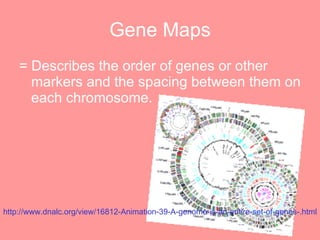
Gene Maps =   Describes the order of genes or other markers and the spacing between them on each chromosome. http://www.dnalc.org/view/16812-Animation-39-A-genome-is-an-entire-set-of-genes-.html
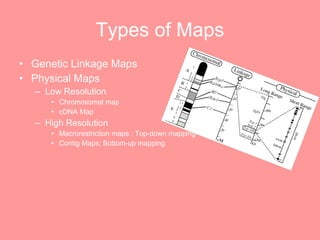
Types of Maps Genetic Linkage Maps Physical Maps Low Resolution Chromosomal map cDNA Map High Resolution Macrorestriction maps : Top-down mapping Contig Maps: Bottom-up mapping
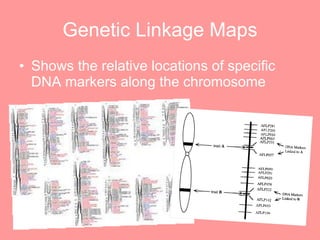
Genetic Linkage Maps Shows the relative locations of specific DNA markers along the chromosome
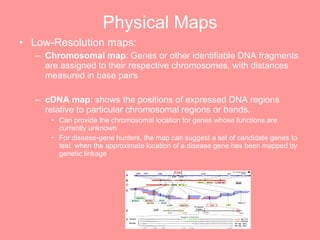
Physical Maps Low-Resolution maps: Chromosomal map : Genes or other identifiable DNA fragments are assigned to their respective chromosomes, with distances measured in base pairs cDNA map : shows the positions of expressed DNA regions relative to particular chromosomal regions or bands. Can provide the chromosomal location for genes whose functions are currently unknown  For disease-gene hunters, the map can suggest a set of candidate genes to test  when the approximate location of a disease gene has been mapped by genetic linkage
Physical Maps High-Resolution maps: Macrorestriction maps :  Top-down mapping :  a single chromosome is cut into lg. pieces, which are ordered and subdivided ; the smaller pieces are mapped further. Resulting in the depiction of the order and distance between sites at which rare-cutter enzymes cleave. Contig maps: Bottom-up mapping :  an approach involving cutting the chromosome into small pieces, each of which is cloned and ordered Resulting with the ordered fragments forming contiguous DNA blocks.
Value of Maps Genetics maps: Can locate the exact location of several important disease genes . i.e. cystic fibrosis, sickle cell , Tay-Sachs disease, and fragile X syndrome . Physical Maps: will eventually be used to analyze physical traits associated with chromosomal abnormalities A completed map will provide biologists with a “Rosetta Stone” for studying human biology  A completed map will also enable medial researches to begin to unravel the mechanisms of inherited diseases.
Disadvantages Will require substantial improvements in the rate, efficiency , and reliability of standard sequencing procedures. Hard to correlate mapping data from different laboratories b/c of differences in generating, isolating, and mapping DNA fragments.
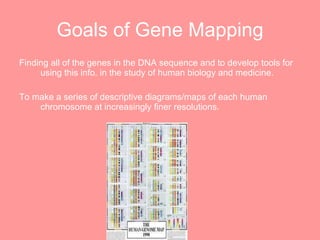
Goals of Gene Mapping Finding all of the genes in the DNA sequence and to develop tools for using this info. in the study of human biology and medicine. To make a series of descriptive diagrams/maps of each human chromosome at increasingly finer resolutions.

1 gene mapping presintaion

  • 1.
    Gene Mapping By:Lauren Mary
  • 2.
    Process of GeneMapping 1) Dividing the chromosomes into smaller fragments that can be propagated and characterized 2) Ordering (mapping) them to correspond to their respective locations on the chromosomes. 3) Determine the base sequence of each of the ordered DNA fragments. http://www.dnalc.org/view/15477-The-public-Human-Genome-Project-mapping-the-genome-sequencing-and-reassembly-3D-animation-.htm
  • 3.
    Gene Maps = Describes the order of genes or other markers and the spacing between them on each chromosome. http://www.dnalc.org/view/16812-Animation-39-A-genome-is-an-entire-set-of-genes-.html
  • 4.
    Types of MapsGenetic Linkage Maps Physical Maps Low Resolution Chromosomal map cDNA Map High Resolution Macrorestriction maps : Top-down mapping Contig Maps: Bottom-up mapping
  • 5.
    Genetic Linkage MapsShows the relative locations of specific DNA markers along the chromosome
  • 6.
    Physical Maps Low-Resolutionmaps: Chromosomal map : Genes or other identifiable DNA fragments are assigned to their respective chromosomes, with distances measured in base pairs cDNA map : shows the positions of expressed DNA regions relative to particular chromosomal regions or bands. Can provide the chromosomal location for genes whose functions are currently unknown For disease-gene hunters, the map can suggest a set of candidate genes to test when the approximate location of a disease gene has been mapped by genetic linkage
  • 7.
    Physical Maps High-Resolutionmaps: Macrorestriction maps : Top-down mapping : a single chromosome is cut into lg. pieces, which are ordered and subdivided ; the smaller pieces are mapped further. Resulting in the depiction of the order and distance between sites at which rare-cutter enzymes cleave. Contig maps: Bottom-up mapping : an approach involving cutting the chromosome into small pieces, each of which is cloned and ordered Resulting with the ordered fragments forming contiguous DNA blocks.
  • 8.
    Value of MapsGenetics maps: Can locate the exact location of several important disease genes . i.e. cystic fibrosis, sickle cell , Tay-Sachs disease, and fragile X syndrome . Physical Maps: will eventually be used to analyze physical traits associated with chromosomal abnormalities A completed map will provide biologists with a “Rosetta Stone” for studying human biology A completed map will also enable medial researches to begin to unravel the mechanisms of inherited diseases.
  • 9.
    Disadvantages Will requiresubstantial improvements in the rate, efficiency , and reliability of standard sequencing procedures. Hard to correlate mapping data from different laboratories b/c of differences in generating, isolating, and mapping DNA fragments.
  • 10.
    Goals of GeneMapping Finding all of the genes in the DNA sequence and to develop tools for using this info. in the study of human biology and medicine. To make a series of descriptive diagrams/maps of each human chromosome at increasingly finer resolutions.