Gene Mapping
By Laura Melissa Ordoñez Sierra
MEDICAL UTILITY BIBLIOGRAHPY GENE MAPPING
By: Laura Melissa Ordonez
Molecular Biology
Teacher: Lina Martinez
• Duke University. "Scientists map
genomic atlas of your inner fish gut:
Genetics of digestion little-changed
in 420 million years." ScienceDaily.
ScienceDaily, 29 August 2017.
www.sciencedaily.com/releases/20
17/08/170829164555.htm
.
• Martinez sanchez, Lina Maria.
Biologia Molecular. 7 ed. Medellin:
UPB. Fac. medicina
• Sanford-Burnham Prebys Medical
Discovery Institute. "Where do heart
cells come from? Id genes play
surprise role in cardiac
development." ScienceDaily.
ScienceDaily, 22 August 2017.
<www.sciencedaily.com/releases/2
017/08/170822104843.htm>.
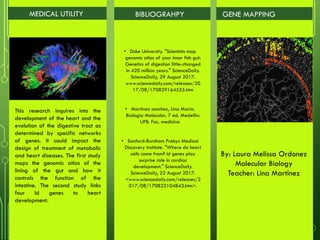
This research inquires into the
development of the heart and the
evolution of the digestive tract as
determined by specific networks
of genes. It could impact the
design of treatment of metabolic
and heart diseases. The first study

maps the genomic atlas of the
lining of the gut and how it
controls the function of the
intestine. The second study links
four Id genes to heart
development.
INTRODUCTION GENETICS OF INTESTINAL
FUNCTION
ID GENES AND CARDIAC
DEVELOPMENT
Gene mapping is the graphic
representation of of the order
and location of genes in each
chromosome as well as other
DNA regions.
This process requires known
relative positions of genetic
markers in order to study the
frequency of recombination
between them and any new
gene or sequence. This allow to
pinpoint their locus on the map.
Gene maps are measured in
centimorgan units (cM). One cM
equals to the distance between
two loci undergoing
recombination in 1 percent of
meiosis.
.
What are some
characteristics of this gene
map?
This map used comparative
biology to estimate the activity
of ancient genome common to
different vertebrae species.
What did they find?
They identified a common set
of genes with shared patterns
of activity in specific regions
along the intestine.
How did they do it?
They established zebrafish as
the experimental platform for
studying the level of
conservation of regulatory
switches transplanted from
other species.
Personal opinion
This research could break
ground into the treatment of
bowel diseases by
manipulating genetic
regulatory elements.
What did they discover?
They discovered that the
removal of the four Id
genes resulted in mouse
embryos without hearts.
How did they do it?
They identified these genes
trough CRISPR-Cas9 gene
editing and microRNA
screening. In particular,
CRISPR allowed them to
knock out gene by gene,
and then all four, to asses
the level of damage done
to undifferentiated cells.
Personal opinion
The study could provide
new tools in the
regeneration of damaged
heart tissue. It also offers
positive outcomes that could
garner support for stem cell
research.
INTRODUCTION
INTRODUCTION
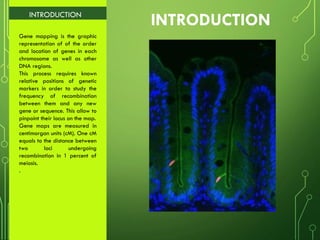
Gene mapping is the graphic
representation of of the order
and location of genes in each
chromosome as well as other
DNA regions.
This process requires known
relative positions of genetic
markers in order to study the
frequency of recombination
between them and any new
gene or sequence. This allow to
pinpoint their locus on the map.
Gene maps are measured in
centimorgan units (cM). One cM
equals to the distance between
two loci undergoing
recombination in 1 percent of
meiosis.
.
GENETICS OF INTESTINAL
FUNCTION
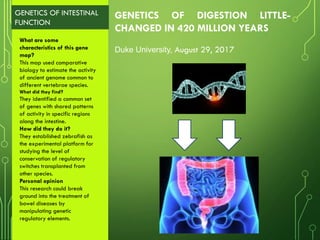
GENETICS OF DIGESTION LITTLE-
CHANGED IN 420 MILLION YEARS
Duke University, August 29, 2017
What are some
characteristics of this gene
map?
This map used comparative
biology to estimate the activity
of ancient genome common to
different vertebrae species.
What did they find?
They identified a common set
of genes with shared patterns
of activity in specific regions
along the intestine.
How did they do it?
They established zebrafish as
the experimental platform for
studying the level of
conservation of regulatory
switches transplanted from
other species.
Personal opinion
This research could break
ground into the treatment of
bowel diseases by
manipulating genetic
regulatory elements.
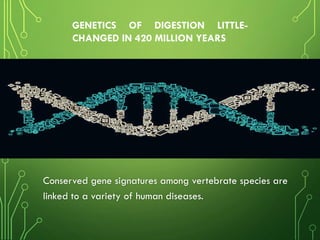
Conserved gene signatures among vertebrate species are
linked to a variety of human diseases.
GENETICS OF DIGESTION LITTLE-
CHANGED IN 420 MILLION YEARS
The conserved genetic signature is
controlled by regulatory elements
that are also shared between
species.
GENETICS OF DIGESTION LITTLE-
CHANGED IN 420 MILLION YEARS
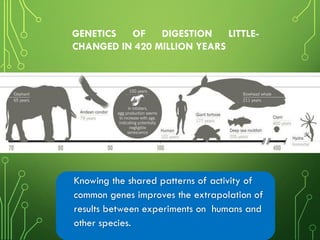
Knowing the shared patterns of activity of
common genes improves the extrapolation of
results between experiments on humans and
other species.
GENETICS OF DIGESTION LITTLE-
CHANGED IN 420 MILLION YEARS
MEDICAL UTILITY
MEDICAL UTILITY
This study brings
into question the
manipulation of
regulatory elements
to control the
expression of genes
linked to bowel
diseases. It also
leads to the
development of
treatments in
animal models
given the common
gene network
across vertebrate
species, thus
minimizing adverse
effects in human
subjects.
PERSONAL OPINION
I think the study improves the
reliability of using animal models to
study genes involved in the
pathophysiology of bowel diseases.
ID GENES PLAY SURPRISE ROLE IN
CARDIAC DEVELOPMENT
Sanford-Burnham Prebys Medical Discovery Institute,
August 22, 2017
ID GENES AND CARDIAC
DEVELOPMENT
What did they discover?
They discovered that the
removal of the four Id
genes resulted in mouse
embryos without hearts.
How did they do it?
They identified these genes
trough CRISPR-Cas9 gene
editing and microRNA
screening. In particular,
CRISPR allowed them to
knock out gene by gene,
and then all four, to asses
the level of damage done
to undifferentiated cells.
Personal opinion
The study could provide
new tools in the
regeneration of damaged
heart tissue. It also offers
positive outcomes that could
garner support for stem cell
research.
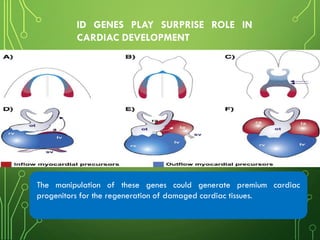
The manipulation of these genes could generate premium cardiac
progenitors for the regeneration of damaged cardiac tissues.
ID GENES PLAY SURPRISE ROLE IN
CARDIAC DEVELOPMENT
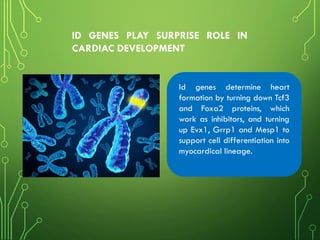
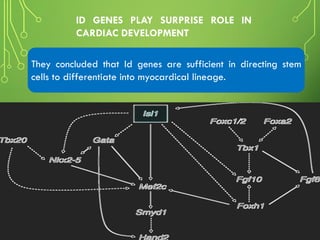
Id genes determine heart
formation by turning down Tcf3
and Foxa2 proteins, which
work as inhibitors, and turning
up Evx1, Grrp1 and Mesp1 to
support cell differentiation into
myocardical lineage.
ID GENES PLAY SURPRISE ROLE IN
CARDIAC DEVELOPMENT
They concluded that Id genes are sufficient in directing stem
cells to differentiate into myocardical lineage.
ID GENES PLAY SURPRISE ROLE IN
CARDIAC DEVELOPMENT
MEDICAL UTILITY
This new data about the
role of genes in heart
development could have
implications in the use of
gene therapy to
regenerate damaged
tissue and thus improve the
outlook of currents
treatments for heart
disease. It could also be
used to prevent the
apparition of congenital
heart disease in embryos.
MEDICAL UTILITY
I think that development of this
technology could result in an affordable
and mainstream approach to the
treatment of heart disease.
PERSONAL OPINION
BIBLIOGRAPHY
• Duke University. "Scientists map genomic atlas
of your inner fish gut: Genetics of digestion
little-changed in 420 million years."
ScienceDaily. ScienceDaily, 29 August 2017.
www.sciencedaily.com/releases/2017/08/170
829164555.htm
• Martinez Sanchez, Lina Maria. Biología
Molecular. 7 ed. Medellin: UPB. Facultad de
medicina.
• Sanford-Burnham Prebys Medical Discovery
Institute. "Where do heart cells come from? Id
genes play surprise role in cardiac
development." ScienceDaily. ScienceDaily, 22
August 2017.
<www.sciencedaily.com/releases/2017/08/1
70822104843.htm>.
Gene mapping

Gene mapping

  • 1.
    Gene Mapping By LauraMelissa Ordoñez Sierra
  • 2.
    MEDICAL UTILITY BIBLIOGRAHPYGENE MAPPING By: Laura Melissa Ordonez Molecular Biology Teacher: Lina Martinez • Duke University. "Scientists map genomic atlas of your inner fish gut: Genetics of digestion little-changed in 420 million years." ScienceDaily. ScienceDaily, 29 August 2017. www.sciencedaily.com/releases/20 17/08/170829164555.htm . • Martinez sanchez, Lina Maria. Biologia Molecular. 7 ed. Medellin: UPB. Fac. medicina • Sanford-Burnham Prebys Medical Discovery Institute. "Where do heart cells come from? Id genes play surprise role in cardiac development." ScienceDaily. ScienceDaily, 22 August 2017. <www.sciencedaily.com/releases/2 017/08/170822104843.htm>. This research inquires into the development of the heart and the evolution of the digestive tract as determined by specific networks of genes. It could impact the design of treatment of metabolic and heart diseases. The first study maps the genomic atlas of the lining of the gut and how it controls the function of the intestine. The second study links four Id genes to heart development.
  • 3.
    INTRODUCTION GENETICS OFINTESTINAL FUNCTION ID GENES AND CARDIAC DEVELOPMENT Gene mapping is the graphic representation of of the order and location of genes in each chromosome as well as other DNA regions. This process requires known relative positions of genetic markers in order to study the frequency of recombination between them and any new gene or sequence. This allow to pinpoint their locus on the map. Gene maps are measured in centimorgan units (cM). One cM equals to the distance between two loci undergoing recombination in 1 percent of meiosis. . What are some characteristics of this gene map? This map used comparative biology to estimate the activity of ancient genome common to different vertebrae species. What did they find? They identified a common set of genes with shared patterns of activity in specific regions along the intestine. How did they do it? They established zebrafish as the experimental platform for studying the level of conservation of regulatory switches transplanted from other species. Personal opinion This research could break ground into the treatment of bowel diseases by manipulating genetic regulatory elements. What did they discover? They discovered that the removal of the four Id genes resulted in mouse embryos without hearts. How did they do it? They identified these genes trough CRISPR-Cas9 gene editing and microRNA screening. In particular, CRISPR allowed them to knock out gene by gene, and then all four, to asses the level of damage done to undifferentiated cells. Personal opinion The study could provide new tools in the regeneration of damaged heart tissue. It also offers positive outcomes that could garner support for stem cell research.
  • 4.
    INTRODUCTION INTRODUCTION Gene mapping isthe graphic representation of of the order and location of genes in each chromosome as well as other DNA regions. This process requires known relative positions of genetic markers in order to study the frequency of recombination between them and any new gene or sequence. This allow to pinpoint their locus on the map. Gene maps are measured in centimorgan units (cM). One cM equals to the distance between two loci undergoing recombination in 1 percent of meiosis. .
  • 5.
    GENETICS OF INTESTINAL FUNCTION GENETICSOF DIGESTION LITTLE- CHANGED IN 420 MILLION YEARS Duke University, August 29, 2017 What are some characteristics of this gene map? This map used comparative biology to estimate the activity of ancient genome common to different vertebrae species. What did they find? They identified a common set of genes with shared patterns of activity in specific regions along the intestine. How did they do it? They established zebrafish as the experimental platform for studying the level of conservation of regulatory switches transplanted from other species. Personal opinion This research could break ground into the treatment of bowel diseases by manipulating genetic regulatory elements.
  • 6.
    Conserved gene signaturesamong vertebrate species are linked to a variety of human diseases. GENETICS OF DIGESTION LITTLE- CHANGED IN 420 MILLION YEARS
  • 7.
    The conserved geneticsignature is controlled by regulatory elements that are also shared between species. GENETICS OF DIGESTION LITTLE- CHANGED IN 420 MILLION YEARS
  • 8.
    Knowing the sharedpatterns of activity of common genes improves the extrapolation of results between experiments on humans and other species. GENETICS OF DIGESTION LITTLE- CHANGED IN 420 MILLION YEARS
  • 9.
    MEDICAL UTILITY MEDICAL UTILITY Thisstudy brings into question the manipulation of regulatory elements to control the expression of genes linked to bowel diseases. It also leads to the development of treatments in animal models given the common gene network across vertebrate species, thus minimizing adverse effects in human subjects.
  • 10.
    PERSONAL OPINION I thinkthe study improves the reliability of using animal models to study genes involved in the pathophysiology of bowel diseases.
  • 11.
    ID GENES PLAYSURPRISE ROLE IN CARDIAC DEVELOPMENT Sanford-Burnham Prebys Medical Discovery Institute, August 22, 2017 ID GENES AND CARDIAC DEVELOPMENT What did they discover? They discovered that the removal of the four Id genes resulted in mouse embryos without hearts. How did they do it? They identified these genes trough CRISPR-Cas9 gene editing and microRNA screening. In particular, CRISPR allowed them to knock out gene by gene, and then all four, to asses the level of damage done to undifferentiated cells. Personal opinion The study could provide new tools in the regeneration of damaged heart tissue. It also offers positive outcomes that could garner support for stem cell research.
  • 12.
    The manipulation ofthese genes could generate premium cardiac progenitors for the regeneration of damaged cardiac tissues. ID GENES PLAY SURPRISE ROLE IN CARDIAC DEVELOPMENT
  • 13.
    Id genes determineheart formation by turning down Tcf3 and Foxa2 proteins, which work as inhibitors, and turning up Evx1, Grrp1 and Mesp1 to support cell differentiation into myocardical lineage. ID GENES PLAY SURPRISE ROLE IN CARDIAC DEVELOPMENT
  • 14.
    They concluded thatId genes are sufficient in directing stem cells to differentiate into myocardical lineage. ID GENES PLAY SURPRISE ROLE IN CARDIAC DEVELOPMENT
  • 15.
    MEDICAL UTILITY This newdata about the role of genes in heart development could have implications in the use of gene therapy to regenerate damaged tissue and thus improve the outlook of currents treatments for heart disease. It could also be used to prevent the apparition of congenital heart disease in embryos. MEDICAL UTILITY
  • 16.
    I think thatdevelopment of this technology could result in an affordable and mainstream approach to the treatment of heart disease. PERSONAL OPINION
  • 17.
    BIBLIOGRAPHY • Duke University."Scientists map genomic atlas of your inner fish gut: Genetics of digestion little-changed in 420 million years." ScienceDaily. ScienceDaily, 29 August 2017. www.sciencedaily.com/releases/2017/08/170 829164555.htm • Martinez Sanchez, Lina Maria. Biología Molecular. 7 ed. Medellin: UPB. Facultad de medicina. • Sanford-Burnham Prebys Medical Discovery Institute. "Where do heart cells come from? Id genes play surprise role in cardiac development." ScienceDaily. ScienceDaily, 22 August 2017. <www.sciencedaily.com/releases/2017/08/1 70822104843.htm>.