Unit 1
Properties of Fluids, Fluid Statics,
Pressure Measurement
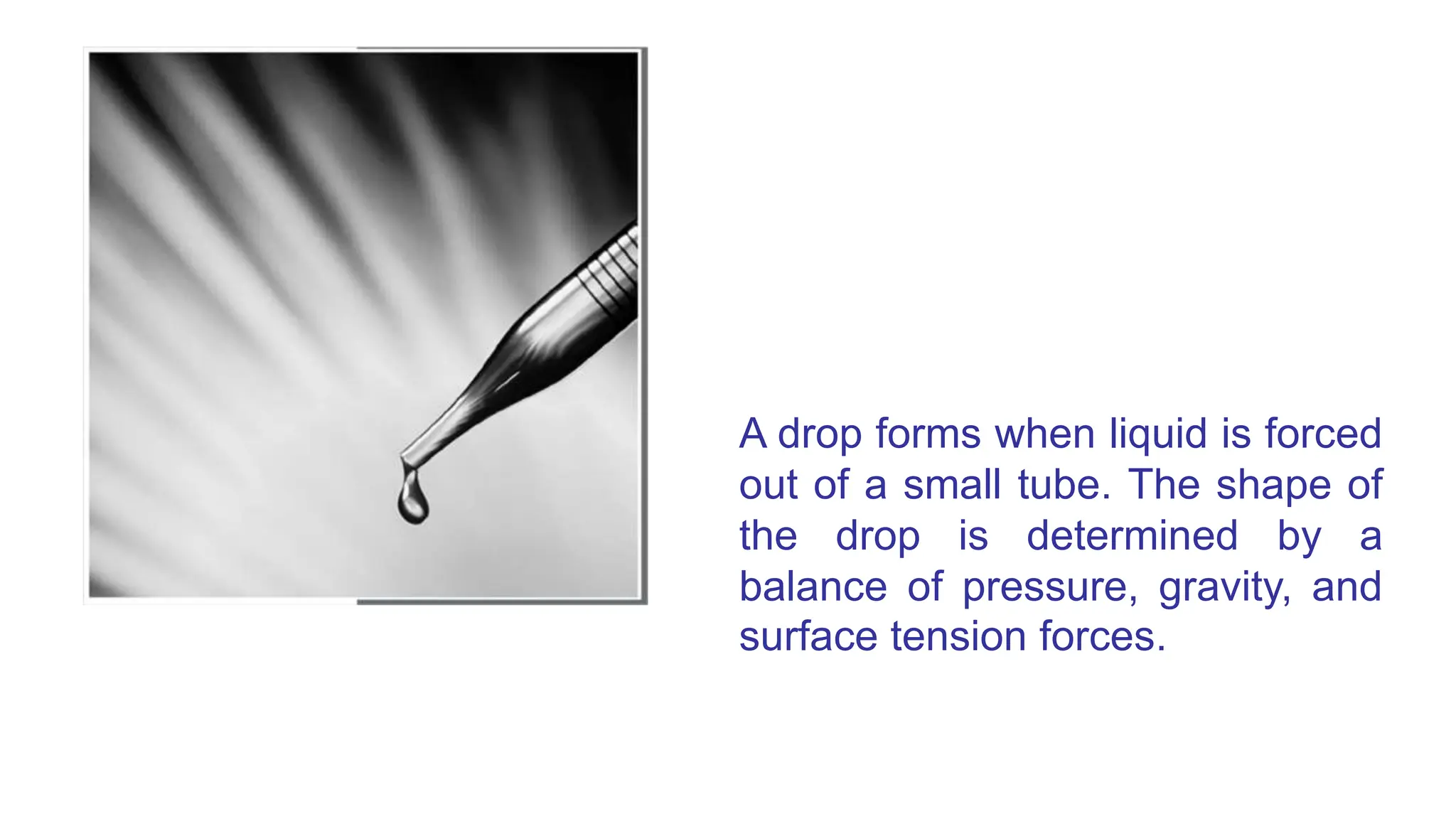
A drop forms when liquid is forced
out of a small tube. The shape of
the drop is determined by a
balance of pressure, gravity, and
surface tension forces.
INTRODUCTION
Property: Any characteristic of a system.
• Some familiar properties are pressure P,
temperature T, volume V, and mass m.
• Properties are considered to be either
intensive or extensive.
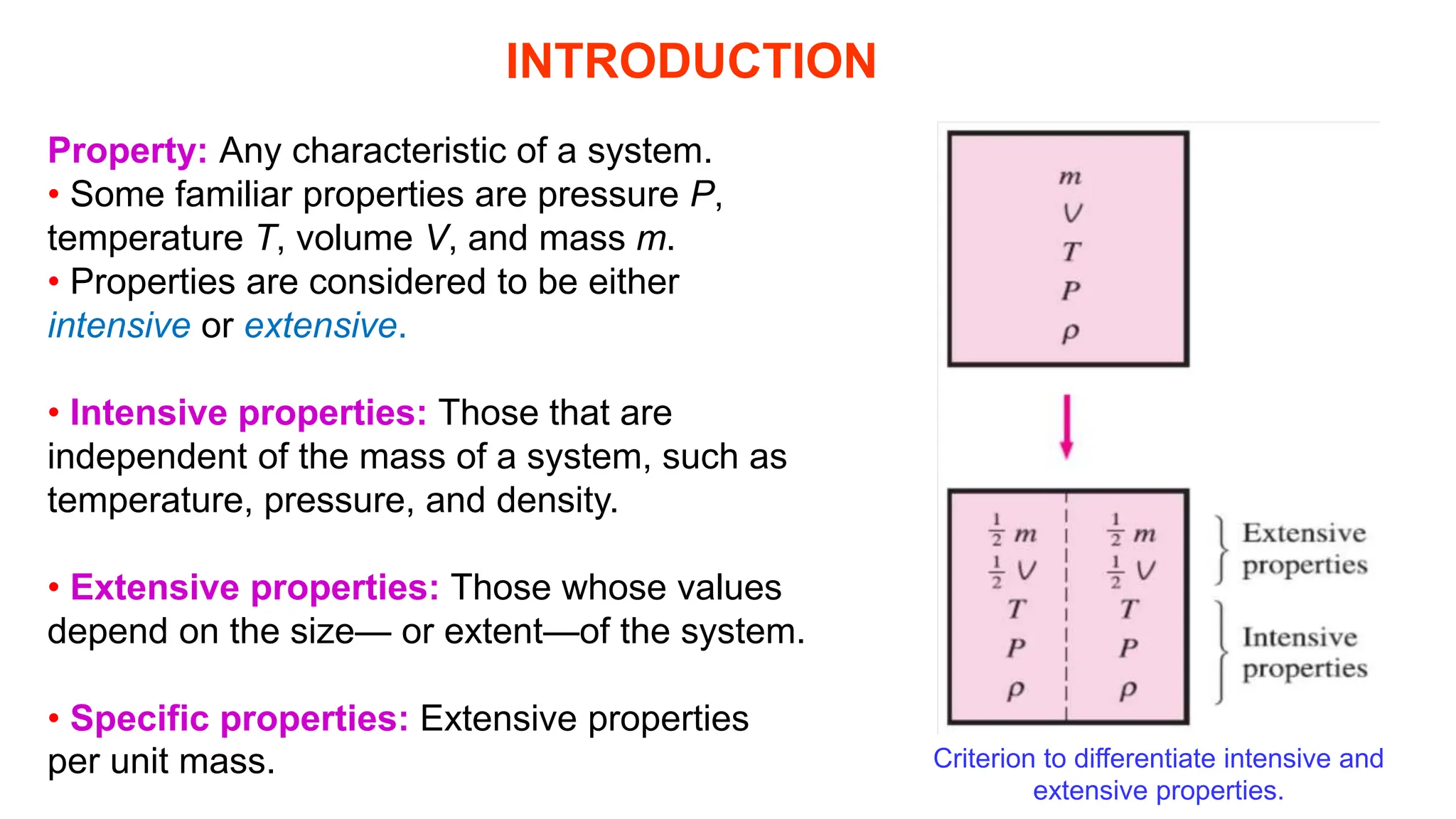
• Intensive properties: Those that are
independent of the mass of a system, such as
temperature, pressure, and density.
• Extensive properties: Those whose values
depend on the size— or extent—of the system.
• Specific properties: Extensive properties
per unit mass. Criterion to differentiate intensive and
extensive properties.
Continuum
• In a fluid system, the intermolecular spacing between the
fluid particles is treated as negligible and the entire fluid mass
system is assumed as continuous distribution of mass, which
is known as continuum.
• The continuum idealization allows us to treat properties as
point functions and to assume the properties vary continually
in space with no jump discontinuities.
• This idealization is valid as long as the size of the system we
deal with is large relative to the space between the molecules.
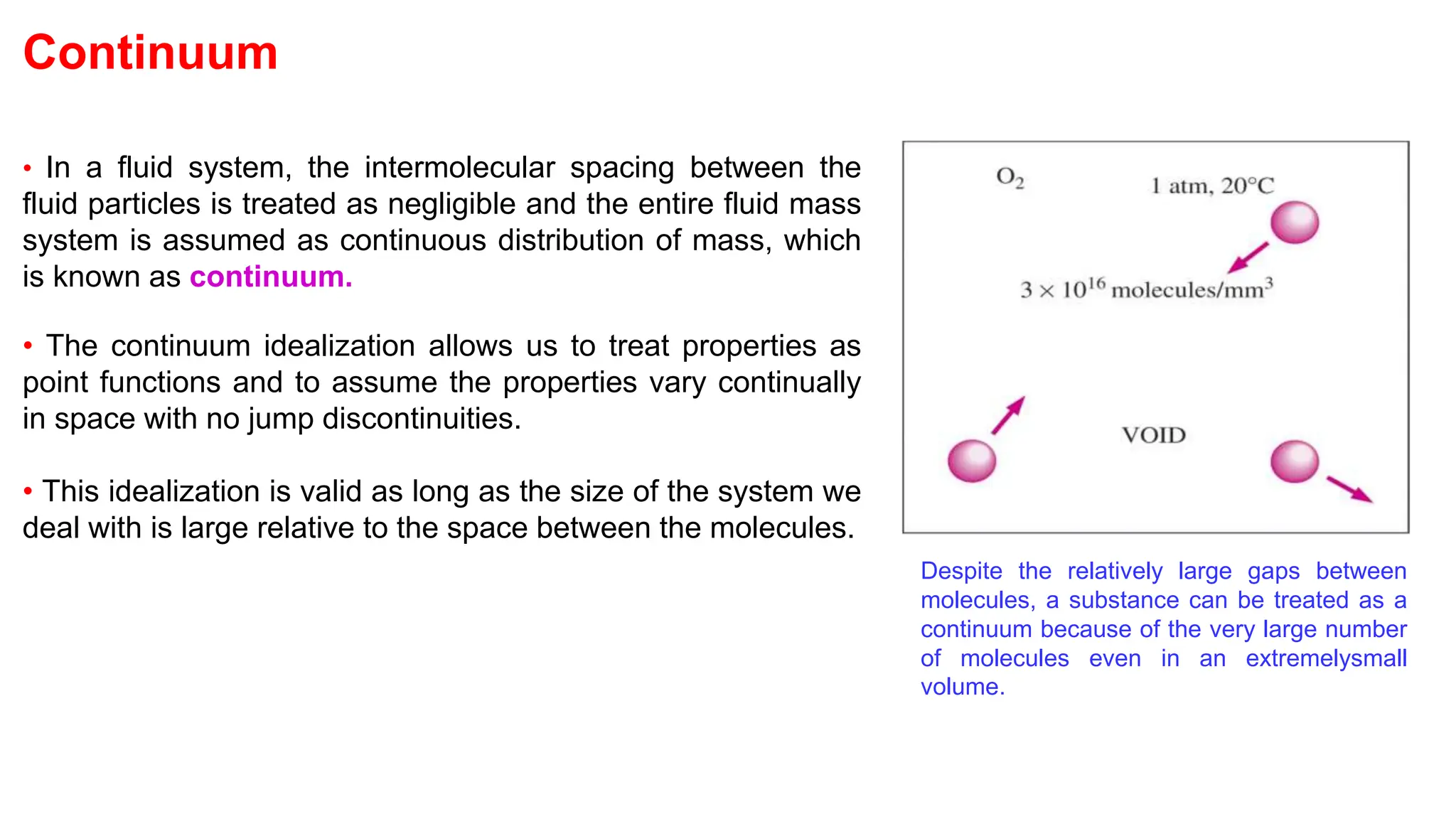
Despite the relatively large gaps between
molecules, a substance can be treated as a
continuum because of the very large number
of molecules even in an extremelysmall
volume.
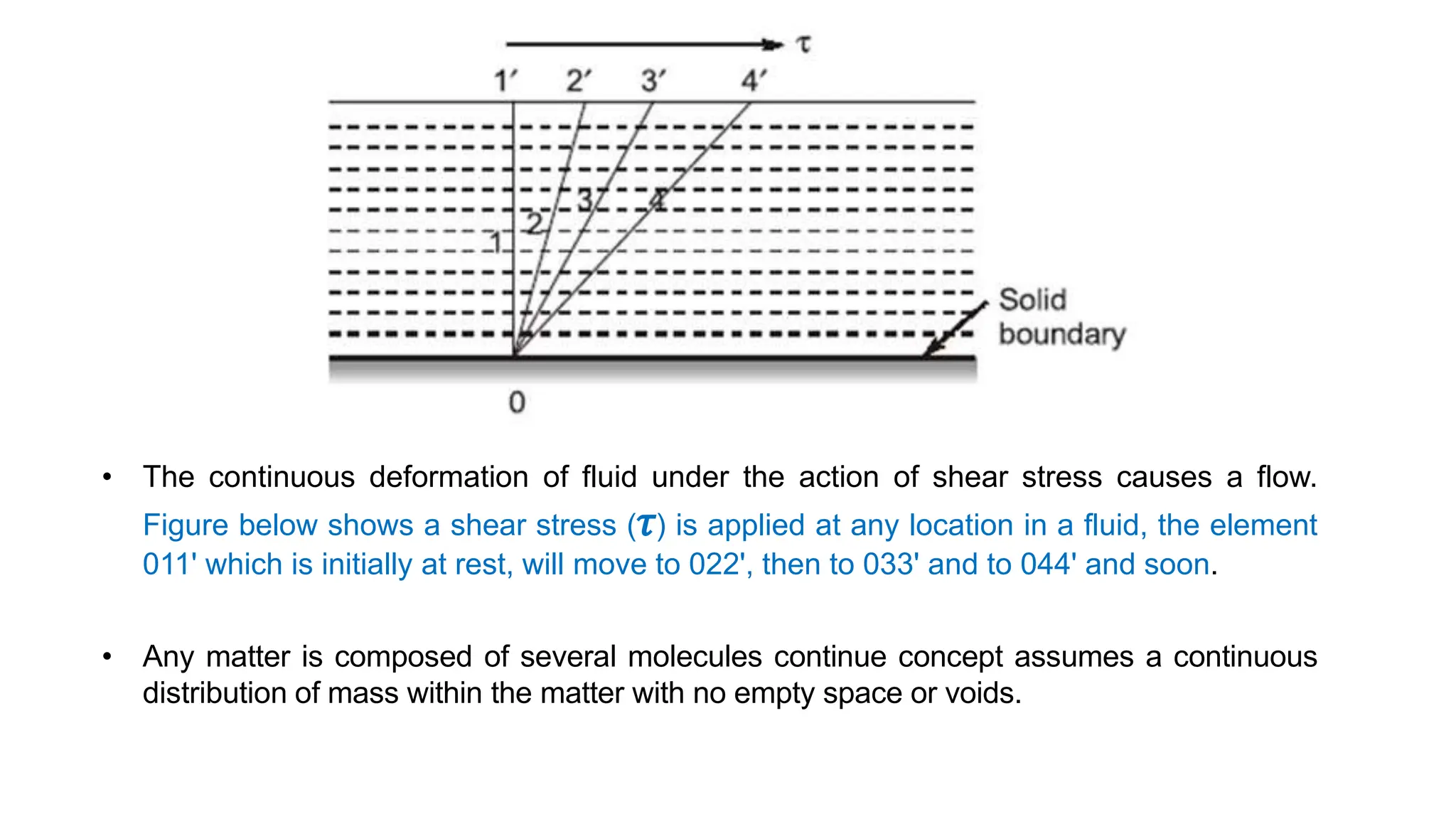
• The continuous deformation of fluid under the action of shear stress causes a flow.
Figure below shows a shear stress (𝜏) is applied at any location in a fluid, the element
011' which is initially at rest, will move to 022', then to 033' and to 044' and soon.
• Any matter is composed of several molecules continue concept assumes a continuous
distribution of mass within the matter with no empty space or voids.
DENSITY AND SPECIFIC GRAVITY
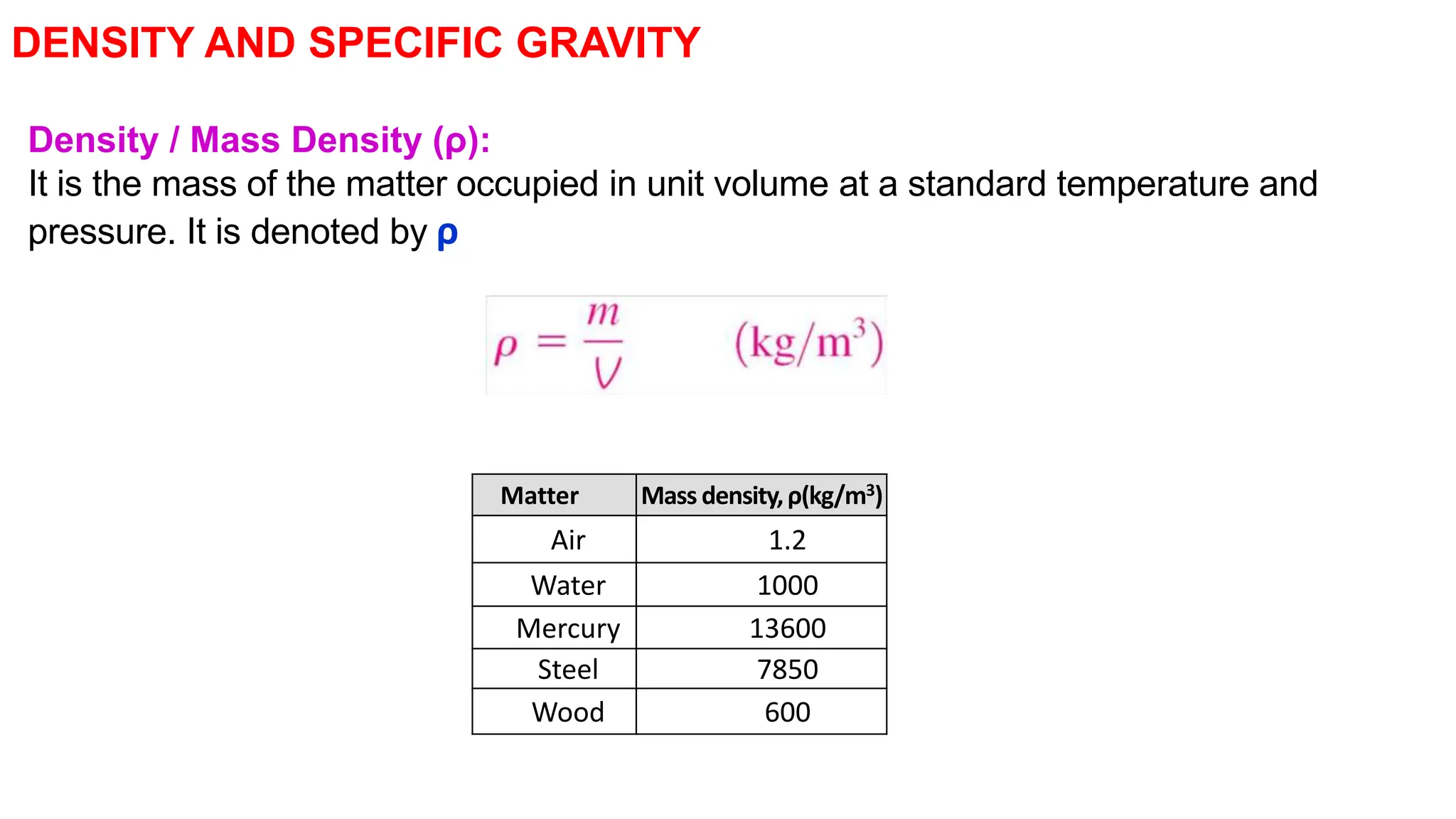
Density / Mass Density (ρ):
It is the mass of the matter occupied in unit volume at a standard temperature and
pressure. It is denoted by ρ
Matter Mass density,ρ(kg/m3)
Air 1.2
Water 1000
Mercury 13600
Steel 7850
Wood 600
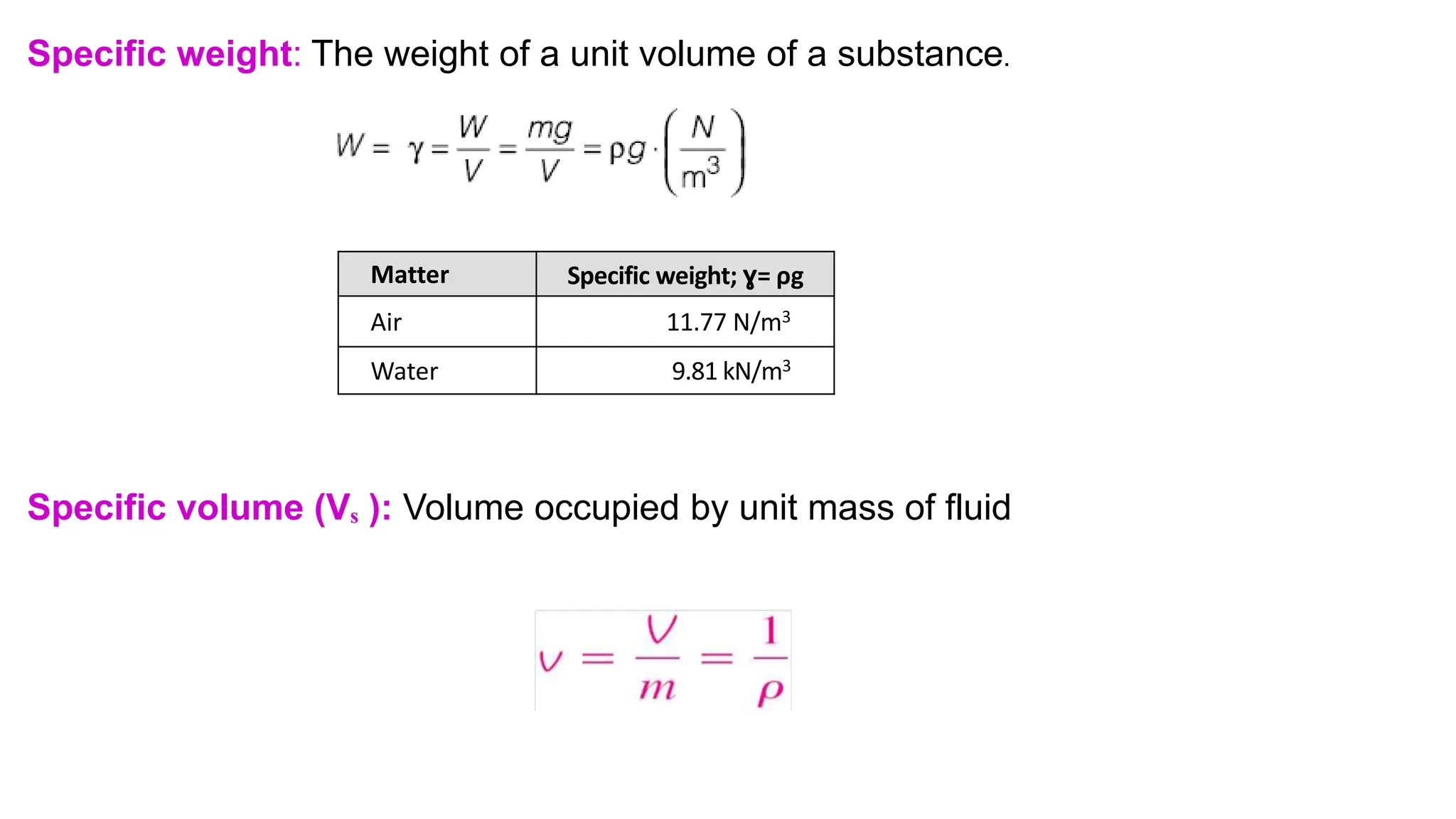
Specific weight: The weight of a unit volume of a substance.
Specific volume (Vₛ ): Volume occupied by unit mass of fluid
Matter Specific weight; ɣ= ρg
Air 11.77 N/m3
Water 9.81 kN/m3
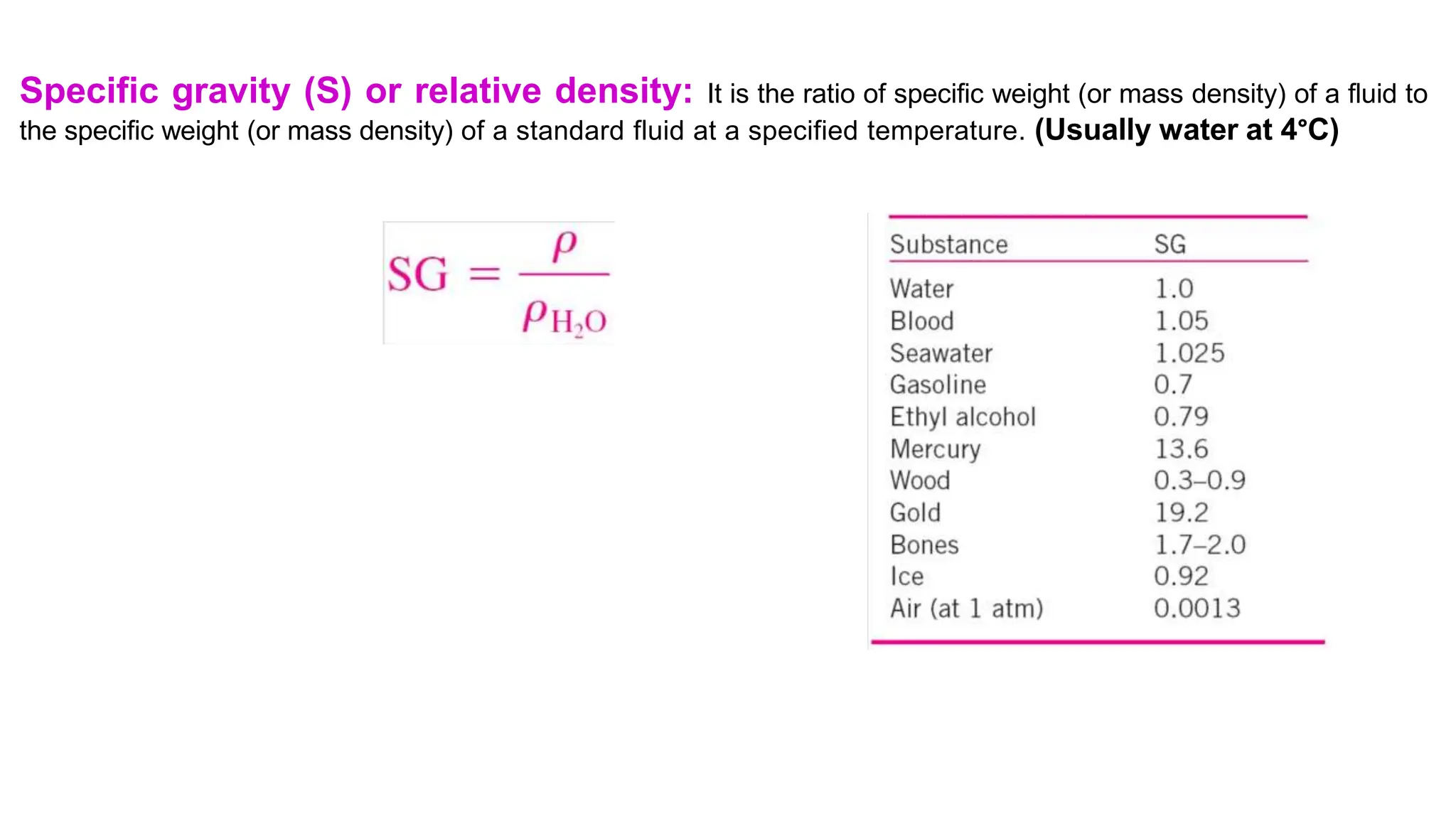
Specific gravity (S) or relative density: It is the ratio of specific weight (or mass density) of a fluid to
the specific weight (or mass density) of a standard fluid at a specified temperature. (Usually water at 4°C)
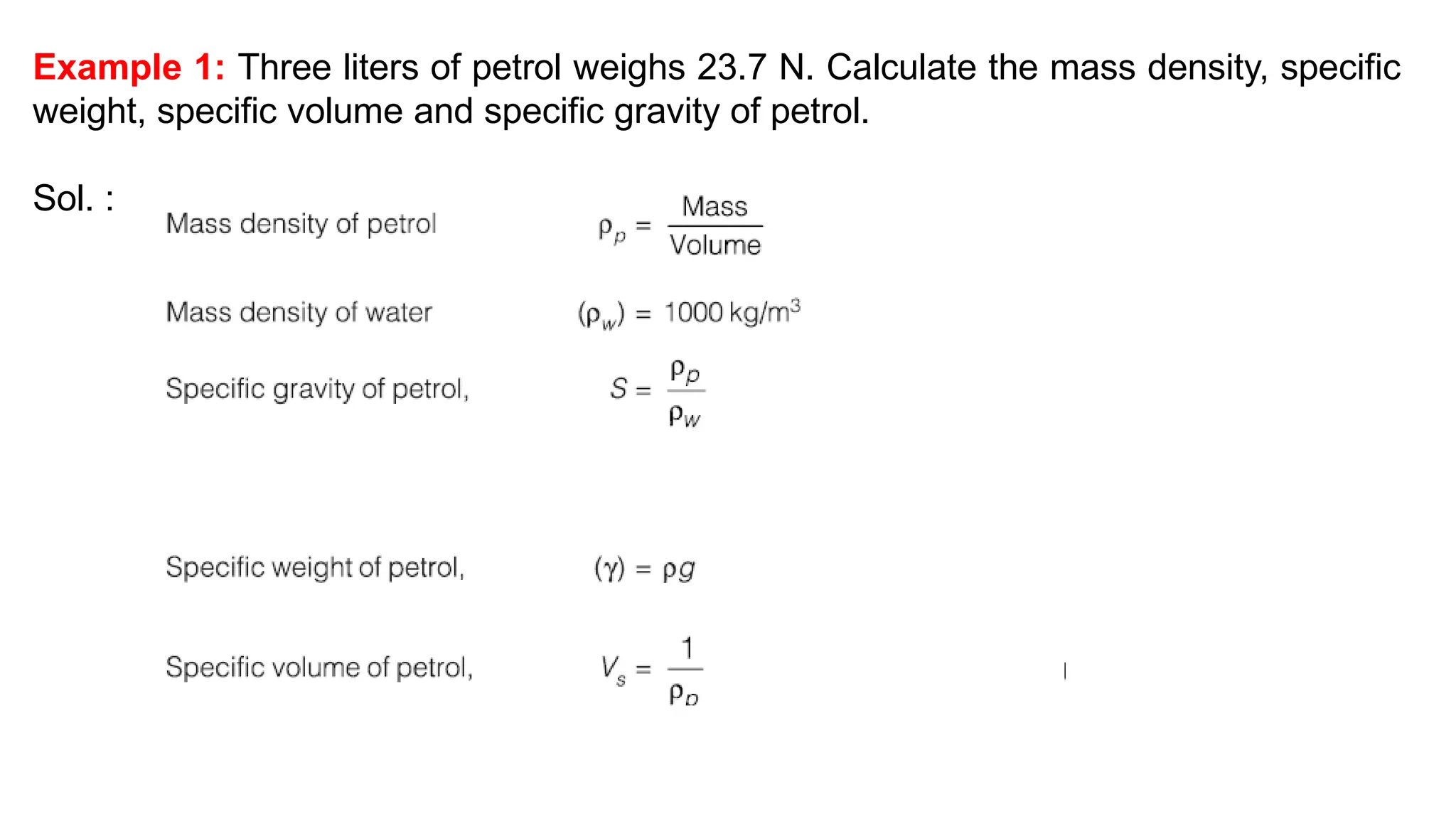
Example 1: Three liters of petrol weighs 23.7 N. Calculate the mass density, specific
weight, specific volume and specific gravity of petrol.
Sol. :
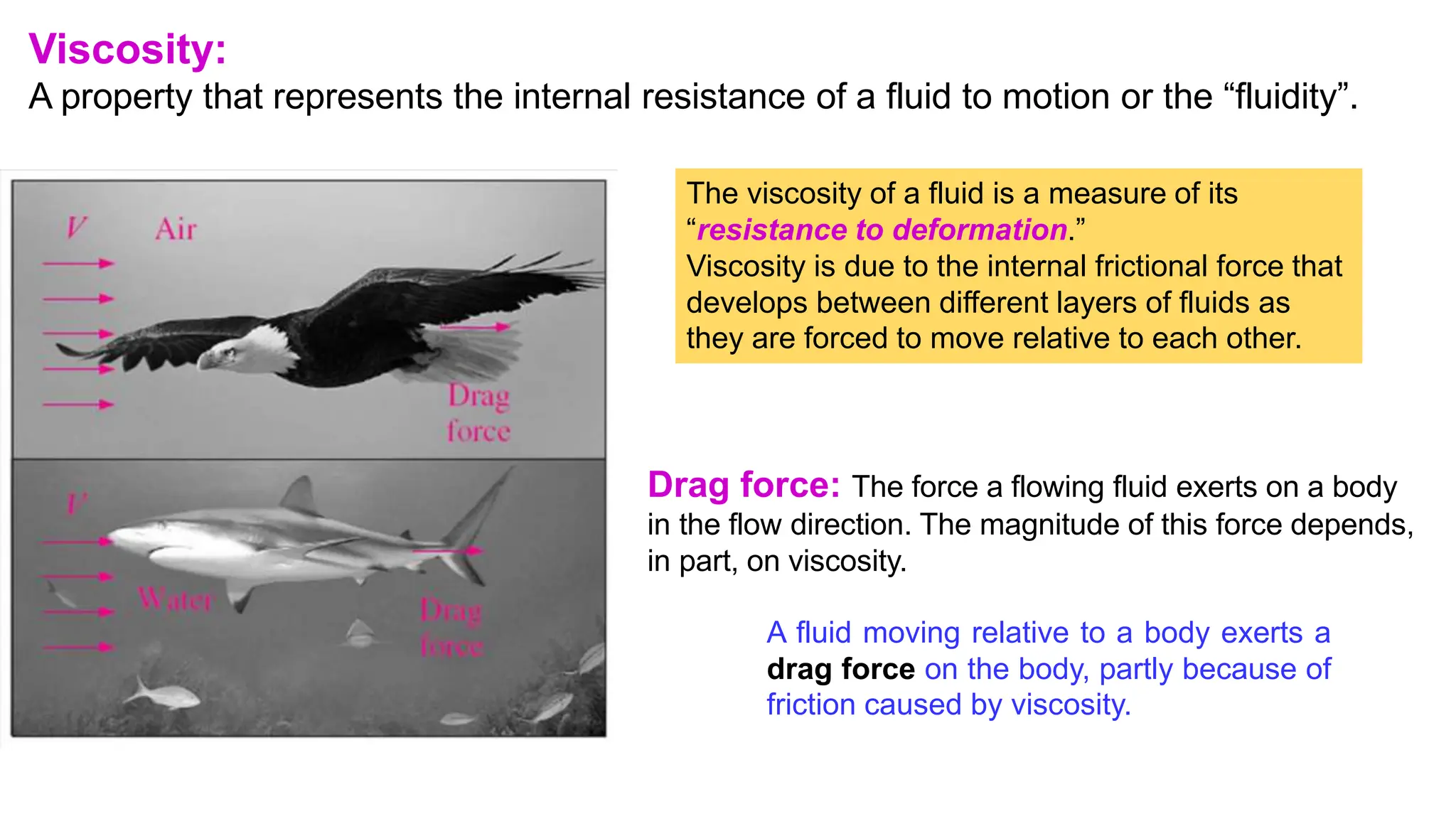
Viscosity:
A property that represents the internal resistance of a fluid to motion or the “fluidity”.
The viscosity of a fluid is a measure of its
“resistance to deformation.”
Viscosity is due to the internal frictional force that
develops between different layers of fluids as
they are forced to move relative to each other.
Drag force: The force a flowing fluid exerts on a body
in the flow direction. The magnitude of this force depends,
in part, on viscosity.
A fluid moving relative to a body exerts a
drag force on the body, partly because of
friction caused by viscosity.
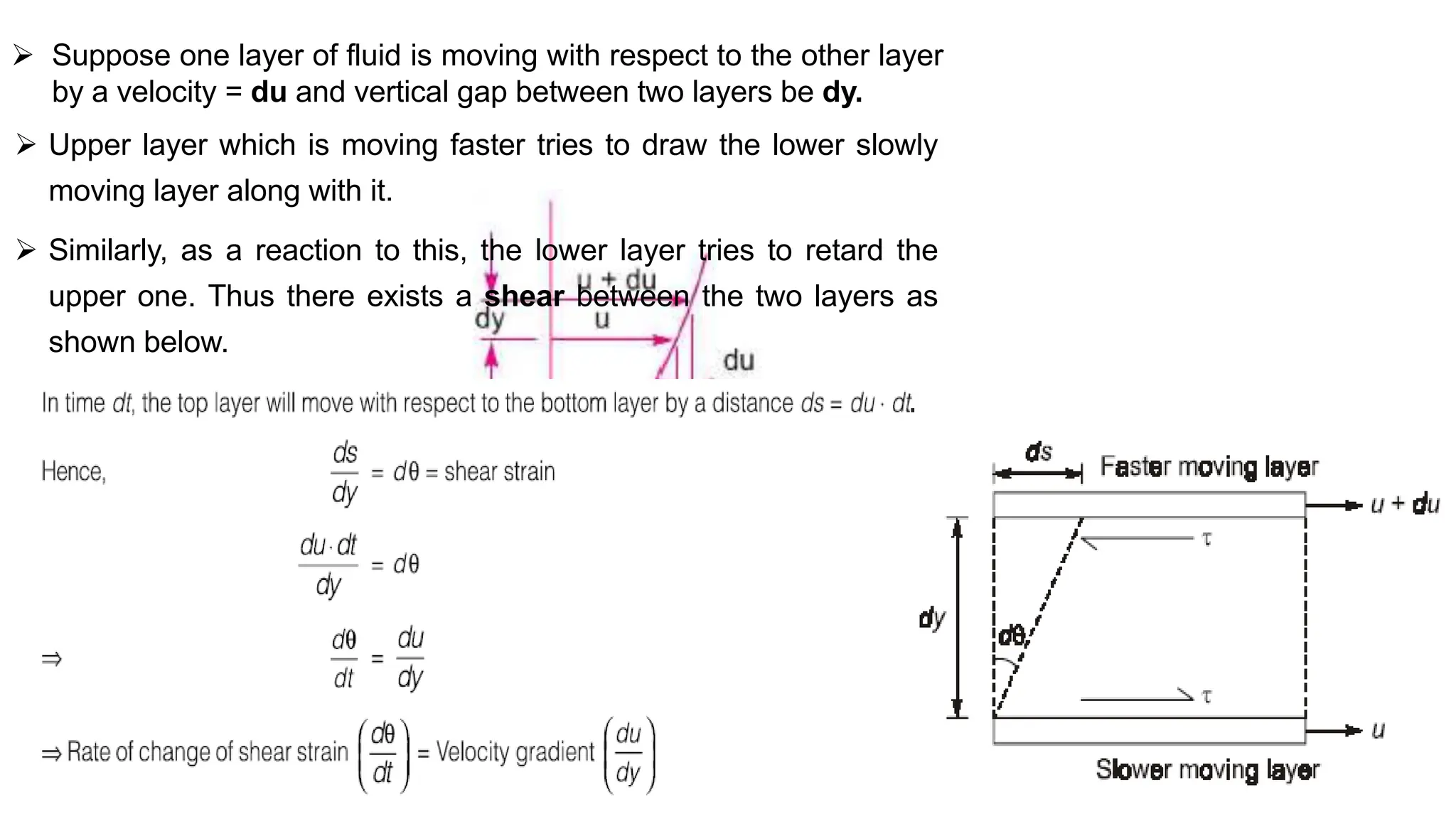
 Suppose one layer of fluid is moving with respect to the other layer
by a velocity = du and vertical gap between two layers be dy.
 Upper layer which is moving faster tries to draw the lower slowly
moving layer along with it.
 Similarly, as a reaction to this, the lower layer tries to retard the
upper one. Thus there exists a shear between the two layers as
shown below.
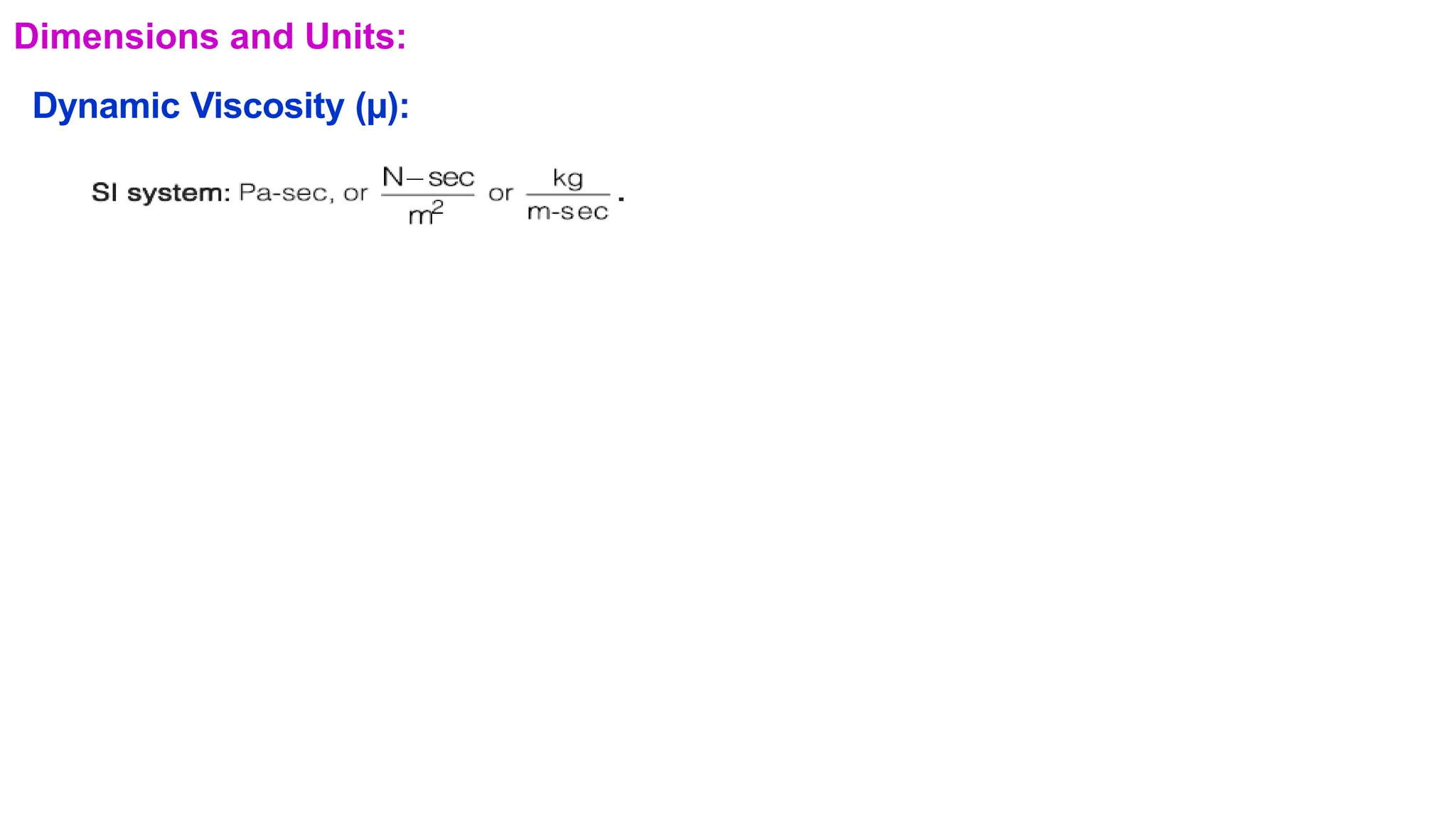
Dimensions and Units:
Dynamic Viscosity (µ):
Kinematic Viscosity (v):
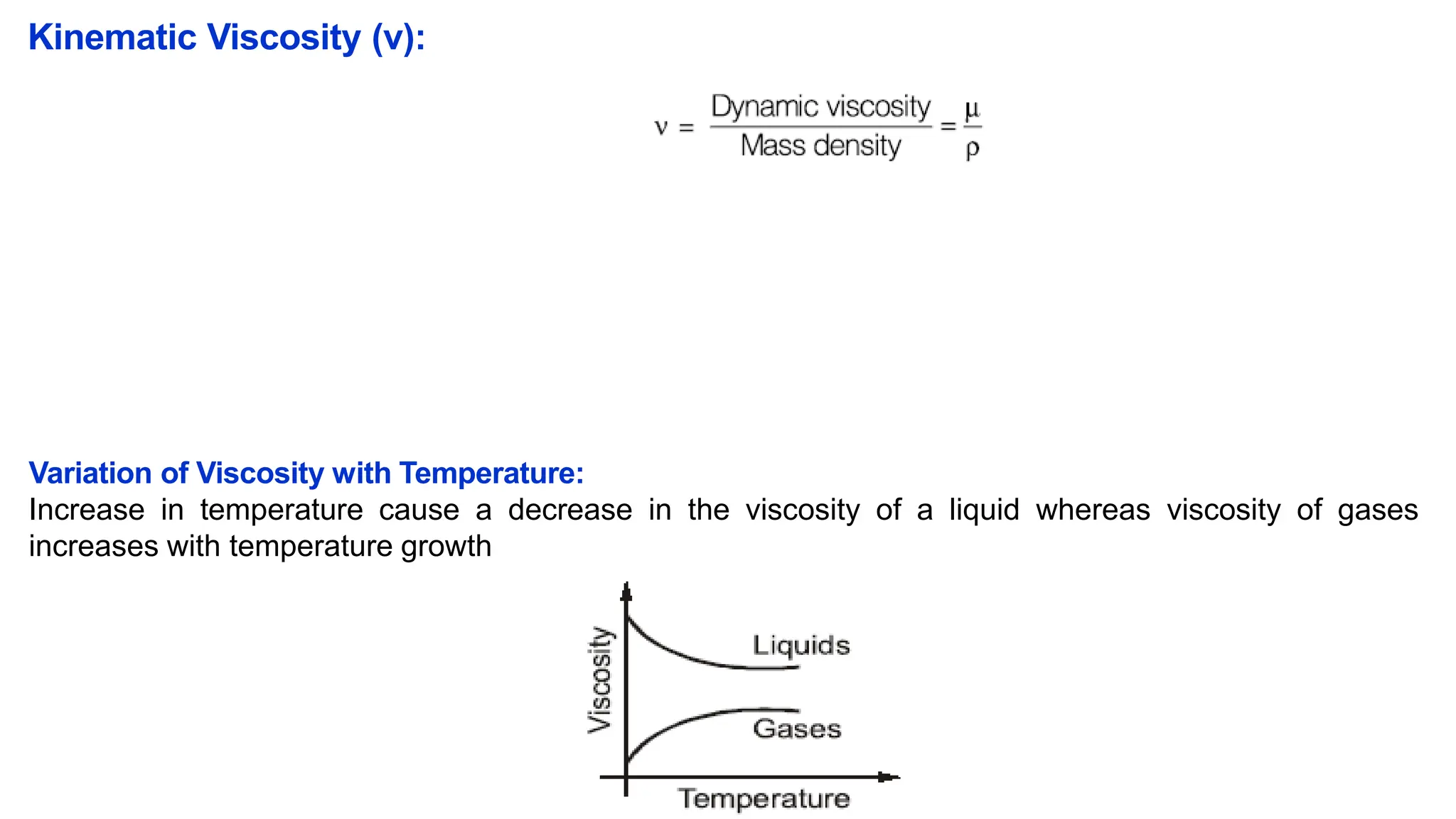
Variation of Viscosity with Temperature:
Increase in temperature cause a decrease in the viscosity of a liquid whereas viscosity of gases
increases with temperature growth
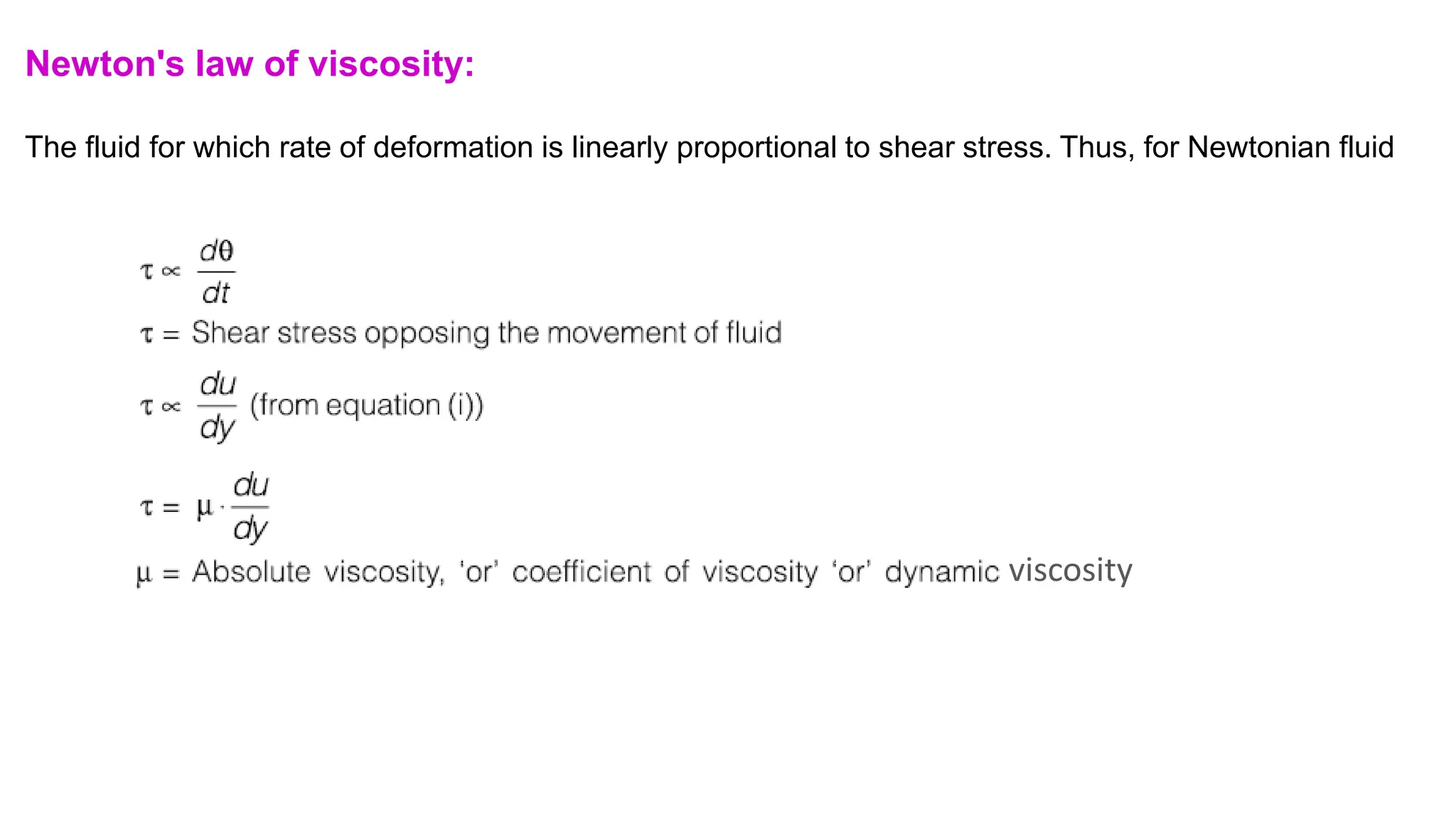
Newton's law of viscosity:
The fluid for which rate of deformation is linearly proportional to shear stress. Thus, for Newtonian fluid
viscosity
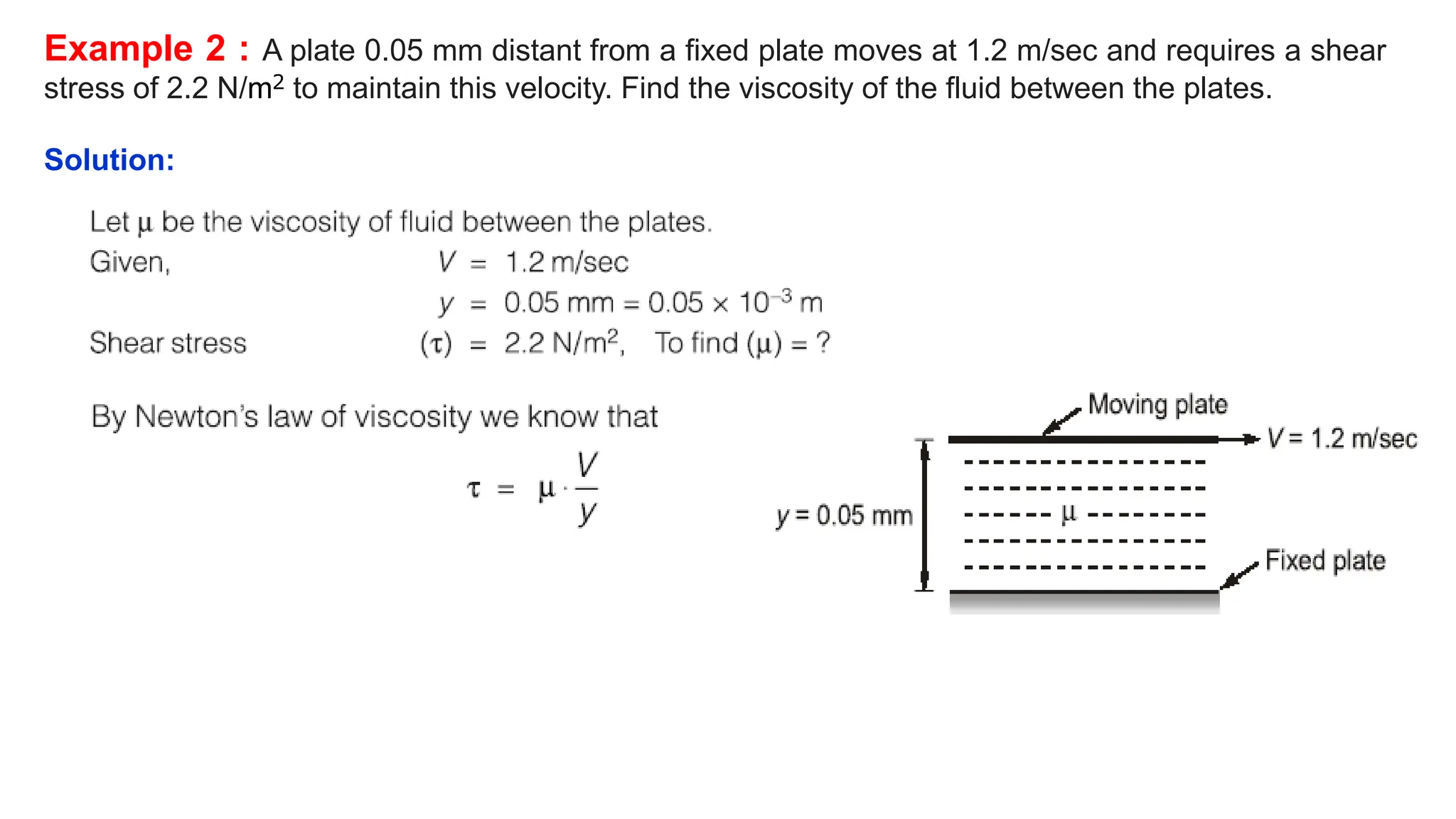
Example 2 : A plate 0.05 mm distant from a fixed plate moves at 1.2 m/sec and requires a shear
stress of 2.2 N/m2 to maintain this velocity. Find the viscosity of the fluid between the plates.
Solution:
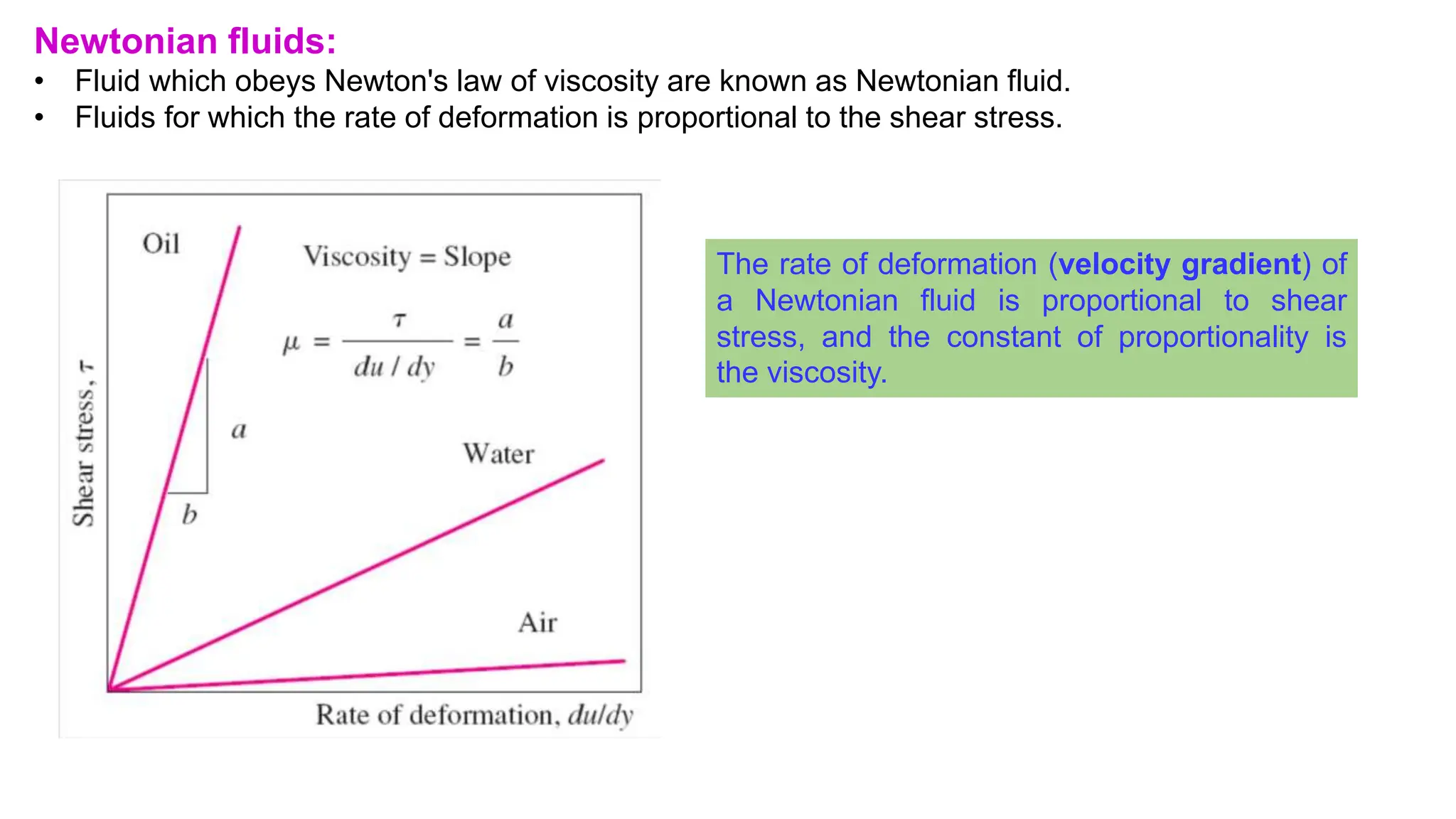
Newtonian fluids:
• Fluid which obeys Newton's law of viscosity are known as Newtonian fluid.
• Fluids for which the rate of deformation is proportional to the shear stress.
The rate of deformation (velocity gradient) of
a Newtonian fluid is proportional to shear
stress, and the constant of proportionality is
the viscosity.
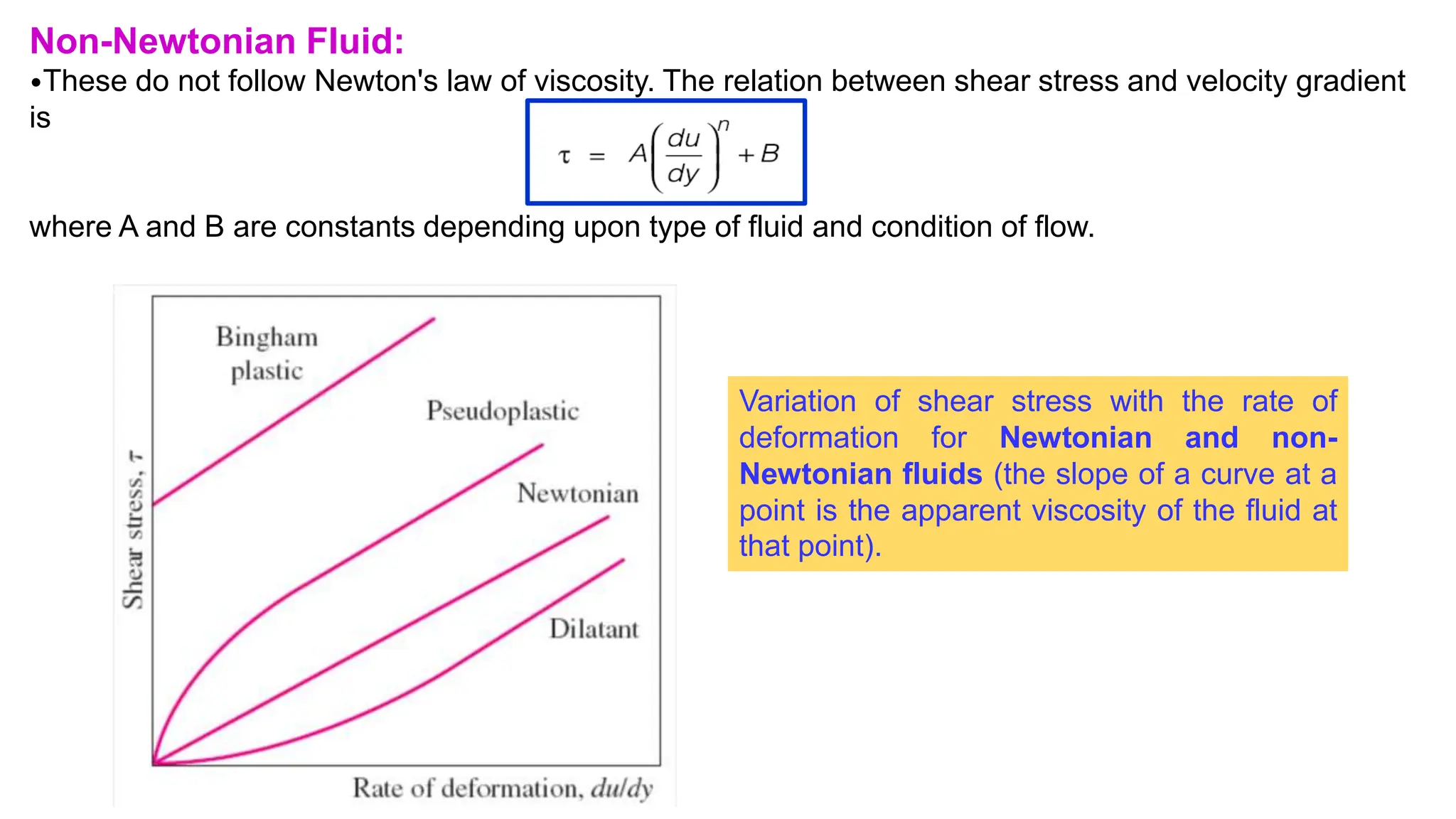
Non-Newtonian Fluid:
•These do not follow Newton's law of viscosity. The relation between shear stress and velocity gradient
is
where A and B are constants depending upon type of fluid and condition of flow.
Variation of shear stress with the rate of
deformation for Newtonian and non-
Newtonian fluids (the slope of a curve at a
point is the apparent viscosity of the fluid at
that point).
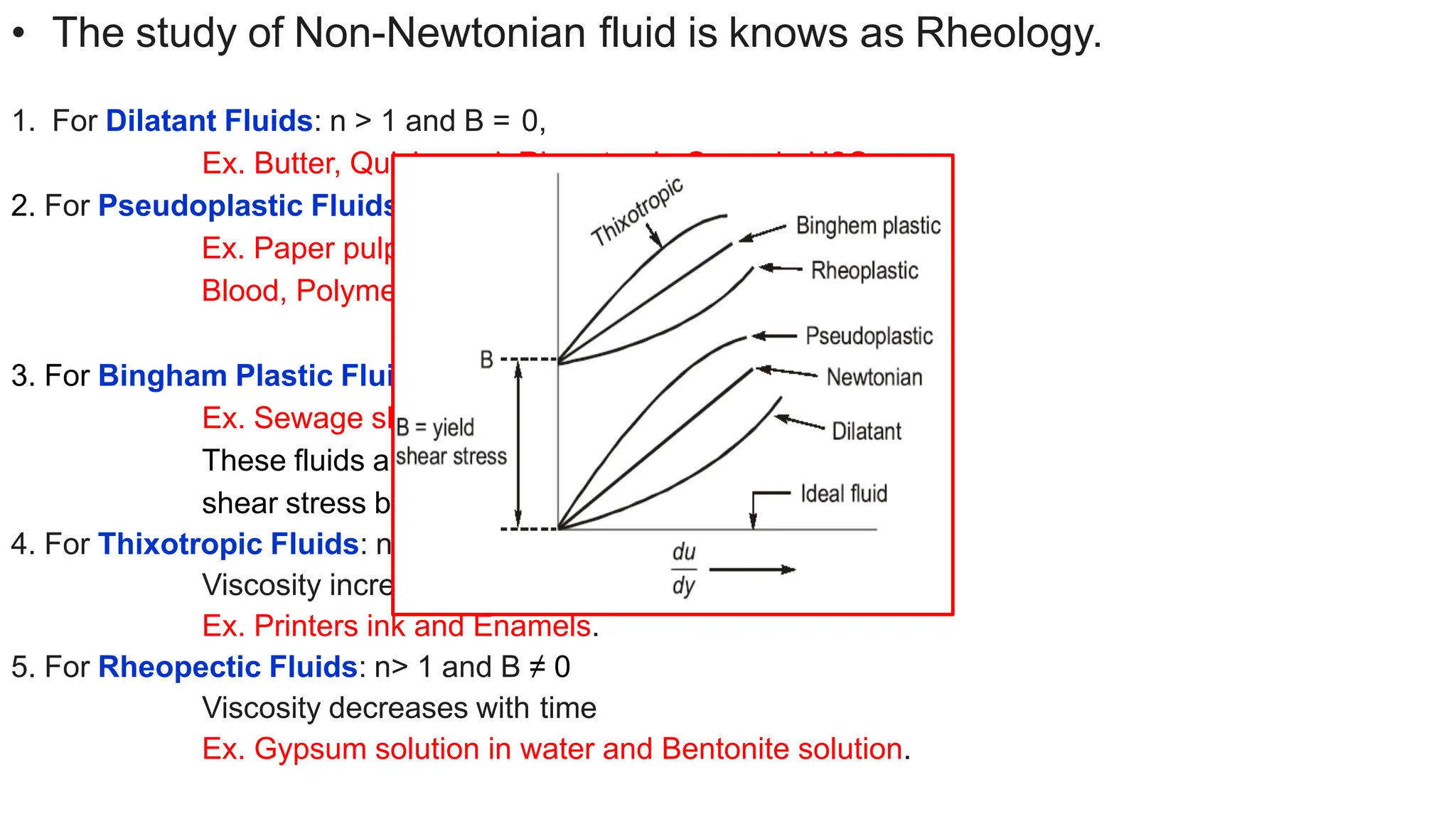
• The study of Non-Newtonian fluid is knows as Rheology.
1. For Dilatant Fluids: n > 1 and B = 0,
Ex. Butter, Quick sand, Rice starch, Sugar in H2O
2. For Pseudoplastic Fluids: n < 1 and B = 0
Ex. Paper pulp, Rubber solution, Lipsticks, Paints,
Blood, Polymetric solutions, milk, etc.
3. For Bingham Plastic Fluids: n = 1 and B ≠ 0
Ex. Sewage sludge, Drilling mud, Tooth paste, Gel.
These fluids always have certain minimum
shear stress before they yield.
4. For Thixotropic Fluids: n < 1 and B≠0
Viscosity increases with time.
Ex. Printers ink and Enamels.
5. For Rheopectic Fluids: n> 1 and B ≠ 0
Viscosity decreases with time
Ex. Gypsum solution in water and Bentonite solution.
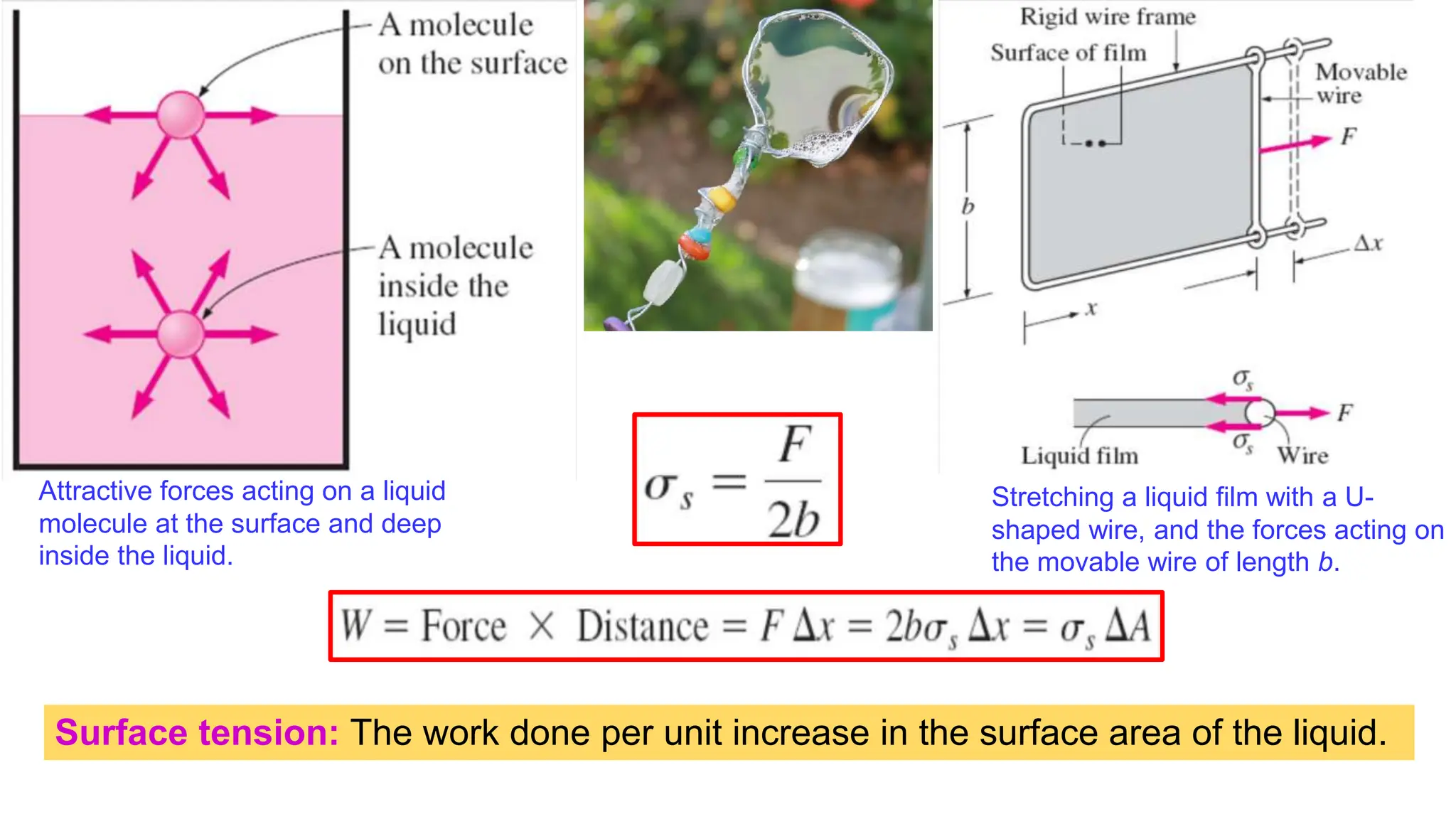
SURFACE TENSION
• Liquid droplets behave like small balloons filled
with the liquid on a solid surface, and the surface
of the liquid acts like a stretched elastic
membrane under tension.
• The pulling force that causes this tension acts
parallel to the surface and is due to the attractive
forces between the molecules of the liquid.
• The magnitude of this force per unit length is
called surface tension (or coefficient of surface
tension) and is usually expressed in the unit N/m.
• This effect is also called surface energy [per unit
area] and is expressed in the equivalent unit of
N.m/m2.
Attractive forces acting on a liquid
molecule at the surface and deep
inside the liquid.
Stretching a liquid film with a U-
shaped wire, and the forces acting on
the movable wire of length b.
Surface tension: The work done per unit increase in the surface area of the liquid.
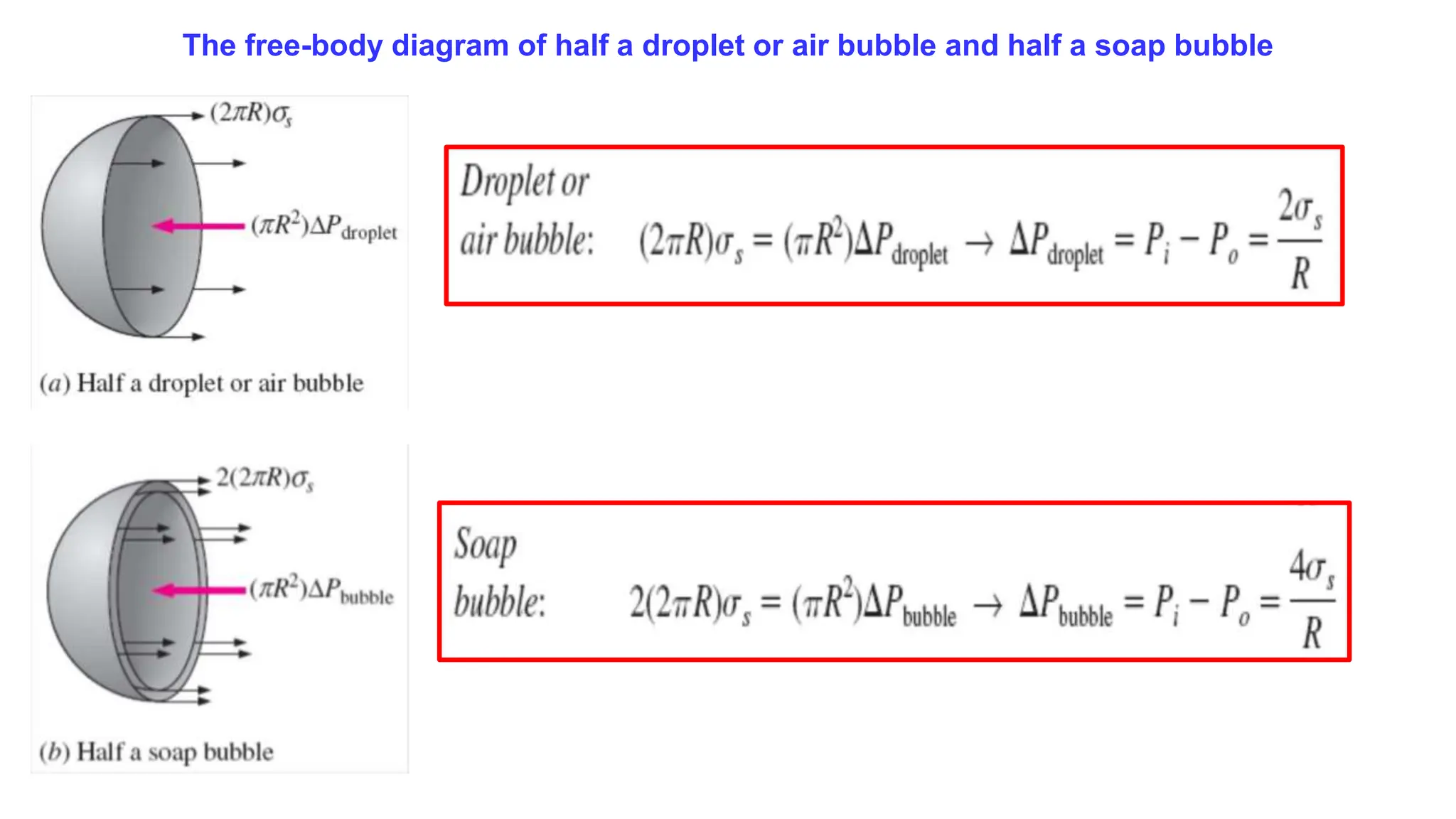
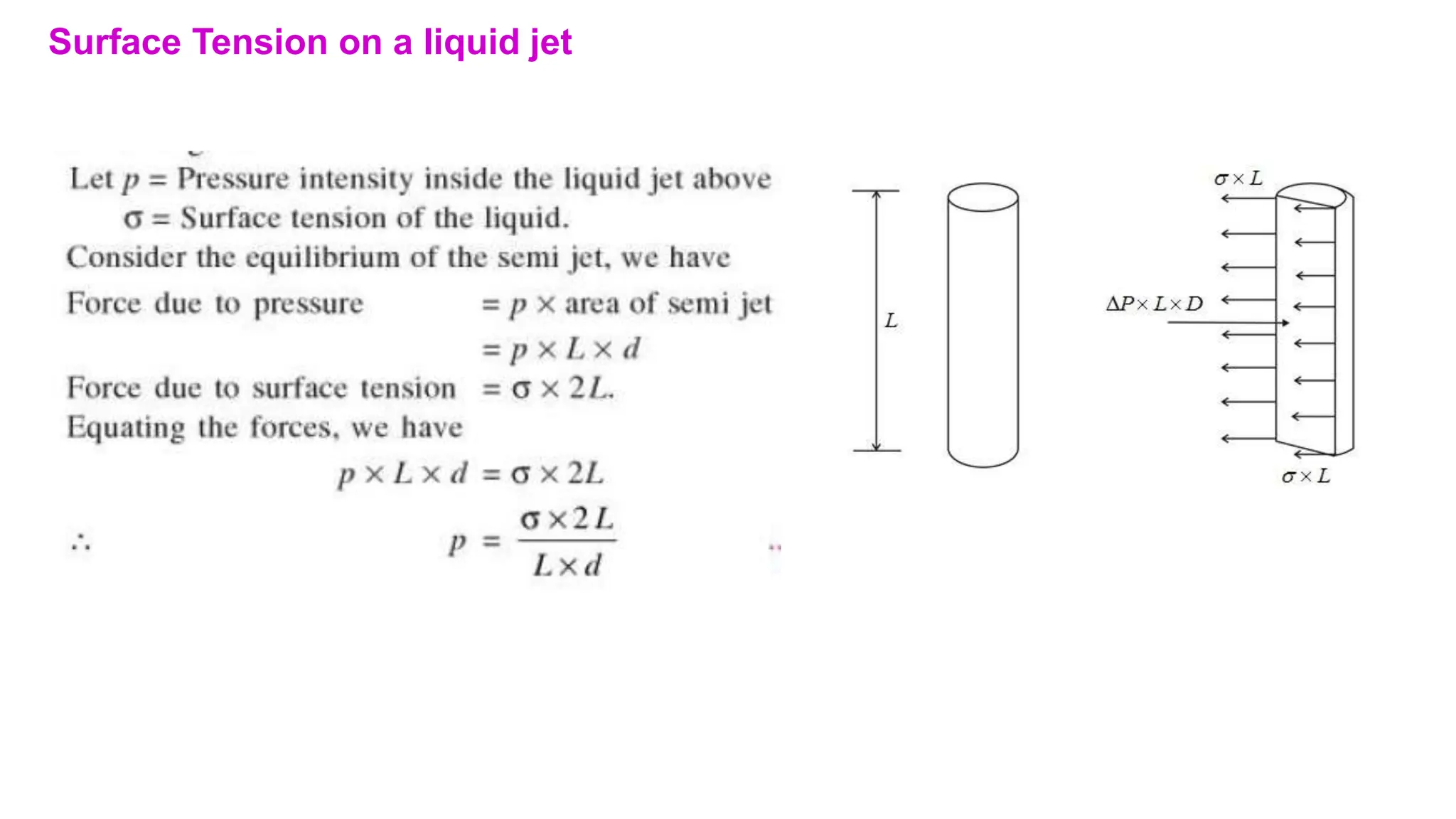
The free-body diagram of half a droplet or air bubble and half a soap bubble
Surface Tension on a liquid jet
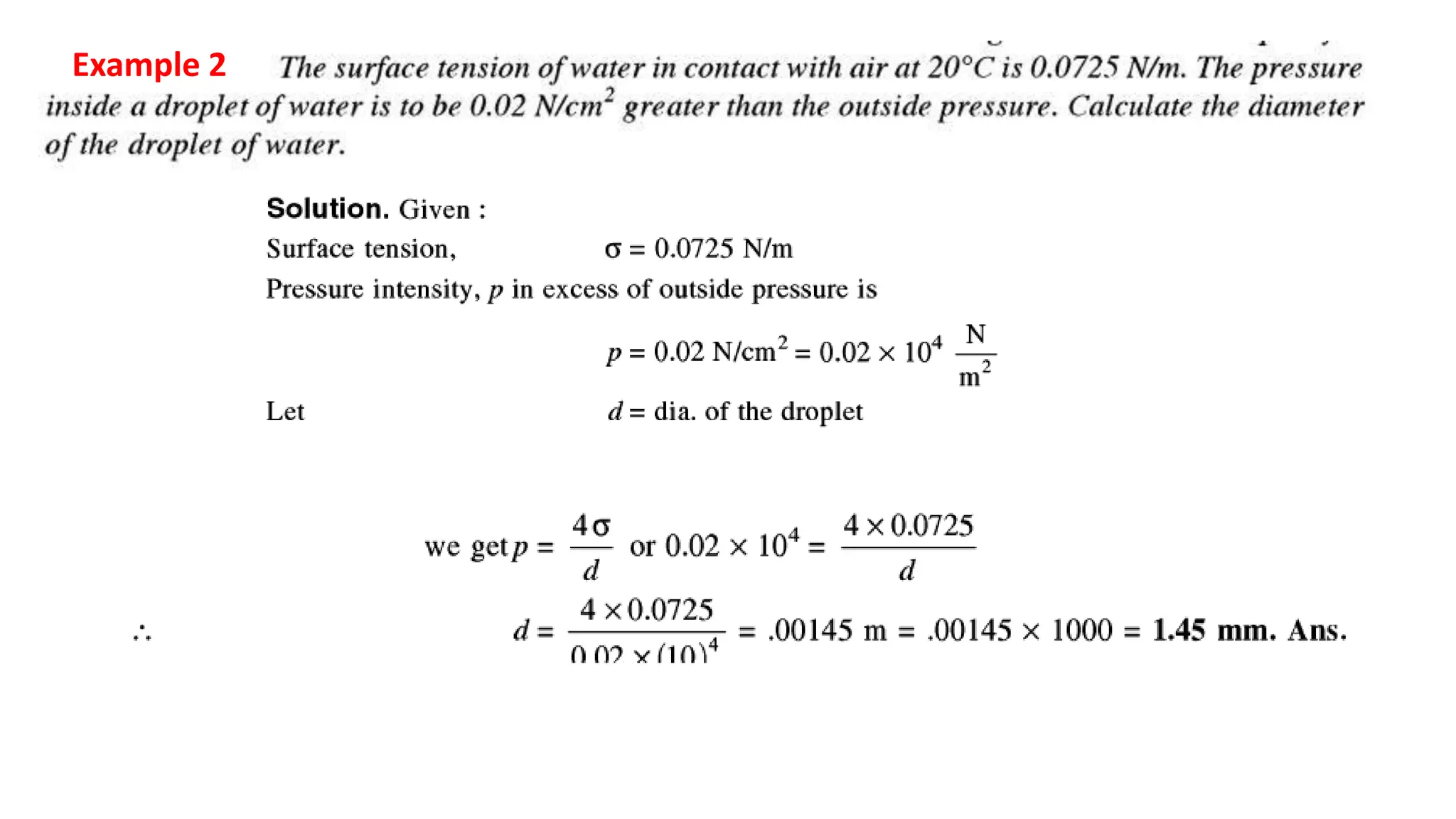
Example 2
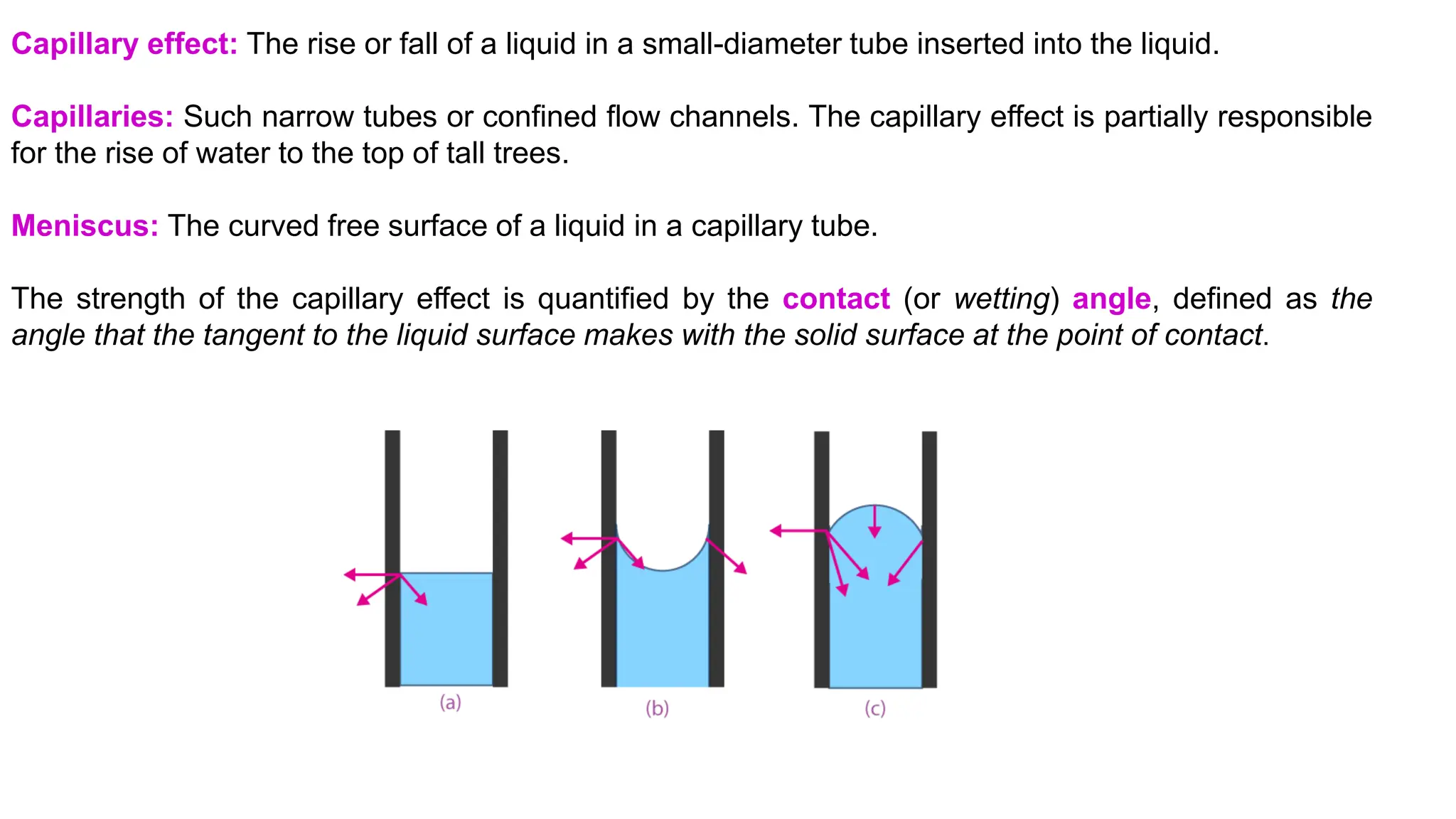
Capillary effect: The rise or fall of a liquid in a small-diameter tube inserted into the liquid.
Capillaries: Such narrow tubes or confined flow channels. The capillary effect is partially responsible
for the rise of water to the top of tall trees.
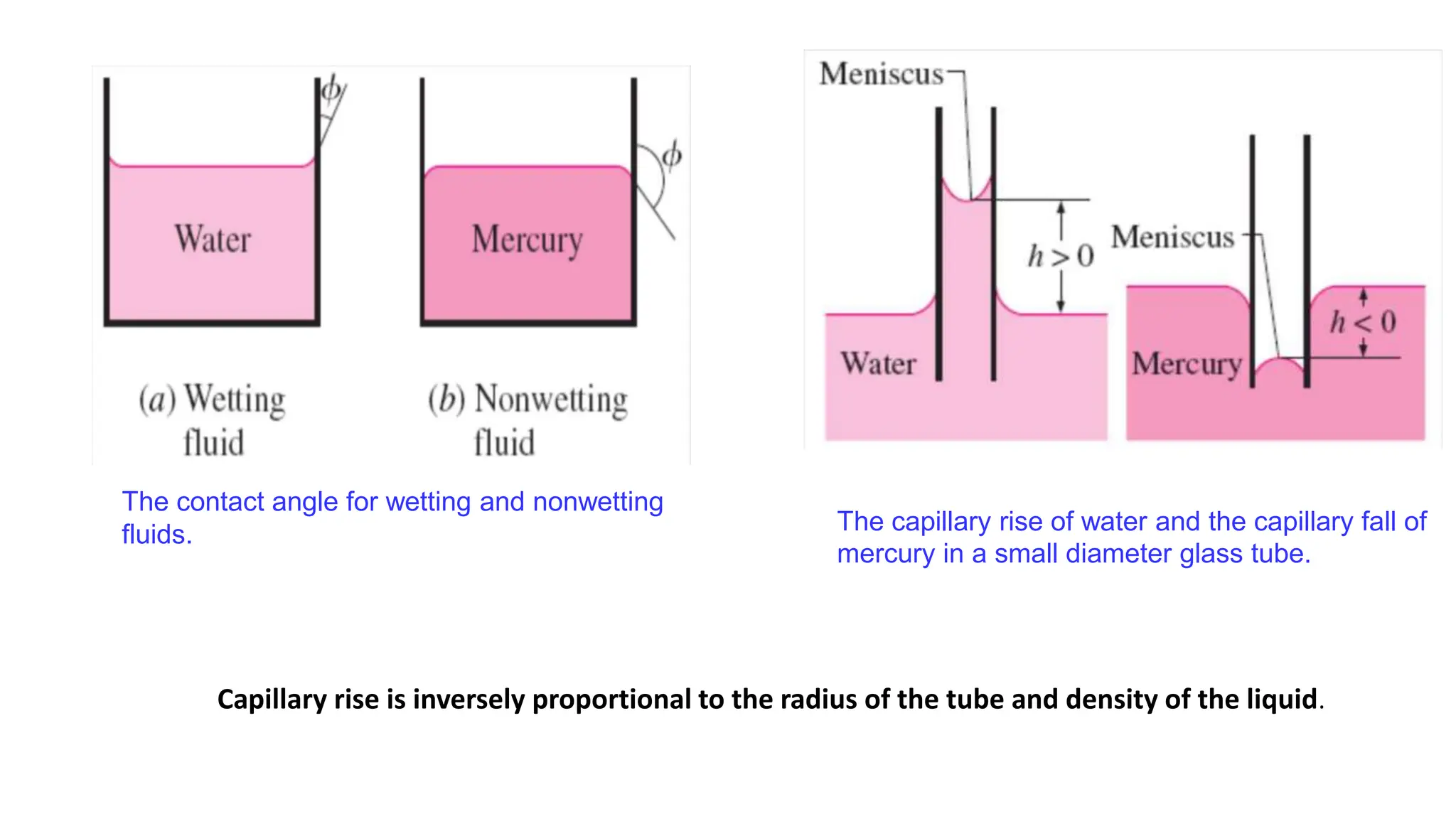
Meniscus: The curved free surface of a liquid in a capillary tube.
The strength of the capillary effect is quantified by the contact (or wetting) angle, defined as the
angle that the tangent to the liquid surface makes with the solid surface at the point of contact.
The capillary rise of water and the capillary fall of
mercury in a small diameter glass tube.
Capillary rise is inversely proportional to the radius of the tube and density of the liquid.
The contact angle for wetting and nonwetting
fluids.
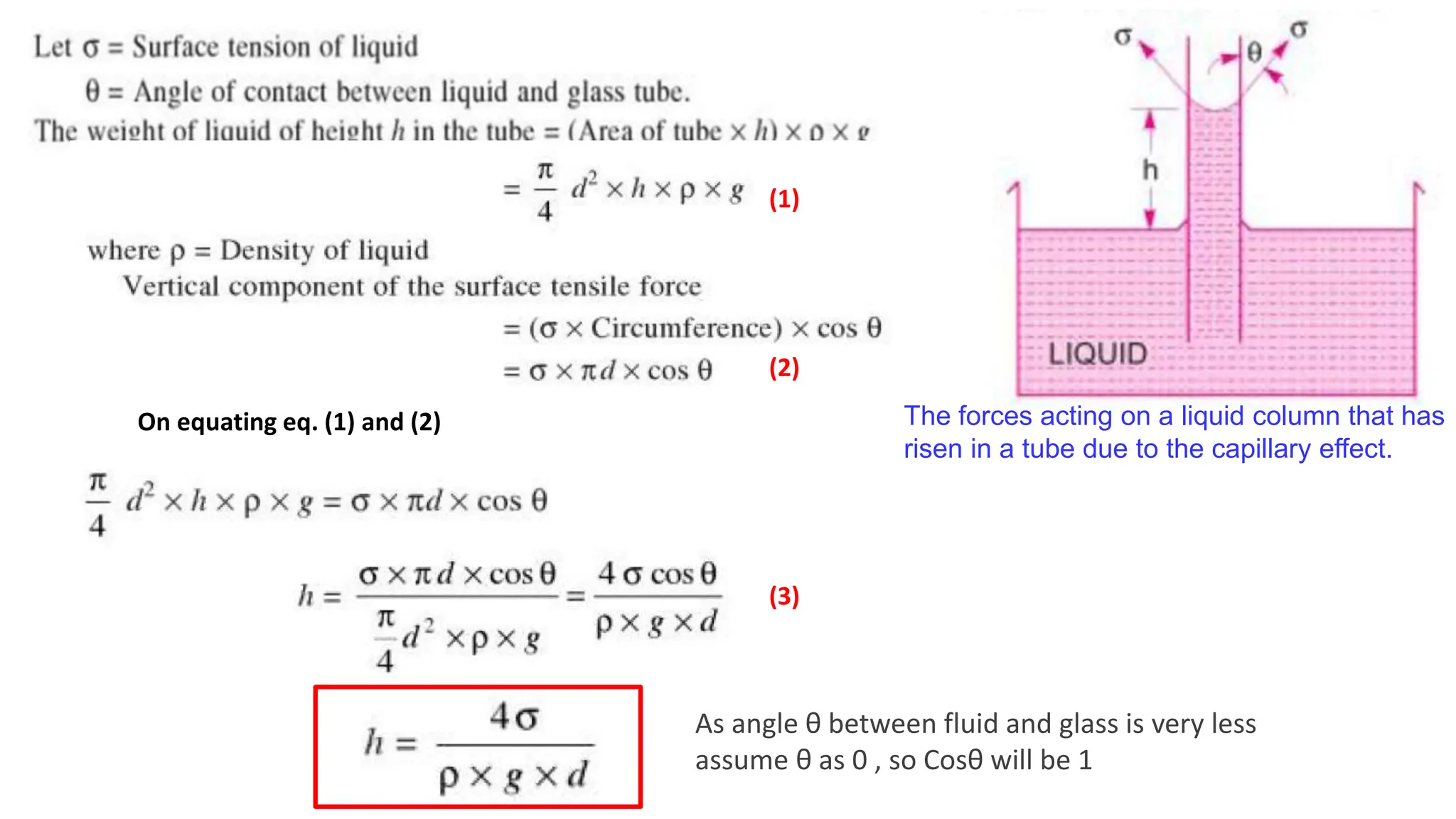
The forces acting on a liquid column that has
risen in a tube due to the capillary effect.
(1)
(2)
(3)
On equating eq. (1) and (2)
As angle θ between fluid and glass is very less
assume θ as 0 , so Cosθ will be 1
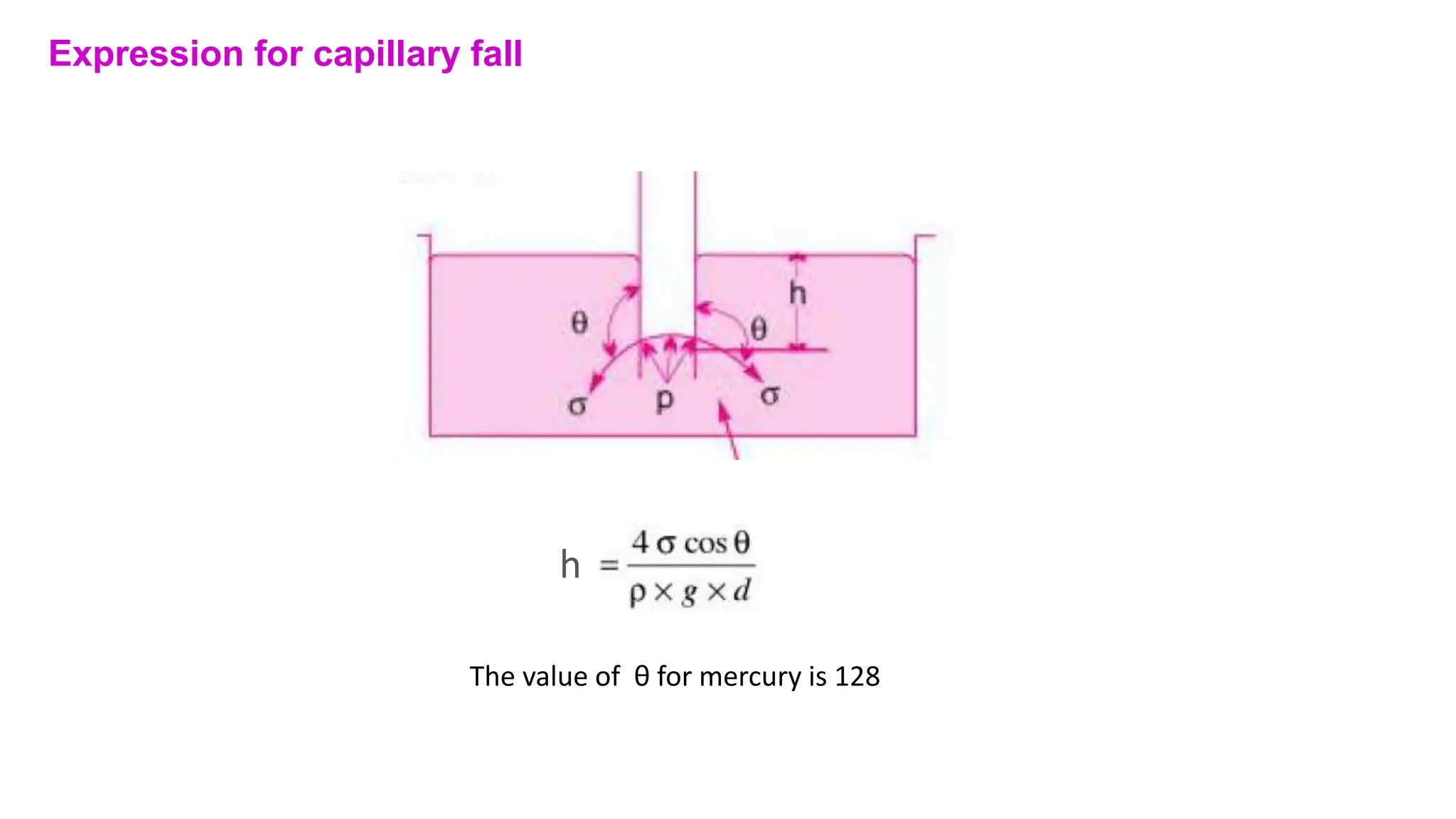
Expression for capillary fall
The value of θ for mercury is 128
h
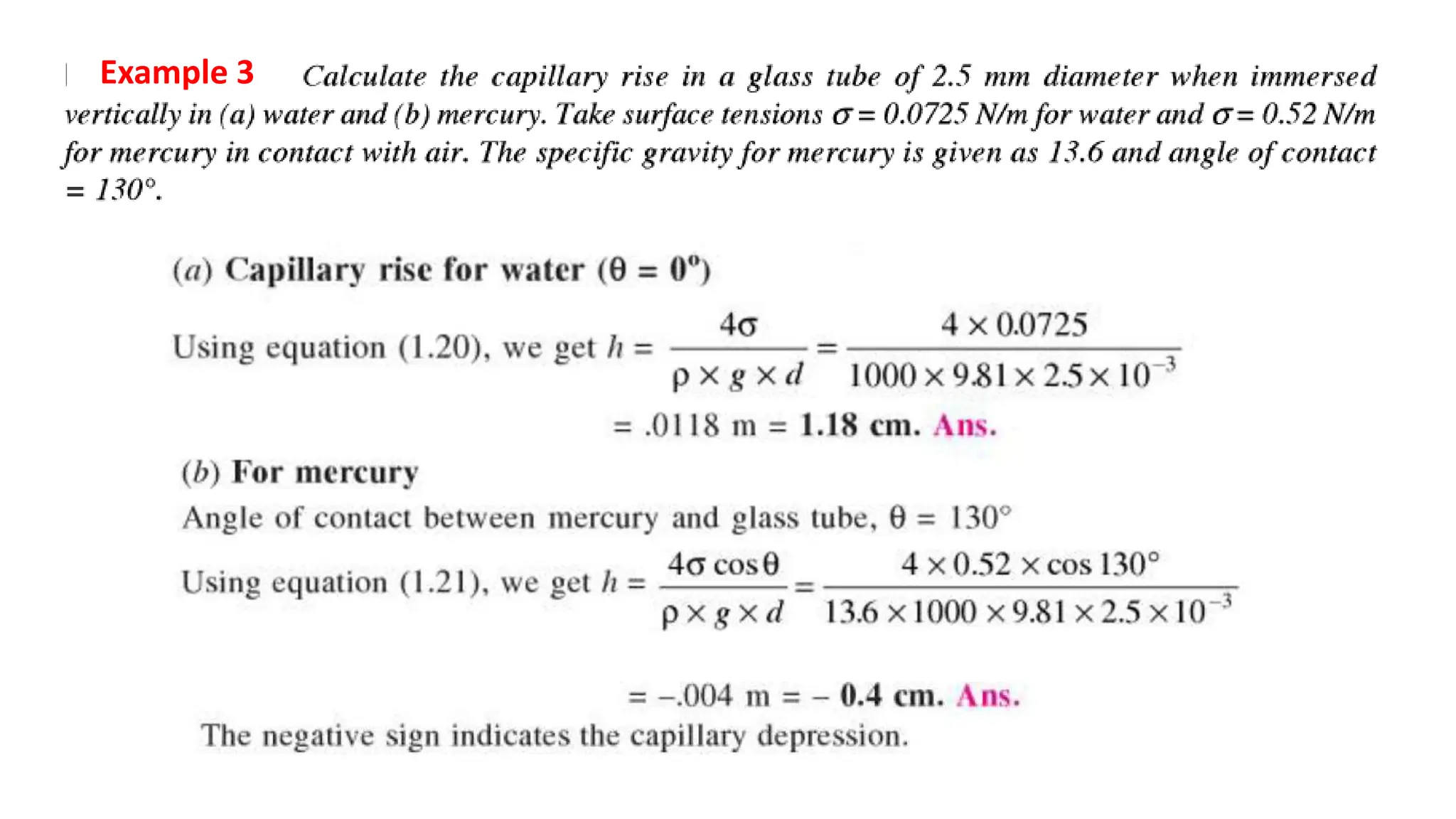
Example 3
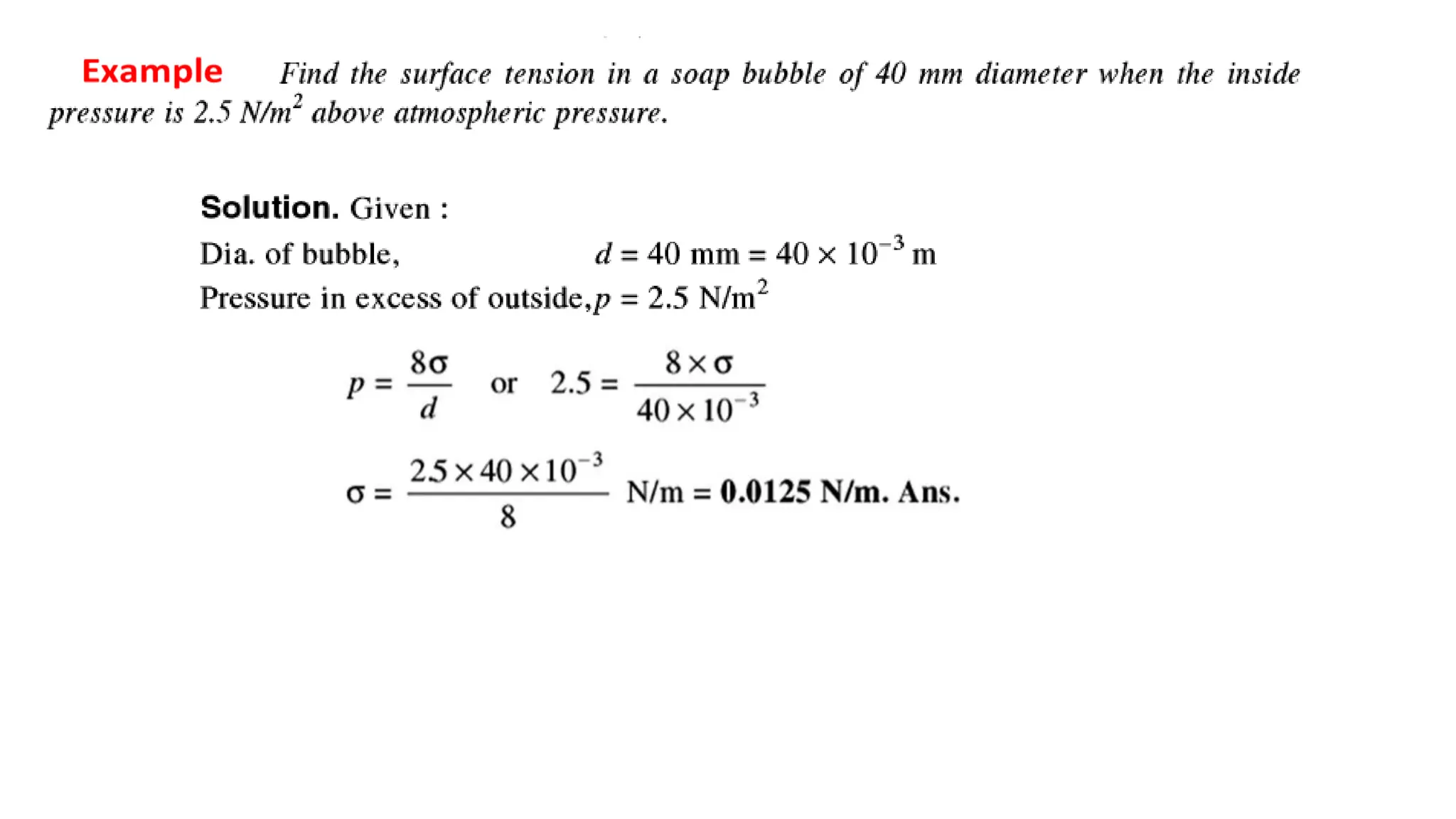
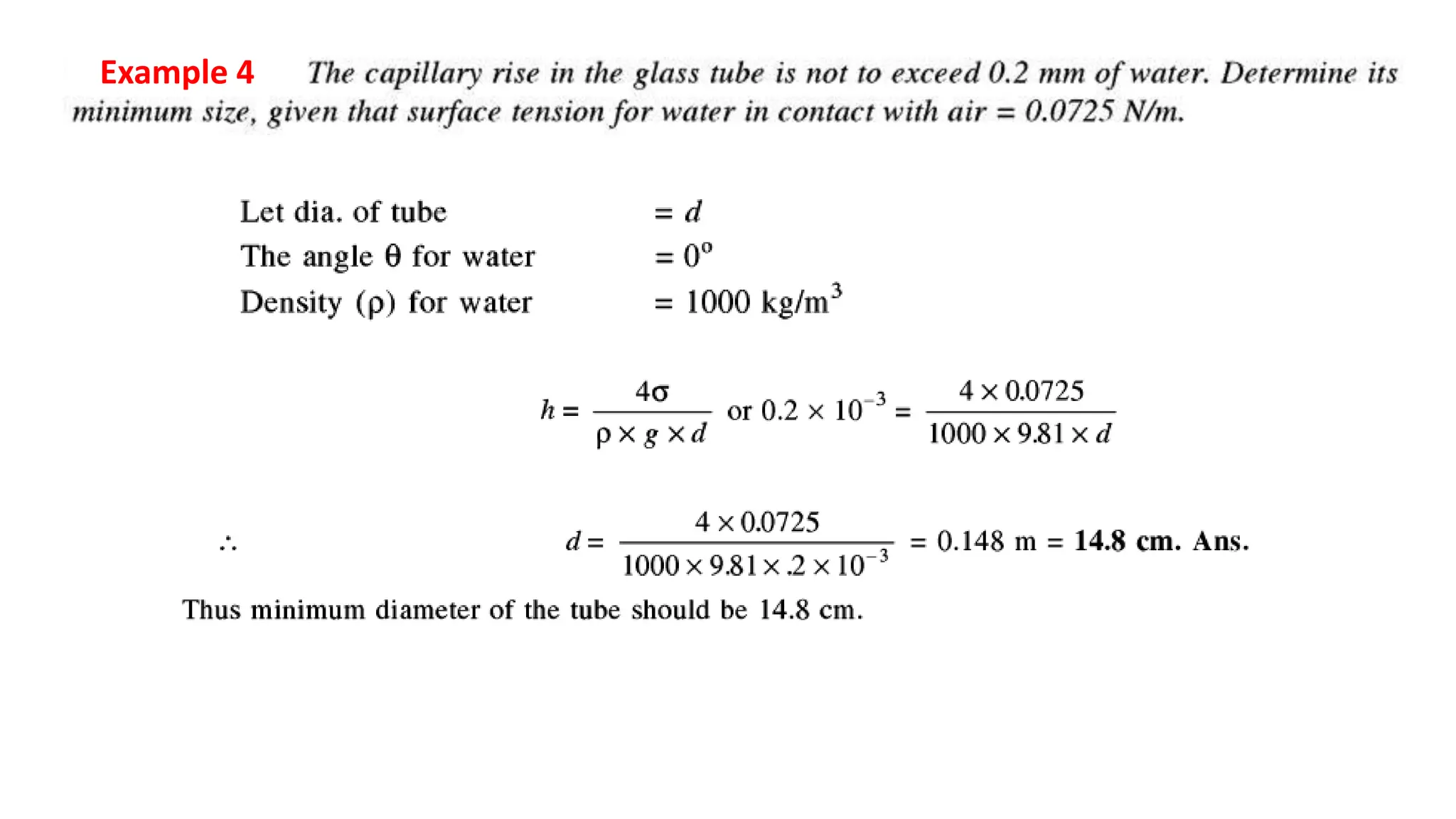
Example 4
PRESSURE AND FLUID
STATICS
32
Objectives
• Determine the variation of pressure in a fluid at rest
• Calculate pressure using various kinds of manometers
• Calculate the forces exerted by a fluid at rest on plane or curved
submerged surfaces.
• Analyze the stability of floating and submerged bodies.
• Analyze the rigid-body motion of fluids in containers during linear
acceleration or rotation.
33
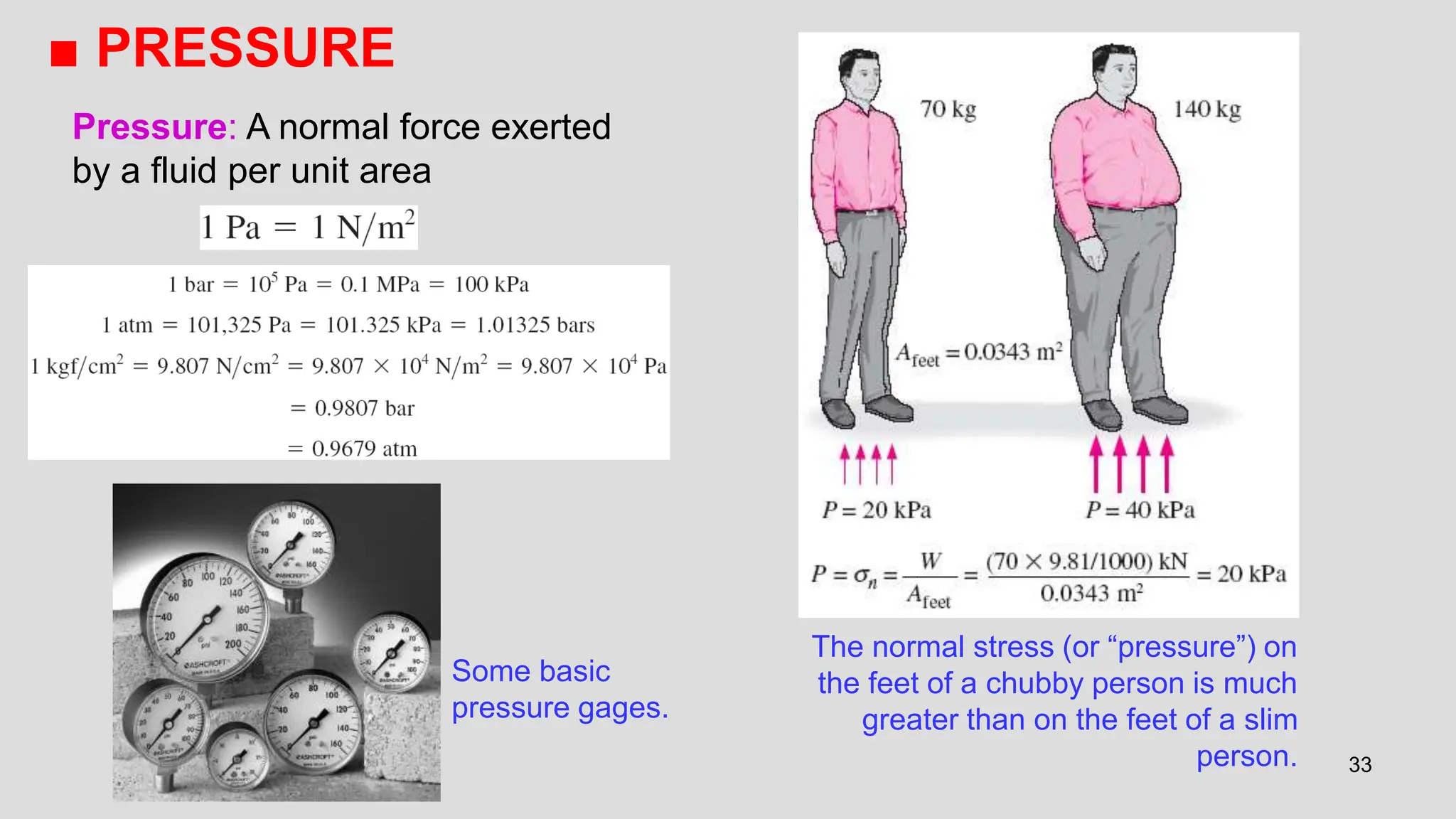
■ PRESSURE
The normal stress (or “pressure”) on
the feet of a chubby person is much
greater than on the feet of a slim
person.
Some basic
pressure gages.
Pressure: A normal force exerted
by a fluid per unit area
34
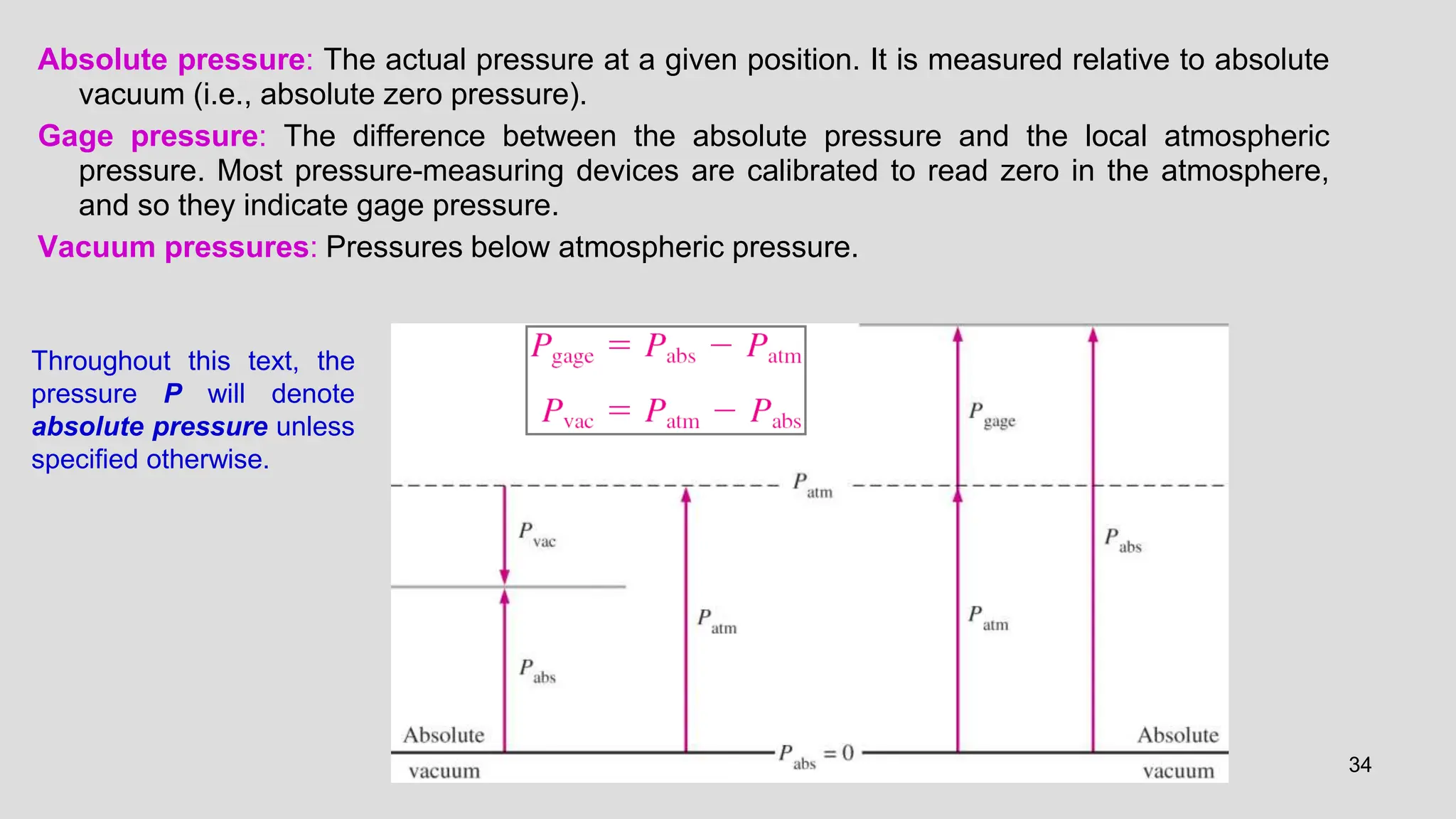
Absolute pressure: The actual pressure at a given position. It is measured relative to absolute
vacuum (i.e., absolute zero pressure).
Gage pressure: The difference between the absolute pressure and the local atmospheric
pressure. Most pressure-measuring devices are calibrated to read zero in the atmosphere,
and so they indicate gage pressure.
Vacuum pressures: Pressures below atmospheric pressure.
Throughout this text, the
pressure P will denote
absolute pressure unless
specified otherwise.
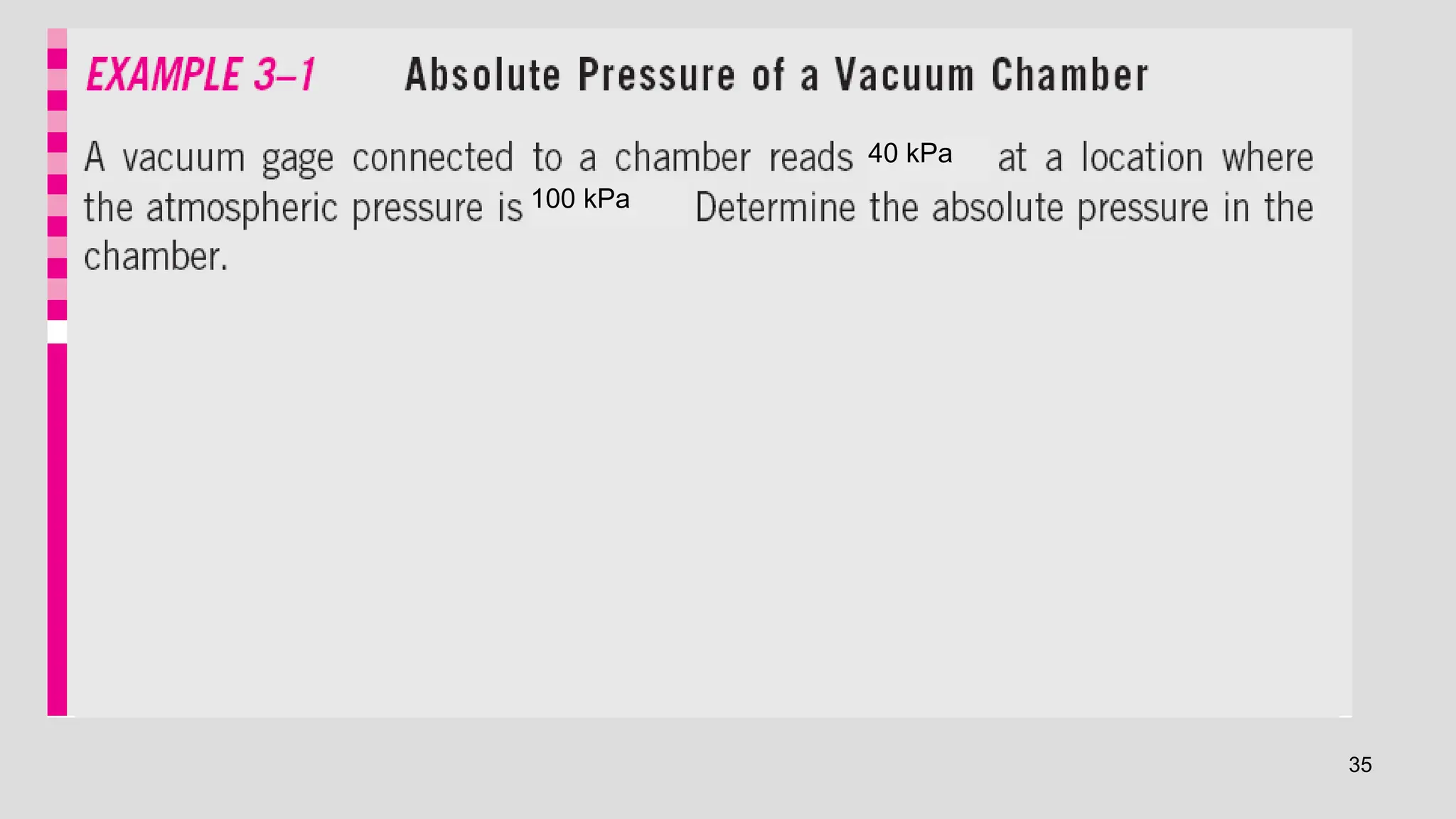
35
40 kPa
100 kPa
100 − 40 = 60 kPa
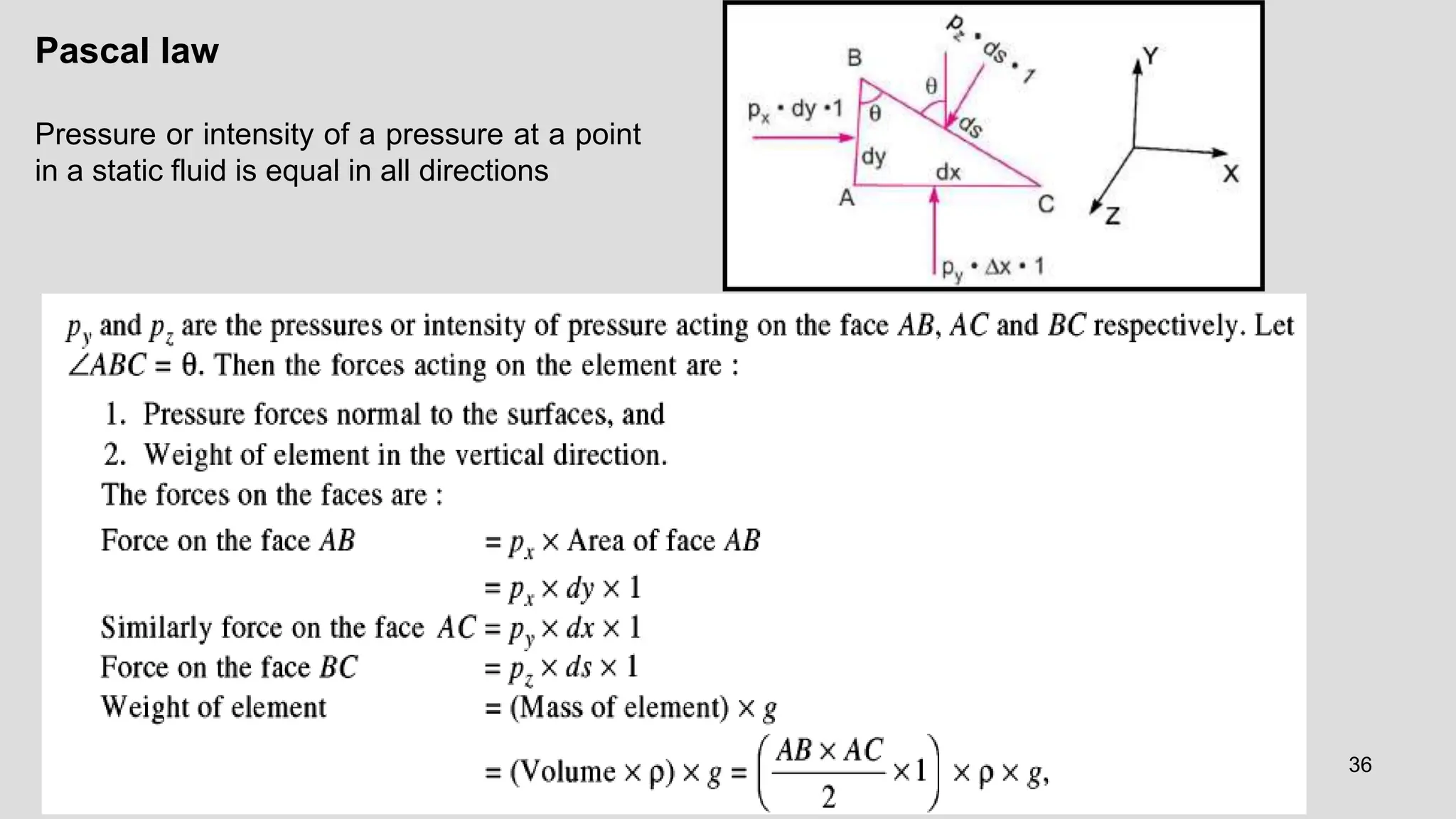
36
Pascal law
Pressure or intensity of a pressure at a point
in a static fluid is equal in all directions
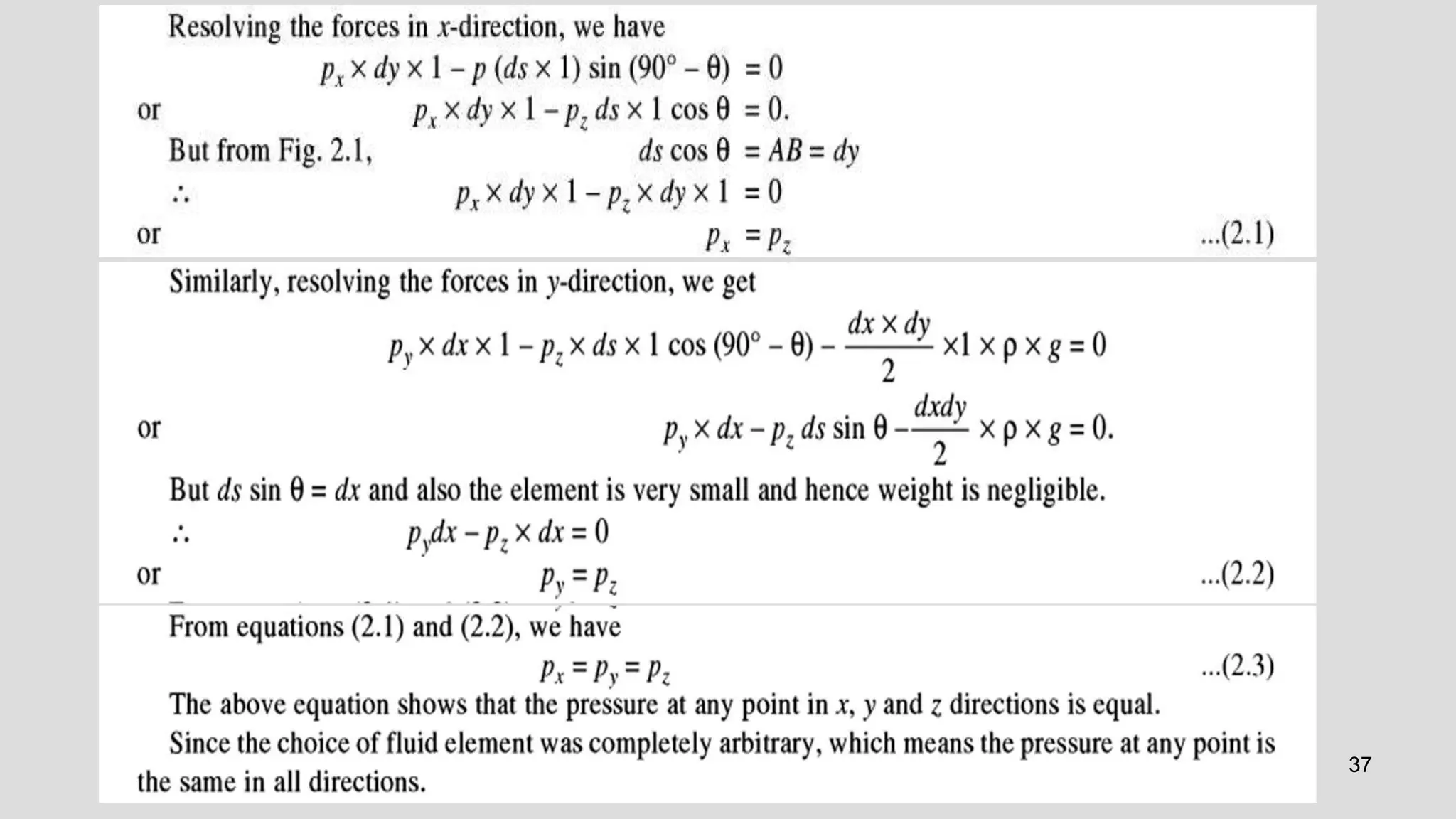
37
38
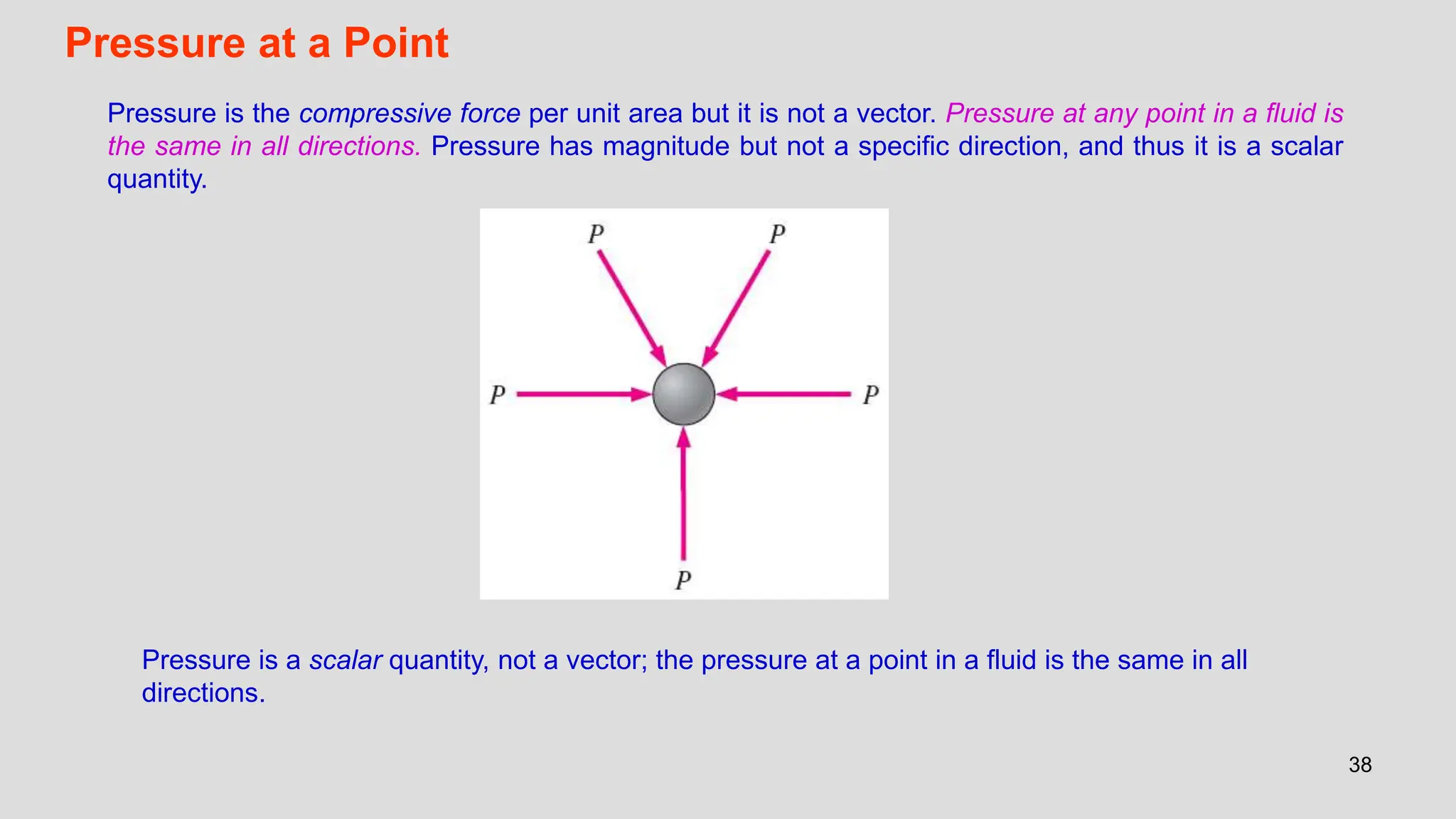
Pressure at a Point
Pressure is a scalar quantity, not a vector; the pressure at a point in a fluid is the same in all
directions.
Pressure is the compressive force per unit area but it is not a vector. Pressure at any point in a fluid is
the same in all directions. Pressure has magnitude but not a specific direction, and thus it is a scalar
quantity.
39
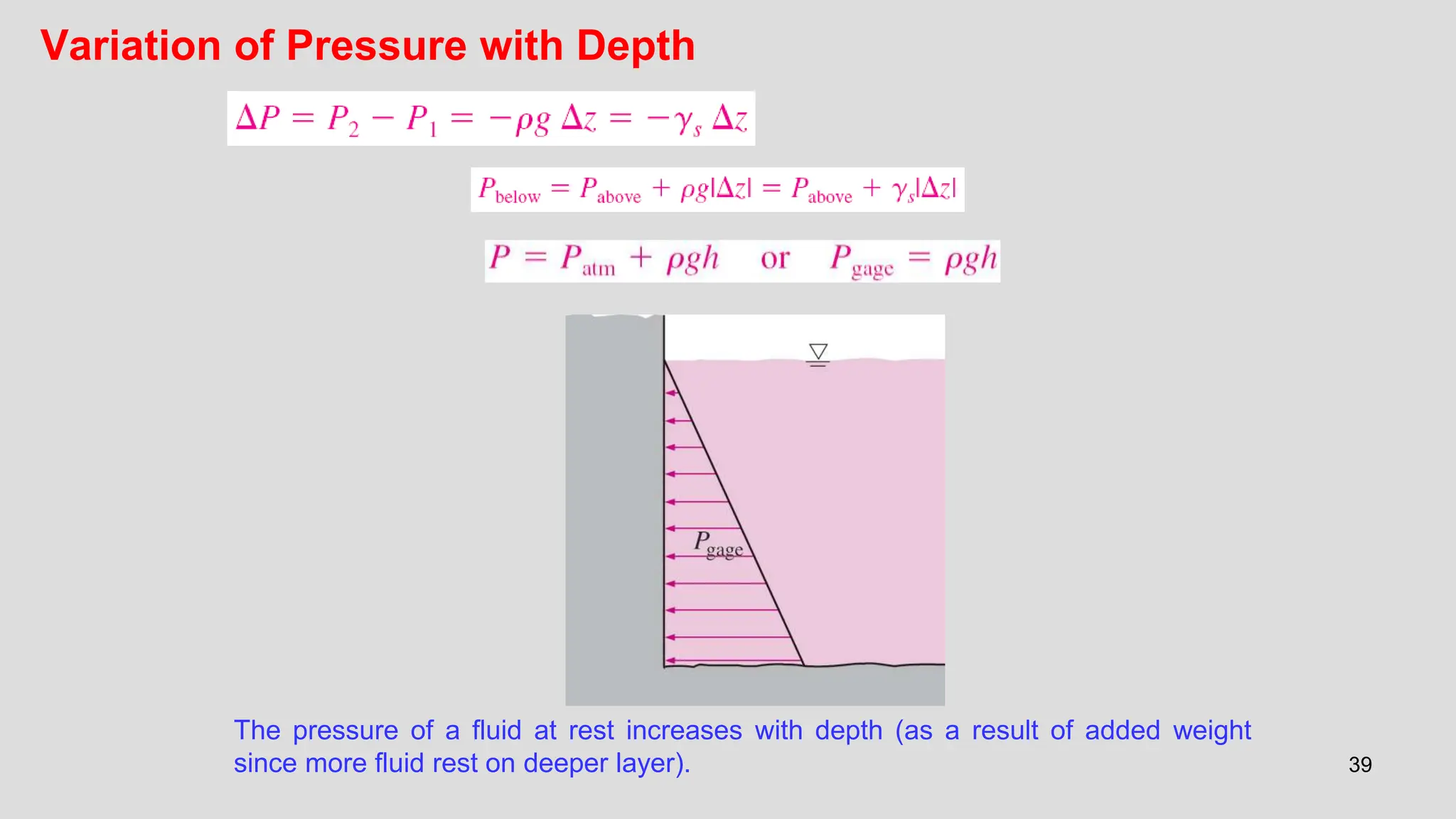
Variation of Pressure with Depth
The pressure of a fluid at rest increases with depth (as a result of added weight
since more fluid rest on deeper layer).
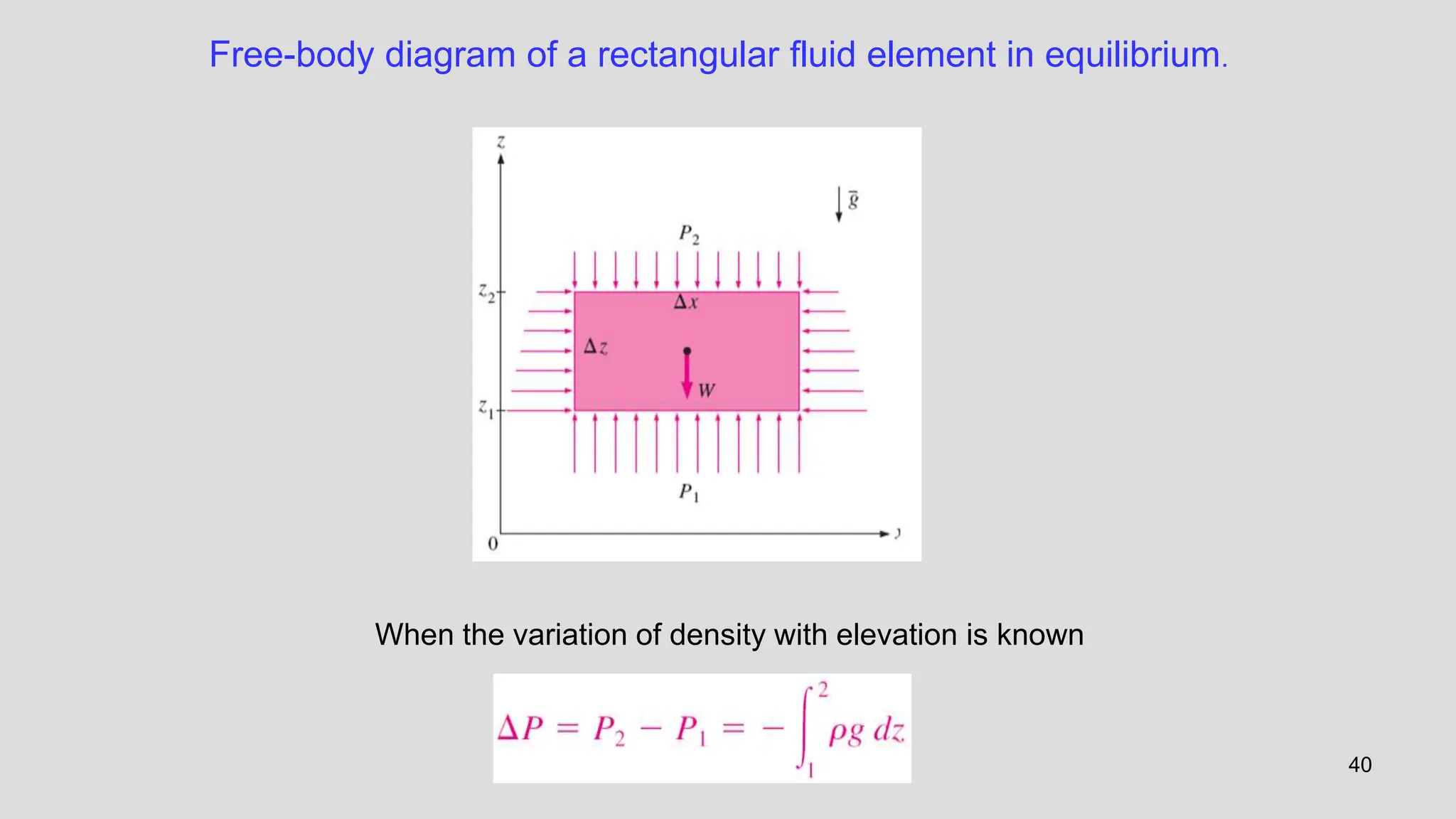
40
When the variation of density with elevation is known
Free-body diagram of a rectangular fluid element in equilibrium.
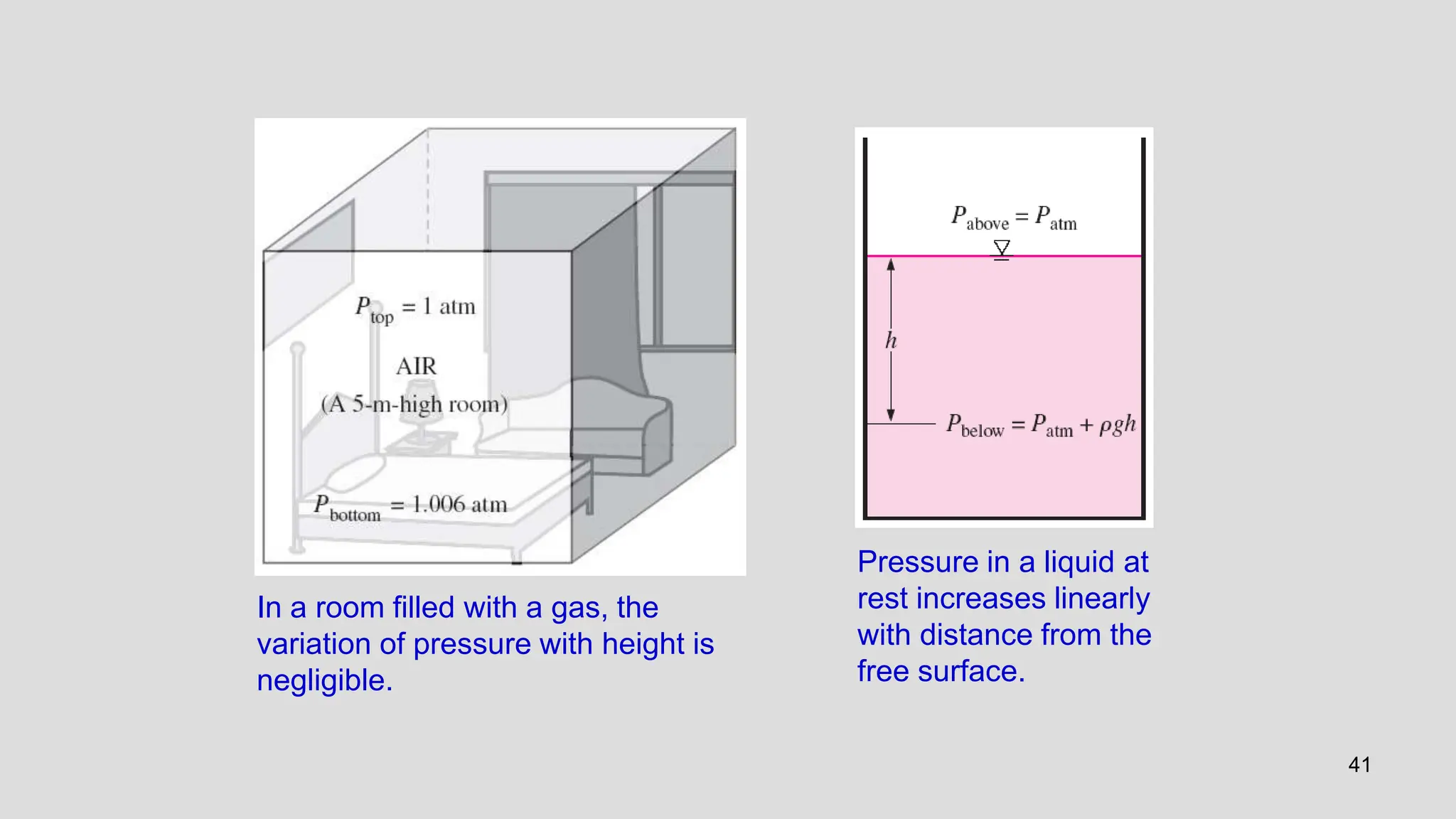
41
In a room filled with a gas, the
variation of pressure with height is
negligible.
Pressure in a liquid at
rest increases linearly
with distance from the
free surface.
42
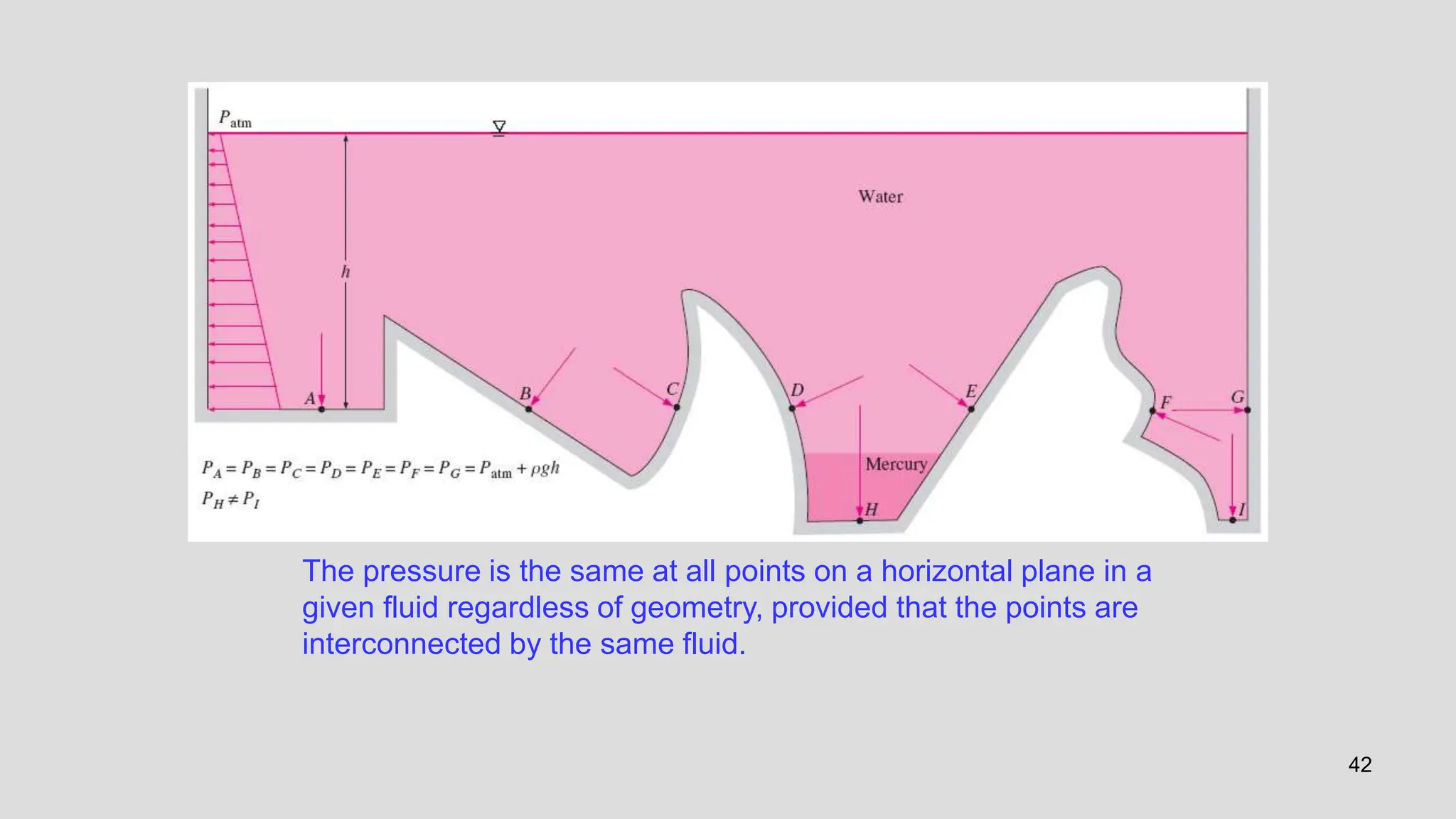
The pressure is the same at all points on a horizontal plane in a
given fluid regardless of geometry, provided that the points are
interconnected by the same fluid.
43
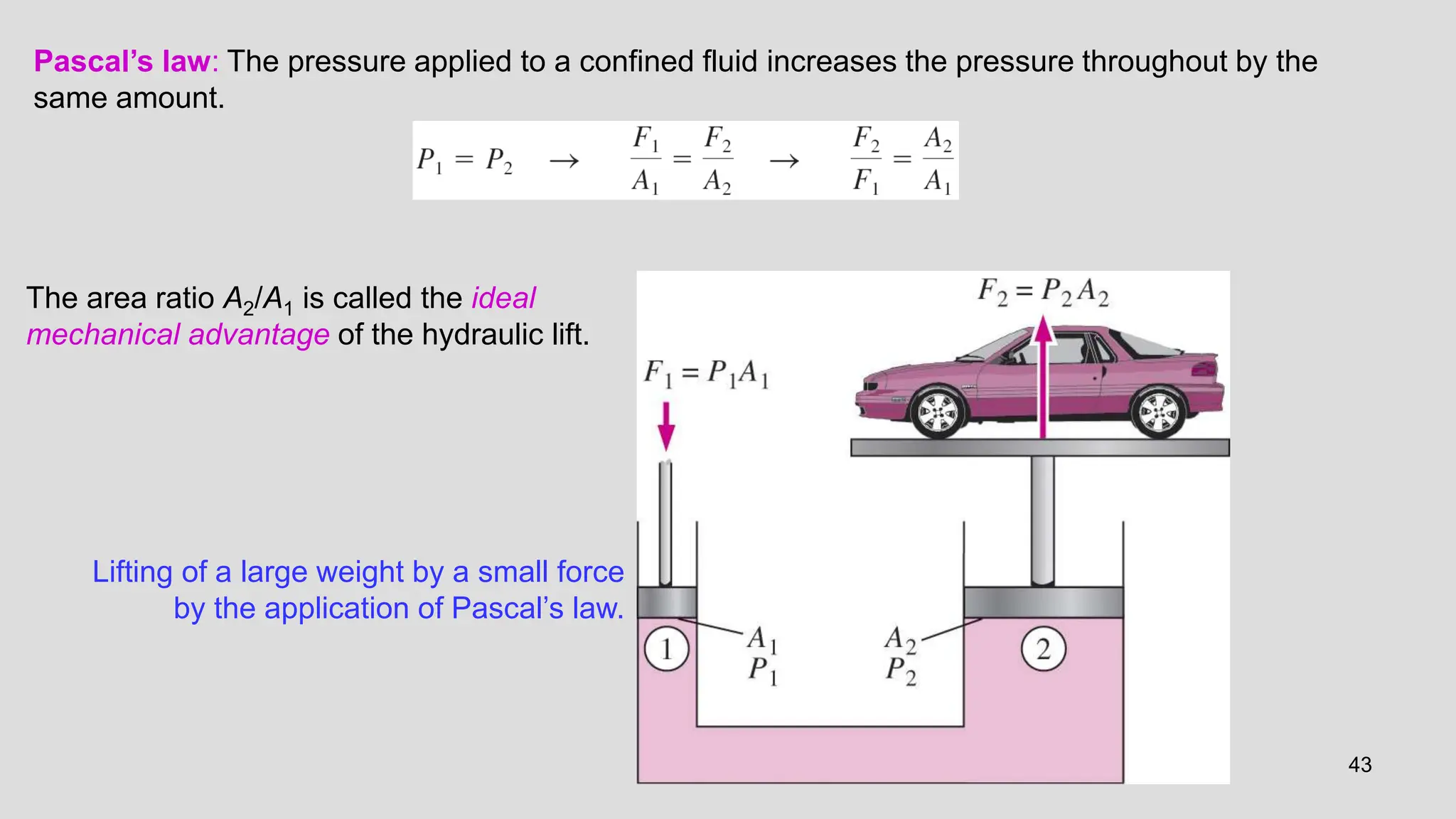
Pascal’s law: The pressure applied to a confined fluid increases the pressure throughout by the
same amount.
Lifting of a large weight by a small force
by the application of Pascal’s law.
The area ratio A2/A1 is called the ideal
mechanical advantage of the hydraulic lift.
44
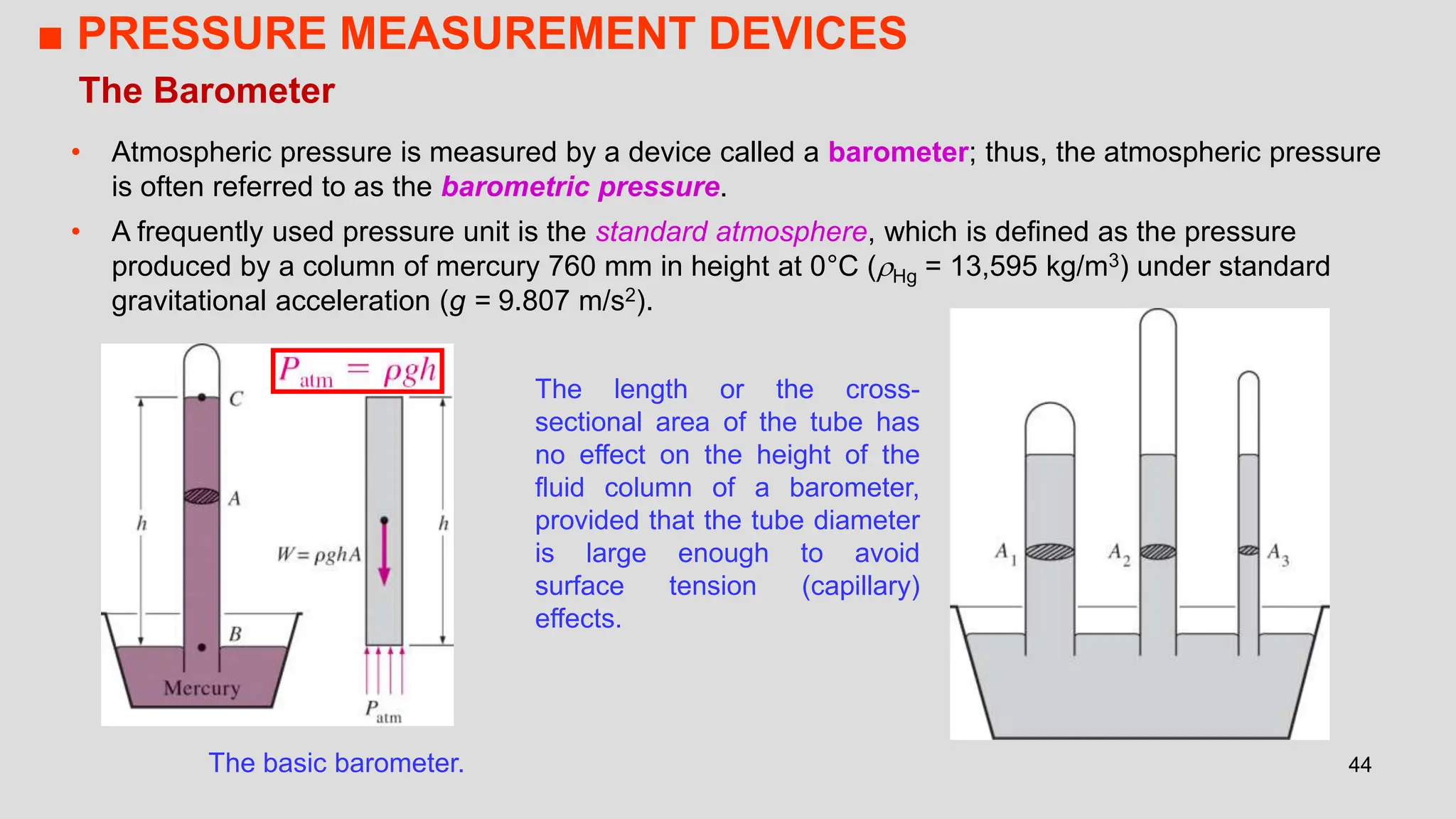
The Barometer
• Atmospheric pressure is measured by a device called a barometer; thus, the atmospheric pressure
is often referred to as the barometric pressure.
• A frequently used pressure unit is the standard atmosphere, which is defined as the pressure
produced by a column of mercury 760 mm in height at 0°C (Hg = 13,595 kg/m3) under standard
gravitational acceleration (g = 9.807 m/s2).
The basic barometer.
The length or the cross-
sectional area of the tube has
no effect on the height of the
fluid column of a barometer,
provided that the tube diameter
is large enough to avoid
surface tension (capillary)
effects.
■ PRESSURE MEASUREMENT DEVICES
45
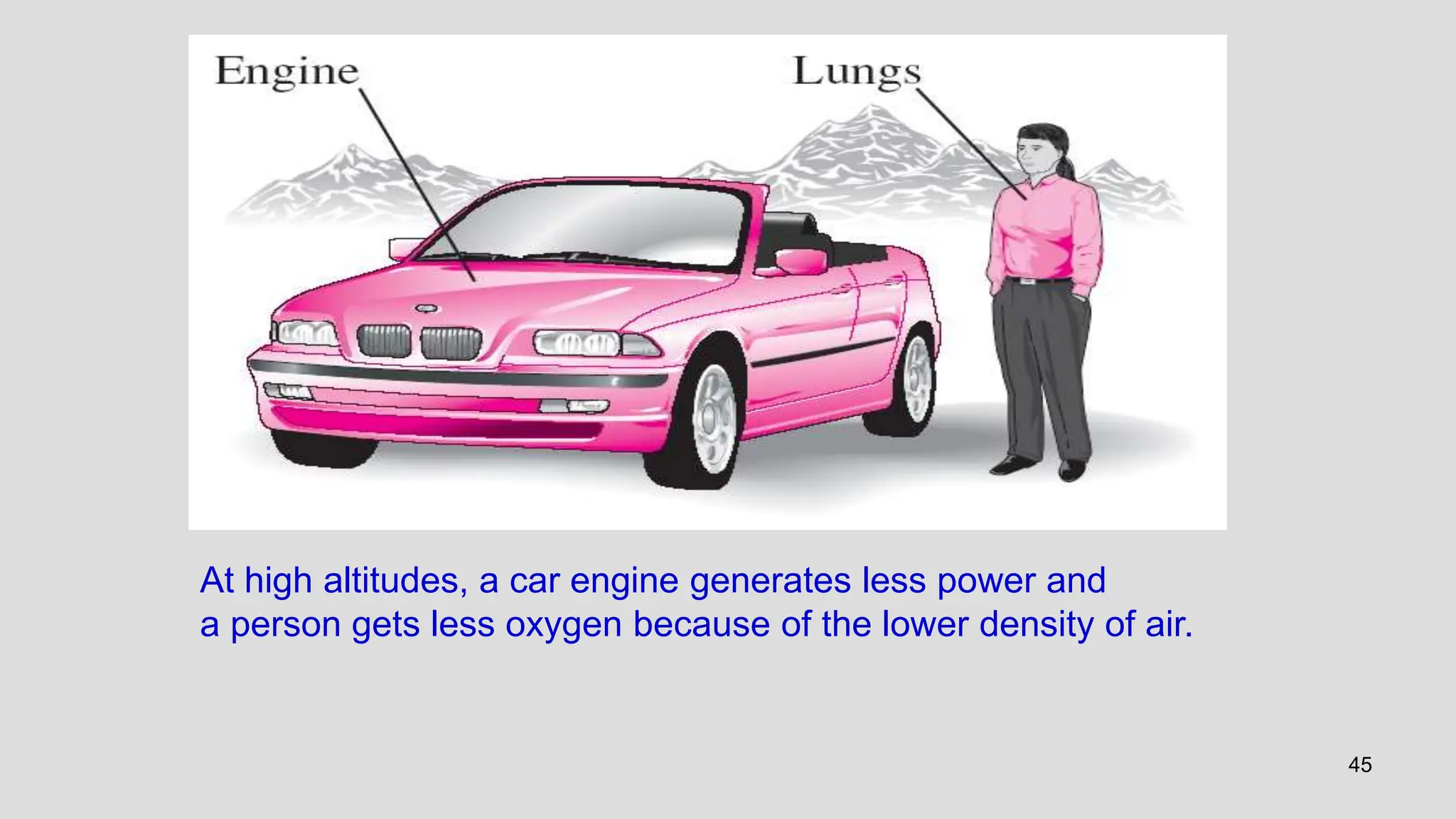
At high altitudes, a car engine generates less power and
a person gets less oxygen because of the lower density of air.
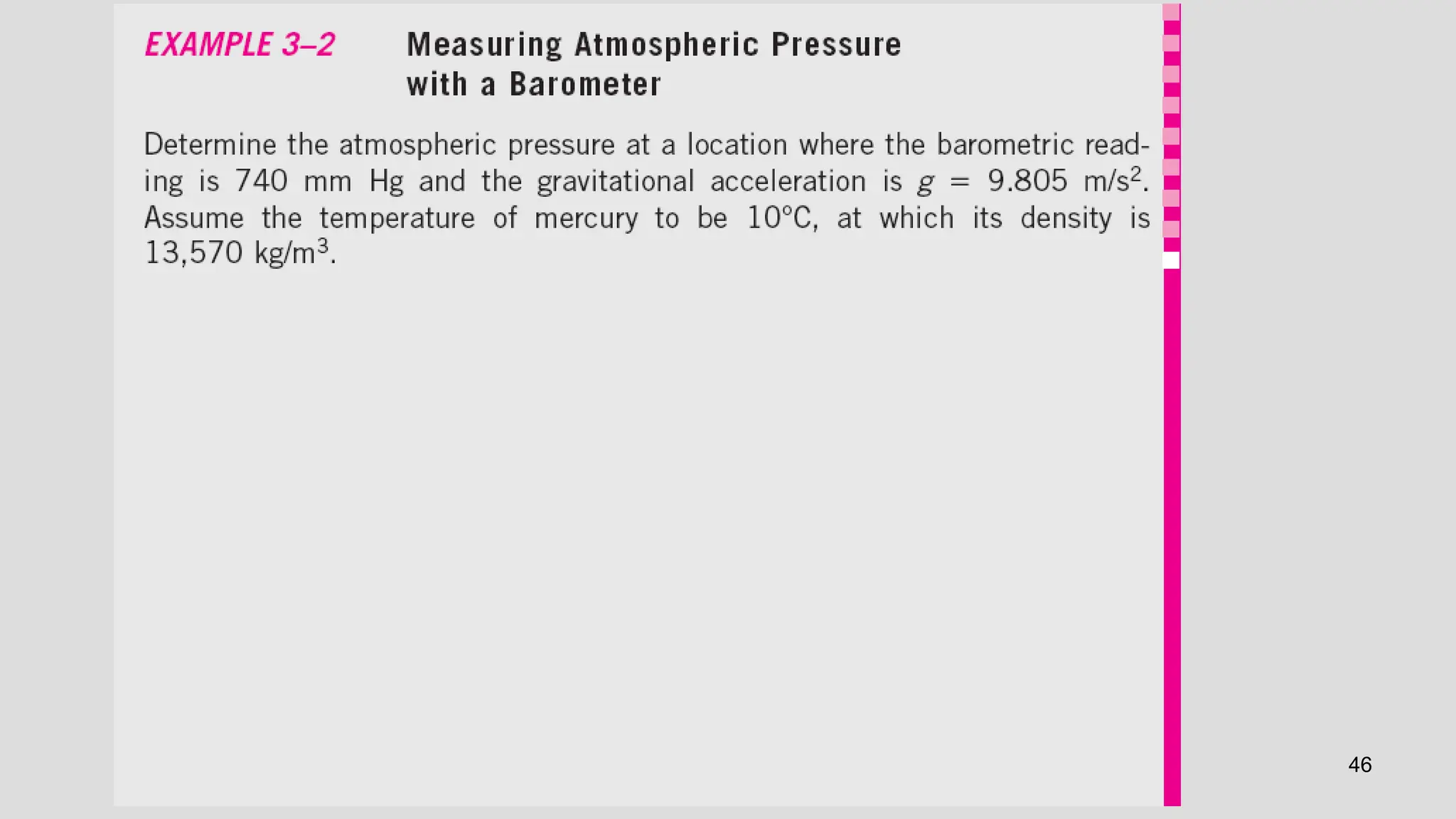
46
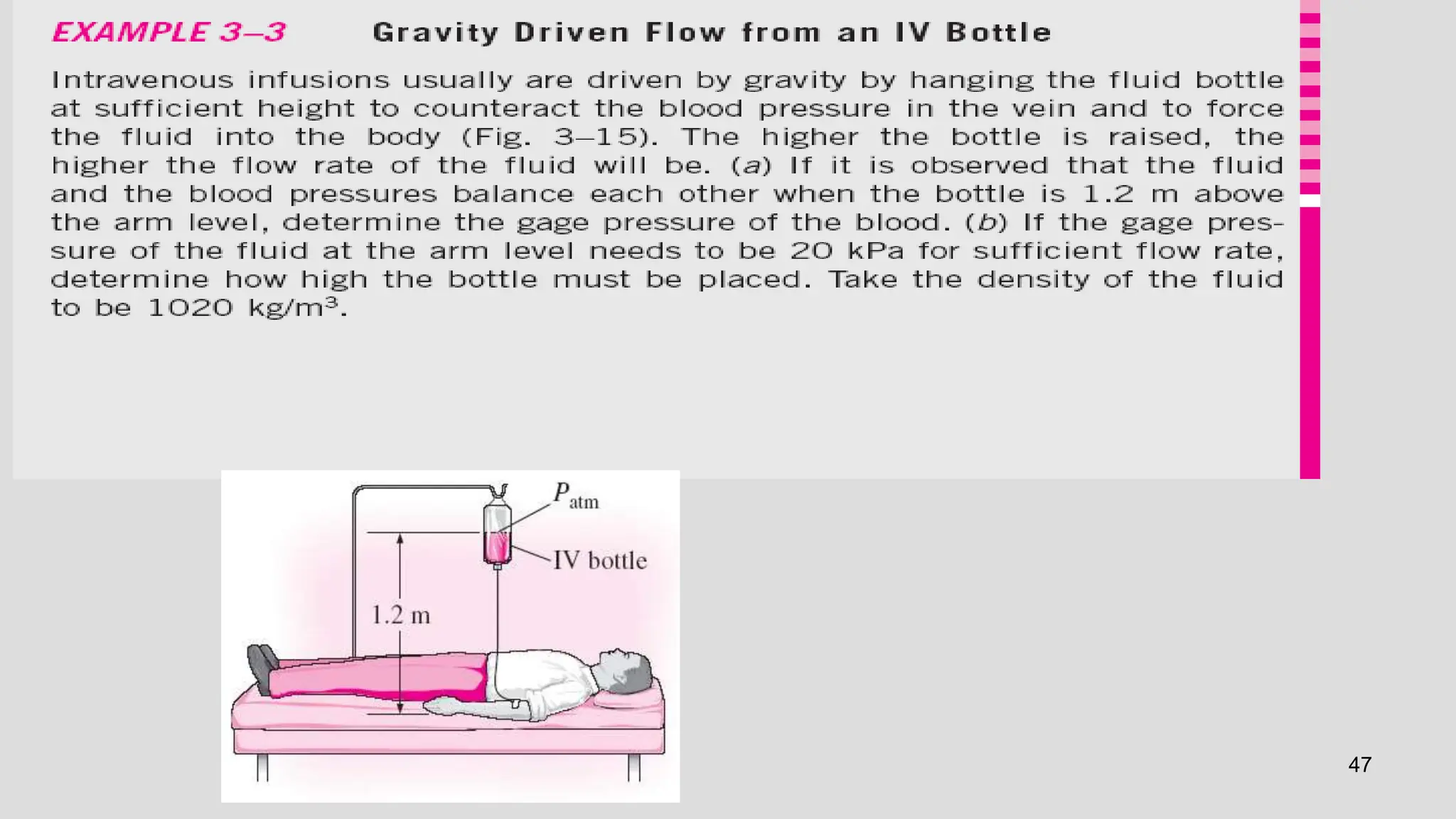
47
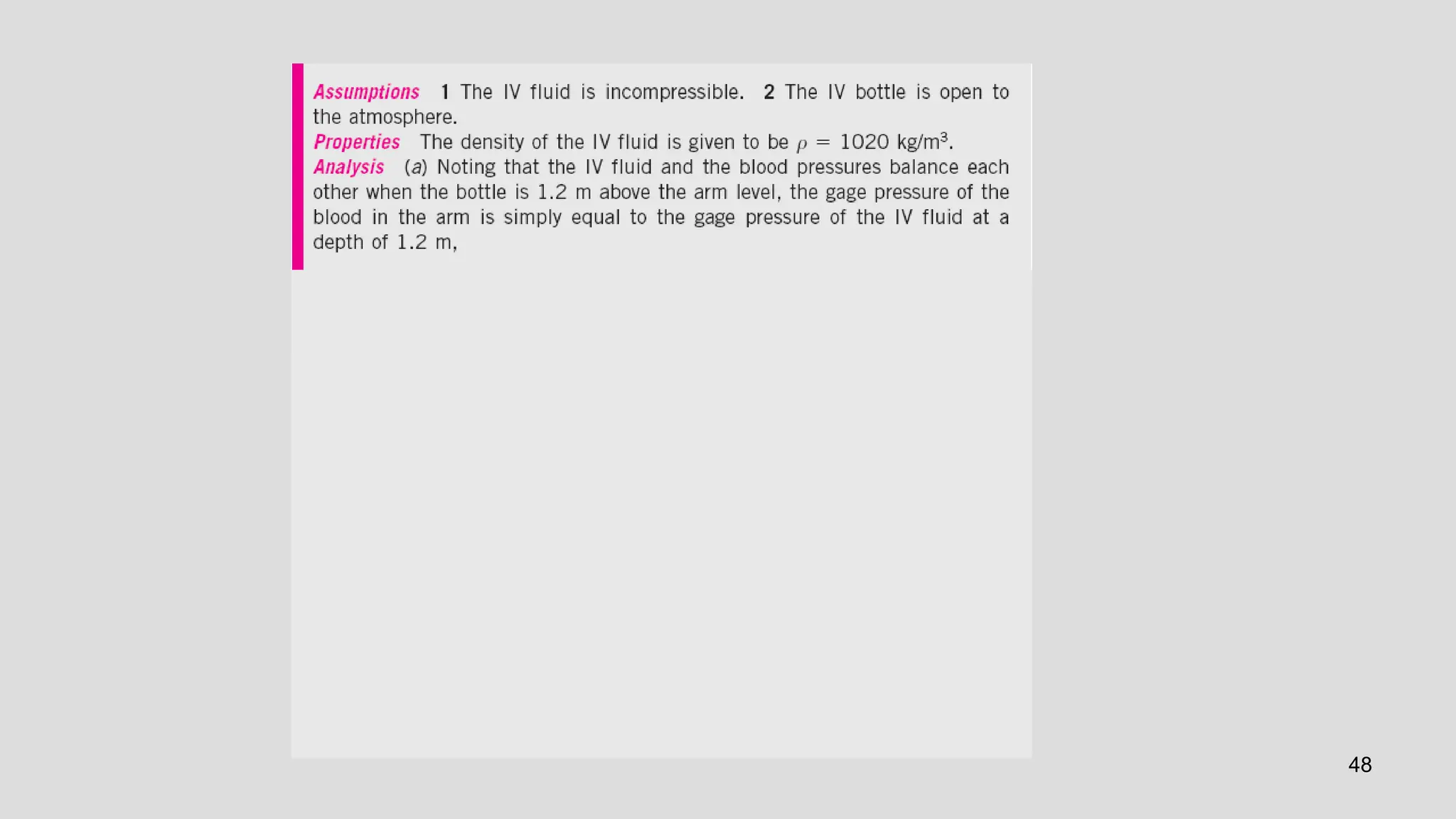
48
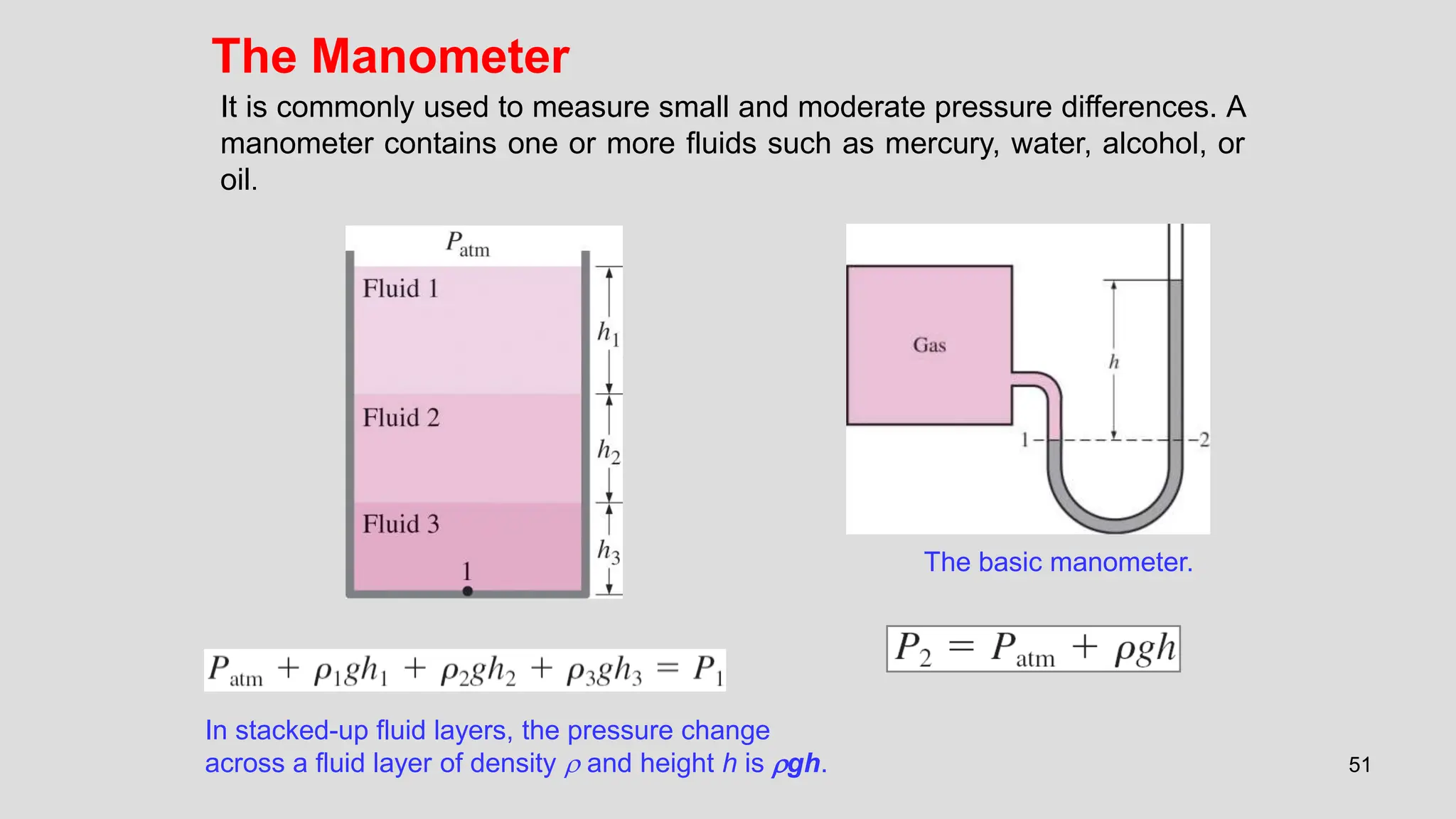
51
The Manometer
In stacked-up fluid layers, the pressure change
across a fluid layer of density  and height h is gh.
The basic manometer.
It is commonly used to measure small and moderate pressure differences. A
manometer contains one or more fluids such as mercury, water, alcohol, or
oil.
52
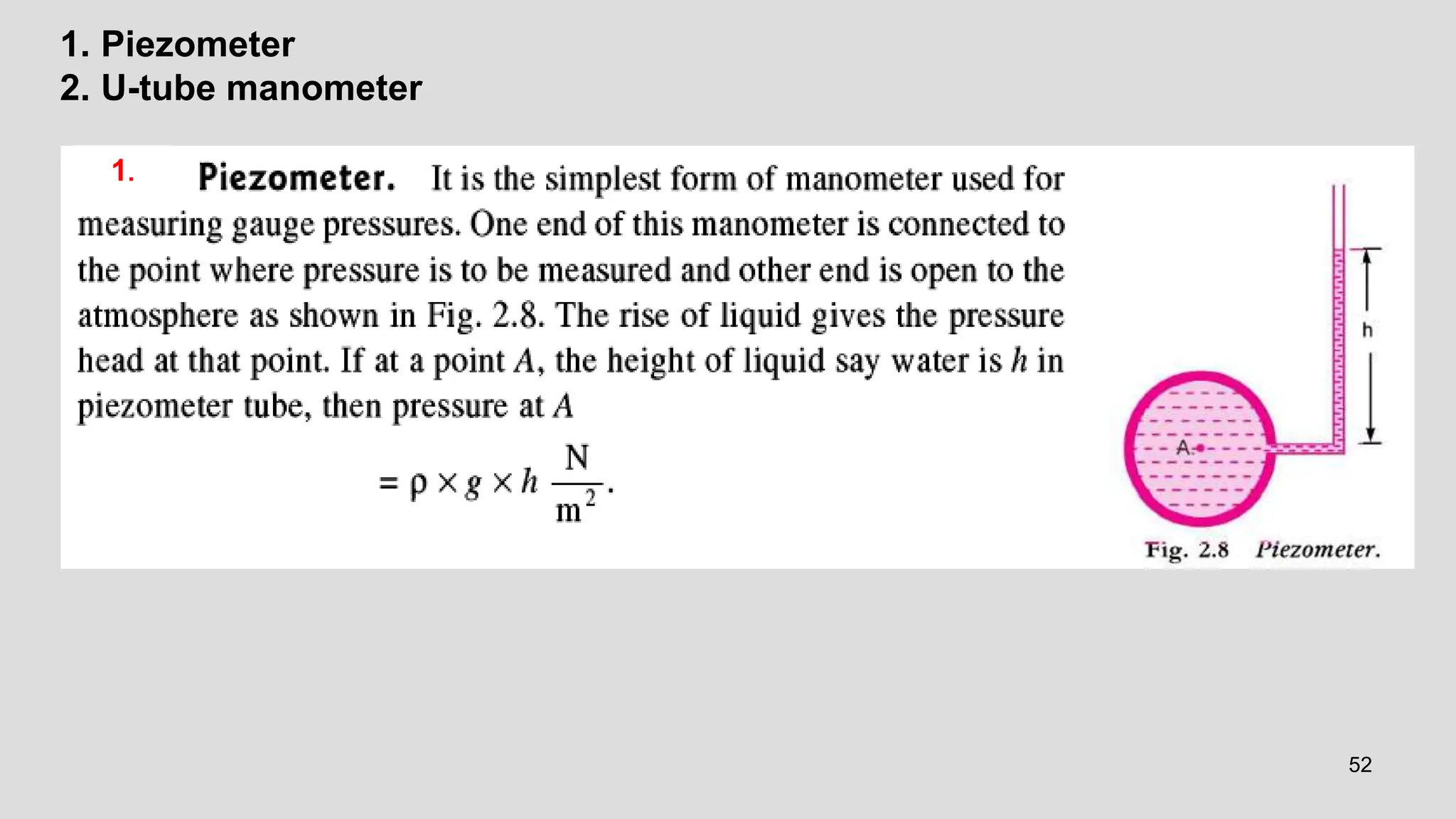
1.
1. Piezometer
2. U-tube manometer
53
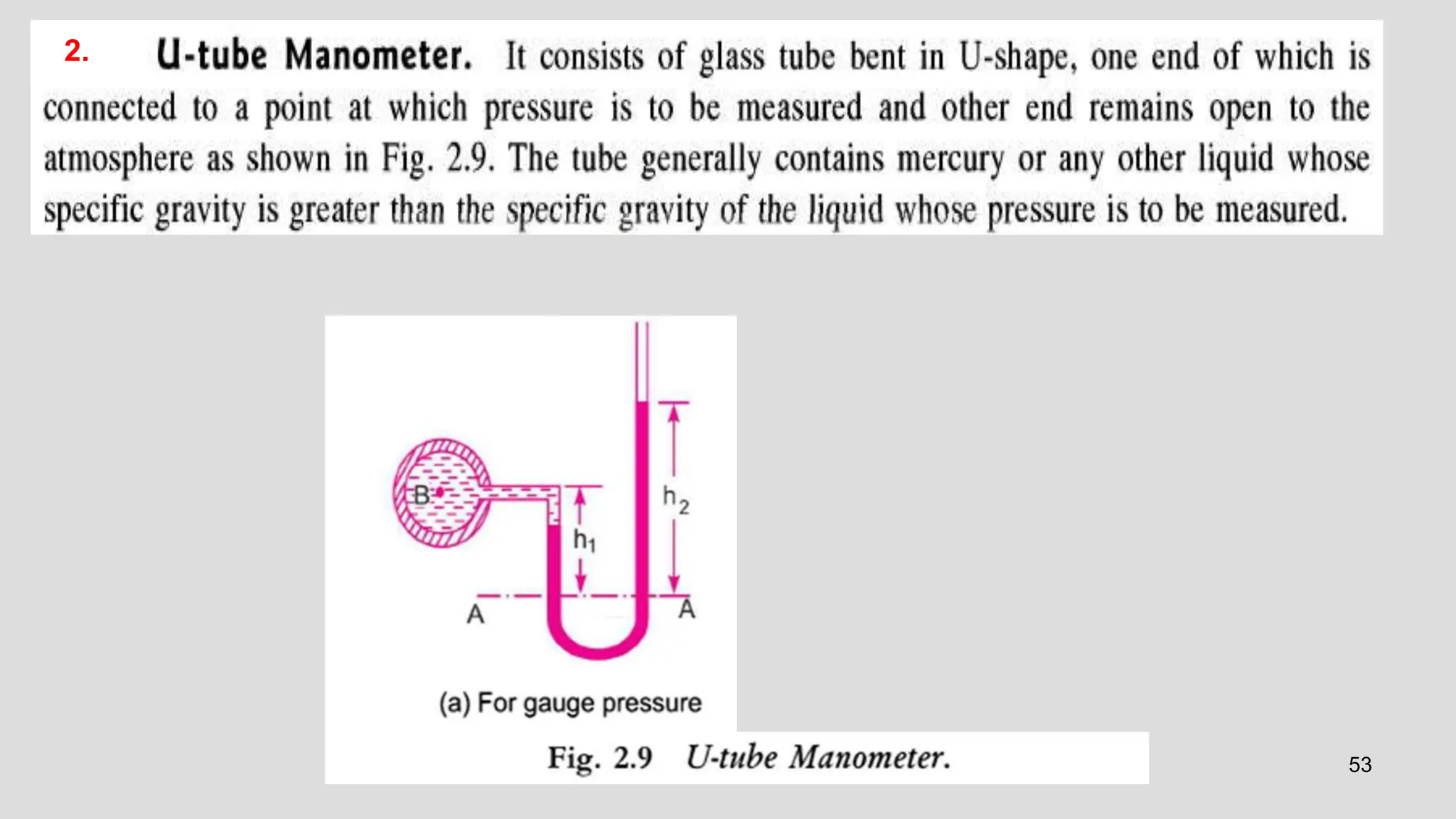
2.
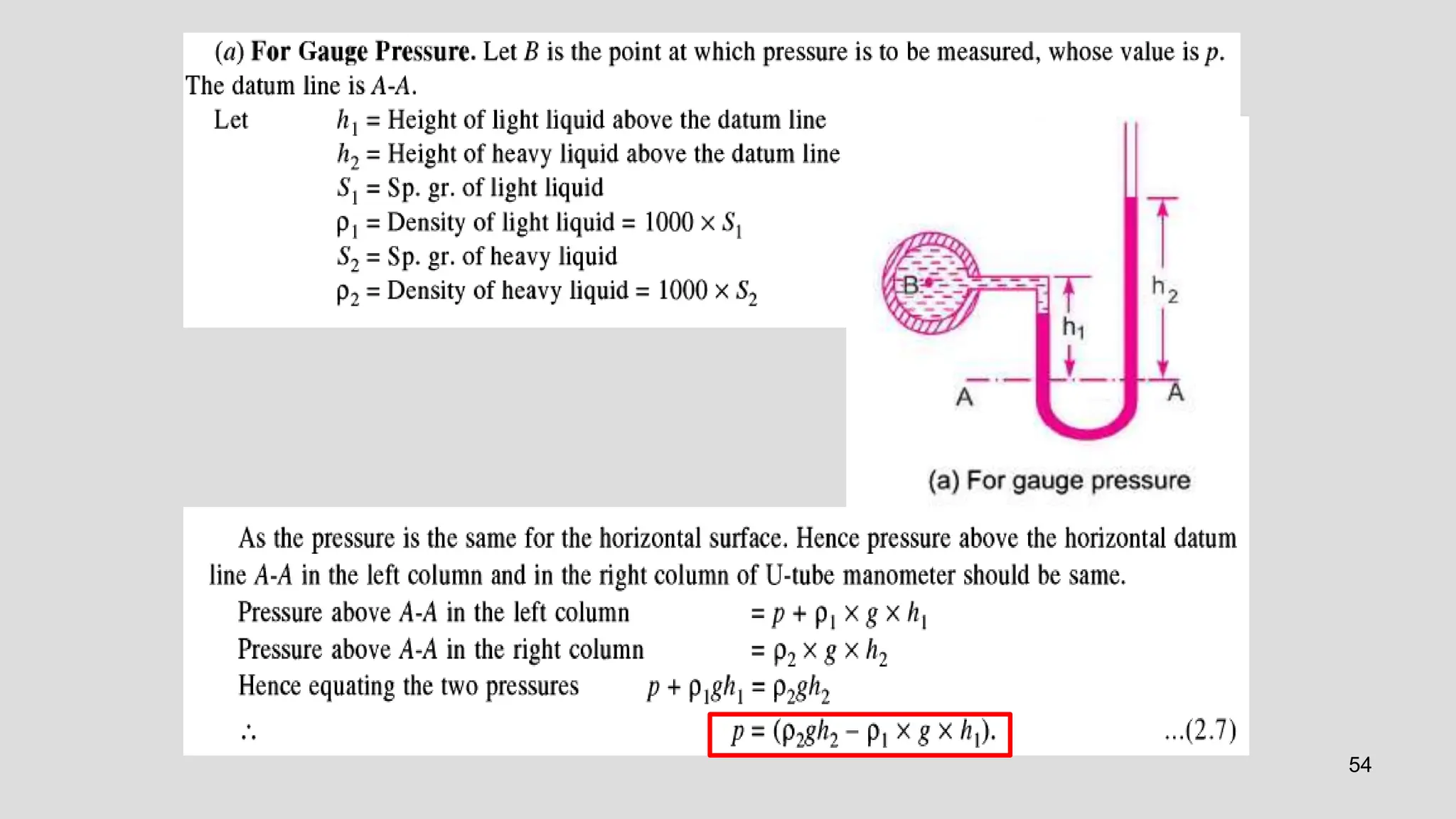
54
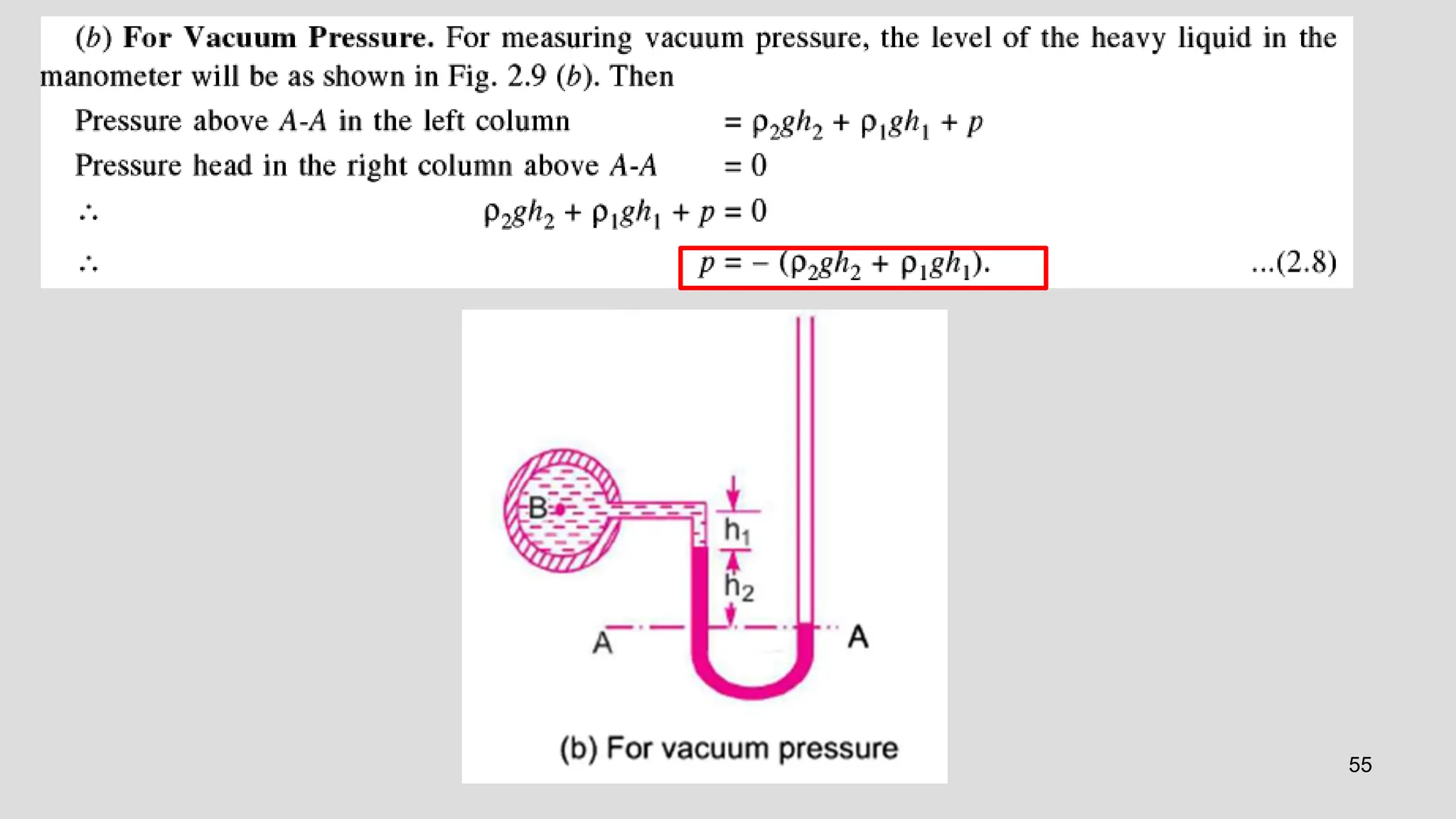
55
56
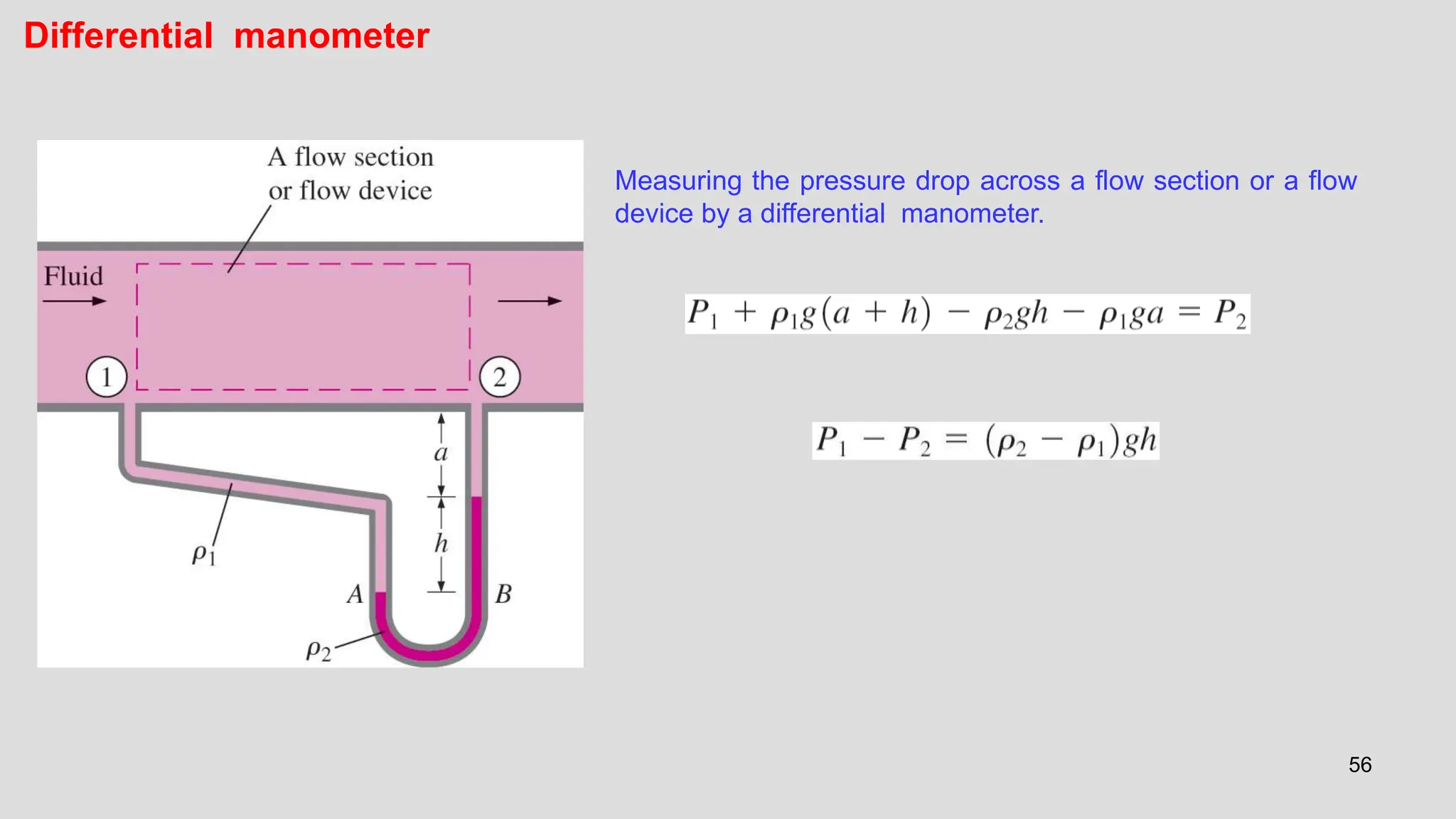
Measuring the pressure drop across a flow section or a flow
device by a differential manometer.
Differential manometer
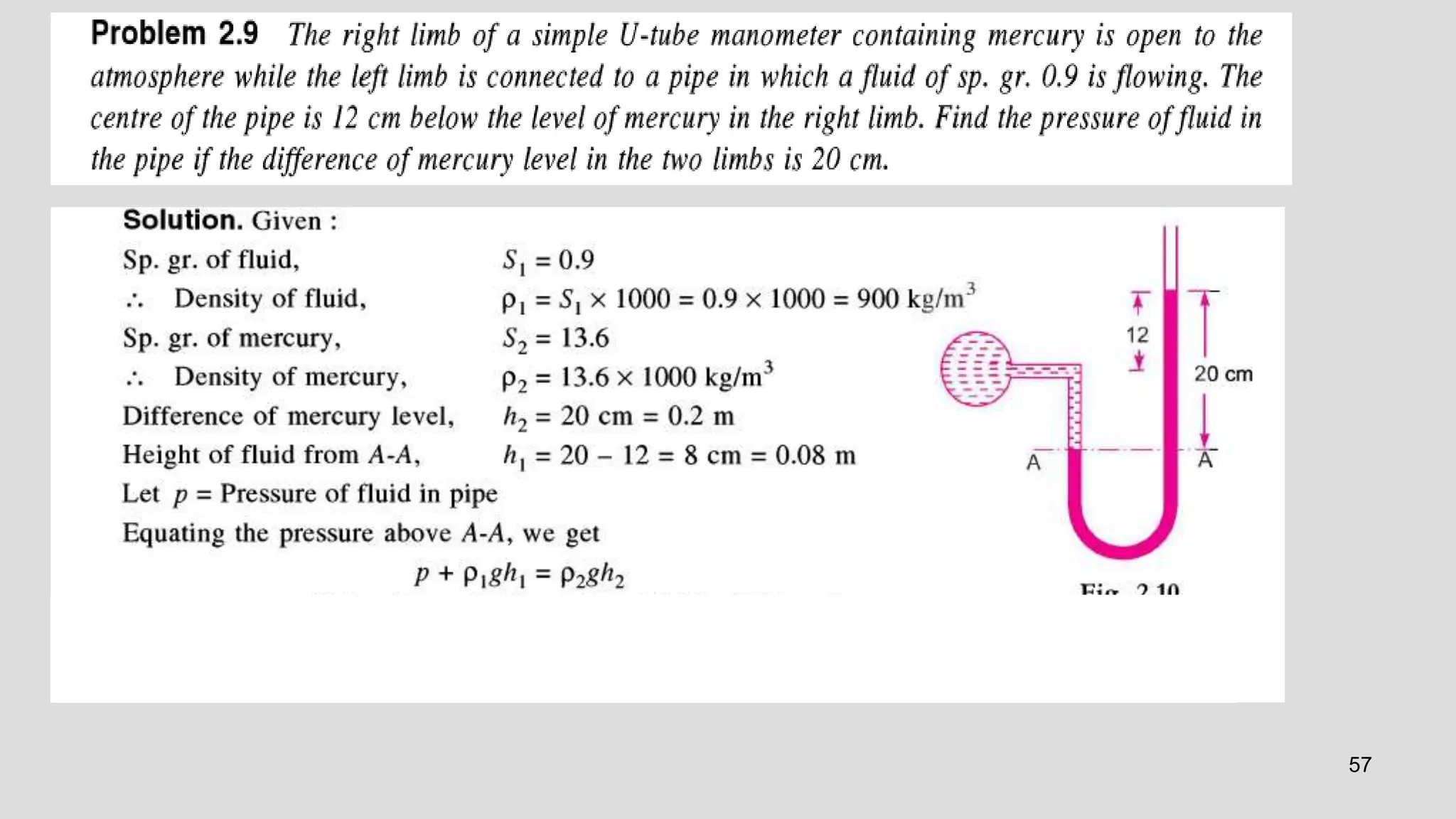
57
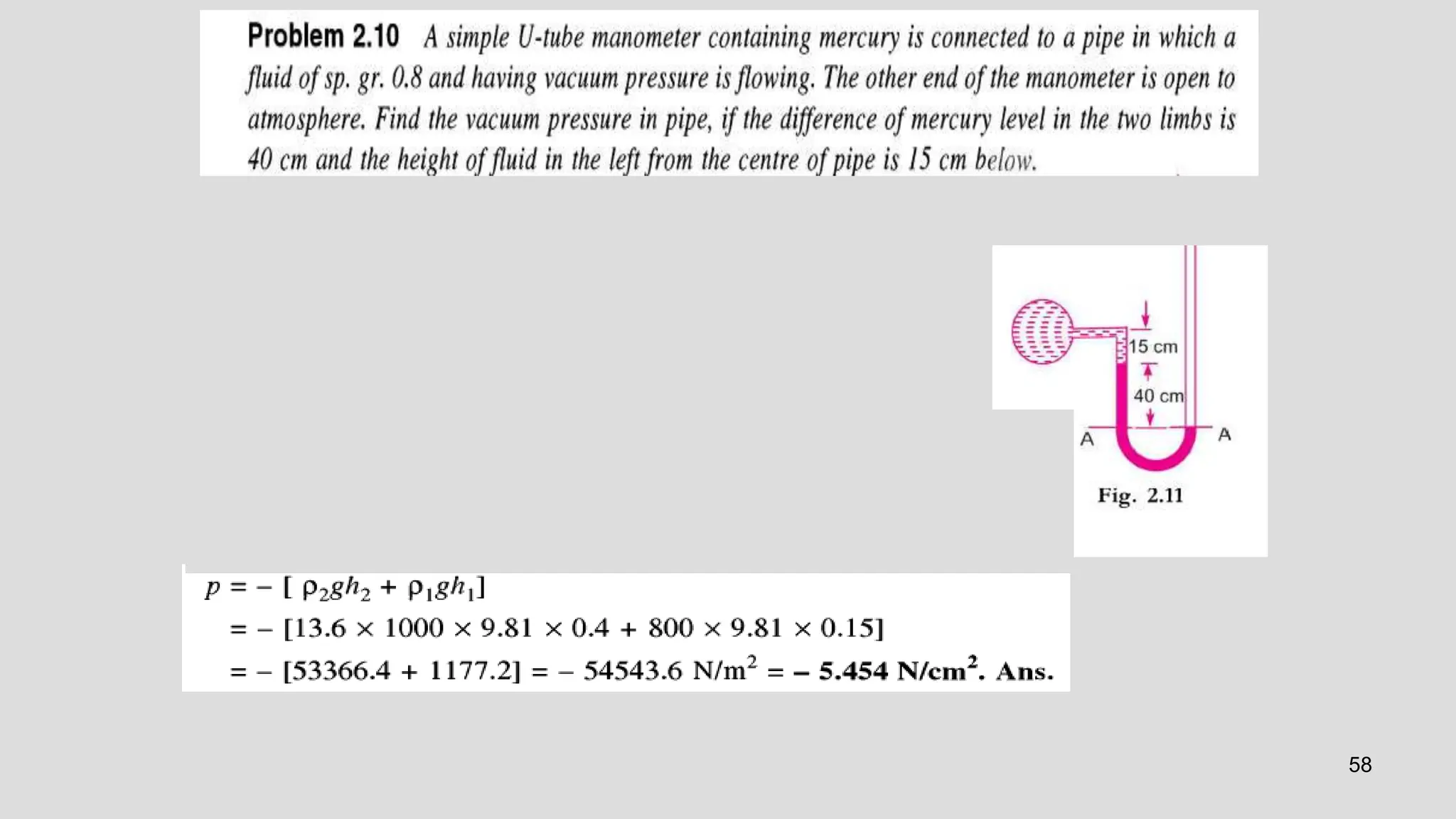
58
61
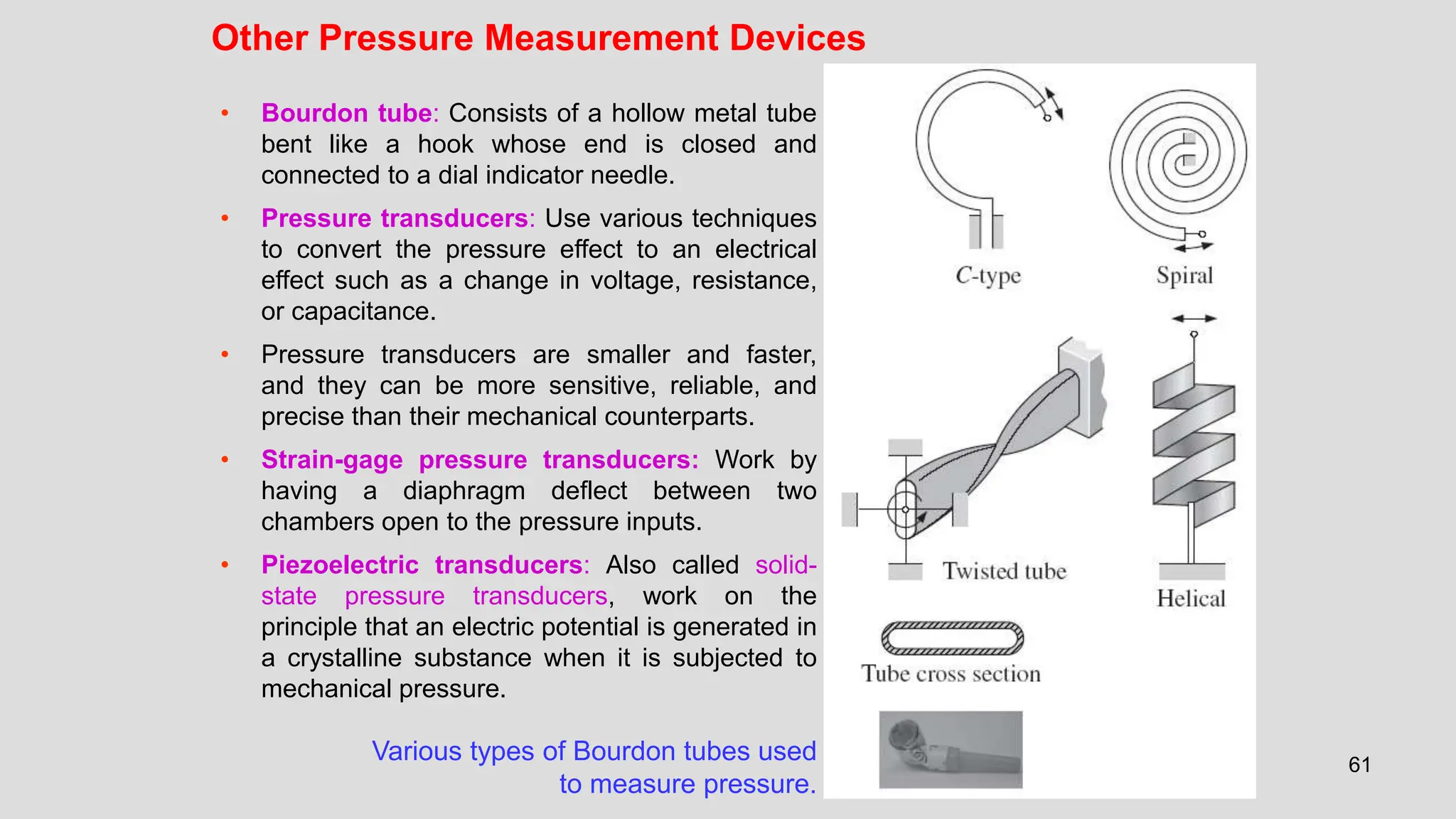
Other Pressure Measurement Devices
Various types of Bourdon tubes used
to measure pressure.
• Bourdon tube: Consists of a hollow metal tube
bent like a hook whose end is closed and
connected to a dial indicator needle.
• Pressure transducers: Use various techniques
to convert the pressure effect to an electrical
effect such as a change in voltage, resistance,
or capacitance.
• Pressure transducers are smaller and faster,
and they can be more sensitive, reliable, and
precise than their mechanical counterparts.
• Strain-gage pressure transducers: Work by
having a diaphragm deflect between two
chambers open to the pressure inputs.
• Piezoelectric transducers: Also called solid-
state pressure transducers, work on the
principle that an electric potential is generated in
a crystalline substance when it is subjected to
mechanical pressure.
62
3–3 ■ INTRODUCTION TO FLUID STATICS
Fluid statics: Deals with problems associated with fluids at rest.
The fluid can be either gaseous or liquid.
Hydrostatics: When the fluid is a liquid.
Aerostatics: When the fluid is a gas.
In fluid statics, there is no relative motion between adjacent fluid
layers, and thus there are no shear (tangential) stresses in the
fluid trying to deform it.
The only stress we deal with in fluid statics is the normal stress, which
is the pressure, and the variation of pressure is due only to the
weight of the fluid.
The topic of fluid statics has significance only in gravity fields.
The design of many engineering systems such as water dams and
liquid storage tanks requires the determination of the forces acting
on the surfaces using fluid statics.
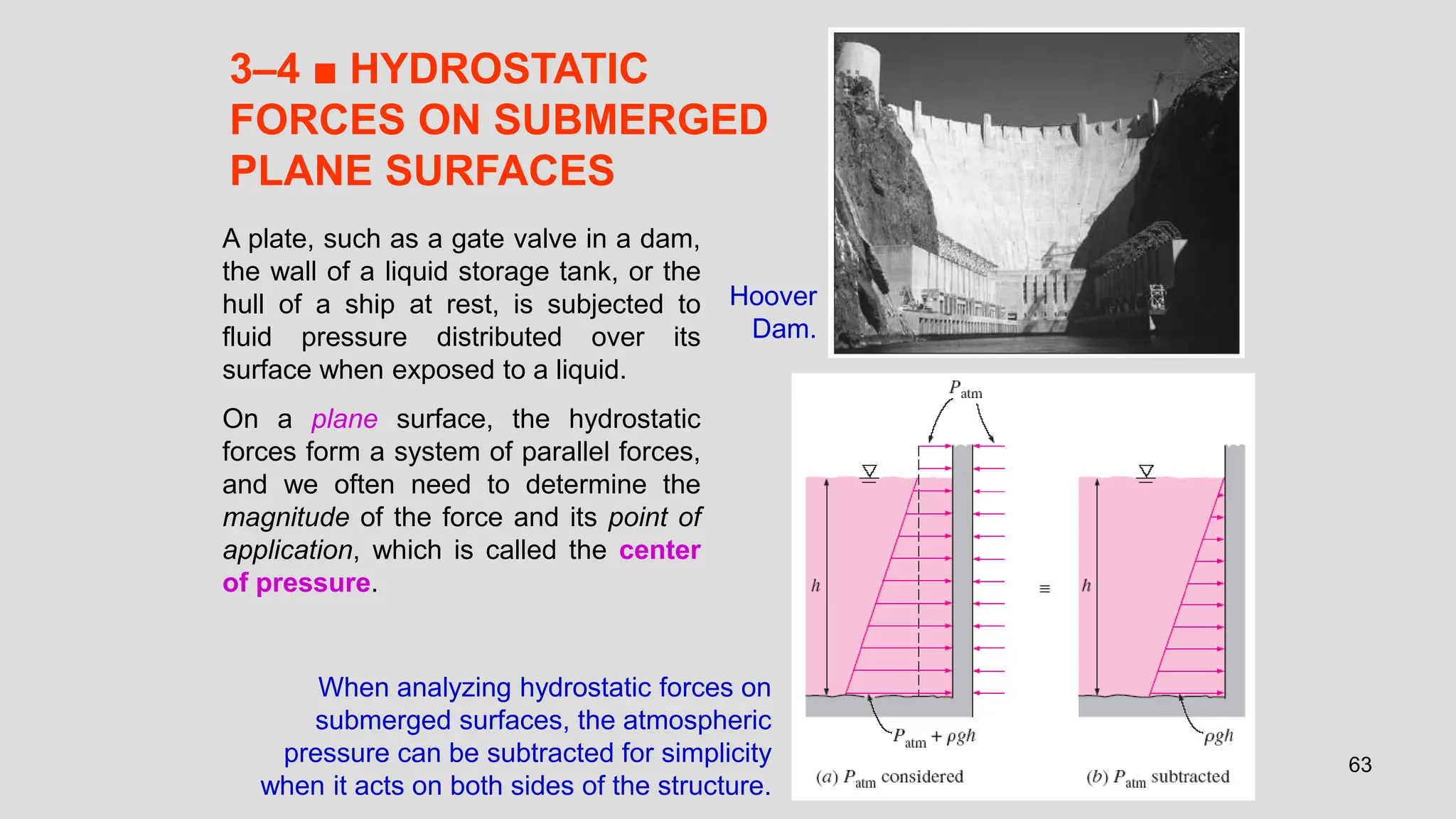
63
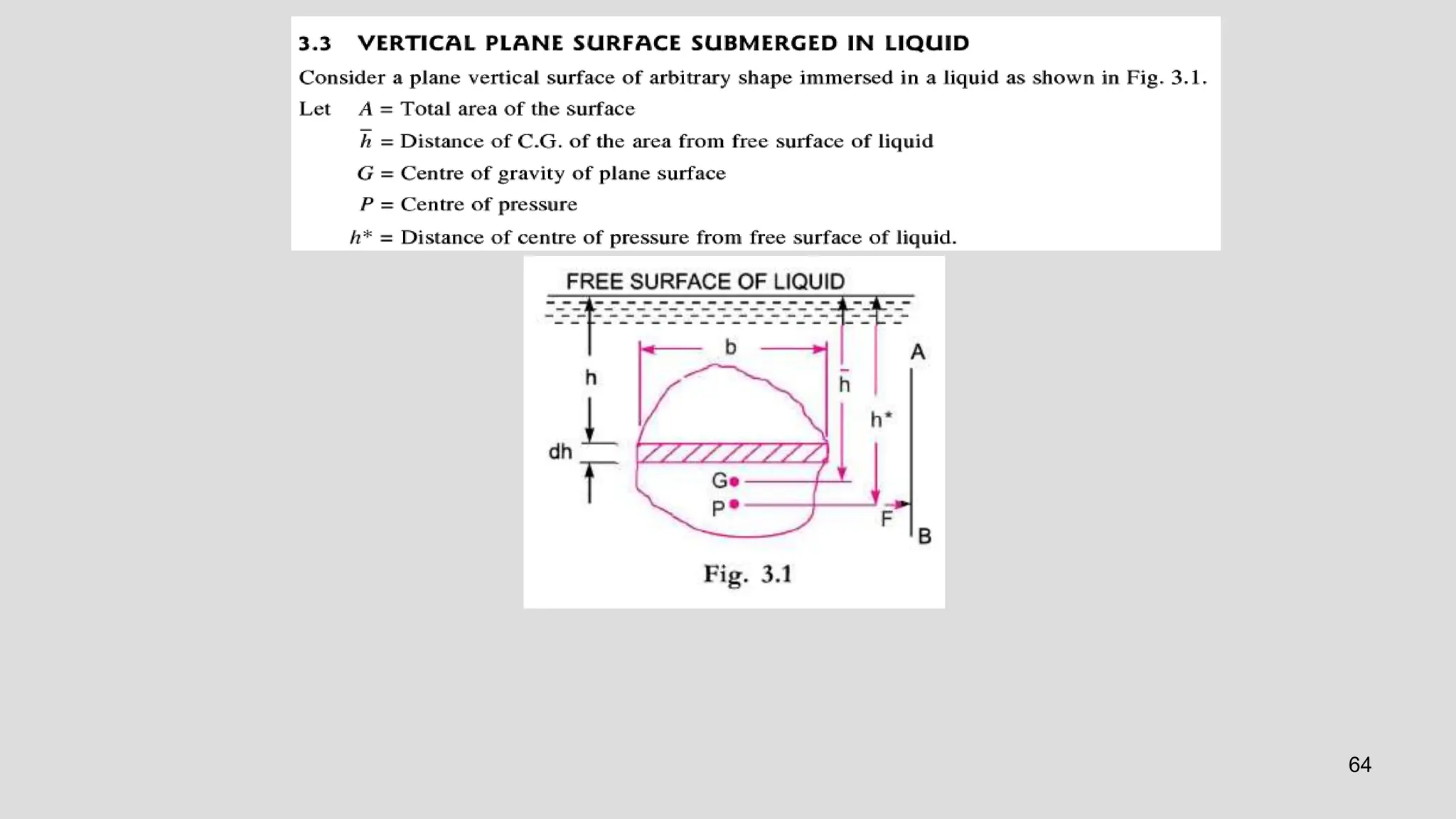
3–4 ■ HYDROSTATIC
FORCES ON SUBMERGED
PLANE SURFACES
Hoover
Dam.
A plate, such as a gate valve in a dam,
the wall of a liquid storage tank, or the
hull of a ship at rest, is subjected to
fluid pressure distributed over its
surface when exposed to a liquid.
On a plane surface, the hydrostatic
forces form a system of parallel forces,
and we often need to determine the
magnitude of the force and its point of
application, which is called the center
of pressure.
When analyzing hydrostatic forces on
submerged surfaces, the atmospheric
pressure can be subtracted for simplicity
when it acts on both sides of the structure.
64
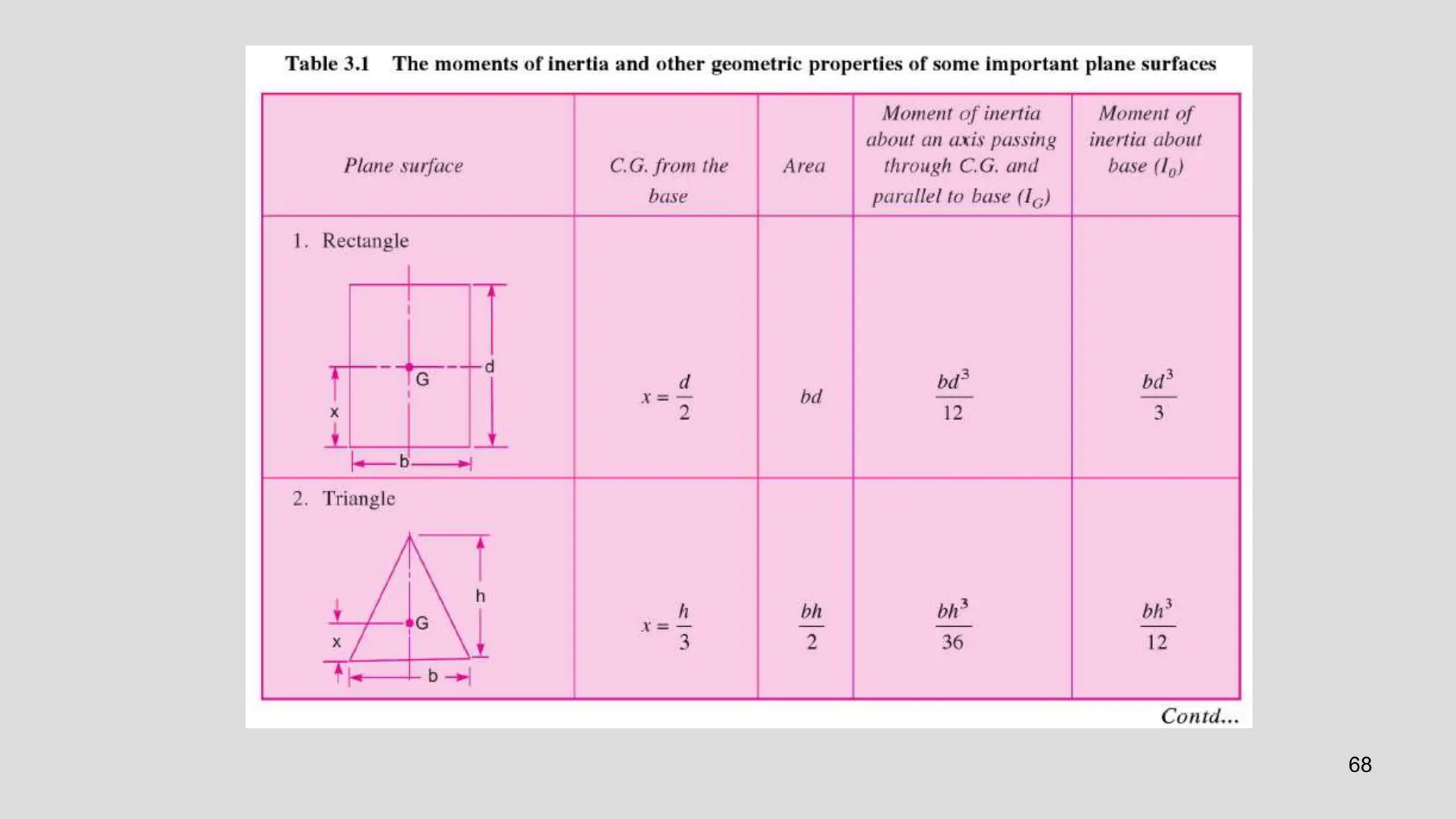
65
66
67
68
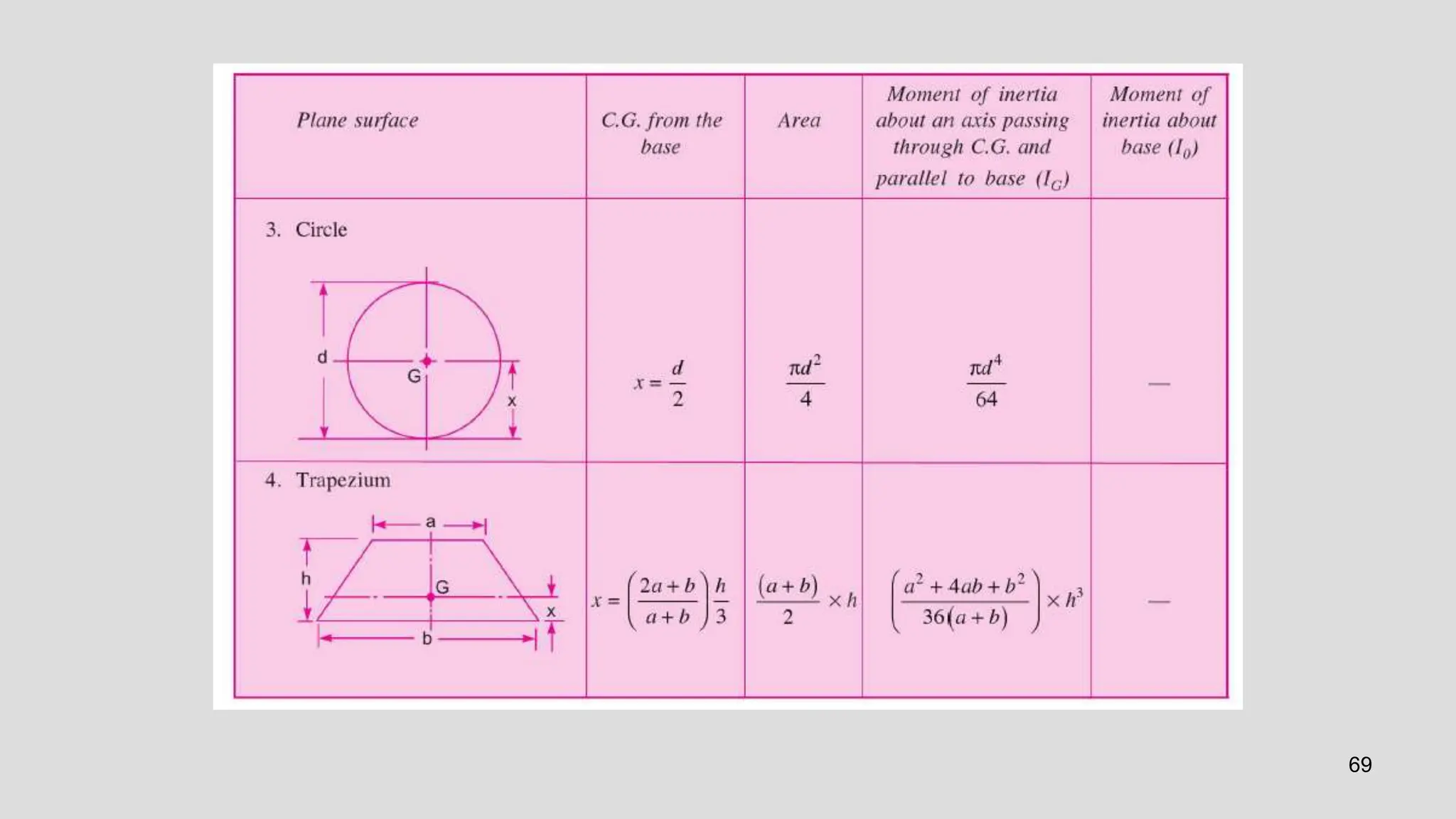
69
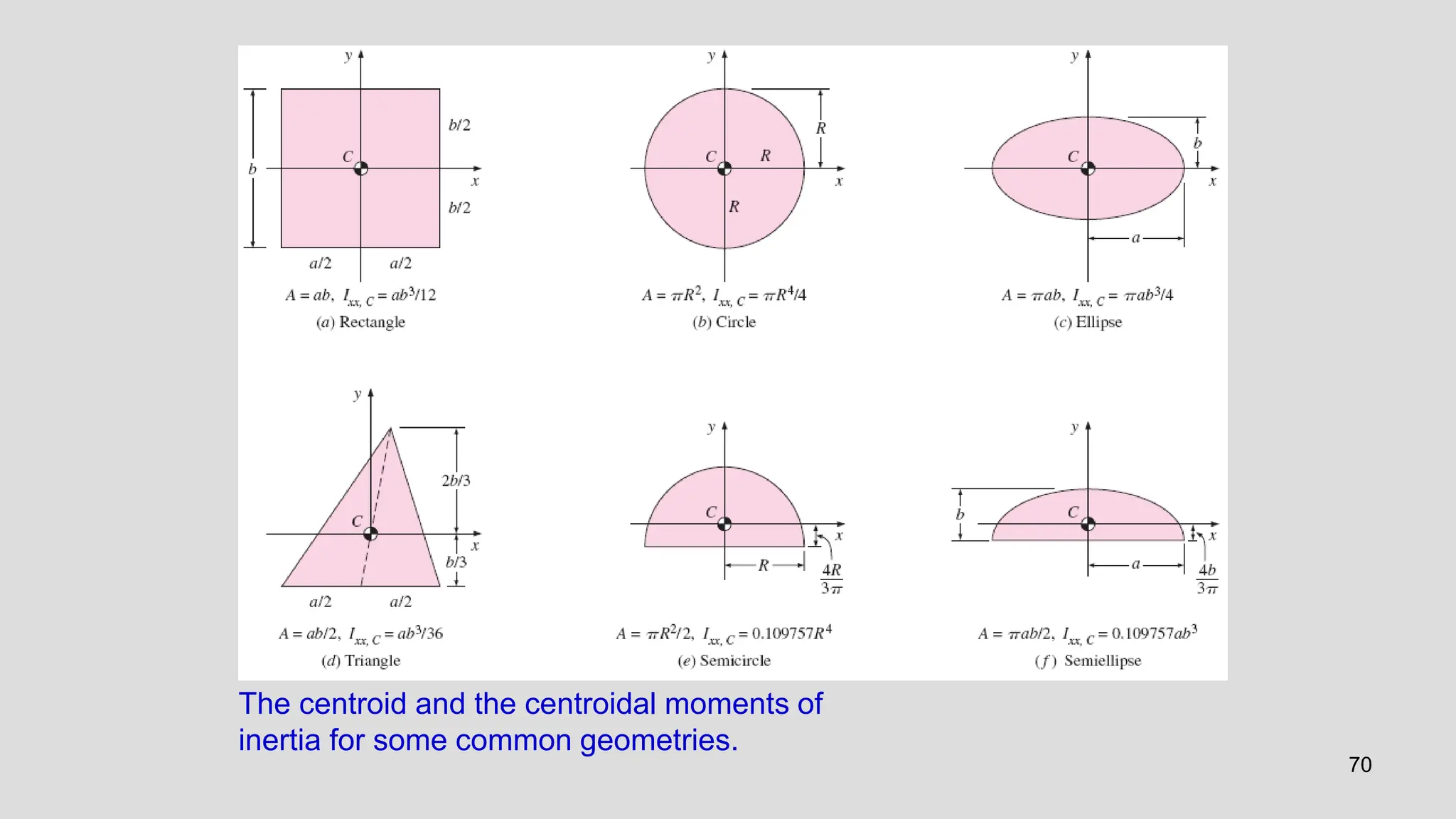
70
The centroid and the centroidal moments of
inertia for some common geometries.
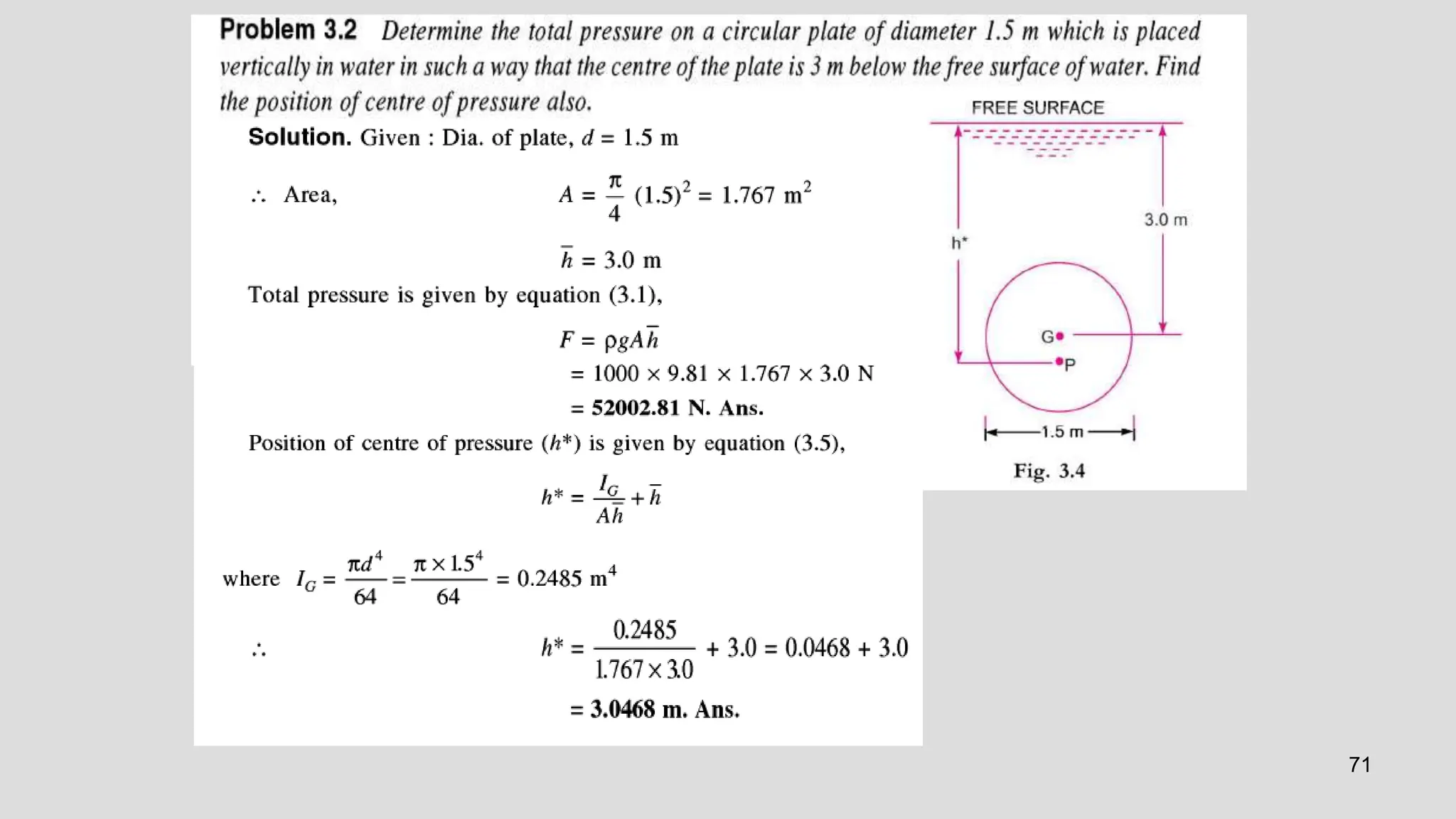
71
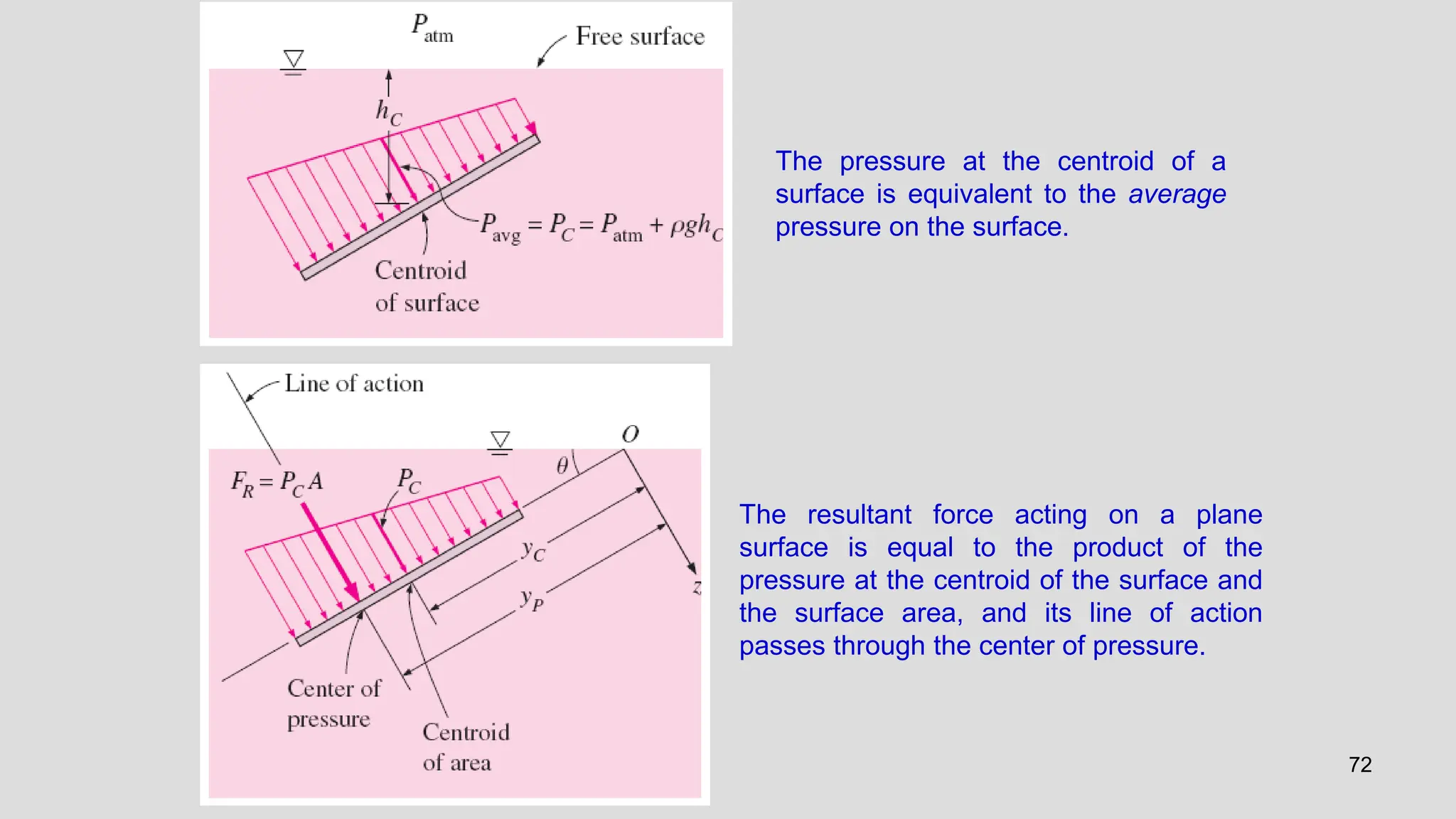
72
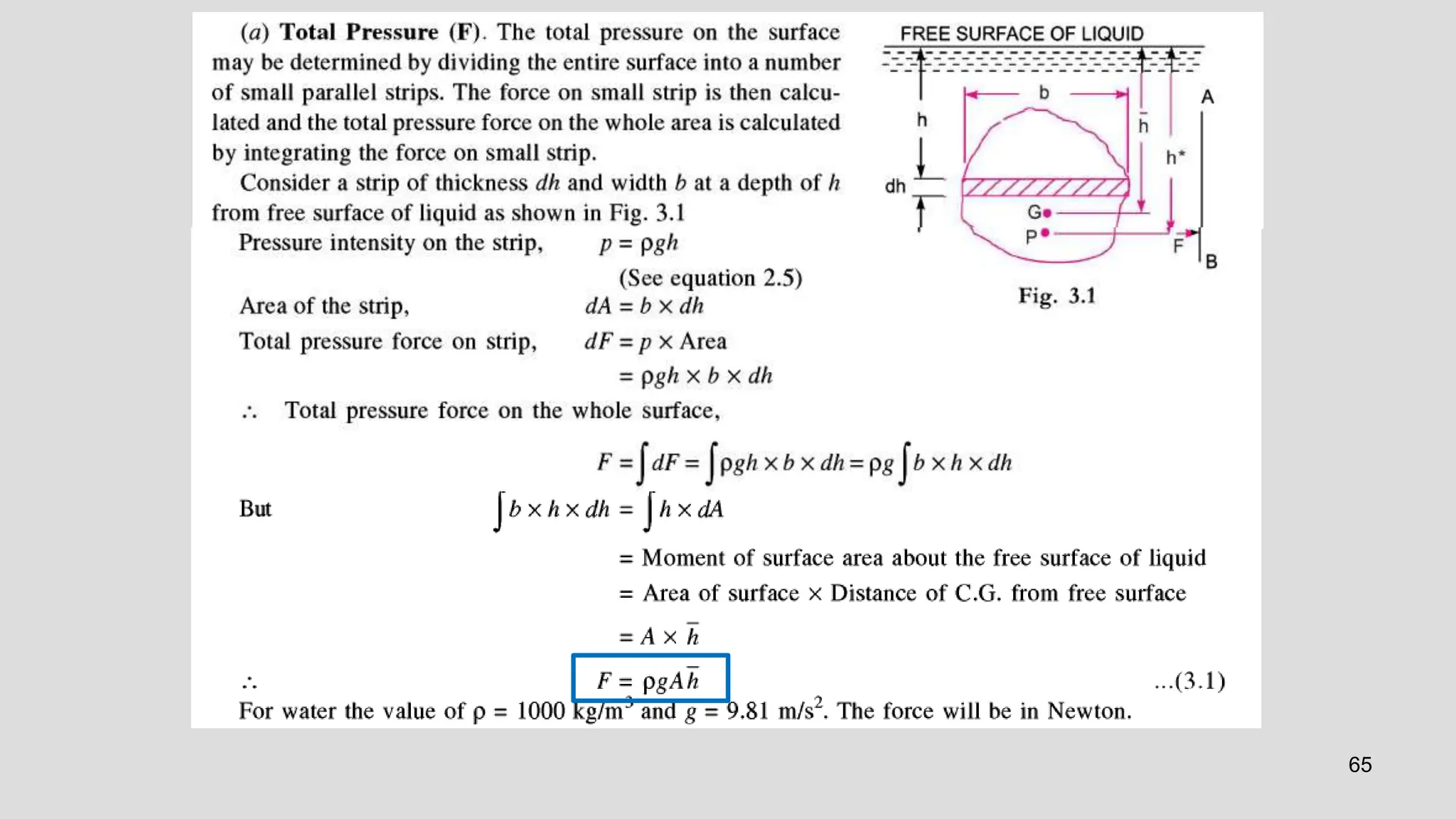
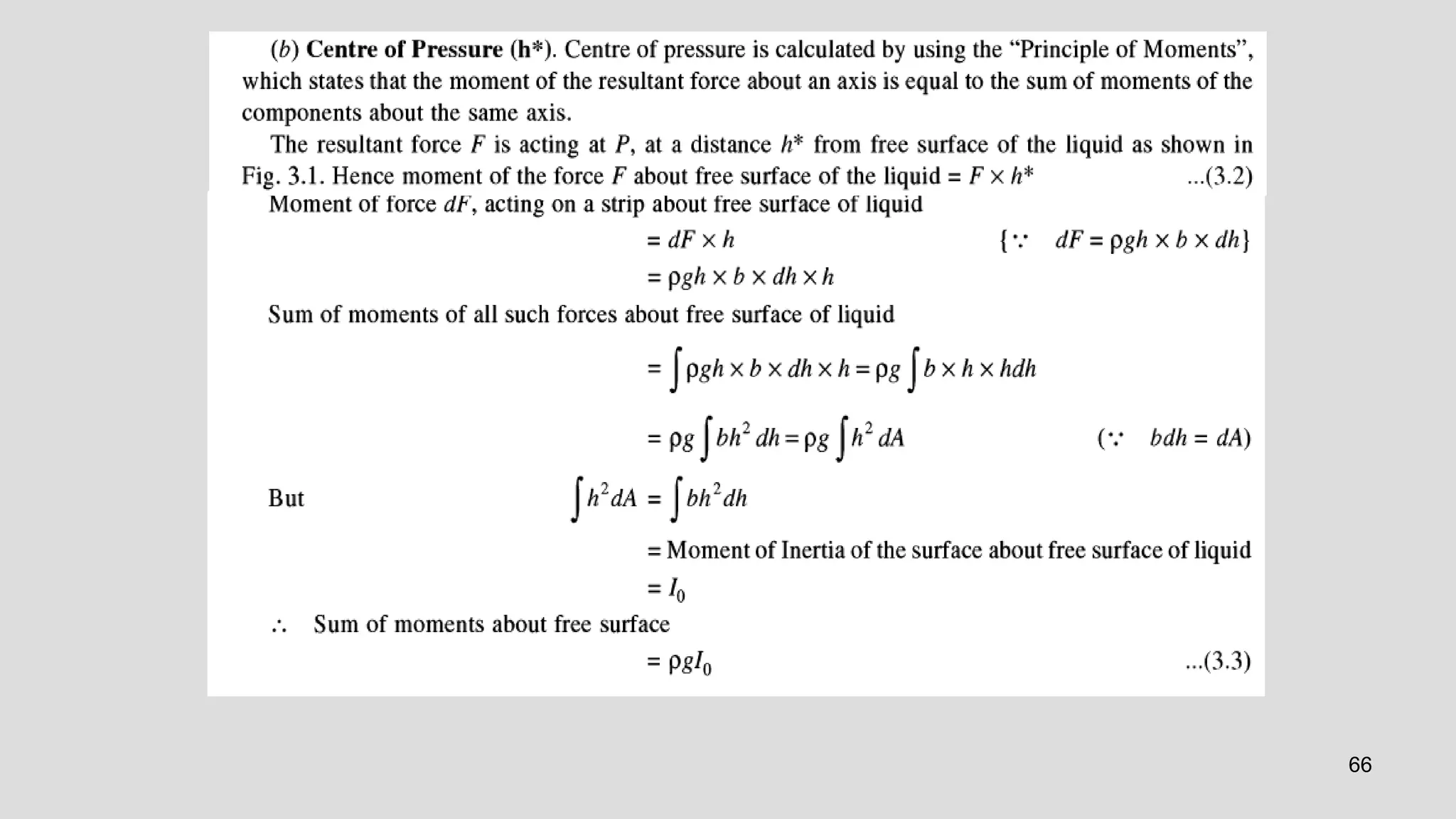
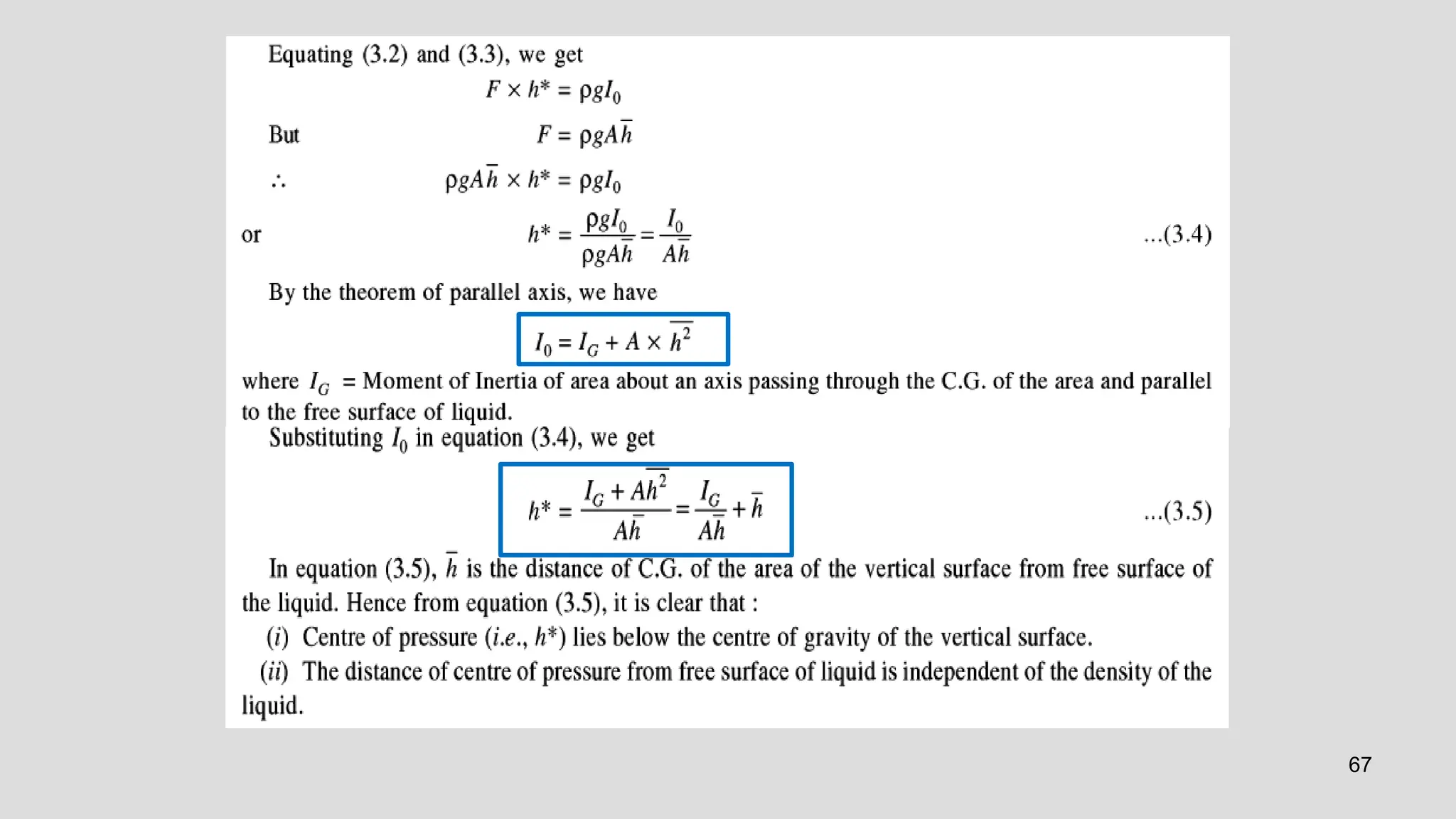
The pressure at the centroid of a
surface is equivalent to the average
pressure on the surface.
The resultant force acting on a plane
surface is equal to the product of the
pressure at the centroid of the surface and
the surface area, and its line of action
passes through the center of pressure.
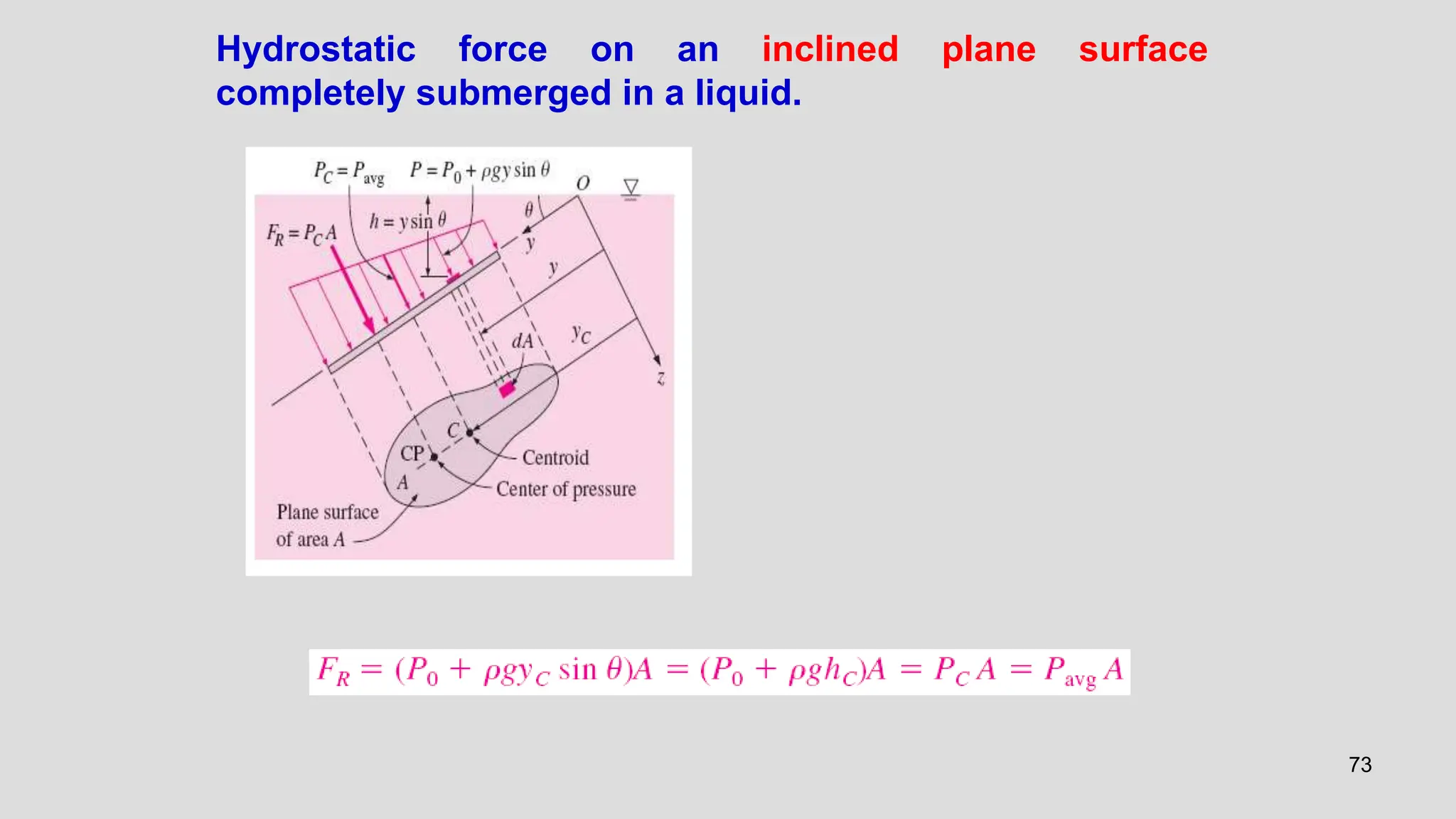
73
Hydrostatic force on an inclined plane surface
completely submerged in a liquid.
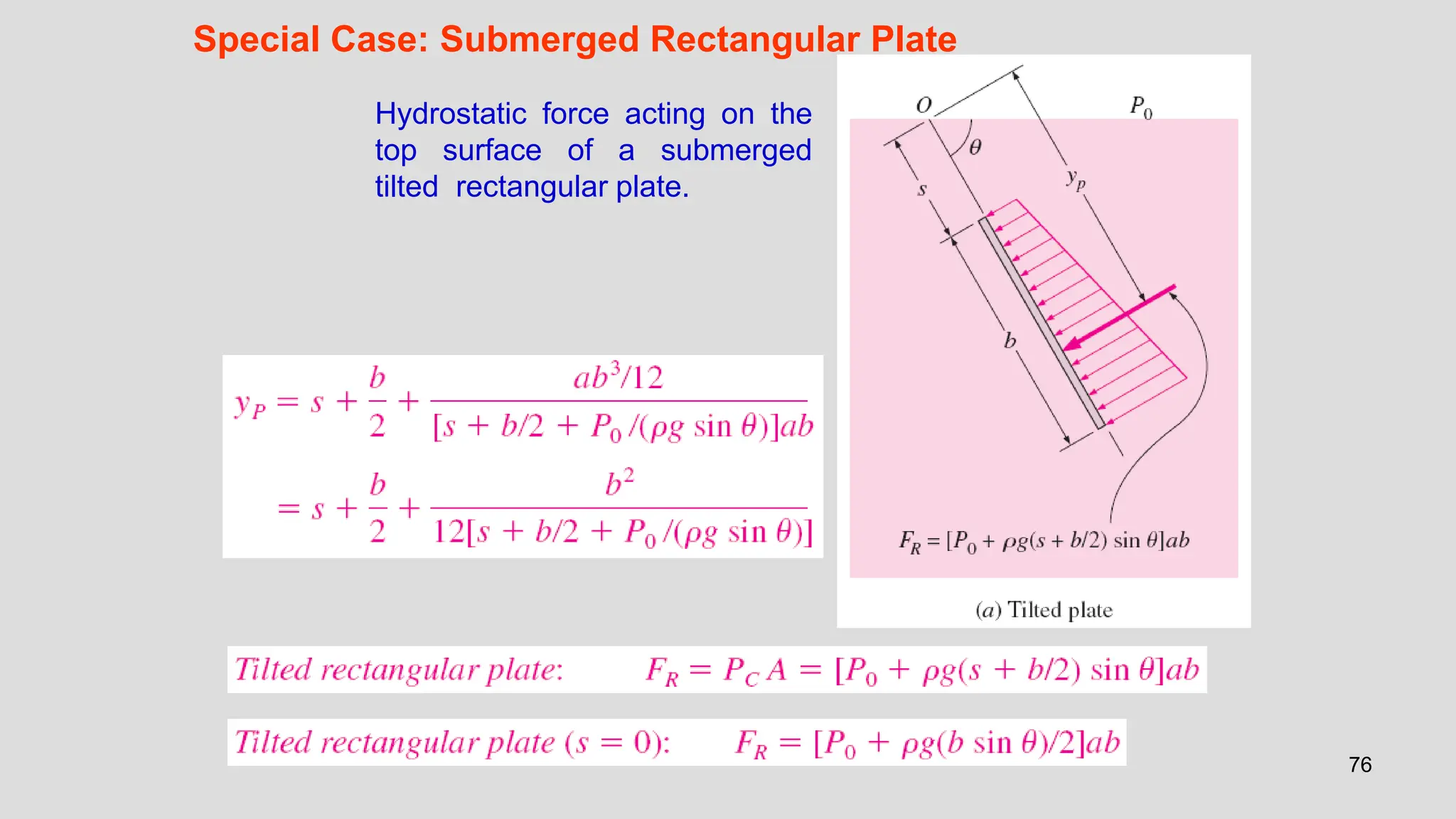
76
Special Case: Submerged Rectangular Plate
Hydrostatic force acting on the
top surface of a submerged
tilted rectangular plate.
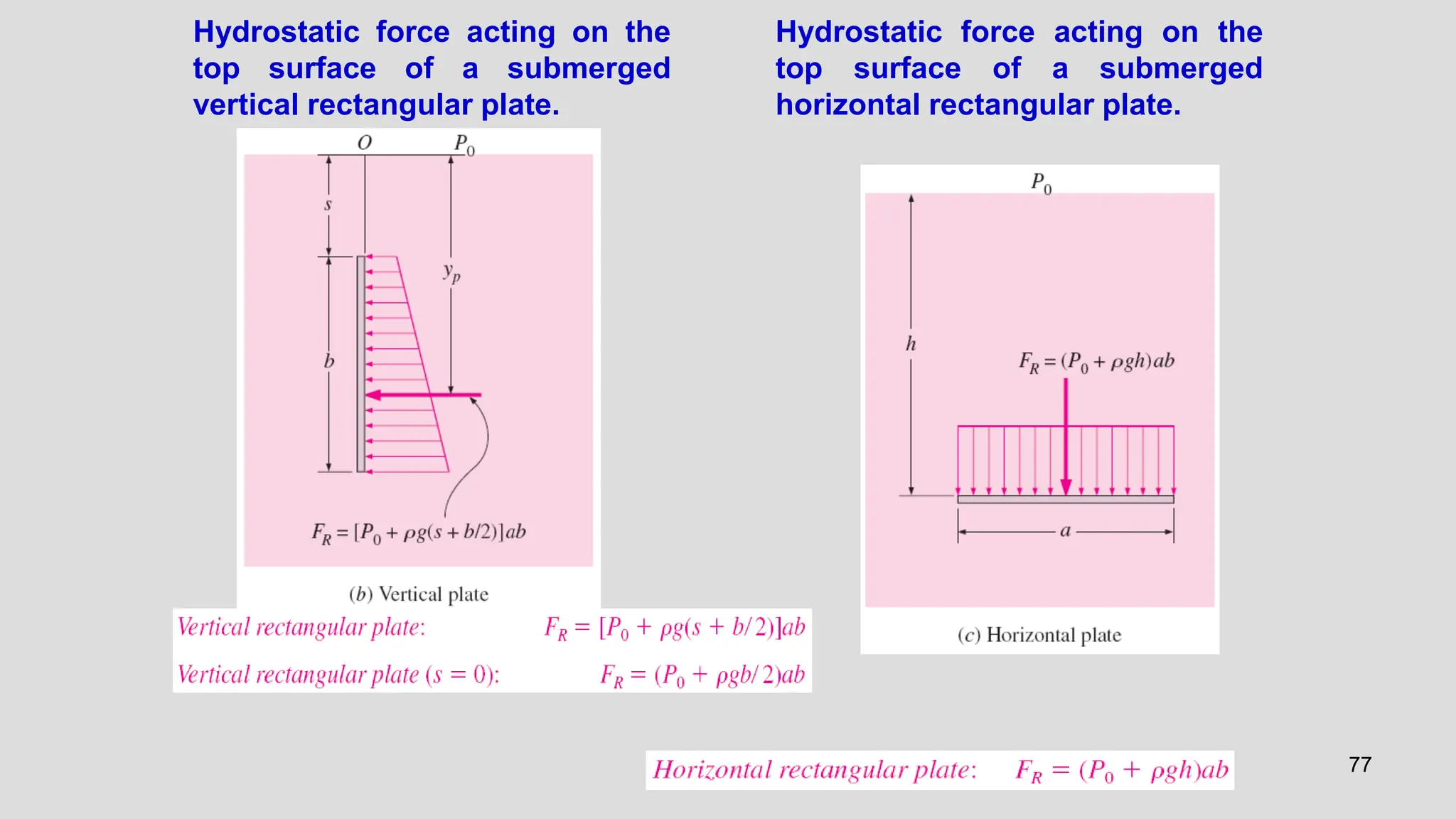
77
Hydrostatic force acting on the
top surface of a submerged
vertical rectangular plate.
Hydrostatic force acting on the
top surface of a submerged
horizontal rectangular plate.
80
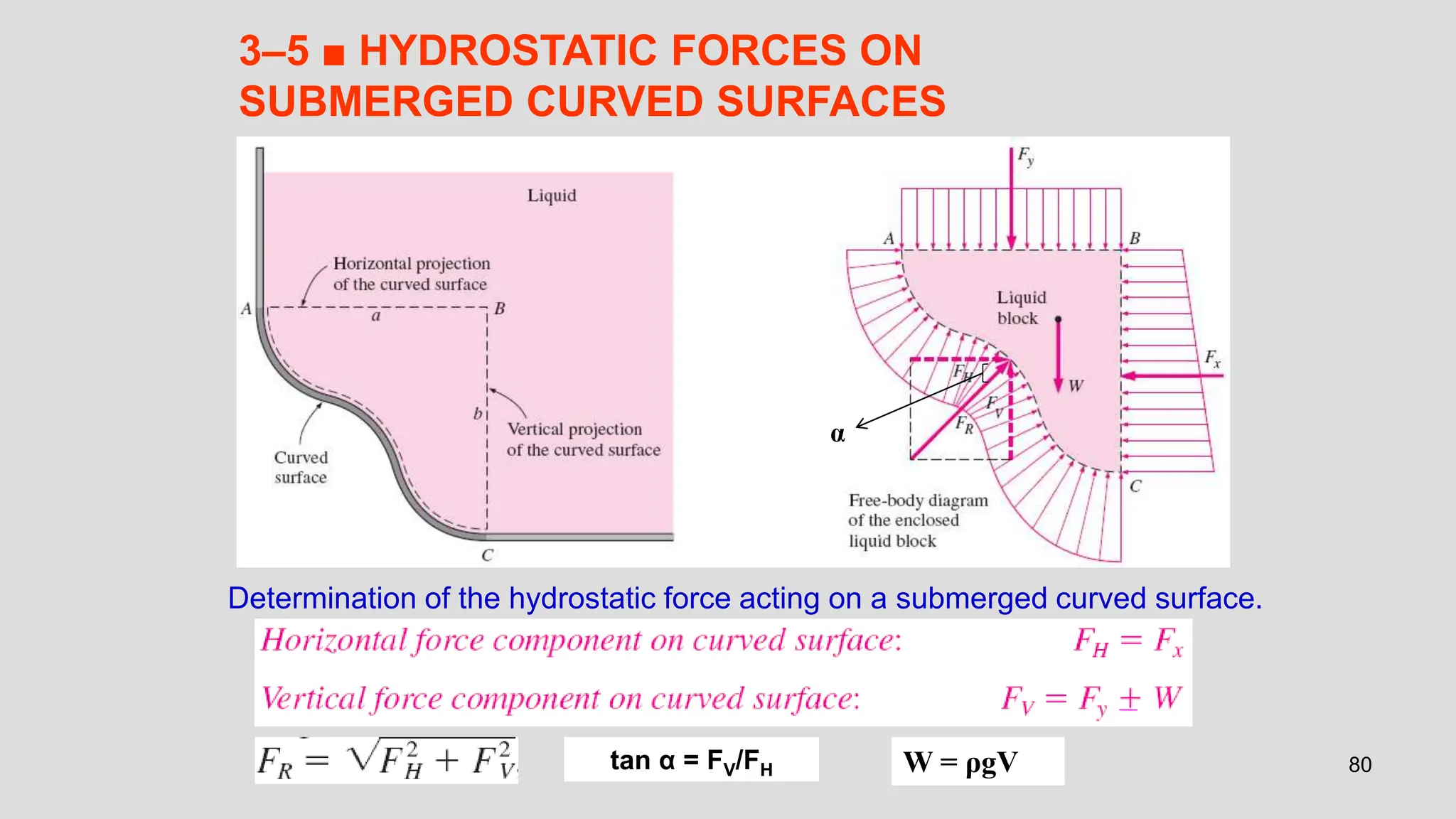
3–5 ■ HYDROSTATIC FORCES ON
SUBMERGED CURVED SURFACES
Determination of the hydrostatic force acting on a submerged curved surface.
W = ρgV
α
tan α = FV/FH
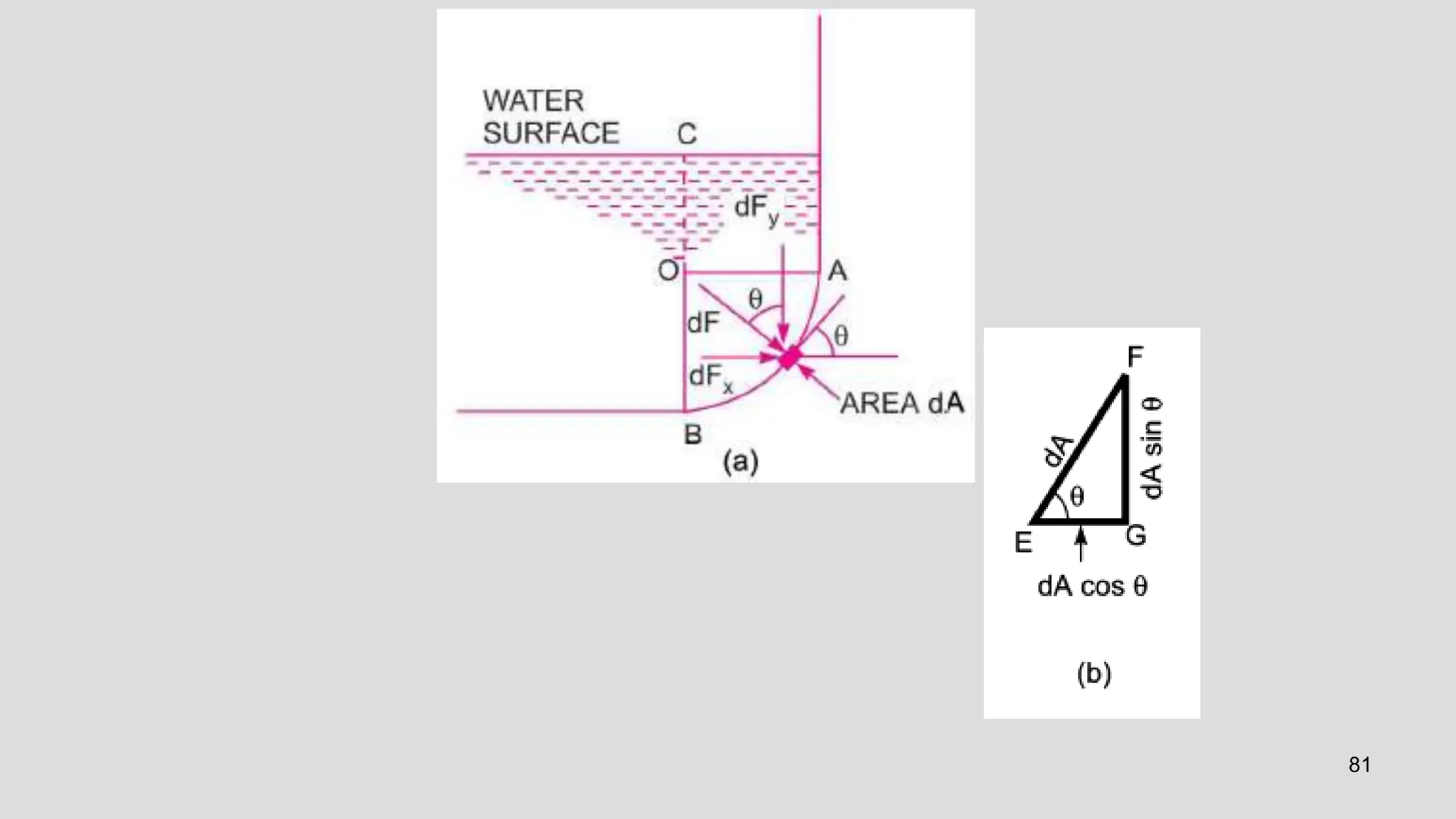
81
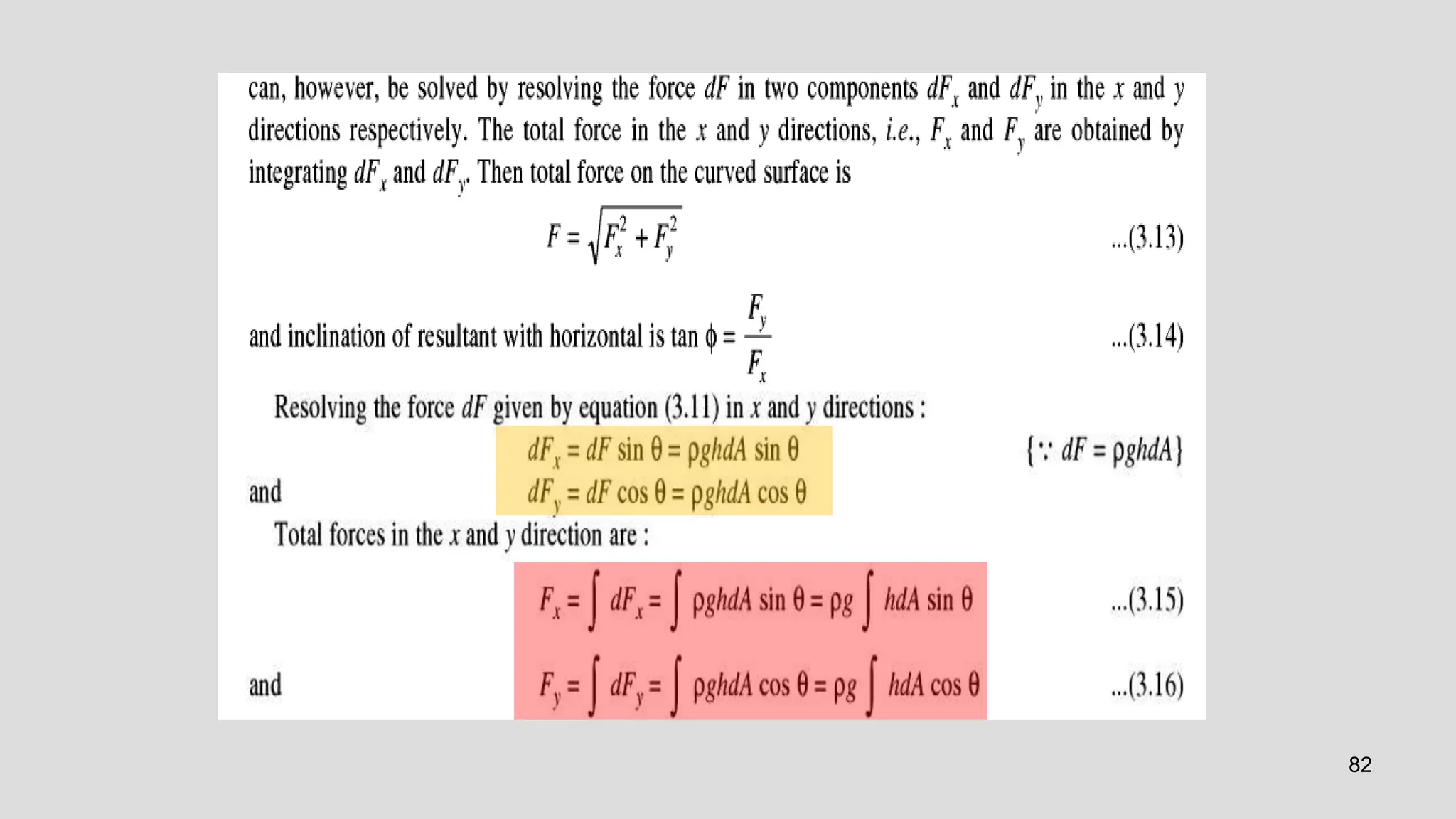
82
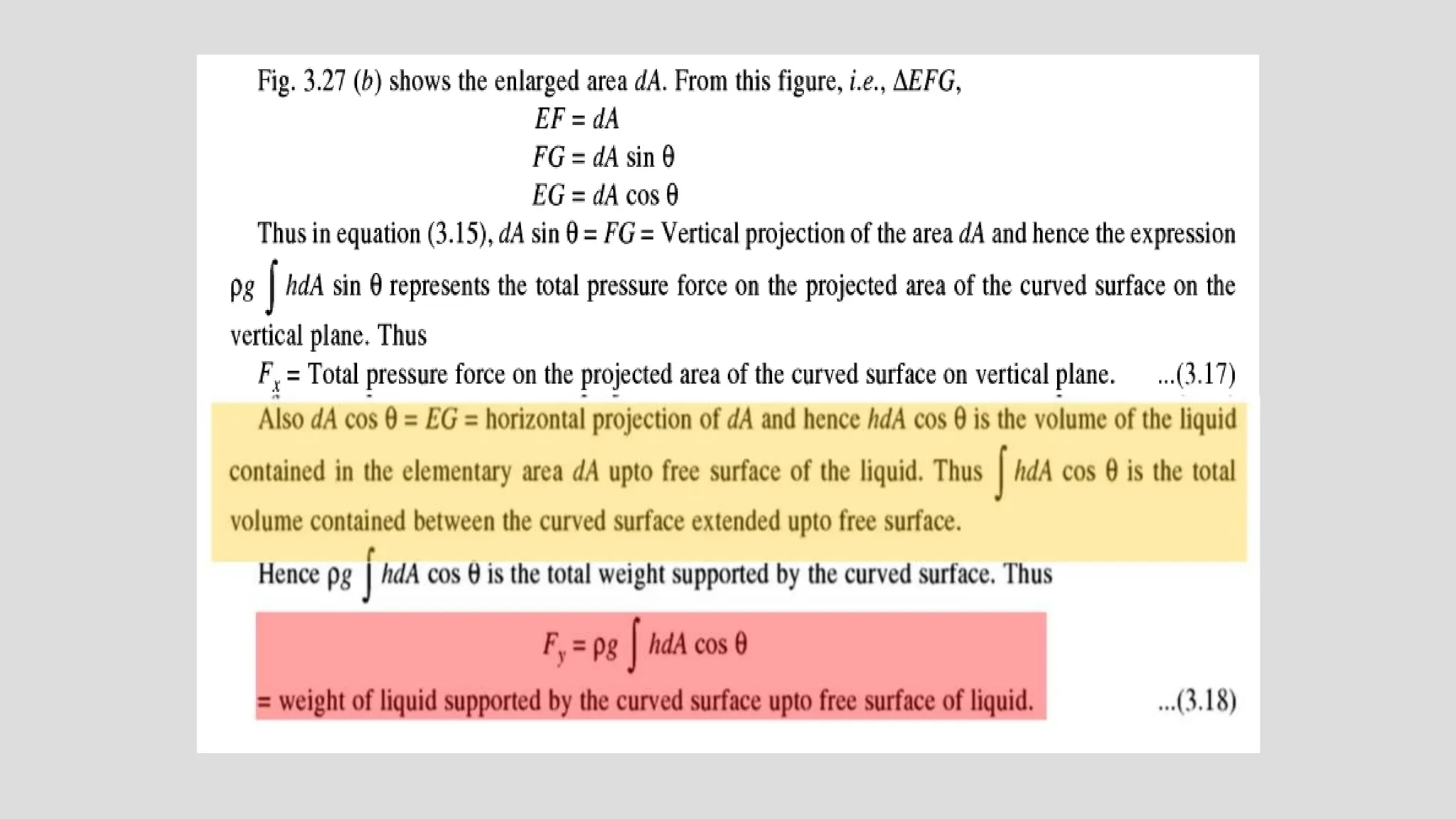
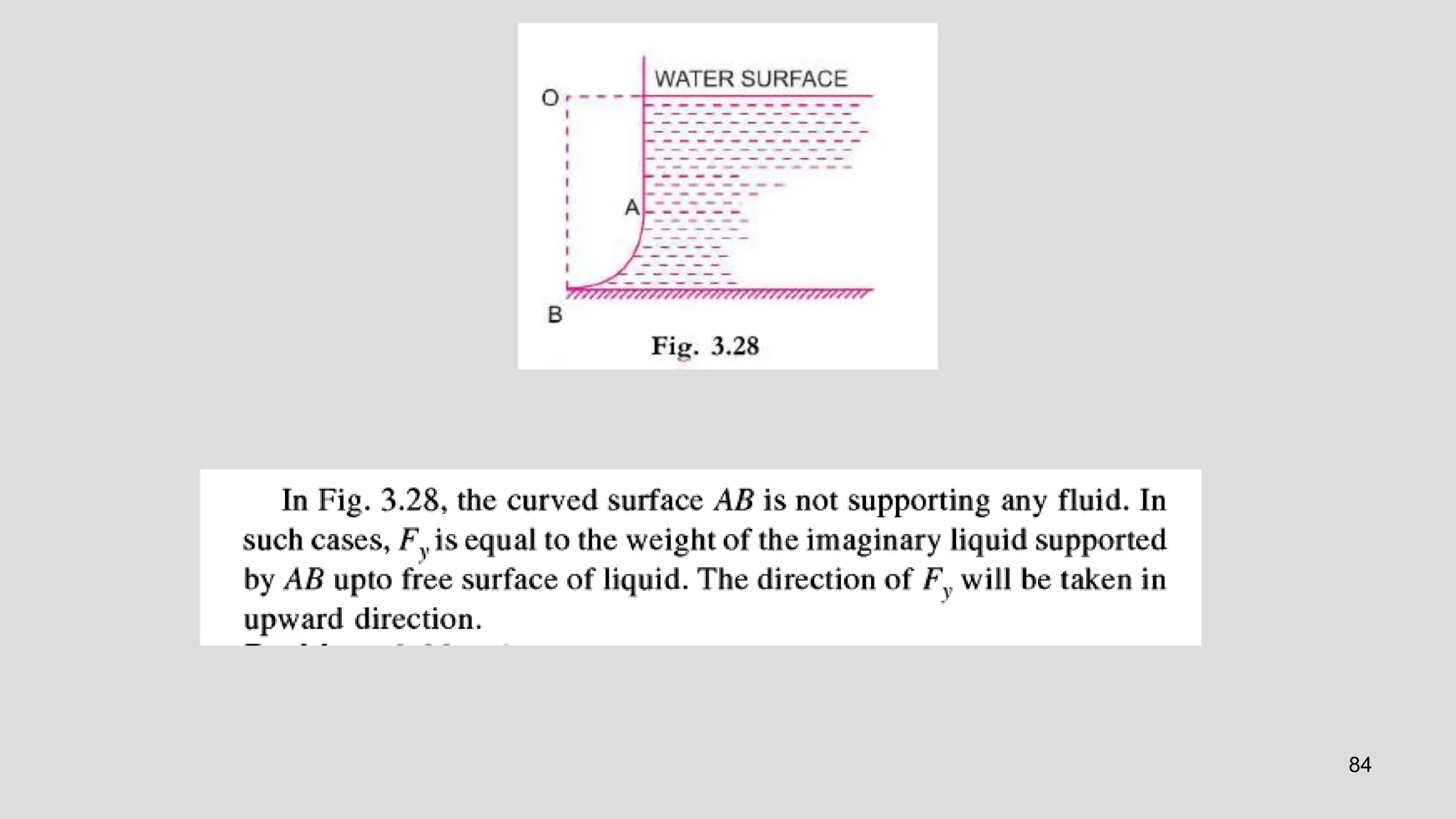
84
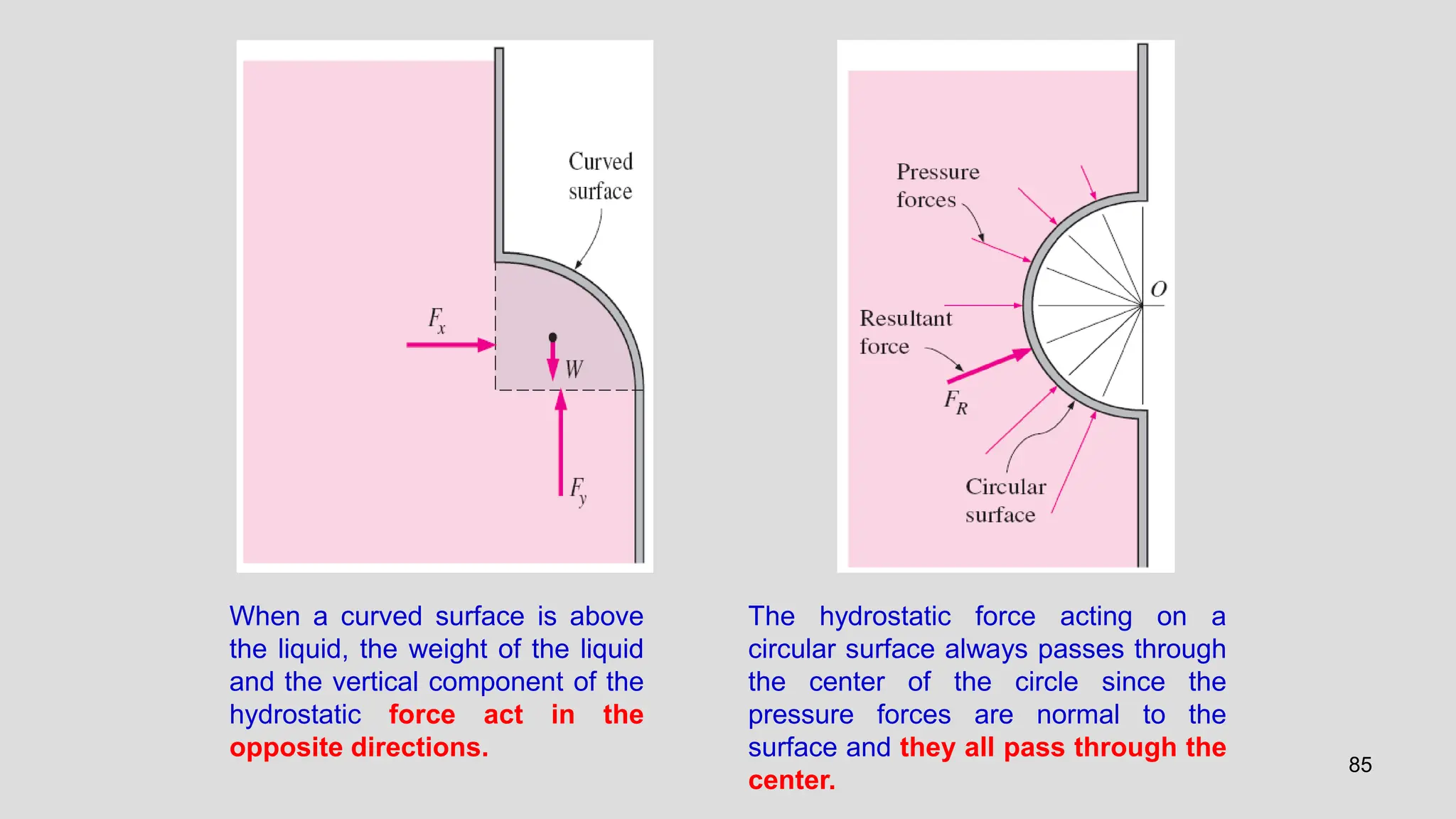
85
When a curved surface is above
the liquid, the weight of the liquid
and the vertical component of the
hydrostatic force act in the
opposite directions.
The hydrostatic force acting on a
circular surface always passes through
the center of the circle since the
pressure forces are normal to the
surface and they all pass through the
center.
90
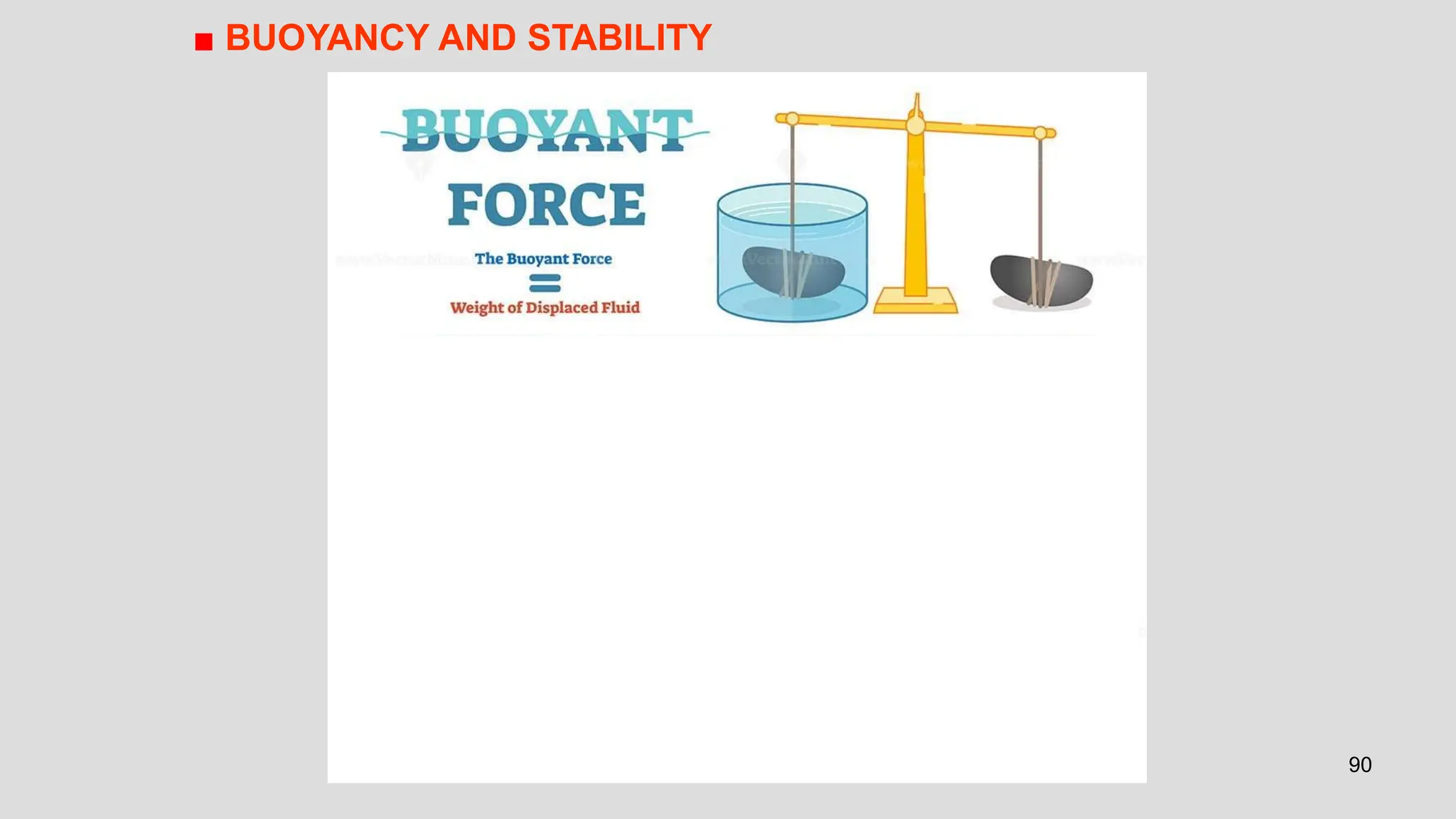
■ BUOYANCY AND STABILITY
91
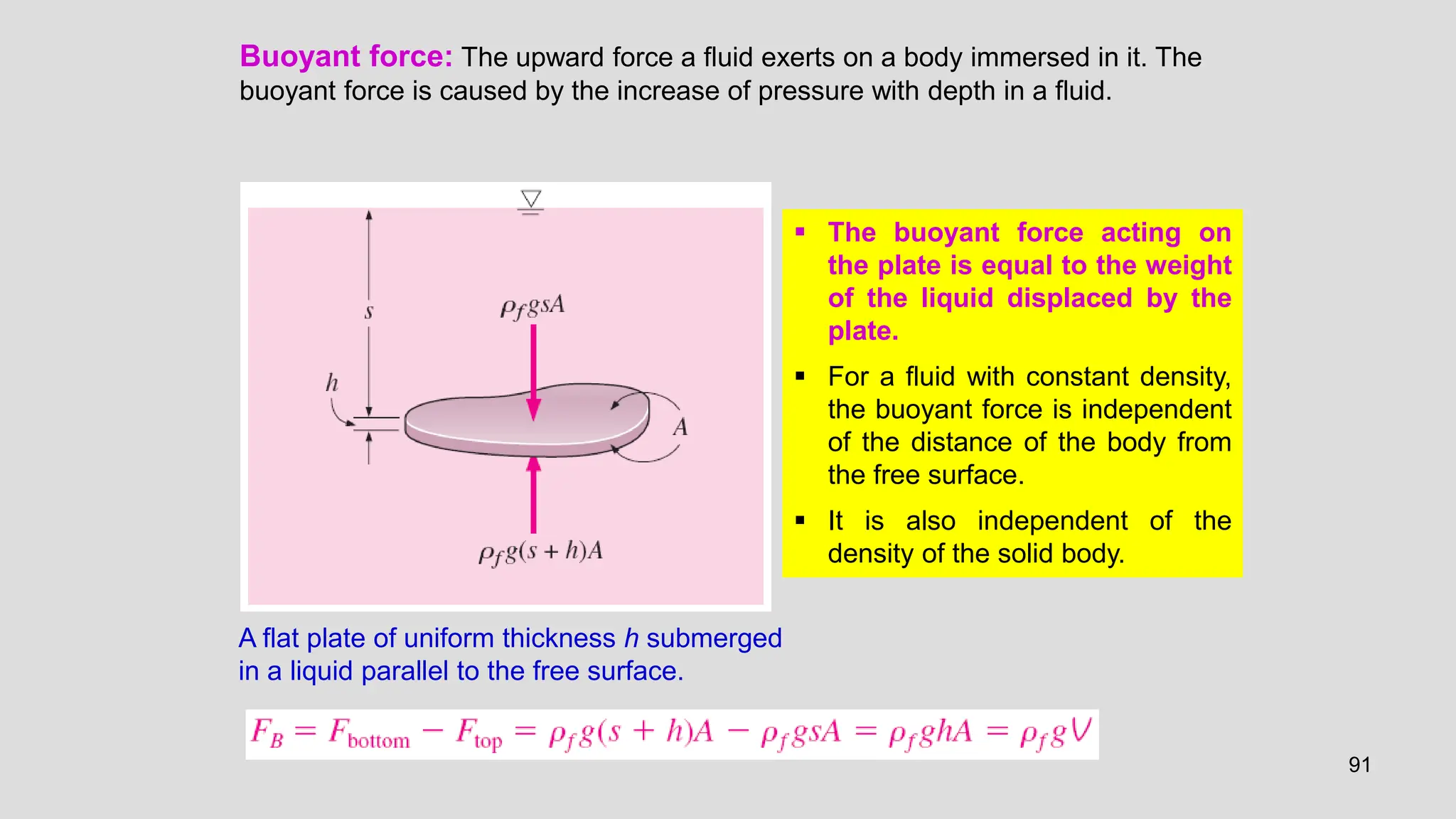
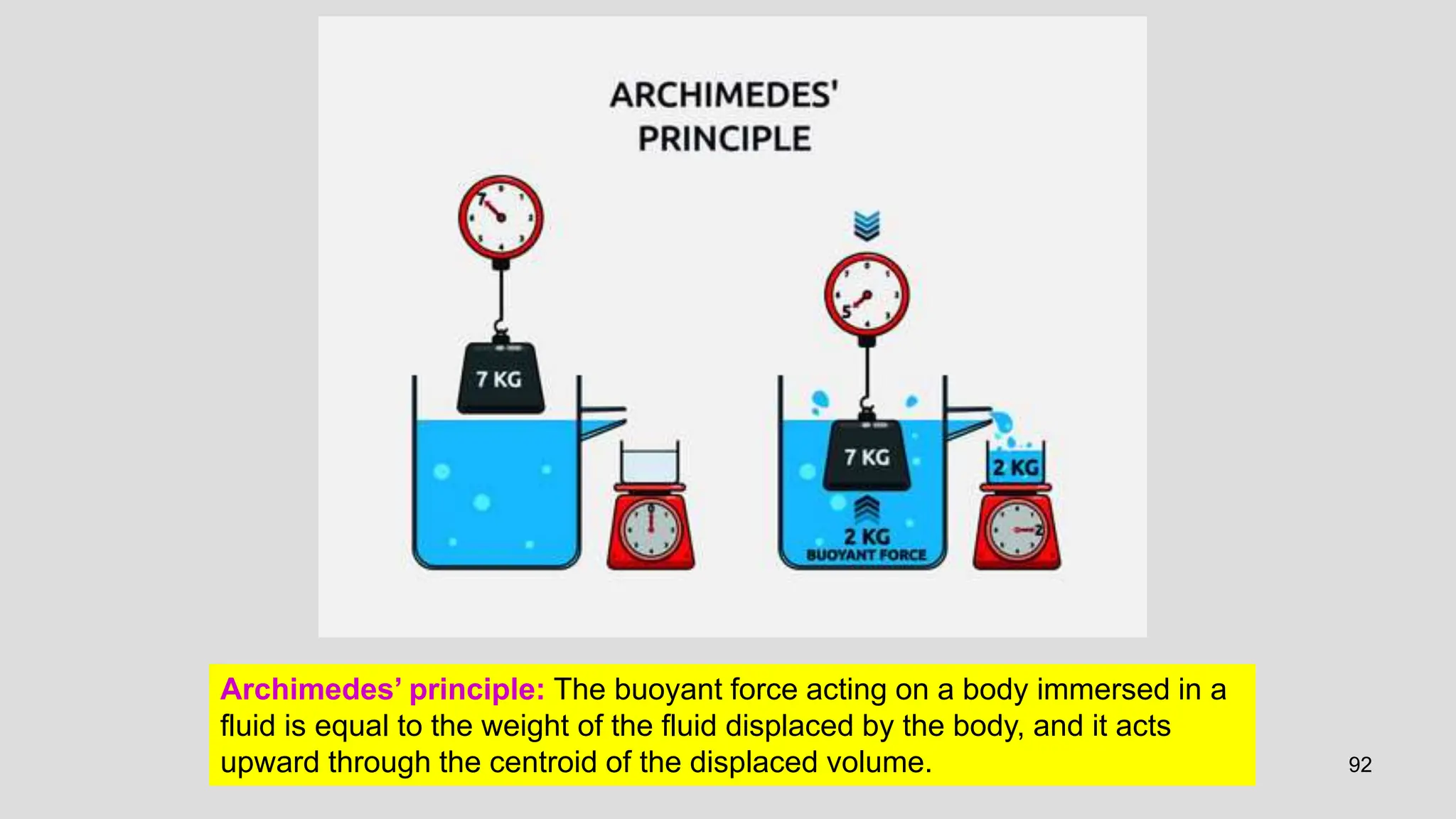
Buoyant force: The upward force a fluid exerts on a body immersed in it. The
buoyant force is caused by the increase of pressure with depth in a fluid.
A flat plate of uniform thickness h submerged
in a liquid parallel to the free surface.
 The buoyant force acting on
the plate is equal to the weight
of the liquid displaced by the
plate.
 For a fluid with constant density,
the buoyant force is independent
of the distance of the body from
the free surface.
 It is also independent of the
density of the solid body.
92
Archimedes’ principle: The buoyant force acting on a body immersed in a
fluid is equal to the weight of the fluid displaced by the body, and it acts
upward through the centroid of the displaced volume.
93
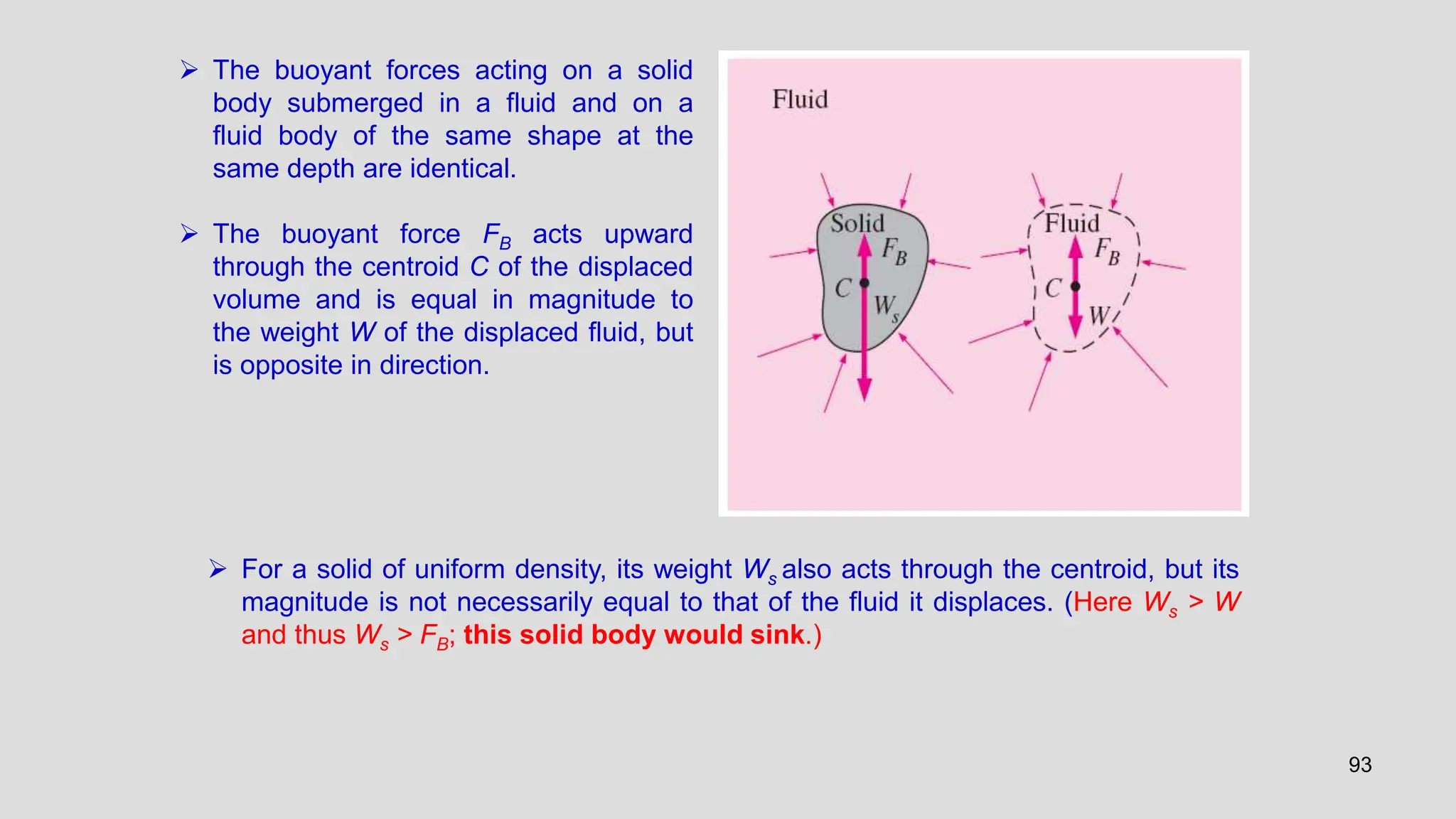
 The buoyant forces acting on a solid
body submerged in a fluid and on a
fluid body of the same shape at the
same depth are identical.
 The buoyant force FB acts upward
through the centroid C of the displaced
volume and is equal in magnitude to
the weight W of the displaced fluid, but
is opposite in direction.
 For a solid of uniform density, its weight Ws also acts through the centroid, but its
magnitude is not necessarily equal to that of the fluid it displaces. (Here Ws > W
and thus Ws > FB; this solid body would sink.)
94
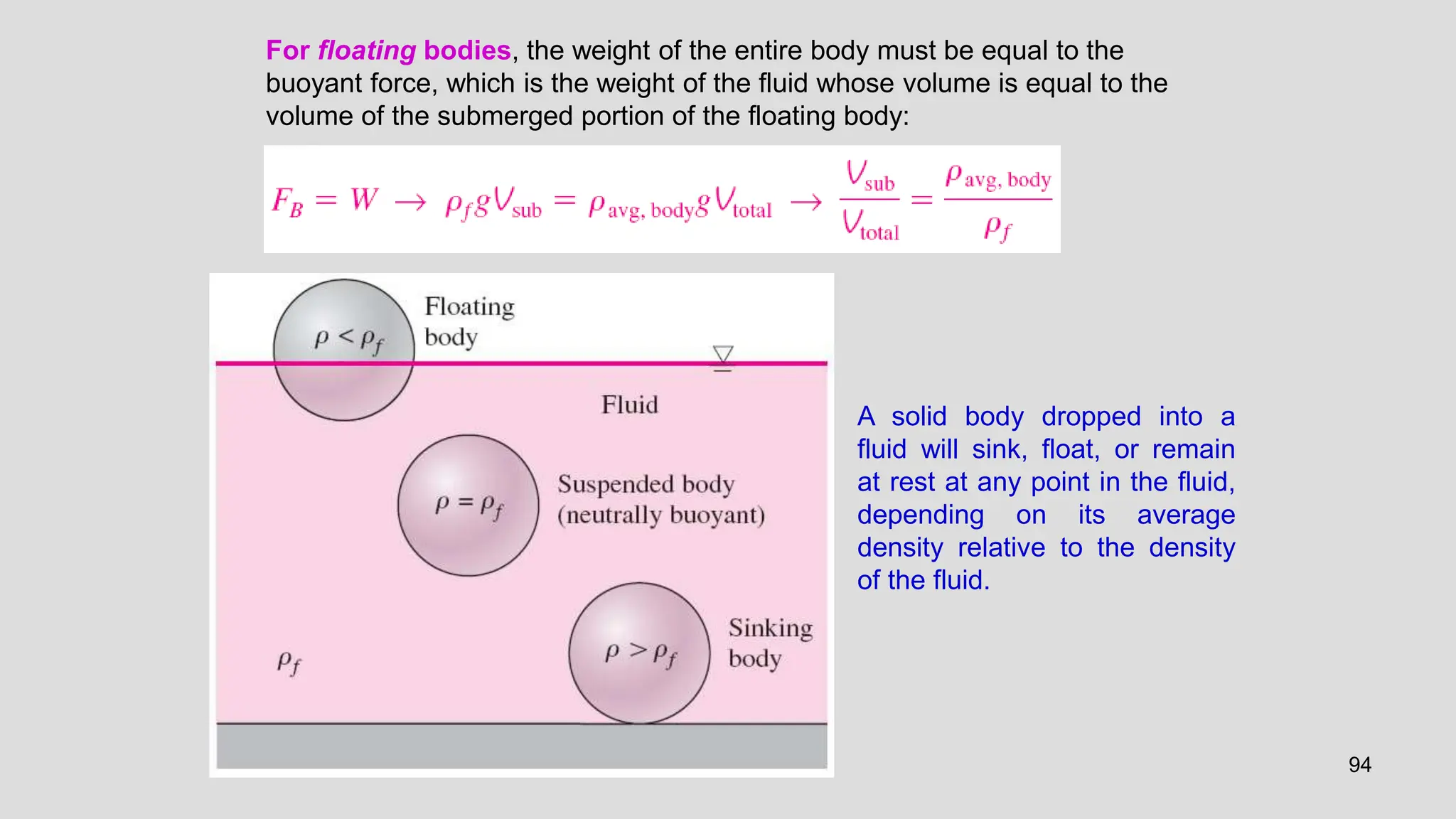
For floating bodies, the weight of the entire body must be equal to the
buoyant force, which is the weight of the fluid whose volume is equal to the
volume of the submerged portion of the floating body:
A solid body dropped into a
fluid will sink, float, or remain
at rest at any point in the fluid,
depending on its average
density relative to the density
of the fluid.
99
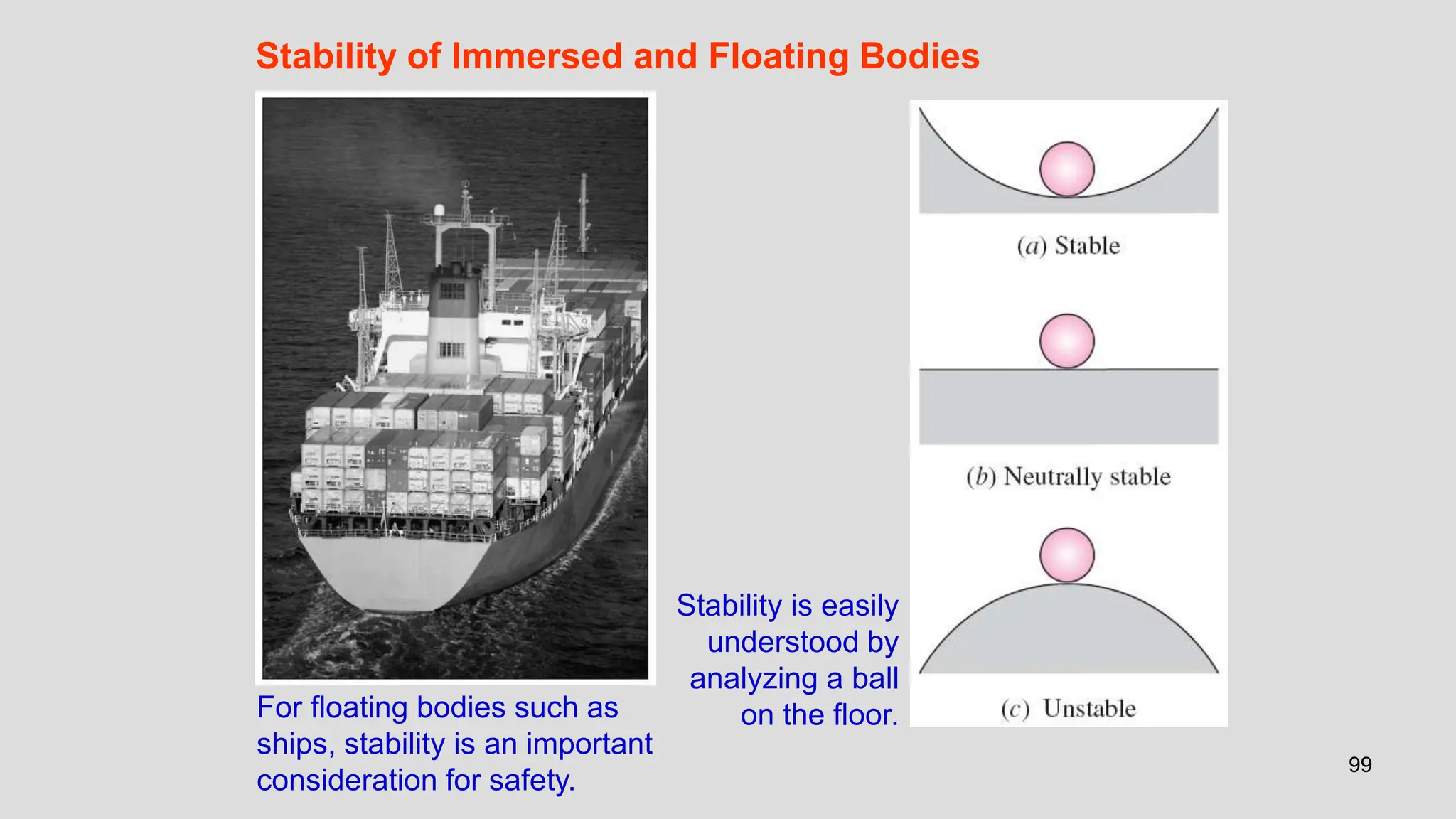
Stability of Immersed and Floating Bodies
For floating bodies such as
ships, stability is an important
consideration for safety.
Stability is easily
understood by
analyzing a ball
on the floor.
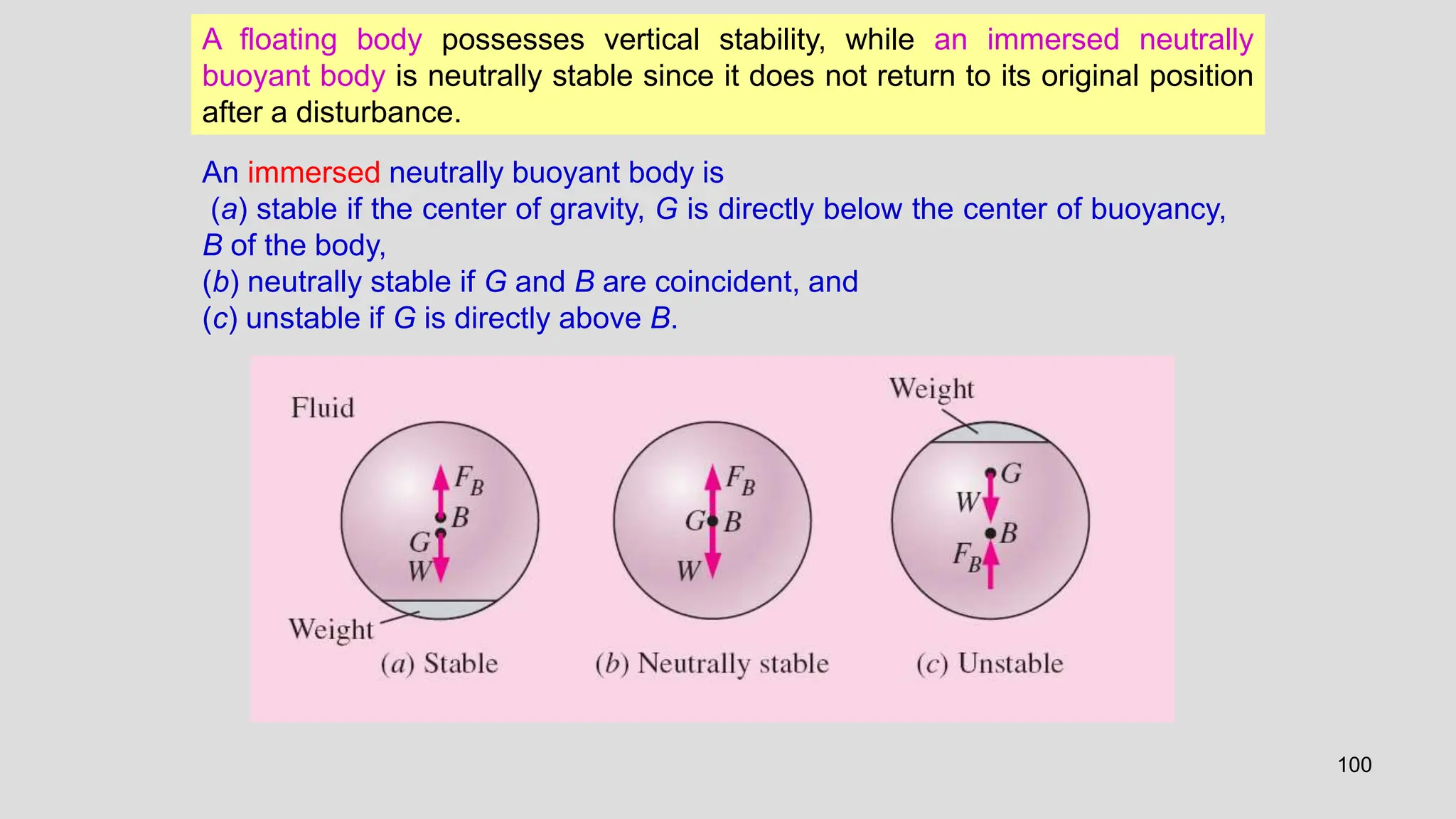
100
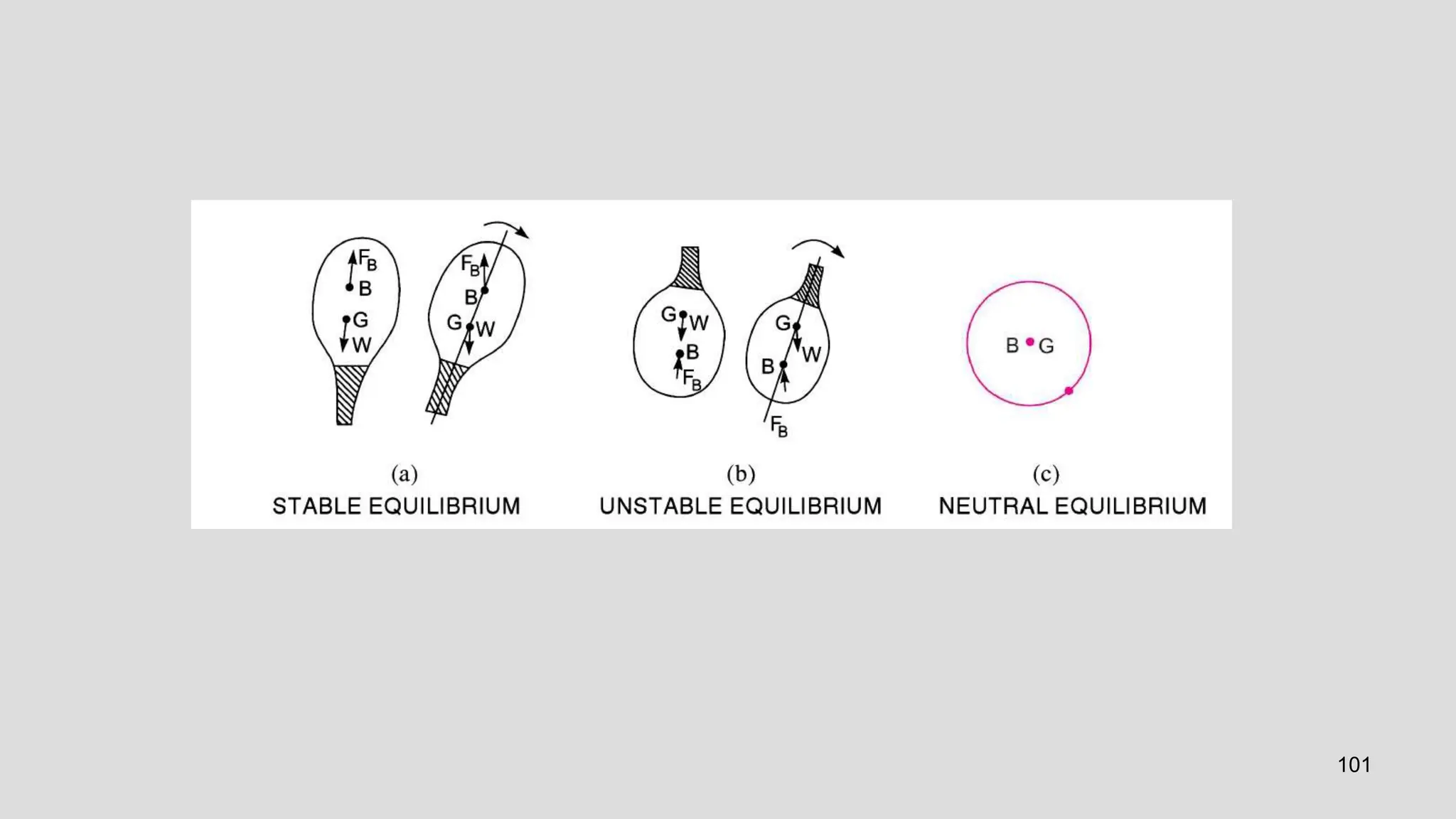
An immersed neutrally buoyant body is
(a) stable if the center of gravity, G is directly below the center of buoyancy,
B of the body,
(b) neutrally stable if G and B are coincident, and
(c) unstable if G is directly above B.
A floating body possesses vertical stability, while an immersed neutrally
buoyant body is neutrally stable since it does not return to its original position
after a disturbance.
101
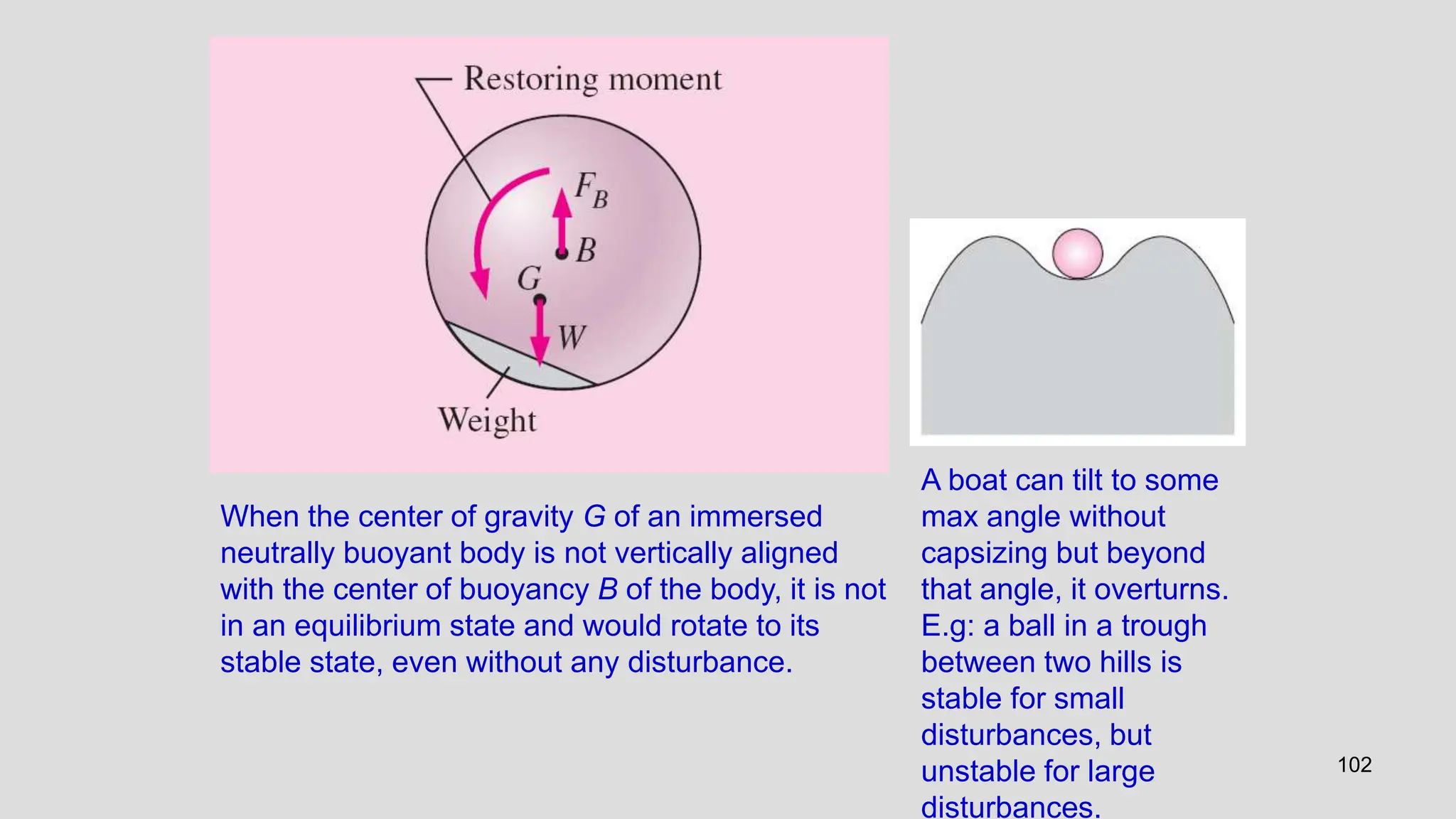
102
When the center of gravity G of an immersed
neutrally buoyant body is not vertically aligned
with the center of buoyancy B of the body, it is not
in an equilibrium state and would rotate to its
stable state, even without any disturbance.
A boat can tilt to some
max angle without
capsizing but beyond
that angle, it overturns.
E.g: a ball in a trough
between two hills is
stable for small
disturbances, but
unstable for large
disturbances.
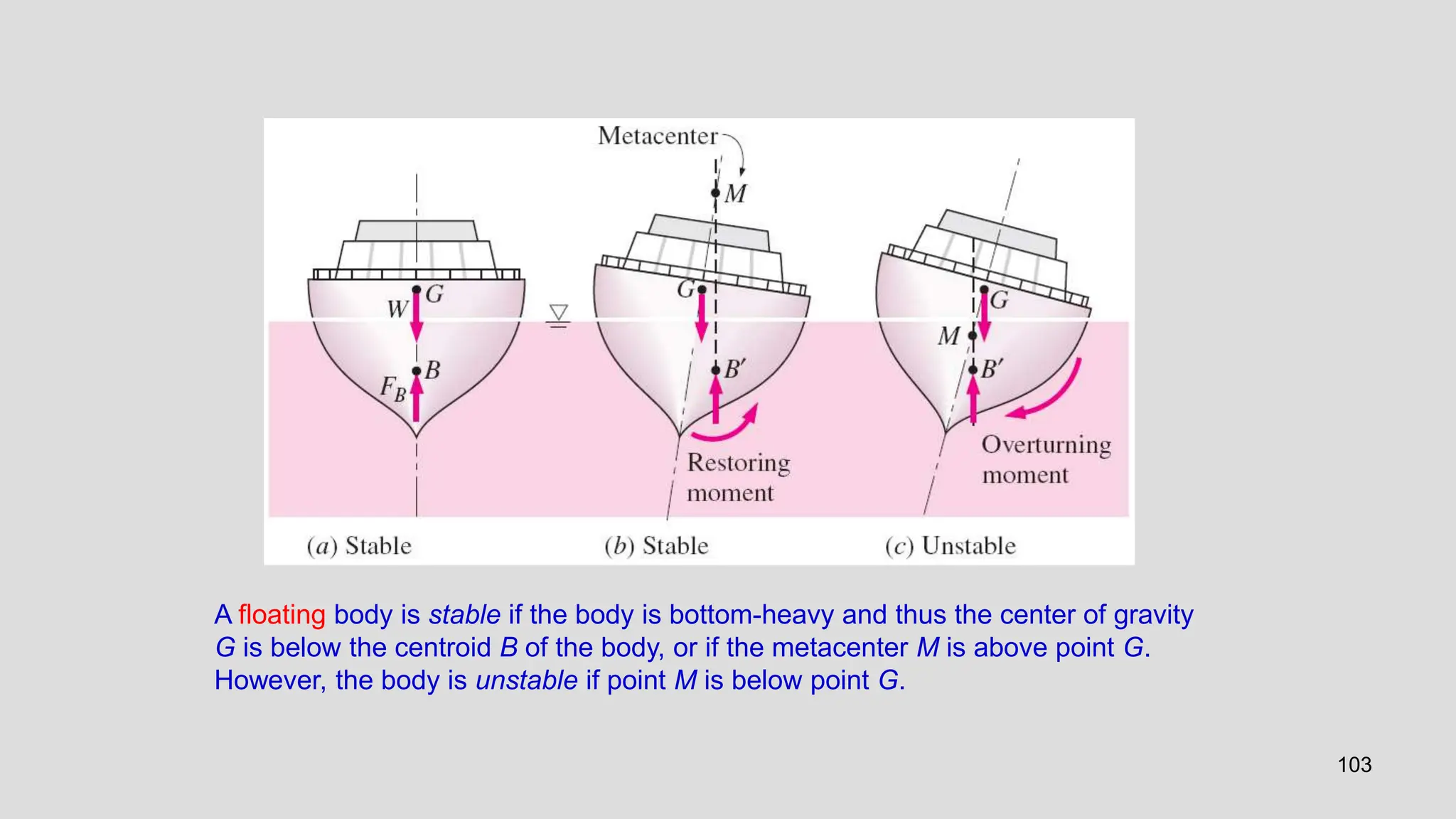
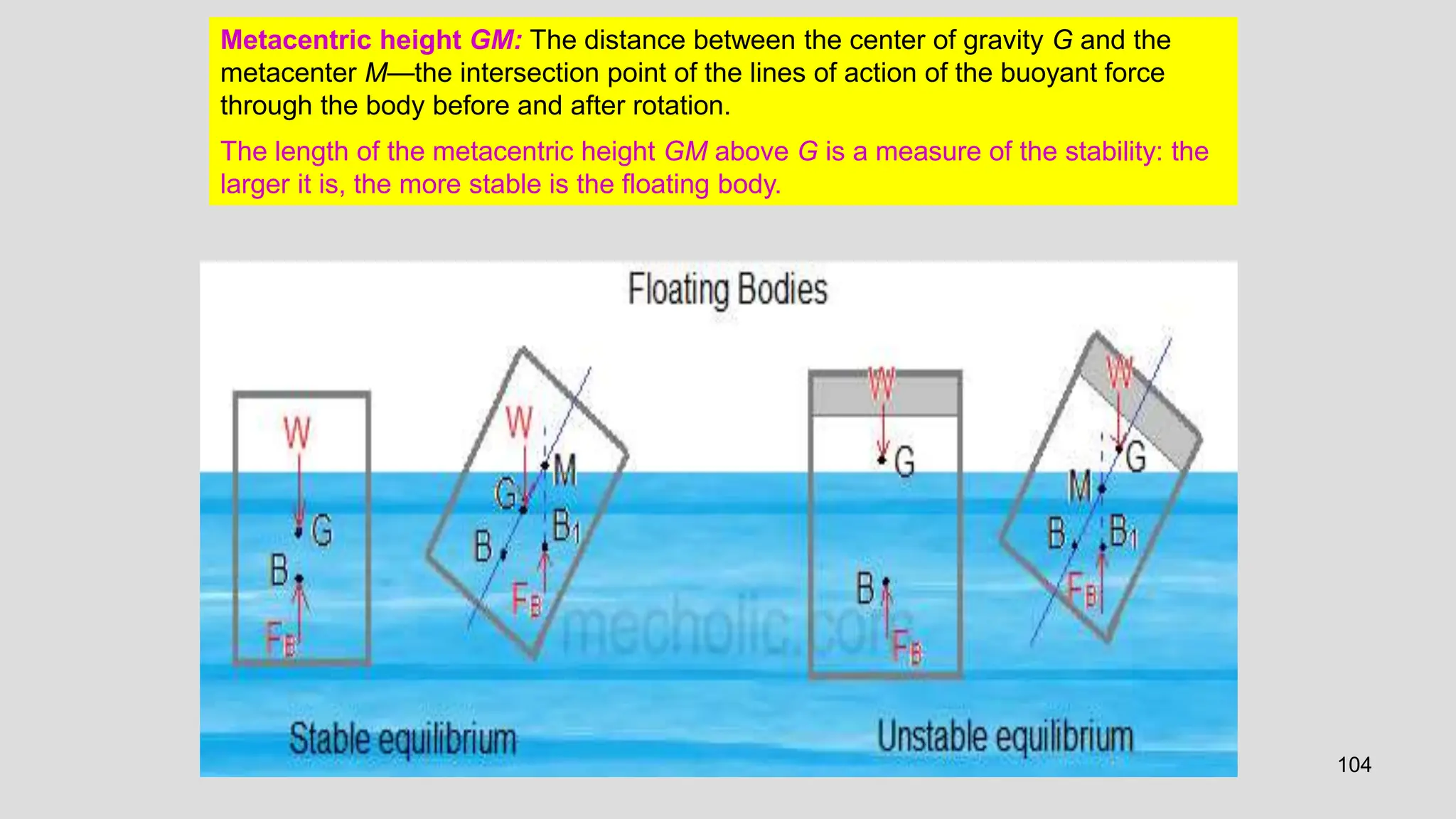
103
A floating body is stable if the body is bottom-heavy and thus the center of gravity
G is below the centroid B of the body, or if the metacenter M is above point G.
However, the body is unstable if point M is below point G.
104
Metacentric height GM: The distance between the center of gravity G and the
metacenter M—the intersection point of the lines of action of the buoyant force
through the body before and after rotation.
The length of the metacentric height GM above G is a measure of the stability: the
larger it is, the more stable is the floating body.
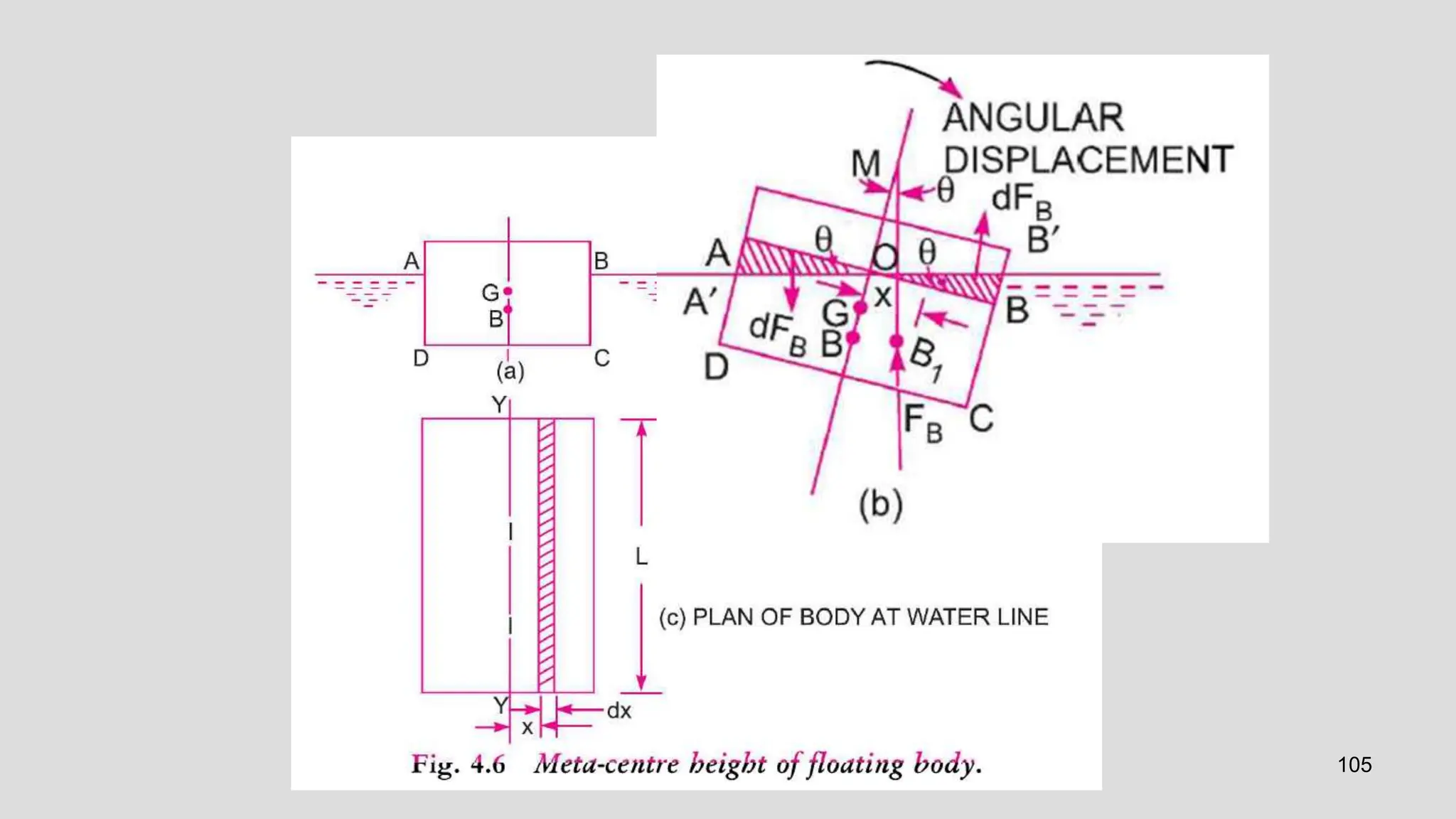
105
106
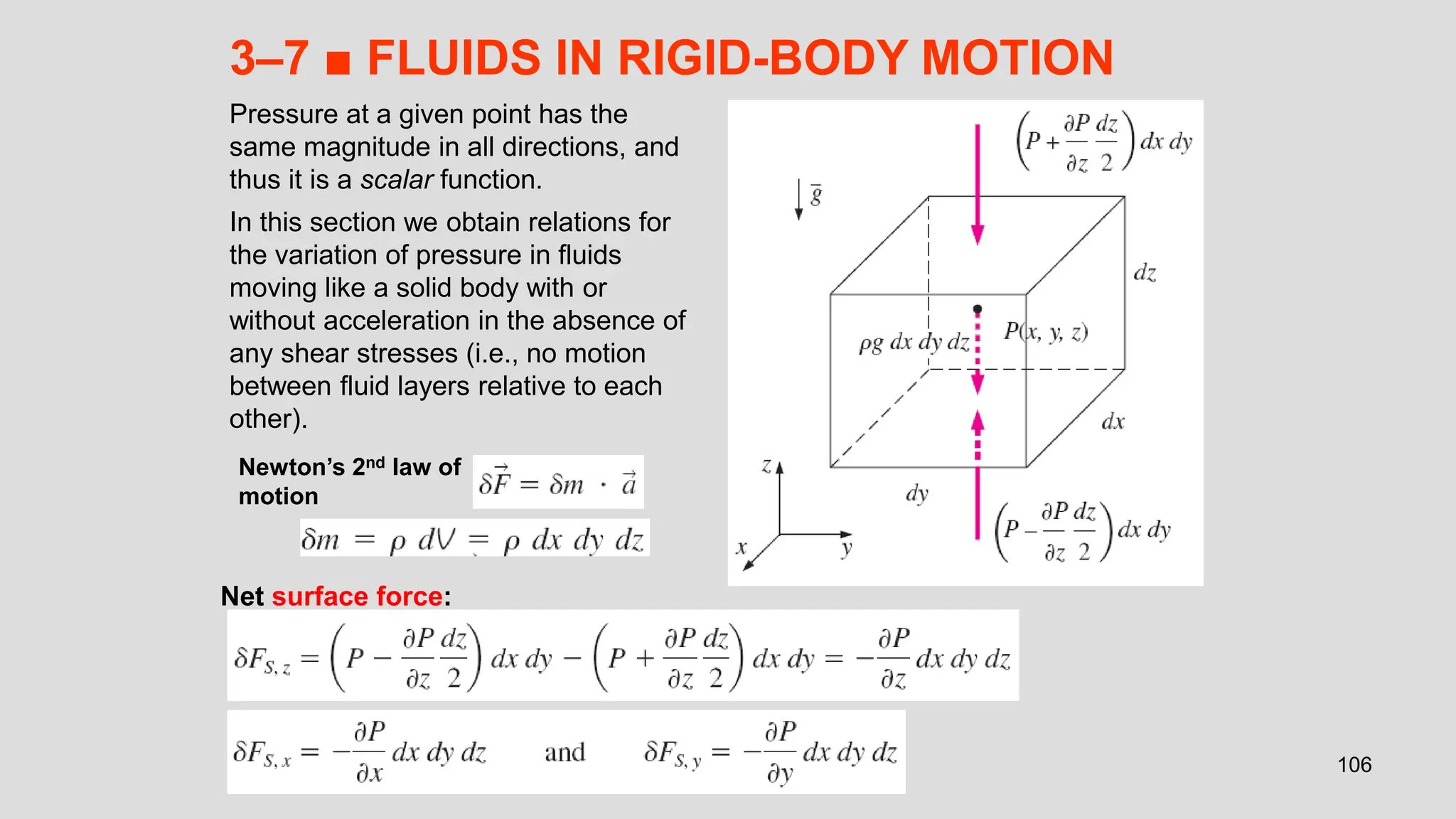
3–7 ■ FLUIDS IN RIGID-BODY MOTION
Pressure at a given point has the
same magnitude in all directions, and
thus it is a scalar function.
In this section we obtain relations for
the variation of pressure in fluids
moving like a solid body with or
without acceleration in the absence of
any shear stresses (i.e., no motion
between fluid layers relative to each
other).
Newton’s 2nd law of
motion
Net surface force:
107
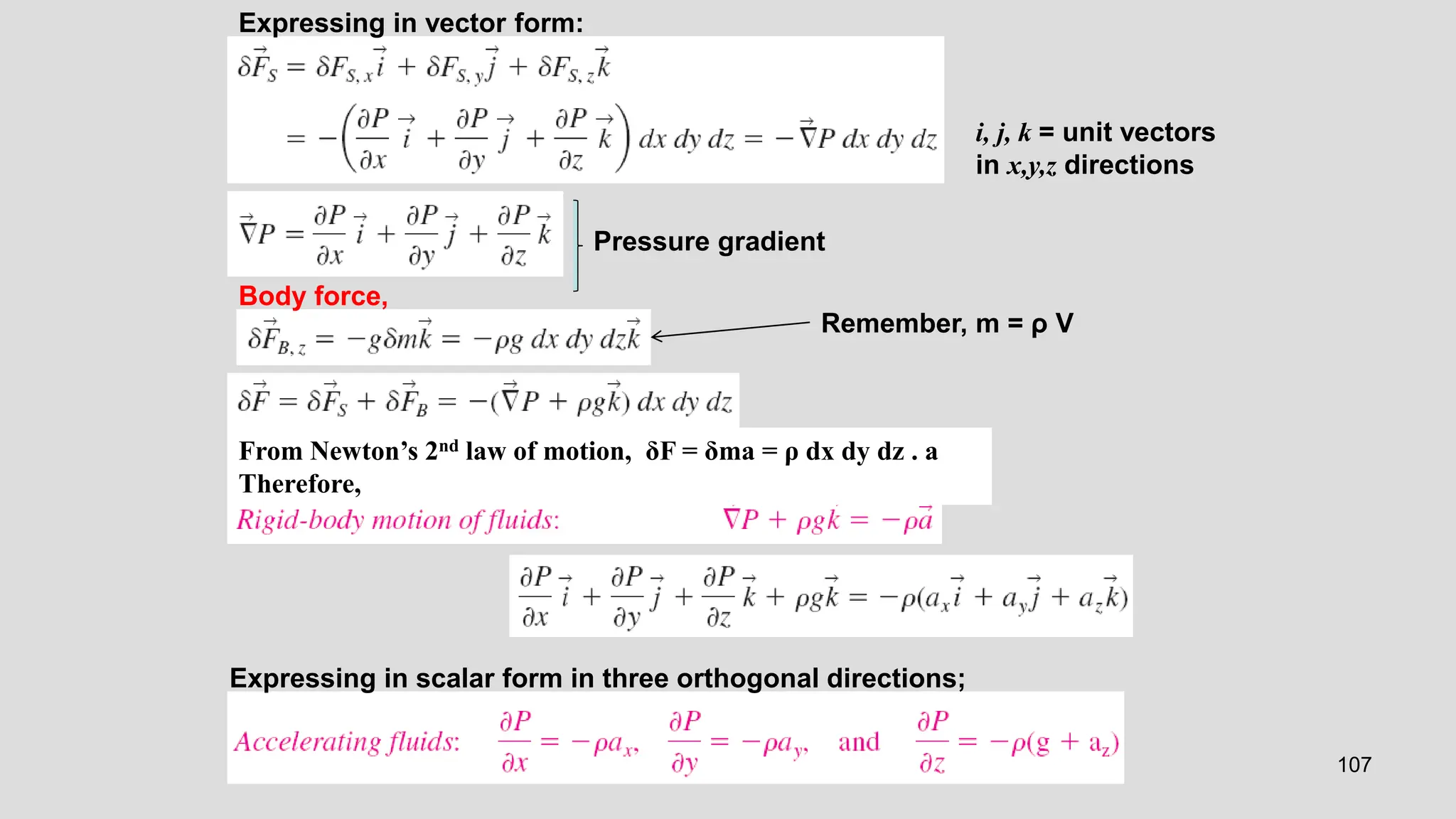
Expressing in vector form:
i, j, k = unit vectors
in x,y,z directions
Pressure gradient
From Newton’s 2nd law of motion, δF = δma = ρ dx dy dz . a
Therefore,
Expressing in scalar form in three orthogonal directions;
Remember, m = ρ V
Body force,
108
Special Case 1: Fluids at Rest
For fluids at rest or moving on a straight path at constant velocity, all
components of acceleration are zero, and the relations reduce to
The pressure remains constant in any horizontal direction (P is
independent of x and y) and varies only in the vertical direction as
a result of gravity [and thus P = P(z)]. These relations are
applicable for both compressible and incompressible fluids.
109
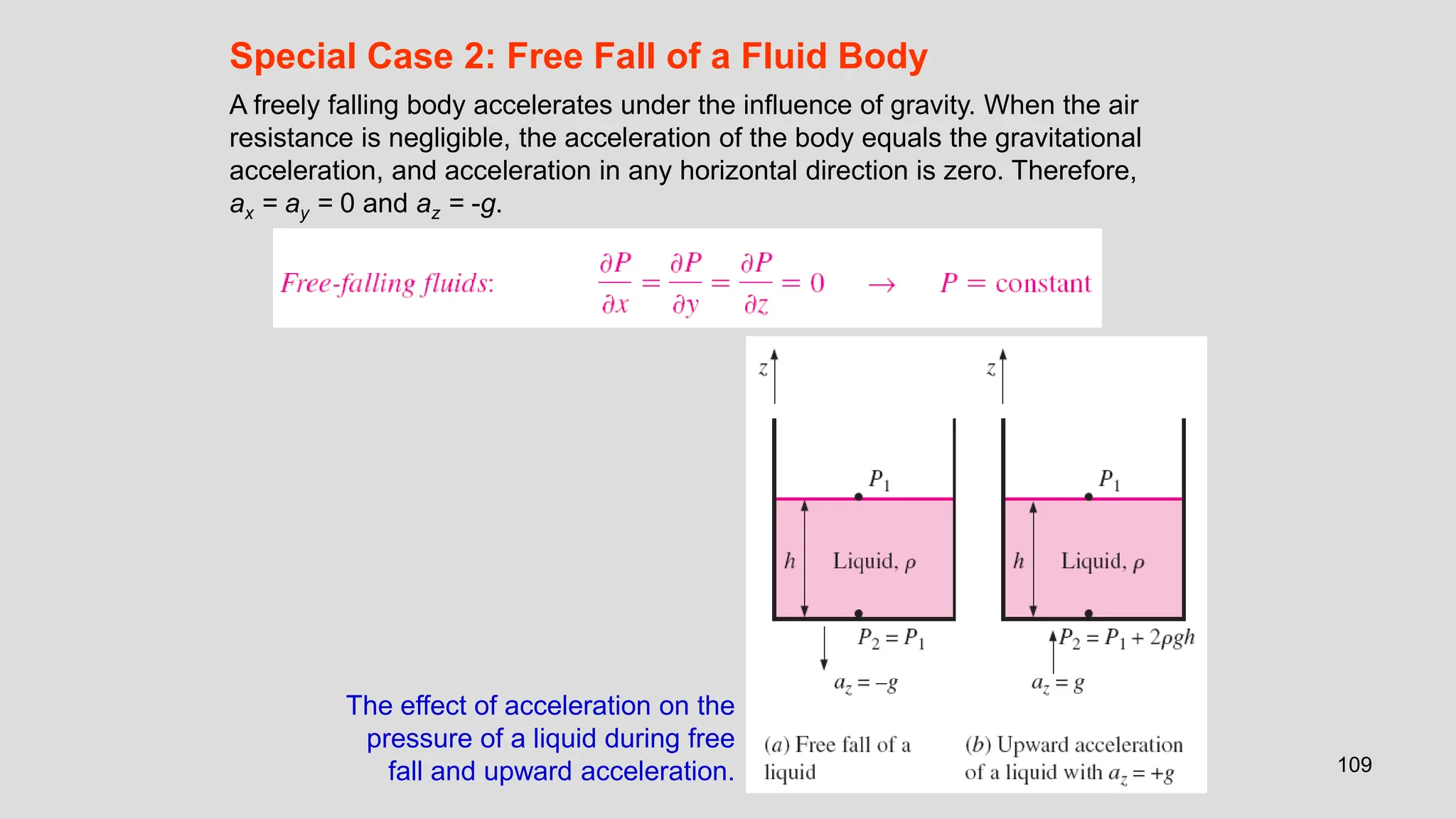
Special Case 2: Free Fall of a Fluid Body
A freely falling body accelerates under the influence of gravity. When the air
resistance is negligible, the acceleration of the body equals the gravitational
acceleration, and acceleration in any horizontal direction is zero. Therefore,
ax = ay = 0 and az = -g.
The effect of acceleration on the
pressure of a liquid during free
fall and upward acceleration.
110
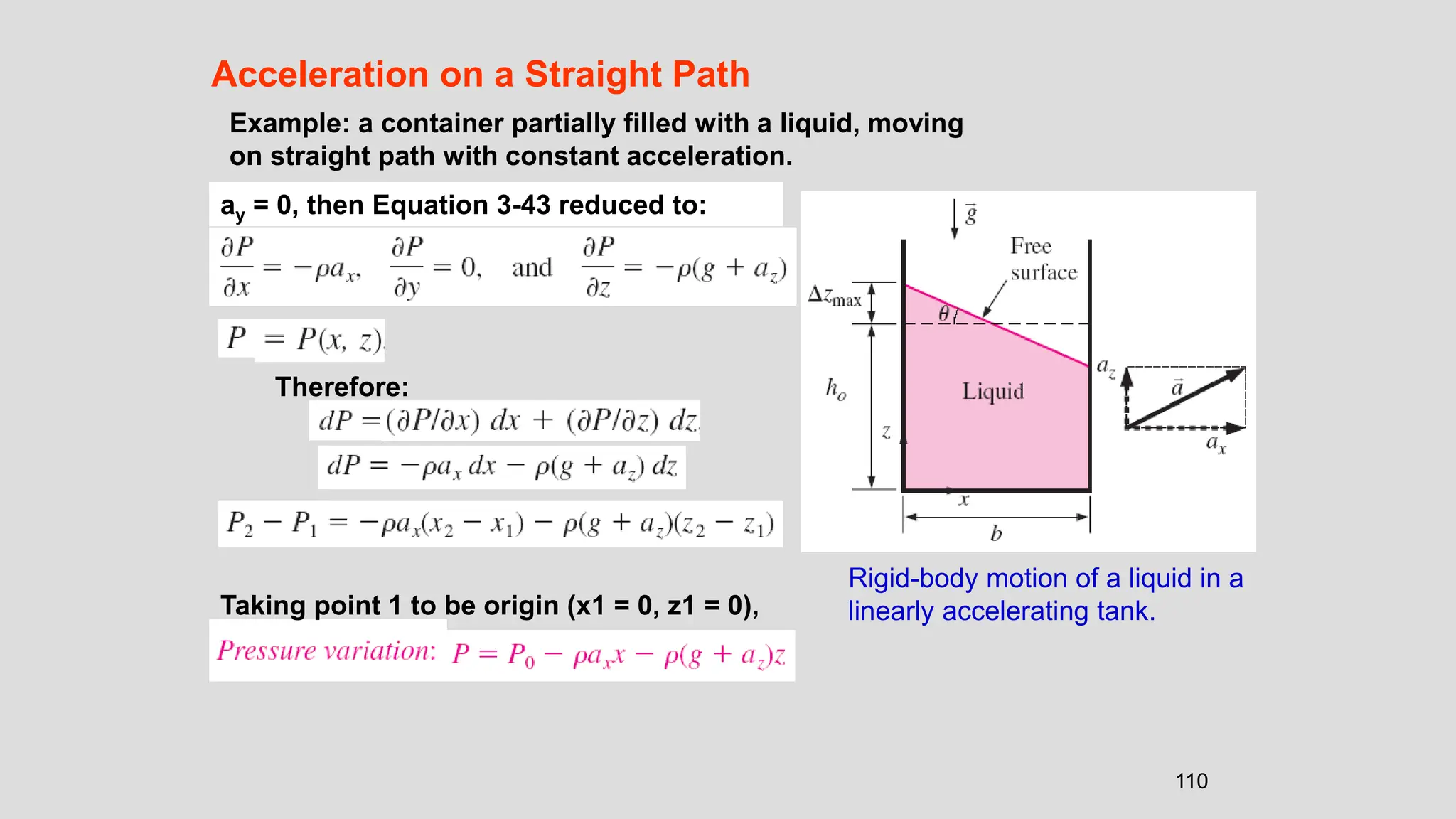
Acceleration on a Straight Path
Rigid-body motion of a liquid in a
linearly accelerating tank.
Example: a container partially filled with a liquid, moving
on straight path with constant acceleration.
ay = 0, then Equation 3-43 reduced to:
Therefore:
Taking point 1 to be origin (x1 = 0, z1 = 0),
111
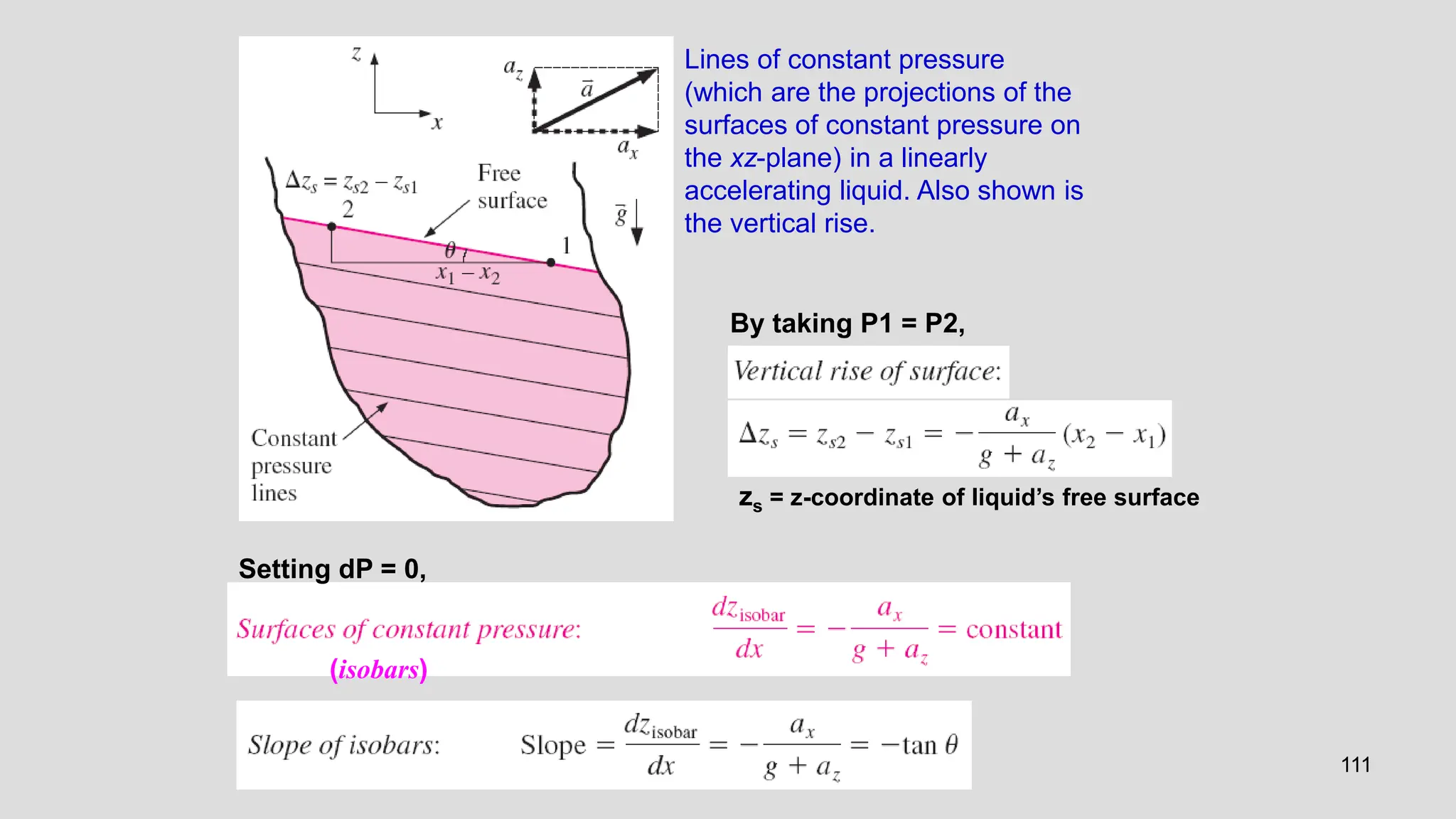
Lines of constant pressure
(which are the projections of the
surfaces of constant pressure on
the xz-plane) in a linearly
accelerating liquid. Also shown is
the vertical rise.
zs = z-coordinate of liquid’s free surface
By taking P1 = P2,
Setting dP = 0,
(isobars)
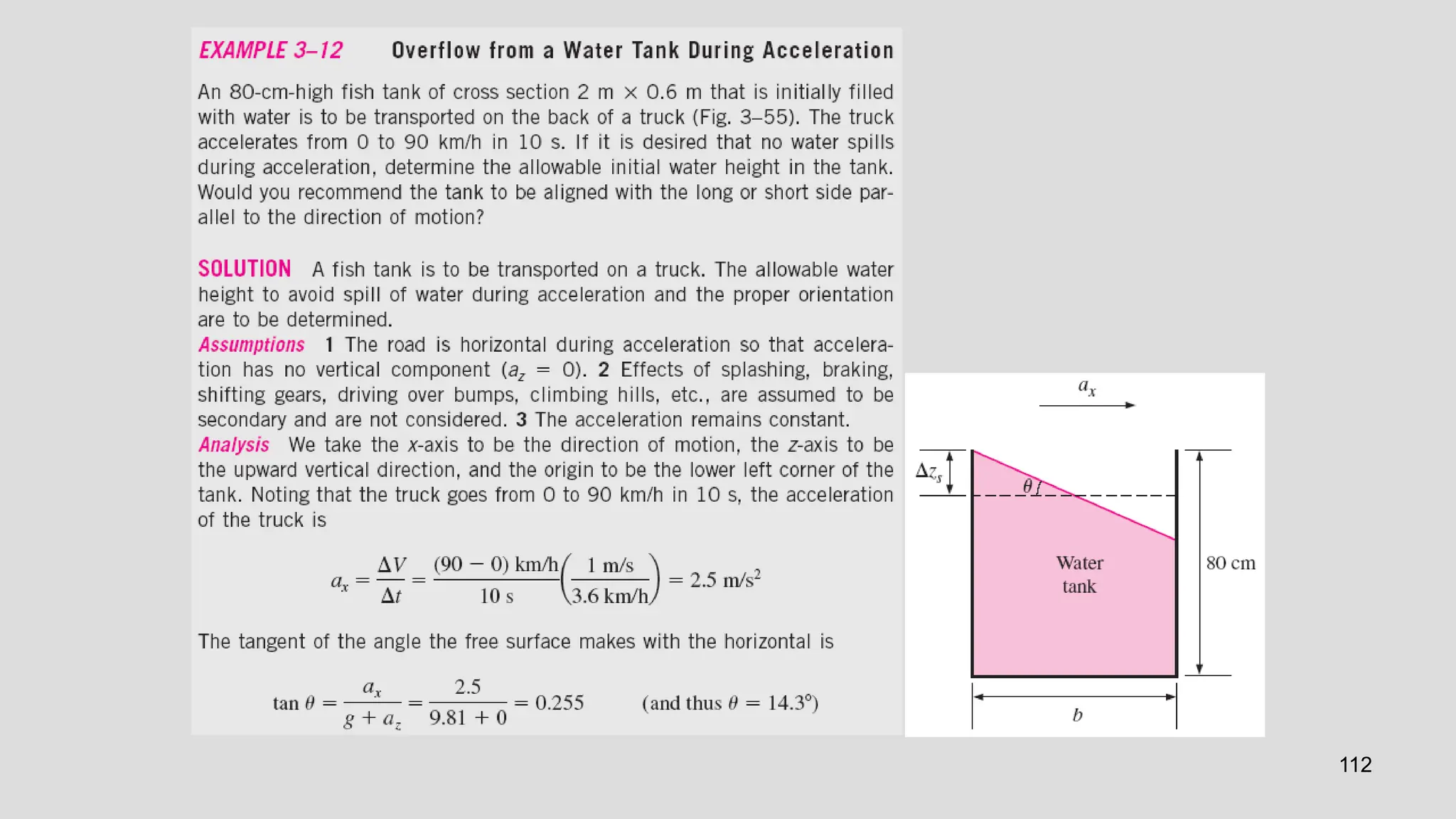
112
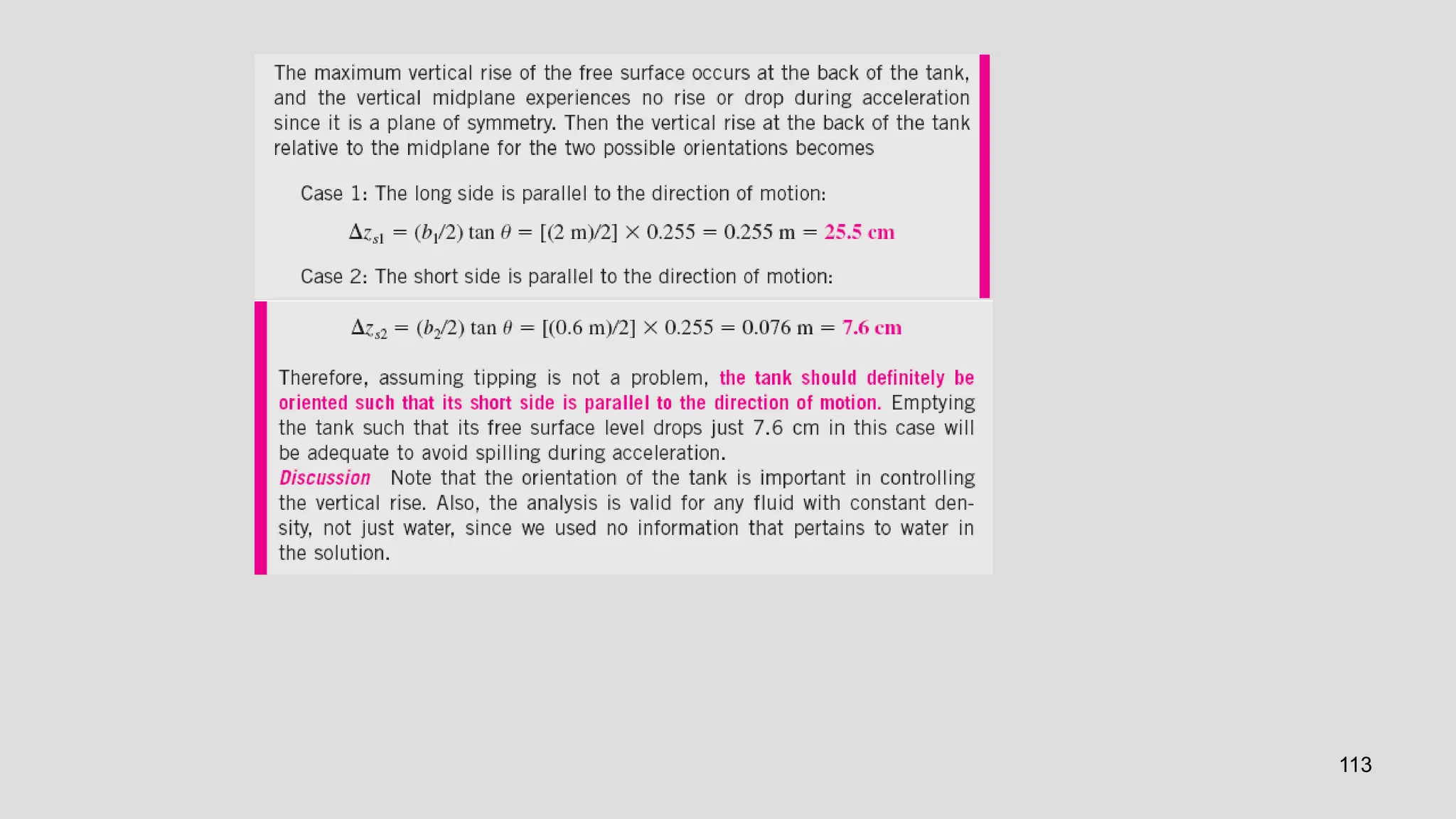
113
114
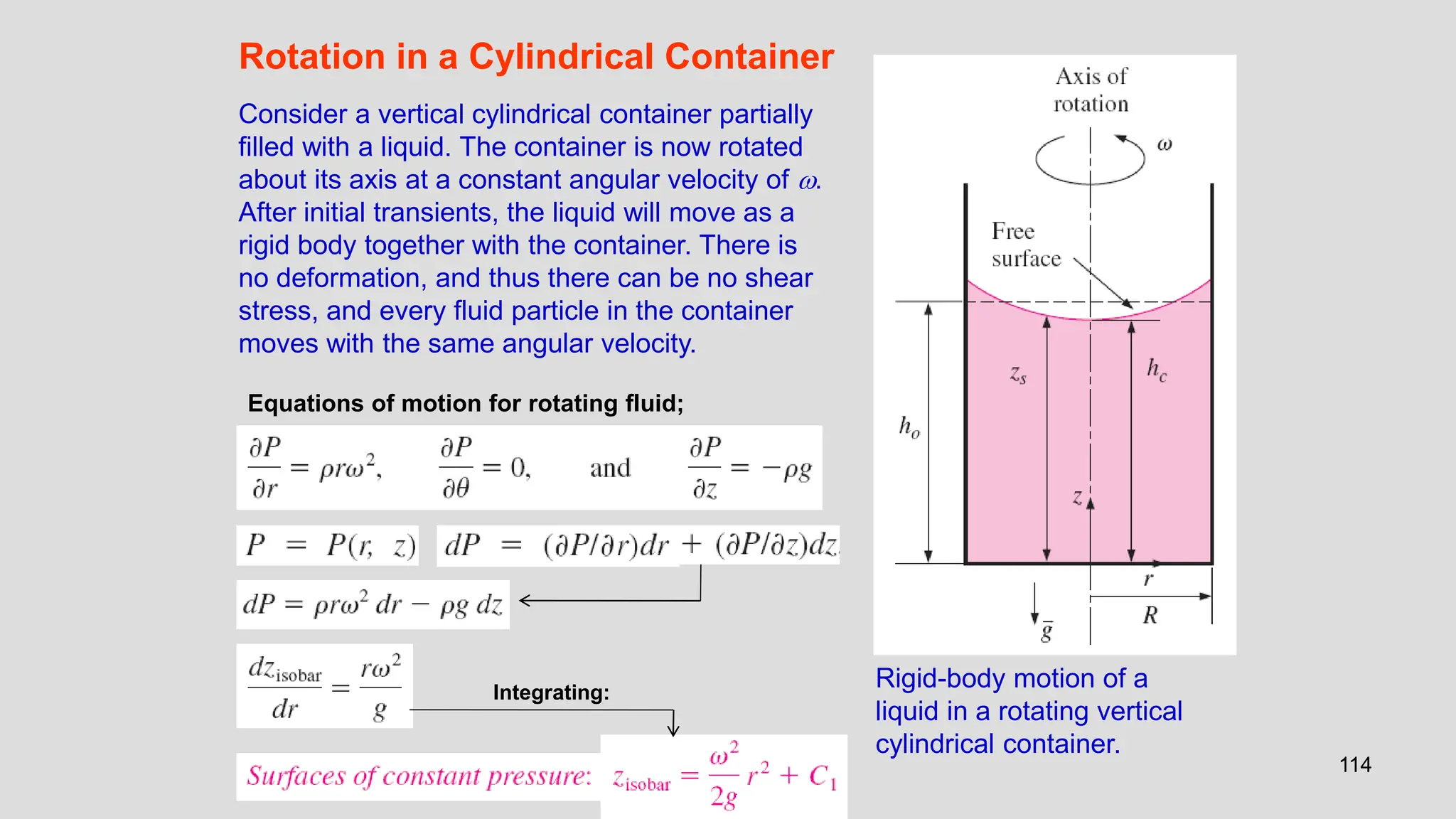
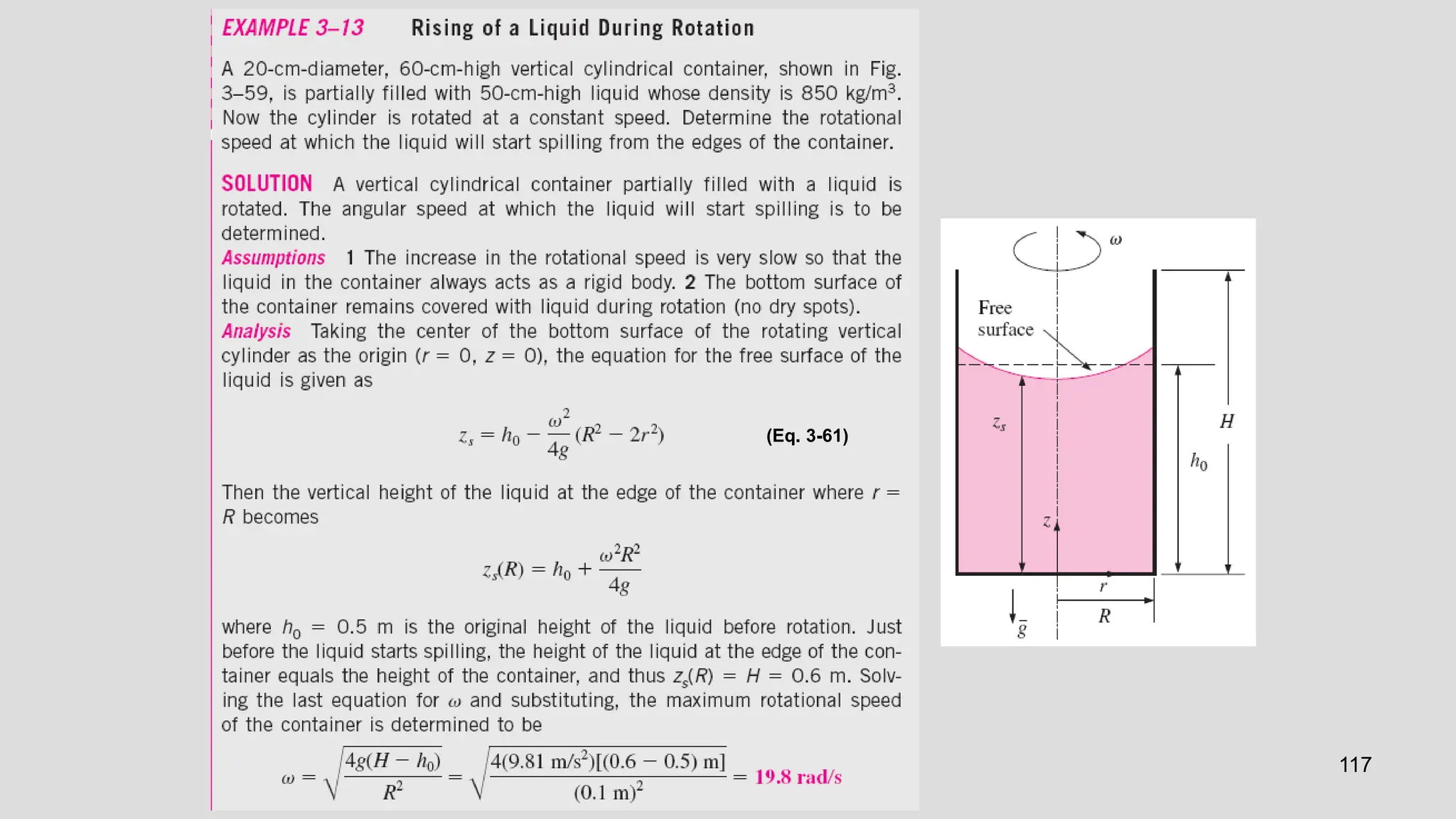
Rotation in a Cylindrical Container
Consider a vertical cylindrical container partially
filled with a liquid. The container is now rotated
about its axis at a constant angular velocity of .
After initial transients, the liquid will move as a
rigid body together with the container. There is
no deformation, and thus there can be no shear
stress, and every fluid particle in the container
moves with the same angular velocity.
Rigid-body motion of a
liquid in a rotating vertical
cylindrical container.
Equations of motion for rotating fluid;
Integrating:
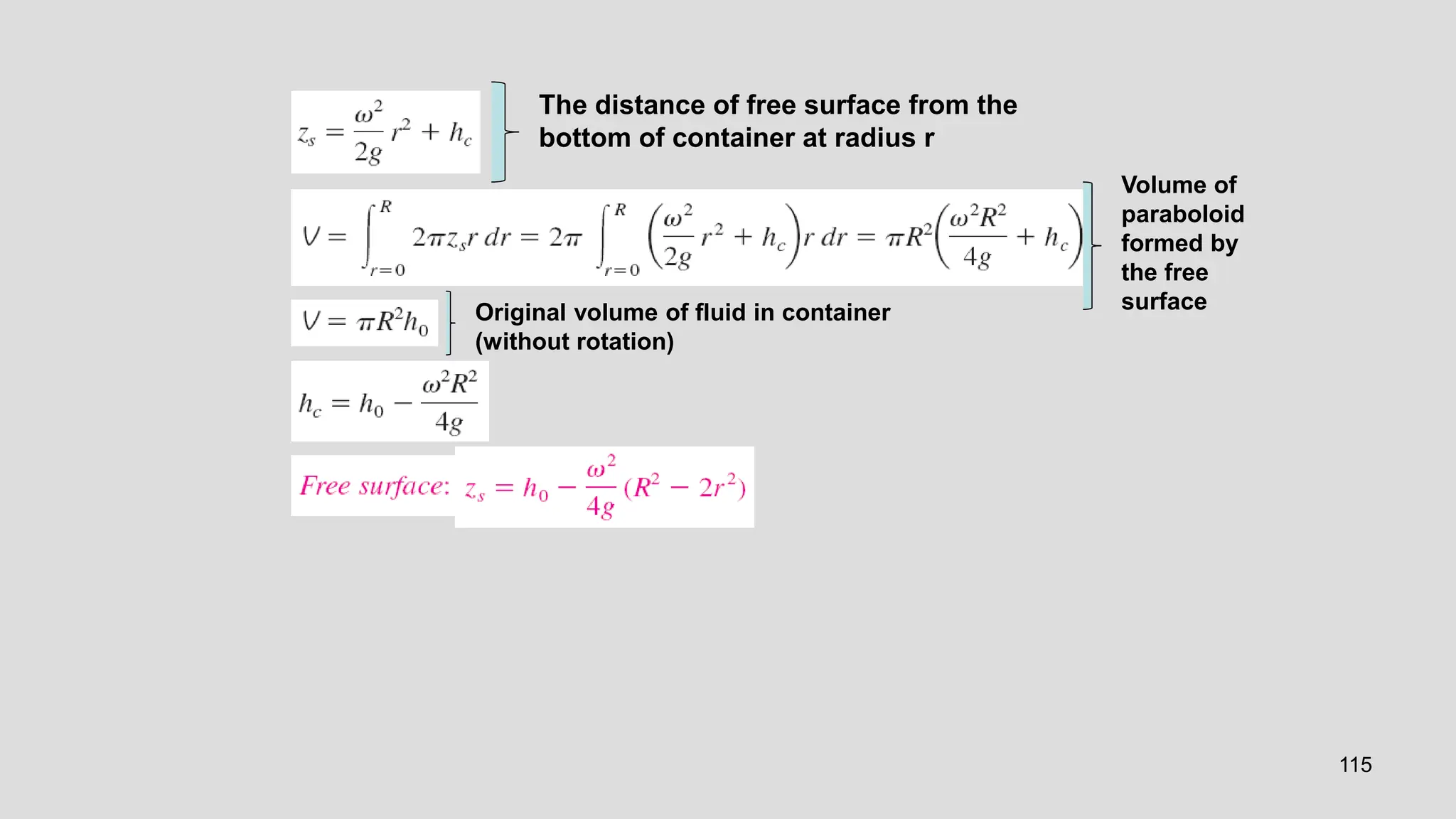
115
The distance of free surface from the
bottom of container at radius r
Volume of
paraboloid
formed by
the free
surface
Original volume of fluid in container
(without rotation)
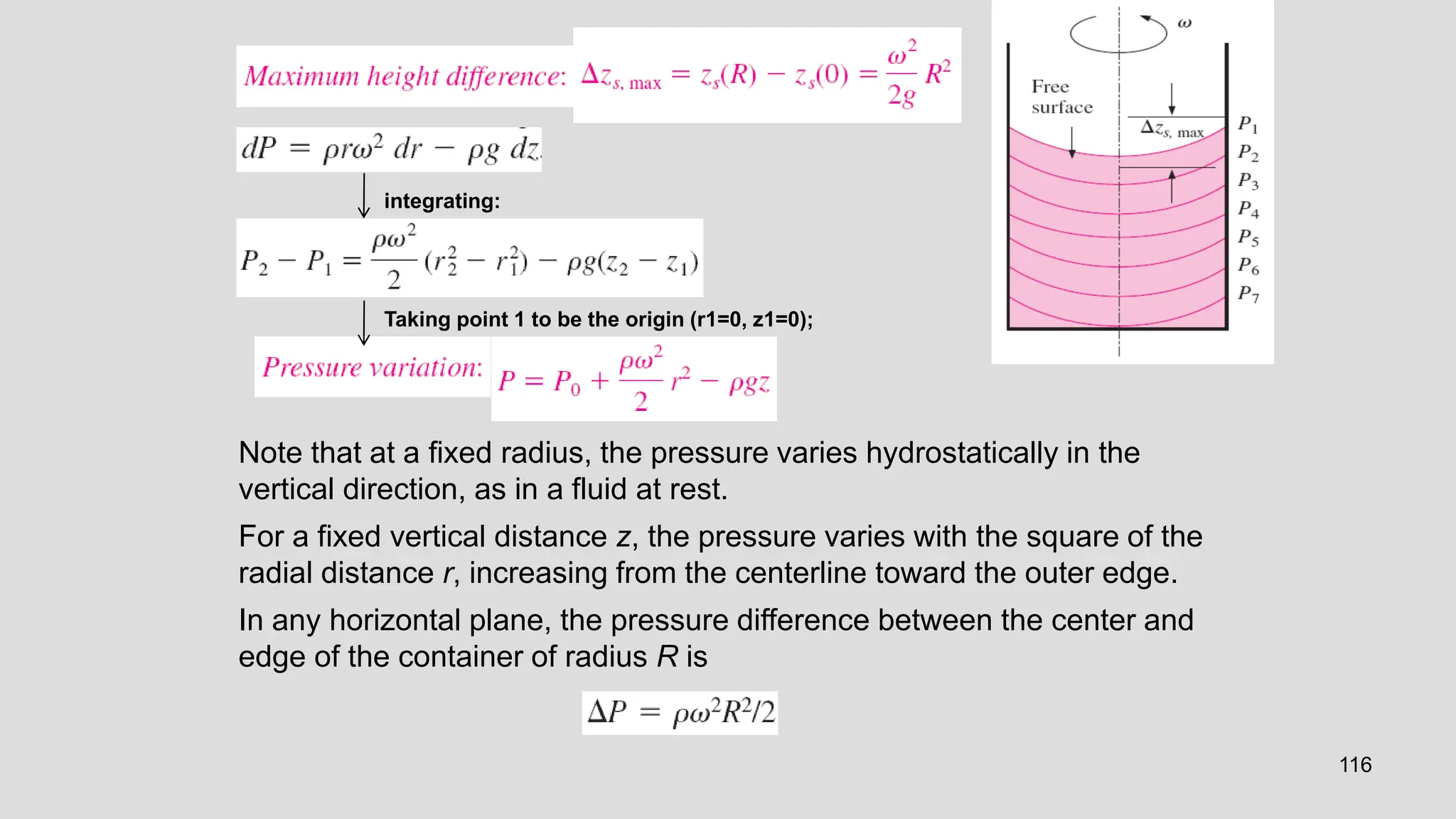
116
Note that at a fixed radius, the pressure varies hydrostatically in the
vertical direction, as in a fluid at rest.
For a fixed vertical distance z, the pressure varies with the square of the
radial distance r, increasing from the centerline toward the outer edge.
In any horizontal plane, the pressure difference between the center and
edge of the container of radius R is
integrating:
Taking point 1 to be the origin (r1=0, z1=0);
117
(Eq. 3-61)
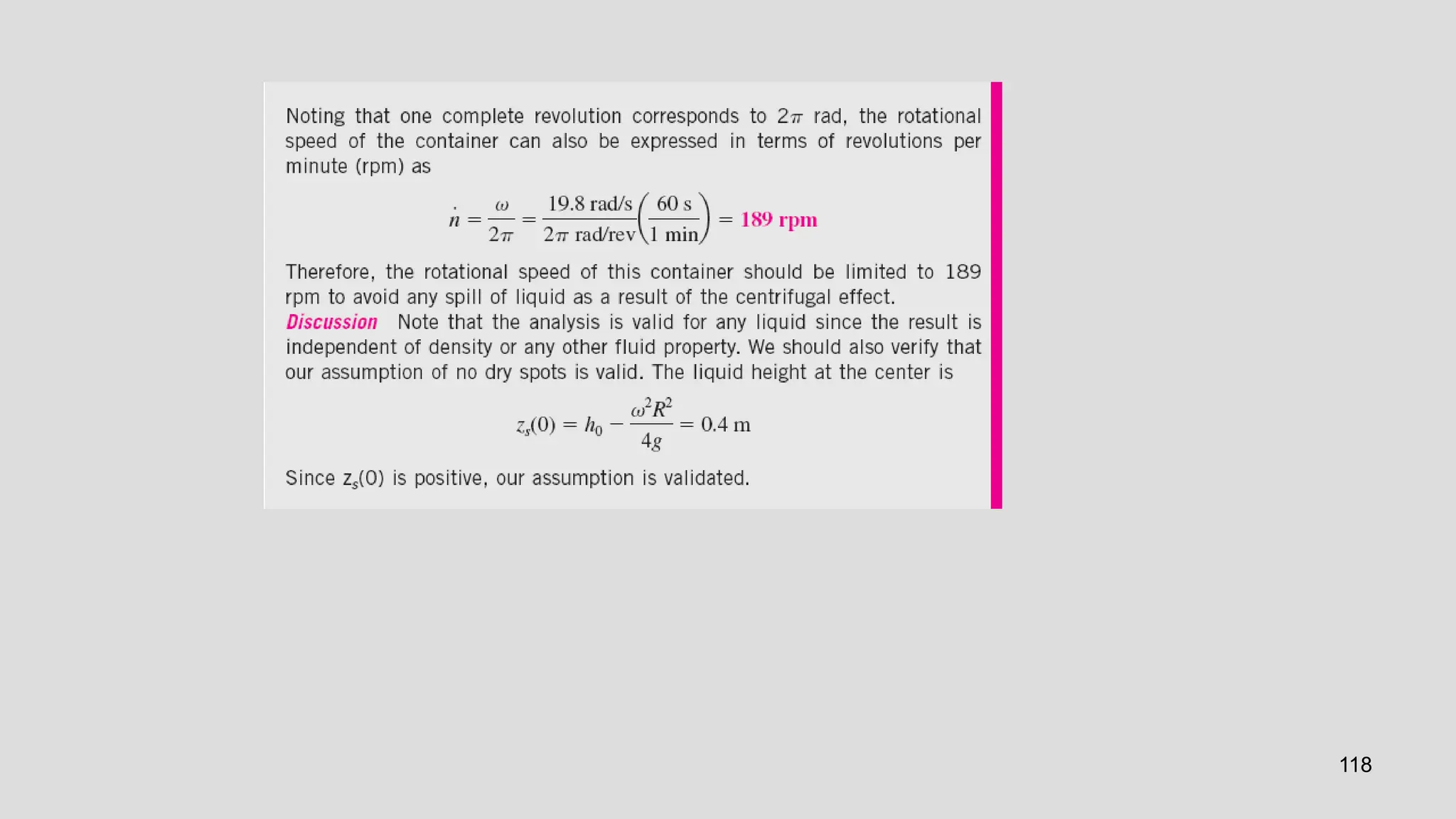
118
119
Summary
• Pressure
• Pressure Measurement Devices
• Introduction to Fluid Statics
• Hydrostatic Forces on Submerged Plane
Surfaces
• Hydrostatic Forces on Submerged Curved
Surfaces
• Buoyancy and Stability
• Fluids in Rigid-Body Motion
Properties of Fluids, Fluid Statics, Pressure Measurement

Properties of Fluids, Fluid Statics, Pressure Measurement

  • 1.
    Unit 1 Properties ofFluids, Fluid Statics, Pressure Measurement
  • 2.
    A drop formswhen liquid is forced out of a small tube. The shape of the drop is determined by a balance of pressure, gravity, and surface tension forces.
  • 3.
    INTRODUCTION Property: Any characteristicof a system. • Some familiar properties are pressure P, temperature T, volume V, and mass m. • Properties are considered to be either intensive or extensive. • Intensive properties: Those that are independent of the mass of a system, such as temperature, pressure, and density. • Extensive properties: Those whose values depend on the size— or extent—of the system. • Specific properties: Extensive properties per unit mass. Criterion to differentiate intensive and extensive properties.
  • 4.
    Continuum • In afluid system, the intermolecular spacing between the fluid particles is treated as negligible and the entire fluid mass system is assumed as continuous distribution of mass, which is known as continuum. • The continuum idealization allows us to treat properties as point functions and to assume the properties vary continually in space with no jump discontinuities. • This idealization is valid as long as the size of the system we deal with is large relative to the space between the molecules. Despite the relatively large gaps between molecules, a substance can be treated as a continuum because of the very large number of molecules even in an extremelysmall volume.
  • 5.
    • The continuousdeformation of fluid under the action of shear stress causes a flow. Figure below shows a shear stress (𝜏) is applied at any location in a fluid, the element 011' which is initially at rest, will move to 022', then to 033' and to 044' and soon. • Any matter is composed of several molecules continue concept assumes a continuous distribution of mass within the matter with no empty space or voids.
  • 6.
    DENSITY AND SPECIFICGRAVITY Density / Mass Density (ρ): It is the mass of the matter occupied in unit volume at a standard temperature and pressure. It is denoted by ρ Matter Mass density,ρ(kg/m3) Air 1.2 Water 1000 Mercury 13600 Steel 7850 Wood 600
  • 7.
    Specific weight: Theweight of a unit volume of a substance. Specific volume (Vₛ ): Volume occupied by unit mass of fluid Matter Specific weight; ɣ= ρg Air 11.77 N/m3 Water 9.81 kN/m3
  • 8.
    Specific gravity (S)or relative density: It is the ratio of specific weight (or mass density) of a fluid to the specific weight (or mass density) of a standard fluid at a specified temperature. (Usually water at 4°C)
  • 9.
    Example 1: Threeliters of petrol weighs 23.7 N. Calculate the mass density, specific weight, specific volume and specific gravity of petrol. Sol. :
  • 10.
    Viscosity: A property thatrepresents the internal resistance of a fluid to motion or the “fluidity”. The viscosity of a fluid is a measure of its “resistance to deformation.” Viscosity is due to the internal frictional force that develops between different layers of fluids as they are forced to move relative to each other. Drag force: The force a flowing fluid exerts on a body in the flow direction. The magnitude of this force depends, in part, on viscosity. A fluid moving relative to a body exerts a drag force on the body, partly because of friction caused by viscosity.
  • 11.
     Suppose onelayer of fluid is moving with respect to the other layer by a velocity = du and vertical gap between two layers be dy.  Upper layer which is moving faster tries to draw the lower slowly moving layer along with it.  Similarly, as a reaction to this, the lower layer tries to retard the upper one. Thus there exists a shear between the two layers as shown below.
  • 12.
  • 13.
    Kinematic Viscosity (v): Variationof Viscosity with Temperature: Increase in temperature cause a decrease in the viscosity of a liquid whereas viscosity of gases increases with temperature growth
  • 14.
    Newton's law ofviscosity: The fluid for which rate of deformation is linearly proportional to shear stress. Thus, for Newtonian fluid viscosity
  • 15.
    Example 2 :A plate 0.05 mm distant from a fixed plate moves at 1.2 m/sec and requires a shear stress of 2.2 N/m2 to maintain this velocity. Find the viscosity of the fluid between the plates. Solution:
  • 16.
    Newtonian fluids: • Fluidwhich obeys Newton's law of viscosity are known as Newtonian fluid. • Fluids for which the rate of deformation is proportional to the shear stress. The rate of deformation (velocity gradient) of a Newtonian fluid is proportional to shear stress, and the constant of proportionality is the viscosity.
  • 17.
    Non-Newtonian Fluid: •These donot follow Newton's law of viscosity. The relation between shear stress and velocity gradient is where A and B are constants depending upon type of fluid and condition of flow. Variation of shear stress with the rate of deformation for Newtonian and non- Newtonian fluids (the slope of a curve at a point is the apparent viscosity of the fluid at that point).
  • 18.
    • The studyof Non-Newtonian fluid is knows as Rheology. 1. For Dilatant Fluids: n > 1 and B = 0, Ex. Butter, Quick sand, Rice starch, Sugar in H2O 2. For Pseudoplastic Fluids: n < 1 and B = 0 Ex. Paper pulp, Rubber solution, Lipsticks, Paints, Blood, Polymetric solutions, milk, etc. 3. For Bingham Plastic Fluids: n = 1 and B ≠ 0 Ex. Sewage sludge, Drilling mud, Tooth paste, Gel. These fluids always have certain minimum shear stress before they yield. 4. For Thixotropic Fluids: n < 1 and B≠0 Viscosity increases with time. Ex. Printers ink and Enamels. 5. For Rheopectic Fluids: n> 1 and B ≠ 0 Viscosity decreases with time Ex. Gypsum solution in water and Bentonite solution.
  • 19.
    SURFACE TENSION • Liquiddroplets behave like small balloons filled with the liquid on a solid surface, and the surface of the liquid acts like a stretched elastic membrane under tension. • The pulling force that causes this tension acts parallel to the surface and is due to the attractive forces between the molecules of the liquid. • The magnitude of this force per unit length is called surface tension (or coefficient of surface tension) and is usually expressed in the unit N/m. • This effect is also called surface energy [per unit area] and is expressed in the equivalent unit of N.m/m2.
  • 20.
    Attractive forces actingon a liquid molecule at the surface and deep inside the liquid. Stretching a liquid film with a U- shaped wire, and the forces acting on the movable wire of length b. Surface tension: The work done per unit increase in the surface area of the liquid.
  • 21.
    The free-body diagramof half a droplet or air bubble and half a soap bubble
  • 22.
    Surface Tension ona liquid jet
  • 23.
  • 25.
    Capillary effect: Therise or fall of a liquid in a small-diameter tube inserted into the liquid. Capillaries: Such narrow tubes or confined flow channels. The capillary effect is partially responsible for the rise of water to the top of tall trees. Meniscus: The curved free surface of a liquid in a capillary tube. The strength of the capillary effect is quantified by the contact (or wetting) angle, defined as the angle that the tangent to the liquid surface makes with the solid surface at the point of contact.
  • 26.
    The capillary riseof water and the capillary fall of mercury in a small diameter glass tube. Capillary rise is inversely proportional to the radius of the tube and density of the liquid. The contact angle for wetting and nonwetting fluids.
  • 27.
    The forces actingon a liquid column that has risen in a tube due to the capillary effect. (1) (2) (3) On equating eq. (1) and (2) As angle θ between fluid and glass is very less assume θ as 0 , so Cosθ will be 1
  • 28.
    Expression for capillaryfall The value of θ for mercury is 128 h
  • 29.
  • 30.
  • 31.
  • 32.
    32 Objectives • Determine thevariation of pressure in a fluid at rest • Calculate pressure using various kinds of manometers • Calculate the forces exerted by a fluid at rest on plane or curved submerged surfaces. • Analyze the stability of floating and submerged bodies. • Analyze the rigid-body motion of fluids in containers during linear acceleration or rotation.
  • 33.
    33 ■ PRESSURE The normalstress (or “pressure”) on the feet of a chubby person is much greater than on the feet of a slim person. Some basic pressure gages. Pressure: A normal force exerted by a fluid per unit area
  • 34.
    34 Absolute pressure: Theactual pressure at a given position. It is measured relative to absolute vacuum (i.e., absolute zero pressure). Gage pressure: The difference between the absolute pressure and the local atmospheric pressure. Most pressure-measuring devices are calibrated to read zero in the atmosphere, and so they indicate gage pressure. Vacuum pressures: Pressures below atmospheric pressure. Throughout this text, the pressure P will denote absolute pressure unless specified otherwise.
  • 35.
    35 40 kPa 100 kPa 100− 40 = 60 kPa
  • 36.
    36 Pascal law Pressure orintensity of a pressure at a point in a static fluid is equal in all directions
  • 37.
  • 38.
    38 Pressure at aPoint Pressure is a scalar quantity, not a vector; the pressure at a point in a fluid is the same in all directions. Pressure is the compressive force per unit area but it is not a vector. Pressure at any point in a fluid is the same in all directions. Pressure has magnitude but not a specific direction, and thus it is a scalar quantity.
  • 39.
    39 Variation of Pressurewith Depth The pressure of a fluid at rest increases with depth (as a result of added weight since more fluid rest on deeper layer).
  • 40.
    40 When the variationof density with elevation is known Free-body diagram of a rectangular fluid element in equilibrium.
  • 41.
    41 In a roomfilled with a gas, the variation of pressure with height is negligible. Pressure in a liquid at rest increases linearly with distance from the free surface.
  • 42.
    42 The pressure isthe same at all points on a horizontal plane in a given fluid regardless of geometry, provided that the points are interconnected by the same fluid.
  • 43.
    43 Pascal’s law: Thepressure applied to a confined fluid increases the pressure throughout by the same amount. Lifting of a large weight by a small force by the application of Pascal’s law. The area ratio A2/A1 is called the ideal mechanical advantage of the hydraulic lift.
  • 44.
    44 The Barometer • Atmosphericpressure is measured by a device called a barometer; thus, the atmospheric pressure is often referred to as the barometric pressure. • A frequently used pressure unit is the standard atmosphere, which is defined as the pressure produced by a column of mercury 760 mm in height at 0°C (Hg = 13,595 kg/m3) under standard gravitational acceleration (g = 9.807 m/s2). The basic barometer. The length or the cross- sectional area of the tube has no effect on the height of the fluid column of a barometer, provided that the tube diameter is large enough to avoid surface tension (capillary) effects. ■ PRESSURE MEASUREMENT DEVICES
  • 45.
    45 At high altitudes,a car engine generates less power and a person gets less oxygen because of the lower density of air.
  • 46.
  • 47.
  • 48.
  • 49.
    51 The Manometer In stacked-upfluid layers, the pressure change across a fluid layer of density  and height h is gh. The basic manometer. It is commonly used to measure small and moderate pressure differences. A manometer contains one or more fluids such as mercury, water, alcohol, or oil.
  • 50.
  • 51.
  • 52.
  • 53.
  • 54.
    56 Measuring the pressuredrop across a flow section or a flow device by a differential manometer. Differential manometer
  • 55.
  • 56.
  • 57.
    61 Other Pressure MeasurementDevices Various types of Bourdon tubes used to measure pressure. • Bourdon tube: Consists of a hollow metal tube bent like a hook whose end is closed and connected to a dial indicator needle. • Pressure transducers: Use various techniques to convert the pressure effect to an electrical effect such as a change in voltage, resistance, or capacitance. • Pressure transducers are smaller and faster, and they can be more sensitive, reliable, and precise than their mechanical counterparts. • Strain-gage pressure transducers: Work by having a diaphragm deflect between two chambers open to the pressure inputs. • Piezoelectric transducers: Also called solid- state pressure transducers, work on the principle that an electric potential is generated in a crystalline substance when it is subjected to mechanical pressure.
  • 58.
    62 3–3 ■ INTRODUCTIONTO FLUID STATICS Fluid statics: Deals with problems associated with fluids at rest. The fluid can be either gaseous or liquid. Hydrostatics: When the fluid is a liquid. Aerostatics: When the fluid is a gas. In fluid statics, there is no relative motion between adjacent fluid layers, and thus there are no shear (tangential) stresses in the fluid trying to deform it. The only stress we deal with in fluid statics is the normal stress, which is the pressure, and the variation of pressure is due only to the weight of the fluid. The topic of fluid statics has significance only in gravity fields. The design of many engineering systems such as water dams and liquid storage tanks requires the determination of the forces acting on the surfaces using fluid statics.
  • 59.
    63 3–4 ■ HYDROSTATIC FORCESON SUBMERGED PLANE SURFACES Hoover Dam. A plate, such as a gate valve in a dam, the wall of a liquid storage tank, or the hull of a ship at rest, is subjected to fluid pressure distributed over its surface when exposed to a liquid. On a plane surface, the hydrostatic forces form a system of parallel forces, and we often need to determine the magnitude of the force and its point of application, which is called the center of pressure. When analyzing hydrostatic forces on submerged surfaces, the atmospheric pressure can be subtracted for simplicity when it acts on both sides of the structure.
  • 60.
  • 61.
  • 62.
  • 63.
  • 64.
  • 65.
  • 66.
    70 The centroid andthe centroidal moments of inertia for some common geometries.
  • 67.
  • 68.
    72 The pressure atthe centroid of a surface is equivalent to the average pressure on the surface. The resultant force acting on a plane surface is equal to the product of the pressure at the centroid of the surface and the surface area, and its line of action passes through the center of pressure.
  • 69.
    73 Hydrostatic force onan inclined plane surface completely submerged in a liquid.
  • 70.
    76 Special Case: SubmergedRectangular Plate Hydrostatic force acting on the top surface of a submerged tilted rectangular plate.
  • 71.
    77 Hydrostatic force actingon the top surface of a submerged vertical rectangular plate. Hydrostatic force acting on the top surface of a submerged horizontal rectangular plate.
  • 72.
    80 3–5 ■ HYDROSTATICFORCES ON SUBMERGED CURVED SURFACES Determination of the hydrostatic force acting on a submerged curved surface. W = ρgV α tan α = FV/FH
  • 73.
  • 74.
  • 76.
  • 77.
    85 When a curvedsurface is above the liquid, the weight of the liquid and the vertical component of the hydrostatic force act in the opposite directions. The hydrostatic force acting on a circular surface always passes through the center of the circle since the pressure forces are normal to the surface and they all pass through the center.
  • 78.
  • 79.
    91 Buoyant force: Theupward force a fluid exerts on a body immersed in it. The buoyant force is caused by the increase of pressure with depth in a fluid. A flat plate of uniform thickness h submerged in a liquid parallel to the free surface.  The buoyant force acting on the plate is equal to the weight of the liquid displaced by the plate.  For a fluid with constant density, the buoyant force is independent of the distance of the body from the free surface.  It is also independent of the density of the solid body.
  • 80.
    92 Archimedes’ principle: Thebuoyant force acting on a body immersed in a fluid is equal to the weight of the fluid displaced by the body, and it acts upward through the centroid of the displaced volume.
  • 81.
    93  The buoyantforces acting on a solid body submerged in a fluid and on a fluid body of the same shape at the same depth are identical.  The buoyant force FB acts upward through the centroid C of the displaced volume and is equal in magnitude to the weight W of the displaced fluid, but is opposite in direction.  For a solid of uniform density, its weight Ws also acts through the centroid, but its magnitude is not necessarily equal to that of the fluid it displaces. (Here Ws > W and thus Ws > FB; this solid body would sink.)
  • 82.
    94 For floating bodies,the weight of the entire body must be equal to the buoyant force, which is the weight of the fluid whose volume is equal to the volume of the submerged portion of the floating body: A solid body dropped into a fluid will sink, float, or remain at rest at any point in the fluid, depending on its average density relative to the density of the fluid.
  • 83.
    99 Stability of Immersedand Floating Bodies For floating bodies such as ships, stability is an important consideration for safety. Stability is easily understood by analyzing a ball on the floor.
  • 84.
    100 An immersed neutrallybuoyant body is (a) stable if the center of gravity, G is directly below the center of buoyancy, B of the body, (b) neutrally stable if G and B are coincident, and (c) unstable if G is directly above B. A floating body possesses vertical stability, while an immersed neutrally buoyant body is neutrally stable since it does not return to its original position after a disturbance.
  • 85.
  • 86.
    102 When the centerof gravity G of an immersed neutrally buoyant body is not vertically aligned with the center of buoyancy B of the body, it is not in an equilibrium state and would rotate to its stable state, even without any disturbance. A boat can tilt to some max angle without capsizing but beyond that angle, it overturns. E.g: a ball in a trough between two hills is stable for small disturbances, but unstable for large disturbances.
  • 87.
    103 A floating bodyis stable if the body is bottom-heavy and thus the center of gravity G is below the centroid B of the body, or if the metacenter M is above point G. However, the body is unstable if point M is below point G.
  • 88.
    104 Metacentric height GM:The distance between the center of gravity G and the metacenter M—the intersection point of the lines of action of the buoyant force through the body before and after rotation. The length of the metacentric height GM above G is a measure of the stability: the larger it is, the more stable is the floating body.
  • 89.
  • 90.
    106 3–7 ■ FLUIDSIN RIGID-BODY MOTION Pressure at a given point has the same magnitude in all directions, and thus it is a scalar function. In this section we obtain relations for the variation of pressure in fluids moving like a solid body with or without acceleration in the absence of any shear stresses (i.e., no motion between fluid layers relative to each other). Newton’s 2nd law of motion Net surface force:
  • 91.
    107 Expressing in vectorform: i, j, k = unit vectors in x,y,z directions Pressure gradient From Newton’s 2nd law of motion, δF = δma = ρ dx dy dz . a Therefore, Expressing in scalar form in three orthogonal directions; Remember, m = ρ V Body force,
  • 92.
    108 Special Case 1:Fluids at Rest For fluids at rest or moving on a straight path at constant velocity, all components of acceleration are zero, and the relations reduce to The pressure remains constant in any horizontal direction (P is independent of x and y) and varies only in the vertical direction as a result of gravity [and thus P = P(z)]. These relations are applicable for both compressible and incompressible fluids.
  • 93.
    109 Special Case 2:Free Fall of a Fluid Body A freely falling body accelerates under the influence of gravity. When the air resistance is negligible, the acceleration of the body equals the gravitational acceleration, and acceleration in any horizontal direction is zero. Therefore, ax = ay = 0 and az = -g. The effect of acceleration on the pressure of a liquid during free fall and upward acceleration.
  • 94.
    110 Acceleration on aStraight Path Rigid-body motion of a liquid in a linearly accelerating tank. Example: a container partially filled with a liquid, moving on straight path with constant acceleration. ay = 0, then Equation 3-43 reduced to: Therefore: Taking point 1 to be origin (x1 = 0, z1 = 0),
  • 95.
    111 Lines of constantpressure (which are the projections of the surfaces of constant pressure on the xz-plane) in a linearly accelerating liquid. Also shown is the vertical rise. zs = z-coordinate of liquid’s free surface By taking P1 = P2, Setting dP = 0, (isobars)
  • 96.
  • 97.
  • 98.
    114 Rotation in aCylindrical Container Consider a vertical cylindrical container partially filled with a liquid. The container is now rotated about its axis at a constant angular velocity of . After initial transients, the liquid will move as a rigid body together with the container. There is no deformation, and thus there can be no shear stress, and every fluid particle in the container moves with the same angular velocity. Rigid-body motion of a liquid in a rotating vertical cylindrical container. Equations of motion for rotating fluid; Integrating:
  • 99.
    115 The distance offree surface from the bottom of container at radius r Volume of paraboloid formed by the free surface Original volume of fluid in container (without rotation)
  • 100.
    116 Note that ata fixed radius, the pressure varies hydrostatically in the vertical direction, as in a fluid at rest. For a fixed vertical distance z, the pressure varies with the square of the radial distance r, increasing from the centerline toward the outer edge. In any horizontal plane, the pressure difference between the center and edge of the container of radius R is integrating: Taking point 1 to be the origin (r1=0, z1=0);
  • 101.
  • 102.
  • 103.
    119 Summary • Pressure • PressureMeasurement Devices • Introduction to Fluid Statics • Hydrostatic Forces on Submerged Plane Surfaces • Hydrostatic Forces on Submerged Curved Surfaces • Buoyancy and Stability • Fluids in Rigid-Body Motion