Section 7.4
                Ionization Energy
Dan Corney
Anna Erkalova
Frank Muzika
John Yoffee
Overview
• Ionization energy – the minimum energy required to remove
  an electron from the ground state of the isolated gaseous
  atom or ion.
• Variations in Successive Ionization
  Energies
• Periodic Trends in First Ionization
  Energies
• Electron Configurations of Ions
• Applications outside of class
Ionization Energy Variations

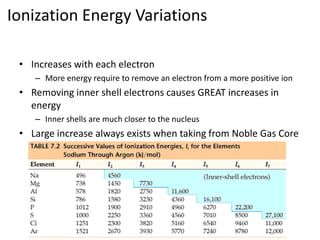
 • Increases with each electron
    – More energy require to remove an electron from a more positive ion
 • Removing inner shell electrons causes GREAT increases in
   energy
    – Inner shells are much closer to the nucleus
 • Large increase always exists when taking from Noble Gas Core
Ionization Energy Variations

               Interesting Facts
 • The table on the previous slide does a
   wonderful job showing ionization energies
   throughout one row in the periodic table
 • The large increase of the inner shell supports
   the idea that only electrons outside the noble
   gas core are involved in reactions
First Ionization Energy Trends


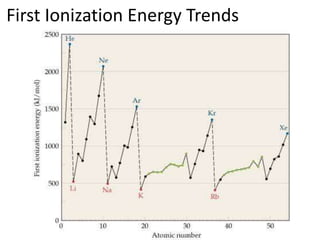
 • Within Rows, I increases with Atomic Number
 • Within Groups, I decreases with Atomic
   Number
 • Representative Elements show a larger range
   of values of I
First Ionization Energy Trends

 • Smaller Atoms tend to have Higher Energies
   – Closer to nucleus
   – Minor irregularities due to
      • Electron repulsion (Nitrogen to Oxygen)
      • Electron Shielding (Beryllium to Boron)
First Ionization Energy Trends
               Interesting Facts
 • Same factors that influence atomic size also
   influence atomic energies.

 • Depends on both the effective nuclear charge
   and average distance of the electron from the
   nucleus
Electron Configuration of Ions

 • Electrons are always removed from orbitals
   with largest principal quantum number.
 • This means that 4s would be removed before
   3d
Electron Configuration of Ions
                Interesting Facts
 • When electrons are added to an atom to form
   an anion, they are added to empty or partially
   filled orbital with the lowest available value of
   n.
 • Ex.
 • F (1s22s22p5)  F- (1s22s22p6)
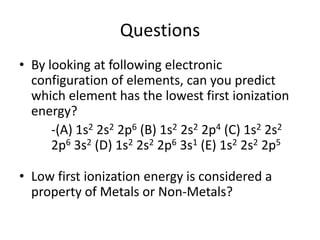
Questions
• By looking at following electronic
  configuration of elements, can you predict
  which element has the lowest first ionization
  energy?
      -(A) 1s2 2s2 2p6 (B) 1s2 2s2 2p4 (C) 1s2 2s2
      2p6 3s2 (D) 1s2 2s2 2p6 3s1 (E) 1s2 2s2 2p5

• Low first ionization energy is considered a
  property of Metals or Non-Metals?
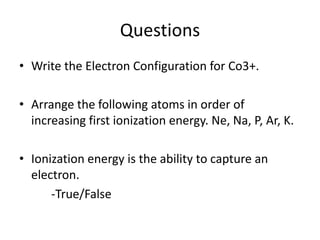
Questions
• Write the Electron Configuration for Co3+.

• Arrange the following atoms in order of
  increasing first ionization energy. Ne, Na, P, Ar, K.

• Ionization energy is the ability to capture an
  electron.
      -True/False
Answers
•   (D) 1s2 2s2 2p6 3s1
•   Metals
•   [Ar]3d6
•   K<Na<P<Ar<Ne
•   True
Outside the Class

Chempowerpoint 121104134258-phpapp03

  • 1.
    Section 7.4 Ionization Energy Dan Corney Anna Erkalova Frank Muzika John Yoffee
  • 2.
    Overview • Ionization energy– the minimum energy required to remove an electron from the ground state of the isolated gaseous atom or ion. • Variations in Successive Ionization Energies • Periodic Trends in First Ionization Energies • Electron Configurations of Ions • Applications outside of class
  • 3.
    Ionization Energy Variations • Increases with each electron – More energy require to remove an electron from a more positive ion • Removing inner shell electrons causes GREAT increases in energy – Inner shells are much closer to the nucleus • Large increase always exists when taking from Noble Gas Core
  • 4.
    Ionization Energy Variations Interesting Facts • The table on the previous slide does a wonderful job showing ionization energies throughout one row in the periodic table • The large increase of the inner shell supports the idea that only electrons outside the noble gas core are involved in reactions
  • 5.
  • 6.
    First Ionization EnergyTrends • Within Rows, I increases with Atomic Number • Within Groups, I decreases with Atomic Number • Representative Elements show a larger range of values of I
  • 7.
    First Ionization EnergyTrends • Smaller Atoms tend to have Higher Energies – Closer to nucleus – Minor irregularities due to • Electron repulsion (Nitrogen to Oxygen) • Electron Shielding (Beryllium to Boron)
  • 8.
    First Ionization EnergyTrends Interesting Facts • Same factors that influence atomic size also influence atomic energies. • Depends on both the effective nuclear charge and average distance of the electron from the nucleus
  • 9.
    Electron Configuration ofIons • Electrons are always removed from orbitals with largest principal quantum number. • This means that 4s would be removed before 3d
  • 10.
    Electron Configuration ofIons Interesting Facts • When electrons are added to an atom to form an anion, they are added to empty or partially filled orbital with the lowest available value of n. • Ex. • F (1s22s22p5)  F- (1s22s22p6)
  • 11.
    Questions • By lookingat following electronic configuration of elements, can you predict which element has the lowest first ionization energy? -(A) 1s2 2s2 2p6 (B) 1s2 2s2 2p4 (C) 1s2 2s2 2p6 3s2 (D) 1s2 2s2 2p6 3s1 (E) 1s2 2s2 2p5 • Low first ionization energy is considered a property of Metals or Non-Metals?
  • 12.
    Questions • Write theElectron Configuration for Co3+. • Arrange the following atoms in order of increasing first ionization energy. Ne, Na, P, Ar, K. • Ionization energy is the ability to capture an electron. -True/False
  • 13.
    Answers • (D) 1s2 2s2 2p6 3s1 • Metals • [Ar]3d6 • K<Na<P<Ar<Ne • True
  • 14.