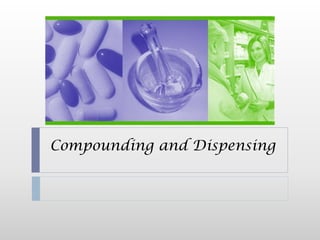
Compounding and Dispensing
Description
 Compounding & Dispensing :
 The practice of Pharmacists regarding the process of compounding and
drug delivery
 Good Pharmacy Practice as a Standard
 Pharmaceutical Care
 Extemporaneous dispensing
 Prescription Handling
 Specific aspects in the practice of compounding & dispensing such:
 Prescription screening and address administrative, clinical and farmasetis
 Dose Calculation
 Labelling and determination of Beyond-use date
 Medication error : Prevention and how to overcome it
 Dosage Form and Patient specific drug delivery system
Objective:
 Understand the role of compounding Pharmacists dispensing &
in practice
 Able to resolve problems of making preparations-specific
preparations
 Applying the techniques of solving problems related to the
administrative aspects, and clinical farmasetis in the giving of
drugs on patients
 Apply the dose determination based on the patient's condition,
the disease and the presence of drug interactions
 Apply the determination of beyond-use date of drugs given to
patients
 Towards a rational treatment
Background:
 Pharmaceutical care
 Patient oriented
 Comprehensive services → improve quality of life of the
patients
Assessment
Care Plan
Follow-up
Evaluation
Patient Care
Process
Pharmacotherapy
Workup
Practitioner
Medication
Experience
Patient
Therapeutic Relationship
Philosophy of Practice
Social Obligation
Responsibilities
Patient-centered approach
Caring
Today’s wants
and needs
Responsibilities
5
Uniqueness of Pharmaceutical Care
Traditional Pharmacy Clinical Pharmacy Pharmaceutical Care
Primary focus Prescription order Physicians or other Patient
or OTC request health professionals
Continuity Upon demand Discontinuous Continuous
Strategy Obey Find fault or prevention Anticipate or improve
Orientation Drug product Process Outcomes
6
Why is there a new concept and
whether it's Pharmaceutical Care?
7
1960---------------1990
 An explosion of drug
 961: 656 type 1999: 8000 type
 1971: 140,000 deaths & 1 million treated
 20% of care due to medication errors
 50% actually can be avoided
 45-65% of patients using drugs not in accordance with the
advice of the prescribers
8
 Danger and risk can arise as a result of how
drugs are used, not because of its chemical
composition
 Most of the problems are not inherent to
the cure, but in the way drugs are
Prescribed: tsb
 And Fresh
 Used/consumed
9
 Facts (1)
 A fifth of in-patients undergoing drug therapy
problems even in the most advanced medical
institutions
 76 billion dollar (US)
 The patient's suffering?
 Brigham and women's Hospital:
 6.5% non-obstetric patients suffered an adverse drug event
(30% serius)
10
 Other studies:
 Due to medication error LOS (Length of Stay) rose 5
days, it costs $ 6,000 increase $ 3 million/yearBedell
1991:
 64% of cardiac arrest at a teaching hospital because of drug
use.
 Other studies:
 Medication Errors occurred on average 10-20% (although not all
serious)
11
Dispensing
 Dispensing + Patient Care
12
Faceless service
 a practice one patient at a time
13
Pharmaceutical care
 Is the direct responsible provision of
medication related care for the purpose of
achieving definit outcomes that improve
patient’s quality of life (ASHP)
 Is a Practice in which the Practitioner
takes Responsibility for a patient’s drug
related needs, and is held Accountable for
this Commitment (Strand)
14
Responsibility
 The fundamental relationship of patient care
 Trust and authority licensed
 Commitment & competency
 Responsibility (documentation)
 Ensure that there was an indication for every item of drug therapy
 Any drug used was the most effective & safest & that the patient
was compliant
15
Medication Related
 Drug therapy
 The decisions of the
 Drug usage
 Consideration of the selection of doses, routes, methods
 Therapeutic drug monitoring
 Granting of the information
 Provision of counseling
 MedicationTherapy Management
16
Care
 The focus of care is the care ofWorking together
with other health staff in the:
 Designing
 Implement
 Monitoring of the therapeutic plan
 That improvement of patient's quality of life is for sure
 Relationships individually Licensed must be:
 Profesional
 Personal
 Commitment
 Mutual respect
 Honestly
 Open communication
 Cooperation
 Empathy
 Sensitivity
 Promotion of patient independence
 Seeing the patient as a person
18
 Patience, understanding,
attention,trust, comfort,
confidence, responsible,
accountable, competence
 Putting the patient first
 Offering reassurance, advocacy
 Supporting the patient
19
Outcomes
 The assurance of improved quality of life
 Cure disease
 Elimination, reduction of symptoms
 Termination/slowing the disease process
 To achieve results
 Identification Of DRP (Drug Related Problem)
 Solve actual DRP
 Prevent potential DRP
20
Quality of Life
 A comprehensive assessment of the quality of life
 Objective assessment
 Subjective assessment
 Patients get involved
21
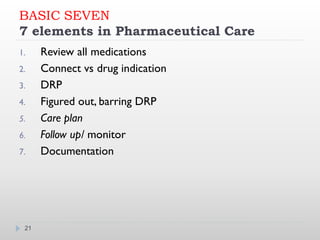
BASIC SEVEN
7 elements in Pharmaceutical Care
1. Review all medications
2. Connect vs drug indication
3. DRP
4. Figured out, barring DRP
5. Care plan
6. Follow up/ monitor
7. Documentation
Good Pharmacy Practice
Standards for Quality of Pharmacy Services :
Recommendation against the required standard in
ensuring quality/quality of service kefarmasian
23
Good Pharmacy Practice
 Why GPP?
 Aspects of legal competency, and ethics in practice
 Control of the regulation
 Rational use of drugs
 Treatment of high quality,safe and cost-effective
 Optimise patient outcomes
 System and Infrastructure Support
24
Good Pharmacy Practice
 Standard that is used to:
 Health promotion
 Provision of medicines and health equipment
 Patient self care
 Prescribing and drug use
25
Contoh elemen GPP dalam :
Pelayanan Obat Resep
 Medication records
 Kompetensi dari Personil yang terlibat dalam Dispensing
 Sumber pengadaan sediaan farmasi
 Penyimpanan dan mutu sediaan farmasi
 Penyiapan dan penjaminan mutu sediaan – sediaan yang
diracik
 Advis tertulis dan penyampaian secara lisan
 Patient follow up and monitoring
 Documentation of professional activities
 Disposal/ pemusnahan
26
Contoh elemen GPP dalam :
Influencing prescribing and medicines use
 Formularies and treatment guidelines
 Generic substitution
 Evaluation of use of medicines
 Adherence support
 Assessment of drug promotion materials
 Medicines information sources
 Reporting of adverse effects, errors, defects in medicine
quality, counterfeits
Extemporaneous Dispensing
When a prescription is received for an extemporaneous
product, there are a number of considerations to be prior
to dispensing.
1. Use of the product
2. Is it safe and suitable for the intended purpose?
3. Calculation of formula for preparation
4. Method of preparation
1. Solubility when applicable
2. Vehicle/ diluent
3. Preservative
4. Flavouring when appropriate
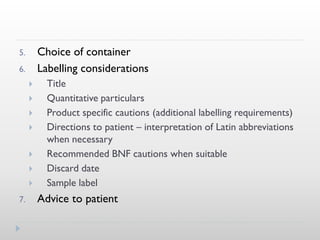
5. Choice of container
6. Labelling considerations
 Title
 Quantitative particulars
 Product specific cautions (additional labelling requirements)
 Directions to patient – interpretation of Latin abbreviations
when necessary
 Recommended BNF cautions when suitable
 Discard date
 Sample label
7. Advice to patient
Extemporaneous Preparation
 Suatu produk dapat diformulasikan secara
extemporaneous hanya jika tidak ada produk sesuai
dengan dikehendaki yang beredar di pasaran
 Example:
Captopril syrup
Captopril powder (puyer)
Omeprazole for NG administration
 An awful lot of events in the field of enteric tablet preparations with a salute also
crushed.
 Please note that the material of a tablet that was overlaid with a particular purpose
such as that controlled drug release, or that the drug is not damaged by stomach
acid and can be diabsorpsi in the intestine.
 Mixing antibiotics (e.g. amoxicillin) and drugs NSAIDS (e.g. paracetamol, ibuprofen,
mefenamic acid, etc) in the form of a preparation headache is not ideal because the
prescribing of antibiotics is a drug taken to run out while the NSAID drugs are
medicines that are taken only when necessary.
 We need to know that antibiotics such as amoxicillin should not be crushed because
it can cause shock anafilaktik that can endanger the patient or the officer making the
drug.
 The real headache-making sometimes don't pay attention to hygiene, humidity of the
room, the room temperature, the use of tools that are not clean, compounding
preparations headache while joking, chatting-chat and the don't m. ..
 Mixing several kinds of drugs in dosage form of headache without
considering the possibility of interactions between the drugs that affect the
interaction of both farmokinetika as well as farmakodinamik drug.
 No need denying also that the condition of our society actually need these
supplies, headache because it still has a number of advantages and
advantages: easy to dose adjustment according to the age and weight of the
patient.
 Still at least drug preparations that are specific to children so that should
be made in the form of headache preparations.
 Treatment costs become cheaper.
 Preparations can help and ease the headache patient kids who have
difficulty taking the medication in the form of preparations in tablets.
5/31/2018LISA ADITAMA
Prescription Medications
 ONLY CERTAIN PEOPLE CAN WRITE A
PRESCRIPTION:
 Doctor of Medicine or osteopathy
 Nurse Practitioner
 Dentist
 Optometrist
 Naturopathic physician
5/31/2018LISA ADITAMA
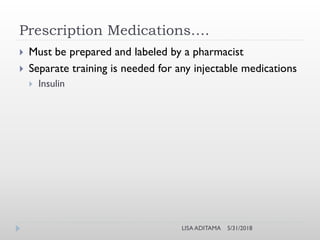
Prescription Medications….
 Must be prepared and labeled by a pharmacist
 Separate training is needed for any injectable medications
 Insulin
5/31/2018LISA ADITAMA
A Little More on Prescriptions
 Written Instruction from a physician (prescription label
will meet this requirement)
 Original Pharmacy container
 Verbal doctors orders can only be taken by a licensed
nurse
5/31/2018LISA ADITAMA
Giving Medications: Five Rights
 Right Patiens
 Right Medication
 Right Dose
 Right Time
 Right Route
General Principles of labelling
59
9. Pharmaceutical Expiration Dates,
Http://www.amaassn/.org/ama/pub/category.html
10. Guidance Expiration Dating of Unit-Dose Repackaged Unit:
Compliance Policy Guide,
http://www.fda.gov/cder/guidance/index.html
11. The United States Pharmacopoeia
12. Clark,T.R., 2002, Beyond Use Dating Of Repackaged Oral Solid,
www.ASCP.com
13. Kupiec,T., 2003,Analitycal Research Laboratories, www.arlok.com
14. A To Z Drugs Facts Comparissons
15. Drug information handbook
16. Langley C, Belcher D, 2008, Pharmaceutical Compounding &
Dispensing

1 3-compounding and dispensing

  • 1.
  • 2.
    Description  Compounding &Dispensing :  The practice of Pharmacists regarding the process of compounding and drug delivery  Good Pharmacy Practice as a Standard  Pharmaceutical Care  Extemporaneous dispensing  Prescription Handling  Specific aspects in the practice of compounding & dispensing such:  Prescription screening and address administrative, clinical and farmasetis  Dose Calculation  Labelling and determination of Beyond-use date  Medication error : Prevention and how to overcome it  Dosage Form and Patient specific drug delivery system
  • 3.
    Objective:  Understand therole of compounding Pharmacists dispensing & in practice  Able to resolve problems of making preparations-specific preparations  Applying the techniques of solving problems related to the administrative aspects, and clinical farmasetis in the giving of drugs on patients  Apply the dose determination based on the patient's condition, the disease and the presence of drug interactions  Apply the determination of beyond-use date of drugs given to patients  Towards a rational treatment
  • 4.
    Background:  Pharmaceutical care Patient oriented  Comprehensive services → improve quality of life of the patients Assessment Care Plan Follow-up Evaluation Patient Care Process Pharmacotherapy Workup Practitioner Medication Experience Patient Therapeutic Relationship Philosophy of Practice Social Obligation Responsibilities Patient-centered approach Caring Today’s wants and needs Responsibilities
  • 5.
    5 Uniqueness of PharmaceuticalCare Traditional Pharmacy Clinical Pharmacy Pharmaceutical Care Primary focus Prescription order Physicians or other Patient or OTC request health professionals Continuity Upon demand Discontinuous Continuous Strategy Obey Find fault or prevention Anticipate or improve Orientation Drug product Process Outcomes
  • 6.
    6 Why is therea new concept and whether it's Pharmaceutical Care?
  • 7.
    7 1960---------------1990  An explosionof drug  961: 656 type 1999: 8000 type  1971: 140,000 deaths & 1 million treated  20% of care due to medication errors  50% actually can be avoided  45-65% of patients using drugs not in accordance with the advice of the prescribers
  • 8.
    8  Danger andrisk can arise as a result of how drugs are used, not because of its chemical composition  Most of the problems are not inherent to the cure, but in the way drugs are Prescribed: tsb  And Fresh  Used/consumed
  • 9.
    9  Facts (1) A fifth of in-patients undergoing drug therapy problems even in the most advanced medical institutions  76 billion dollar (US)  The patient's suffering?  Brigham and women's Hospital:  6.5% non-obstetric patients suffered an adverse drug event (30% serius)
  • 10.
    10  Other studies: Due to medication error LOS (Length of Stay) rose 5 days, it costs $ 6,000 increase $ 3 million/yearBedell 1991:  64% of cardiac arrest at a teaching hospital because of drug use.  Other studies:  Medication Errors occurred on average 10-20% (although not all serious)
  • 11.
  • 12.
    12 Faceless service  apractice one patient at a time
  • 13.
    13 Pharmaceutical care  Isthe direct responsible provision of medication related care for the purpose of achieving definit outcomes that improve patient’s quality of life (ASHP)  Is a Practice in which the Practitioner takes Responsibility for a patient’s drug related needs, and is held Accountable for this Commitment (Strand)
  • 14.
    14 Responsibility  The fundamentalrelationship of patient care  Trust and authority licensed  Commitment & competency  Responsibility (documentation)  Ensure that there was an indication for every item of drug therapy  Any drug used was the most effective & safest & that the patient was compliant
  • 15.
    15 Medication Related  Drugtherapy  The decisions of the  Drug usage  Consideration of the selection of doses, routes, methods  Therapeutic drug monitoring  Granting of the information  Provision of counseling  MedicationTherapy Management
  • 16.
    16 Care  The focusof care is the care ofWorking together with other health staff in the:  Designing  Implement  Monitoring of the therapeutic plan  That improvement of patient's quality of life is for sure
  • 17.
     Relationships individuallyLicensed must be:  Profesional  Personal  Commitment  Mutual respect  Honestly  Open communication  Cooperation  Empathy  Sensitivity  Promotion of patient independence  Seeing the patient as a person
  • 18.
    18  Patience, understanding, attention,trust,comfort, confidence, responsible, accountable, competence  Putting the patient first  Offering reassurance, advocacy  Supporting the patient
  • 19.
    19 Outcomes  The assuranceof improved quality of life  Cure disease  Elimination, reduction of symptoms  Termination/slowing the disease process  To achieve results  Identification Of DRP (Drug Related Problem)  Solve actual DRP  Prevent potential DRP
  • 20.
    20 Quality of Life A comprehensive assessment of the quality of life  Objective assessment  Subjective assessment  Patients get involved
  • 21.
    21 BASIC SEVEN 7 elementsin Pharmaceutical Care 1. Review all medications 2. Connect vs drug indication 3. DRP 4. Figured out, barring DRP 5. Care plan 6. Follow up/ monitor 7. Documentation
  • 22.
    Good Pharmacy Practice Standardsfor Quality of Pharmacy Services : Recommendation against the required standard in ensuring quality/quality of service kefarmasian
  • 23.
    23 Good Pharmacy Practice Why GPP?  Aspects of legal competency, and ethics in practice  Control of the regulation  Rational use of drugs  Treatment of high quality,safe and cost-effective  Optimise patient outcomes  System and Infrastructure Support
  • 24.
    24 Good Pharmacy Practice Standard that is used to:  Health promotion  Provision of medicines and health equipment  Patient self care  Prescribing and drug use
  • 25.
    25 Contoh elemen GPPdalam : Pelayanan Obat Resep  Medication records  Kompetensi dari Personil yang terlibat dalam Dispensing  Sumber pengadaan sediaan farmasi  Penyimpanan dan mutu sediaan farmasi  Penyiapan dan penjaminan mutu sediaan – sediaan yang diracik  Advis tertulis dan penyampaian secara lisan  Patient follow up and monitoring  Documentation of professional activities  Disposal/ pemusnahan
  • 26.
    26 Contoh elemen GPPdalam : Influencing prescribing and medicines use  Formularies and treatment guidelines  Generic substitution  Evaluation of use of medicines  Adherence support  Assessment of drug promotion materials  Medicines information sources  Reporting of adverse effects, errors, defects in medicine quality, counterfeits
  • 27.
  • 32.
    When a prescriptionis received for an extemporaneous product, there are a number of considerations to be prior to dispensing. 1. Use of the product 2. Is it safe and suitable for the intended purpose? 3. Calculation of formula for preparation 4. Method of preparation 1. Solubility when applicable 2. Vehicle/ diluent 3. Preservative 4. Flavouring when appropriate
  • 33.
    5. Choice ofcontainer 6. Labelling considerations  Title  Quantitative particulars  Product specific cautions (additional labelling requirements)  Directions to patient – interpretation of Latin abbreviations when necessary  Recommended BNF cautions when suitable  Discard date  Sample label 7. Advice to patient
  • 34.
    Extemporaneous Preparation  Suatuproduk dapat diformulasikan secara extemporaneous hanya jika tidak ada produk sesuai dengan dikehendaki yang beredar di pasaran  Example: Captopril syrup Captopril powder (puyer) Omeprazole for NG administration
  • 37.
     An awfullot of events in the field of enteric tablet preparations with a salute also crushed.  Please note that the material of a tablet that was overlaid with a particular purpose such as that controlled drug release, or that the drug is not damaged by stomach acid and can be diabsorpsi in the intestine.  Mixing antibiotics (e.g. amoxicillin) and drugs NSAIDS (e.g. paracetamol, ibuprofen, mefenamic acid, etc) in the form of a preparation headache is not ideal because the prescribing of antibiotics is a drug taken to run out while the NSAID drugs are medicines that are taken only when necessary.  We need to know that antibiotics such as amoxicillin should not be crushed because it can cause shock anafilaktik that can endanger the patient or the officer making the drug.  The real headache-making sometimes don't pay attention to hygiene, humidity of the room, the room temperature, the use of tools that are not clean, compounding preparations headache while joking, chatting-chat and the don't m. ..
  • 38.
     Mixing severalkinds of drugs in dosage form of headache without considering the possibility of interactions between the drugs that affect the interaction of both farmokinetika as well as farmakodinamik drug.  No need denying also that the condition of our society actually need these supplies, headache because it still has a number of advantages and advantages: easy to dose adjustment according to the age and weight of the patient.  Still at least drug preparations that are specific to children so that should be made in the form of headache preparations.  Treatment costs become cheaper.  Preparations can help and ease the headache patient kids who have difficulty taking the medication in the form of preparations in tablets.
  • 49.
    5/31/2018LISA ADITAMA Prescription Medications ONLY CERTAIN PEOPLE CAN WRITE A PRESCRIPTION:  Doctor of Medicine or osteopathy  Nurse Practitioner  Dentist  Optometrist  Naturopathic physician
  • 50.
    5/31/2018LISA ADITAMA Prescription Medications…. Must be prepared and labeled by a pharmacist  Separate training is needed for any injectable medications  Insulin
  • 51.
    5/31/2018LISA ADITAMA A LittleMore on Prescriptions  Written Instruction from a physician (prescription label will meet this requirement)  Original Pharmacy container  Verbal doctors orders can only be taken by a licensed nurse
  • 52.
    5/31/2018LISA ADITAMA Giving Medications:Five Rights  Right Patiens  Right Medication  Right Dose  Right Time  Right Route
  • 53.
  • 59.
    59 9. Pharmaceutical ExpirationDates, Http://www.amaassn/.org/ama/pub/category.html 10. Guidance Expiration Dating of Unit-Dose Repackaged Unit: Compliance Policy Guide, http://www.fda.gov/cder/guidance/index.html 11. The United States Pharmacopoeia 12. Clark,T.R., 2002, Beyond Use Dating Of Repackaged Oral Solid, www.ASCP.com 13. Kupiec,T., 2003,Analitycal Research Laboratories, www.arlok.com 14. A To Z Drugs Facts Comparissons 15. Drug information handbook 16. Langley C, Belcher D, 2008, Pharmaceutical Compounding & Dispensing