Pharmacy Practice
for
Pharmaceutical Compounding
Dr. L.T.M. Muungo
Drugs
Dose Forms
and
Delivery Systems
Topics
• Pharmaceuticals
• Sources of Drugs
• Uses of Drugs
• Comparison of Dose Forms and Delivery
Systems
• Solid Dose Forms
• Liquid Dose Forms
• Inhalation Dose Forms
• Delivery Systems
• Drug References
Learning Objectives
• Define the term drug and distinguish between over-the-
counter and legend drugs
• Explain the parts of a National Drug Code number
• Categorize drugs by source as natural, synthetic,
synthesized, or semi-synthetic
• Explain the uses of drugs as therapeutic,
Pharmacodynamics, diagnostic, prophylactic, and
destructive agents
Learning Objectives
• Define and differentiate between the terms dose form
and delivery system
• Enumerate and explain the properties and identify
advantages and disadvantages of the major dose forms
and delivery systems for drugs
• Identify the function of various reference texts
commonly used in pharmacy
Pharmaceuticals
• A drug is any substance taken into or applied to
the body for the purpose of altering the body’s
biochemical functions and thus its physiological
processes
– a medical substance or remedy used to change the way
a living organism functions
– also called a medication
Pharmaceuticals
Drugs products contain many components:
• an active ingredient is the biochemically reactive
component of the drug
• inert ingredients or inactive ingredients have little or no
physiological effect
– stabilize the tablet or liquid formulation
– provide the raw material for many topical creams and
ointments
– ensure sterility of injectable products
– assist in the masking of unpleasant tasting medications for
pediatric patients
National Drug Code (NDC)
• A National Drug Code (NDC) number is a unique
number assigned to a product
– identifies the manufacturer, drug, packaging size, and type
– appears on all drug labels
• Contains ten characters
– four or five digit labeler code, identifying the manufacturer
or distributor of the drug
– a three- or four- digit product code, identifying the drug
(active ingredient and its dose form)
– a two-digit package code
National Drug Code (NDC)
• NDC bar code numbers are used
– for drug recalls
– to compare medications dispensed in the filling process to
minimize medication errors
Parts of a National Drug Code
(NDC) Number
Visit the NDC Directory
Classes of Drugs
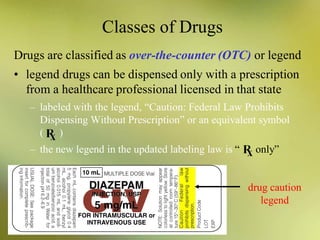
Drugs are classified as over-the-counter (OTC) or legend
• legend drugs can be dispensed only with a prescription
from a healthcare professional licensed in that state
– labeled with the legend, “Caution: Federal Law Prohibits
Dispensing Without Prescription” or an equivalent symbol
( )
– the new legend in the updated labeling law is “ only”
drug caution
legend
Classes of Drugs
• Drugs with potential for abuse are classified
according to five drug schedules based on the
potential for abuse and physical and psychological
dependence
– Schedule II drugs such as narcotics and amphetamines
have a high potential for abuse and dependence
– Schedule V cough syrups have a low potential for
abuse and limited potential for creating physical or
psychological dependence
Classes of Drugs
• Over-the-counter drugs can be dispensed without a
prescription
– proven relatively safe to be sold without prescription
• OTC drug labels
– must contain all the information necessary for a consumer
to safely take the medication
Learn more about the Drug Facts label at the Consumer Healthcare
Products Association Web site
Classes of Drugs
• Diet supplements, especially herbs, should be
considered drugs
– can cause side effects, adverse reactions, and drug
interactions
• Do not have the same stringent controls as legend
and OTC medications
Learn more about independent testing of diet supplements by
visiting ConsumerLab’s Web site
Classes of Drugs
• Diet supplements are considered “food
supplements” to maintain health
– a patient should not exceed the recommended daily
dose without the knowledge of a physician
– the pharmacy technician can assist the pharmacist by
gathering information on patient use of diet
supplements and adding this data to the computer
profile
Classes of Drugs
• Homeopathic medications are very small
dilutions of natural drugs claimed to stimulate the
immune system
• Homeopathy is derived from the Greek words
homos (i.e., similar) and pathos (i.e., suffering or
disease)
Classes of Drugs
• Most homeopathics are OTC, but some
are prescription only.
Discussion
What are the differences between the
various classes of pharmaceuticals?
Can this system be directly compared to the
Zambian drug classification?
Discussion
What are the differences between the
various classes of pharmaceuticals?
Answer: OTCs same as Zambian, may be
purchased without prescriptions while legend
drugs that are equivalent to POMs require a
prescription from an authorized practitioner;
controlled substances compared to CDs, have
abuse potential, and homeopathic medications
are natural extracts, usually OTC.
• drug
• active ingredient
• inert ingredient
• National Drug Code (NDC)
• over-the-counter (OTC)
• homeopathic medications
Terms to Remember
Sources of Drugs
• Drugs come from various sources
• Can be classified as:
– natural
– synthetic (created artificially)
– synthesized (created artificially but in imitation of
naturally occurring substances)
– semisynthetic (containing both natural and synthetic
components)
Drugs from Natural Sources
• Some drugs are naturally occurring biological
products
– made or taken from single-celled organisms, plants,
animals, and humans
• Many herbal products come from
natural sources
• Modern-day drugs from natural sources
include:
– penicillin (extracted from certain molds)
– acetylsalicylic acid, commonly known as
aspirin, is derived from the bark of the
white willow tree
• A synthesized drug is a drug that is created
artificially
• A synthetic drug is a drug that is created
artificially in imitation of naturally occurring
substances
– to exert a specific pharmacologic effect
• A semisynthetic drug is a drug that is created
artificially and contains both natural and synthetic
components
Synthetic, Synthesized, and
Semisynthetic Drugs
Synthetic, Synthesized, and
Semisynthetic Drugs
• Biotechnology combines the science of biology,
chemistry, and immunology to produce synthetic,
unique drugs with specific therapeutic effects
• These drugs can be created by means of the
recombinant deoxyribonucleic acid
(recombinant DNA) techniques of genetic
engineering
– using living organisms or parts of organisms for
specific purposes such as creating a synthetic drug
Synthetic, Synthesized, and
Semisynthetic Drugs
• Deoxyribonucleic acid (DNA) is the complex,
helically shaped molecule that carries the genetic
code
• Contains the instructions, or recipe, for creating
messenger ribonucleic acid (mRNA)
– mRNA contains the recipe for arranging amino acids into
proteins for living organisms
• By transferring a segment of recombined DNA into a
host cell, scientists can change what proteins the cell
produces
Modeling DNA
(a) A single nucleotide.
(b) A short section of a DNA molecule consisting of two rows of
nucleotides connected by weak bonds between the bases
adenine (A) and thymine (T), guanine (G), and cytosine (C).
(c) Long strands of DNA twisted to form a double helix.
Synthetic, Synthesized, and
Semisynthetic Drugs
• Antibodies are a part of the immune system to neutralize
antigens or foreign substances in the body
• Monoclonal antibodies are pure antibodies produced in
a laboratory against a known specific antigen
– can be used to attack tumors and to diagnose a great variety of
conditions
• Genetic engineering is the hybridization techniques for
creating MAbs
• The Human Genome Project is the mapping of the
biochemical instructions that make up the human
body in health and disease
– potential disease can be identified at an earlier date, and
new treatments can be specifically designed to treat
them
Synthetic, Synthesized, and
Semisynthetic Drugs
Learn more about the Human Genome Project
Discussion
Give examples of drugs from various
sources.
Discussion
Give examples of drugs from various
sources.
Answer: Drugs may come from natural
sources (quinine from cinchona bark), may be
synthetic (barbiturates), or may be
semisynthetic (semisynthetic penicillins), or
may result from biotechnology (human
insulin).
Terms to Remember
• synthesized drug
• synthetic drug
• semisynthetic drug
• biotechnology
• recombinant
deoxyribonucleic acid
(recombinant DNA)
• deoxyribonucleic acid
(DNA)
• ribonucleic acid
(mRNA)
• antibodies
• monoclonal
antibodies
• genetic engineering
Uses of Drugs
• Medications are used to:
– treat and cure illness
– aid in diagnosis
– prevent illnesses
• The action of a medication cannot be fully
accounted for without considering the dose form
selected
Therapeutic Agents
• A therapeutic agent is any drug that helps to:
– maintain health
– relieve symptoms
– combat illness
– reverse disease processes
Pharmacodynamic Agents
• A pharmacodynamic agent is one that alters
bodily functioning in a desired way
– stimulate or relax muscles
– dilate or constrict pupils
– increase or decrease blood sugar
Diagnostic Agents
• A diagnostic agent facilitates an examination or
conclusion as to the nature or extent of a disease
condition
• Radiopharmaceuticals are chemicals containing
radioactive isotopes, used diagnostically (and also
therapeutically)
– nuclear pharmacy is the procuring, storage, compounding,
dispensing, and provision of information about
radiopharmaceuticals
Get more information on nuclear pharmacy technician training
programs at the American Pharmacists Association Web page
Prophylactic Agents
• A prophylactic agent prevents illness or disease
from occurring
– antiseptic
– germicidal liquid iodine
– any vaccine is considered a prophylactic agent
Destructive Agents
• A destructive agent has a -cidal action, meaning it kills
bacteria, fungi, viruses, or even normal cells or
abnormal cancer cells
– many antibiotics are bactericidal (they kill bacteria)
– radioactive iodine is used to destroy some of the thyroid gland
in patients with hyperthyroidism
– antineoplastic drugs used in cancer chemotherapy to destroy
malignant tumors
Discussion
Give examples of the various uses of drugs.
Discussion
Give examples of the various uses of drugs.
Answer: Drugs may be used to maintain
health (aspirin to prevent heart attack), to
relieve symptoms (analgesics), combat illness
(antibiotics), or reverse disease processes
(antihypertensive).
• therapeutic agent
• pharmacodynamic agent
• diagnostic agent
• radiopharmaceuticals
• prophylactic agent
• destructive agent
• antineoplastic drug
Terms to Remember
Comparison of Dose Forms and
Delivery Systems
• Dose form refers to the physical manifestation of a drug
as a solid, liquid, or gas that can be used in a particular
way
– common dose forms include tablets, capsules, creams,
ointments, solutions, injections, and aerosols
• Delivery system may mean any of the following:
– device used to deliver the drug
– design feature of the dose form that affects the delivery of the
drug
– means for transporting a drug to its site(s) of action within the
body
Comparison of Dose Forms and Delivery
Systems
• Delivery systems differ in pharmacological properties
– sites of action
– rate of delivery
– quantities of active ingredient delivered
• Choice of delivery system depends on
– active ingredient to be delivered
– amount of active ingredient to be delivered
– means or route by which ingredient is to be delivered
– to what sites, at what rate, over what period of time, for what
purpose
• dose form
• delivery system
Terms to Remember
Solid Dose Forms
• used more frequently than any other form
• are safest for self-administration
Tablets
• A tablet is a solid dose form produced by compression
containing one or more active ingredients and,
commonly, other pharmacological ingredients
including:
– diluents
– binders (promote adhesion of materials in tablet)
– lubricating agents (give a sheen and aid in manufacturing
process)
– disintegrates (help break up ingredients)
– solubilizers, colorings, flavorings
Tablets
• Some tablets are scored once
or twice to facilitate breaking
into portions for half or even
quarter doses
• Unscored tablets should not be
broken because the dose may not be equal in each
piece
– a tablet-splitter may be used for some unscored tablets
– odd-shaped tablets are often difficult to cut, even with a
tablet splitter
Tablets
• Careful tablet splitting may be a way to reduce
medication costs, but it is not recommended for all
drugs
• Patients must be warned not to take a full tablet if such
action would result in an overdose of medication
Tablets
• Compression tablets are the most inexpensive and
common dose form
• Multiple compression tablets (MCTs) are
produced by multiple compressions
– created for appearance alone, to combine incompatible
substances into a single medication, or to provide for
controlled release in successive events, or stages
(a) Two layers or compressions
(b) Three layers or compressions
Tablets
• A caplet is an oblong tablet that is a hybrid of the
capsule and tablet
– offers the advantage of easier swallowing than a large
tablet and more stability (and longer shelf life) than a
capsule
• Most tablets are uncoated
• A coating is a special outside layer that dissolves
or ruptures at the site of application
• Formulated to
– mask bitter taste
– prevent drug destruction in stomach
– delay release of drug into the intestines
Tablets
• Sugar-coated tablets (SCTs) contain an outside
layer of sugar
– protects the medication
– improves appearance and flavor
– BUT makes tablets much larger and heavier and more
difficult to swallow
• Film-coated tablets (FCTs) contain a thin outer
layer of a polymer
– thinner, lighter in weight, and cheaper to manufacture
than sugar coatings
– colored to provide an attractive appearance
Tablets
• Enteric-coated tablets (ECTs) are designed to resist
destruction by acid of gastric fluids
– release the active ingredient once it reaches the higher pH
of the intestine
• ECTs are used for drugs that are:
– destroyed by gastric acid
– irritating to the esophageal tract or stomach
– better absorbed by the intestines
Tablets
Enteric-coated tablets (ECTs) should not be
split.
Tablets
• A controlled-release medication is designed to
regulate the rate at which a drug is released from
the tablet and into the body
• May vary the rate of dissolution or the release of
the active drug
Tablets
Controlled-release dose forms should not be
split.
Controlled-release Medications
• A delayed-release dose form does not release the active
drug immediately after administration
• An extended-release dose form allows reduced
frequency of dosing
– also called long-acting, timed-release, and sustained-release
dose forms
• A transdermal system dose form is designed to deliver
drugs to systemic circulation by passage through the skin
– similar to how the extended-release tablets act by passage
through the stomach and/or small intestine
Controlled-release Medications
Watch the drug labels very carefully! Delayed-
release medication is not the same as extended- or
controlled-release medication of the same drug!
Other Tablet Types
• Chewable tablets have a flavored and/or colored base
– designed to be masticated (chewed)
• Effervescent tablets are granular salts that release gas
– dispense active ingredients into solution when placed in
water or juice
• Buccal tablets (and gum) are placed in the buccal
pouch
– between the cheek and the gum
– dissolved and absorbed by the buccal mucosa
Other Tablet Types
• Sublingual tablets are designed to be dissolved under
the tongue
– medication dissolved under the tongue is absorbed very
quickly
– immediately enters the bloodstream
• Vaginal tablets (or inserts) are placed into the vagina
– by means of an applicator
– dissolved and absorbed through the vaginal mucosa
Capsules
• A capsule is a solid dose form consisting of a
gelatin shell that encloses the drug
– usually swallowed whole
– tasteless and are easier to swallow than tablets
• Contains powders, granules, liquids, or some
combination with one or more active ingredients
• Since a capsule is enclosed, flavorings are not
common for this dose form
Capsules
• Can be designed in a controlled-release dose form
• Controlled-release capsules are taken less often
– increases compliance
• Long-acting form may give better control over the
disease state
– may be initially more expensive
– but fewer need to be purchased
• Takes a longer time for side effects to subside
Suppositories
• A suppository is a solid dose forms designed for
insertion into body orifices
– rectum or the vagina or, less commonly, the urethra
• May be the preferred dose form in
some cases when patient has nausea
and vomiting
• Avoided when possible because of
patient discomfort
Suppositories
The patient must remove the foil before inserting
the suppository!
Effervescent Salts
• Effervescent salts are granules or coarse powders
containing one or more medicinal agents
– contains some combination of sodium bicarbonate with
citric acid, tartaric acid, or sodium biphosphate
• Release carbon dioxide gas when dissolved
– causes a distinctive bubbling
Implants or Pellets
• Implants, or pellets, are dose forms placed under
the skin by means of minor surgery
• Used for long-term, controlled release of
medications
• Advantages include enhanced patient compliance
and convenience
• Complications at the site of insertion have limited
widespread use
Lozenges, Troches, or Pastilles
• Lozenges are dose forms containing active
ingredients and flavorings that are dissolved in the
mouth
– also known as troches or pastilles
– generally have local effects
Plasters
• Plasters are solid or semisolid and medicated or
nonmedicated preparations that adhere to the body
– contain backing material such as paper, cotton, linen,
silk, moleskin, or plastic
Powders and Granules
• Usually ordered in bulk, dispensed as needed in the
prescribed amount
• Granules are larger than powders
– formed by adding very small amounts of liquid to powders and
passing the mixture through a screen or a granulating device
• Granules
– are generally of irregular shape
– have excellent flow characteristics
– are more stable than powders
– may contain colorings, flavorings, and coatings
– may have controlled-release characteristics
Discussion
What factors may influence the choice of a
dosage form for a drug?
Discussion
What factors may influence the choice of a
dosage form for a drug?
Answer: Choice of dosage form may be
influenced by release properties, drug stability,
or route of administration.
Terms to Remember
• tablet
• controlled-release
medication
• capsule
• suppository
• effervescent salt
• implants
• lozenges
• plasters
Liquid Dose Forms
• Liquid dose forms consist of one or more active
ingredients in a liquid vehicle
• Two major categories are:
– solutions, in which active ingredients are dissolved in
the liquid vehicle
– dispersions, in which undissolved ingredients are
dispersed throughout a liquid vehicle
Liquid Dose Forms
• Advantages over solid dose forms are:
– ease of swallowing
– ease of adjusting the dose
– tablets or capsules cannot always be divided
• Disadvantage is:
– less stable than their solid counterparts
Liquid Dose Forms
Care should be taken to monitor storage
conditions of the liquid dose forms, to rotate
stock, and to check expiration dates often.
Solutions
• Solutions are classified by vehicle as:
– aqueous (water based)
– alcoholic (alcohol based)
– hydroalcoholic (water and alcohol based)
• A solvent is the vehicle that makes up the greater
part of a solution
• A solute is an ingredient dissolved in a solution
Solutions
• An enema is usually a water-based solution
administered rectally for cleansing the bowel or
delivering active drug
• A collodion is a vehicle that is a volatile liquid
dissolved in a mixture of alcohol and ether and used
for a variety of topical uses
– upon application to skin, the solvent vaporizes, leaving a
film coating containing medication
Solutions
• Aromatic water is a solution of water containing
volatile oils or other substances
• An elixir is a clear, sweetened, flavored
hydroalcoholic solution containing water and ethanol
• A syrup is an aqueous solution thickened with a large
amount of sugar or a sugar substitute
– may contain additional flavorings, colors, or aromatic
agents
– often the preferred vehicle to mask the taste for pediatric
medications
Solutions
• An extract is a potent dose form derived from animal
or plant sources
– from which most or all the solvent has been evaporated
– used in the formulation or compounding of medications
• A fluidextract is a liquid dose form prepared by
extraction from plant sources
• A tincture is an alcoholic or hydroalcoholic solution
of extractions from plants
• Spirits are alcoholic or hydroalcoholic solutions
containing volatile, aromatic ingredients
Solutions
A low-alcohol or alcohol-free product is
preferred for most pediatric products.
Solutions
• Parenteral solutions are products that are prepared
in a sterile environment for administration by
injection
• Two major delivery systems exist:
– intravenous (IV) infusions: fluids administered directly
into a vein
– injections
• intravenous (IV) – into a vein
• intramuscular (IM) – into the muscle
• subcutaneous (SQ or SC) – under the skin
• intradermal (ID) – into the skin
Dispersions
• Dispersions are undissolved ingredients mixed
throughout a liquid vehicle
– Classified by size of the dispersed ingredient(s) into
suspensions and emulsions containing:
• relatively large particles
• magmas, gels, and jellies (contain fine particles)
• ultrafines particles, less than a micron in size, called a
colloidal dispersion
• A suspension is a dispersion of a solid in a liquid
• An emulsion is a dispersion of a liquid in another
liquid
Dispersions
• Solutions are classified by route of administration
– oral (taken by mouth)
– topical (lotions applied to the skin)
– injectable suspensions
• Emulsions vary in their viscosity, or rate of flow.
Some common types are:
– oil-in-water (O/W) emulsion: emulsion containing a
small amount of oil dispersed in water
– water-in-oil (W/O) emulsion: emulsion containing a
small amount of water dispersed in an oil
Suspensions
Suspensions should always include a “Shake
Well” label.
Dispersions
• A lotion is a liquid for topical application containing
insoluble dispersed solids or immiscible liquids
• A gel is a dispersion containing fine particles for
topical use on the skin
– particles are ultrafine
– colloidal dimensions
– linked to form a semisolid
Dispersions
• An ointment is a semisolid emulsion for topical
application
• May be medicated or nonmedicated and may contain
various bases:
– oleaginous or greasy bases such as petroleum jelly
– W/O emulsions such as lanolin
– O/W emulsions such as hydrophilic
ointment
– water-soluble or greaseless bases
such as polyethylene glycol ointment
Dispersions
• Pastes are like ointments but contain more solid
materials and are stiffer and apply more thickly
– Zinc oxide paste
– Acetonide dental paste
• Creams are considered O/W emulsions. Apply
smoothly to the skin and leave a very thin film.
Most creams are considered vanishing.
Discussion
Why do the differences between solutions and
dispersions have advantages in pharmaceutical
practice?
Discussion
Why do the differences between solutions and
dispersions have advantages in pharmaceutical
practice?
Answer: Solutions do not require shaking, but are
only appropriate for particles that dissolve in
suitable vehicles. Some dispersions have a thicker
consistency that is an advantage for topical use.
• solution
• dispersion
• solvent
• solute
• parenteral solution
• suspension
• emulsion
• oil-in-water (O/W)
emulsion
• water-in-oil (W/O)
emulsion
• ointment
• paste
Terms to Remember
Inhalation Dose Forms
• Inhalations are gases, vapors, solutions, or suspensions
intended to be inhaled via the nasal or oral respiratory
routes
• A spray consists of a container with a valve assembly
that, when activated, emits a fine dispersion of liquid,
solid, or gaseous material
– an aerosol is a spray in a pressurized container with a
propellant to carry the active ingredient to its location of
application
– breath-activated devices of powders in place of aerosolized
propellants
• Most sprays and aerosols are for
– topical application to skin or to oral mucous membranes
– inhalation aerosols breathed in through the nose or mouth
Terms to Remember
• inhalation
• spray
Discussion
What are some of the uses for inhalation
dose forms?
Discussion
What are some of the uses for inhalation
dose forms?
Answer: Sprays and aerosols are often used for
nasal decongestants and for inhalation of
antiasthmatic drugs. Many anti-inflammatory
medications are available both as a nasal spray
for allergies and as an aerosol for inhalation for
asthma.
Delivery Systems
• A delivery system may be
– a device used to deliver the drug
– a design feature of the dose form that affects the
delivery of the drug
– how a medication is formulated to release the active
ingredient
Inhalation Delivery Systems
• One of the most rapid means of administering
medication
• Gases such as oxygen, nitrous oxide or “laughing gas,”
and ether are administered by inhalation
• Medicated inhalations intended for the lung are
administered via
– metered-dose inhalers (MDIs)
• hand held, breath-activated, propellant-driven inhalers
– nebulizers
– vaporizers and humidifiers
• mechanical devices which deliver moisture to the air
Inhalation Delivery Systems
• A nebulizer is a device used to deliver medication in a
fine-mist form to the lung
– deliver a mist containing extremely small, or micronized,
powder
– a “nebulized” mist of medication may be more effective
than an “aerosolized” spray in delivering medications into
the deeper areas of the lung in
infants and young children
Syringe, Injection, and Infusion
Delivery Systems
• Injections of medications act rapidly to control
and treat symptoms
• Syringes are calibrated devices used to accurately
draw up, measure, and deliver medication through
a needle
• Injections must be sterile because they introduce
medication directly into the body
Syringe, Injection, and Infusion
Delivery Systems
Only trained professionals and healthcare
providers should give injections, and some risk
to the patient is always present.
Syringe, Injection, and Infusion
Delivery Systems
• Glass syringes are fairly expensive
• Plastic syringes are easy to handle, disposable, and
come from the manufacturer in sterile packaging
– clearly preferred
– used both within and outside the hospital setting
• Different states have different regulations on the
sale of syringes
– potential diversion for injection of illegal drugs
– some states may require a prescription or the placement
of syringes behind the prescription counter to control
their sales
Syringe, Injection, and Infusion
Delivery Systems
insulin syringe
(measures from 30
to 100 U)
tuberculin syringe (with
cannulas ranging from 0.01
mL to 1 mL [used for skin
tests and drawing up very
small volumes of solution])
standard
hypodermic
syringes in sizes
from 1mL to 60mL
Syringe, Injection, and Infusion
Delivery Systems
• Injections may be administered to almost any
organ or part of the body
• Injectables come prefilled or are filled at the time
of injection from single or multidose vials
– single-dose vials generally have no preservative
– multiple-dose vials, although they contain a
preservative, should be dated and discarded (usually
after thirty days)
– ampules are small glass containers that are opened by
breaking off the neck of the container
Syringe, Injection, and Infusion
Delivery Systems
Other devices for injection include:
• A patient-controlled analgesia
(PCA) infusion device used by a
patient to deliver small doses of
medication for chronic pain
• Jet injectors, which use pressure rather than a needle
to deliver the medication
• Ambulatory injection devices that the patient can
wear while moving about
Syringe, Injection, and Infusion
Delivery Systems
Only the patient should control the PCA pump
button.
Syringe, Injection, and Infusion
Delivery Systems
• Intravenous (IV) infusion
– method for delivering a large amount of fluid over a
prolonged period of time at a slow, steady rate
– used to deliver blood, water, other fluids, electrolytes,
nutrients
• IV infusions are used to:
– deliver pain-killing or blood clot buster medications
– replenish body fluids
– deliver nutrients to patients who cannot or will not feed
themselves
Intrauterine and Cervical Delivery
Systems
• An intrauterine delivery system is a way to deliver
medication to prevent conception or treat cancer
– drug-releasing device placed into the uterus
– may contain a progestin hormone to prevent pregnancy on
a long-term (1 to 5 years) basis
• Cervical delivery systems are placed as a ring
surrounding the cervix to slowly release medication
– replaced monthly by the patient and used as contraceptive
aids
Intrauterine and Cervical Delivery
Systems
Occasionally, the patient will expel these devices
spontaneously and may experience a high risk of
pelvic infection.
Transdermal Delivery Systems
• A transdermal delivery system (TDS) is a method for
delivering medications percutaneously (through the
skin)
• Also known as a “patch”
– consists of a backing, a drug reservoir, a control membrane,
an adhesive layer, and a protective strip
– the strip is removed, and the adhesive layer is attached to
the skin
Transdermal Delivery Systems
• Drug movement is by osmosis through the control
membrane, delivering medication systemically, rather
than locally
• Medication delivery can be controlled over 24 hours or
longer
– improves patient convenience and compliance
Other Delivery Systems
• Unit dose disposable syringes are prefilled syringes that
contain a single premeasured dose of medication and
are thrown away after use
• An oral syringe is a device without a needle to
administer medication to pediatric or elderly patients
unable to swallow tablets or capsules
– a calibrated device consisting of a plunger and a cannula, or
barrel
– used for administration of precisely measured amounts of
liquid medication by mouth
Other Delivery Systems
• A bulb syringe is a device used to irrigate eyes or ears
with water
– bulb is first depressed to expel the air that it contains, and the
tip is then inserted into the liquid to be administered
– bulb is released while the end is in the liquid, and liquid rises
to fill the vacuum created
– end of the bulb is then removed from the liquid, and the liquid
is administered by depressing the bulb again
Other Delivery Systems
• A dropper uses a bulb to create a vacuum for drawing
up a liquid
– contains a small, squeezable bulb at one end and a hollow
glass or plastic tube with a tapering point
– may be incorporated into the cap of a vial or other
container
• gtt is an abbreviation for unit of pharmaceutical
measurement for droppers and IV infusions to indicate
drops
– due to the differing viscosities of fluids, the size of a drop
varies considerably from medication to medication
• Droppers are often used for otic or ophthalmic
administration, as well as for oral medications
Other Delivery Systems
• Ocular inserts are a type of contact lens device with
active medication for administration in the eye
– small, transparent membranes
– placed between the eye and the lower conjunctiva
• Hospices and long-term care facilities use straws
(long, hollow tubes) prefilled with pain medications
• Another delivery system for contraceptives is the
polyurethane sponge
Discussion
What are some advantages of the specialized
medication delivery systems?
Discussion
What are some advantages of the specialized
medication delivery systems?
Answer: Delivery systems enable more efficient
delivery of medications to their sites of action,
greater convenience, and/or patient safety.
Terms to Remember
• nebulizer
• patient-controlled analgesia (PCA) infusion device
• intrauterine delivery system
• transdermal delivery system (TDS)
• oral syringe
• bulb syringe
• ocular insert
Drug References
1. Official legal standards for drugs in the U.S. are established by the United States Pharmacopeial Convention (USP)
2. Standards are published in two reference works
a. the United States Pharmacopeia
b. National Formulary (NF)
c. Both are revised every 5 years
d. also printed in a combined edition
3. United States Pharmacopeia–National Formulary (USP–NF
4. The Physician’s Desk Reference
a. published annually with reprints of package inserts from the pharmaceutical manufacturers of most drugs
b. useful for identifying unknown drugs by color, shape, and coding
5. USP Drug Information
a. originally published by USP
b. patient counseling information for the pharmacist
6. The American Hospital Formulary Service (AHFS)
a. information on drugs commonly used in the hospital
7. The Handbook of Nonprescription Drugs
a. published by the American Pharmacists Association
b. provides a good reference for OTC drugs
8. FDA Electronic Orange Book
a. officially named Approved Drug Products with Therapeutic Equivalence Evaluations
b. available online
c. information on generic equivalency of drugs that may have many sources
Drug References
1. Remington: The Science and Practice of Pharmacy
1. useful in compounding pharmacy for drug stability and compatibility information
2. The Lawrence Review of Natural Products
1. scientific monographs on herbal medications
3. Homeopathic Pharmacopeia of the United States
1. compilation of standards for the source, composition, and preparation of homeopathic medications
4. Drug Facts and Comparisons
a. factual information on:
 product availability
 indications
 administration and dose
 pharmacological actions
 contraindications
 warnings and precautions
 adverse reactions
 overdose and patient instructions
b. updated monthly with new inserts
c. available on CD-ROM
Any Questions
Discussion
• What drug references are available in your
practice or educational setting?
• Have you referred to them? For what kinds
of information?

1 2-pharmaceutical compounding

  • 1.
  • 2.
  • 3.
    Topics • Pharmaceuticals • Sourcesof Drugs • Uses of Drugs • Comparison of Dose Forms and Delivery Systems • Solid Dose Forms • Liquid Dose Forms • Inhalation Dose Forms • Delivery Systems • Drug References
  • 4.
    Learning Objectives • Definethe term drug and distinguish between over-the- counter and legend drugs • Explain the parts of a National Drug Code number • Categorize drugs by source as natural, synthetic, synthesized, or semi-synthetic • Explain the uses of drugs as therapeutic, Pharmacodynamics, diagnostic, prophylactic, and destructive agents
  • 5.
    Learning Objectives • Defineand differentiate between the terms dose form and delivery system • Enumerate and explain the properties and identify advantages and disadvantages of the major dose forms and delivery systems for drugs • Identify the function of various reference texts commonly used in pharmacy
  • 6.
    Pharmaceuticals • A drugis any substance taken into or applied to the body for the purpose of altering the body’s biochemical functions and thus its physiological processes – a medical substance or remedy used to change the way a living organism functions – also called a medication
  • 7.
    Pharmaceuticals Drugs products containmany components: • an active ingredient is the biochemically reactive component of the drug • inert ingredients or inactive ingredients have little or no physiological effect – stabilize the tablet or liquid formulation – provide the raw material for many topical creams and ointments – ensure sterility of injectable products – assist in the masking of unpleasant tasting medications for pediatric patients
  • 8.
    National Drug Code(NDC) • A National Drug Code (NDC) number is a unique number assigned to a product – identifies the manufacturer, drug, packaging size, and type – appears on all drug labels • Contains ten characters – four or five digit labeler code, identifying the manufacturer or distributor of the drug – a three- or four- digit product code, identifying the drug (active ingredient and its dose form) – a two-digit package code
  • 9.
    National Drug Code(NDC) • NDC bar code numbers are used – for drug recalls – to compare medications dispensed in the filling process to minimize medication errors
  • 10.
    Parts of aNational Drug Code (NDC) Number Visit the NDC Directory
  • 11.
    Classes of Drugs Drugsare classified as over-the-counter (OTC) or legend • legend drugs can be dispensed only with a prescription from a healthcare professional licensed in that state – labeled with the legend, “Caution: Federal Law Prohibits Dispensing Without Prescription” or an equivalent symbol ( ) – the new legend in the updated labeling law is “ only” drug caution legend
  • 12.
    Classes of Drugs •Drugs with potential for abuse are classified according to five drug schedules based on the potential for abuse and physical and psychological dependence – Schedule II drugs such as narcotics and amphetamines have a high potential for abuse and dependence – Schedule V cough syrups have a low potential for abuse and limited potential for creating physical or psychological dependence
  • 13.
    Classes of Drugs •Over-the-counter drugs can be dispensed without a prescription – proven relatively safe to be sold without prescription • OTC drug labels – must contain all the information necessary for a consumer to safely take the medication Learn more about the Drug Facts label at the Consumer Healthcare Products Association Web site
  • 14.
    Classes of Drugs •Diet supplements, especially herbs, should be considered drugs – can cause side effects, adverse reactions, and drug interactions • Do not have the same stringent controls as legend and OTC medications Learn more about independent testing of diet supplements by visiting ConsumerLab’s Web site
  • 15.
    Classes of Drugs •Diet supplements are considered “food supplements” to maintain health – a patient should not exceed the recommended daily dose without the knowledge of a physician – the pharmacy technician can assist the pharmacist by gathering information on patient use of diet supplements and adding this data to the computer profile
  • 16.
    Classes of Drugs •Homeopathic medications are very small dilutions of natural drugs claimed to stimulate the immune system • Homeopathy is derived from the Greek words homos (i.e., similar) and pathos (i.e., suffering or disease)
  • 17.
    Classes of Drugs •Most homeopathics are OTC, but some are prescription only.
  • 18.
    Discussion What are thedifferences between the various classes of pharmaceuticals? Can this system be directly compared to the Zambian drug classification?
  • 19.
    Discussion What are thedifferences between the various classes of pharmaceuticals? Answer: OTCs same as Zambian, may be purchased without prescriptions while legend drugs that are equivalent to POMs require a prescription from an authorized practitioner; controlled substances compared to CDs, have abuse potential, and homeopathic medications are natural extracts, usually OTC.
  • 20.
    • drug • activeingredient • inert ingredient • National Drug Code (NDC) • over-the-counter (OTC) • homeopathic medications Terms to Remember
  • 21.
    Sources of Drugs •Drugs come from various sources • Can be classified as: – natural – synthetic (created artificially) – synthesized (created artificially but in imitation of naturally occurring substances) – semisynthetic (containing both natural and synthetic components)
  • 22.
    Drugs from NaturalSources • Some drugs are naturally occurring biological products – made or taken from single-celled organisms, plants, animals, and humans • Many herbal products come from natural sources • Modern-day drugs from natural sources include: – penicillin (extracted from certain molds) – acetylsalicylic acid, commonly known as aspirin, is derived from the bark of the white willow tree
  • 23.
    • A synthesizeddrug is a drug that is created artificially • A synthetic drug is a drug that is created artificially in imitation of naturally occurring substances – to exert a specific pharmacologic effect • A semisynthetic drug is a drug that is created artificially and contains both natural and synthetic components Synthetic, Synthesized, and Semisynthetic Drugs
  • 24.
    Synthetic, Synthesized, and SemisyntheticDrugs • Biotechnology combines the science of biology, chemistry, and immunology to produce synthetic, unique drugs with specific therapeutic effects • These drugs can be created by means of the recombinant deoxyribonucleic acid (recombinant DNA) techniques of genetic engineering – using living organisms or parts of organisms for specific purposes such as creating a synthetic drug
  • 25.
    Synthetic, Synthesized, and SemisyntheticDrugs • Deoxyribonucleic acid (DNA) is the complex, helically shaped molecule that carries the genetic code • Contains the instructions, or recipe, for creating messenger ribonucleic acid (mRNA) – mRNA contains the recipe for arranging amino acids into proteins for living organisms • By transferring a segment of recombined DNA into a host cell, scientists can change what proteins the cell produces
  • 26.
    Modeling DNA (a) Asingle nucleotide. (b) A short section of a DNA molecule consisting of two rows of nucleotides connected by weak bonds between the bases adenine (A) and thymine (T), guanine (G), and cytosine (C). (c) Long strands of DNA twisted to form a double helix.
  • 27.
    Synthetic, Synthesized, and SemisyntheticDrugs • Antibodies are a part of the immune system to neutralize antigens or foreign substances in the body • Monoclonal antibodies are pure antibodies produced in a laboratory against a known specific antigen – can be used to attack tumors and to diagnose a great variety of conditions • Genetic engineering is the hybridization techniques for creating MAbs
  • 28.
    • The HumanGenome Project is the mapping of the biochemical instructions that make up the human body in health and disease – potential disease can be identified at an earlier date, and new treatments can be specifically designed to treat them Synthetic, Synthesized, and Semisynthetic Drugs Learn more about the Human Genome Project
  • 29.
    Discussion Give examples ofdrugs from various sources.
  • 30.
    Discussion Give examples ofdrugs from various sources. Answer: Drugs may come from natural sources (quinine from cinchona bark), may be synthetic (barbiturates), or may be semisynthetic (semisynthetic penicillins), or may result from biotechnology (human insulin).
  • 31.
    Terms to Remember •synthesized drug • synthetic drug • semisynthetic drug • biotechnology • recombinant deoxyribonucleic acid (recombinant DNA) • deoxyribonucleic acid (DNA) • ribonucleic acid (mRNA) • antibodies • monoclonal antibodies • genetic engineering
  • 32.
    Uses of Drugs •Medications are used to: – treat and cure illness – aid in diagnosis – prevent illnesses • The action of a medication cannot be fully accounted for without considering the dose form selected
  • 33.
    Therapeutic Agents • Atherapeutic agent is any drug that helps to: – maintain health – relieve symptoms – combat illness – reverse disease processes
  • 34.
    Pharmacodynamic Agents • Apharmacodynamic agent is one that alters bodily functioning in a desired way – stimulate or relax muscles – dilate or constrict pupils – increase or decrease blood sugar
  • 35.
    Diagnostic Agents • Adiagnostic agent facilitates an examination or conclusion as to the nature or extent of a disease condition • Radiopharmaceuticals are chemicals containing radioactive isotopes, used diagnostically (and also therapeutically) – nuclear pharmacy is the procuring, storage, compounding, dispensing, and provision of information about radiopharmaceuticals Get more information on nuclear pharmacy technician training programs at the American Pharmacists Association Web page
  • 36.
    Prophylactic Agents • Aprophylactic agent prevents illness or disease from occurring – antiseptic – germicidal liquid iodine – any vaccine is considered a prophylactic agent
  • 37.
    Destructive Agents • Adestructive agent has a -cidal action, meaning it kills bacteria, fungi, viruses, or even normal cells or abnormal cancer cells – many antibiotics are bactericidal (they kill bacteria) – radioactive iodine is used to destroy some of the thyroid gland in patients with hyperthyroidism – antineoplastic drugs used in cancer chemotherapy to destroy malignant tumors
  • 38.
    Discussion Give examples ofthe various uses of drugs.
  • 39.
    Discussion Give examples ofthe various uses of drugs. Answer: Drugs may be used to maintain health (aspirin to prevent heart attack), to relieve symptoms (analgesics), combat illness (antibiotics), or reverse disease processes (antihypertensive).
  • 40.
    • therapeutic agent •pharmacodynamic agent • diagnostic agent • radiopharmaceuticals • prophylactic agent • destructive agent • antineoplastic drug Terms to Remember
  • 41.
    Comparison of DoseForms and Delivery Systems • Dose form refers to the physical manifestation of a drug as a solid, liquid, or gas that can be used in a particular way – common dose forms include tablets, capsules, creams, ointments, solutions, injections, and aerosols • Delivery system may mean any of the following: – device used to deliver the drug – design feature of the dose form that affects the delivery of the drug – means for transporting a drug to its site(s) of action within the body
  • 42.
    Comparison of DoseForms and Delivery Systems • Delivery systems differ in pharmacological properties – sites of action – rate of delivery – quantities of active ingredient delivered • Choice of delivery system depends on – active ingredient to be delivered – amount of active ingredient to be delivered – means or route by which ingredient is to be delivered – to what sites, at what rate, over what period of time, for what purpose
  • 43.
    • dose form •delivery system Terms to Remember
  • 44.
    Solid Dose Forms •used more frequently than any other form • are safest for self-administration
  • 45.
    Tablets • A tabletis a solid dose form produced by compression containing one or more active ingredients and, commonly, other pharmacological ingredients including: – diluents – binders (promote adhesion of materials in tablet) – lubricating agents (give a sheen and aid in manufacturing process) – disintegrates (help break up ingredients) – solubilizers, colorings, flavorings
  • 46.
    Tablets • Some tabletsare scored once or twice to facilitate breaking into portions for half or even quarter doses • Unscored tablets should not be broken because the dose may not be equal in each piece – a tablet-splitter may be used for some unscored tablets – odd-shaped tablets are often difficult to cut, even with a tablet splitter
  • 47.
    Tablets • Careful tabletsplitting may be a way to reduce medication costs, but it is not recommended for all drugs • Patients must be warned not to take a full tablet if such action would result in an overdose of medication
  • 48.
    Tablets • Compression tabletsare the most inexpensive and common dose form • Multiple compression tablets (MCTs) are produced by multiple compressions – created for appearance alone, to combine incompatible substances into a single medication, or to provide for controlled release in successive events, or stages (a) Two layers or compressions (b) Three layers or compressions
  • 49.
    Tablets • A capletis an oblong tablet that is a hybrid of the capsule and tablet – offers the advantage of easier swallowing than a large tablet and more stability (and longer shelf life) than a capsule • Most tablets are uncoated • A coating is a special outside layer that dissolves or ruptures at the site of application • Formulated to – mask bitter taste – prevent drug destruction in stomach – delay release of drug into the intestines
  • 50.
    Tablets • Sugar-coated tablets(SCTs) contain an outside layer of sugar – protects the medication – improves appearance and flavor – BUT makes tablets much larger and heavier and more difficult to swallow • Film-coated tablets (FCTs) contain a thin outer layer of a polymer – thinner, lighter in weight, and cheaper to manufacture than sugar coatings – colored to provide an attractive appearance
  • 51.
    Tablets • Enteric-coated tablets(ECTs) are designed to resist destruction by acid of gastric fluids – release the active ingredient once it reaches the higher pH of the intestine • ECTs are used for drugs that are: – destroyed by gastric acid – irritating to the esophageal tract or stomach – better absorbed by the intestines
  • 52.
  • 53.
    Tablets • A controlled-releasemedication is designed to regulate the rate at which a drug is released from the tablet and into the body • May vary the rate of dissolution or the release of the active drug
  • 54.
  • 55.
    Controlled-release Medications • Adelayed-release dose form does not release the active drug immediately after administration • An extended-release dose form allows reduced frequency of dosing – also called long-acting, timed-release, and sustained-release dose forms • A transdermal system dose form is designed to deliver drugs to systemic circulation by passage through the skin – similar to how the extended-release tablets act by passage through the stomach and/or small intestine
  • 56.
    Controlled-release Medications Watch thedrug labels very carefully! Delayed- release medication is not the same as extended- or controlled-release medication of the same drug!
  • 57.
    Other Tablet Types •Chewable tablets have a flavored and/or colored base – designed to be masticated (chewed) • Effervescent tablets are granular salts that release gas – dispense active ingredients into solution when placed in water or juice • Buccal tablets (and gum) are placed in the buccal pouch – between the cheek and the gum – dissolved and absorbed by the buccal mucosa
  • 58.
    Other Tablet Types •Sublingual tablets are designed to be dissolved under the tongue – medication dissolved under the tongue is absorbed very quickly – immediately enters the bloodstream • Vaginal tablets (or inserts) are placed into the vagina – by means of an applicator – dissolved and absorbed through the vaginal mucosa
  • 59.
    Capsules • A capsuleis a solid dose form consisting of a gelatin shell that encloses the drug – usually swallowed whole – tasteless and are easier to swallow than tablets • Contains powders, granules, liquids, or some combination with one or more active ingredients • Since a capsule is enclosed, flavorings are not common for this dose form
  • 60.
    Capsules • Can bedesigned in a controlled-release dose form • Controlled-release capsules are taken less often – increases compliance • Long-acting form may give better control over the disease state – may be initially more expensive – but fewer need to be purchased • Takes a longer time for side effects to subside
  • 61.
    Suppositories • A suppositoryis a solid dose forms designed for insertion into body orifices – rectum or the vagina or, less commonly, the urethra • May be the preferred dose form in some cases when patient has nausea and vomiting • Avoided when possible because of patient discomfort
  • 62.
    Suppositories The patient mustremove the foil before inserting the suppository!
  • 63.
    Effervescent Salts • Effervescentsalts are granules or coarse powders containing one or more medicinal agents – contains some combination of sodium bicarbonate with citric acid, tartaric acid, or sodium biphosphate • Release carbon dioxide gas when dissolved – causes a distinctive bubbling
  • 64.
    Implants or Pellets •Implants, or pellets, are dose forms placed under the skin by means of minor surgery • Used for long-term, controlled release of medications • Advantages include enhanced patient compliance and convenience • Complications at the site of insertion have limited widespread use
  • 65.
    Lozenges, Troches, orPastilles • Lozenges are dose forms containing active ingredients and flavorings that are dissolved in the mouth – also known as troches or pastilles – generally have local effects
  • 66.
    Plasters • Plasters aresolid or semisolid and medicated or nonmedicated preparations that adhere to the body – contain backing material such as paper, cotton, linen, silk, moleskin, or plastic
  • 67.
    Powders and Granules •Usually ordered in bulk, dispensed as needed in the prescribed amount • Granules are larger than powders – formed by adding very small amounts of liquid to powders and passing the mixture through a screen or a granulating device • Granules – are generally of irregular shape – have excellent flow characteristics – are more stable than powders – may contain colorings, flavorings, and coatings – may have controlled-release characteristics
  • 68.
    Discussion What factors mayinfluence the choice of a dosage form for a drug?
  • 69.
    Discussion What factors mayinfluence the choice of a dosage form for a drug? Answer: Choice of dosage form may be influenced by release properties, drug stability, or route of administration.
  • 70.
    Terms to Remember •tablet • controlled-release medication • capsule • suppository • effervescent salt • implants • lozenges • plasters
  • 71.
    Liquid Dose Forms •Liquid dose forms consist of one or more active ingredients in a liquid vehicle • Two major categories are: – solutions, in which active ingredients are dissolved in the liquid vehicle – dispersions, in which undissolved ingredients are dispersed throughout a liquid vehicle
  • 72.
    Liquid Dose Forms •Advantages over solid dose forms are: – ease of swallowing – ease of adjusting the dose – tablets or capsules cannot always be divided • Disadvantage is: – less stable than their solid counterparts
  • 73.
    Liquid Dose Forms Careshould be taken to monitor storage conditions of the liquid dose forms, to rotate stock, and to check expiration dates often.
  • 74.
    Solutions • Solutions areclassified by vehicle as: – aqueous (water based) – alcoholic (alcohol based) – hydroalcoholic (water and alcohol based) • A solvent is the vehicle that makes up the greater part of a solution • A solute is an ingredient dissolved in a solution
  • 75.
    Solutions • An enemais usually a water-based solution administered rectally for cleansing the bowel or delivering active drug • A collodion is a vehicle that is a volatile liquid dissolved in a mixture of alcohol and ether and used for a variety of topical uses – upon application to skin, the solvent vaporizes, leaving a film coating containing medication
  • 76.
    Solutions • Aromatic wateris a solution of water containing volatile oils or other substances • An elixir is a clear, sweetened, flavored hydroalcoholic solution containing water and ethanol • A syrup is an aqueous solution thickened with a large amount of sugar or a sugar substitute – may contain additional flavorings, colors, or aromatic agents – often the preferred vehicle to mask the taste for pediatric medications
  • 77.
    Solutions • An extractis a potent dose form derived from animal or plant sources – from which most or all the solvent has been evaporated – used in the formulation or compounding of medications • A fluidextract is a liquid dose form prepared by extraction from plant sources • A tincture is an alcoholic or hydroalcoholic solution of extractions from plants • Spirits are alcoholic or hydroalcoholic solutions containing volatile, aromatic ingredients
  • 78.
    Solutions A low-alcohol oralcohol-free product is preferred for most pediatric products.
  • 79.
    Solutions • Parenteral solutionsare products that are prepared in a sterile environment for administration by injection • Two major delivery systems exist: – intravenous (IV) infusions: fluids administered directly into a vein – injections • intravenous (IV) – into a vein • intramuscular (IM) – into the muscle • subcutaneous (SQ or SC) – under the skin • intradermal (ID) – into the skin
  • 80.
    Dispersions • Dispersions areundissolved ingredients mixed throughout a liquid vehicle – Classified by size of the dispersed ingredient(s) into suspensions and emulsions containing: • relatively large particles • magmas, gels, and jellies (contain fine particles) • ultrafines particles, less than a micron in size, called a colloidal dispersion • A suspension is a dispersion of a solid in a liquid • An emulsion is a dispersion of a liquid in another liquid
  • 81.
    Dispersions • Solutions areclassified by route of administration – oral (taken by mouth) – topical (lotions applied to the skin) – injectable suspensions • Emulsions vary in their viscosity, or rate of flow. Some common types are: – oil-in-water (O/W) emulsion: emulsion containing a small amount of oil dispersed in water – water-in-oil (W/O) emulsion: emulsion containing a small amount of water dispersed in an oil
  • 82.
    Suspensions Suspensions should alwaysinclude a “Shake Well” label.
  • 83.
    Dispersions • A lotionis a liquid for topical application containing insoluble dispersed solids or immiscible liquids • A gel is a dispersion containing fine particles for topical use on the skin – particles are ultrafine – colloidal dimensions – linked to form a semisolid
  • 84.
    Dispersions • An ointmentis a semisolid emulsion for topical application • May be medicated or nonmedicated and may contain various bases: – oleaginous or greasy bases such as petroleum jelly – W/O emulsions such as lanolin – O/W emulsions such as hydrophilic ointment – water-soluble or greaseless bases such as polyethylene glycol ointment
  • 85.
    Dispersions • Pastes arelike ointments but contain more solid materials and are stiffer and apply more thickly – Zinc oxide paste – Acetonide dental paste • Creams are considered O/W emulsions. Apply smoothly to the skin and leave a very thin film. Most creams are considered vanishing.
  • 86.
    Discussion Why do thedifferences between solutions and dispersions have advantages in pharmaceutical practice?
  • 87.
    Discussion Why do thedifferences between solutions and dispersions have advantages in pharmaceutical practice? Answer: Solutions do not require shaking, but are only appropriate for particles that dissolve in suitable vehicles. Some dispersions have a thicker consistency that is an advantage for topical use.
  • 88.
    • solution • dispersion •solvent • solute • parenteral solution • suspension • emulsion • oil-in-water (O/W) emulsion • water-in-oil (W/O) emulsion • ointment • paste Terms to Remember
  • 89.
    Inhalation Dose Forms •Inhalations are gases, vapors, solutions, or suspensions intended to be inhaled via the nasal or oral respiratory routes • A spray consists of a container with a valve assembly that, when activated, emits a fine dispersion of liquid, solid, or gaseous material – an aerosol is a spray in a pressurized container with a propellant to carry the active ingredient to its location of application – breath-activated devices of powders in place of aerosolized propellants • Most sprays and aerosols are for – topical application to skin or to oral mucous membranes – inhalation aerosols breathed in through the nose or mouth
  • 90.
    Terms to Remember •inhalation • spray
  • 91.
    Discussion What are someof the uses for inhalation dose forms?
  • 92.
    Discussion What are someof the uses for inhalation dose forms? Answer: Sprays and aerosols are often used for nasal decongestants and for inhalation of antiasthmatic drugs. Many anti-inflammatory medications are available both as a nasal spray for allergies and as an aerosol for inhalation for asthma.
  • 93.
    Delivery Systems • Adelivery system may be – a device used to deliver the drug – a design feature of the dose form that affects the delivery of the drug – how a medication is formulated to release the active ingredient
  • 94.
    Inhalation Delivery Systems •One of the most rapid means of administering medication • Gases such as oxygen, nitrous oxide or “laughing gas,” and ether are administered by inhalation • Medicated inhalations intended for the lung are administered via – metered-dose inhalers (MDIs) • hand held, breath-activated, propellant-driven inhalers – nebulizers – vaporizers and humidifiers • mechanical devices which deliver moisture to the air
  • 95.
    Inhalation Delivery Systems •A nebulizer is a device used to deliver medication in a fine-mist form to the lung – deliver a mist containing extremely small, or micronized, powder – a “nebulized” mist of medication may be more effective than an “aerosolized” spray in delivering medications into the deeper areas of the lung in infants and young children
  • 96.
    Syringe, Injection, andInfusion Delivery Systems • Injections of medications act rapidly to control and treat symptoms • Syringes are calibrated devices used to accurately draw up, measure, and deliver medication through a needle • Injections must be sterile because they introduce medication directly into the body
  • 97.
    Syringe, Injection, andInfusion Delivery Systems Only trained professionals and healthcare providers should give injections, and some risk to the patient is always present.
  • 98.
    Syringe, Injection, andInfusion Delivery Systems • Glass syringes are fairly expensive • Plastic syringes are easy to handle, disposable, and come from the manufacturer in sterile packaging – clearly preferred – used both within and outside the hospital setting • Different states have different regulations on the sale of syringes – potential diversion for injection of illegal drugs – some states may require a prescription or the placement of syringes behind the prescription counter to control their sales
  • 99.
    Syringe, Injection, andInfusion Delivery Systems insulin syringe (measures from 30 to 100 U) tuberculin syringe (with cannulas ranging from 0.01 mL to 1 mL [used for skin tests and drawing up very small volumes of solution]) standard hypodermic syringes in sizes from 1mL to 60mL
  • 100.
    Syringe, Injection, andInfusion Delivery Systems • Injections may be administered to almost any organ or part of the body • Injectables come prefilled or are filled at the time of injection from single or multidose vials – single-dose vials generally have no preservative – multiple-dose vials, although they contain a preservative, should be dated and discarded (usually after thirty days) – ampules are small glass containers that are opened by breaking off the neck of the container
  • 101.
    Syringe, Injection, andInfusion Delivery Systems Other devices for injection include: • A patient-controlled analgesia (PCA) infusion device used by a patient to deliver small doses of medication for chronic pain • Jet injectors, which use pressure rather than a needle to deliver the medication • Ambulatory injection devices that the patient can wear while moving about
  • 102.
    Syringe, Injection, andInfusion Delivery Systems Only the patient should control the PCA pump button.
  • 103.
    Syringe, Injection, andInfusion Delivery Systems • Intravenous (IV) infusion – method for delivering a large amount of fluid over a prolonged period of time at a slow, steady rate – used to deliver blood, water, other fluids, electrolytes, nutrients • IV infusions are used to: – deliver pain-killing or blood clot buster medications – replenish body fluids – deliver nutrients to patients who cannot or will not feed themselves
  • 104.
    Intrauterine and CervicalDelivery Systems • An intrauterine delivery system is a way to deliver medication to prevent conception or treat cancer – drug-releasing device placed into the uterus – may contain a progestin hormone to prevent pregnancy on a long-term (1 to 5 years) basis • Cervical delivery systems are placed as a ring surrounding the cervix to slowly release medication – replaced monthly by the patient and used as contraceptive aids
  • 105.
    Intrauterine and CervicalDelivery Systems Occasionally, the patient will expel these devices spontaneously and may experience a high risk of pelvic infection.
  • 106.
    Transdermal Delivery Systems •A transdermal delivery system (TDS) is a method for delivering medications percutaneously (through the skin) • Also known as a “patch” – consists of a backing, a drug reservoir, a control membrane, an adhesive layer, and a protective strip – the strip is removed, and the adhesive layer is attached to the skin
  • 107.
    Transdermal Delivery Systems •Drug movement is by osmosis through the control membrane, delivering medication systemically, rather than locally • Medication delivery can be controlled over 24 hours or longer – improves patient convenience and compliance
  • 108.
    Other Delivery Systems •Unit dose disposable syringes are prefilled syringes that contain a single premeasured dose of medication and are thrown away after use • An oral syringe is a device without a needle to administer medication to pediatric or elderly patients unable to swallow tablets or capsules – a calibrated device consisting of a plunger and a cannula, or barrel – used for administration of precisely measured amounts of liquid medication by mouth
  • 109.
    Other Delivery Systems •A bulb syringe is a device used to irrigate eyes or ears with water – bulb is first depressed to expel the air that it contains, and the tip is then inserted into the liquid to be administered – bulb is released while the end is in the liquid, and liquid rises to fill the vacuum created – end of the bulb is then removed from the liquid, and the liquid is administered by depressing the bulb again
  • 110.
    Other Delivery Systems •A dropper uses a bulb to create a vacuum for drawing up a liquid – contains a small, squeezable bulb at one end and a hollow glass or plastic tube with a tapering point – may be incorporated into the cap of a vial or other container • gtt is an abbreviation for unit of pharmaceutical measurement for droppers and IV infusions to indicate drops – due to the differing viscosities of fluids, the size of a drop varies considerably from medication to medication • Droppers are often used for otic or ophthalmic administration, as well as for oral medications
  • 111.
    Other Delivery Systems •Ocular inserts are a type of contact lens device with active medication for administration in the eye – small, transparent membranes – placed between the eye and the lower conjunctiva • Hospices and long-term care facilities use straws (long, hollow tubes) prefilled with pain medications • Another delivery system for contraceptives is the polyurethane sponge
  • 112.
    Discussion What are someadvantages of the specialized medication delivery systems?
  • 113.
    Discussion What are someadvantages of the specialized medication delivery systems? Answer: Delivery systems enable more efficient delivery of medications to their sites of action, greater convenience, and/or patient safety.
  • 114.
    Terms to Remember •nebulizer • patient-controlled analgesia (PCA) infusion device • intrauterine delivery system • transdermal delivery system (TDS) • oral syringe • bulb syringe • ocular insert
  • 115.
    Drug References 1. Officiallegal standards for drugs in the U.S. are established by the United States Pharmacopeial Convention (USP) 2. Standards are published in two reference works a. the United States Pharmacopeia b. National Formulary (NF) c. Both are revised every 5 years d. also printed in a combined edition 3. United States Pharmacopeia–National Formulary (USP–NF 4. The Physician’s Desk Reference a. published annually with reprints of package inserts from the pharmaceutical manufacturers of most drugs b. useful for identifying unknown drugs by color, shape, and coding 5. USP Drug Information a. originally published by USP b. patient counseling information for the pharmacist 6. The American Hospital Formulary Service (AHFS) a. information on drugs commonly used in the hospital 7. The Handbook of Nonprescription Drugs a. published by the American Pharmacists Association b. provides a good reference for OTC drugs 8. FDA Electronic Orange Book a. officially named Approved Drug Products with Therapeutic Equivalence Evaluations b. available online c. information on generic equivalency of drugs that may have many sources
  • 116.
    Drug References 1. Remington:The Science and Practice of Pharmacy 1. useful in compounding pharmacy for drug stability and compatibility information 2. The Lawrence Review of Natural Products 1. scientific monographs on herbal medications 3. Homeopathic Pharmacopeia of the United States 1. compilation of standards for the source, composition, and preparation of homeopathic medications 4. Drug Facts and Comparisons a. factual information on:  product availability  indications  administration and dose  pharmacological actions  contraindications  warnings and precautions  adverse reactions  overdose and patient instructions b. updated monthly with new inserts c. available on CD-ROM
  • 117.
  • 118.
    Discussion • What drugreferences are available in your practice or educational setting? • Have you referred to them? For what kinds of information?