Medication adherence
By
Mr. Krushna Kashinathrao Zambare
HOD, Pharmacology
SBSPM B. Pharmacy College, Ambajogai
DEFINITION
 The extent to which patients take medications as
prescribed by physician.
OR
 The extent to which patient correctly follows medical
advice.
OR
 As per WHO "the degree to which the person's behavior
corresponds with the agreed recommendations from a
health care provider."
Prof.K.K.Zambare
CAUSES OF MEDICATION NON-ADHERENCE
 Intentionally non-adherence to medication
 Intentionally the patient deviates from the treatment
regimen
 Unintentional non-adherence to medication
 Due to carelessness
 Due to Forgetfulness
 High cost of medicine
 Late repurchase of medicines
Prof.K.K.Zambare
PROBLEMS LINKED WITH MEDICATION NON-
ADHERENCE
 Therapeutic failure
 Increased exposure to toxicological effects of drugs
 Recurrence of disease
 Unable to cure disease and disease progression
 Leads to complications of disease
 Economic lost to patient
 Low quality of life
 Patients death
Prof.K.K.Zambare
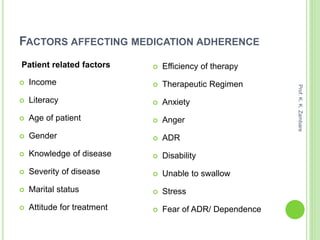
FACTORS AFFECTING MEDICATION ADHERENCE
Patient related factors
 Income
 Literacy
 Age of patient
 Gender
 Knowledge of disease
 Severity of disease
 Marital status
 Attitude for treatment
 Efficiency of therapy
 Therapeutic Regimen
 Anxiety
 Anger
 ADR
 Disability
 Unable to swallow
 Stress
 Fear of ADR/ Dependence
Prof.K.K.Zambare
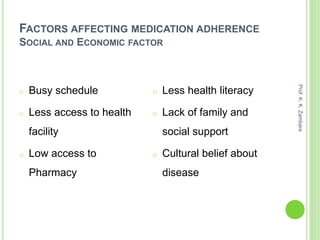
FACTORS AFFECTING MEDICATION ADHERENCE
SOCIAL AND ECONOMIC FACTOR
o Busy schedule
o Less access to health
facility
o Low access to
Pharmacy
o Less health literacy
o Lack of family and
social support
o Cultural belief about
disease
Prof.K.K.Zambare
FACTORS AFFECTING MEDICATION ADHERENCE
Disease related factor
o Less symptoms of severity
o No symptom or disappearance of symptom
o Psychological diseases
Prof.K.K.Zambare
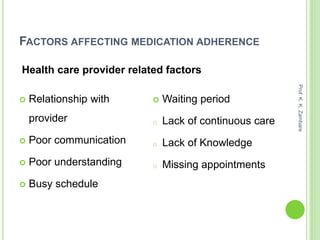
FACTORS AFFECTING MEDICATION ADHERENCE
 Relationship with
provider
 Poor communication
 Poor understanding
 Busy schedule
 Waiting period
o Lack of continuous care
o Lack of Knowledge
o Missing appointments
Health care provider related factors
Prof.K.K.Zambare
FACTORS AFFECTING MEDICATION ADHERENCE
Therapy related factors
 Number of doses
 Duration of therapy
 Frequent changes in drugs
 Lack of Immediate relief
 ADR/Side effect
Prof.K.K.Zambare
PHARMACIST ROLE IN THE MEDICATION ADHERENCE
o Communication should be good with any patient
o Help the patient education
o Talk friendly to patients
o Always remain approachable to patients
o Ease the patients to talk about their disease
without hesitation
Prof.K.K.Zambare
PHARMACIST ROLE IN THE MEDICATION ADHERENCE
o Create awareness about the disease to patients
o Listen carefully the problem of patients
o Explain properly disease condition
o Explain the therapeutic regimen
o Keep an eye on ADR and Side effects
o Check the understanding of patient
Prof.K.K.Zambare
PHARMACIST ROLE IN THE MEDICATION ADHERENCE
o Monitor effectiveness of therapy
o Always communicate in same language
o Take account of psychological state and
spiritual need of patient
o Good communication between Pharmacist -
Physician and Pharmacist-Patient
Prof.K.K.Zambare
MONITORING OF PATIENT MEDICATION ADHERENCE
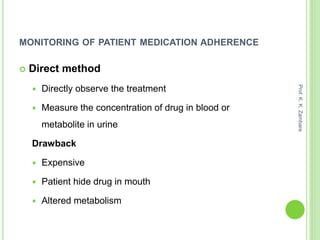
 Direct method
 Directly observe the treatment
 Measure the concentration of drug in blood or
metabolite in urine
Drawback
 Expensive
 Patient hide drug in mouth
 Altered metabolism
Prof.K.K.Zambare
MONITORING OF PATIENT MEDICATION ADHERENCE
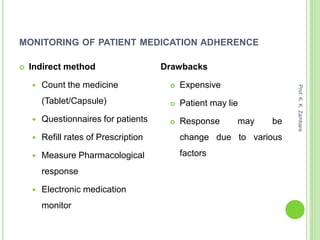
 Indirect method
 Count the medicine
(Tablet/Capsule)
 Questionnaires for patients
 Refill rates of Prescription
 Measure Pharmacological
response
 Electronic medication
monitor
Drawbacks
 Expensive
 Patient may lie
 Response may be
change due to various
factors
Prof.K.K.Zambare
MONITORING OF PATIENT MEDICATION ADHERENCE
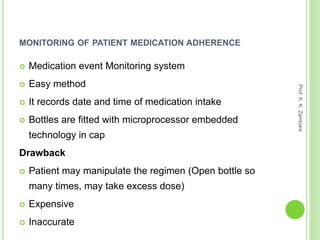
 Medication event Monitoring system
 Easy method
 It records date and time of medication intake
 Bottles are fitted with microprocessor embedded
technology in cap
Drawback
 Patient may manipulate the regimen (Open bottle so
many times, may take excess dose)
 Expensive
 Inaccurate
Prof.K.K.Zambare

Medication adherence

  • 1.
    Medication adherence By Mr. KrushnaKashinathrao Zambare HOD, Pharmacology SBSPM B. Pharmacy College, Ambajogai
  • 2.
    DEFINITION  The extentto which patients take medications as prescribed by physician. OR  The extent to which patient correctly follows medical advice. OR  As per WHO "the degree to which the person's behavior corresponds with the agreed recommendations from a health care provider." Prof.K.K.Zambare
  • 3.
    CAUSES OF MEDICATIONNON-ADHERENCE  Intentionally non-adherence to medication  Intentionally the patient deviates from the treatment regimen  Unintentional non-adherence to medication  Due to carelessness  Due to Forgetfulness  High cost of medicine  Late repurchase of medicines Prof.K.K.Zambare
  • 4.
    PROBLEMS LINKED WITHMEDICATION NON- ADHERENCE  Therapeutic failure  Increased exposure to toxicological effects of drugs  Recurrence of disease  Unable to cure disease and disease progression  Leads to complications of disease  Economic lost to patient  Low quality of life  Patients death Prof.K.K.Zambare
  • 5.
    FACTORS AFFECTING MEDICATIONADHERENCE Patient related factors  Income  Literacy  Age of patient  Gender  Knowledge of disease  Severity of disease  Marital status  Attitude for treatment  Efficiency of therapy  Therapeutic Regimen  Anxiety  Anger  ADR  Disability  Unable to swallow  Stress  Fear of ADR/ Dependence Prof.K.K.Zambare
  • 6.
    FACTORS AFFECTING MEDICATIONADHERENCE SOCIAL AND ECONOMIC FACTOR o Busy schedule o Less access to health facility o Low access to Pharmacy o Less health literacy o Lack of family and social support o Cultural belief about disease Prof.K.K.Zambare
  • 7.
    FACTORS AFFECTING MEDICATIONADHERENCE Disease related factor o Less symptoms of severity o No symptom or disappearance of symptom o Psychological diseases Prof.K.K.Zambare
  • 8.
    FACTORS AFFECTING MEDICATIONADHERENCE  Relationship with provider  Poor communication  Poor understanding  Busy schedule  Waiting period o Lack of continuous care o Lack of Knowledge o Missing appointments Health care provider related factors Prof.K.K.Zambare
  • 9.
    FACTORS AFFECTING MEDICATIONADHERENCE Therapy related factors  Number of doses  Duration of therapy  Frequent changes in drugs  Lack of Immediate relief  ADR/Side effect Prof.K.K.Zambare
  • 10.
    PHARMACIST ROLE INTHE MEDICATION ADHERENCE o Communication should be good with any patient o Help the patient education o Talk friendly to patients o Always remain approachable to patients o Ease the patients to talk about their disease without hesitation Prof.K.K.Zambare
  • 11.
    PHARMACIST ROLE INTHE MEDICATION ADHERENCE o Create awareness about the disease to patients o Listen carefully the problem of patients o Explain properly disease condition o Explain the therapeutic regimen o Keep an eye on ADR and Side effects o Check the understanding of patient Prof.K.K.Zambare
  • 12.
    PHARMACIST ROLE INTHE MEDICATION ADHERENCE o Monitor effectiveness of therapy o Always communicate in same language o Take account of psychological state and spiritual need of patient o Good communication between Pharmacist - Physician and Pharmacist-Patient Prof.K.K.Zambare
  • 13.
    MONITORING OF PATIENTMEDICATION ADHERENCE  Direct method  Directly observe the treatment  Measure the concentration of drug in blood or metabolite in urine Drawback  Expensive  Patient hide drug in mouth  Altered metabolism Prof.K.K.Zambare
  • 14.
    MONITORING OF PATIENTMEDICATION ADHERENCE  Indirect method  Count the medicine (Tablet/Capsule)  Questionnaires for patients  Refill rates of Prescription  Measure Pharmacological response  Electronic medication monitor Drawbacks  Expensive  Patient may lie  Response may be change due to various factors Prof.K.K.Zambare
  • 15.
    MONITORING OF PATIENTMEDICATION ADHERENCE  Medication event Monitoring system  Easy method  It records date and time of medication intake  Bottles are fitted with microprocessor embedded technology in cap Drawback  Patient may manipulate the regimen (Open bottle so many times, may take excess dose)  Expensive  Inaccurate Prof.K.K.Zambare