ISO - International
organization for Standardization
- international setting body.
- founded on 23 Feb 1947.
- headquartered in Geneva.
 An independent, non-governmental international
organization with a membership of 164 national
standard bodies.
 ISO creates documents that provide requirements ,
specifications, guidelines or characteristics that can be
used to ensure that materials, products, processes and
services are fit for their purpose.
 A bridge between public & private sector.
• ISO developed the Food Safety Management System
Certification. It has requirements for Food Safety
Management Systems processes and procedures .
• ISO 22000 certification is for all food sector companies (
Producers , Processors, Distributors ) as well as all related
industries, such as packaging, transport, animal feed,
cleaning, disinfecting, equipment production, etc.
• ISO 22000 is also used as a basis for the Food Safety
Systems Certification (FSSC 22000) , is a GFSI approved
scheme.
 Global Food Safety Initiative
 private organization, headquartered in
France.
 the consumer goods forum under Belgian
law (may 2000) which maintains a scheme
to benchmark food safety standards for
manufacturers as well as farm assurance
standards.
 FSSC 22000 is a certification scheme that absorbs ISO
22000 and contains a more extensive list of standards to
be met by the enterprise.
 Compared to ISO 22000 ,
The procedure of certification is not
different. The requirements of FSSC 22000 scheme are
more extensive and rigid, so the certification under this
scheme is a very long and labour - intensive process.
This standard meets a two part need to:
 Improvement safety for all food sector
stakeholders,
 Harmonize existing food safety methods through
a internationally recognized reference system.
 ISO 22000 - Food safety management systems -
Requirements for any organization in the food chain.
 ISO 22001 - Guidelines on the application of ISO
9001:2000 for the food and drink industry.
 ISO/TS 22002- Prerequisite programs on food safety—
Part 1: Food manufacturing;
Part 2: Catering;
Part 3: Farming;
Part 4: Food packaging manufacture;
Part 5: Transport & storage;
Part 6: Feed and animal food production.
 ISO TS 22003 - Food safety management systems for
bodies providing audit and certification of FSMS.
 ISO TS 22004 - Food safety management systems -
Guidance on the application of ISO 22000:2005.
 ISO 22005 - Traceability in the feed and food chain -
General principles and basic requirements for system
design and implementation.
 ISO 22006 - Quality management systems - Guidance
on the application of ISO 9002:2000 for crop production.
 PRPs are an integral part of food safety stds & audit
schemes the world over.
 ISO 22000, emphasizes the importance of PRPs, that is
“basic conditions & activities that are necessary to
maintain a hygienic environment throughout the food
chain , suitable for production, handling and provision of
safe end product & safe food for human.”
 OPRPs are defined as a PRP that has a control measure
that controls a significant hazard.
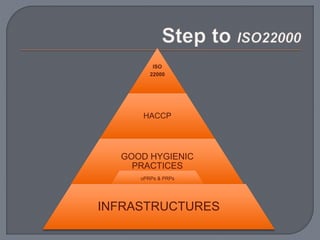
ISO
22000
HACCP
GOOD HYGIENIC
PRACTICES
oPRPs & PRPs
INFRASTRUCTURES
 Plan: 1, commit to a food safety policy
2, plan your objectives
 Do: implement the program
& resources
 Check: check & assess the
result and progress
 Act: review & improve the system
ISO
22000
Interactive
communication
Traceability
HACCP
plan
PRPs
System
approach
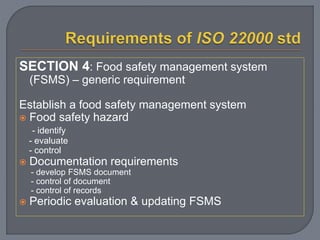
SECTION 4: Food safety management system
(FSMS) – generic requirement
Establish a food safety management system
 Food safety hazard
- identify
- evaluate
- control
 Documentation requirements
- develop FSMS document
- control of document
- control of records
 Periodic evaluation & updating FSMS
SECTION 5: Management responsibility
 Management commitment
 Food safety policy
 Food safety management system planning
 Responsibility & authority
- Communication ( external & internal )
- Emergency preparedness & response
 Management review (input & output)
SECTION 6: Resource management.
 provide adequate FSMS resources
- establish
- implement
- maintain
- update
 provide adequate human resource
- competence, awareness & training.
 Provide adequate infrastructure
 Work environment
- measure to prevent cross contamination.
- work space requirement.
- protective work wear requirement.
- availability & location of employee facilities.
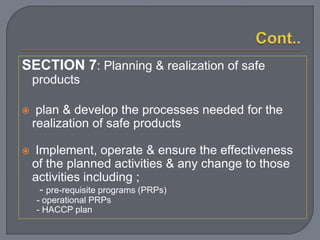
SECTION 7: Planning & realization of safe
products
 plan & develop the processes needed for the
realization of safe products
 Implement, operate & ensure the effectiveness
of the planned activities & any change to those
activities including ;
- pre-requisite programs (PRPs)
- operational PRPs
- HACCP plan
 Update the following information;
- product characteristics
- process steps
- control measures
- HACCP plan
- procedures, instructions, specifying PRPs
- plan & perform verification activities
Traceability system ( lot system)
 Control non conformity
- correction actions
- handling potentially unsafe products
- evaluation of release
- disposition of non conforming product
SECTION 8: Validation, verification &
improvement
 Confirm & validate food safety method
 FSMS verification
- internal audit
- evaluation of individual verification, result
- analysis of results of verification actives
 improvement
 That can be applied to any organization in the food
chain, farm to fork. Becoming certified to ISO 22000
allows a company to show their customers that they have
a food safety management system in place.
 This provides customer confidence in the product. This
is becoming more and more important as customers
demand safe food and food processors require that
ingredients obtained from their suppliers to be safe.
 ISO 9000 was first published in 1987.
 The ISO 9000 standard is continually being revised
by standing technical committees and advisory
groups, who receive feedback from those
professionals who are implementing the standard
 •1987
 •1994
 •2000
 •2008
 •2015
 2018
 ISO 9000 deals with the fundamentals of quality
management systems, including the eight
management principles upon which the family of
standards is based.
 ISO 9001 deals with the requirements that
organizations wishing to meet the standard must
fulfill.
 Third-party certification bodies provide
independent confirmation that organizations meet
the requirements of ISO 9001.
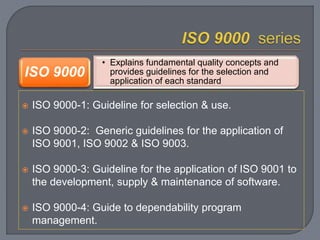
 ISO 9000-1: Guideline for selection & use.
 ISO 9000-2: Generic guidelines for the application of
ISO 9001, ISO 9002 & ISO 9003.
 ISO 9000-3: Guideline for the application of ISO 9001 to
the development, supply & maintenance of software.
 ISO 9000-4: Guide to dependability program
management.
• Explains fundamental quality concepts and
provides guidelines for the selection and
application of each standard
ISO 9000
• Model for quality assurance in
design , development, production,
installation and servicing
ISO 9001
• Model for quality assurance in the
production and installation of
manufacturing systems
ISO 9002
• Model for Quality assurance in
final inspection and testing.
ISO 9003
 ISO 9004-1: Guidelines.
 ISO 9004-2: Guidelines for services.
 ISO 9004-3: for processed materials.
 ISO 9004-4: for quality improvement.
 ISO 9004-5: for quality plans.
 ISO 9004-6: for project management.
 ISO 9004-7: for configuration management.
• Guidelines for the applications of
standards in quality management and
quality systems
ISO 9004
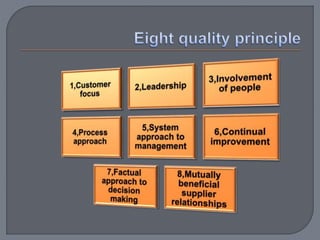
 Organizations depend on their customers and
therefore should understand current and future
customer needs, should meet customer
requirements and strive to exceed customer
expectations.
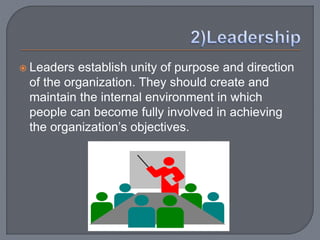
 Leaders establish unity of purpose and direction
of the organization. They should create and
maintain the internal environment in which
people can become fully involved in achieving
the organization’s objectives.
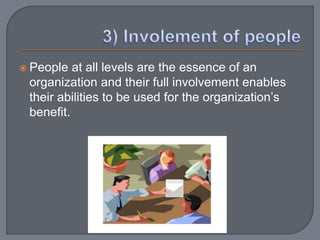
 People at all levels are the essence of an
organization and their full involvement enables
their abilities to be used for the organization’s
benefit.
 A desired result is achieved more efficiently
when activities and related resources are
managed as a process
 Identifying, understanding, and managing
interrelate processes as a system contributes to
the organization’s effectiveness and efficiency in
achieving its objectives
 Continual improvement of the organization’s
overall performance should be a permanent
objective of the organization.
 Effective decisions are based on the analysis of
data and information.
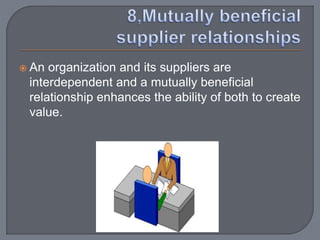
 An organization and its suppliers are
interdependent and a mutually beneficial
relationship enhances the ability of both to create
value.
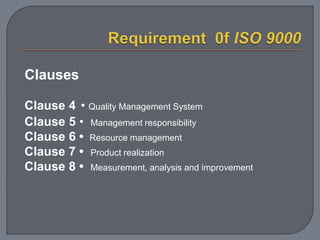
Clauses
Clause 4 • Quality Management System
Clause 5 • Management responsibility
Clause 6 • Resource management
Clause 7 • Product realization
Clause 8 • Measurement, analysis and improvement
 Quality Management system Clause
- General requirements
- Documentation requirement
- Quality manual
- Control of records and documents
 Management responsibility clause
- Customer focus
- Quality objective
- Quality policy
- Quality management system planning
- Management representative
- Internal communication
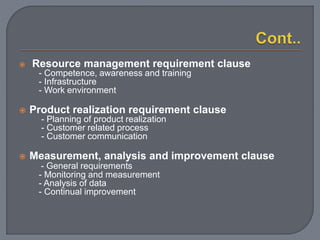
 Resource management requirement clause
- Competence, awareness and training
- Infrastructure
- Work environment
 Product realization requirement clause
- Planning of product realization
- Customer related process
- Customer communication
 Measurement, analysis and improvement clause
- General requirements
- Monitoring and measurement
- Analysis of data
- Continual improvement
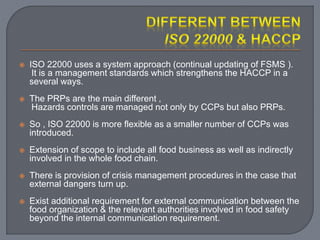
 ISO 22000 uses a system approach (continual updating of FSMS ).
It is a management standards which strengthens the HACCP in a
several ways.
 The PRPs are the main different ,
Hazards controls are managed not only by CCPs but also PRPs.
 So , ISO 22000 is more flexible as a smaller number of CCPs was
introduced.
 Extension of scope to include all food business as well as indirectly
involved in the whole food chain.
 There is provision of crisis management procedures in the case that
external dangers turn up.
 Exist additional requirement for external communication between the
food organization & the relevant authorities involved in food safety
beyond the internal communication requirement.
 ISO 22000 is fully compatible with other ISO std such as ISO 9000.
 The focus of ISO 9000 is Quality ,while the focus of ISO 22000 is
Food safety.
 ISO 22000 extends the successful management system approach of
the ISO 9001:2000 Quality management system std which is widely
implemented in all sectors but does not itself specifically address
food safety.
 ISO 22000 can be applied on its own, or in combination with other
management system stds such a ISO 9001:2000, with /without
independent (third party ) certification of conformity.
 Companies already certified to ISO 9001 will find it easy to extend
this certification to ISO 22000.
 Create a more efficient, effective operation
 Increase customer satisfaction and retention
 Reduce audits
 Enhance marketing
 Improve employee motivation, awareness and
morale
 Promote international trade
 Increase profit
 Reduce waste and increases productivity
 The ISO logo is a registered trademark and cannot be
used by anyone outside of ISO, unless authorized.
 If you wish to use a logo to demonstrate certification,
contact the certification body that issued the certificate.
Committee on Conformity assessment
it involves a set of processes that show
your product, service or system meets the
requirements of a standard.
Benefits:
 It provides consumers and other stakeholders with
added confidence.
 It gives your company a competitive edge.
 It helps regulators ensure that health, safety or
environmental conditions are met.
 Evaluate several certification bodies.
 Check if the certification body uses the
relevant CASCO standard
 Check if it is accredited.
 ISO does not certify organizations itself.
 Many countries have formed accreditation bodies
to authorize ("accredit") the certification bodies.
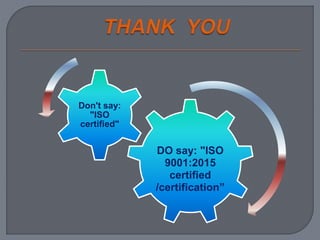
DO say: "ISO
9001:2015
certified
/certification”
Don't say:
"ISO
certified"

Iso 22000 & 9000

  • 2.
    ISO - International organizationfor Standardization - international setting body. - founded on 23 Feb 1947. - headquartered in Geneva.
  • 3.
     An independent,non-governmental international organization with a membership of 164 national standard bodies.  ISO creates documents that provide requirements , specifications, guidelines or characteristics that can be used to ensure that materials, products, processes and services are fit for their purpose.  A bridge between public & private sector.
  • 4.
    • ISO developedthe Food Safety Management System Certification. It has requirements for Food Safety Management Systems processes and procedures . • ISO 22000 certification is for all food sector companies ( Producers , Processors, Distributors ) as well as all related industries, such as packaging, transport, animal feed, cleaning, disinfecting, equipment production, etc. • ISO 22000 is also used as a basis for the Food Safety Systems Certification (FSSC 22000) , is a GFSI approved scheme.
  • 5.
     Global FoodSafety Initiative  private organization, headquartered in France.  the consumer goods forum under Belgian law (may 2000) which maintains a scheme to benchmark food safety standards for manufacturers as well as farm assurance standards.
  • 6.
     FSSC 22000is a certification scheme that absorbs ISO 22000 and contains a more extensive list of standards to be met by the enterprise.  Compared to ISO 22000 , The procedure of certification is not different. The requirements of FSSC 22000 scheme are more extensive and rigid, so the certification under this scheme is a very long and labour - intensive process.
  • 7.
    This standard meetsa two part need to:  Improvement safety for all food sector stakeholders,  Harmonize existing food safety methods through a internationally recognized reference system.
  • 8.
     ISO 22000- Food safety management systems - Requirements for any organization in the food chain.  ISO 22001 - Guidelines on the application of ISO 9001:2000 for the food and drink industry.  ISO/TS 22002- Prerequisite programs on food safety— Part 1: Food manufacturing; Part 2: Catering; Part 3: Farming; Part 4: Food packaging manufacture; Part 5: Transport & storage; Part 6: Feed and animal food production.
  • 9.
     ISO TS22003 - Food safety management systems for bodies providing audit and certification of FSMS.  ISO TS 22004 - Food safety management systems - Guidance on the application of ISO 22000:2005.  ISO 22005 - Traceability in the feed and food chain - General principles and basic requirements for system design and implementation.  ISO 22006 - Quality management systems - Guidance on the application of ISO 9002:2000 for crop production.
  • 10.
     PRPs arean integral part of food safety stds & audit schemes the world over.  ISO 22000, emphasizes the importance of PRPs, that is “basic conditions & activities that are necessary to maintain a hygienic environment throughout the food chain , suitable for production, handling and provision of safe end product & safe food for human.”  OPRPs are defined as a PRP that has a control measure that controls a significant hazard.
  • 11.
  • 12.
     Plan: 1,commit to a food safety policy 2, plan your objectives  Do: implement the program & resources  Check: check & assess the result and progress  Act: review & improve the system
  • 13.
  • 14.
    SECTION 4: Foodsafety management system (FSMS) – generic requirement Establish a food safety management system  Food safety hazard - identify - evaluate - control  Documentation requirements - develop FSMS document - control of document - control of records  Periodic evaluation & updating FSMS
  • 15.
    SECTION 5: Managementresponsibility  Management commitment  Food safety policy  Food safety management system planning  Responsibility & authority - Communication ( external & internal ) - Emergency preparedness & response  Management review (input & output)
  • 16.
    SECTION 6: Resourcemanagement.  provide adequate FSMS resources - establish - implement - maintain - update  provide adequate human resource - competence, awareness & training.  Provide adequate infrastructure  Work environment - measure to prevent cross contamination. - work space requirement. - protective work wear requirement. - availability & location of employee facilities.
  • 17.
    SECTION 7: Planning& realization of safe products  plan & develop the processes needed for the realization of safe products  Implement, operate & ensure the effectiveness of the planned activities & any change to those activities including ; - pre-requisite programs (PRPs) - operational PRPs - HACCP plan
  • 18.
     Update thefollowing information; - product characteristics - process steps - control measures - HACCP plan - procedures, instructions, specifying PRPs - plan & perform verification activities Traceability system ( lot system)  Control non conformity - correction actions - handling potentially unsafe products - evaluation of release - disposition of non conforming product
  • 19.
    SECTION 8: Validation,verification & improvement  Confirm & validate food safety method  FSMS verification - internal audit - evaluation of individual verification, result - analysis of results of verification actives  improvement
  • 21.
     That canbe applied to any organization in the food chain, farm to fork. Becoming certified to ISO 22000 allows a company to show their customers that they have a food safety management system in place.  This provides customer confidence in the product. This is becoming more and more important as customers demand safe food and food processors require that ingredients obtained from their suppliers to be safe.
  • 22.
     ISO 9000was first published in 1987.  The ISO 9000 standard is continually being revised by standing technical committees and advisory groups, who receive feedback from those professionals who are implementing the standard  •1987  •1994  •2000  •2008  •2015  2018
  • 23.
     ISO 9000deals with the fundamentals of quality management systems, including the eight management principles upon which the family of standards is based.  ISO 9001 deals with the requirements that organizations wishing to meet the standard must fulfill.  Third-party certification bodies provide independent confirmation that organizations meet the requirements of ISO 9001.
  • 24.
     ISO 9000-1:Guideline for selection & use.  ISO 9000-2: Generic guidelines for the application of ISO 9001, ISO 9002 & ISO 9003.  ISO 9000-3: Guideline for the application of ISO 9001 to the development, supply & maintenance of software.  ISO 9000-4: Guide to dependability program management. • Explains fundamental quality concepts and provides guidelines for the selection and application of each standard ISO 9000
  • 25.
    • Model forquality assurance in design , development, production, installation and servicing ISO 9001 • Model for quality assurance in the production and installation of manufacturing systems ISO 9002 • Model for Quality assurance in final inspection and testing. ISO 9003
  • 26.
     ISO 9004-1:Guidelines.  ISO 9004-2: Guidelines for services.  ISO 9004-3: for processed materials.  ISO 9004-4: for quality improvement.  ISO 9004-5: for quality plans.  ISO 9004-6: for project management.  ISO 9004-7: for configuration management. • Guidelines for the applications of standards in quality management and quality systems ISO 9004
  • 28.
     Organizations dependon their customers and therefore should understand current and future customer needs, should meet customer requirements and strive to exceed customer expectations.
  • 29.
     Leaders establishunity of purpose and direction of the organization. They should create and maintain the internal environment in which people can become fully involved in achieving the organization’s objectives.
  • 30.
     People atall levels are the essence of an organization and their full involvement enables their abilities to be used for the organization’s benefit.
  • 31.
     A desiredresult is achieved more efficiently when activities and related resources are managed as a process
  • 32.
     Identifying, understanding,and managing interrelate processes as a system contributes to the organization’s effectiveness and efficiency in achieving its objectives
  • 33.
     Continual improvementof the organization’s overall performance should be a permanent objective of the organization.
  • 34.
     Effective decisionsare based on the analysis of data and information.
  • 35.
     An organizationand its suppliers are interdependent and a mutually beneficial relationship enhances the ability of both to create value.
  • 36.
    Clauses Clause 4 •Quality Management System Clause 5 • Management responsibility Clause 6 • Resource management Clause 7 • Product realization Clause 8 • Measurement, analysis and improvement
  • 37.
     Quality Managementsystem Clause - General requirements - Documentation requirement - Quality manual - Control of records and documents  Management responsibility clause - Customer focus - Quality objective - Quality policy - Quality management system planning - Management representative - Internal communication
  • 38.
     Resource managementrequirement clause - Competence, awareness and training - Infrastructure - Work environment  Product realization requirement clause - Planning of product realization - Customer related process - Customer communication  Measurement, analysis and improvement clause - General requirements - Monitoring and measurement - Analysis of data - Continual improvement
  • 39.
     ISO 22000uses a system approach (continual updating of FSMS ). It is a management standards which strengthens the HACCP in a several ways.  The PRPs are the main different , Hazards controls are managed not only by CCPs but also PRPs.  So , ISO 22000 is more flexible as a smaller number of CCPs was introduced.  Extension of scope to include all food business as well as indirectly involved in the whole food chain.  There is provision of crisis management procedures in the case that external dangers turn up.  Exist additional requirement for external communication between the food organization & the relevant authorities involved in food safety beyond the internal communication requirement.
  • 40.
     ISO 22000is fully compatible with other ISO std such as ISO 9000.  The focus of ISO 9000 is Quality ,while the focus of ISO 22000 is Food safety.  ISO 22000 extends the successful management system approach of the ISO 9001:2000 Quality management system std which is widely implemented in all sectors but does not itself specifically address food safety.  ISO 22000 can be applied on its own, or in combination with other management system stds such a ISO 9001:2000, with /without independent (third party ) certification of conformity.  Companies already certified to ISO 9001 will find it easy to extend this certification to ISO 22000.
  • 42.
     Create amore efficient, effective operation  Increase customer satisfaction and retention  Reduce audits  Enhance marketing  Improve employee motivation, awareness and morale  Promote international trade  Increase profit  Reduce waste and increases productivity
  • 43.
     The ISOlogo is a registered trademark and cannot be used by anyone outside of ISO, unless authorized.  If you wish to use a logo to demonstrate certification, contact the certification body that issued the certificate.
  • 44.
    Committee on Conformityassessment it involves a set of processes that show your product, service or system meets the requirements of a standard. Benefits:  It provides consumers and other stakeholders with added confidence.  It gives your company a competitive edge.  It helps regulators ensure that health, safety or environmental conditions are met.
  • 45.
     Evaluate severalcertification bodies.  Check if the certification body uses the relevant CASCO standard  Check if it is accredited.  ISO does not certify organizations itself.  Many countries have formed accreditation bodies to authorize ("accredit") the certification bodies.
  • 47.