Workshop:
Massive Open Online Courses (MOOCs) for
Language Learning and Communication
Carmen Holotescu, UPT
Gabriela Grosseck, UVT
PCTS9 - LANGUAGE AND COMMUNICATION IN THE DIGITAL ERA
March 26-27, 2015, Timisoara Romania
- Discovering MOOCs: Classification, Platforms, Directories
- Relations between MOOCs and Open Educational
Resources and Practices
- Scenarios for integrating MOOCs in university courses for
Language Learning and Communication
Topics
OER Definition
[…] „the open provision of
educational resources,
enabled by information and
communication
technologies, for
consultation, use and
adaptation by a community
of users for non-commercial
purposes.”
unesco.org/new/en/communication-and-information/access-to-knowledge/open-educational-resources
UNESCO (2002)
unesdoc.unesco.org/images/0021/002136/213605e.pdf
What are OERs? Open Educational Resources
„are any type of educational
materials that are in the public
domain or introduced with an open
license.
The nature of these open materials
means that anyone can legally and
freely copy, use, adapt and re-share
them. OERs range from textbooks to
curricula, syllabi, lecture notes,
assignments, tests, projects, audio,
video
and animation.”
„ICT tools, Open Educational
Resources, and open practices
allow for an increase in the
effectiveness of education,
allowing for more personalised
learning, a better learning
experience.
Ultimately, opening up
education may lead to a
situation where all individuals
may learn anytime, anywhere,
with the support of anyone,
using any device.”
Open Education Europa
Opening up education through new technologies
openeducationeuropa.eu
ec.europa.eu/education/policy/strategic-framework/education-
technology.htm
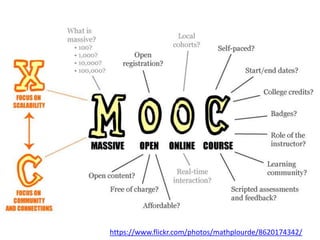
https://www.flickr.com/photos/mathplourde/8620174342/
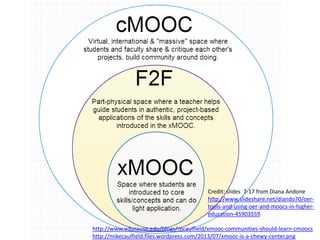
http://www.educause.edu/blogs/mcaulfield/xmooc-communities-should-learn-cmoocs
http://mikecaulfield.files.wordpress.com/2013/07/xmooc-is-a-chewy-center.png
Credit: slides 7-17 from Diana Andone
http://www.slideshare.net/diando70/oer-
tools-and-using-oer-and-moocs-in-higher-
education-45903559
MOOC
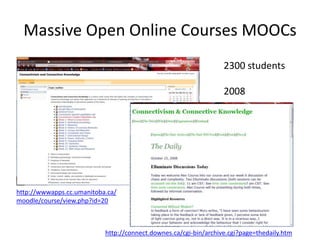
• In 2008, George Siemens and Stephen Downes co-taught a
class thought to be the first to use the term MOOC. The
course, called “Connectivism and Connective Knowledge,”
was presented to 25 tuition-paying students at the University
of Manitoba and offered at the same time to around 2,300
students from the general public who took the online class at
no cost.
• https://web.archive.org/web/20080629220943/http://ltc.um
anitoba.ca:83/connectivism/
• check also http://elearning.upt.ro/workshop-opening-up-education/n-32-70-
185/d
Massive Open Online Courses MOOCs
http://connect.downes.ca/cgi-bin/archive.cgi?page=thedaily.htm
http://wwwapps.cc.umanitoba.ca/
moodle/course/view.php?id=20
2300 students
2008
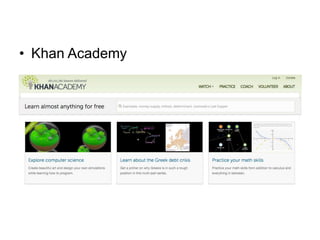
• Khan Academy
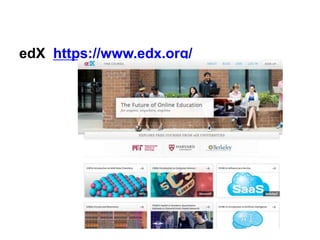
edX https://www.edx.org/
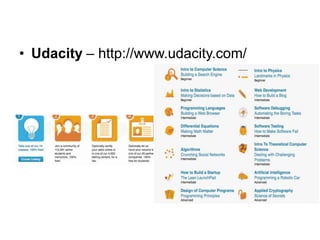
• Udacity – http://www.udacity.com/
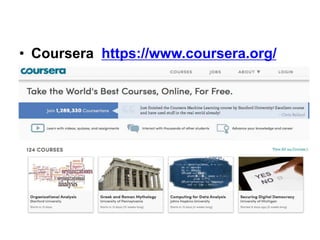
• Coursera https://www.coursera.org/
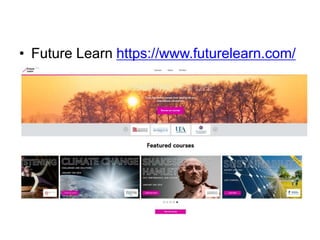
• Future Learn https://www.futurelearn.com/
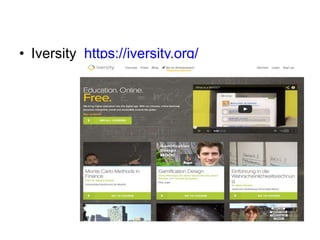
• Iversity https://iversity.org/
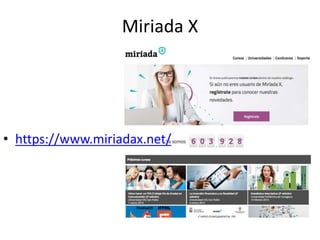
Miriada X
• https://www.miriadax.net/
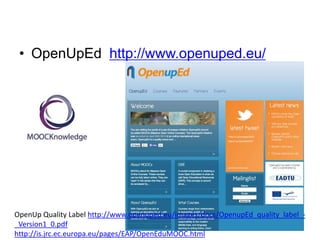
• OpenUpEd http://www.openuped.eu/
OpenUp Quality Label http://www.openuped.eu/images/docs/OpenupEd_quality_label_-
_Version1_0.pdf
http://is.jrc.ec.europa.eu/pages/EAP/OpenEduMOOC.html
http://platform.europeanmoocs.eu/
http://emoocs2015.eu/
http://home.eadtu.eu/
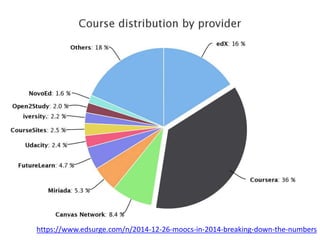
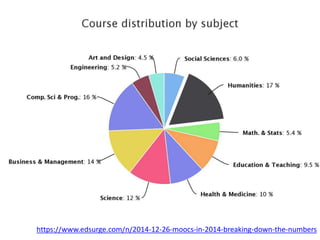
https://www.edsurge.com/n/2014-12-26-moocs-in-2014-breaking-down-the-numbers
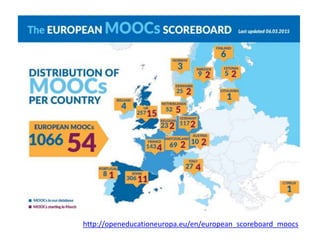
http://openeducationeuropa.eu/en/european_scoreboard_moocs
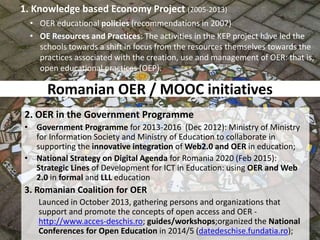
Romanian OER / MOOC initiatives
2. OER in the Government Programme
• Government Programme for 2013-2016 (Dec 2012): Ministry of Ministry
for Information Society and Ministry of Education to collaborate in
supporting the innovative integration of Web2.0 and OER in education;
• National Strategy on Digital Agenda for Romania 2020 (Feb 2015):
Strategic Lines of Development for ICT in Education: using OER and Web
2.0 in formal and LLL education
3. Romanian Coalition for OER
Launced in October 2013, gathering persons and organizations that
support and promote the concepts of open access and OER -
http://www.acces-deschis.ro; guides/workshops;organized the National
Conferences for Open Education in 2014/5 (datedeschise.fundatia.ro);
1. Knowledge based Economy Project (2005-2013)
• OER educational policies (recommendations in 2007)
• OE Resources and Practices: The activities in the KEP project have led the
schools towards a shift in focus from the resources themselves towards the
practices associated with the creation, use and management of OER: that is,
open educational practices (OEP).
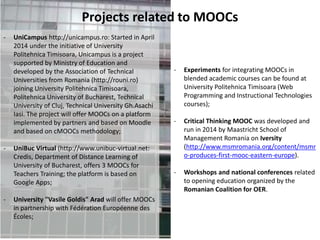
Projects related to MOOCs
- UniCampus http://unicampus.ro: Started in April
2014 under the initiative of University
Politehnica Timisoara, Unicampus is a project
supported by Ministry of Education and
developed by the Association of Technical
Universities from Romania (http://rouni.ro)
joining University Politehnica Timisoara,
Politehnica University of Bucharest, Technical
University of Cluj, Technical University Gh.Asachi
Iasi. The project will offer MOOCs on a platform
implemented by partners and based on Moodle
and based on cMOOCs methodology;
- UniBuc Virtual (http://www.unibuc-virtual.net:
Credis, Department of Distance Learning of
University of Bucharest, offers 3 MOOCs for
Teachers Training; the platform is based on
Google Apps;
- University "Vasile Goldis" Arad will offer MOOCs
in partnership with Fédération Européenne des
Écoles;
- Experiments for integrating MOOCs in
blended academic courses can be found at
University Politehnica Timisoara (Web
Programming and Instructional Technologies
courses);
- Critical Thinking MOOC was developed and
run in 2014 by Maastricht School of
Management Romania on Iversity
(http://www.msmromania.org/content/msmr
o-produces-first-mooc-eastern-europe).
- Workshops and national conferences related
to opening education organized by the
Romanian Coalition for OER.
Integrating MOOCs in Blended Courses
Carmen Holotescu, Gabriela Grosseck, Vladimir Cretu, Antoanela Naaji (2014)
upt.academia.edu/CarmenHolotescu
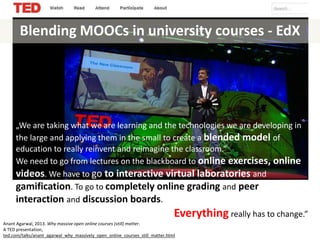
Blending MOOCs in university courses - EdX
„We are taking what we are learning and the technologies we are developing in
the large and applying them in the small to create a blended model of
education to really reinvent and reimagine the classroom.”
We need to go from lectures on the blackboard to online exercises, online
videos. We have to go to interactive virtual laboratories and
gamification. To go to completely online grading and peer
interaction and discussion boards.
Everything really has to change.”
Anant Agarwal, 2013. Why massive open online courses (still) matter.
A TED presentation,
ted.com/talks/anant_agarwal_why_massively_open_online_courses_still_matter.html
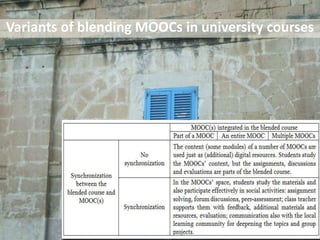
Variants of blending MOOCs in university courses
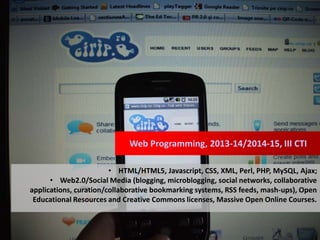
Web Programming, 2013-14/2014-15, III CTI
• HTML/HTML5, Javascript, CSS, XML, Perl, PHP, MySQL, Ajax;
• Web2.0/Social Media (blogging, microblogging, social networks, collaborative
applications, curation/collaborative bookmarking systems, RSS feeds, mash-ups), Open
Educational Resources and Creative Commons licenses, Massive Open Online Courses.
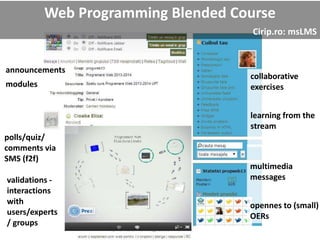
announcements
modules
collaborative
exercises
learning from the
stream
multimedia
messages
opennes to (small)
OERs
polls/quiz/
comments via
SMS (f2f)
validations -
interactions
with
users/experts
/ groups
Web Programming Blended Course
Cirip.ro: msLMS
Mobile learning features
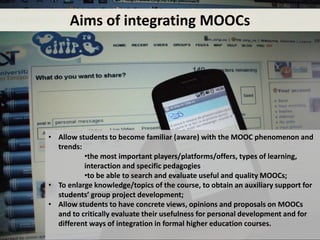
• Allow students to become familiar (aware) with the MOOC phenomenon and
trends:
•the most important players/platforms/offers, types of learning,
interaction and specific pedagogies
•to be able to search and evaluate useful and quality MOOCs;
• To enlarge knowledge/topics of the course, to obtain an auxiliary support for
students’ group project development;
• Allow students to have concrete views, opinions and proposals on MOOCs
and to critically evaluate their usefulness for personal development and for
different ways of integration in formal higher education courses.
Aims of integrating MOOCs
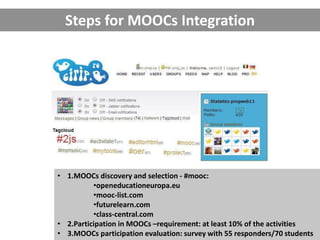
Steps for MOOCs Integration
• 1.MOOCs discovery and selection - #mooc:
•openeducationeuropa.eu
•mooc-list.com
•futurelearn.com
•class-central.com
• 2.Participation in MOOCs –requirement: at least 10% of the activities
• 3.MOOCs participation evaluation: survey with 55 responders/70 students
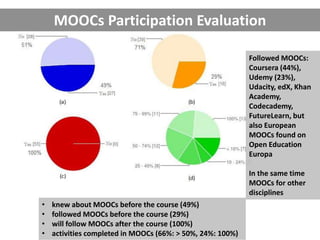
MOOCs Participation Evaluation
• knew about MOOCs before the course (49%)
• followed MOOCs before the course (29%)
• will follow MOOCs after the course (100%)
• activities completed in MOOCs (66%: > 50%, 24%: 100%)
Followed MOOCs:
Coursera (44%),
Udemy (23%),
Udacity, edX, Khan
Academy,
Codecademy,
FutureLearn, but
also European
MOOCs found on
Open Education
Europa
In the same time
MOOCs for other
disciplines
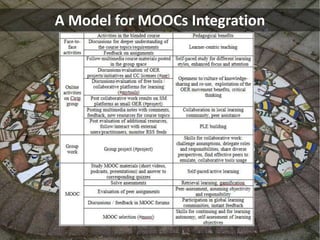
A Model for MOOCs Integration
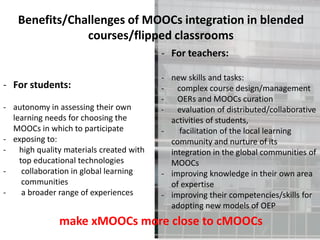
- For teachers:
- new skills and tasks:
- complex course design/management
- OERs and MOOCs curation
- evaluation of distributed/collaborative
activities of students,
- facilitation of the local learning
community and nurture of its
integration in the global communities of
MOOCs
- improving knowledge in their own area
of expertise
- improving their competencies/skills for
adopting new models of OEP
- For students:
- autonomy in assessing their own
learning needs for choosing the
MOOCs in which to participate
- exposing to:
- high quality materials created with
top educational technologies
- collaboration in global learning
communities
- a broader range of experiences
Benefits/Challenges of MOOCs integration in blended
courses/flipped classrooms
make xMOOCs more close to cMOOCs
• 1.Please pick up 2-4 MOOCs which could be useful for your
courses / professional development:
•openeducationeuropa.eu
•mooc-list.com
•futurelearn.com
•class-central.com
• 2.Possible scenarios for integrating MOOCs in your courses
• 3.Benefits, challenges, drawbacks
Image from http://markbrodinsky.com/your-turn-its-just-about-life/
Thank you!
Carmen Holotescu
Twitter @cami13
Gabriela Grosseck
Twitter @ggrosseck

Massive Open Online Courses (MOOCs) for Language Learning and Communication

  • 1.
    Workshop: Massive Open OnlineCourses (MOOCs) for Language Learning and Communication Carmen Holotescu, UPT Gabriela Grosseck, UVT PCTS9 - LANGUAGE AND COMMUNICATION IN THE DIGITAL ERA March 26-27, 2015, Timisoara Romania
  • 2.
    - Discovering MOOCs:Classification, Platforms, Directories - Relations between MOOCs and Open Educational Resources and Practices - Scenarios for integrating MOOCs in university courses for Language Learning and Communication Topics
  • 3.
    OER Definition […] „theopen provision of educational resources, enabled by information and communication technologies, for consultation, use and adaptation by a community of users for non-commercial purposes.” unesco.org/new/en/communication-and-information/access-to-knowledge/open-educational-resources UNESCO (2002)
  • 4.
    unesdoc.unesco.org/images/0021/002136/213605e.pdf What are OERs?Open Educational Resources „are any type of educational materials that are in the public domain or introduced with an open license. The nature of these open materials means that anyone can legally and freely copy, use, adapt and re-share them. OERs range from textbooks to curricula, syllabi, lecture notes, assignments, tests, projects, audio, video and animation.”
  • 5.
    „ICT tools, OpenEducational Resources, and open practices allow for an increase in the effectiveness of education, allowing for more personalised learning, a better learning experience. Ultimately, opening up education may lead to a situation where all individuals may learn anytime, anywhere, with the support of anyone, using any device.” Open Education Europa Opening up education through new technologies openeducationeuropa.eu ec.europa.eu/education/policy/strategic-framework/education- technology.htm
  • 6.
  • 7.
    http://www.educause.edu/blogs/mcaulfield/xmooc-communities-should-learn-cmoocs http://mikecaulfield.files.wordpress.com/2013/07/xmooc-is-a-chewy-center.png Credit: slides 7-17from Diana Andone http://www.slideshare.net/diando70/oer- tools-and-using-oer-and-moocs-in-higher- education-45903559
  • 8.
    MOOC • In 2008,George Siemens and Stephen Downes co-taught a class thought to be the first to use the term MOOC. The course, called “Connectivism and Connective Knowledge,” was presented to 25 tuition-paying students at the University of Manitoba and offered at the same time to around 2,300 students from the general public who took the online class at no cost. • https://web.archive.org/web/20080629220943/http://ltc.um anitoba.ca:83/connectivism/ • check also http://elearning.upt.ro/workshop-opening-up-education/n-32-70- 185/d
  • 9.
    Massive Open OnlineCourses MOOCs http://connect.downes.ca/cgi-bin/archive.cgi?page=thedaily.htm http://wwwapps.cc.umanitoba.ca/ moodle/course/view.php?id=20 2300 students 2008
  • 10.
  • 11.
  • 12.
    • Udacity –http://www.udacity.com/
  • 13.
  • 14.
    • Future Learnhttps://www.futurelearn.com/
  • 15.
  • 16.
  • 17.
    • OpenUpEd http://www.openuped.eu/ OpenUpQuality Label http://www.openuped.eu/images/docs/OpenupEd_quality_label_- _Version1_0.pdf http://is.jrc.ec.europa.eu/pages/EAP/OpenEduMOOC.html
  • 18.
  • 19.
  • 20.
  • 21.
  • 22.
    Romanian OER /MOOC initiatives 2. OER in the Government Programme • Government Programme for 2013-2016 (Dec 2012): Ministry of Ministry for Information Society and Ministry of Education to collaborate in supporting the innovative integration of Web2.0 and OER in education; • National Strategy on Digital Agenda for Romania 2020 (Feb 2015): Strategic Lines of Development for ICT in Education: using OER and Web 2.0 in formal and LLL education 3. Romanian Coalition for OER Launced in October 2013, gathering persons and organizations that support and promote the concepts of open access and OER - http://www.acces-deschis.ro; guides/workshops;organized the National Conferences for Open Education in 2014/5 (datedeschise.fundatia.ro); 1. Knowledge based Economy Project (2005-2013) • OER educational policies (recommendations in 2007) • OE Resources and Practices: The activities in the KEP project have led the schools towards a shift in focus from the resources themselves towards the practices associated with the creation, use and management of OER: that is, open educational practices (OEP).
  • 23.
    Projects related toMOOCs - UniCampus http://unicampus.ro: Started in April 2014 under the initiative of University Politehnica Timisoara, Unicampus is a project supported by Ministry of Education and developed by the Association of Technical Universities from Romania (http://rouni.ro) joining University Politehnica Timisoara, Politehnica University of Bucharest, Technical University of Cluj, Technical University Gh.Asachi Iasi. The project will offer MOOCs on a platform implemented by partners and based on Moodle and based on cMOOCs methodology; - UniBuc Virtual (http://www.unibuc-virtual.net: Credis, Department of Distance Learning of University of Bucharest, offers 3 MOOCs for Teachers Training; the platform is based on Google Apps; - University "Vasile Goldis" Arad will offer MOOCs in partnership with Fédération Européenne des Écoles; - Experiments for integrating MOOCs in blended academic courses can be found at University Politehnica Timisoara (Web Programming and Instructional Technologies courses); - Critical Thinking MOOC was developed and run in 2014 by Maastricht School of Management Romania on Iversity (http://www.msmromania.org/content/msmr o-produces-first-mooc-eastern-europe). - Workshops and national conferences related to opening education organized by the Romanian Coalition for OER.
  • 24.
    Integrating MOOCs inBlended Courses Carmen Holotescu, Gabriela Grosseck, Vladimir Cretu, Antoanela Naaji (2014) upt.academia.edu/CarmenHolotescu
  • 25.
    Blending MOOCs inuniversity courses - EdX „We are taking what we are learning and the technologies we are developing in the large and applying them in the small to create a blended model of education to really reinvent and reimagine the classroom.” We need to go from lectures on the blackboard to online exercises, online videos. We have to go to interactive virtual laboratories and gamification. To go to completely online grading and peer interaction and discussion boards. Everything really has to change.” Anant Agarwal, 2013. Why massive open online courses (still) matter. A TED presentation, ted.com/talks/anant_agarwal_why_massively_open_online_courses_still_matter.html
  • 26.
    Variants of blendingMOOCs in university courses
  • 27.
    Web Programming, 2013-14/2014-15,III CTI • HTML/HTML5, Javascript, CSS, XML, Perl, PHP, MySQL, Ajax; • Web2.0/Social Media (blogging, microblogging, social networks, collaborative applications, curation/collaborative bookmarking systems, RSS feeds, mash-ups), Open Educational Resources and Creative Commons licenses, Massive Open Online Courses.
  • 28.
    announcements modules collaborative exercises learning from the stream multimedia messages opennesto (small) OERs polls/quiz/ comments via SMS (f2f) validations - interactions with users/experts / groups Web Programming Blended Course Cirip.ro: msLMS
  • 29.
    Mobile learning features •Allow students to become familiar (aware) with the MOOC phenomenon and trends: •the most important players/platforms/offers, types of learning, interaction and specific pedagogies •to be able to search and evaluate useful and quality MOOCs; • To enlarge knowledge/topics of the course, to obtain an auxiliary support for students’ group project development; • Allow students to have concrete views, opinions and proposals on MOOCs and to critically evaluate their usefulness for personal development and for different ways of integration in formal higher education courses. Aims of integrating MOOCs
  • 30.
    Steps for MOOCsIntegration • 1.MOOCs discovery and selection - #mooc: •openeducationeuropa.eu •mooc-list.com •futurelearn.com •class-central.com • 2.Participation in MOOCs –requirement: at least 10% of the activities • 3.MOOCs participation evaluation: survey with 55 responders/70 students
  • 31.
    MOOCs Participation Evaluation •knew about MOOCs before the course (49%) • followed MOOCs before the course (29%) • will follow MOOCs after the course (100%) • activities completed in MOOCs (66%: > 50%, 24%: 100%) Followed MOOCs: Coursera (44%), Udemy (23%), Udacity, edX, Khan Academy, Codecademy, FutureLearn, but also European MOOCs found on Open Education Europa In the same time MOOCs for other disciplines
  • 32.
    A Model forMOOCs Integration
  • 33.
    - For teachers: -new skills and tasks: - complex course design/management - OERs and MOOCs curation - evaluation of distributed/collaborative activities of students, - facilitation of the local learning community and nurture of its integration in the global communities of MOOCs - improving knowledge in their own area of expertise - improving their competencies/skills for adopting new models of OEP - For students: - autonomy in assessing their own learning needs for choosing the MOOCs in which to participate - exposing to: - high quality materials created with top educational technologies - collaboration in global learning communities - a broader range of experiences Benefits/Challenges of MOOCs integration in blended courses/flipped classrooms make xMOOCs more close to cMOOCs
  • 34.
    • 1.Please pickup 2-4 MOOCs which could be useful for your courses / professional development: •openeducationeuropa.eu •mooc-list.com •futurelearn.com •class-central.com • 2.Possible scenarios for integrating MOOCs in your courses • 3.Benefits, challenges, drawbacks Image from http://markbrodinsky.com/your-turn-its-just-about-life/
  • 35.
    Thank you! Carmen Holotescu Twitter@cami13 Gabriela Grosseck Twitter @ggrosseck