 Mobile wireless technology came
early in 1970s.
 Mobile Wireless Technology has
experienced different generations of
Technology mainly from 0G to 4G.
Implementation work of 5G is going
on.
 Mobile radio telephone systems (0G)
preceded modern cellular mobile
telephony technology.
 The mobile wireless communication
was possible only by the introduction
of 1G technology.

 2G technology replaced the
analogy technology by digital
communication .
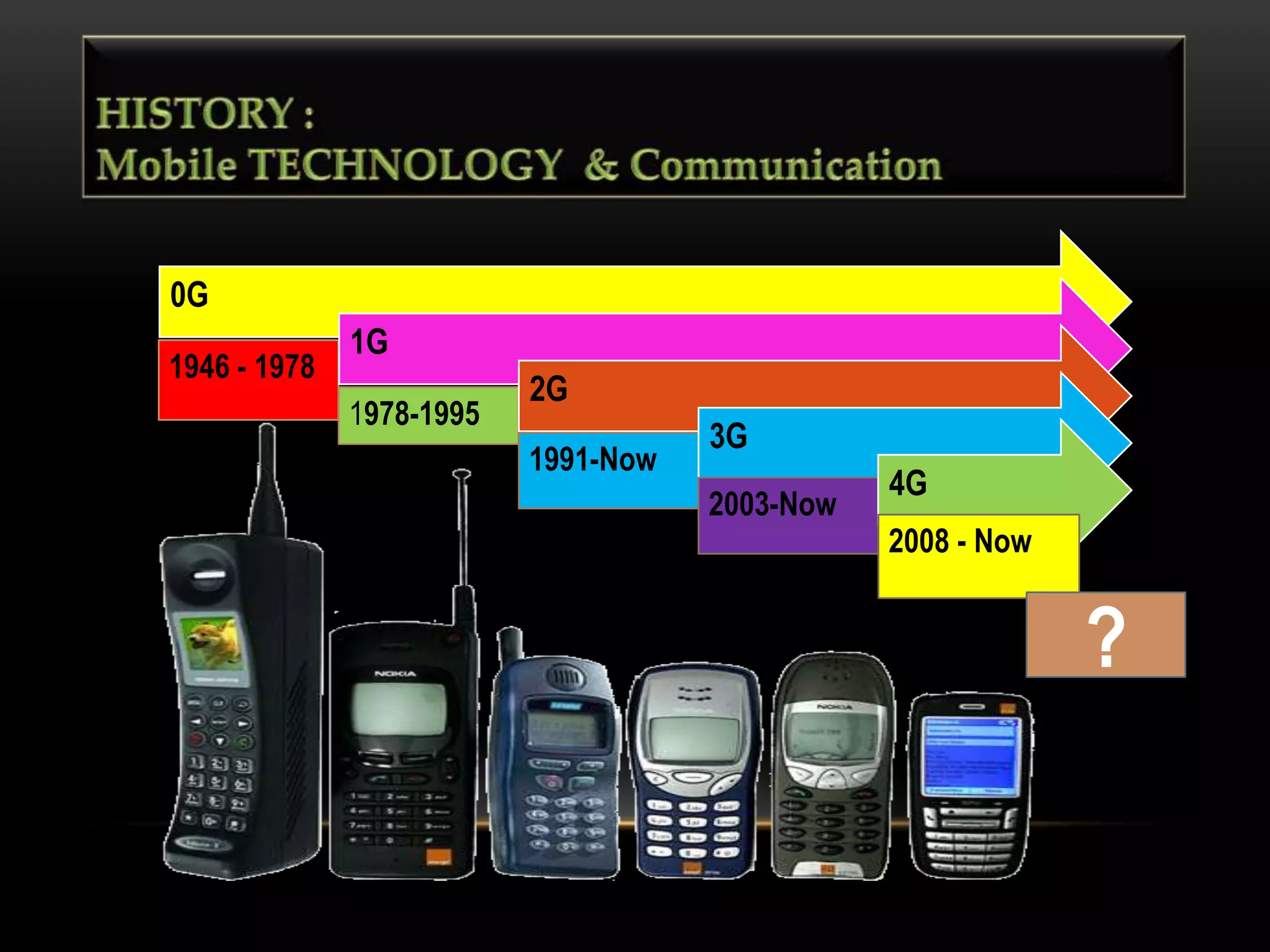
0G
1946 - 1978

1G
1978-1995

2G
1991-Now

3G
2003-Now

4G
2008 - Now

?
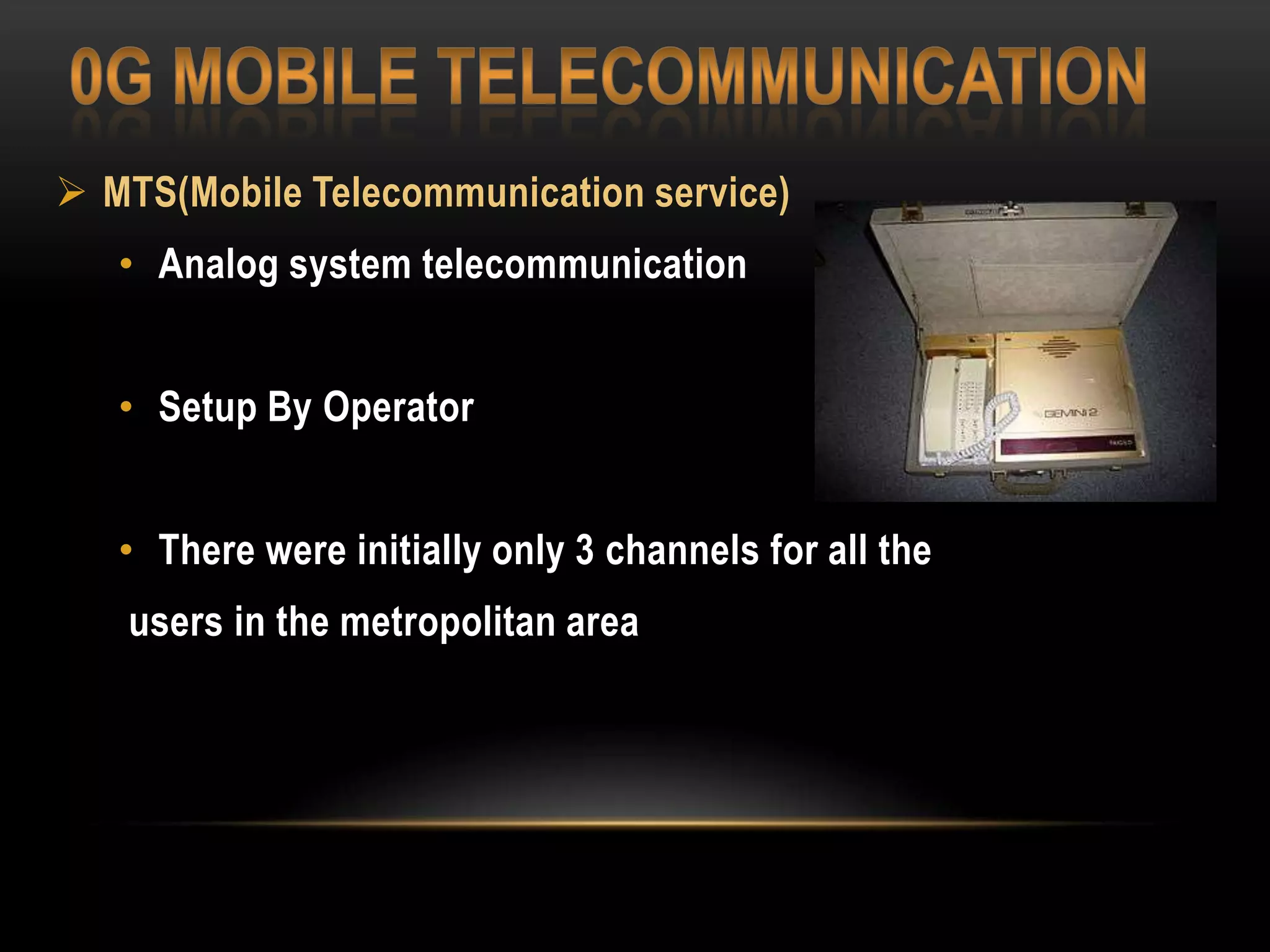
 MTS(Mobile Telecommunication service)
• Analog system telecommunication
• Setup By Operator

• There were initially only 3 channels for all the
users in the metropolitan area
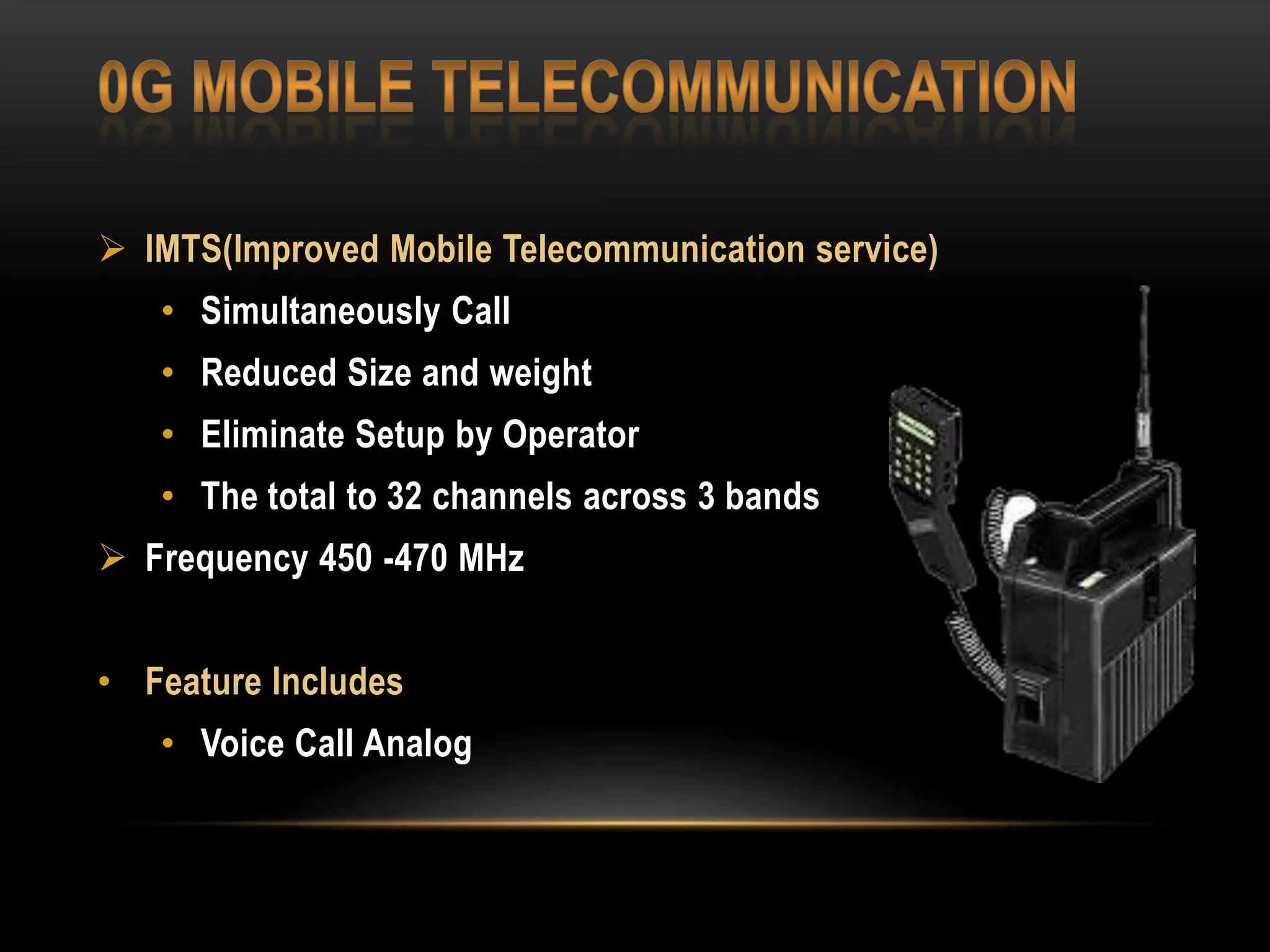
 IMTS(Improved Mobile Telecommunication service)
• Simultaneously Call
• Reduced Size and weight
• Eliminate Setup by Operator
• The total to 32 channels across 3 bands

 Frequency 450 -470 MHz
• Feature Includes
• Voice Call Analog
 Introduced in 1980s
 NMT (Nordic Mobile Telephone)
 AMPS(Advanced Mobile Phone System)
 The first commercially automated cellular network (the 1G generation) was
launched in Japan by (Nippon Telegraph and Telephone) in 1979, initially in
the metropolitan area of Tokyo
• Frequency 800 MHz
• Analog Systems
• Feature Includes

• Voice Call Analog
• Text message also possible with some sophisticated
devices

•

It has low capacity, unreliable handoff

•

poor voice links

•

no security at all
• GSM ( Global System Mobile
Communication)
• 2G cellular telecom networks were
commercially launched on
the GSM standard in Finland 1991
•

GPRS( General Packet Radio Service)

• Frequency 900 , 1800 MHz (GSM) , 1900 MHz
CDMA(code division multiple access)
• SimCard
• Digital System ( voice and data)
• Data transfer rate : 62 Kbps – 144 Kbps
• Text messages, picture messages and MMS (multi media
messages)
• Use it for travelling purpose.
• Content Download (Music, Picture , Animation)(2.5 G)
• WAP Browsing (2.5 G)
• STK (Sims Tool Kit)
• Refers as personal communication service

• Include the 2.5G and 2.75G
Mobile Technology and communication
• 3G Technology is designed for multimedia communication
• 3G has the following enhancements over 2.5G
• 
Enhanced audio and video streaming;
• 
Several Times higher data speed;
• 
Video-conferencing support;

•  and WAP browsing at higher speeds
Web
• 
IPTV (TV through the Internet) support.
• 
There are many 3G technologies as
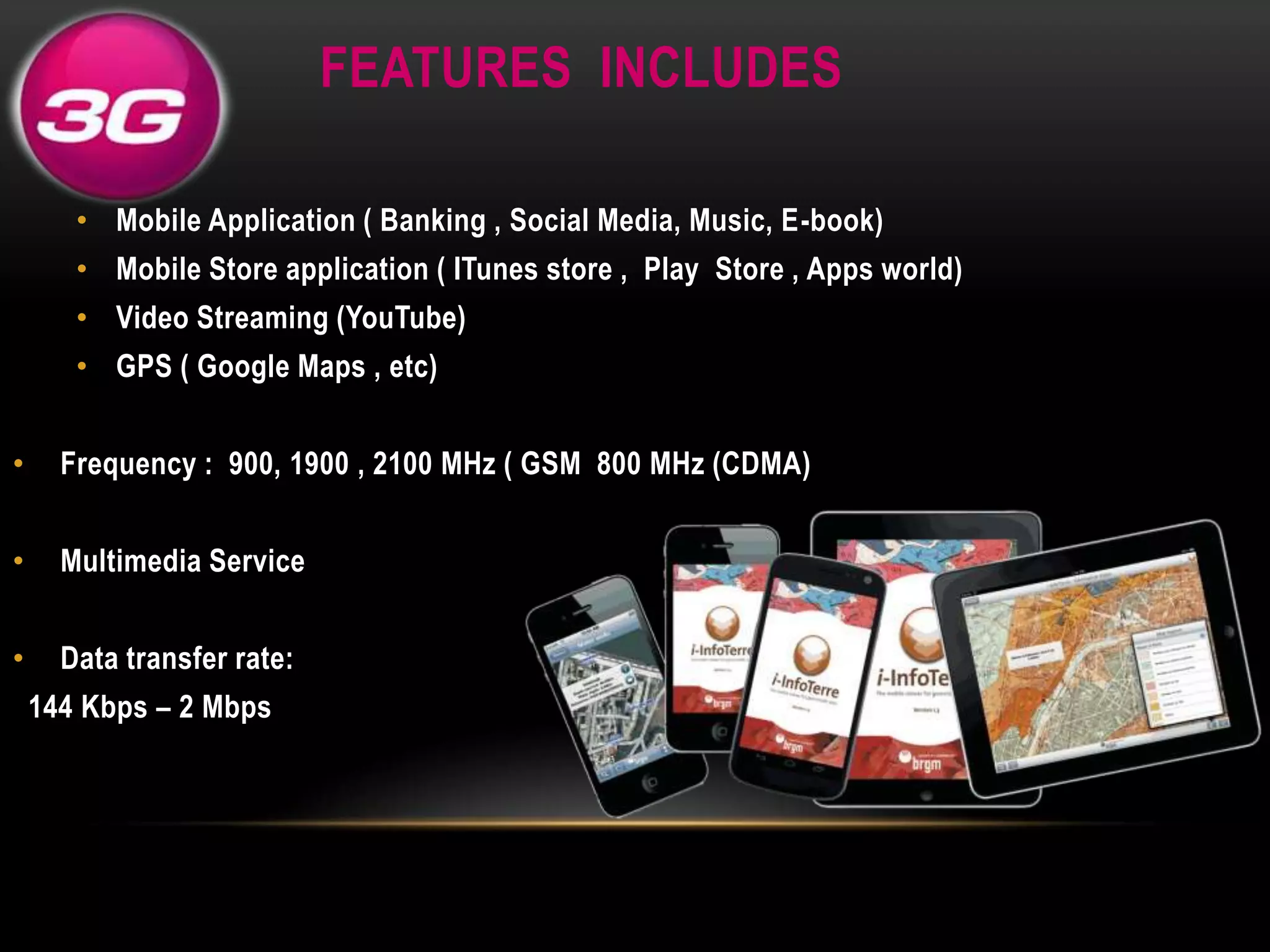
FEATURES INCLUDES
• Mobile Application ( Banking , Social Media, Music, E-book)
• Mobile Store application ( ITunes store , Play Store , Apps world)

• Video Streaming (YouTube)
• GPS ( Google Maps , etc)
•

Frequency : 900, 1900 , 2100 MHz ( GSM 800 MHz (CDMA)

•

Multimedia Service

•

Data transfer rate:
144 Kbps – 2 Mbps
MOBILE TELECOMMUNICATION
• A 4G system provides mobile ultra-broadband Internet access
• WIMAX(Worldwide Interoperability for Microwave Access)
• LTE(Long Term Evolution)
• Multimedia High Quality Data
• Data transfer rate: 20 Mbps -100 Mbps
• Wireless Technology
• Video streaming High Quality
• Broadcast TV (IP TV)
• Sales Force Automation
• Real Time Financial Information
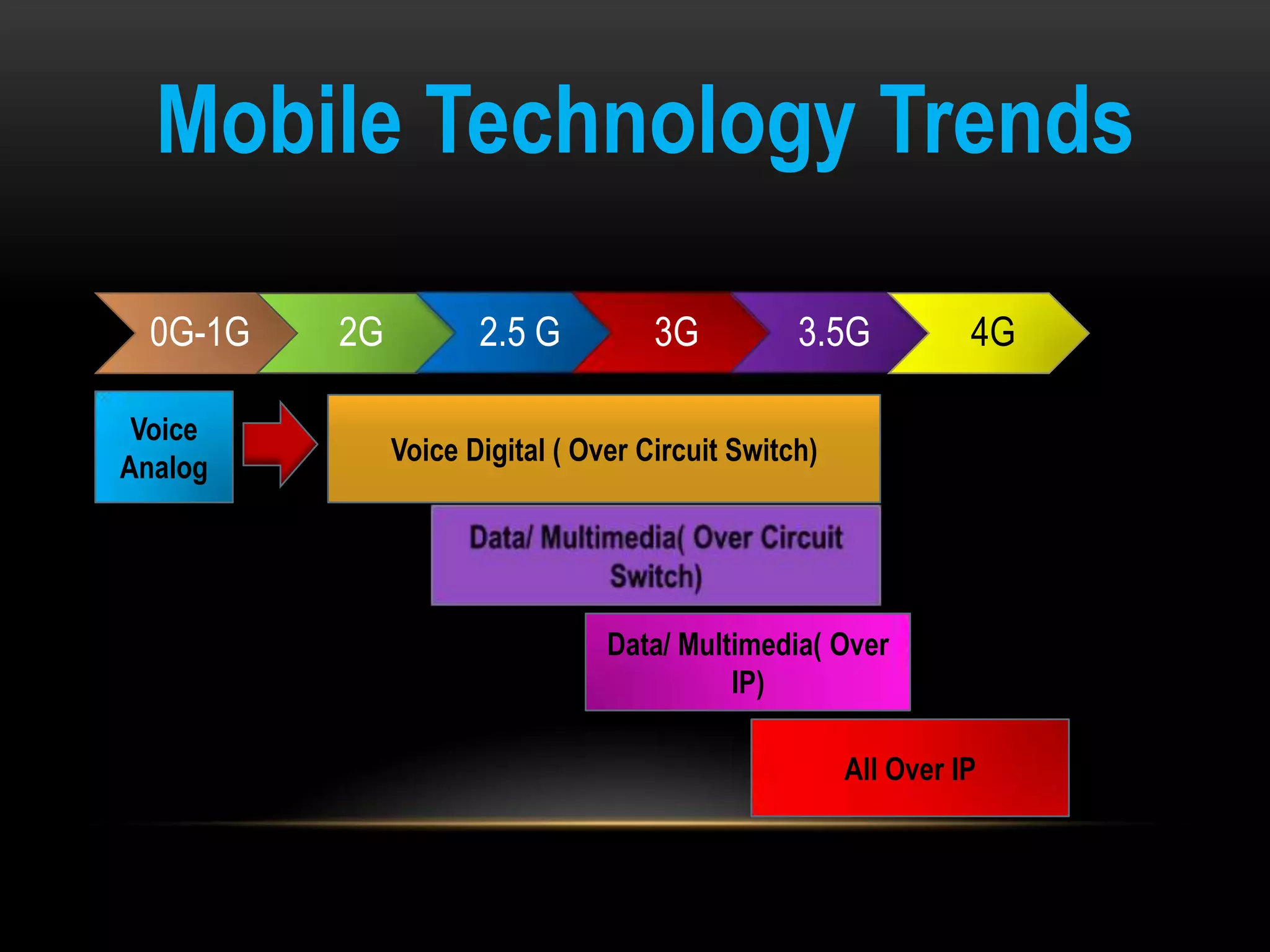
Mobile Technology Trends
0G-1G
Voice
Analog

2G

2.5 G

3G

3.5G

4G

Voice Digital ( Over Circuit Switch)

Data/ Multimedia( Over
IP)
All Over IP
0G to 5Gl
0G to 5Gl

0G to 5Gl

  • 3.
     Mobile wirelesstechnology came early in 1970s.  Mobile Wireless Technology has experienced different generations of Technology mainly from 0G to 4G. Implementation work of 5G is going on.  Mobile radio telephone systems (0G) preceded modern cellular mobile telephony technology.  The mobile wireless communication was possible only by the introduction of 1G technology.  2G technology replaced the analogy technology by digital communication .
  • 4.
  • 5.
     MTS(Mobile Telecommunicationservice) • Analog system telecommunication • Setup By Operator • There were initially only 3 channels for all the users in the metropolitan area
  • 6.
     IMTS(Improved MobileTelecommunication service) • Simultaneously Call • Reduced Size and weight • Eliminate Setup by Operator • The total to 32 channels across 3 bands  Frequency 450 -470 MHz • Feature Includes • Voice Call Analog
  • 8.
     Introduced in1980s  NMT (Nordic Mobile Telephone)  AMPS(Advanced Mobile Phone System)  The first commercially automated cellular network (the 1G generation) was launched in Japan by (Nippon Telegraph and Telephone) in 1979, initially in the metropolitan area of Tokyo • Frequency 800 MHz • Analog Systems
  • 9.
    • Feature Includes •Voice Call Analog • Text message also possible with some sophisticated devices • It has low capacity, unreliable handoff • poor voice links • no security at all
  • 10.
    • GSM (Global System Mobile Communication) • 2G cellular telecom networks were commercially launched on the GSM standard in Finland 1991 • GPRS( General Packet Radio Service) • Frequency 900 , 1800 MHz (GSM) , 1900 MHz CDMA(code division multiple access) • SimCard • Digital System ( voice and data) • Data transfer rate : 62 Kbps – 144 Kbps
  • 11.
    • Text messages,picture messages and MMS (multi media messages) • Use it for travelling purpose. • Content Download (Music, Picture , Animation)(2.5 G) • WAP Browsing (2.5 G) • STK (Sims Tool Kit) • Refers as personal communication service • Include the 2.5G and 2.75G
  • 12.
    Mobile Technology andcommunication • 3G Technology is designed for multimedia communication • 3G has the following enhancements over 2.5G •  Enhanced audio and video streaming; •  Several Times higher data speed; •  Video-conferencing support; •  and WAP browsing at higher speeds Web •  IPTV (TV through the Internet) support. •  There are many 3G technologies as
  • 13.
    FEATURES INCLUDES • MobileApplication ( Banking , Social Media, Music, E-book) • Mobile Store application ( ITunes store , Play Store , Apps world) • Video Streaming (YouTube) • GPS ( Google Maps , etc) • Frequency : 900, 1900 , 2100 MHz ( GSM 800 MHz (CDMA) • Multimedia Service • Data transfer rate: 144 Kbps – 2 Mbps
  • 16.
    MOBILE TELECOMMUNICATION • A4G system provides mobile ultra-broadband Internet access • WIMAX(Worldwide Interoperability for Microwave Access) • LTE(Long Term Evolution) • Multimedia High Quality Data • Data transfer rate: 20 Mbps -100 Mbps • Wireless Technology
  • 17.
    • Video streamingHigh Quality • Broadcast TV (IP TV) • Sales Force Automation • Real Time Financial Information
  • 18.
    Mobile Technology Trends 0G-1G Voice Analog 2G 2.5G 3G 3.5G 4G Voice Digital ( Over Circuit Switch) Data/ Multimedia( Over IP) All Over IP