Universal Gravitation
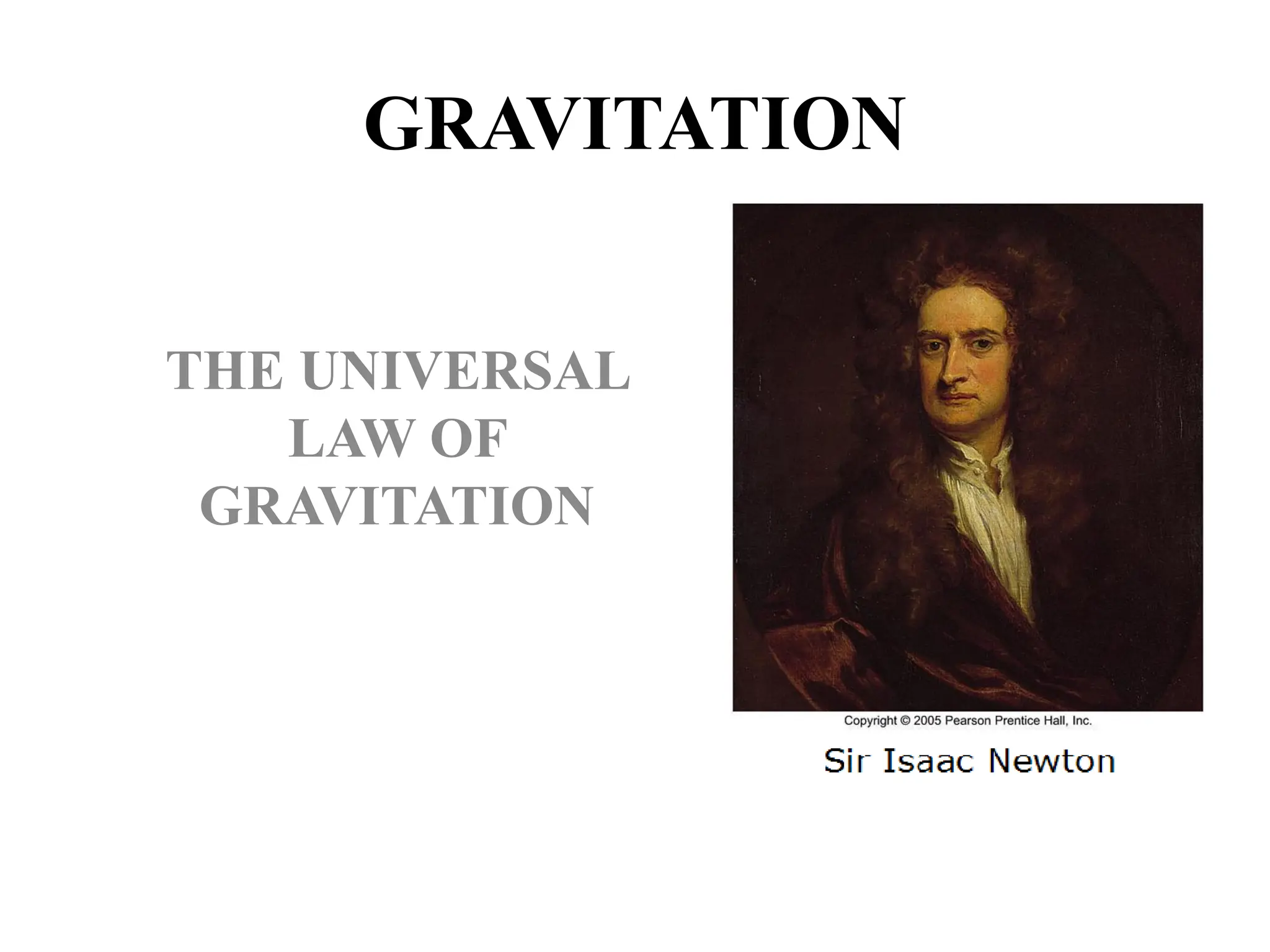
• Newtonrealized that gravity acts everywhere
in the universe, not just on Earth.
• It is the force that makes an apple fall to the
ground.
• It is the force that keeps the moon orbiting
around Earth.
• It is the force that keeps all the planets in our
solar system orbiting around the sun.
3.
•What Newton realizedis now called the law of universal
gravitation.
•The law of universal gravitation states that the force of
gravity acts between all objects in the universe.
•This means that any two objects in the universe, without
exception, attract each other.
•You are attracted not only to Earth but also to all the other
objects around you.
4.
•Earth and theobjects around you are attracted to you as
well.
•However, you do not notice the attraction among objects
because these forces are small compared to the force of
Earth’s attraction.
5.
Factors Affecting Gravity
•Two factors affect the gravitational attraction between objects:
– Mass
– Distance
• Mass is a measure of the amount of matter in an object.
• The SI unit of mass is the kilogram.
• One kilogram is the mass of about 400 modern pennies.
• Everything that has mass is made up of matter.
• The more mass an object has, the greater its gravitational force.
• Because the sun’s mass is so great, it exerts a large gravitational
force on the planets.
• That’s one reason why the planets orbit the sun.
6.
Factors Affecting Gravity
•In addition to mass, gravitational force depends on the distance
between the objects.
• The farther apart two objects are, the lesser the gravitational
force between them.
• For a spacecraft traveling toward Mars, Earth’s gravitational
pull decreases as the spacecraft's distance from Earth
increases.
• Eventually the gravitational pull of Mars becomes greater than
Earth’s, and the spacecraft is more attracted toward Mars.
7.
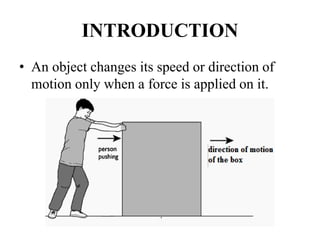
INTRODUCTION
• An objectchanges its speed or direction of
motion only when a force is applied on it.
8.
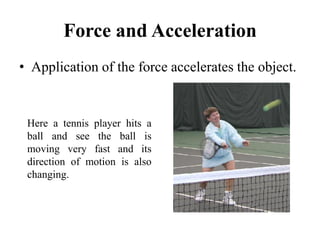
Force and Acceleration
•Application of the force accelerates the object.
Here a tennis player hits a
ball and see the ball is
moving very fast and its
direction of motion is also
changing.
9.
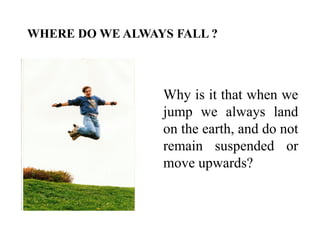
Why is itthat when we
jump we always land
on the earth, and do not
remain suspended or
move upwards?
WHERE DO WE ALWAYS FALL ?
10.
What makes usto fall on the earth always?
• There is always some force acting on us that
guides our direction of falling.
• No matter from where ever we jump, or we
drop objects from anywhere they will always
fall towards the earth.
11.
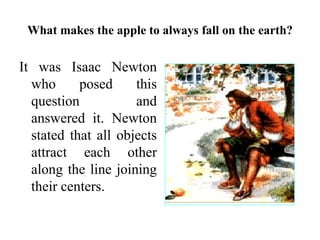
What makes theapple to always fall on the earth?
It was Isaac Newton
who posed this
question and
answered it. Newton
stated that all objects
attract each other
along the line joining
their centers.
12.
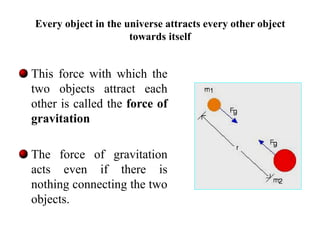
Every object inthe universe attracts every other object
towards itself
This force with which the
two objects attract each
other is called the force of
gravitation
The force of gravitation
acts even if there is
nothing connecting the two
objects.
13.
The Universal Lawof Gravitation
• Newton did not stop after proposing that a
force of gravitation exists. He expressed the
law in a clear and precise language- the
language of mathematics.
14.
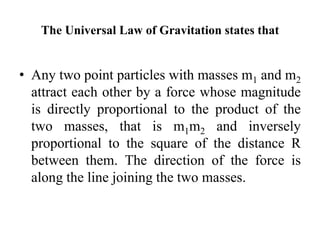
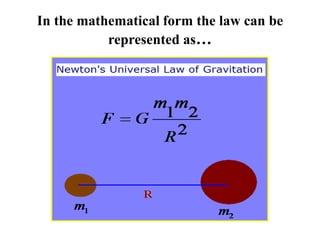
The Universal Lawof Gravitation states that
• Any two point particles with masses m1 and m2
attract each other by a force whose magnitude
is directly proportional to the product of the
two masses, that is m1m2 and inversely
proportional to the square of the distance R
between them. The direction of the force is
along the line joining the two masses.
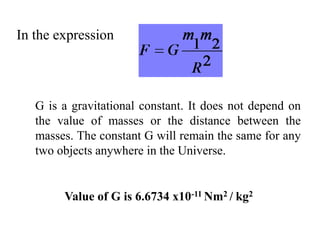
In the expression
Gis a gravitational constant. It does not depend on
the value of masses or the distance between the
masses. The constant G will remain the same for any
two objects anywhere in the Universe.
Value of G is 6.6734 x10⁻¹¹ Nm2 / kg2
17.
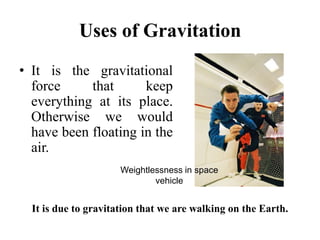
Uses of Gravitation
•It is the gravitational
force that keep
everything at its place.
Otherwise we would
have been floating in the
air.
It is due to gravitation that we are walking on the Earth.
Weightlessness in space
vehicle
18.
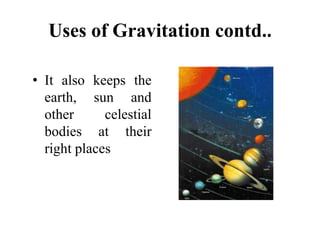
Uses of Gravitationcontd..
• It also keeps the
earth, sun and
other celestial
bodies at their
right places
19.
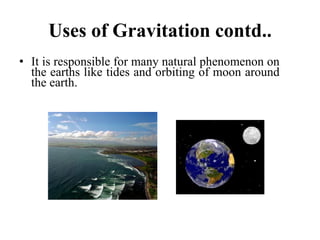
Uses of Gravitationcontd..
• It is responsible for many natural phenomenon on
the earths like tides and orbiting of moon around
the earth.
20.
Weight and Mass
•Mass is sometimes confused with weight.
• Mass is a measure of the amount of matter in an object; weight is the
measure of the gravitational force exerted on an object.
• Weight is measured in newtons, and Mass is measured in kilograms.
• Newtons are much smaller than kilograms.
• A body’s weight can change depending on whether it’s on earth, the moon,
mars and so on. Unlike your weight, your mass won’t change if you move
to another planet.
• On earth, 1 kg has a weight of 9.8 N, and on the moon, 1 kg has a weight of
only 1.6 N.
• The force of gravity on a person or object at the surface of a planet is
known as weight.
• So, when you step on a bathroom scale, you are determining the
gravitational force Earth is exerting on you.
21.
Weight and Mass
•Weight varies with the strength of the gravitational force but
mass does not.
• Suppose on Earth Mr. X reads 69 kg or 676 N. On the moon,
Mr. X would still has a mass of 69 kg, but his weight would
be only 110 N. So, one way to lose weight is to go to the
moon.
• Suppose you weighed yourself on Earth to be 450 newtons.
• Then you traveled to the moon and weighed yourself again.
• You might be surprised to find out that you weigh only about
75 newtons – the weight of about 8 kilograms on Earth!
• You weigh less on the moon because the moon’s mass is only
a fraction of Earth’s
22.
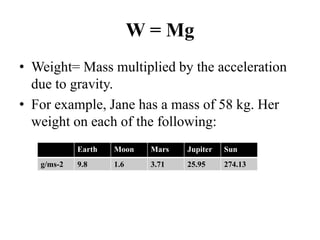
W = Mg
•Weight= Mass multiplied by the acceleration
due to gravity.
• For example, Jane has a mass of 58 kg. Her
weight on each of the following:
Earth Moon Mars Jupiter Sun
g/ms-2 9.8 1.6 3.71 25.95 274.13
23.
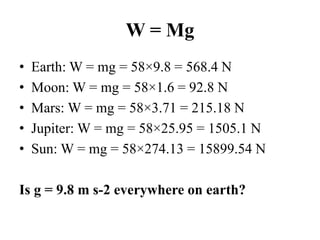
W = Mg
•Earth: W = mg = 58×9.8 = 568.4 N
• Moon: W = mg = 58×1.6 = 92.8 N
• Mars: W = mg = 58×3.71 = 215.18 N
• Jupiter: W = mg = 58×25.95 = 1505.1 N
• Sun: W = mg = 58×274.13 = 15899.54 N
Is g = 9.8 m s-2 everywhere on earth?
24.
W = Mg
•Answer is No.
• Standard gravity, or standard acceleration due
to free fall, usually denoted by go or gn, is the
nominal acceleration of body in a vacuum near
the surface of the earth. It is defined to be
precisely 9.80665 m s-2.