

Supply chain & logistics optimization at Shell
Julien Granger, Ph.D.
Consultant, Shell Global Solutions
Julien.Granger@shell.com
http://www.shell.com/global/products-
services/solutions-for-businesses/globalsolutions.html
Use this area for cover image
(height 6.5cm, width 8cm)
Supply chain & logistics
optimization at Shell
ORTEC Optimus 2015
23-25 March 2015
Atlanta, Georgia, U.S.A.
Nort Thijssen
3/29/2015
Julien Granger, Ph.D.
Shell Global Solutions
3
DEFINITIONS & CAUTIONARY NOTE
Reserves: Our use of the term “reserves” in this presentation means SEC proved oil and gas reserves.
Resources: Our use of the term “resources” in this presentation includes quantities of oil and gas not yet classified as SEC proved oil and gas reserves. Resources are
consistent with the Society of Petroleum Engineers 2P and 2C definitions.
Organic: Our use of the term Organic includes SEC proved oil and gas reserves excluding changes resulting from acquisitions, divestments and year-average pricing
impact.
Resources plays: our use of the term ‘resources plays’ refers to tight, shale and coal bed methane oil and gas acreage.
The companies in which Royal Dutch Shell plc directly and indirectly owns investments are separate entities. In this presentation “Shell”, “Shell group” and “Royal Dutch
Shell” are sometimes used for convenience where references are made to Royal Dutch Shell plc and its subsidiaries in general. Likewise, the words “we”, “us” and “our” are
also used to refer to subsidiaries in general or to those who work for them. These expressions are also used where no useful purpose is served by identifying the particular
company or companies. ‘‘Subsidiaries’’, “Shell subsidiaries” and “Shell companies” as used in this presentation refer to companies in which Royal Dutch Shell either directly
or indirectly has control, by having either a majority of the voting rights or the right to exercise a controlling influence. The companies in which Shell has significant influence
but not control are referred to as “associated companies” or “associates” and companies in which Shell has joint control are referred to as “jointly controlled entities”. In this
presentation, associates and jointly controlled entities are also referred to as “equity-accounted investments”. The term “Shell interest” is used for convenience to indicate
the direct and/or indirect ownership interest held by Shell in a venture, partnership or company, after exclusion of all third-party interest.
This presentation contains forward-looking statements concerning the financial condition, results of operations and businesses of Royal Dutch Shell. All statements other
than statements of historical fact are, or may be deemed to be, forward-looking statements. Forward-looking statements are statements of future expectations that are
based on management’s current expectations and assumptions and involve known and unknown risks and uncertainties that could cause actual results, performance or
events to differ materially from those expressed or implied in these statements. Forward-looking statements include, among other things, statements concerning the
potential exposure of Royal Dutch Shell to market risks and statements expressing management’s expectations, beliefs, estimates, forecasts, projections and assumptions.
These forward-looking statements are identified by their use of terms and phrases such as ‘‘anticipate’’, ‘‘believe’’, ‘‘could’’, ‘‘estimate’’, ‘‘expect’’, ‘‘intend’’, ‘‘may’’, ‘‘plan’’,
‘‘objectives’’, ‘‘outlook’’, ‘‘probably’’, ‘‘project’’, ‘‘will’’, ‘‘seek’’, ‘‘target’’, ‘‘risks’’, ‘‘goals’’, ‘‘should’’ and similar terms and phrases. There are a number of factors that could
affect the future operations of Royal Dutch Shell and could cause those results to differ materially from those expressed in the forward-looking statements included in this
presentation, including (without limitation): (a) price fluctuations in crude oil and natural gas; (b) changes in demand for Shell’s products; (c) currency fluctuations; (d) drilling
and production results; (e) reserves estimates; (f) loss of market share and industry competition; (g) environmental and physical risks; (h) risks associated with the
identification of suitable potential acquisition properties and targets, and successful negotiation and completion of such transactions; (i) the risk of doing business in
developing countries and countries subject to international sanctions; (j) legislative, fiscal and regulatory developments including potential litigation and regulatory measures
as a result of climate changes; (k) economic and financial market conditions in various countries and regions; (l) political risks, including the risks of expropriation and
renegotiation of the terms of contracts with governmental entities, delays or advancements in the approval of projects and delays in the reimbursement for shared costs;
and (m) changes in trading conditions. All forward-looking statements contained in this presentation are expressly qualified in their entirety by the cautionary statements
contained or referred to in this section. Readers should not place undue reliance on forward-looking statements. Additional factors that may affect future results are
contained in Royal Dutch Shell’s 20-F for the year ended 31 December, 2013 (available at www.shell.com/investor and www.sec.gov ). These factors also should be
considered by the reader. Each forward-looking statement speaks only as of the date of this presentation, 24 March, 2015. Neither Royal Dutch Shell nor any of its
subsidiaries undertake any obligation to publicly update or revise any forward-looking statement as a result of new information, future events or other information. In light of
these risks, results could differ materially from those stated, implied or inferred from the forward-looking statements contained in this presentation. There can be no
assurance that dividend payments will match or exceed those set out in this presentation in the future, or that they will be made at all.
We use certain terms in this presentation, such as discovery potential, that the United States Securities and Exchange Commission (SEC) guidelines strictly prohibit us from
including in filings with the SEC. U.S. Investors are urged to consider closely the disclosure in our Form 20-F, File No 1-32575, available on the SEC website www.sec.gov.
You can also obtain this form from the SEC by calling 1-800-SEC-0330.
4
Agenda
We provide a high-level overview of some supply chain & logistics
optimization case studies solved in partnership with ORTEC.
Case studies:
1. Energy systems modelling
2. Production-logistics optimization in gas-to-chemicals
3. Ecosystems services – land use change optimization
5
SHELL
Shell aims to be the most competitive and innovative
energy company in the world.
DOWNSTREAM
PROJECTS &
TECHNOLOGY
UPSTREAM Searches for and recovers oil and natural gas
Refines, supplies, trades and ships crude
worldwide; manufactures and markets a range of
products.
Manages delivery of Shell’s major projects
and drives research and innovation.
Shell Global Solutions International BV
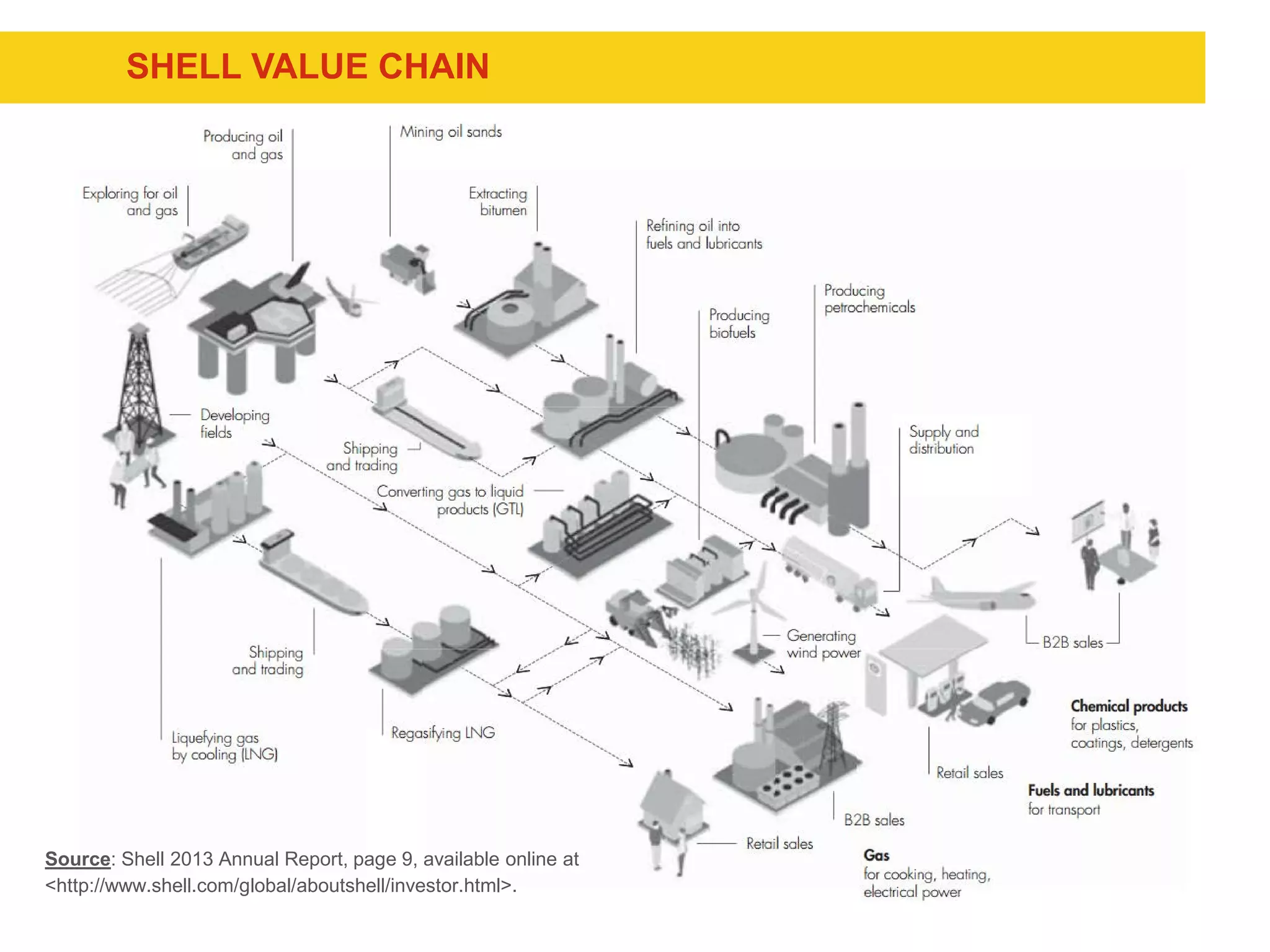
SHELL VALUE CHAIN
Source: Shell 2013 Annual Report, page 9, available online at
<http://www.shell.com/global/aboutshell/investor.html>.
Supply chain & logistics optimization at Shell
Energy systems modelling with
GMOS/NetSim
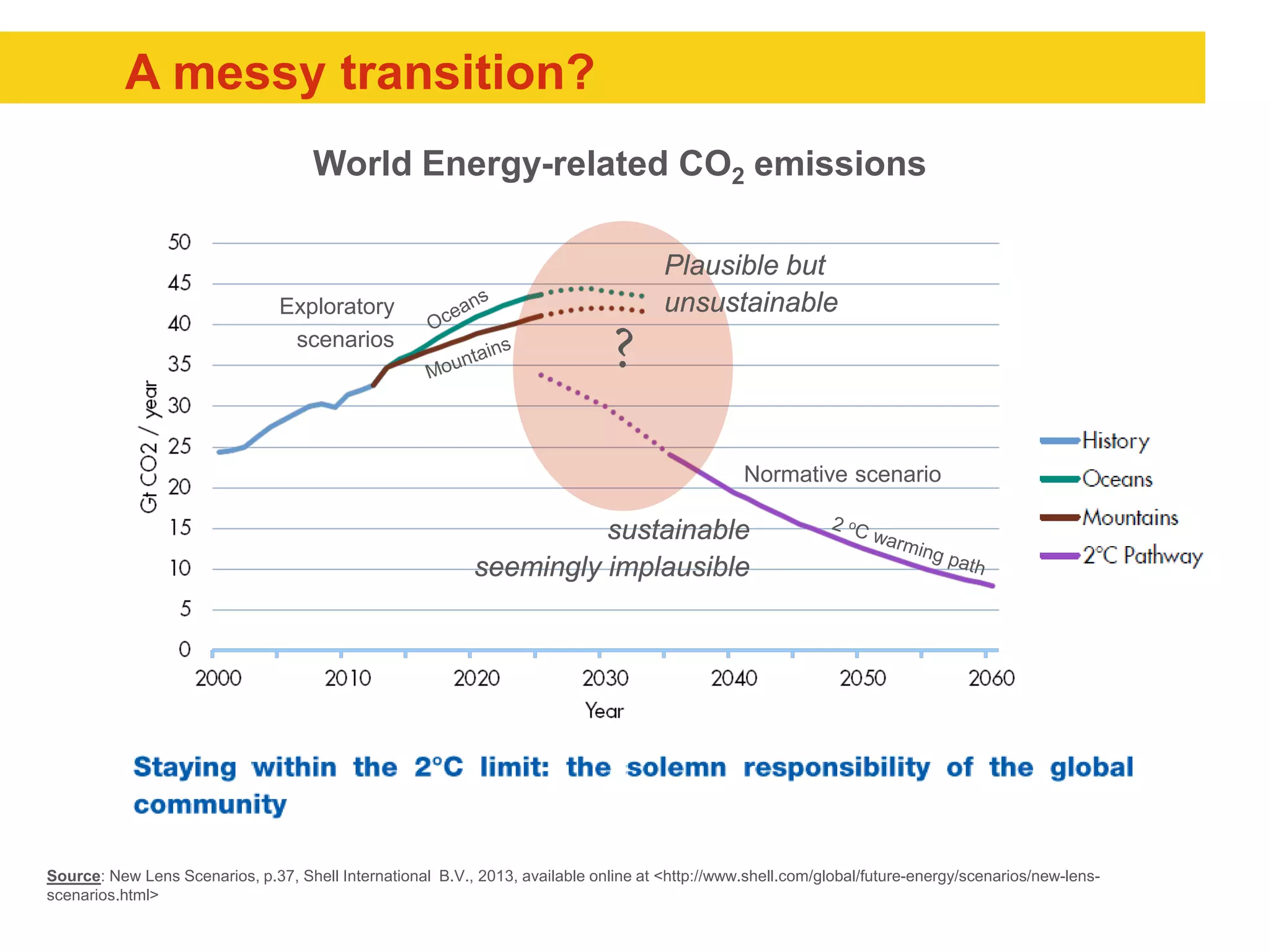
A messy transition?
?
Normative scenario
sustainable
seemingly implausible
Exploratory
scenarios
Plausible but
unsustainable
World Energy-related CO2 emissions
Source: New Lens Scenarios, p.37, Shell International B.V., 2013, available online at <http://www.shell.com/global/future-energy/scenarios/new-lens-
scenarios.html>
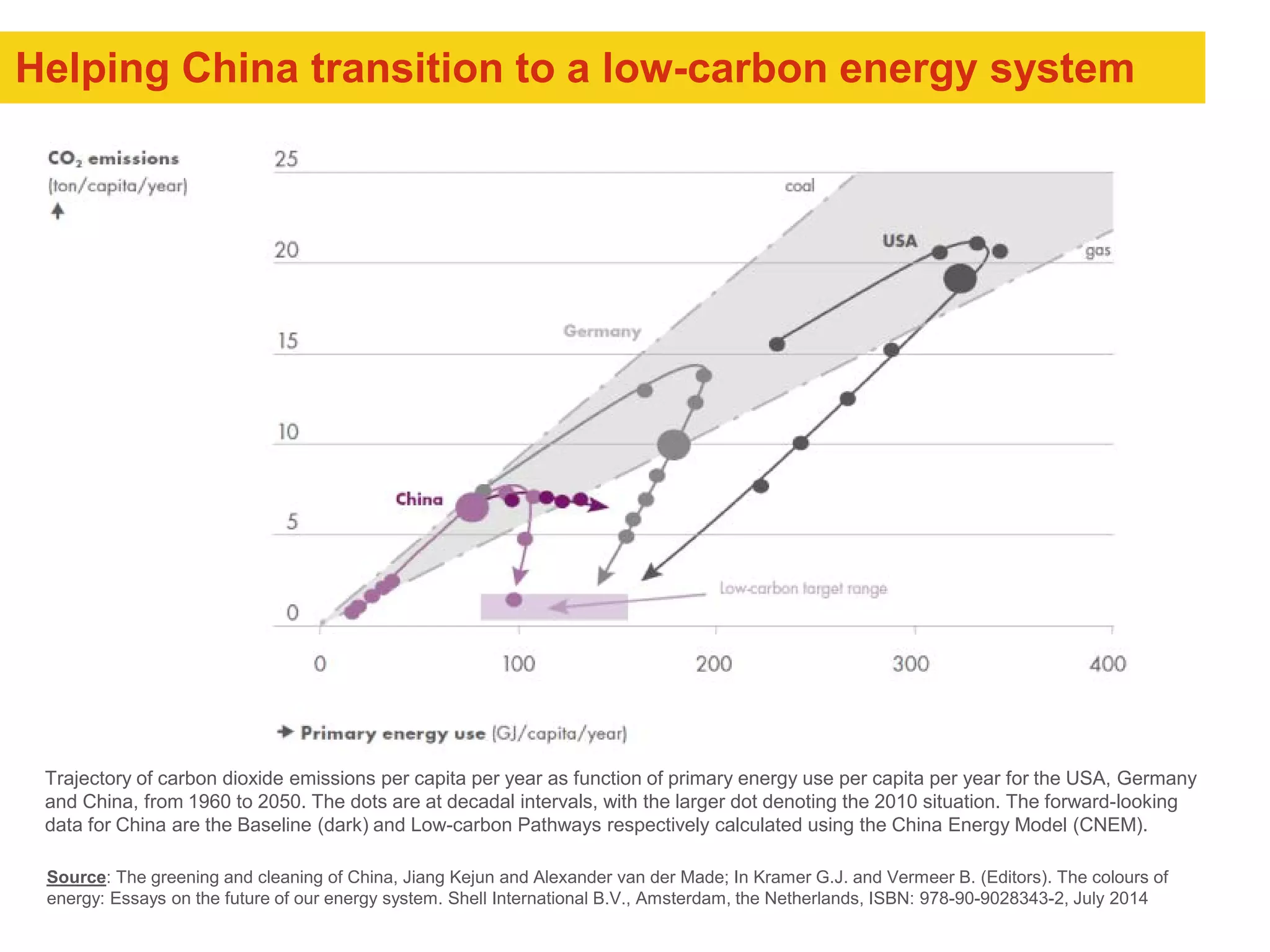
Helping China transition to a low-carbon energy system
Source: The greening and cleaning of China, Jiang Kejun and Alexander van der Made; In Kramer G.J. and Vermeer B. (Editors). The colours of
energy: Essays on the future of our energy system. Shell International B.V., Amsterdam, the Netherlands, ISBN: 978-90-9028343-2, July 2014
Trajectory of carbon dioxide emissions per capita per year as function of primary energy use per capita per year for the USA, Germany
and China, from 1960 to 2050. The dots are at decadal intervals, with the larger dot denoting the 2010 situation. The forward-looking
data for China are the Baseline (dark) and Low-carbon Pathways respectively calculated using the China Energy Model (CNEM).
Shell Global Solutions International BV
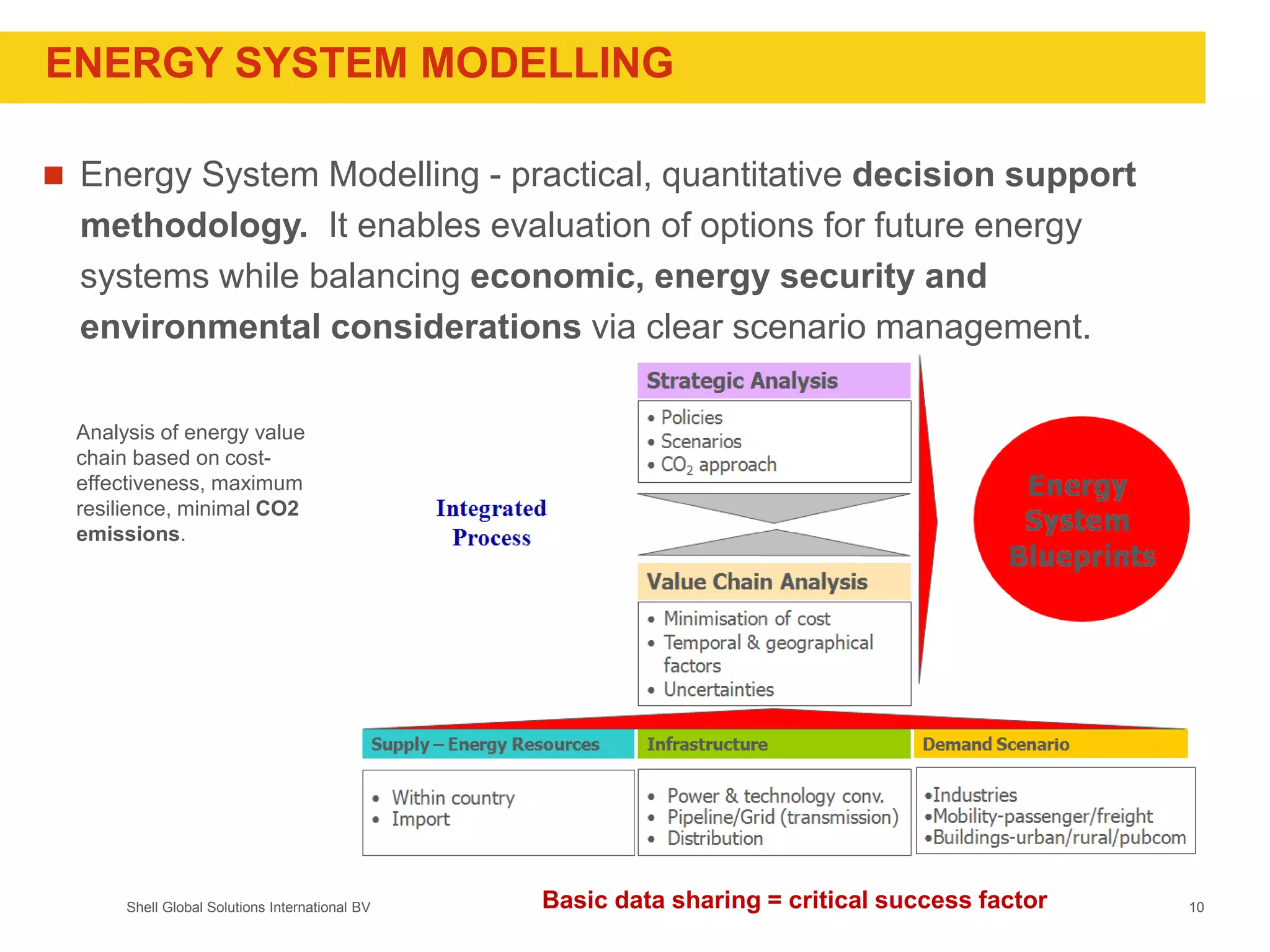
ENERGY SYSTEM MODELLING
 Energy System Modelling - practical, quantitative decision support
methodology. It enables evaluation of options for future energy
systems while balancing economic, energy security and
environmental considerations via clear scenario management.
Analysis of energy value
chain based on cost-
effectiveness, maximum
resilience, minimal CO2
emissions.
10Basic data sharing = critical success factor
Shell Global Solutions International BV
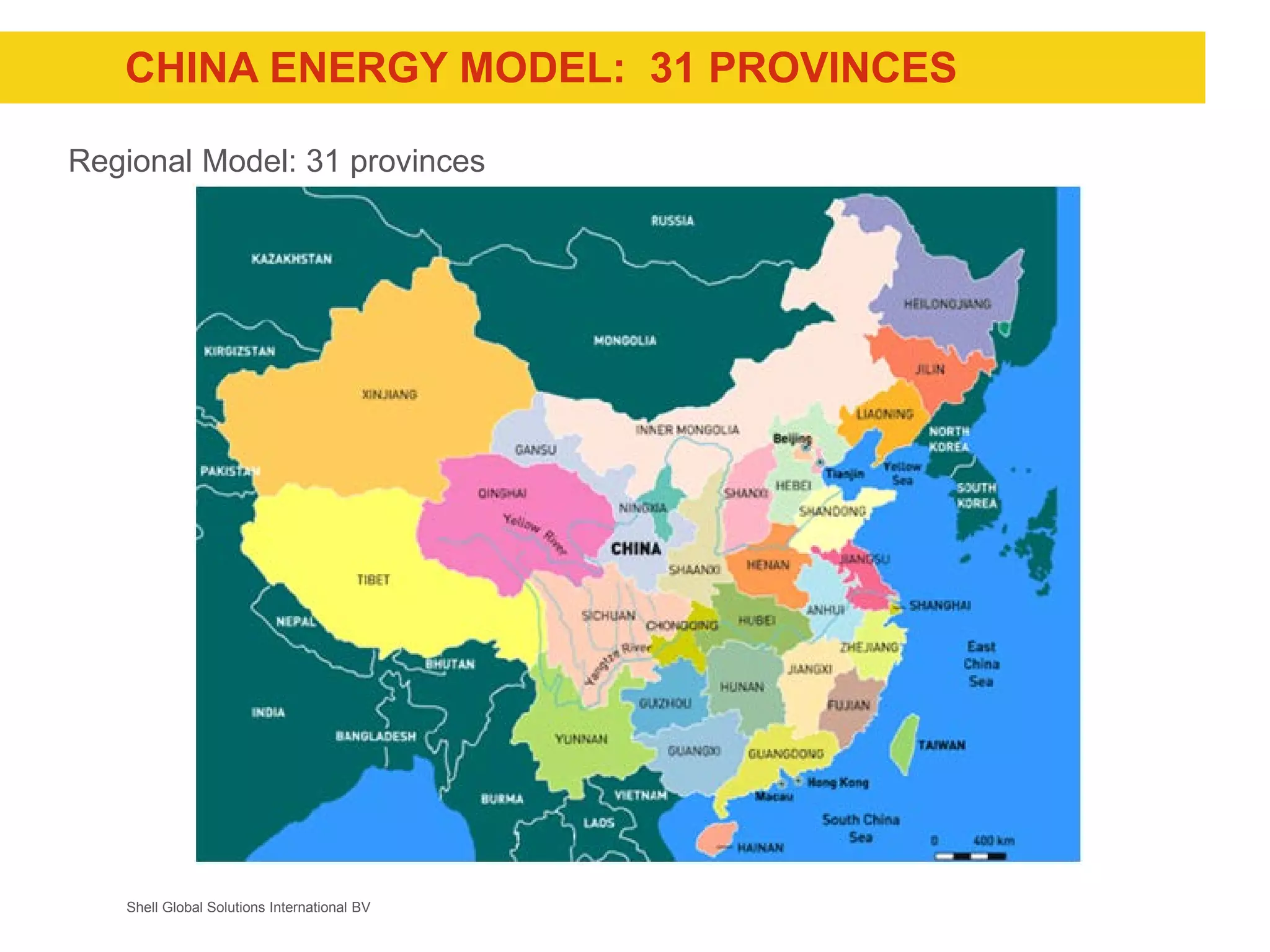
CHINA ENERGY MODEL: 31 PROVINCES
Regional Model: 31 provinces
1. Supply of resources to be transported into energy conversion
technologies
2. Energy conversion technologies, including opex, capex, scale,
indexed by period to capture technology improvements
3. Demand for energy per industry sector per province per period
China Energy model: network structure
Shell Global Solutions International BV
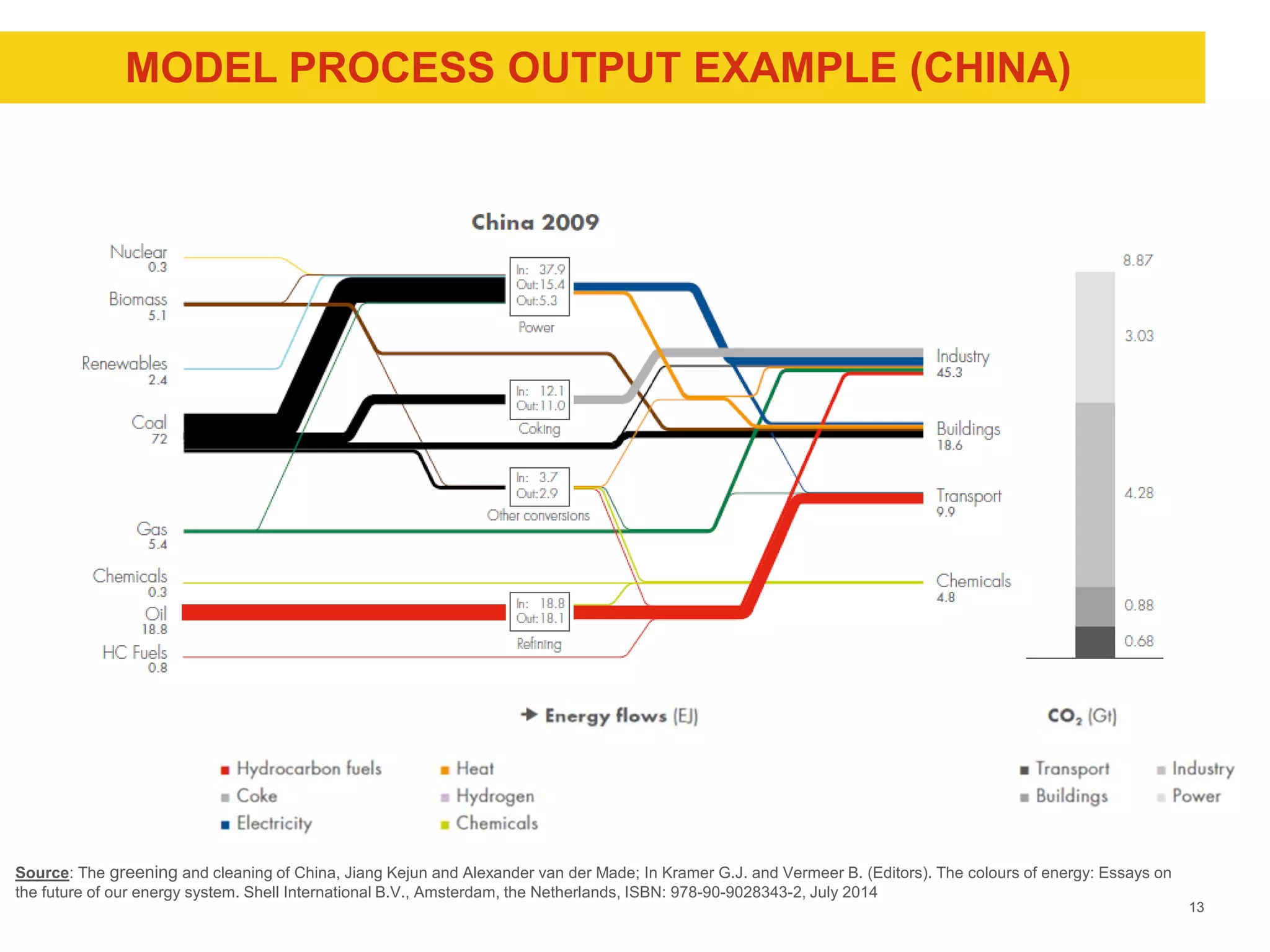
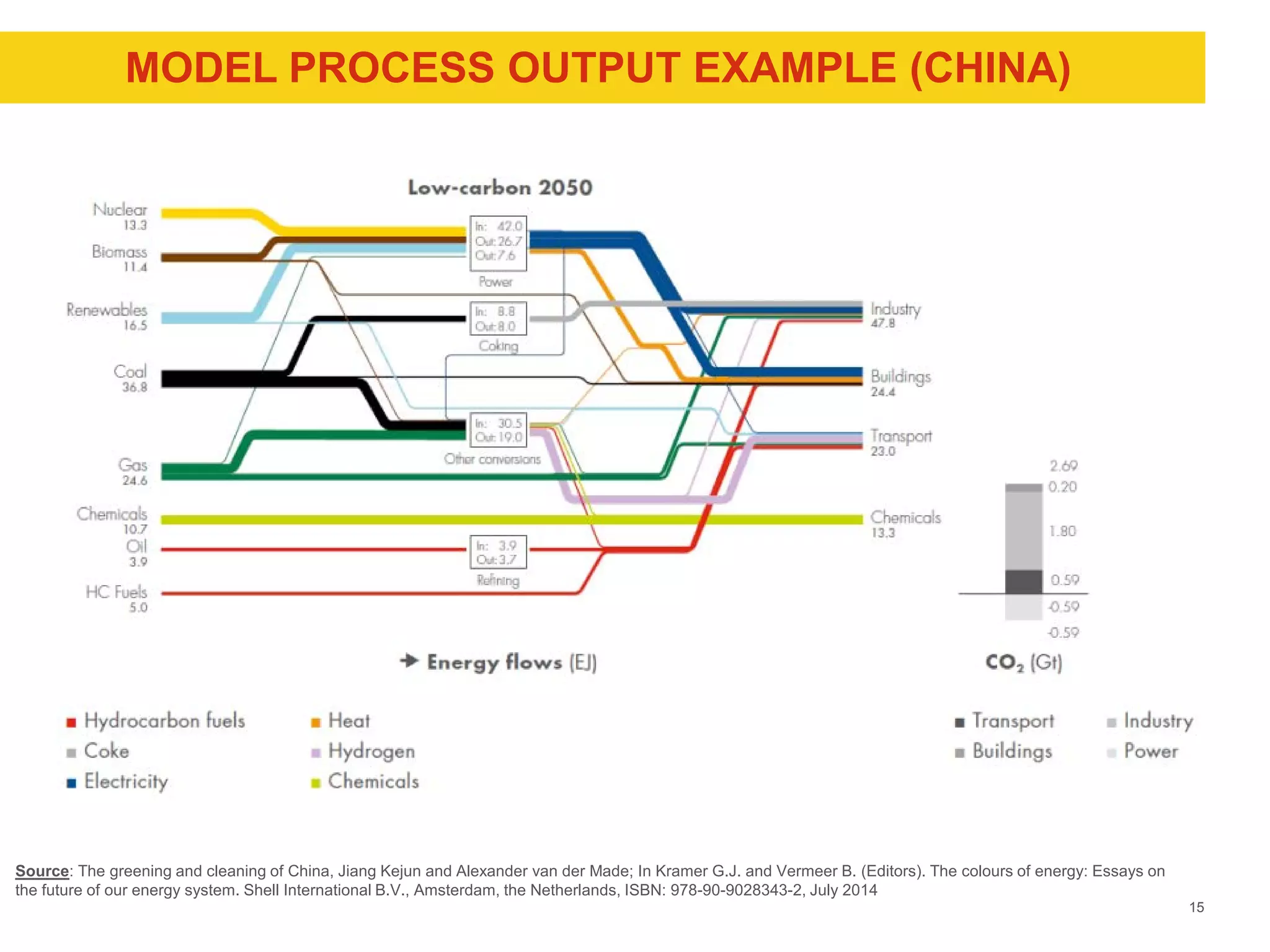
MODEL PROCESS OUTPUT EXAMPLE (CHINA)
13
Source: The greening and cleaning of China, Jiang Kejun and Alexander van der Made; In Kramer G.J. and Vermeer B. (Editors). The colours of energy: Essays on
the future of our energy system. Shell International B.V., Amsterdam, the Netherlands, ISBN: 978-90-9028343-2, July 2014
Shell Global Solutions International BV
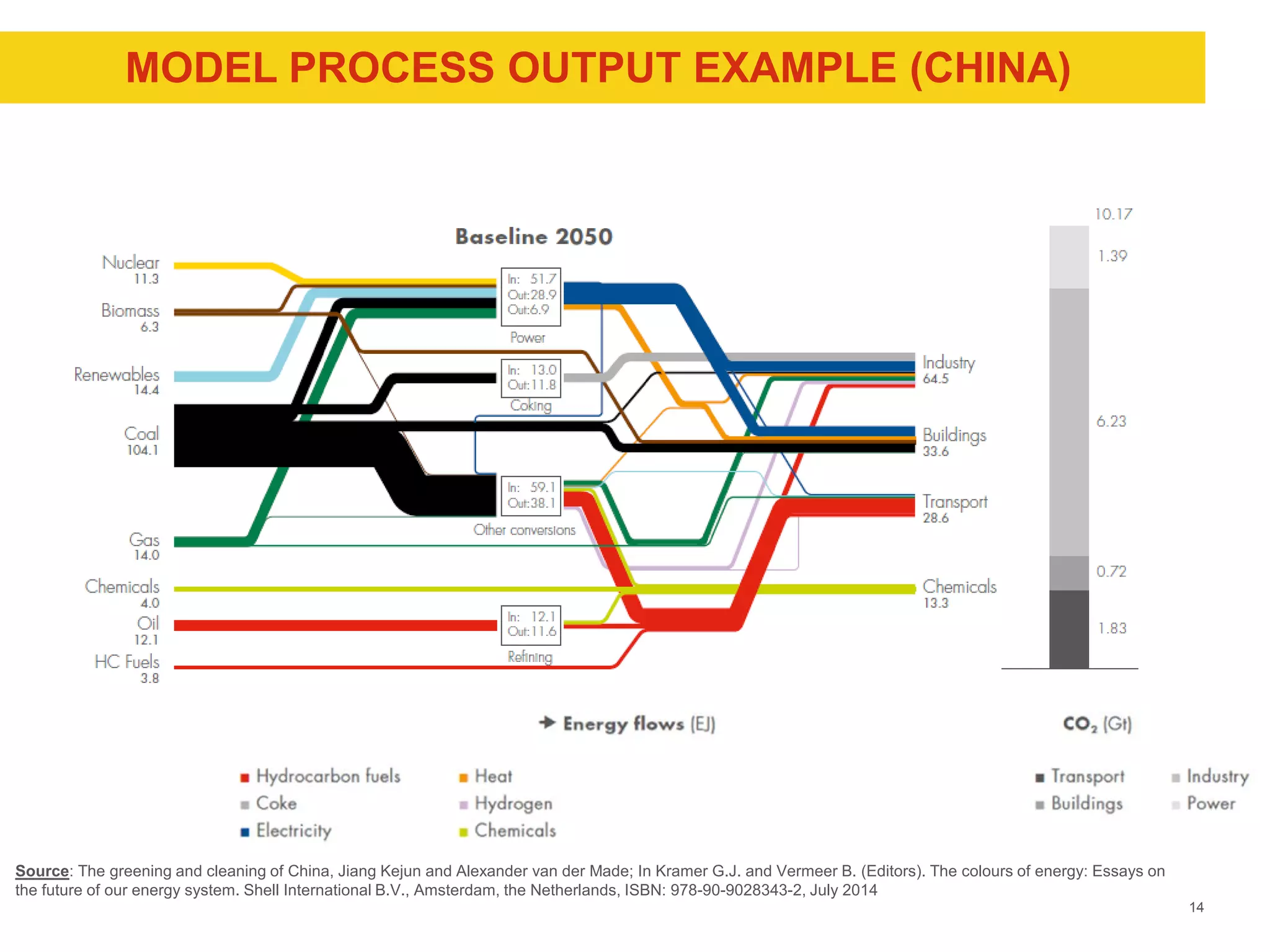
MODEL PROCESS OUTPUT EXAMPLE (CHINA)
14
Source: The greening and cleaning of China, Jiang Kejun and Alexander van der Made; In Kramer G.J. and Vermeer B. (Editors). The colours of energy: Essays on
the future of our energy system. Shell International B.V., Amsterdam, the Netherlands, ISBN: 978-90-9028343-2, July 2014
Shell Global Solutions International BV
MODEL PROCESS OUTPUT EXAMPLE (CHINA)
15
Source: The greening and cleaning of China, Jiang Kejun and Alexander van der Made; In Kramer G.J. and Vermeer B. (Editors). The colours of energy: Essays on
the future of our energy system. Shell International B.V., Amsterdam, the Netherlands, ISBN: 978-90-9028343-2, July 2014
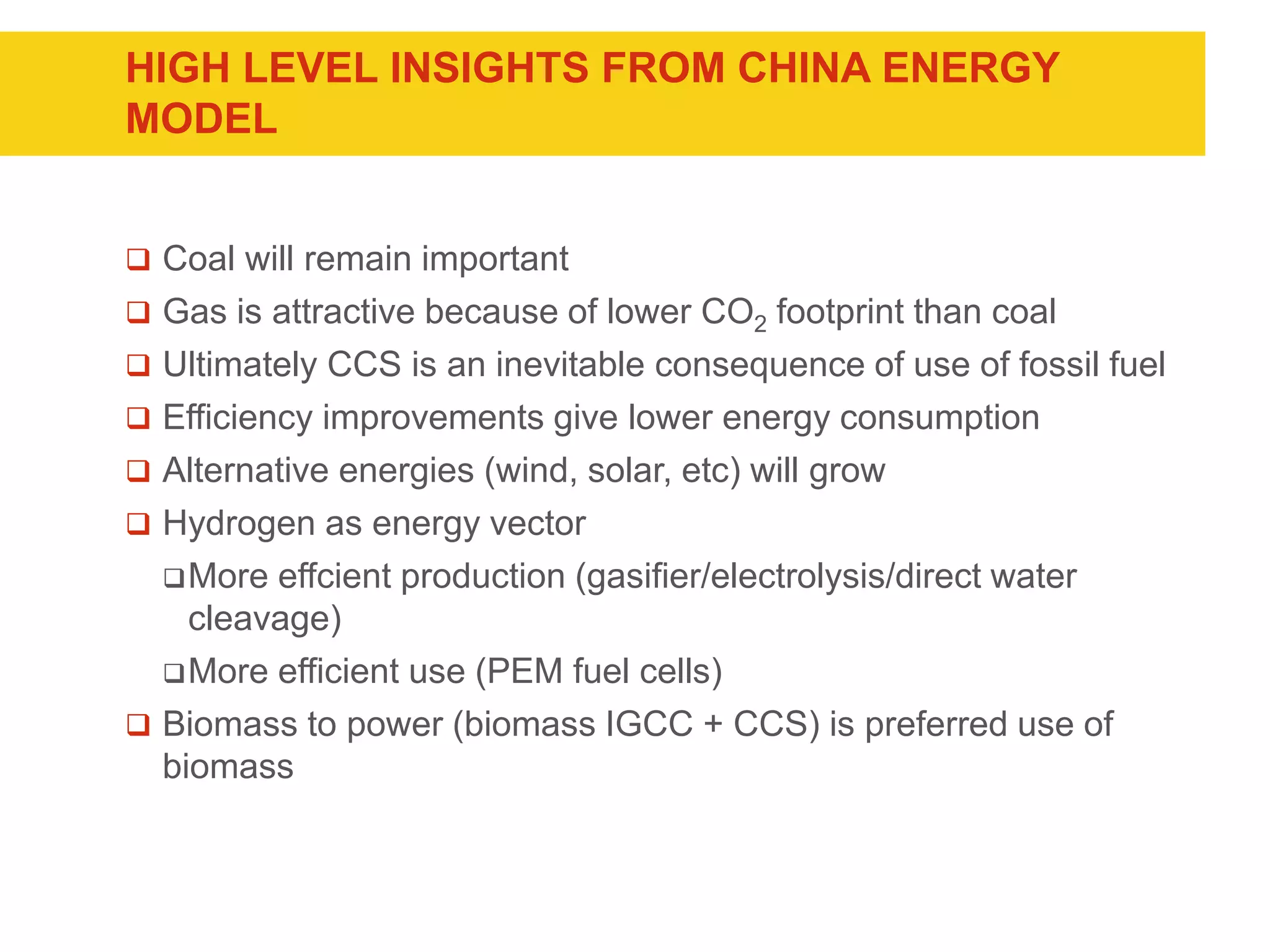
HIGH LEVEL INSIGHTS FROM CHINA ENERGY
MODEL
 Coal will remain important
 Gas is attractive because of lower CO2 footprint than coal
 Ultimately CCS is an inevitable consequence of use of fossil fuel
 Efficiency improvements give lower energy consumption
 Alternative energies (wind, solar, etc) will grow
 Hydrogen as energy vector
More effcient production (gasifier/electrolysis/direct water
cleavage)
More efficient use (PEM fuel cells)
 Biomass to power (biomass IGCC + CCS) is preferred use of
biomass
Supply chain & logistics optimization at Shell
Production-logistics optimization in
gas-to-chemicals
Shell Global Solutions International BV
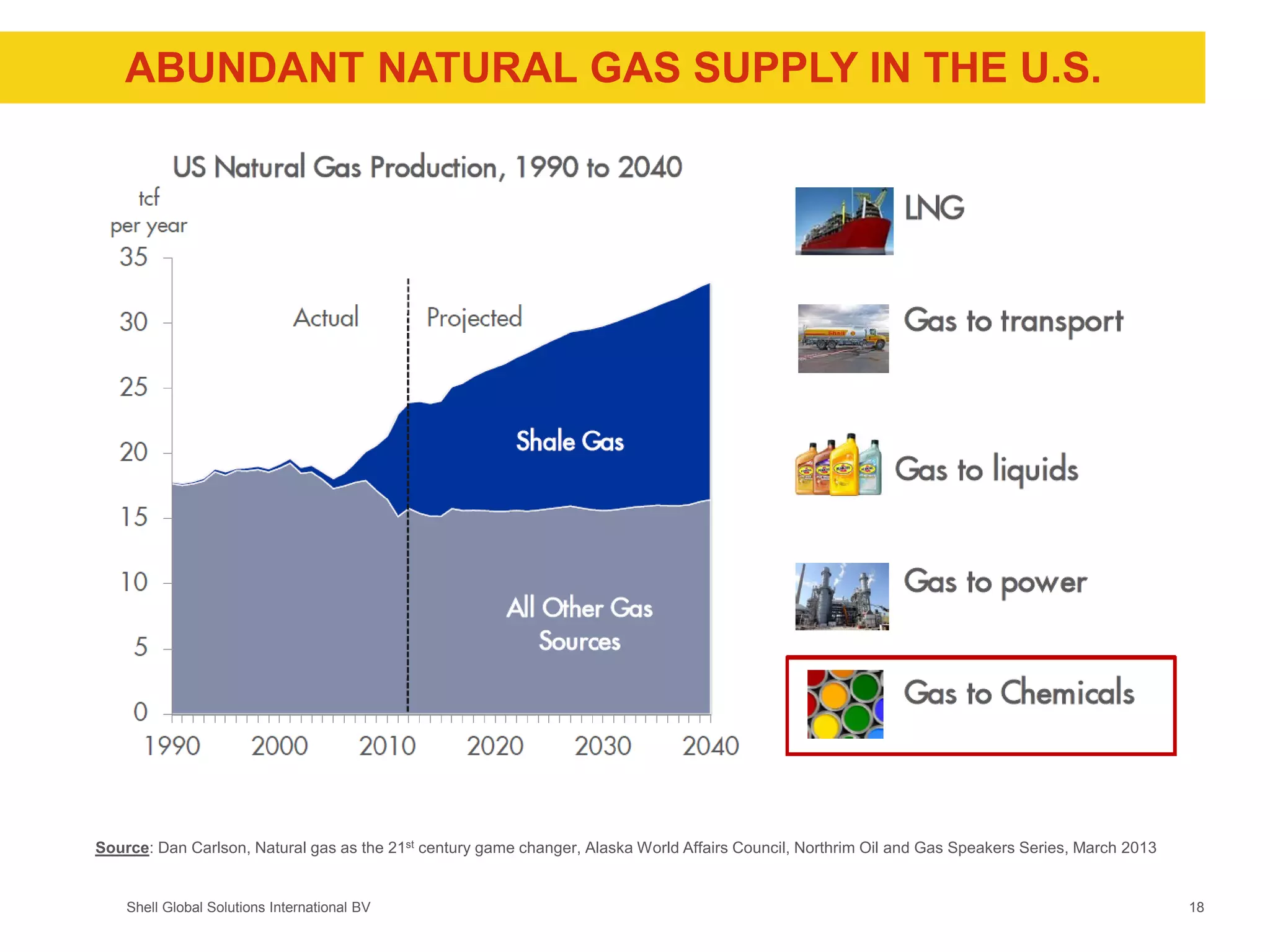
ABUNDANT NATURAL GAS SUPPLY IN THE U.S.
Source: Dan Carlson, Natural gas as the 21st century game changer, Alaska World Affairs Council, Northrim Oil and Gas Speakers Series, March 2013
18
Shell Global Solutions International BV
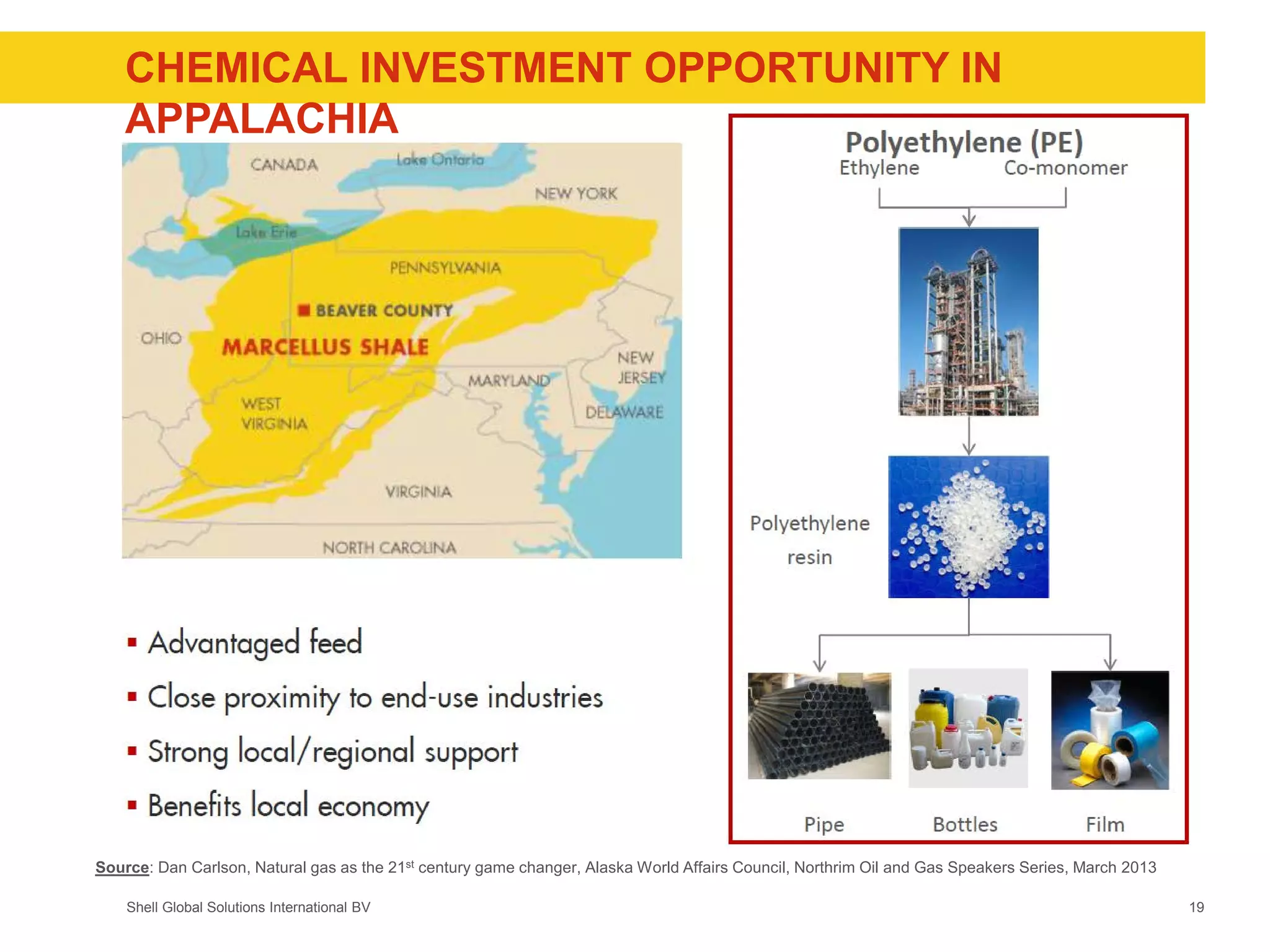
CHEMICAL INVESTMENT OPPORTUNITY IN
APPALACHIA
Source: Dan Carlson, Natural gas as the 21st century game changer, Alaska World Affairs Council, Northrim Oil and Gas Speakers Series, March 2013
19
Shell Global Solutions International BV
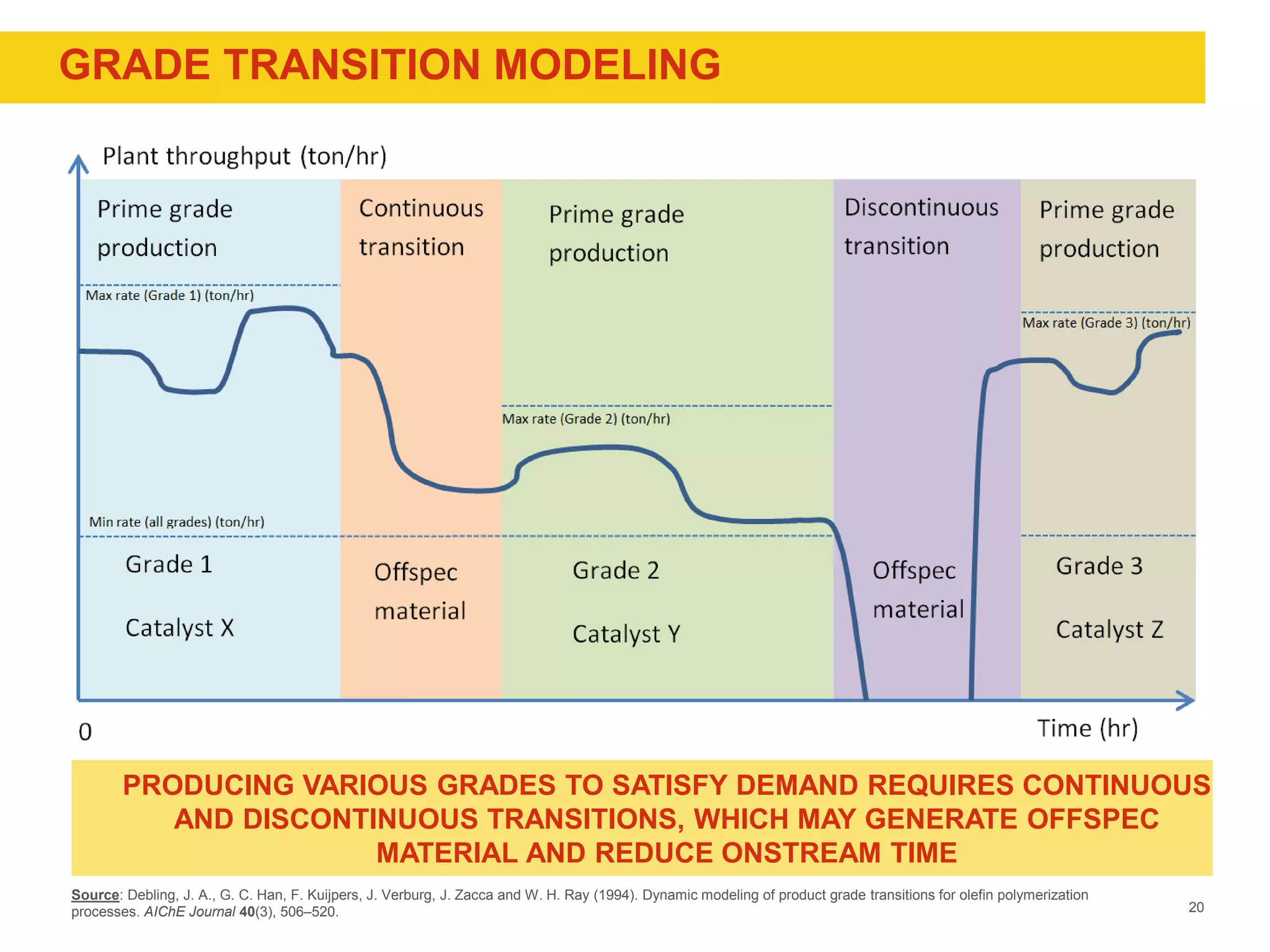
GRADE TRANSITION MODELING
20
PRODUCING VARIOUS GRADES TO SATISFY DEMAND REQUIRES CONTINUOUS
AND DISCONTINUOUS TRANSITIONS, WHICH MAY GENERATE OFFSPEC
MATERIAL AND REDUCE ONSTREAM TIME
Source: Debling, J. A., G. C. Han, F. Kuijpers, J. Verburg, J. Zacca and W. H. Ray (1994). Dynamic modeling of product grade transitions for olefin polymerization
processes. AIChE Journal 40(3), 506–520.
Shell Global Solutions International BV
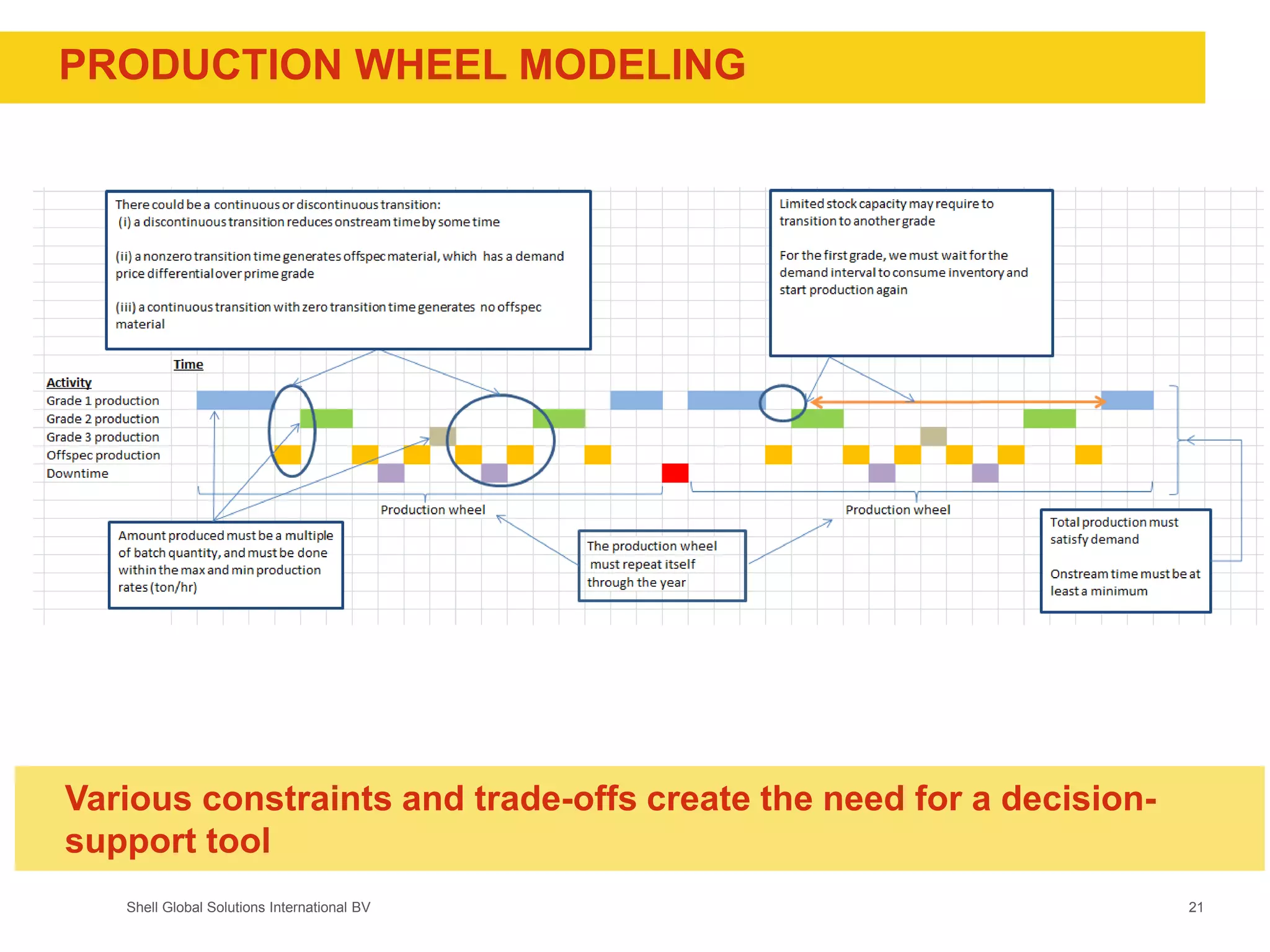
PRODUCTION WHEEL MODELING
21
Various constraints and trade-offs create the need for a decision-
support tool
Shell Global Solutions International BV
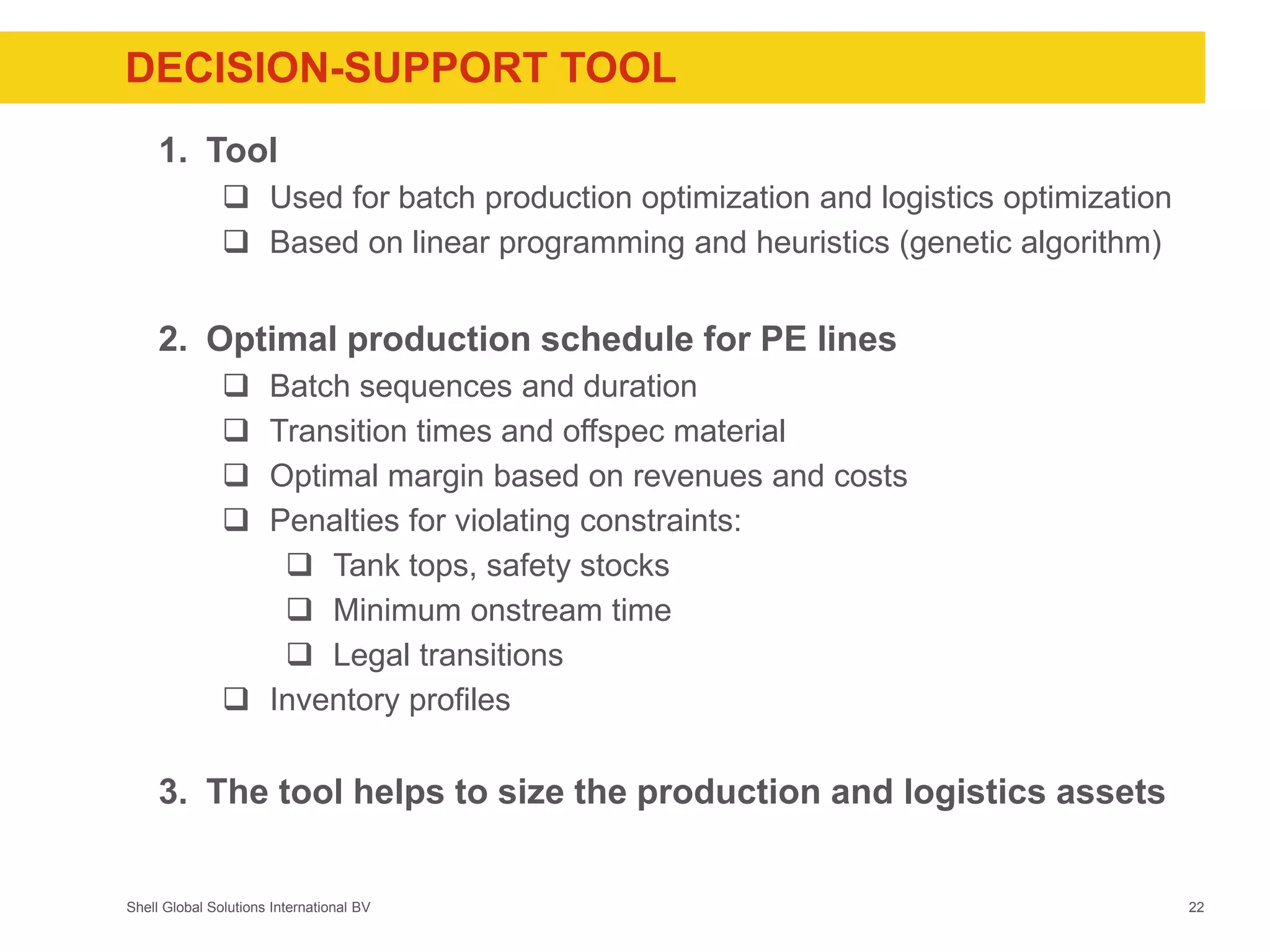
DECISION-SUPPORT TOOL
1. Tool
 Used for batch production optimization and logistics optimization
 Based on linear programming and heuristics (genetic algorithm)
2. Optimal production schedule for PE lines
 Batch sequences and duration
 Transition times and offspec material
 Optimal margin based on revenues and costs
 Penalties for violating constraints:
 Tank tops, safety stocks
 Minimum onstream time
 Legal transitions
 Inventory profiles
3. The tool helps to size the production and logistics assets
22
Supply chain & logistics optimization at Shell
Ecosystems services – capturing the
value of ecosystems
Shell Global Solutions International BV 25
Shell Global Solutions International BV 26
Shell Global Solutions International BV 27
Shell Global Solutions International BV 28
Shell Global Solutions International BV 29
Shell Global Solutions International BV 30
Shell Global Solutions International BV 31
Shell Global Solutions International BV 32
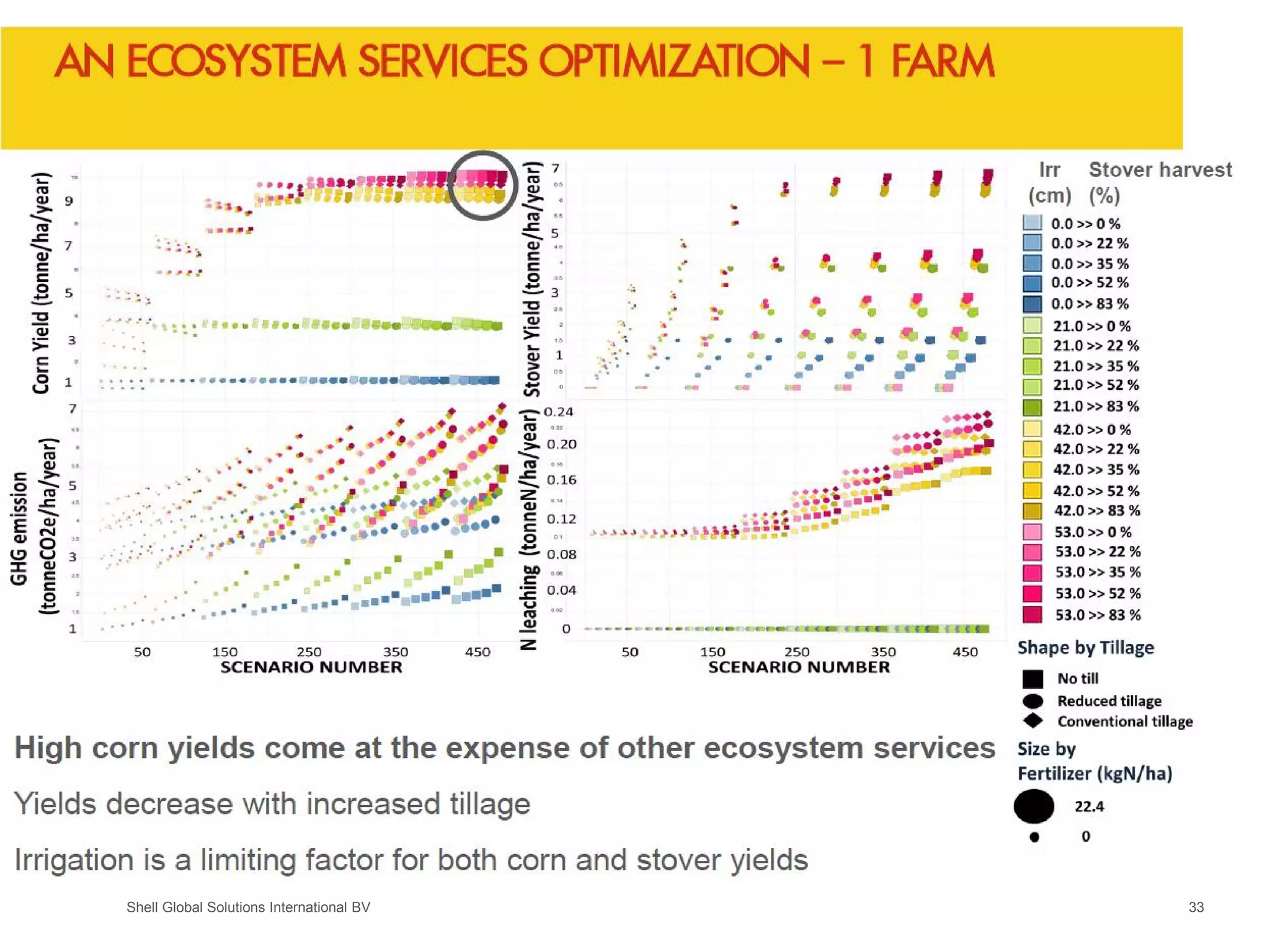
Shell Global Solutions International BV 33
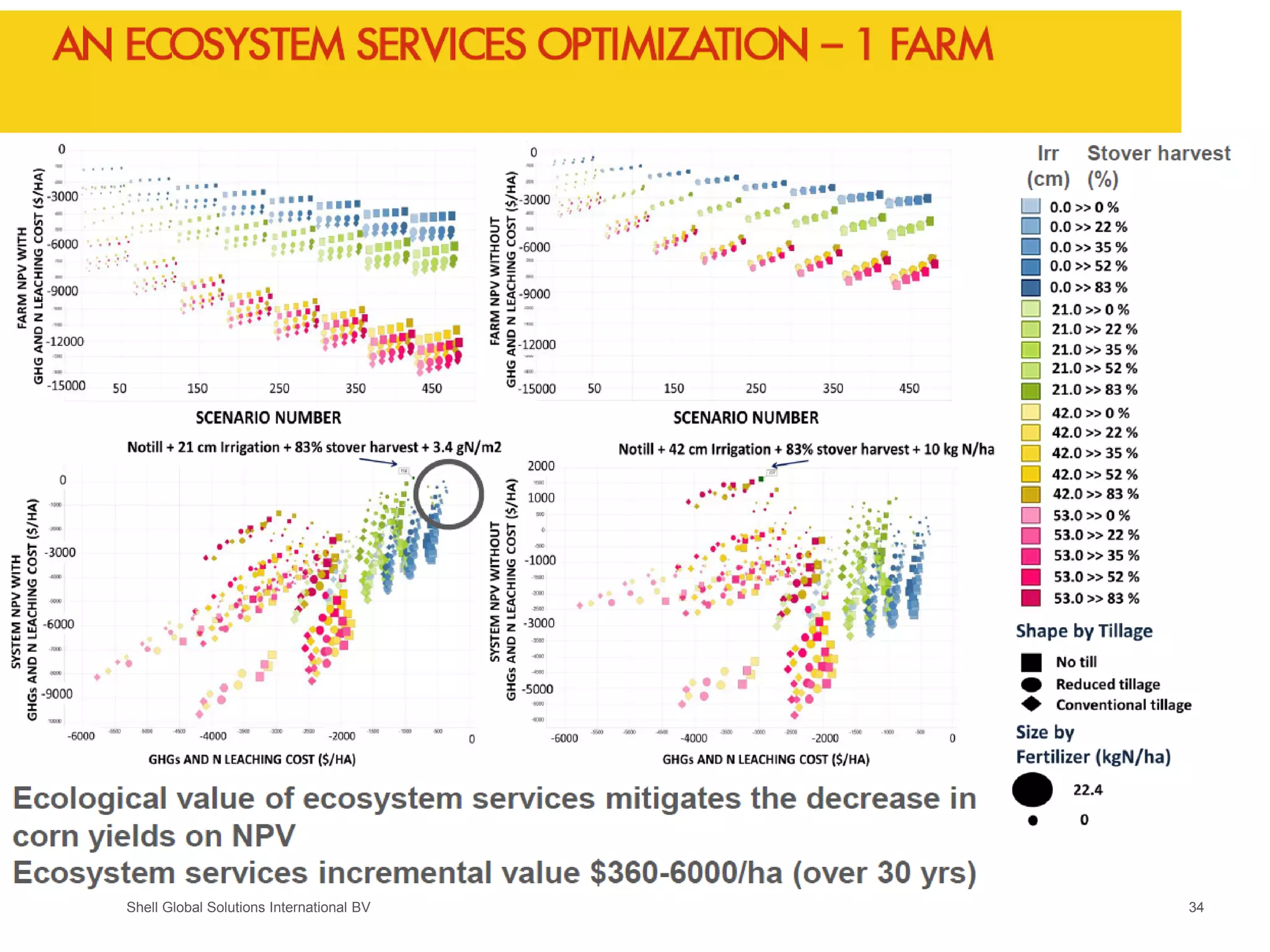
Shell Global Solutions International BV 34
Shell Global Solutions International BV
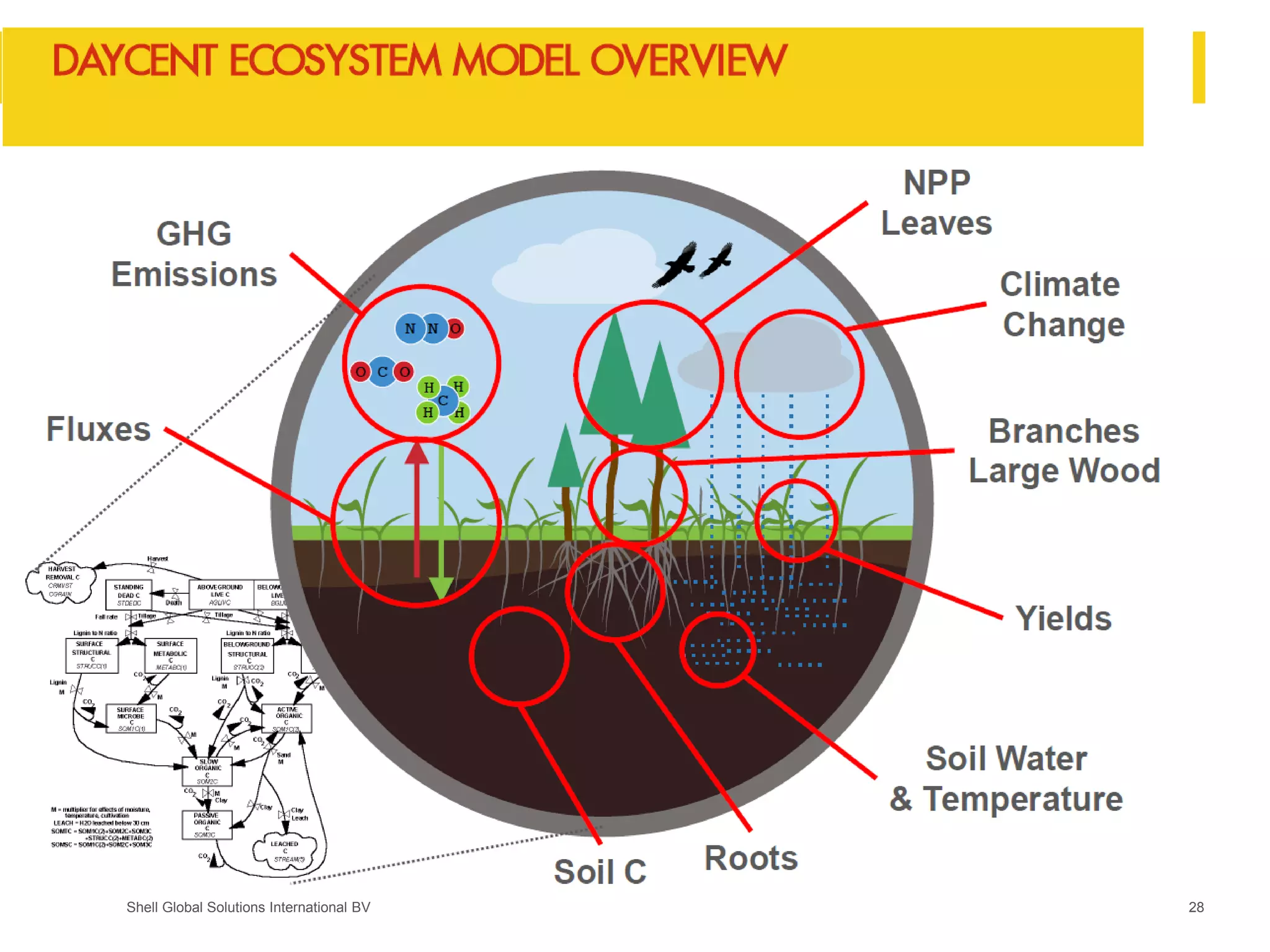
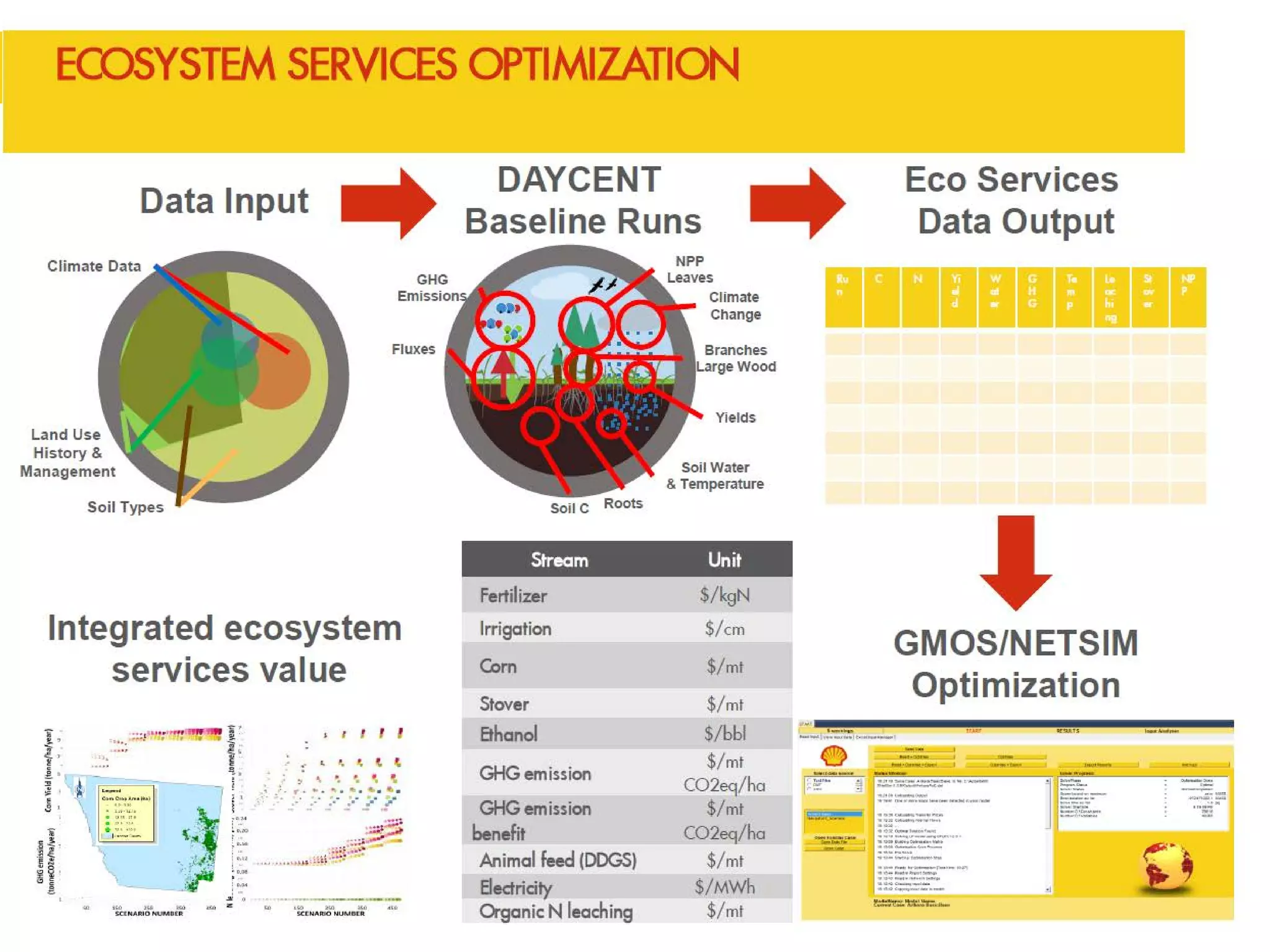
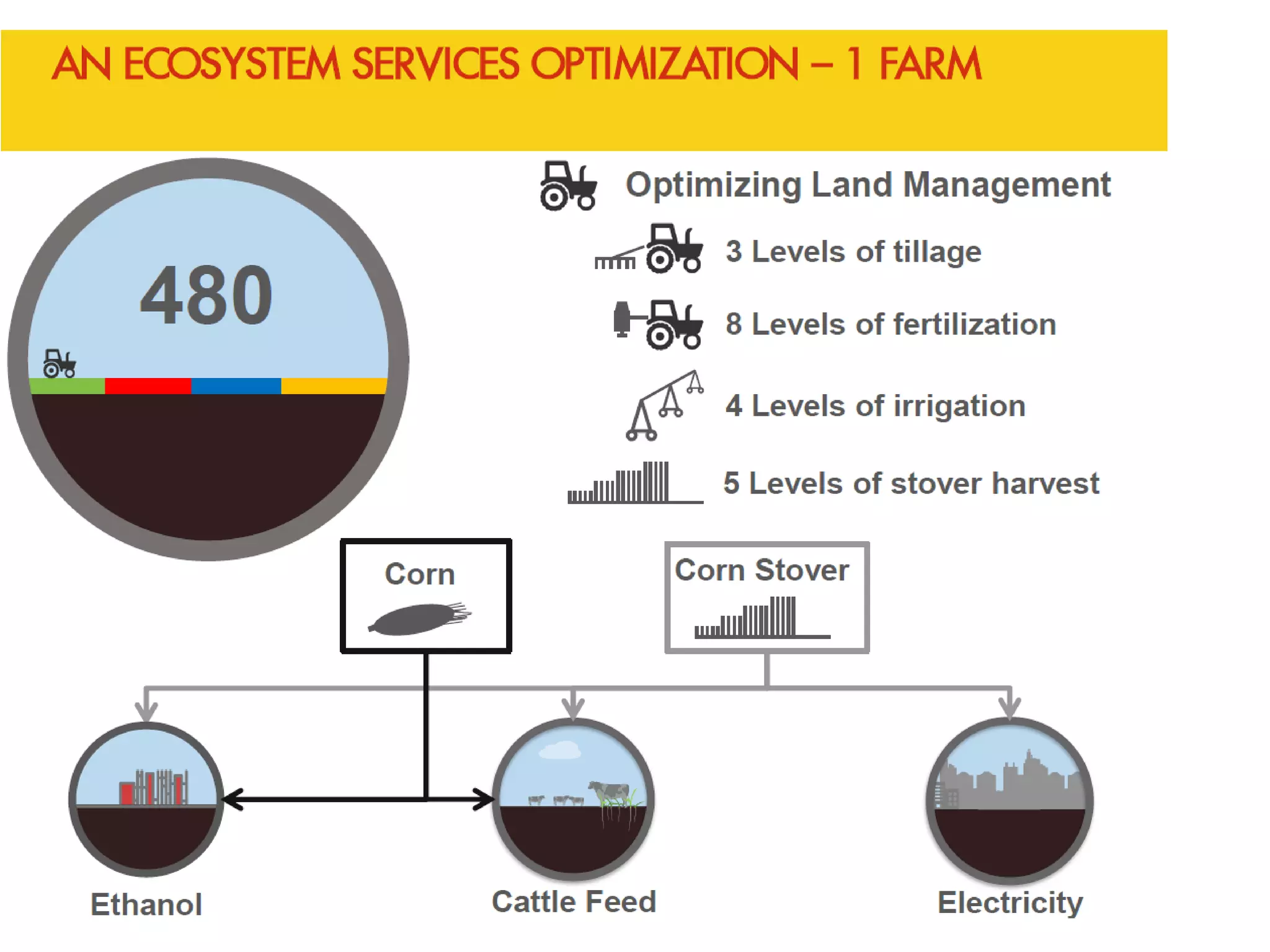
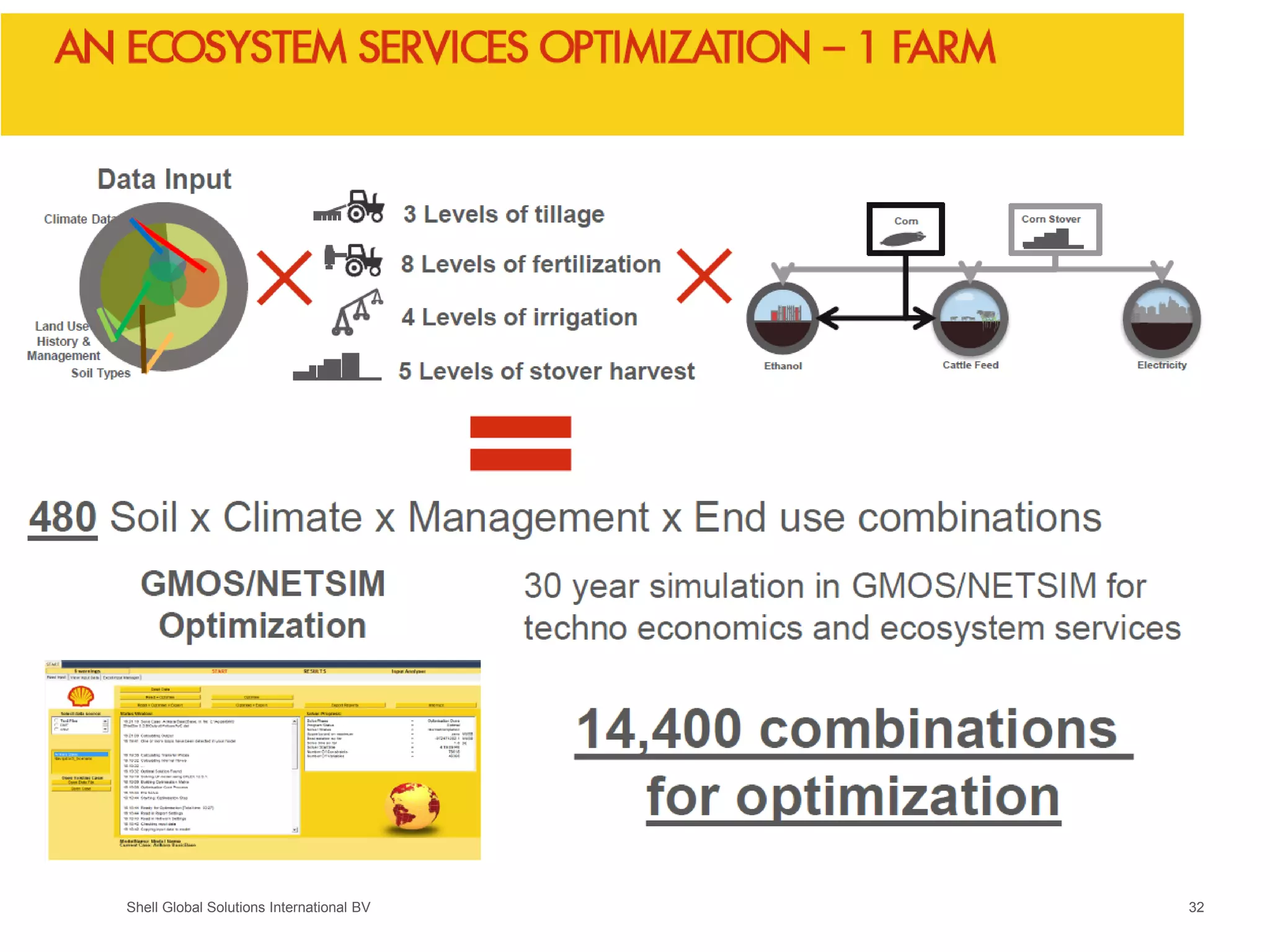
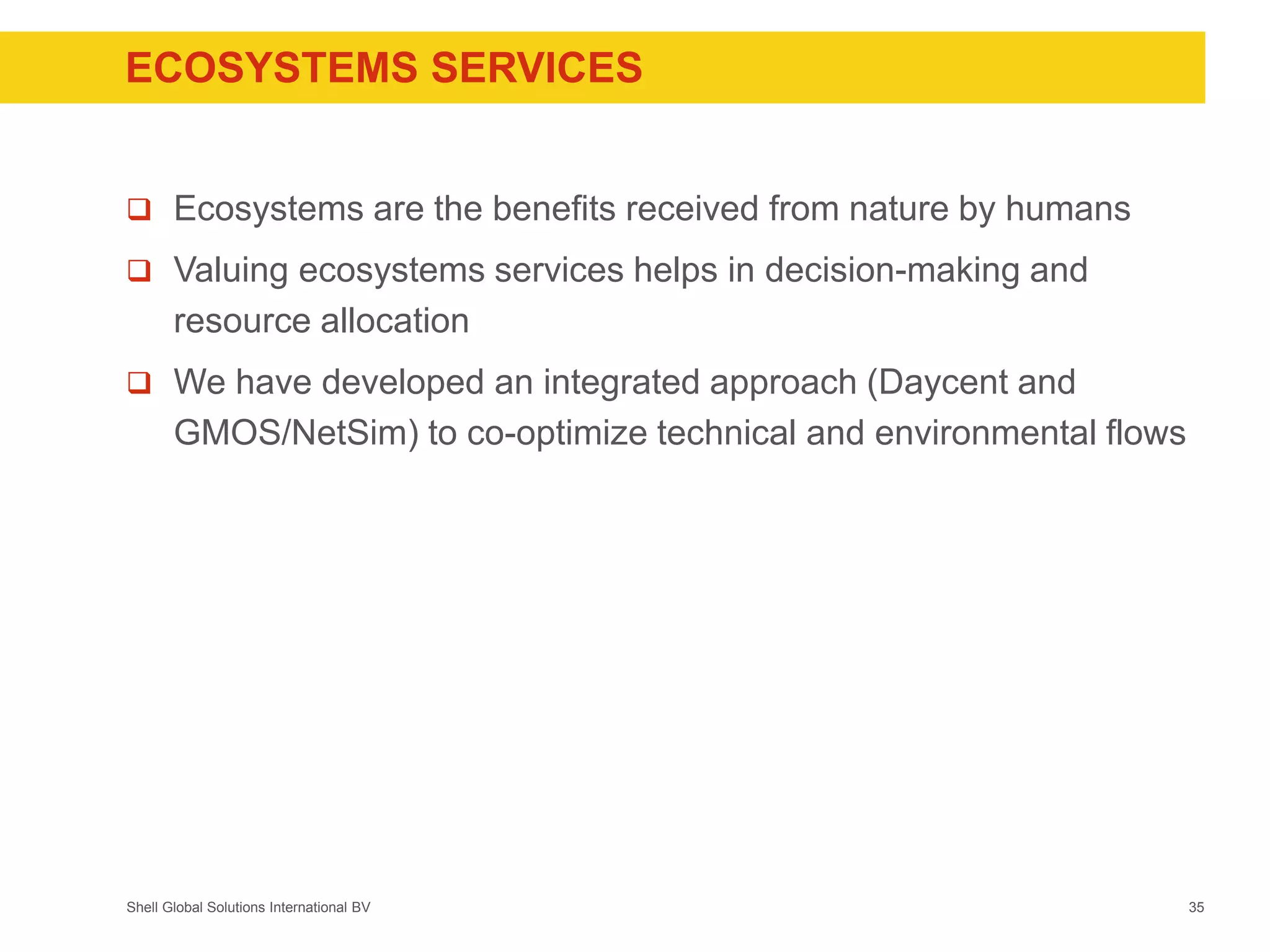
ECOSYSTEMS SERVICES
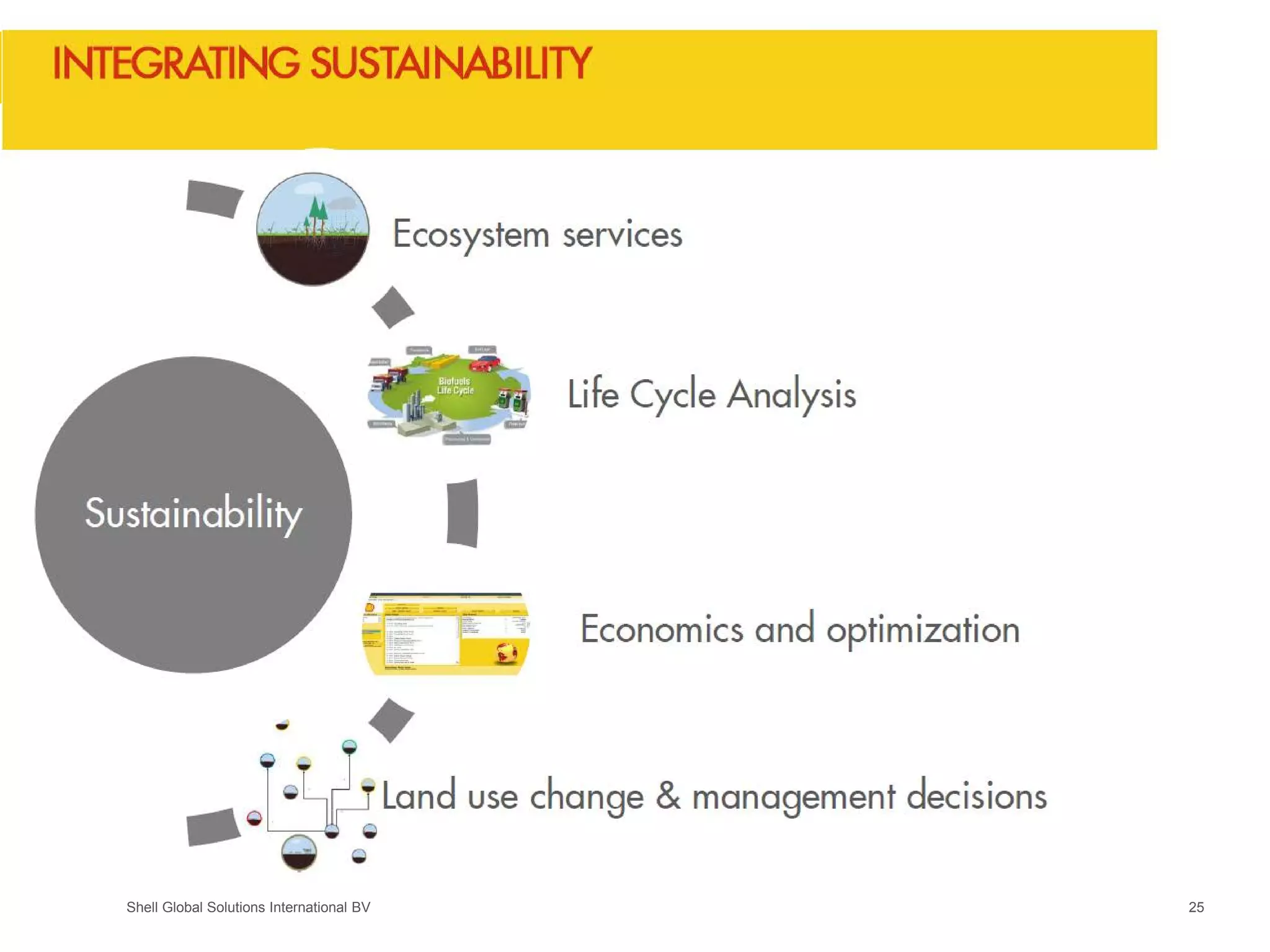
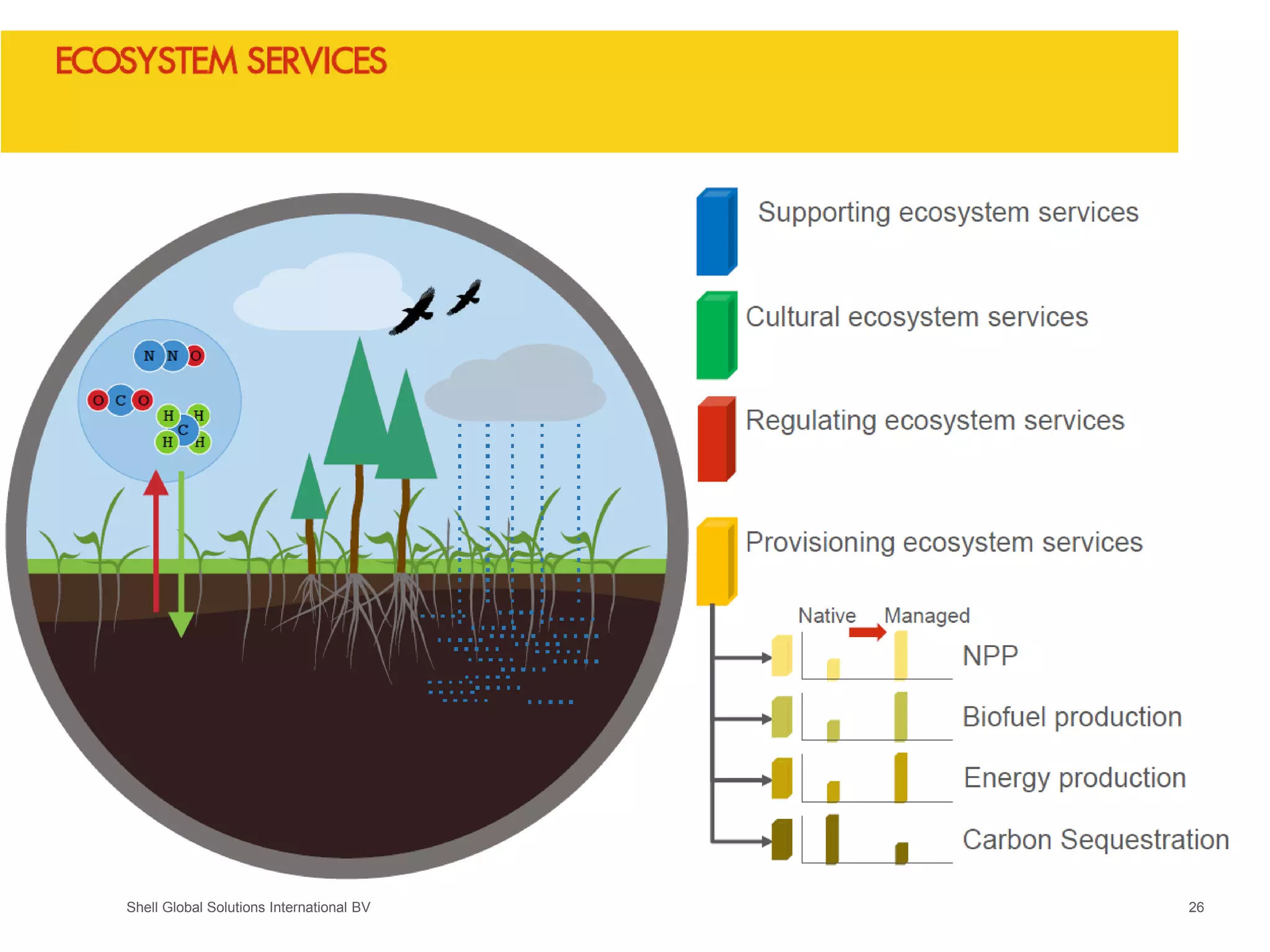
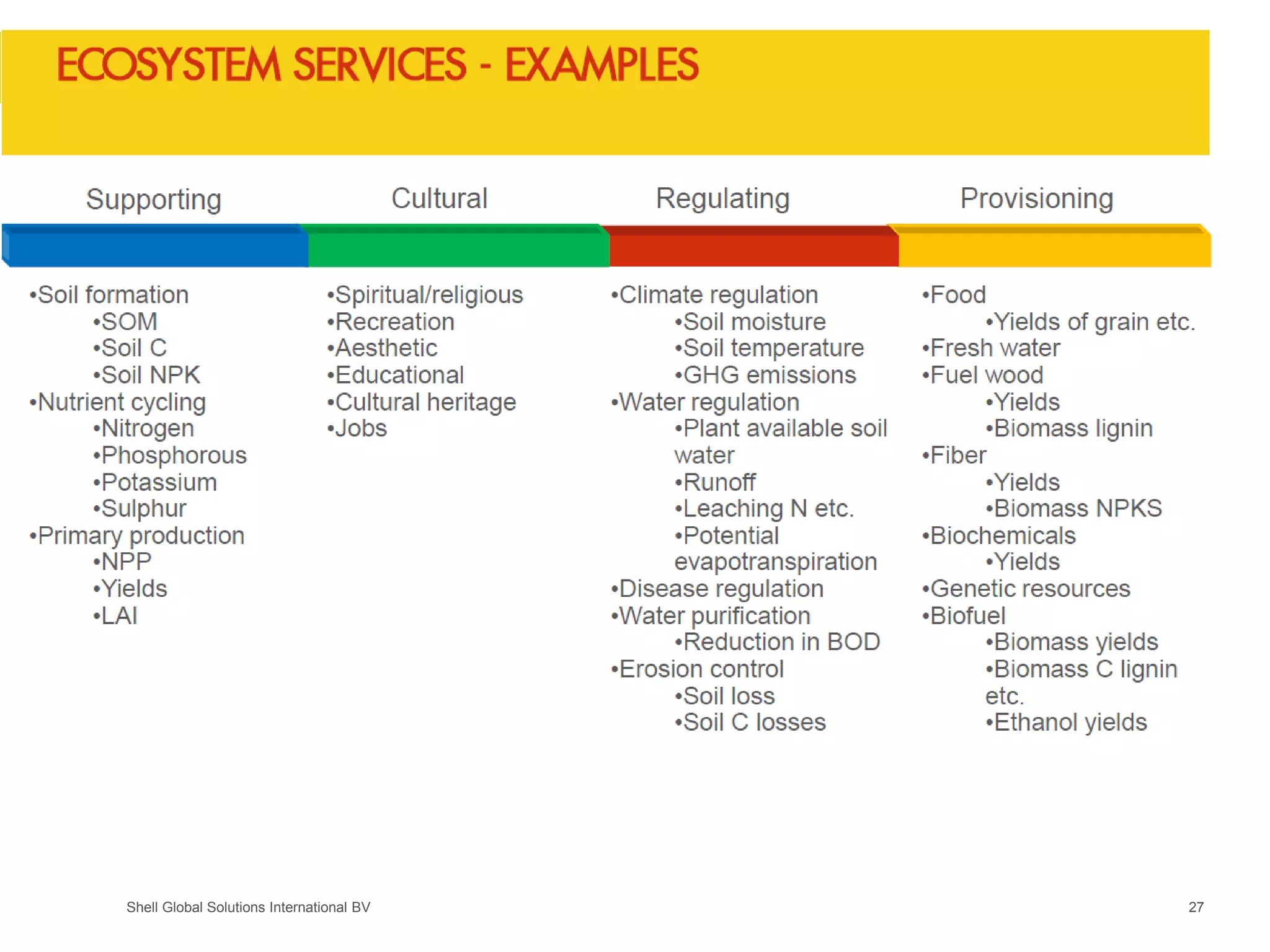
 Ecosystems are the benefits received from nature by humans
 Valuing ecosystems services helps in decision-making and
resource allocation
 We have developed an integrated approach (Daycent and
GMOS/NetSim) to co-optimize technical and environmental flows
35
Supply Chain & Logistics Optimization at Shell | OPTIMUS 2015 Atlanta

Supply Chain & Logistics Optimization at Shell | OPTIMUS 2015 Atlanta

  • 1.
    Supply chain &logistics optimization at Shell Julien Granger, Ph.D. Consultant, Shell Global Solutions Julien.Granger@shell.com http://www.shell.com/global/products- services/solutions-for-businesses/globalsolutions.html
  • 2.
    Use this areafor cover image (height 6.5cm, width 8cm) Supply chain & logistics optimization at Shell ORTEC Optimus 2015 23-25 March 2015 Atlanta, Georgia, U.S.A. Nort Thijssen 3/29/2015 Julien Granger, Ph.D. Shell Global Solutions
  • 3.
    3 DEFINITIONS & CAUTIONARYNOTE Reserves: Our use of the term “reserves” in this presentation means SEC proved oil and gas reserves. Resources: Our use of the term “resources” in this presentation includes quantities of oil and gas not yet classified as SEC proved oil and gas reserves. Resources are consistent with the Society of Petroleum Engineers 2P and 2C definitions. Organic: Our use of the term Organic includes SEC proved oil and gas reserves excluding changes resulting from acquisitions, divestments and year-average pricing impact. Resources plays: our use of the term ‘resources plays’ refers to tight, shale and coal bed methane oil and gas acreage. The companies in which Royal Dutch Shell plc directly and indirectly owns investments are separate entities. In this presentation “Shell”, “Shell group” and “Royal Dutch Shell” are sometimes used for convenience where references are made to Royal Dutch Shell plc and its subsidiaries in general. Likewise, the words “we”, “us” and “our” are also used to refer to subsidiaries in general or to those who work for them. These expressions are also used where no useful purpose is served by identifying the particular company or companies. ‘‘Subsidiaries’’, “Shell subsidiaries” and “Shell companies” as used in this presentation refer to companies in which Royal Dutch Shell either directly or indirectly has control, by having either a majority of the voting rights or the right to exercise a controlling influence. The companies in which Shell has significant influence but not control are referred to as “associated companies” or “associates” and companies in which Shell has joint control are referred to as “jointly controlled entities”. In this presentation, associates and jointly controlled entities are also referred to as “equity-accounted investments”. The term “Shell interest” is used for convenience to indicate the direct and/or indirect ownership interest held by Shell in a venture, partnership or company, after exclusion of all third-party interest. This presentation contains forward-looking statements concerning the financial condition, results of operations and businesses of Royal Dutch Shell. All statements other than statements of historical fact are, or may be deemed to be, forward-looking statements. Forward-looking statements are statements of future expectations that are based on management’s current expectations and assumptions and involve known and unknown risks and uncertainties that could cause actual results, performance or events to differ materially from those expressed or implied in these statements. Forward-looking statements include, among other things, statements concerning the potential exposure of Royal Dutch Shell to market risks and statements expressing management’s expectations, beliefs, estimates, forecasts, projections and assumptions. These forward-looking statements are identified by their use of terms and phrases such as ‘‘anticipate’’, ‘‘believe’’, ‘‘could’’, ‘‘estimate’’, ‘‘expect’’, ‘‘intend’’, ‘‘may’’, ‘‘plan’’, ‘‘objectives’’, ‘‘outlook’’, ‘‘probably’’, ‘‘project’’, ‘‘will’’, ‘‘seek’’, ‘‘target’’, ‘‘risks’’, ‘‘goals’’, ‘‘should’’ and similar terms and phrases. There are a number of factors that could affect the future operations of Royal Dutch Shell and could cause those results to differ materially from those expressed in the forward-looking statements included in this presentation, including (without limitation): (a) price fluctuations in crude oil and natural gas; (b) changes in demand for Shell’s products; (c) currency fluctuations; (d) drilling and production results; (e) reserves estimates; (f) loss of market share and industry competition; (g) environmental and physical risks; (h) risks associated with the identification of suitable potential acquisition properties and targets, and successful negotiation and completion of such transactions; (i) the risk of doing business in developing countries and countries subject to international sanctions; (j) legislative, fiscal and regulatory developments including potential litigation and regulatory measures as a result of climate changes; (k) economic and financial market conditions in various countries and regions; (l) political risks, including the risks of expropriation and renegotiation of the terms of contracts with governmental entities, delays or advancements in the approval of projects and delays in the reimbursement for shared costs; and (m) changes in trading conditions. All forward-looking statements contained in this presentation are expressly qualified in their entirety by the cautionary statements contained or referred to in this section. Readers should not place undue reliance on forward-looking statements. Additional factors that may affect future results are contained in Royal Dutch Shell’s 20-F for the year ended 31 December, 2013 (available at www.shell.com/investor and www.sec.gov ). These factors also should be considered by the reader. Each forward-looking statement speaks only as of the date of this presentation, 24 March, 2015. Neither Royal Dutch Shell nor any of its subsidiaries undertake any obligation to publicly update or revise any forward-looking statement as a result of new information, future events or other information. In light of these risks, results could differ materially from those stated, implied or inferred from the forward-looking statements contained in this presentation. There can be no assurance that dividend payments will match or exceed those set out in this presentation in the future, or that they will be made at all. We use certain terms in this presentation, such as discovery potential, that the United States Securities and Exchange Commission (SEC) guidelines strictly prohibit us from including in filings with the SEC. U.S. Investors are urged to consider closely the disclosure in our Form 20-F, File No 1-32575, available on the SEC website www.sec.gov. You can also obtain this form from the SEC by calling 1-800-SEC-0330.
  • 4.
    4 Agenda We provide ahigh-level overview of some supply chain & logistics optimization case studies solved in partnership with ORTEC. Case studies: 1. Energy systems modelling 2. Production-logistics optimization in gas-to-chemicals 3. Ecosystems services – land use change optimization
  • 5.
    5 SHELL Shell aims tobe the most competitive and innovative energy company in the world. DOWNSTREAM PROJECTS & TECHNOLOGY UPSTREAM Searches for and recovers oil and natural gas Refines, supplies, trades and ships crude worldwide; manufactures and markets a range of products. Manages delivery of Shell’s major projects and drives research and innovation.
  • 6.
    Shell Global SolutionsInternational BV SHELL VALUE CHAIN Source: Shell 2013 Annual Report, page 9, available online at <http://www.shell.com/global/aboutshell/investor.html>.
  • 7.
    Supply chain &logistics optimization at Shell Energy systems modelling with GMOS/NetSim
  • 8.
    A messy transition? ? Normativescenario sustainable seemingly implausible Exploratory scenarios Plausible but unsustainable World Energy-related CO2 emissions Source: New Lens Scenarios, p.37, Shell International B.V., 2013, available online at <http://www.shell.com/global/future-energy/scenarios/new-lens- scenarios.html>
  • 9.
    Helping China transitionto a low-carbon energy system Source: The greening and cleaning of China, Jiang Kejun and Alexander van der Made; In Kramer G.J. and Vermeer B. (Editors). The colours of energy: Essays on the future of our energy system. Shell International B.V., Amsterdam, the Netherlands, ISBN: 978-90-9028343-2, July 2014 Trajectory of carbon dioxide emissions per capita per year as function of primary energy use per capita per year for the USA, Germany and China, from 1960 to 2050. The dots are at decadal intervals, with the larger dot denoting the 2010 situation. The forward-looking data for China are the Baseline (dark) and Low-carbon Pathways respectively calculated using the China Energy Model (CNEM).
  • 10.
    Shell Global SolutionsInternational BV ENERGY SYSTEM MODELLING  Energy System Modelling - practical, quantitative decision support methodology. It enables evaluation of options for future energy systems while balancing economic, energy security and environmental considerations via clear scenario management. Analysis of energy value chain based on cost- effectiveness, maximum resilience, minimal CO2 emissions. 10Basic data sharing = critical success factor
  • 11.
    Shell Global SolutionsInternational BV CHINA ENERGY MODEL: 31 PROVINCES Regional Model: 31 provinces
  • 12.
    1. Supply ofresources to be transported into energy conversion technologies 2. Energy conversion technologies, including opex, capex, scale, indexed by period to capture technology improvements 3. Demand for energy per industry sector per province per period China Energy model: network structure
  • 13.
    Shell Global SolutionsInternational BV MODEL PROCESS OUTPUT EXAMPLE (CHINA) 13 Source: The greening and cleaning of China, Jiang Kejun and Alexander van der Made; In Kramer G.J. and Vermeer B. (Editors). The colours of energy: Essays on the future of our energy system. Shell International B.V., Amsterdam, the Netherlands, ISBN: 978-90-9028343-2, July 2014
  • 14.
    Shell Global SolutionsInternational BV MODEL PROCESS OUTPUT EXAMPLE (CHINA) 14 Source: The greening and cleaning of China, Jiang Kejun and Alexander van der Made; In Kramer G.J. and Vermeer B. (Editors). The colours of energy: Essays on the future of our energy system. Shell International B.V., Amsterdam, the Netherlands, ISBN: 978-90-9028343-2, July 2014
  • 15.
    Shell Global SolutionsInternational BV MODEL PROCESS OUTPUT EXAMPLE (CHINA) 15 Source: The greening and cleaning of China, Jiang Kejun and Alexander van der Made; In Kramer G.J. and Vermeer B. (Editors). The colours of energy: Essays on the future of our energy system. Shell International B.V., Amsterdam, the Netherlands, ISBN: 978-90-9028343-2, July 2014
  • 16.
    HIGH LEVEL INSIGHTSFROM CHINA ENERGY MODEL  Coal will remain important  Gas is attractive because of lower CO2 footprint than coal  Ultimately CCS is an inevitable consequence of use of fossil fuel  Efficiency improvements give lower energy consumption  Alternative energies (wind, solar, etc) will grow  Hydrogen as energy vector More effcient production (gasifier/electrolysis/direct water cleavage) More efficient use (PEM fuel cells)  Biomass to power (biomass IGCC + CCS) is preferred use of biomass
  • 17.
    Supply chain &logistics optimization at Shell Production-logistics optimization in gas-to-chemicals
  • 18.
    Shell Global SolutionsInternational BV ABUNDANT NATURAL GAS SUPPLY IN THE U.S. Source: Dan Carlson, Natural gas as the 21st century game changer, Alaska World Affairs Council, Northrim Oil and Gas Speakers Series, March 2013 18
  • 19.
    Shell Global SolutionsInternational BV CHEMICAL INVESTMENT OPPORTUNITY IN APPALACHIA Source: Dan Carlson, Natural gas as the 21st century game changer, Alaska World Affairs Council, Northrim Oil and Gas Speakers Series, March 2013 19
  • 20.
    Shell Global SolutionsInternational BV GRADE TRANSITION MODELING 20 PRODUCING VARIOUS GRADES TO SATISFY DEMAND REQUIRES CONTINUOUS AND DISCONTINUOUS TRANSITIONS, WHICH MAY GENERATE OFFSPEC MATERIAL AND REDUCE ONSTREAM TIME Source: Debling, J. A., G. C. Han, F. Kuijpers, J. Verburg, J. Zacca and W. H. Ray (1994). Dynamic modeling of product grade transitions for olefin polymerization processes. AIChE Journal 40(3), 506–520.
  • 21.
    Shell Global SolutionsInternational BV PRODUCTION WHEEL MODELING 21 Various constraints and trade-offs create the need for a decision- support tool
  • 22.
    Shell Global SolutionsInternational BV DECISION-SUPPORT TOOL 1. Tool  Used for batch production optimization and logistics optimization  Based on linear programming and heuristics (genetic algorithm) 2. Optimal production schedule for PE lines  Batch sequences and duration  Transition times and offspec material  Optimal margin based on revenues and costs  Penalties for violating constraints:  Tank tops, safety stocks  Minimum onstream time  Legal transitions  Inventory profiles 3. The tool helps to size the production and logistics assets 22
  • 24.
    Supply chain &logistics optimization at Shell Ecosystems services – capturing the value of ecosystems
  • 25.
    Shell Global SolutionsInternational BV 25
  • 26.
    Shell Global SolutionsInternational BV 26
  • 27.
    Shell Global SolutionsInternational BV 27
  • 28.
    Shell Global SolutionsInternational BV 28
  • 29.
    Shell Global SolutionsInternational BV 29
  • 30.
    Shell Global SolutionsInternational BV 30
  • 31.
    Shell Global SolutionsInternational BV 31
  • 32.
    Shell Global SolutionsInternational BV 32
  • 33.
    Shell Global SolutionsInternational BV 33
  • 34.
    Shell Global SolutionsInternational BV 34
  • 35.
    Shell Global SolutionsInternational BV ECOSYSTEMS SERVICES  Ecosystems are the benefits received from nature by humans  Valuing ecosystems services helps in decision-making and resource allocation  We have developed an integrated approach (Daycent and GMOS/NetSim) to co-optimize technical and environmental flows 35