SUPPLY CHAIN MANAGEMENT
Group no. 2AMIT RAI – 10SHUBHANGI CHOUHAN – 61KULVINDER PATHANIA – 27PRATEEK CHHABRA – 16ASHISH SONAWARE – 29GAURAV CHOUHAN – 57
AMULType - 		CooperativeIndustry -		DairyFounded -		1946Key people - 		Dr. VerghesekurienRevenue - 		INR 67.11billion (2008-2009)Employee - 		Marketing arm: 735		Milk producers: 2.8 million
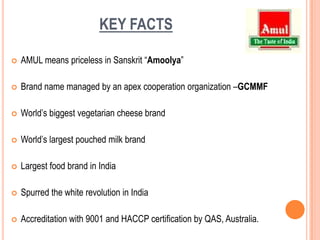
KEY FACTSAMUL means priceless in Sanskrit “Amoolya”Brand name managed by an apex cooperation organization –GCMMFWorld’s biggest vegetarian cheese brandWorld’s largest pouched milk brand Largest food brand in IndiaSpurred the white revolution in IndiaAccreditation with 9001 and HACCP certification by QAS, Australia.
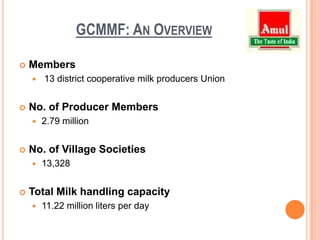
GCMMF: An OverviewMembers13 district cooperative milk producers UnionNo. of Producer Members2.79 millionNo. of Village Societies13,328Total Milk handling capacity11.22 million liters per day
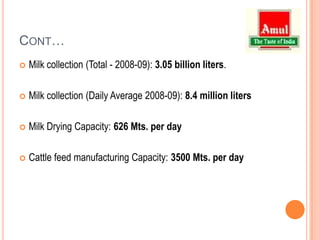
Cont…Milk collection (Total - 2008-09): 3.05 billion liters.Milk collection (Daily Average 2008-09): 8.4 million litersMilk Drying Capacity: 626 Mts. per dayCattle feed manufacturing Capacity: 3500 Mts. per day
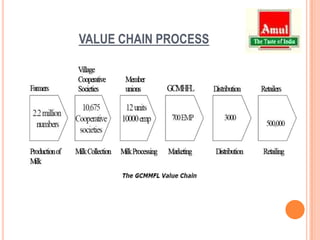
VALUE CHAIN PROCESS
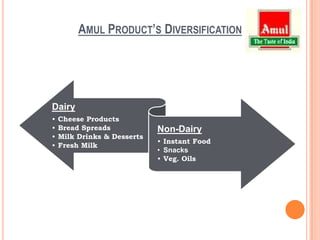
Amul Product’s Diversification
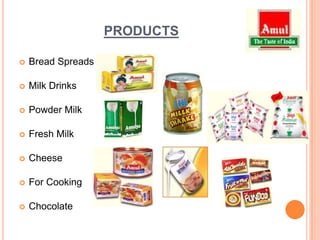
PRODUCTSBread Spreads Milk DrinksPowder Milk Fresh Milk Cheese For Cooking Chocolate
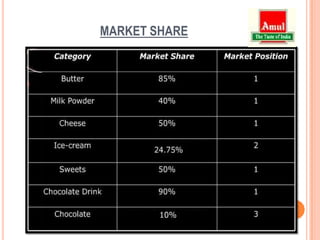
MARKET SHARE
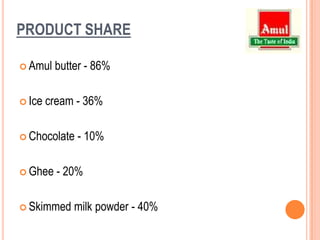
PRODUCT SHAREAmul butter - 86%Ice cream - 36%Chocolate - 10%Ghee - 20%Skimmed milk powder - 40%
PROBLEMS TO BE ADDRESSED Logistics in collection –6 million liters of milk per dayFrom about 10,600 separate village cooperative societies.Approximately 2.8 million milk producing member.Logistic in coordination of –Storing the milk.Processing the milk.Distributing the milk.
Cont….Supplier logistics –Weighing the milk.Determining of fat content.Calculation of the purchase price.
EVOLUTION of “IT”The evolution of IT in AMUL was took place  in the guidance of  DR.B.M Vyas.The milk collection center at  village cooperative societies, were first automated.Application and utilization of GIS.Data analysis software  utilization for milk production estimation and increasing productivity.VATS  network between all the level of distribution network and GCMMF.
Shift processThe company zeroed in on ERP as means to keep pace with dynamically changing business environment.TCS was hired to guide them in its implementation.The project was named as Enterprise wise integrated application system (EIAS)
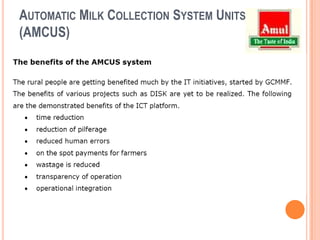
IMPLEMENTATIONAmul start implementation of ERP in phases.Automatic milk collection system units(AMCUS) at village society were installed in the first phase to automate milk production logistics.AMCUS facilities to capture member information, milk fat content, volume collected, and amount payable to each member electronically.
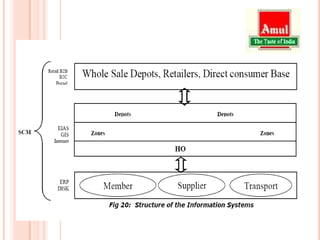
Cont….Amul also connected its zonal offices, regional offices and member’s dairies through VSATs.The customized ERP- EIAS has been implemented across the organization integrating various operational departments.Amulis also using Geographic Information Systems (GIS) for business planning and optimization of collection processes.
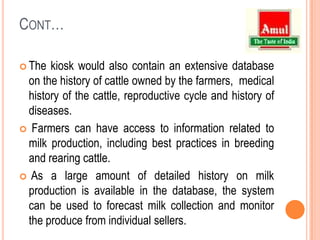
Cont…Indian Institute of Management – Ahmedabad supplemented Amul’s IT strategy by providing an application software – Dairy Information System Kiosk(DISK) to facilitate data analysis and decision support in improving milk collection. The kiosk would also contain an extensive database on the history of cattle owned by the farmers,  medical history of the cattle, reproductive cycle and history of diseases. Farmers can have access to information related to milk production, including best practices in breeding and rearing cattle.  As a large amount of detailed history on milk production is available in the database, the system can be used to forecast milk collection and monitor the produce from individual sellers.
Cont…The kiosk would also contain an extensive database on the history of cattle owned by the farmers,  medical history of the cattle, reproductive cycle and history of diseases. Farmers can have access to information related to milk production, including best practices in breeding and rearing cattle.  As a large amount of detailed history on milk production is available in the database, the system can be used to forecast milk collection and monitor the produce from individual sellers.
Automatic Milk Collection System Units (AMCUS)
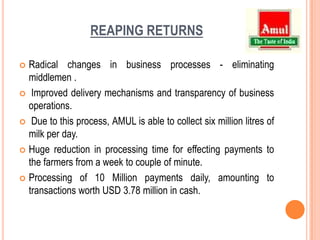
REAPING RETURNS Radical changes in business processes - eliminating middlemen . Improved delivery mechanisms and transparency of business operations. Due to this process, AMUL is able to collect six million litres of milk per day. Huge reduction in processing time for effecting payments to the farmers from a week to couple of minute.Processing of 10 Million payments daily, amounting to transactions worth USD 3.78 million in cash.
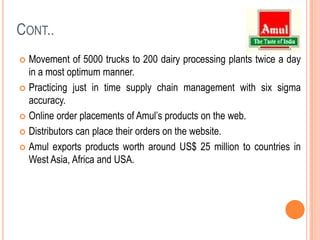
Cont..Movement of 5000 trucks to 200 dairy processing plants twice a day in a most optimum manner.Practicing just in time supply chain management with six sigma accuracy. Online order placements of Amul’s products on the web. Distributors can place their orders on the website. Amulexports products worth around US$ 25 million to countries in West Asia, Africa and USA.
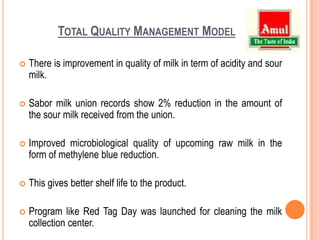
Total Quality Management ModelThere is improvement in quality of milk in term of acidity and sour milk.Sabor milk union records show 2% reduction in the amount of the sour milk received from the union.Improved microbiological quality of upcoming raw milk in the form of methylene blue reduction.This gives better shelf life to the product.Program like Red Tag Day was launched for cleaning the milk collection center.
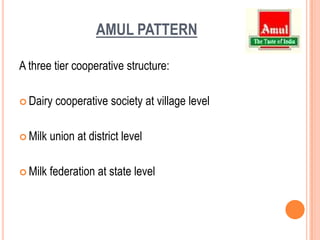
AMUL PATTERNA three tier cooperative structure:Dairy cooperative society at village level Milk union at district level Milk federation at state level
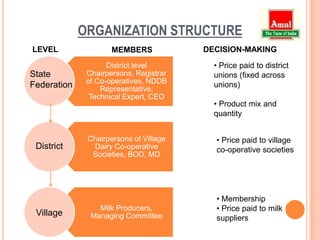
ORGANIZATION STRUCTUREDECISION-MAKINGLEVELMEMBERS Price paid to district unions (fixed across unions)
 Product mix and quantityState Federation Price paid to village co-operative societiesDistrict Membership
 Price paid to milk suppliersVillage
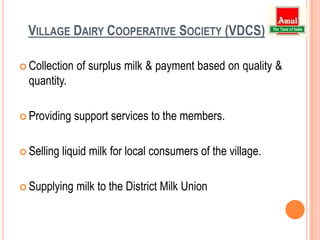
Village Dairy Cooperative Society (VDCS)Collection of surplus milk & payment based on quality & quantity.Providing support services to the members.Selling liquid milk for local consumers of the village.Supplying milk to the District Milk Union
District Cooperative Milk Producers’ Union (Milk Union)Procurement of milk from the Village Dairy Societies of the District.Arranging transportation of raw milk from the VDCS to the Milk Union.Providing input services to the producers.Conducting training on Cooperative development
Cont..Providing management support & regular supervision to the VDCS.Establish Chilling Centers & Dairy Plants for processing the milk.Selling liquid milk & milk products within the District.Process milk into various milk & milk products.Decide on the prices of milk to be paid to milk producers.
State Cooperative Milk Federation (Federation)Marketing of milk & milk productsEstablish distribution network Arranging transportation from the Milk Unions to the market.Creating & maintaining a brandProviding Technical Inputs, management support & advisory services.Decide on the products to be manufactured at various Milk Unions (product-mix)Conduct long-term Milk Production, Procurement, Processing & Marketing PlanningConflict Resolution & keeping the entire structure intact
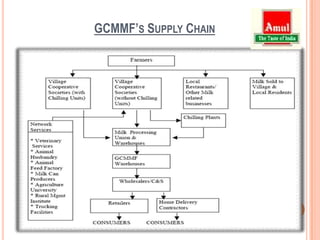
GCMMF’s Supply Chain
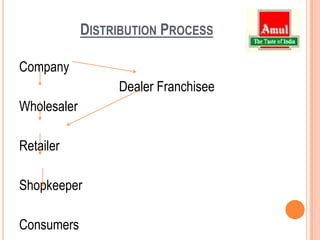
Distribution ProcessCompany                               Dealer FranchiseeWholesalerRetailerShopkeeperConsumers
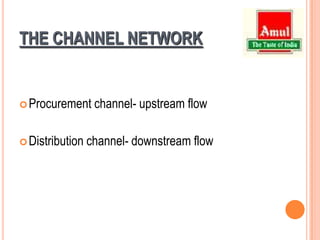
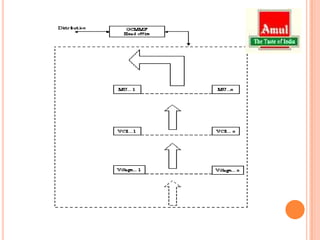
THE CHANNEL NETWORKProcurement channel- upstream flowDistribution channel- downstream flow
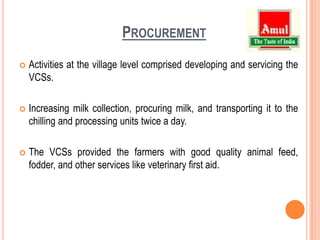
ProcurementActivities at the village level comprised developing and servicing the VCSs.Increasing milk collection, procuring milk, and transporting it to the chilling and processing units twice a day.The VCSs provided the farmers with good quality animal feed, fodder, and other services like veterinary first aid.
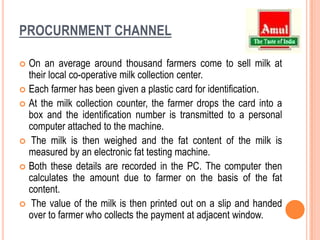
PROCURNMENT CHANNELOn an average around thousand farmers come to sell milk at their local co-operative milk collection center.Each farmer has been given a plastic card for identification.At the milk collection counter, the farmer drops the card into a box and the identification number is transmitted to a personal computer attached to the machine. The milk is then weighed and the fat content of the milk is measured by an electronic fat testing machine. Both these details are recorded in the PC. The computer then calculates the amount due to farmer on the basis of the fat content. The value of the milk is then printed out on a slip and handed over to farmer who collects the payment at adjacent window.
COLD STORAGE NETWORKChillers in proximity of villagesPrompt transport to district facilities for further dispatch to consumers/ processing units.Chilled trucks to transport processed productsDelivery to local chillers by insulated rail tankers and chilled trucks.Refrigerators and freezers with retailers and departmental stores to retain freshness.
DistributionGCMMF coordinated with various unions to get a regular supply of milk and dairy products.The processed milk and dairy products were procured from district dairy unions and distributed through third party distributors.To ensure quality and timely deliveries, GCMMF and the district unions had several mechanisms in place.The unions monitored the supplies of milk and the distribution of finished products.
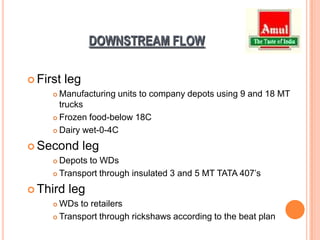
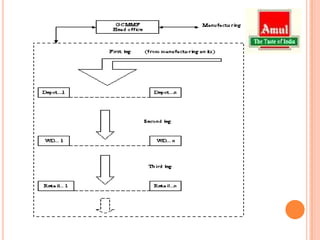
DOWNSTREAM FLOWFirst legManufacturing units to company depots using 9 and 18 MT trucksFrozen food-below 18CDairy wet-0-4CSecond legDepots to WDsTransport through insulated 3 and 5 MT TATA 407’s Third legWDs to retailersTransport through rickshaws according to the beat plan
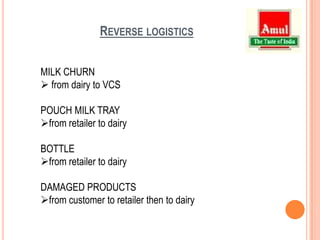
Reverse logisticsMILK CHURNfrom dairy to VCSPOUCH MILK TRAY from retailer to dairyBOTTLEfrom retailer to dairyDAMAGED PRODUCTS from customer to retailer then to dairyLessons for managing large networksLong term perspectiveSimultaneous development of markets and suppliers.Network partnership Vs. ownershipCost leadership and value for money Technology and Information Sharing
Direct retailingAmul has recently entered into direct retailing through "Amul Utterly Delicious" parlors created in major cities.Amul has plans to create a large chain of such outlets to be managed by franchisees throughout the country.More than 2000 parlor with a turnover of 200 crore.
Expansion planTie up with the WalMartExport is in 15 countries.Plan to open 10000 Amulparlor by the end of the 2010.
Mission  2020Very ambitious future plan –Turnover of 27000 crore.(three fold increase in the group turn over.)Milk production 33.1 million liter/day.Milk drying capacity 200 mt/day
Amul (Recently in news)Milk via milk train.Tie up with Adani Logistics. 50 wagon each capacity 24k liter.Initial transport cost was 40 crores,reduce it to half.

Amul Logistics

  • 1.
  • 2.
    Group no. 2AMITRAI – 10SHUBHANGI CHOUHAN – 61KULVINDER PATHANIA – 27PRATEEK CHHABRA – 16ASHISH SONAWARE – 29GAURAV CHOUHAN – 57
  • 3.
    AMULType - CooperativeIndustry- DairyFounded - 1946Key people - Dr. VerghesekurienRevenue - INR 67.11billion (2008-2009)Employee - Marketing arm: 735 Milk producers: 2.8 million
  • 4.
    KEY FACTSAMUL meanspriceless in Sanskrit “Amoolya”Brand name managed by an apex cooperation organization –GCMMFWorld’s biggest vegetarian cheese brandWorld’s largest pouched milk brand Largest food brand in IndiaSpurred the white revolution in IndiaAccreditation with 9001 and HACCP certification by QAS, Australia.
  • 5.
    GCMMF: An OverviewMembers13district cooperative milk producers UnionNo. of Producer Members2.79 millionNo. of Village Societies13,328Total Milk handling capacity11.22 million liters per day
  • 6.
    Cont…Milk collection (Total- 2008-09): 3.05 billion liters.Milk collection (Daily Average 2008-09): 8.4 million litersMilk Drying Capacity: 626 Mts. per dayCattle feed manufacturing Capacity: 3500 Mts. per day
  • 7.
  • 8.
  • 9.
    PRODUCTSBread Spreads MilkDrinksPowder Milk Fresh Milk Cheese For Cooking Chocolate
  • 10.
  • 11.
    PRODUCT SHAREAmul butter- 86%Ice cream - 36%Chocolate - 10%Ghee - 20%Skimmed milk powder - 40%
  • 12.
    PROBLEMS TO BEADDRESSED Logistics in collection –6 million liters of milk per dayFrom about 10,600 separate village cooperative societies.Approximately 2.8 million milk producing member.Logistic in coordination of –Storing the milk.Processing the milk.Distributing the milk.
  • 13.
    Cont….Supplier logistics –Weighingthe milk.Determining of fat content.Calculation of the purchase price.
  • 14.
    EVOLUTION of “IT”Theevolution of IT in AMUL was took place in the guidance of DR.B.M Vyas.The milk collection center at village cooperative societies, were first automated.Application and utilization of GIS.Data analysis software utilization for milk production estimation and increasing productivity.VATS network between all the level of distribution network and GCMMF.
  • 15.
    Shift processThe companyzeroed in on ERP as means to keep pace with dynamically changing business environment.TCS was hired to guide them in its implementation.The project was named as Enterprise wise integrated application system (EIAS)
  • 16.
    IMPLEMENTATIONAmul start implementationof ERP in phases.Automatic milk collection system units(AMCUS) at village society were installed in the first phase to automate milk production logistics.AMCUS facilities to capture member information, milk fat content, volume collected, and amount payable to each member electronically.
  • 18.
    Cont….Amul also connectedits zonal offices, regional offices and member’s dairies through VSATs.The customized ERP- EIAS has been implemented across the organization integrating various operational departments.Amulis also using Geographic Information Systems (GIS) for business planning and optimization of collection processes.
  • 19.
    Cont…Indian Institute ofManagement – Ahmedabad supplemented Amul’s IT strategy by providing an application software – Dairy Information System Kiosk(DISK) to facilitate data analysis and decision support in improving milk collection. The kiosk would also contain an extensive database on the history of cattle owned by the farmers, medical history of the cattle, reproductive cycle and history of diseases. Farmers can have access to information related to milk production, including best practices in breeding and rearing cattle. As a large amount of detailed history on milk production is available in the database, the system can be used to forecast milk collection and monitor the produce from individual sellers.
  • 20.
    Cont…The kiosk wouldalso contain an extensive database on the history of cattle owned by the farmers, medical history of the cattle, reproductive cycle and history of diseases. Farmers can have access to information related to milk production, including best practices in breeding and rearing cattle. As a large amount of detailed history on milk production is available in the database, the system can be used to forecast milk collection and monitor the produce from individual sellers.
  • 21.
    Automatic Milk CollectionSystem Units (AMCUS)
  • 22.
    REAPING RETURNS Radicalchanges in business processes - eliminating middlemen . Improved delivery mechanisms and transparency of business operations. Due to this process, AMUL is able to collect six million litres of milk per day. Huge reduction in processing time for effecting payments to the farmers from a week to couple of minute.Processing of 10 Million payments daily, amounting to transactions worth USD 3.78 million in cash.
  • 23.
    Cont..Movement of 5000trucks to 200 dairy processing plants twice a day in a most optimum manner.Practicing just in time supply chain management with six sigma accuracy. Online order placements of Amul’s products on the web. Distributors can place their orders on the website. Amulexports products worth around US$ 25 million to countries in West Asia, Africa and USA.
  • 24.
    Total Quality ManagementModelThere is improvement in quality of milk in term of acidity and sour milk.Sabor milk union records show 2% reduction in the amount of the sour milk received from the union.Improved microbiological quality of upcoming raw milk in the form of methylene blue reduction.This gives better shelf life to the product.Program like Red Tag Day was launched for cleaning the milk collection center.
  • 25.
    AMUL PATTERNA threetier cooperative structure:Dairy cooperative society at village level Milk union at district level Milk federation at state level
  • 26.
    ORGANIZATION STRUCTUREDECISION-MAKINGLEVELMEMBERS Pricepaid to district unions (fixed across unions)
  • 27.
    Product mixand quantityState Federation Price paid to village co-operative societiesDistrict Membership
  • 28.
    Price paidto milk suppliersVillage
  • 29.
    Village Dairy CooperativeSociety (VDCS)Collection of surplus milk & payment based on quality & quantity.Providing support services to the members.Selling liquid milk for local consumers of the village.Supplying milk to the District Milk Union
  • 30.
    District Cooperative MilkProducers’ Union (Milk Union)Procurement of milk from the Village Dairy Societies of the District.Arranging transportation of raw milk from the VDCS to the Milk Union.Providing input services to the producers.Conducting training on Cooperative development
  • 31.
    Cont..Providing management support& regular supervision to the VDCS.Establish Chilling Centers & Dairy Plants for processing the milk.Selling liquid milk & milk products within the District.Process milk into various milk & milk products.Decide on the prices of milk to be paid to milk producers.
  • 32.
    State Cooperative MilkFederation (Federation)Marketing of milk & milk productsEstablish distribution network Arranging transportation from the Milk Unions to the market.Creating & maintaining a brandProviding Technical Inputs, management support & advisory services.Decide on the products to be manufactured at various Milk Unions (product-mix)Conduct long-term Milk Production, Procurement, Processing & Marketing PlanningConflict Resolution & keeping the entire structure intact
  • 33.
  • 34.
    Distribution ProcessCompany Dealer FranchiseeWholesalerRetailerShopkeeperConsumers
  • 35.
    THE CHANNEL NETWORKProcurementchannel- upstream flowDistribution channel- downstream flow
  • 36.
    ProcurementActivities at thevillage level comprised developing and servicing the VCSs.Increasing milk collection, procuring milk, and transporting it to the chilling and processing units twice a day.The VCSs provided the farmers with good quality animal feed, fodder, and other services like veterinary first aid.
  • 37.
    PROCURNMENT CHANNELOn anaverage around thousand farmers come to sell milk at their local co-operative milk collection center.Each farmer has been given a plastic card for identification.At the milk collection counter, the farmer drops the card into a box and the identification number is transmitted to a personal computer attached to the machine. The milk is then weighed and the fat content of the milk is measured by an electronic fat testing machine. Both these details are recorded in the PC. The computer then calculates the amount due to farmer on the basis of the fat content. The value of the milk is then printed out on a slip and handed over to farmer who collects the payment at adjacent window.
  • 39.
    COLD STORAGE NETWORKChillersin proximity of villagesPrompt transport to district facilities for further dispatch to consumers/ processing units.Chilled trucks to transport processed productsDelivery to local chillers by insulated rail tankers and chilled trucks.Refrigerators and freezers with retailers and departmental stores to retain freshness.
  • 40.
    DistributionGCMMF coordinated withvarious unions to get a regular supply of milk and dairy products.The processed milk and dairy products were procured from district dairy unions and distributed through third party distributors.To ensure quality and timely deliveries, GCMMF and the district unions had several mechanisms in place.The unions monitored the supplies of milk and the distribution of finished products.
  • 41.
    DOWNSTREAM FLOWFirst legManufacturingunits to company depots using 9 and 18 MT trucksFrozen food-below 18CDairy wet-0-4CSecond legDepots to WDsTransport through insulated 3 and 5 MT TATA 407’s Third legWDs to retailersTransport through rickshaws according to the beat plan
  • 43.
    Reverse logisticsMILK CHURNfromdairy to VCSPOUCH MILK TRAY from retailer to dairyBOTTLEfrom retailer to dairyDAMAGED PRODUCTS from customer to retailer then to dairyLessons for managing large networksLong term perspectiveSimultaneous development of markets and suppliers.Network partnership Vs. ownershipCost leadership and value for money Technology and Information Sharing
  • 44.
    Direct retailingAmul hasrecently entered into direct retailing through "Amul Utterly Delicious" parlors created in major cities.Amul has plans to create a large chain of such outlets to be managed by franchisees throughout the country.More than 2000 parlor with a turnover of 200 crore.
  • 45.
    Expansion planTie upwith the WalMartExport is in 15 countries.Plan to open 10000 Amulparlor by the end of the 2010.
  • 46.
    Mission 2020Veryambitious future plan –Turnover of 27000 crore.(three fold increase in the group turn over.)Milk production 33.1 million liter/day.Milk drying capacity 200 mt/day
  • 47.
    Amul (Recently innews)Milk via milk train.Tie up with Adani Logistics. 50 wagon each capacity 24k liter.Initial transport cost was 40 crores,reduce it to half.
  • 48.