RAHUL BABAR
A supply chain is a system of organizations,
people, technology, activities, information
and resources involved in moving a product
or service from supplier to customer. Supply
chain activities transform natural resources,
raw materials and components into a finished
product that is delivered to the end customer.
-Council of Supply Chain Management Professionals
(CSCMP)
Background
Traditionally companies aim for- greater speed and cost-
effectiveness
Companies couldn’t sustain that competitive advantage
Mark down in USA in 1980s was 10% and 30% in 2000s
Wal-mart, Dell and Amazon were successful to maintain a
competitive advantage through supply chain management
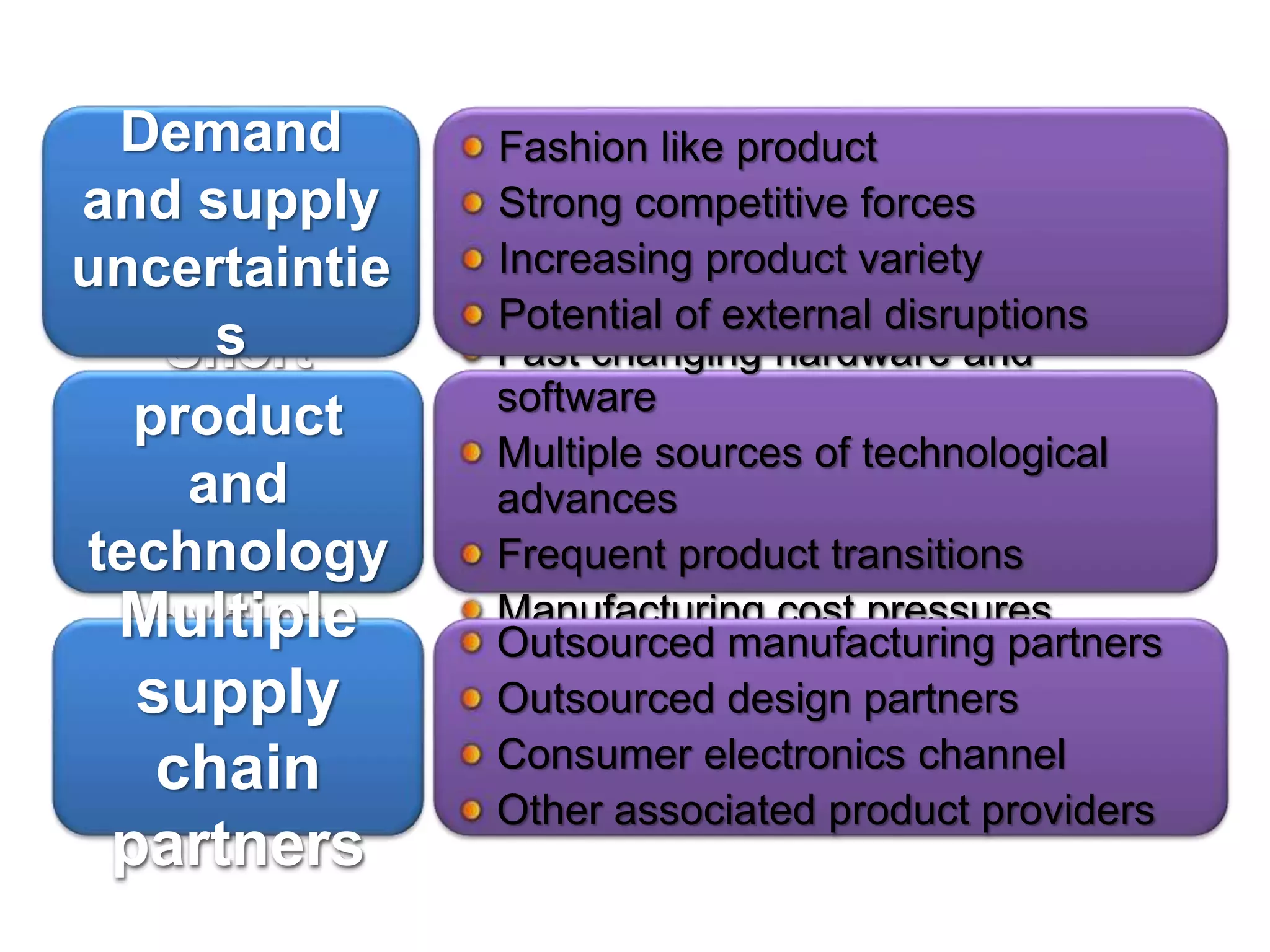
Fast changing hardware and
software
Multiple sources of technological
advances
Frequent product transitions
Manufacturing cost pressures
Short
product
and
technology
cycles Outsourced manufacturing partners
Outsourced design partners
Consumer electronics channel
Other associated product providers
Multiple
supply
chain
partners
Fashion like product
Strong competitive forces
Increasing product variety
Potential of external disruptions
Demand
and supply
uncertaintie
s
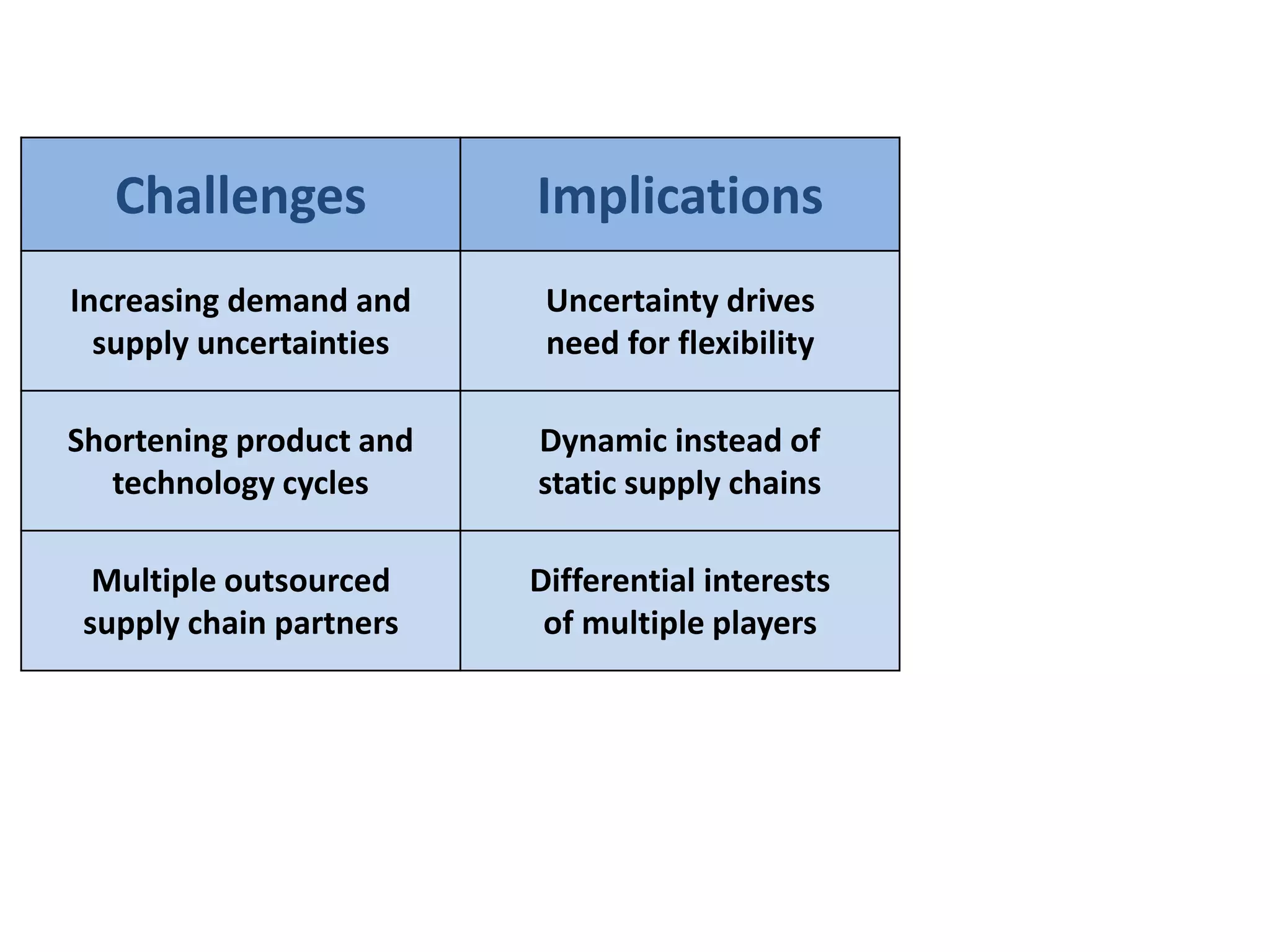
Challenges Implications
Increasing demand and
supply uncertainties
Uncertainty drives
need for flexibility
Shortening product and
technology cycles
Dynamic instead of
static supply chains
Multiple outsourced
supply chain partners
Differential interests
of multiple players
Agility
Adaptability
Alignment
Challenges Implications
Increasing demand and
supply uncertainties
Uncertainty drives
need for flexibility
Shortening product and
technology cycles
Dynamic instead of
static supply chains
Multiple outsourced
supply chain partners
Differential interests
of multiple players
According to Lee, H. (2003)…
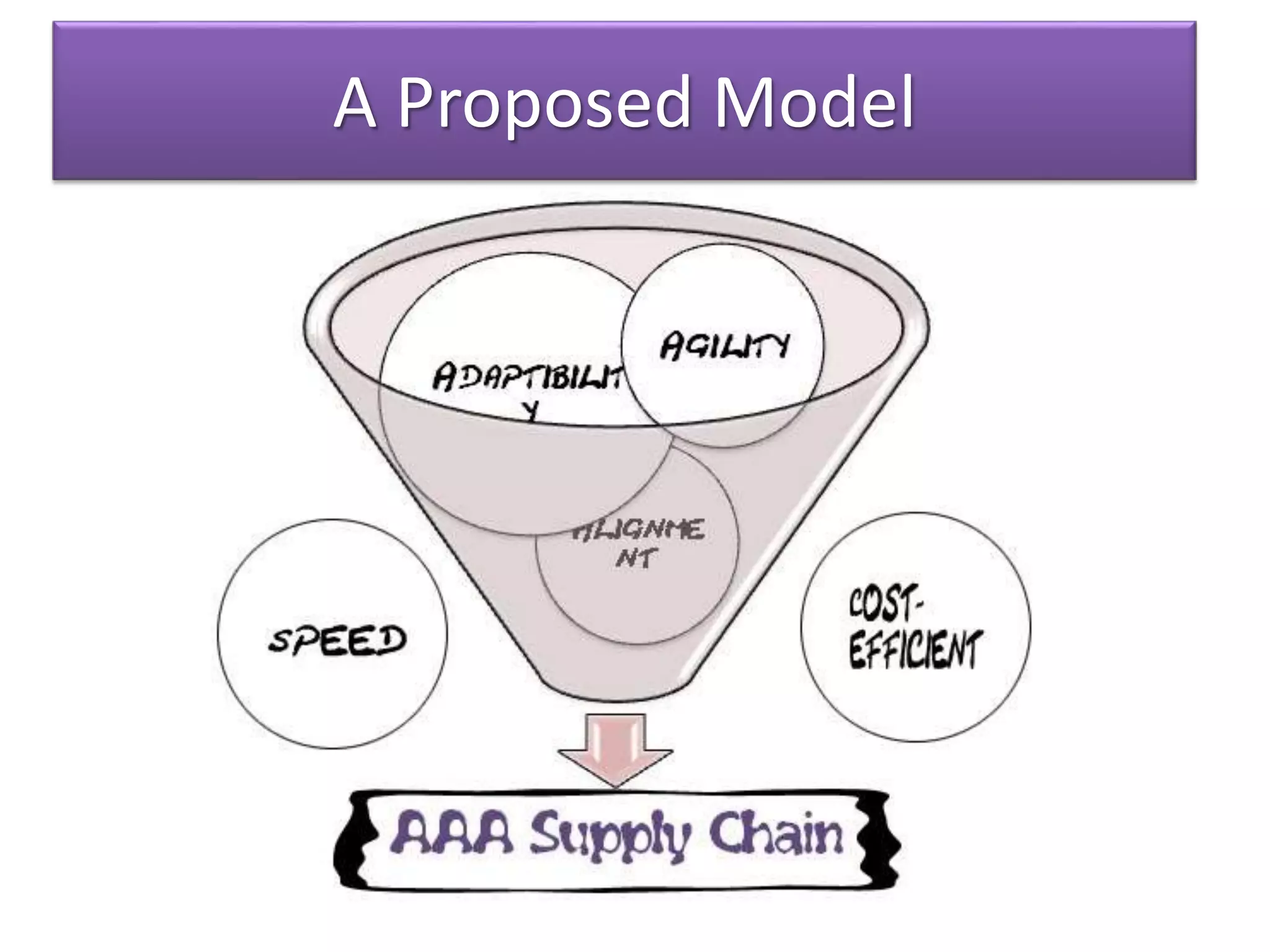
In addition to being efficient supply chains should possess
three very different qualities- agility, adaptability and
alignment- which he referred to as the “Triple-A Supply Chain”
Agility
Adaptability
Alignment
It enables a company to handle unexpected external
disruptions smoothly and cost-efficiently and to
recover promptly from shocks such as natural
disasters, epidemics, and computer viruses.
Objective: to respond to short-term changes in
demand or supply quickly.
Agility
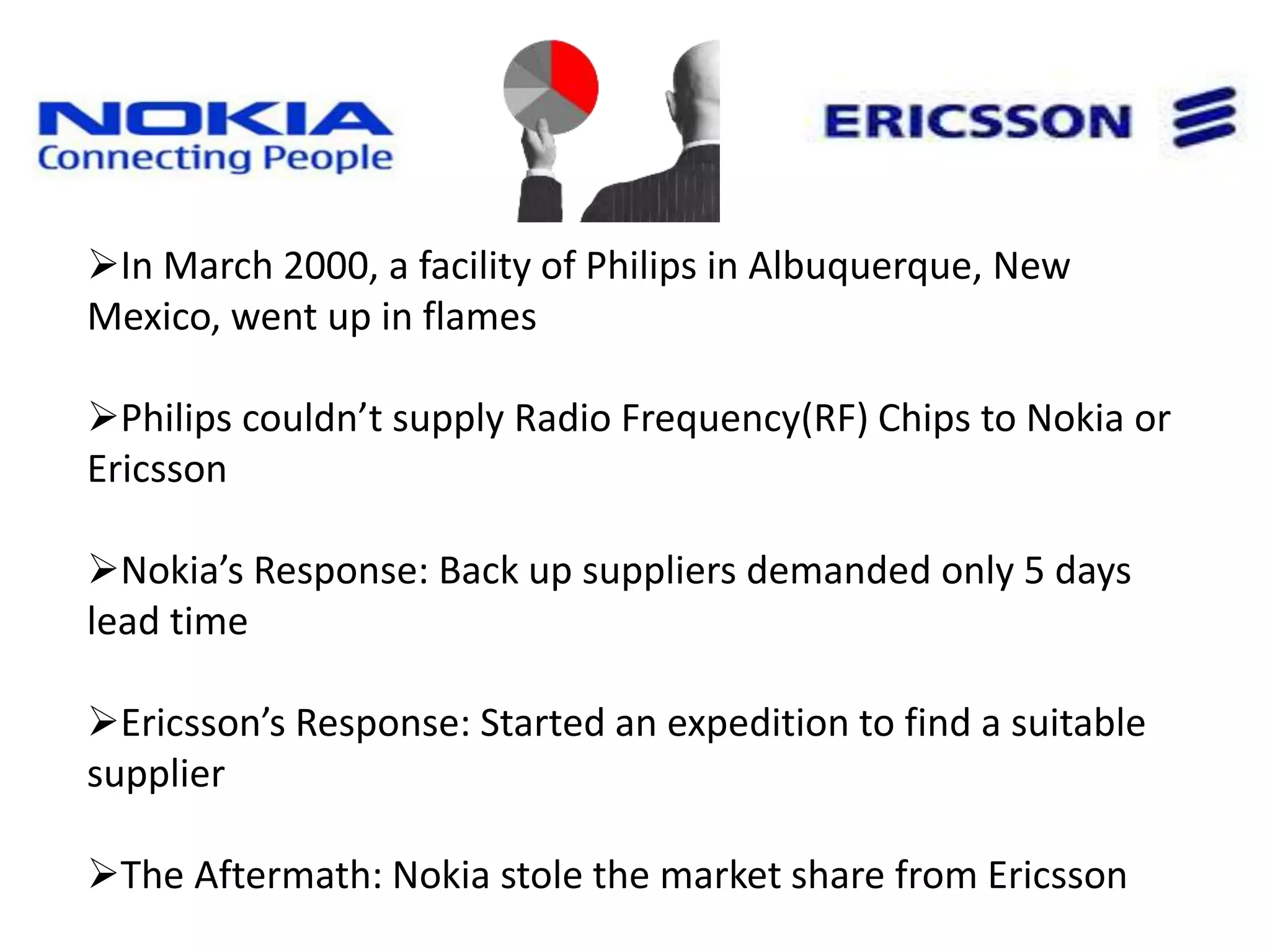
In March 2000, a facility of Philips in Albuquerque, New
Mexico, went up in flames
Philips couldn’t supply Radio Frequency(RF) Chips to Nokia or
Ericsson
Nokia’s Response: Back up suppliers demanded only 5 days
lead time
Ericsson’s Response: Started an expedition to find a suitable
supplier
The Aftermath: Nokia stole the market share from Ericsson
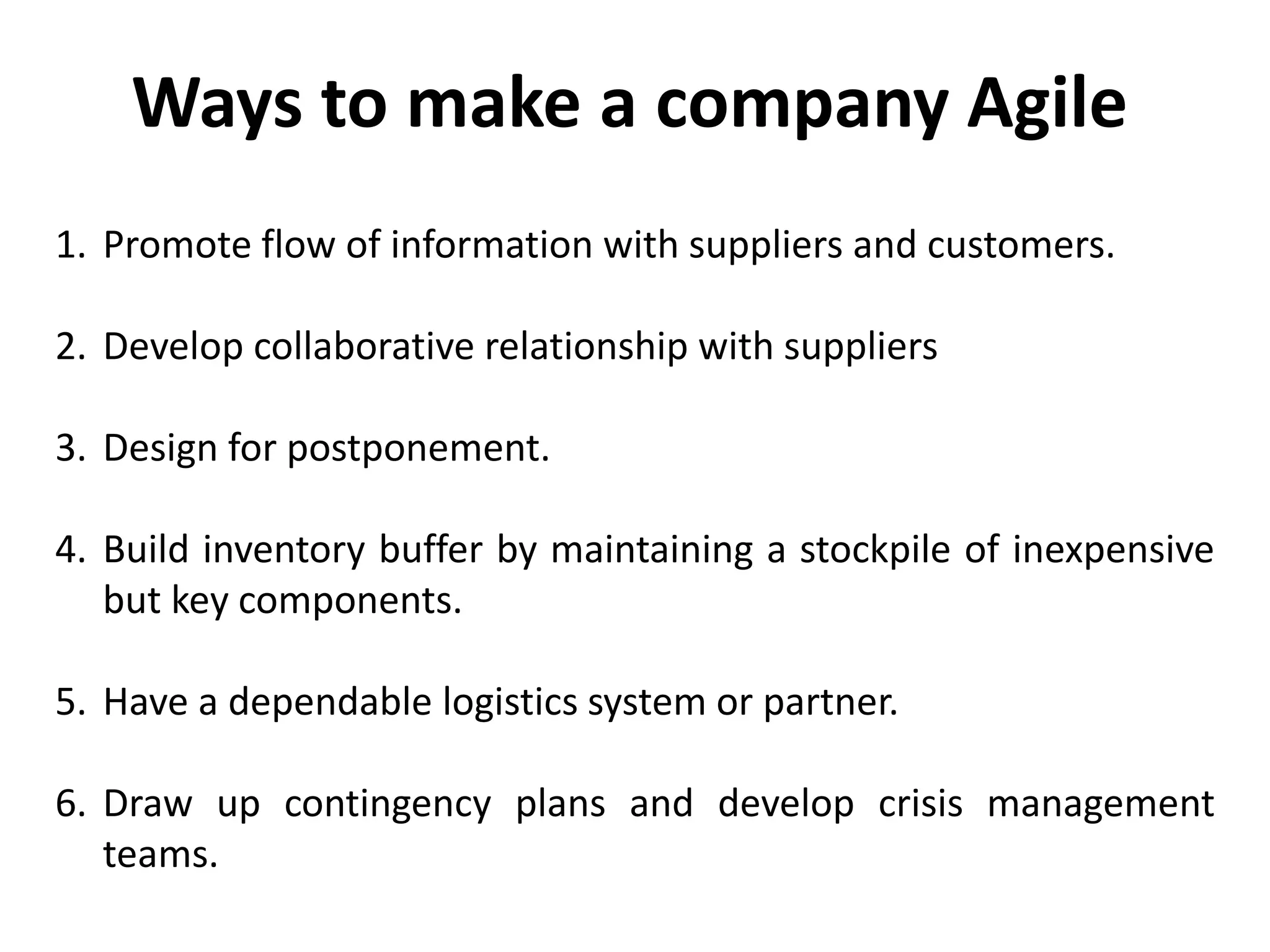
1. Promote flow of information with suppliers and customers.
2. Develop collaborative relationship with suppliers
3. Design for postponement.
4. Build inventory buffer by maintaining a stockpile of inexpensive
but key components.
5. Have a dependable logistics system or partner.
6. Draw up contingency plans and develop crisis management
teams.
Ways to make a company Agile
Ability to adjust to structural shifts in market demand or supply,
modify supply network to company strategies, products and
technologies
Enables a company to evolve over time as economic progress,
political shifts, demographic trends, and technological advances
reshape markets.
Objective: to adjust supply chain design to
accommodate market changes.
Adaptability
In 2000, MS outsourced hardware production to Flexotronics.
MS announced the deadline - December 1, 2001 to target
Christmas shoppers
Flexotronics shifted production to Mexico and Hungary
MS launched the product in record time
Sony’s Response: Deep discount
Flexotronics’s Response: Shift production to China
The Aftermath: MS engulfed 20% market share of Playstation.
1. Monitor economies all over the world to spot new supply bases
and markets.
2. Use intermediaries to develop fresh suppliers and logistics
infrastructure.
3. Evaluate needs of ultimate consumers- not just immediate
customers.
4. Create flexible product designs.
5. Determine where company’s products stand in terms of
technology cycles and product life cycles.
Making a company ‘Adaptable’
To encourage free flow of information
with suppliers and customers on a regular
basis.
Objective: The objective of aligning a supply
chain is to establish incentives for supply chain
partners to improve performance of the entire
chain.
Alignment
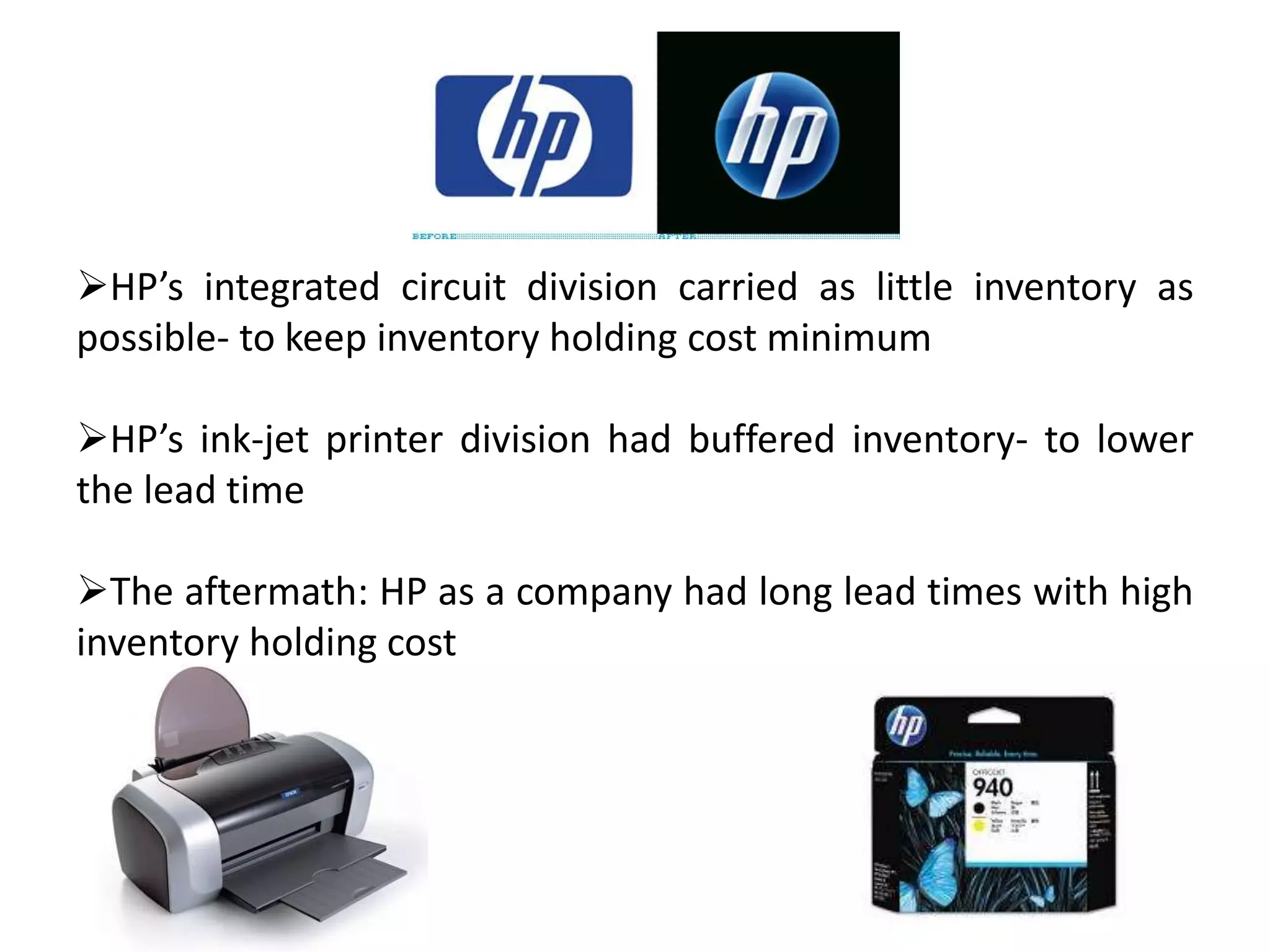
HP’s integrated circuit division carried as little inventory as
possible- to keep inventory holding cost minimum
HP’s ink-jet printer division had buffered inventory- to lower
the lead time
The aftermath: HP as a company had long lead times with high
inventory holding cost
1.Exchange information and knowledge freely with
vendors and customers.
2.Lay down roles, tasks and responsibilities clearly
for suppliers and customers.
3.Equitably share risks, costs, and gains of
improvement initiatives.
Making a company ‘Aligned’
A Proposed Model
1. Agility
• Real-time systems to detect changes in customer
preferences and track sales and customer data at
every store
• Satellite connections link stores with distribution
centers, suppliers, and logistics providers
• Reallocates inventory among stores and reconfigures
store shelves three times daily to cater to different
customer groups at different hours
• Within six hours after the 1995 Kobe
earthquake, SEJ overcame highway gridlock by
mobilizing helicopters and motorcycles to
deliver 64,000 rice balls to its stores in the
beleaguered city.
• Making partners' incentives and disincentives
clear
• When carriers fail to deliver on time, they pay
a penalty
• Helps carriers save money by forgoing the
typical time-consuming requirement that
store managers verify all contents of each
delivery truck
RESPONSE
Companies need fresh attitude and new culture to their supply
chain to deliver a Triple A performance.
Companies must give up efficiency mind set and be prepared to
keep changing networks.
Instead of taking care of your own interests take responsibility of
whole chain.
Technologies can’t alone make this changes, only managers can
make this happen.

Triple A Supply Chain

  • 1.
  • 2.
    A supply chainis a system of organizations, people, technology, activities, information and resources involved in moving a product or service from supplier to customer. Supply chain activities transform natural resources, raw materials and components into a finished product that is delivered to the end customer. -Council of Supply Chain Management Professionals (CSCMP)
  • 3.
    Background Traditionally companies aimfor- greater speed and cost- effectiveness Companies couldn’t sustain that competitive advantage Mark down in USA in 1980s was 10% and 30% in 2000s Wal-mart, Dell and Amazon were successful to maintain a competitive advantage through supply chain management
  • 4.
    Fast changing hardwareand software Multiple sources of technological advances Frequent product transitions Manufacturing cost pressures Short product and technology cycles Outsourced manufacturing partners Outsourced design partners Consumer electronics channel Other associated product providers Multiple supply chain partners Fashion like product Strong competitive forces Increasing product variety Potential of external disruptions Demand and supply uncertaintie s
  • 5.
    Challenges Implications Increasing demandand supply uncertainties Uncertainty drives need for flexibility Shortening product and technology cycles Dynamic instead of static supply chains Multiple outsourced supply chain partners Differential interests of multiple players
  • 6.
    Agility Adaptability Alignment Challenges Implications Increasing demandand supply uncertainties Uncertainty drives need for flexibility Shortening product and technology cycles Dynamic instead of static supply chains Multiple outsourced supply chain partners Differential interests of multiple players
  • 7.
    According to Lee,H. (2003)… In addition to being efficient supply chains should possess three very different qualities- agility, adaptability and alignment- which he referred to as the “Triple-A Supply Chain” Agility Adaptability Alignment
  • 8.
    It enables acompany to handle unexpected external disruptions smoothly and cost-efficiently and to recover promptly from shocks such as natural disasters, epidemics, and computer viruses. Objective: to respond to short-term changes in demand or supply quickly. Agility
  • 9.
    In March 2000,a facility of Philips in Albuquerque, New Mexico, went up in flames Philips couldn’t supply Radio Frequency(RF) Chips to Nokia or Ericsson Nokia’s Response: Back up suppliers demanded only 5 days lead time Ericsson’s Response: Started an expedition to find a suitable supplier The Aftermath: Nokia stole the market share from Ericsson
  • 10.
    1. Promote flowof information with suppliers and customers. 2. Develop collaborative relationship with suppliers 3. Design for postponement. 4. Build inventory buffer by maintaining a stockpile of inexpensive but key components. 5. Have a dependable logistics system or partner. 6. Draw up contingency plans and develop crisis management teams. Ways to make a company Agile
  • 11.
    Ability to adjustto structural shifts in market demand or supply, modify supply network to company strategies, products and technologies Enables a company to evolve over time as economic progress, political shifts, demographic trends, and technological advances reshape markets. Objective: to adjust supply chain design to accommodate market changes. Adaptability
  • 12.
    In 2000, MSoutsourced hardware production to Flexotronics. MS announced the deadline - December 1, 2001 to target Christmas shoppers Flexotronics shifted production to Mexico and Hungary MS launched the product in record time Sony’s Response: Deep discount Flexotronics’s Response: Shift production to China The Aftermath: MS engulfed 20% market share of Playstation.
  • 13.
    1. Monitor economiesall over the world to spot new supply bases and markets. 2. Use intermediaries to develop fresh suppliers and logistics infrastructure. 3. Evaluate needs of ultimate consumers- not just immediate customers. 4. Create flexible product designs. 5. Determine where company’s products stand in terms of technology cycles and product life cycles. Making a company ‘Adaptable’
  • 14.
    To encourage freeflow of information with suppliers and customers on a regular basis. Objective: The objective of aligning a supply chain is to establish incentives for supply chain partners to improve performance of the entire chain. Alignment
  • 15.
    HP’s integrated circuitdivision carried as little inventory as possible- to keep inventory holding cost minimum HP’s ink-jet printer division had buffered inventory- to lower the lead time The aftermath: HP as a company had long lead times with high inventory holding cost
  • 16.
    1.Exchange information andknowledge freely with vendors and customers. 2.Lay down roles, tasks and responsibilities clearly for suppliers and customers. 3.Equitably share risks, costs, and gains of improvement initiatives. Making a company ‘Aligned’
  • 17.
  • 19.
    1. Agility • Real-timesystems to detect changes in customer preferences and track sales and customer data at every store • Satellite connections link stores with distribution centers, suppliers, and logistics providers • Reallocates inventory among stores and reconfigures store shelves three times daily to cater to different customer groups at different hours
  • 20.
    • Within sixhours after the 1995 Kobe earthquake, SEJ overcame highway gridlock by mobilizing helicopters and motorcycles to deliver 64,000 rice balls to its stores in the beleaguered city.
  • 21.
    • Making partners'incentives and disincentives clear • When carriers fail to deliver on time, they pay a penalty • Helps carriers save money by forgoing the typical time-consuming requirement that store managers verify all contents of each delivery truck
  • 22.
  • 25.
    Companies need freshattitude and new culture to their supply chain to deliver a Triple A performance. Companies must give up efficiency mind set and be prepared to keep changing networks. Instead of taking care of your own interests take responsibility of whole chain. Technologies can’t alone make this changes, only managers can make this happen.