The document summarizes key aspects of the MIPS architecture including data types, registers, data declarations, instructions, and control structures. It describes MIPS as a 32-bit architecture that uses registers for all operations. General purpose registers include 32 registers that can be addressed by number or name. Load and store instructions are used to transfer data between registers and memory. Arithmetic instructions operate on registers and control structures allow for conditional and unconditional branching.
Data Types andLiterals
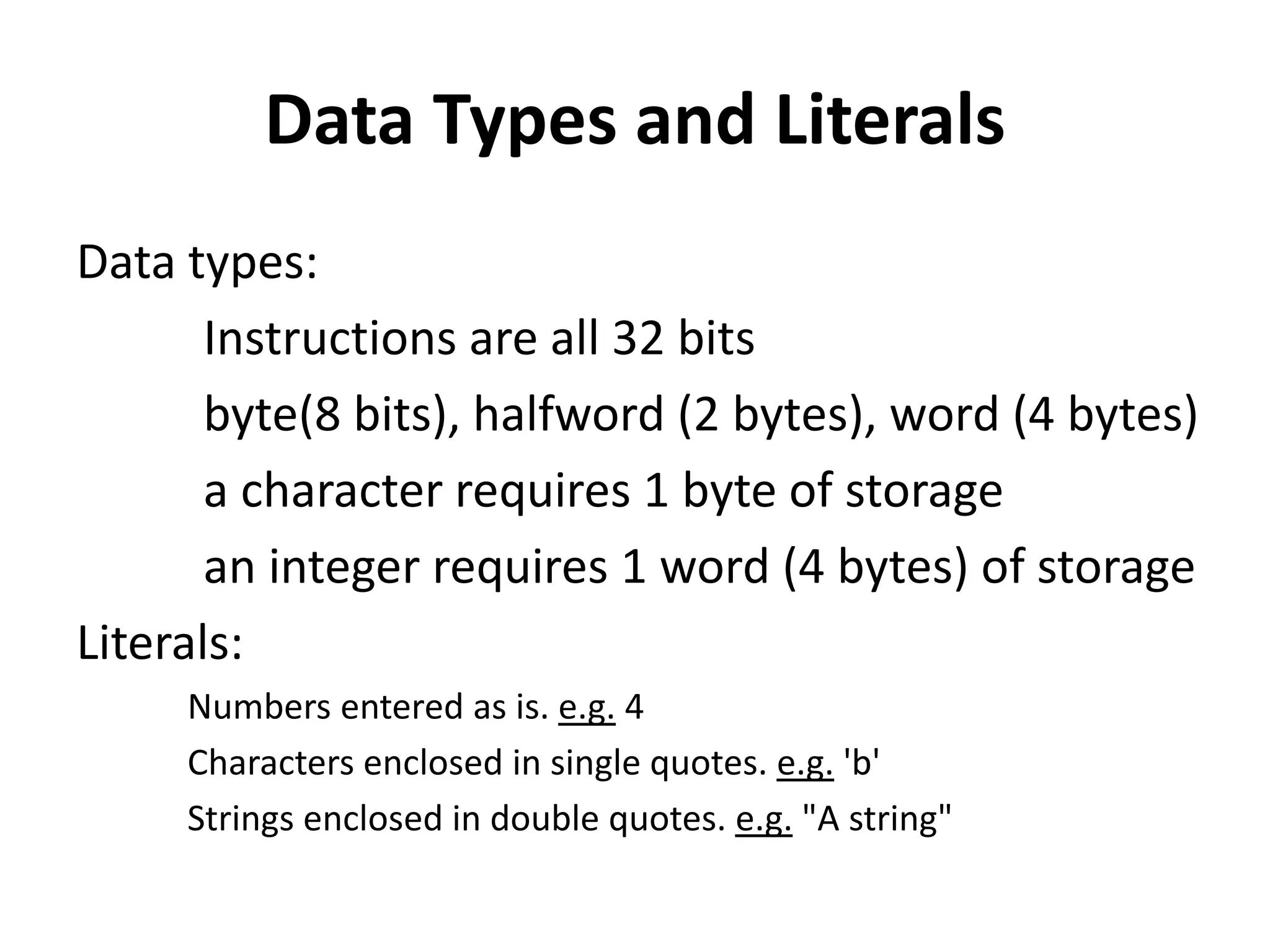
Data types:
Instructions are all 32 bits
byte(8 bits), halfword (2 bytes), word (4 bytes)
a character requires 1 byte of storage
an integer requires 1 word (4 bytes) of storage
Literals:
Numbers entered as is. e.g. 4
Characters enclosed in single quotes. e.g. 'b'
Strings enclosed in double quotes. e.g. "A string"
3.
Registers
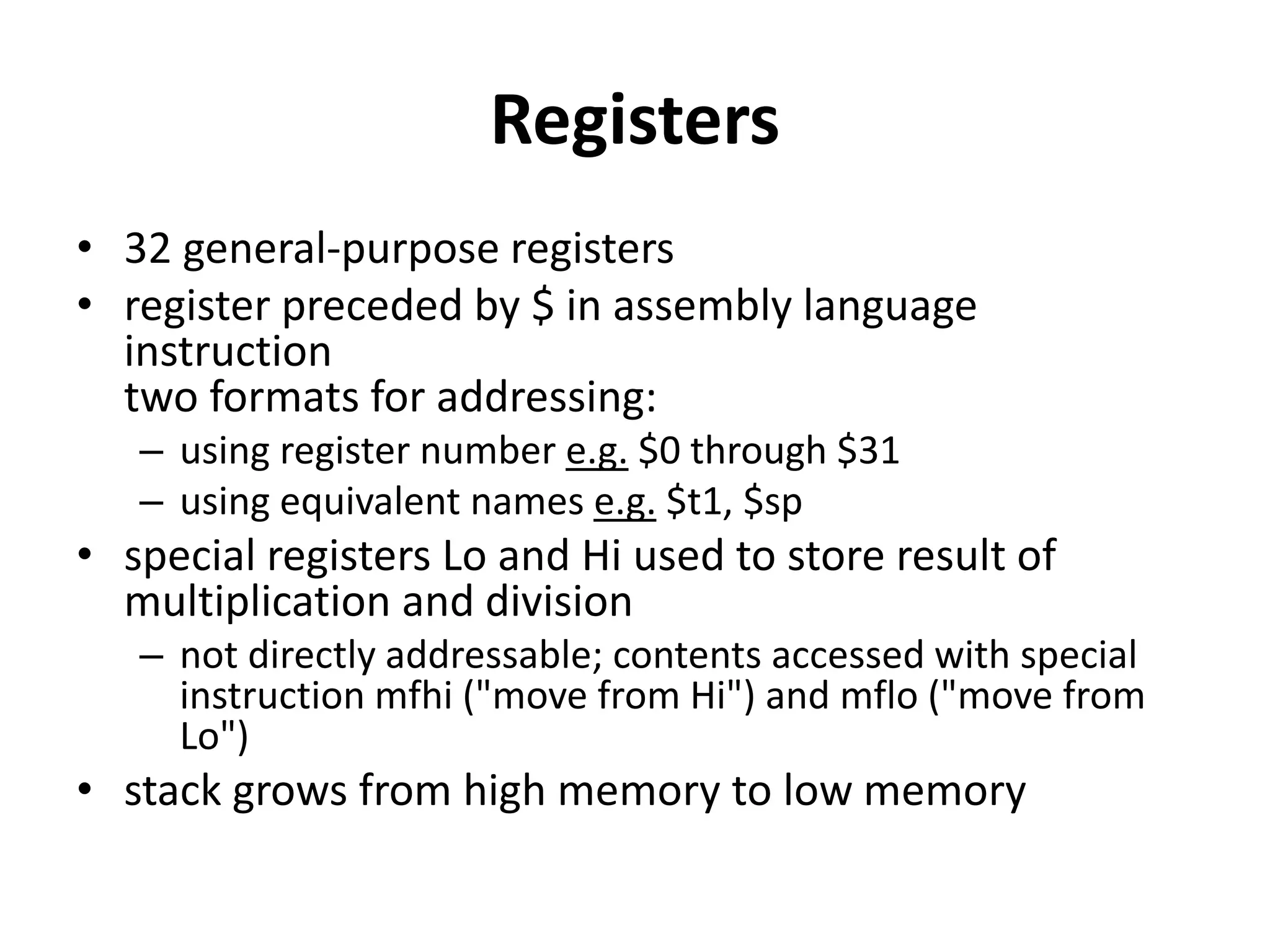
• 32 general-purposeregisters
• register preceded by $ in assembly language
instruction
two formats for addressing:
– using register number e.g. $0 through $31
– using equivalent names e.g. $t1, $sp
• special registers Lo and Hi used to store result of
multiplication and division
– not directly addressable; contents accessed with special
instruction mfhi ("move from Hi") and mflo ("move from
Lo")
• stack grows from high memory to low memory
4.
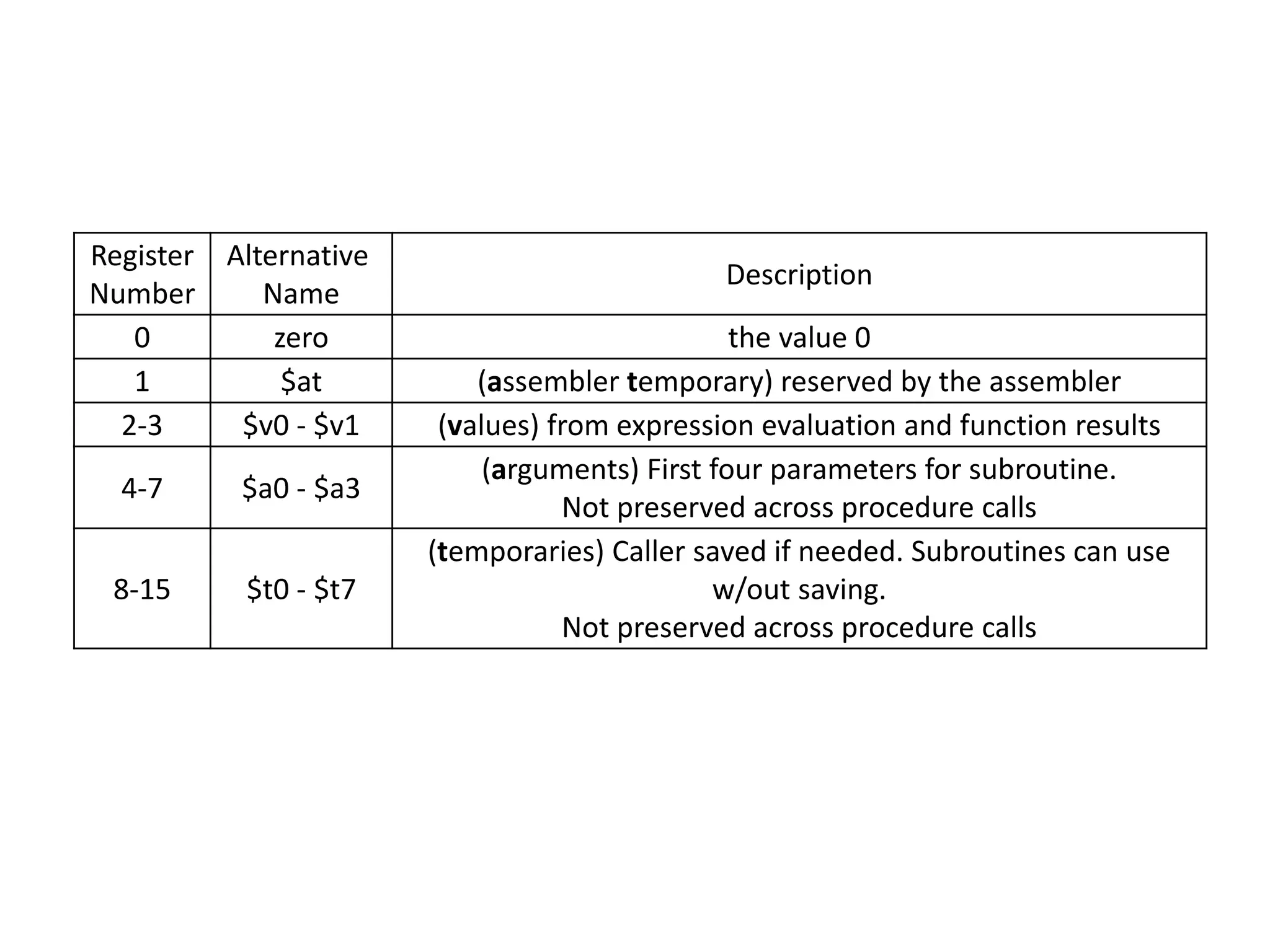
Register
Number
Alternative
Name
Description
0 zero thevalue 0
1 $at (assembler temporary) reserved by the assembler
2-3 $v0 - $v1 (values) from expression evaluation and function results
4-7 $a0 - $a3
(arguments) First four parameters for subroutine.
Not preserved across procedure calls
8-15 $t0 - $t7
(temporaries) Caller saved if needed. Subroutines can use
w/out saving.
Not preserved across procedure calls
5.
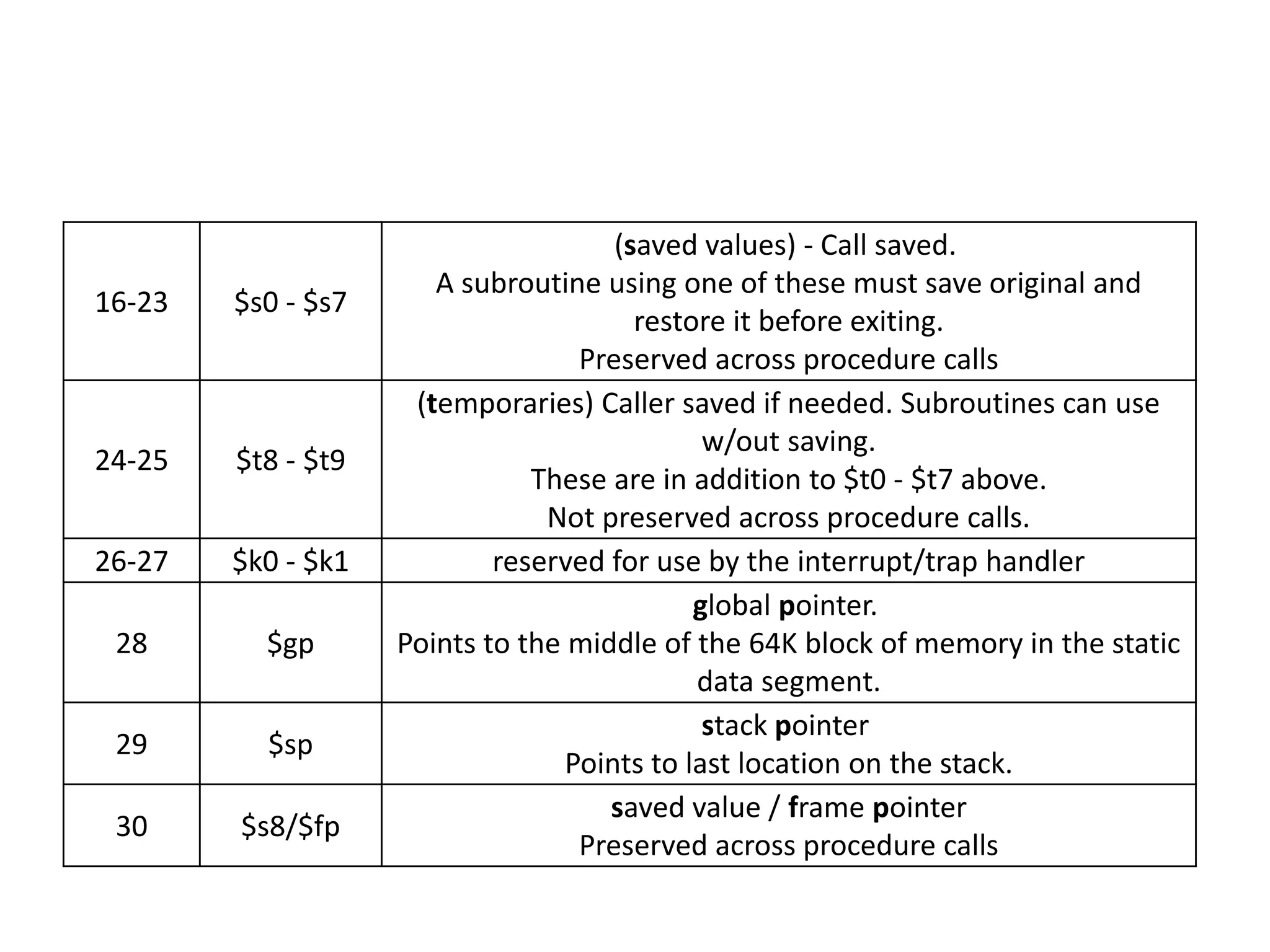
16-23 $s0 -$s7
(saved values) - Call saved.
A subroutine using one of these must save original and
restore it before exiting.
Preserved across procedure calls
24-25 $t8 - $t9
(temporaries) Caller saved if needed. Subroutines can use
w/out saving.
These are in addition to $t0 - $t7 above.
Not preserved across procedure calls.
26-27 $k0 - $k1 reserved for use by the interrupt/trap handler
28 $gp
global pointer.
Points to the middle of the 64K block of memory in the static
data segment.
29 $sp
stack pointer
Points to last location on the stack.
30 $s8/$fp
saved value / frame pointer
Preserved across procedure calls
6.
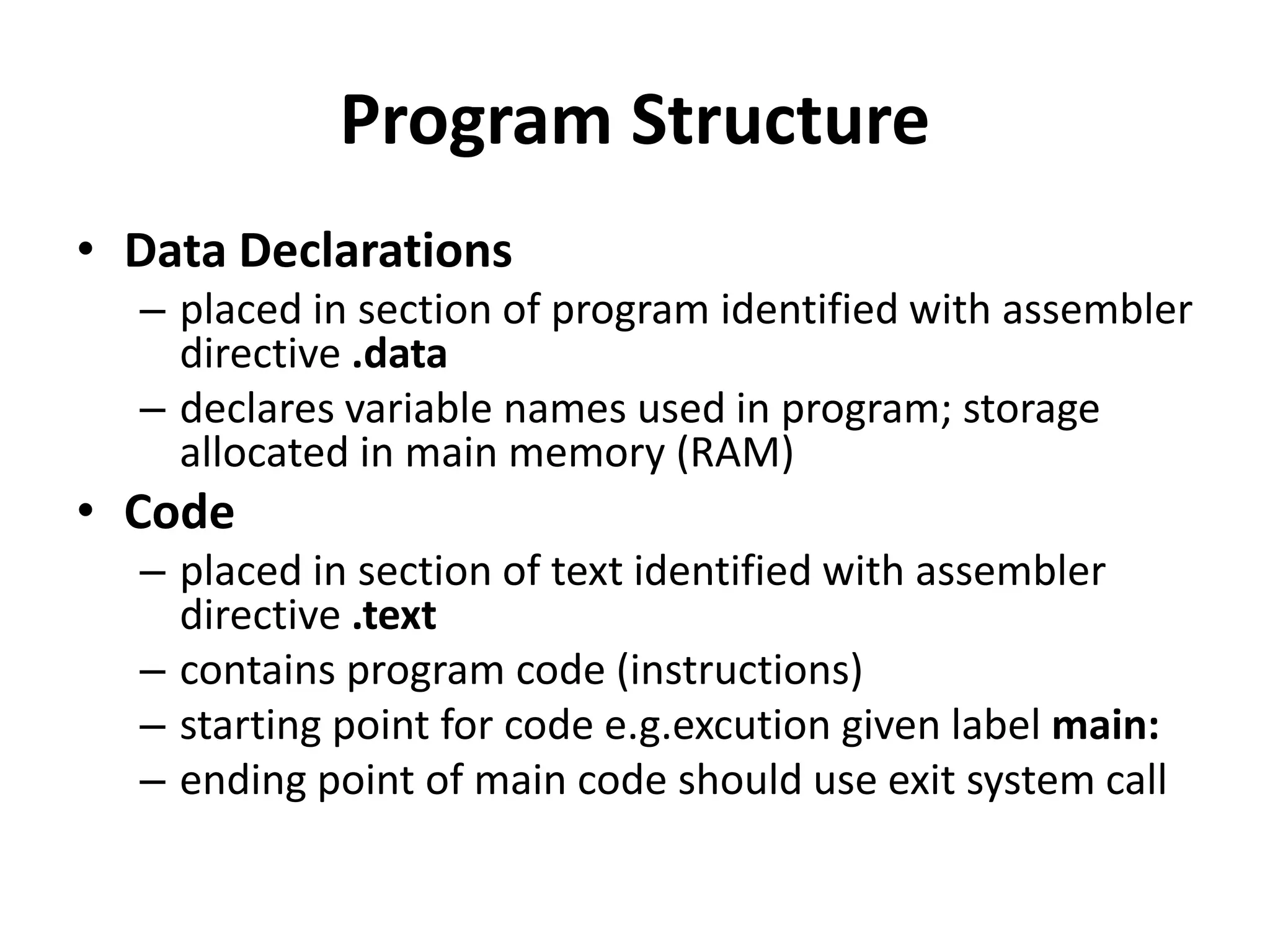
Program Structure
• DataDeclarations
– placed in section of program identified with assembler
directive .data
– declares variable names used in program; storage
allocated in main memory (RAM)
• Code
– placed in section of text identified with assembler
directive .text
– contains program code (instructions)
– starting point for code e.g.excution given label main:
– ending point of main code should use exit system call
7.
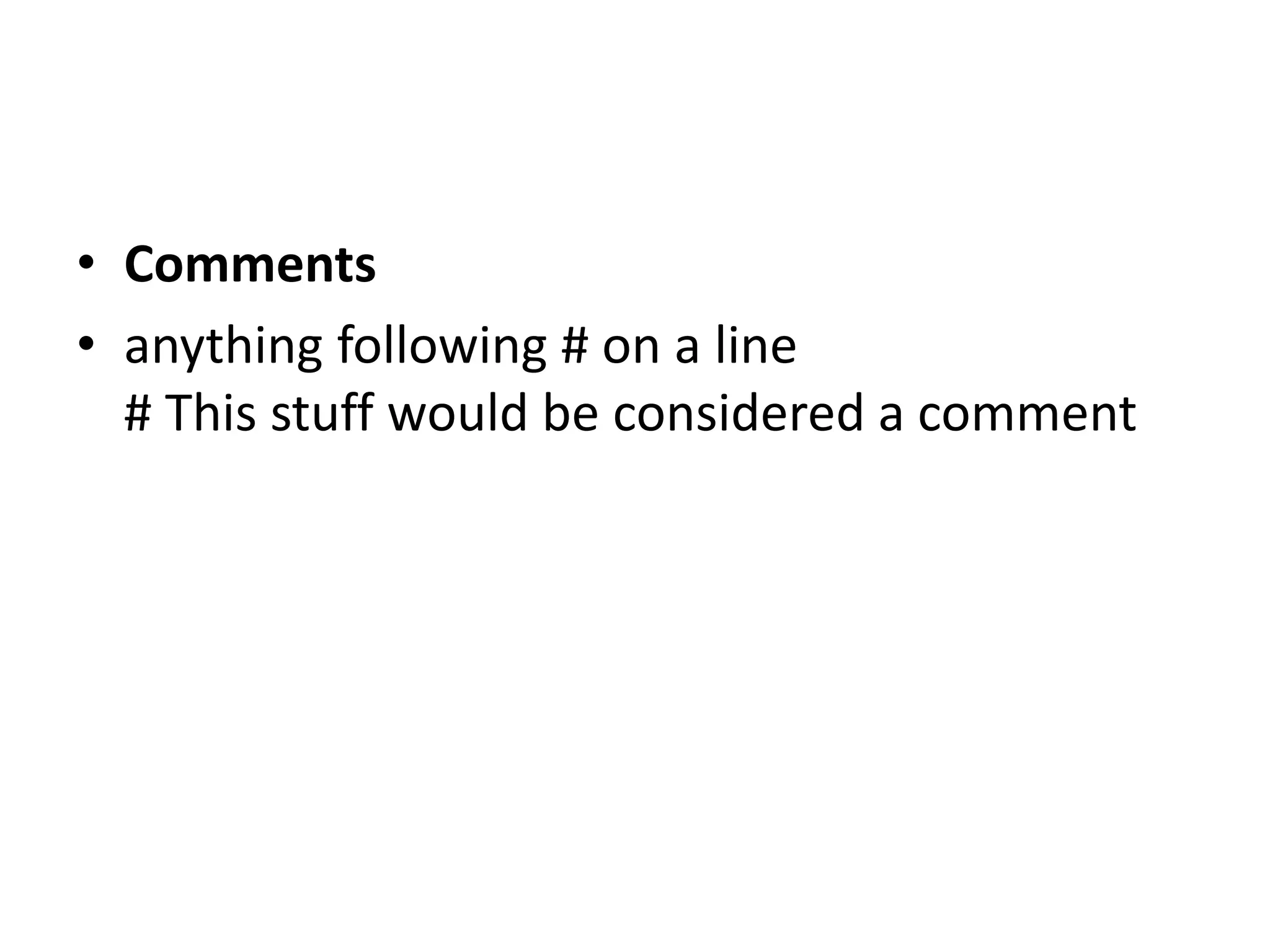
• Comments
• anythingfollowing # on a line
# This stuff would be considered a comment
8.
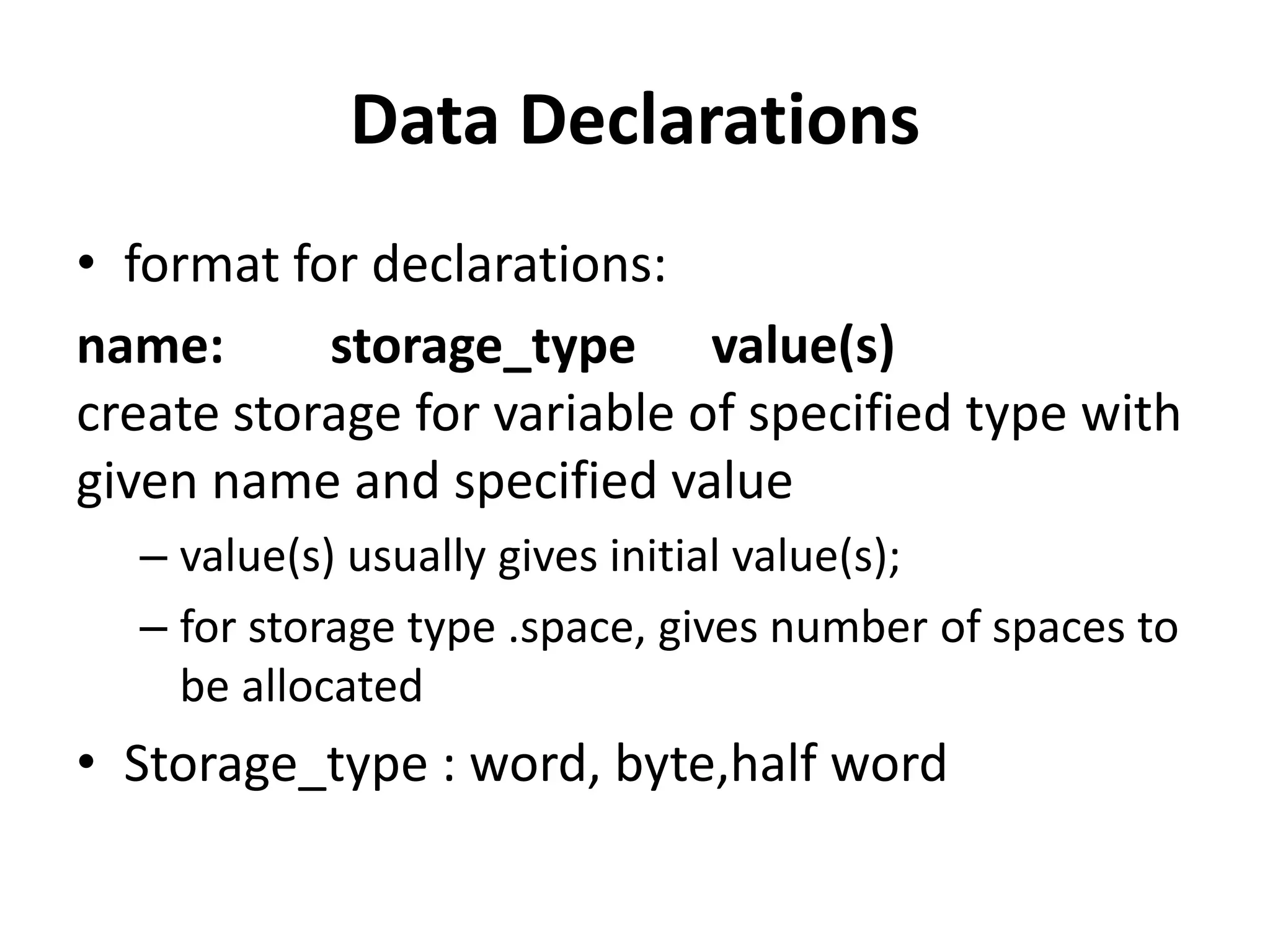
Data Declarations
• formatfor declarations:
name: storage_type value(s)
create storage for variable of specified type with
given name and specified value
– value(s) usually gives initial value(s);
– for storage type .space, gives number of spaces to
be allocated
• Storage_type : word, byte,half word
9.
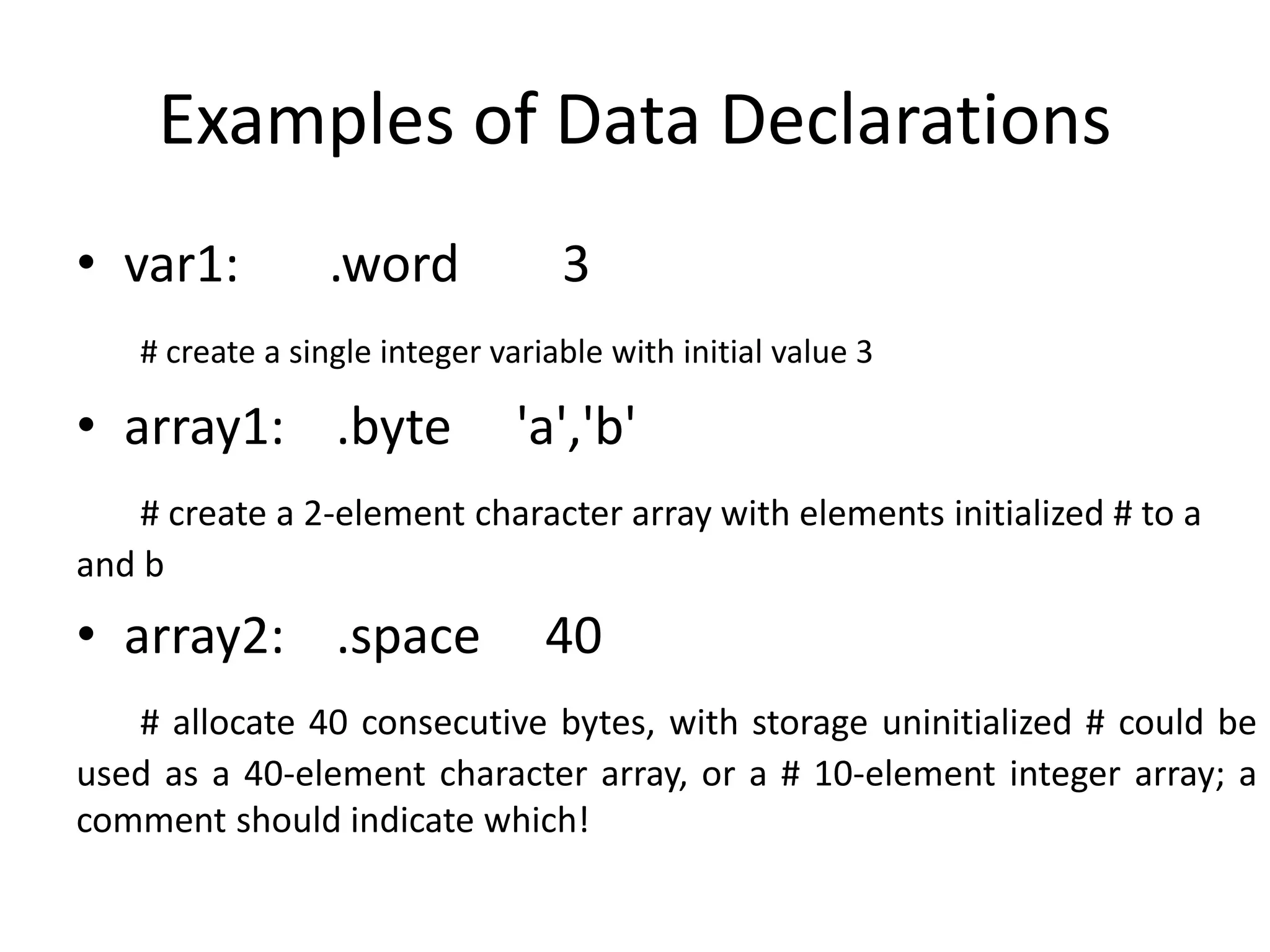
Examples of DataDeclarations
• var1: .word 3
# create a single integer variable with initial value 3
• array1: .byte 'a','b'
# create a 2-element character array with elements initialized # to a
and b
• array2: .space 40
# allocate 40 consecutive bytes, with storage uninitialized # could be
used as a 40-element character array, or a # 10-element integer array; a
comment should indicate which!
10.
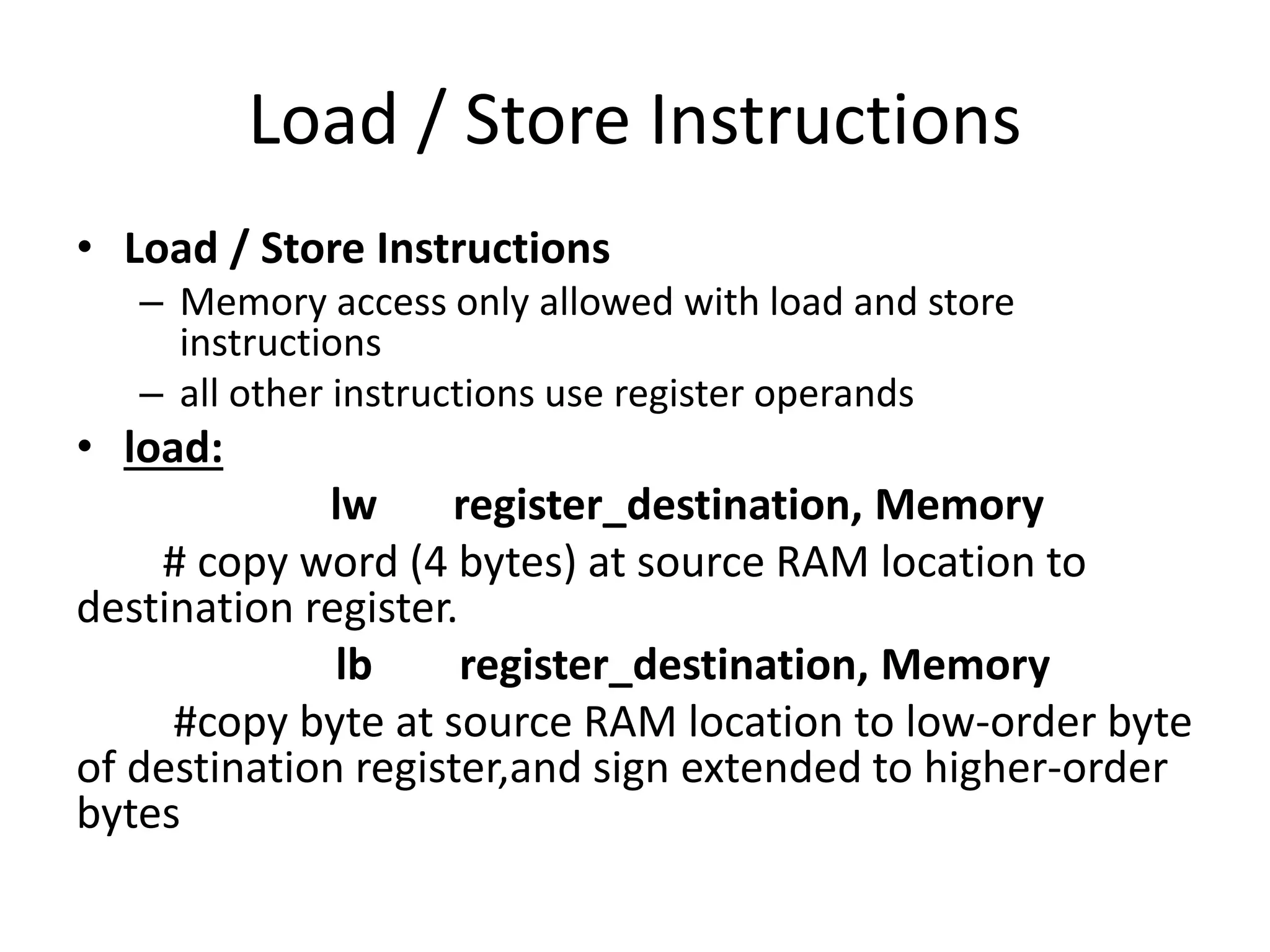
Load / StoreInstructions
• Load / Store Instructions
– Memory access only allowed with load and store
instructions
– all other instructions use register operands
• load:
lw register_destination, Memory
# copy word (4 bytes) at source RAM location to
destination register.
lb register_destination, Memory
#copy byte at source RAM location to low-order byte
of destination register,and sign extended to higher-order
bytes
11.
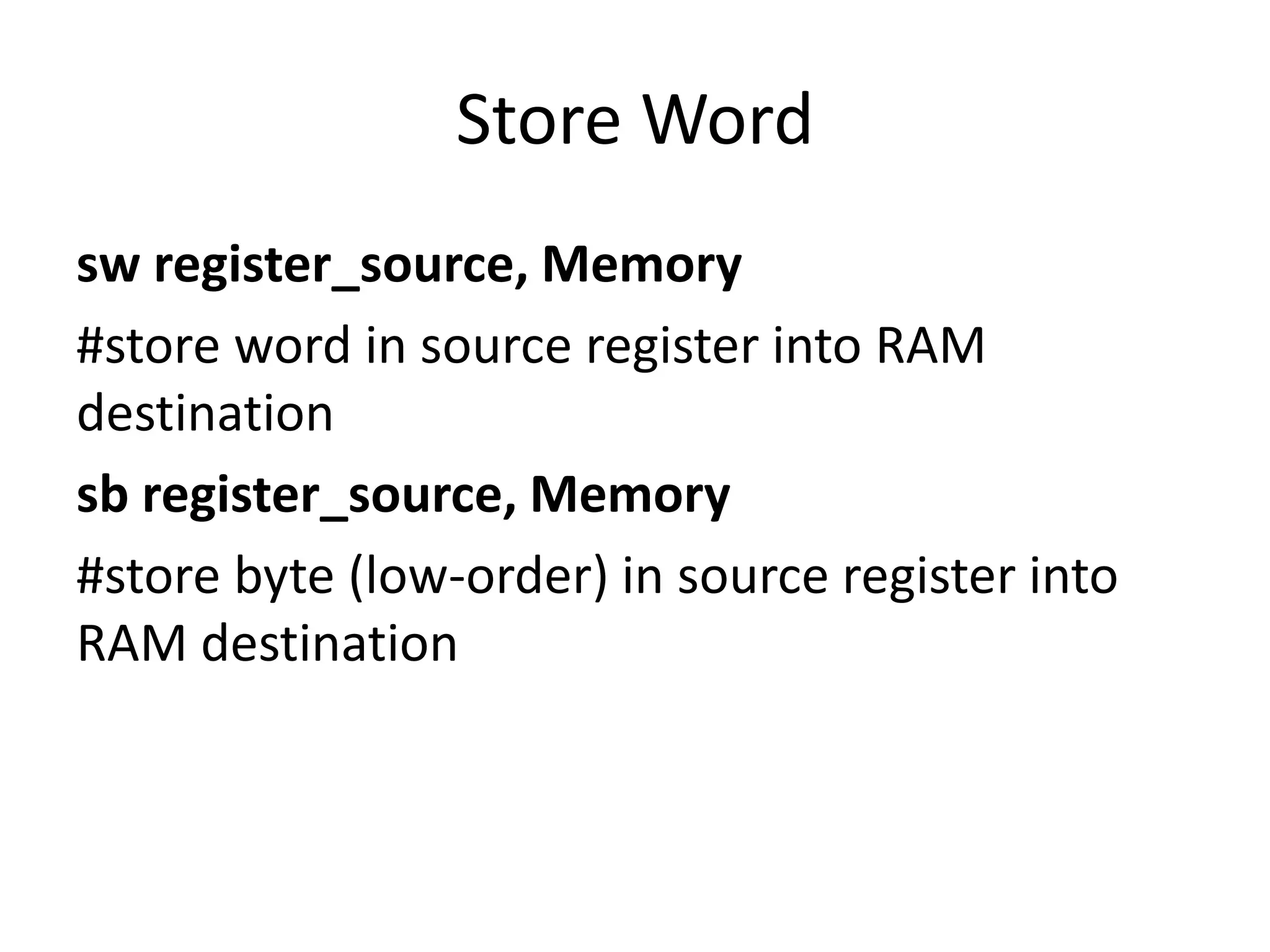
Store Word
sw register_source,Memory
#store word in source register into RAM
destination
sb register_source, Memory
#store byte (low-order) in source register into
RAM destination
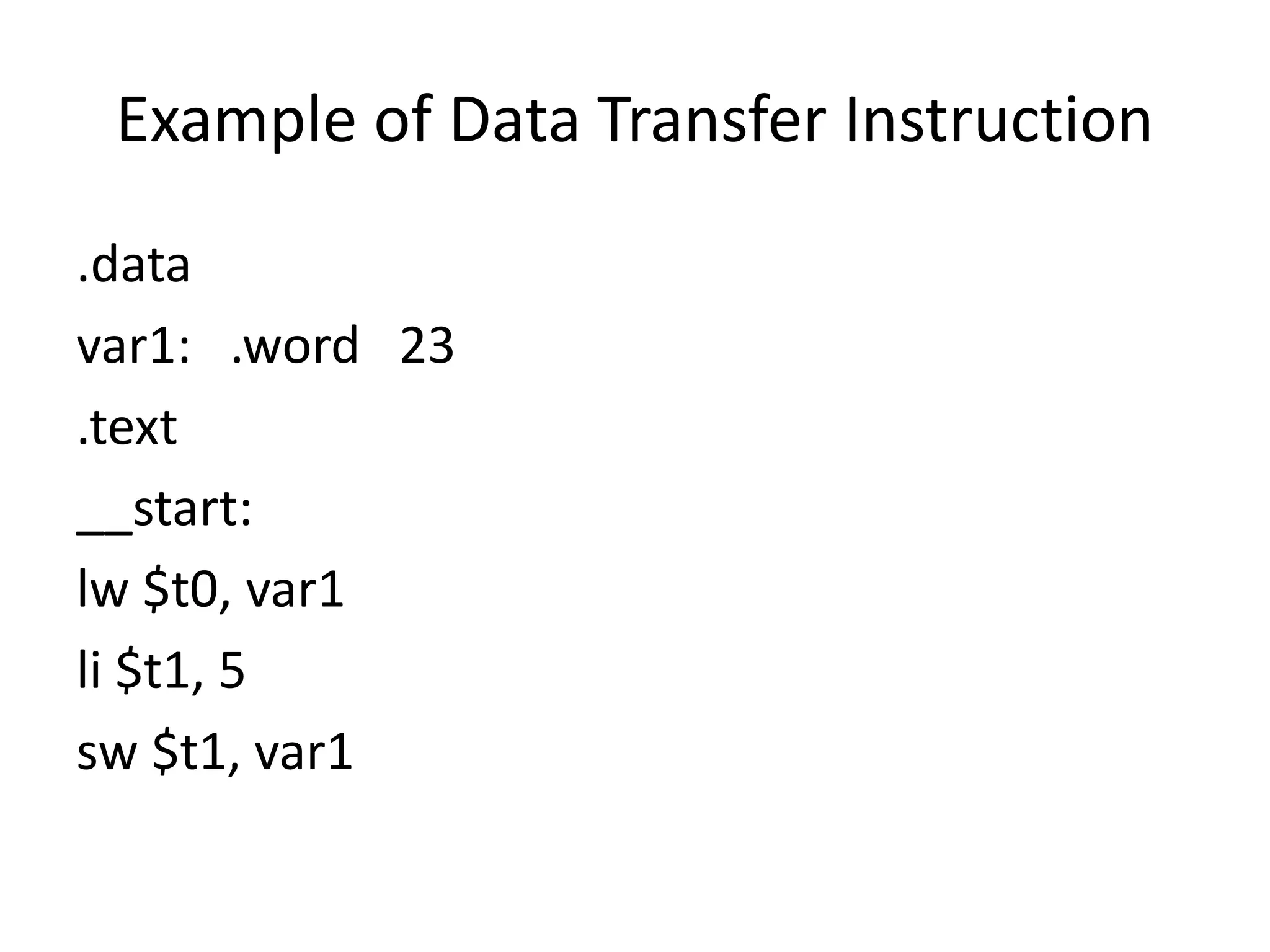
Example of DataTransfer Instruction
.data
var1: .word 23
.text
__start:
lw $t0, var1
li $t1, 5
sw $t1, var1
14.
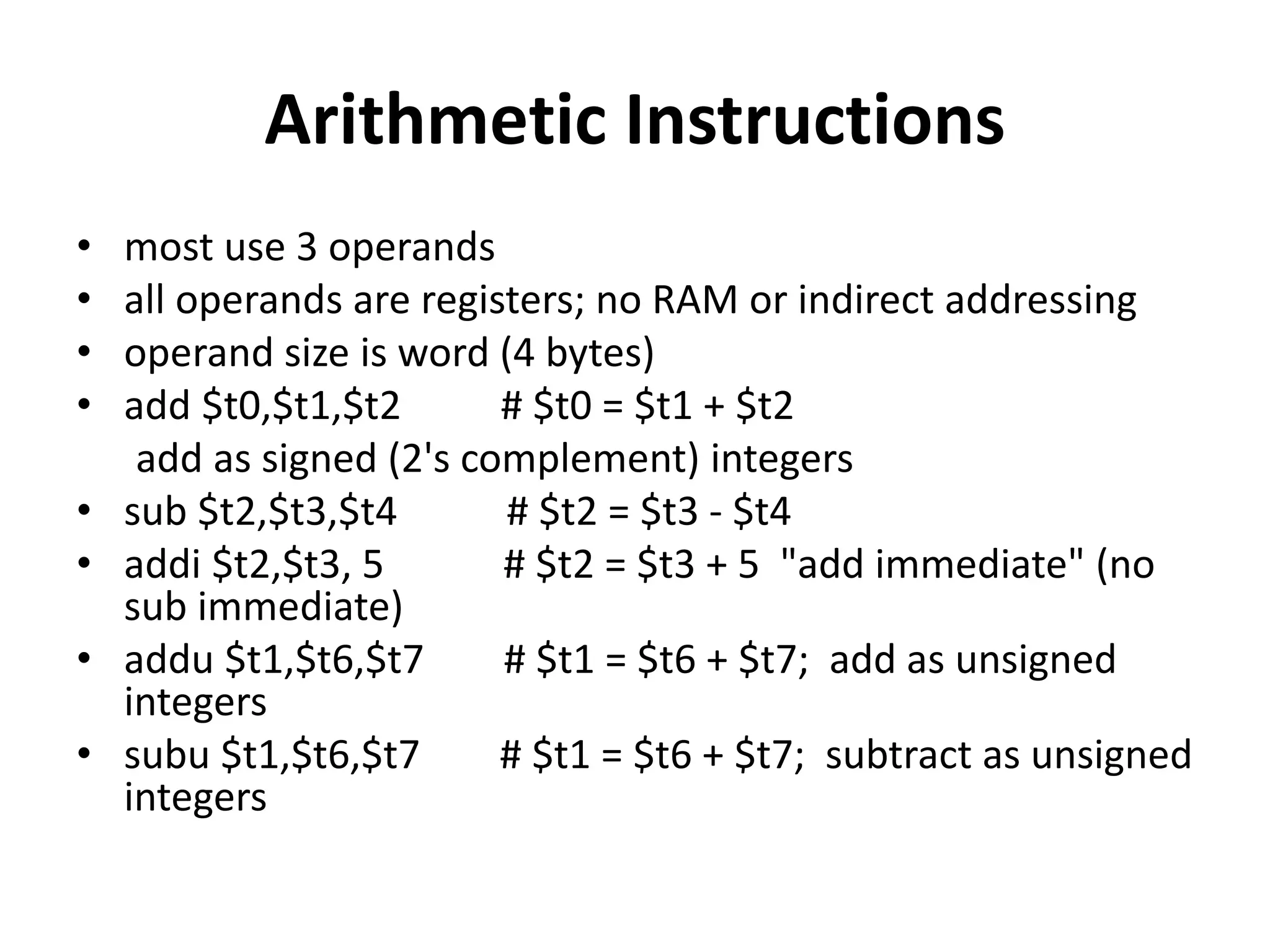
Arithmetic Instructions
• mostuse 3 operands
• all operands are registers; no RAM or indirect addressing
• operand size is word (4 bytes)
• add $t0,$t1,$t2 # $t0 = $t1 + $t2
add as signed (2's complement) integers
• sub $t2,$t3,$t4 # $t2 = $t3 - $t4
• addi $t2,$t3, 5 # $t2 = $t3 + 5 "add immediate" (no
sub immediate)
• addu $t1,$t6,$t7 # $t1 = $t6 + $t7; add as unsigned
integers
• subu $t1,$t6,$t7 # $t1 = $t6 + $t7; subtract as unsigned
integers
15.
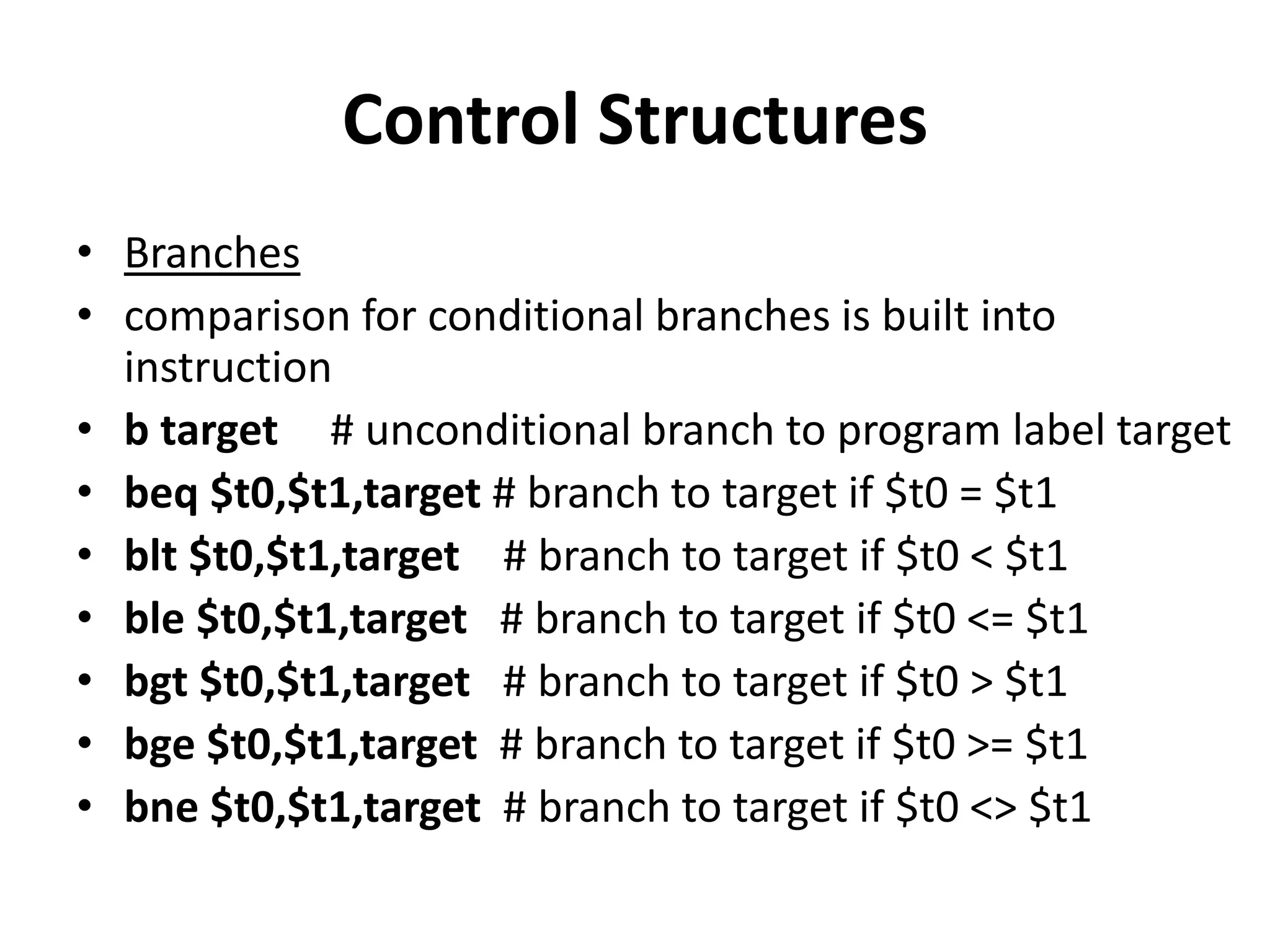
Control Structures
• Branches
•comparison for conditional branches is built into
instruction
• b target # unconditional branch to program label target
• beq $t0,$t1,target # branch to target if $t0 = $t1
• blt $t0,$t1,target # branch to target if $t0 < $t1
• ble $t0,$t1,target # branch to target if $t0 <= $t1
• bgt $t0,$t1,target # branch to target if $t0 > $t1
• bge $t0,$t1,target # branch to target if $t0 >= $t1
• bne $t0,$t1,target # branch to target if $t0 <> $t1
16.
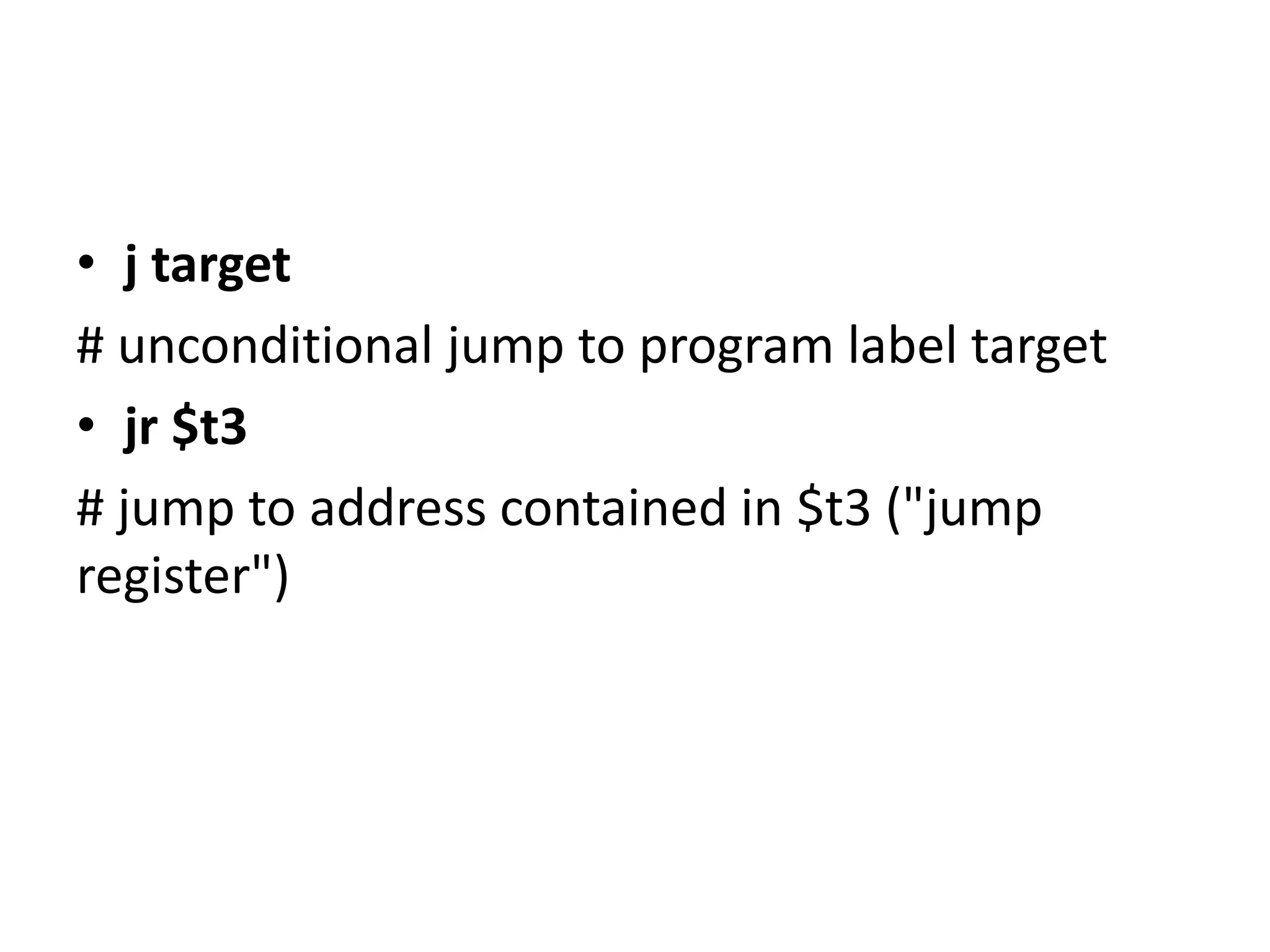
• j target
#unconditional jump to program label target
• jr $t3
# jump to address contained in $t3 ("jump
register")


![Chap03[1]](https://cdn.slidesharecdn.com/ss_thumbnails/chap031-140914002717-phpapp01-thumbnail.jpg?width=640&height=640&fit=bounds)


![Vibe Coding vs. Spec-Driven Development [Free Meetup]](https://cdn.slidesharecdn.com/ss_thumbnails/vibecodingvsspecdrivendevelopment-251209105622-43f455e7-thumbnail.jpg?width=640&height=640&fit=bounds)


