Project SLOPE
1
WP 6 – System integration
Project SLOPE
Mid-term Review
2/Jul/2015
T6.1– Definition of the integration steps
Brussels, July 2nd, 2015
Task Overview
Mid-term Review
2/Jul/2015
• Status: Completed (100%)
• Length: 7 Months (From M10 to M16)
• 5 Involved Partners
• Leader: GraphiTech
• Participants: COMPOLAB, MHG, FLY, ITENE
• Aim: Achieve a complete integration of the different components
that are part of the SLOPE platform to be tested on pilot areas
• Output:
• D.6.01 System integration and validation plan
Mid-term Review
2/Jul/15
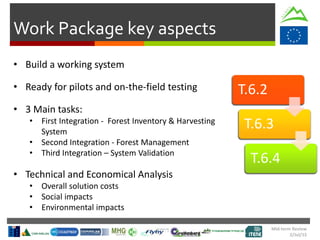
Work Package key aspects
• Build a working system
• Ready for pilots and on-the-field testing
• 3 Main tasks:
• First Integration - Forest Inventory & Harvesting
System
• Second Integration - Forest Management
• Third Integration – System Validation
• Technical and Economical Analysis
• Overall solution costs
• Social impacts
• Environmental impacts
T.6.2
T.6.3
T.6.4
Mid-term Review
2/Jul/15
Process
• Evaluate existing software development processes
• Definition of the integration strategy
• Enrich each integration task (6.2, 6.3, 6.4) with the chosen
strategy
Mid-term Review
2/Jul/15
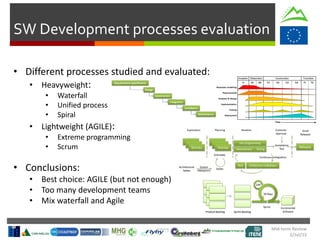
SW Development processes evaluation
• Different processes studied and evaluated:
• Heavyweight:
• Waterfall
• Unified process
• Spiral
• Lightweight (AGILE):
• Extreme programming
• Scrum
• Conclusions:
• Best choice: AGILE (but not enough)
• Too many development teams
• Mix waterfall and Agile
Mid-term Review
2/Jul/15
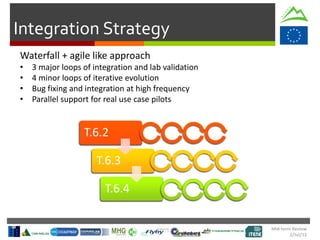
Integration Strategy
Waterfall + agile like approach
• 3 major loops of integration and lab validation
• 4 minor loops of iterative evolution
• Bug fixing and integration at high frequency
• Parallel support for real use case pilots
T.6.2
T.6.3
T.6.4
Mid-term Review
2/Jul/15
Integration Strategy
For each main integration step:
• Definition of the involved components
• Timeline with integration steps, milestones, telcos, days for testing
• One testing scenario based on the use case
• Recognize Involved actors
• Definition of required HW and SW
• Functional requirements
• defining a function
• Non-functional requirements
• defining a criteria for an operation
• Testing approach
Mid-term Review
2/Jul/15
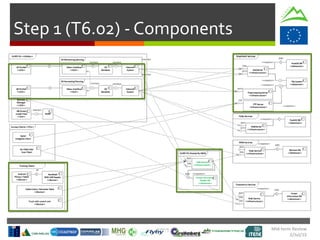
Step 1 (T6.02) - Components
Mid-term Review
2/Jul/15
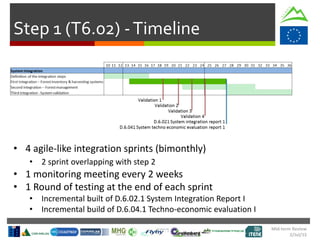
Step 1 (T6.02) -Timeline
• 4 agile-like integration sprints (bimonthly)
• 2 sprint overlapping with step 2
• 1 monitoring meeting every 2 weeks
• 1 Round of testing at the end of each sprint
• Incremental built of D.6.02.1 System Integration Report I
• Incremental build of D.6.04.1 Techno-economic evaluation I
Mid-term Review
2/Jul/15
Step 1 (T6.02) – Integration
1. Connection of the 3D modelling for harvesting planning (T.2.4) with the FIS
2. Connection of handheld devices (e.g. RFID UHF readers) with the FIS
3. Connection of cable crane and processor head enhanced HW with the FIS
4. Connection of truck control units with the FIS
5. Connection of planning and editing functionalities already available in the
3D modelling for harvesting planning system with the FIS
Mid-term Review
2/Jul/15
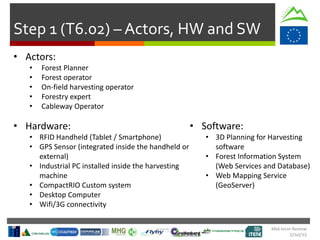
Step 1 (T6.02) – Actors, HW and SW
• Actors:
• Forest Planner
• Forest operator
• On-field harvesting operator
• Forestry expert
• Cableway Operator
• Hardware:
• RFID Handheld (Tablet / Smartphone)
• GPS Sensor (integrated inside the handheld or
external)
• Industrial PC installed inside the harvesting
machine
• CompactRIO Custom system
• Desktop Computer
• Wifi/3G connectivity
• Software:
• 3D Planning for Harvesting
software
• Forest Information System
(Web Services and Database)
• Web Mapping Service
(GeoServer)
Mid-term Review
2/Jul/15
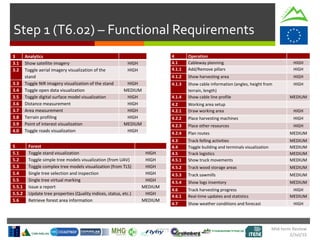
Step 1 (T6.02) – Functional Requirements
3 Analytics
3.1 Show satellite imagery HIGH
3.2 Toggle aerial imagery visualization of the
stand
HIGH
3.3 Toggle NIR imagery visualization of the stand HIGH
3.4 Toggle open data visualization MEDIUM
3.5 Toggle digital surface model visualization HIGH
3.6 Distance measurement HIGH
3.7 Area measurement HIGH
3.8 Terrain profiling HIGH
3.9 Point of interest visualization MEDIUM
4.0 Toggle roads visualization HIGH
4 Operation
4.1 Cableway planning HIGH
4.1.1 Add/Remove pillars HIGH
4.1.2 Show harvesting area HIGH
4.1.3 Show cable information (angles, height from
terrain, length)
HIGH
4.1.4 Show cable line profile MEDIUM
4.2 Working area setup
4.2.1 Draw working area HIGH
4.2.2 Place harvesting machines HIGH
4.2.3 Place other resources HIGH
4.2.4 Plan routes MEDIUM
4.3 Track felling activities MEDIUM
4.4 Toggle building and terminals visualization MEDIUM
4.5 Track logistics MEDIUM
4.5.1 Show truck movements MEDIUM
4.5.2 Track wood storage areas MEDIUM
4.5.3 Track sawmills MEDIUM
4.5.4 Show logs inventory MEDIUM
4.6 Track harvesting progress HIGH
4.6.1 Real-time updates and statistics MEDIUM
4.7 Show weather conditions and forecast HIGH
5 Forest
5.1 Toggle stand visualization HIGH
5.2 Toggle simple tree models visualization (from UAV) HIGH
5.3 Toggle complex tree models visualization (from TLS) HIGH
5.4 Single tree selection and inspection HIGH
5.5 Single tree virtual marking HIGH
5.5.1 Issue a report MEDIUM
5.5.2 Update tree properties (Quality indices, status, etc.) HIGH
5.6 Retrieve forest area information MEDIUM
Mid-term Review
2/Jul/15
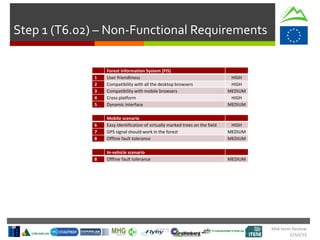
Step 1 (T6.02) – Non-Functional Requirements
Forest Information System (FIS)
1 User friendliness HIGH
2 Compatibility with all the desktop browsers HIGH
3 Compatibility with mobile browsers MEDIUM
4 Cross platform HIGH
5 Dynamic interface MEDIUM
Mobile scenario
6 Easy identification of virtually marked trees on the field HIGH
7 GPS signal should work in the forest MEDIUM
8 Offline fault tolerance MEDIUM
In-vehicle scenario
8 Offline fault tolerance MEDIUM
Mid-term Review
2/Jul/15
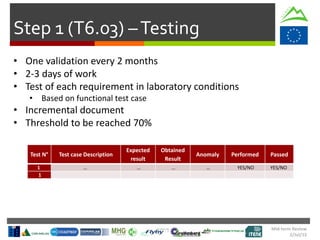
Step 1 (T6.03) –Testing
• One validation every 2 months
• 2-3 days of work
• Test of each requirement in laboratory conditions
• Based on functional test case
• Incremental document
• Threshold to be reached 70%
Test N° Test case Description
Expected
result
Obtained
Result
Anomaly Performed Passed
1 … … … … YES/NO YES/NO
1
Mid-term Review
2/Jul/15
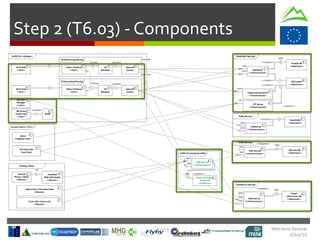
Step 2 (T6.03) - Components
Mid-term Review
2/Jul/15
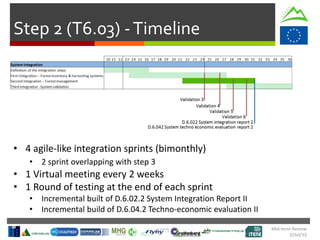
Step 2 (T6.03) -Timeline
• 4 agile-like integration sprints (bimonthly)
• 2 sprint overlapping with step 3
• 1 Virtual meeting every 2 weeks
• 1 Round of testing at the end of each sprint
• Incremental built of D.6.02.2 System Integration Report II
• Incremental build of D.6.04.2 Techno-economic evaluation II
Mid-term Review
2/Jul/15
Step 2 (T6.03) – Integration
1. Refinement of already existing Web services to access the FIS
2. Development of new Web Services functions to cope with online
purchasing/invoicing, real-time operation control and logistic optimization
3. Connection of purchasing/invoicing system with the FIS
4. Connection of real-time operation control system with the FIS
Mid-term Review
2/Jul/15
Step 2 (T6.03) – Actors, HW and SW
• Actors:
• Forest Planner
• Forestry expert
• Truck Operator
• Hardware:
• In-vehicle GPS System
• Software:
• Real-time enterprise resource
planning system
• Online selling and auction system
• MHG Mobile app
Mid-term Review
2/Jul/15
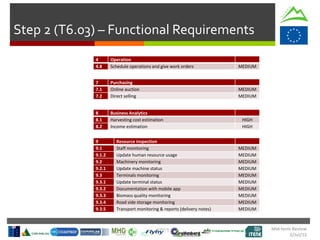
Step 2 (T6.03) – Functional Requirements
4 Operation
4.8 Schedule operations and give work orders MEDIUM
7 Purchasing
7.1 Online auction MEDIUM
7.2 Direct selling MEDIUM
8 Business Analytics
8.1 Harvesting cost estimation HIGH
8.2 Income estimation HIGH
9 Resource inspection
9.1 Staff monitoring MEDIUM
9.1.2 Update human resource usage MEDIUM
9.2 Machinery monitoring MEDIUM
9.2.1 Update machine status MEDIUM
9.3 Terminals monitoring MEDIUM
9.3.1 Update terminal status MEDIUM
9.3.2 Documentation with mobile app MEDIUM
9.3.3 Biomass quality monitoring MEDIUM
9.3.4 Road side storage monitoring MEDIUM
9.3.5 Transport monitoring & reports (delivery notes) MEDIUM
Mid-term Review
2/Jul/15
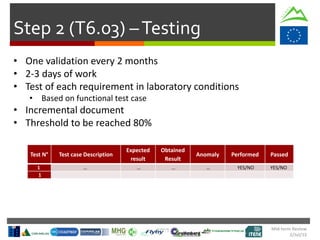
Step 2 (T6.03) –Testing
• One validation every 2 months
• 2-3 days of work
• Test of each requirement in laboratory conditions
• Based on functional test case
• Incremental document
• Threshold to be reached 80%
Test N° Test case Description
Expected
result
Obtained
Result
Anomaly Performed Passed
1 … … … … YES/NO YES/NO
1
Mid-term Review
2/Jul/15
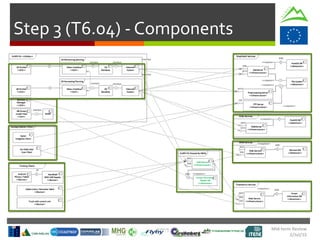
Step 3 (T6.04) - Components
Mid-term Review
2/Jul/15
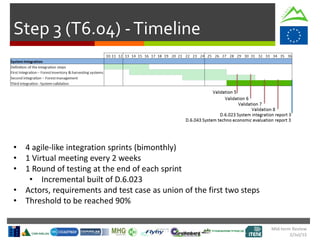
Step 3 (T6.04) -Timeline
• 4 agile-like integration sprints (bimonthly)
• 1 Virtual meeting every 2 weeks
• 1 Round of testing at the end of each sprint
• Incremental built of D.6.023
• Actors, requirements and test case as union of the first two steps
• Threshold to be reached 90%
Mid-term Review
2/Jul/15
Conclusions
• Guidelines for efficient and continuous integration
• 4 sprints with validation and reporting per task
• Regular monitoring meetings
• Incremental testing phase
• Ready for changing requirements
• Partners
• Forestry Actors
Mid-term Review
2/Jul/15
Contact info
Daniele Magliocchetti: daniele.magliocchetti@graphitech.it
Thank you for your attention
Project SLOPE
Mid-term Review
2/Jul/2015
T6.2– First Integration
Forest Inventory & Harvesting System
Brussels, July 2nd, 2015
Task Overview
Mid-term Review
2/Jul/2015
• Status: In progress (20%)
• Length: 14 Months (From M14 to M27)
• 8 Involved Partners
• Leader: GraphiTech
• Participants: COMPOLAB, MHG, FLY, GRE, TRE, ITENE, CNR
• Aim:
• Integration of forest information system (FIS) with harvesting
measurement systems and software components
• Output:
• D.6.21 System integration report I
• D.6.41 SLOPE System Techno-Economic Evaluation Report I
Mid-term Review
2/Jul/15
Task Overview
1. Connection of the 3D modelling for harvesting planning (T.2.4) with the FIS
2. Connection of handheld devices (e.g. RFID UHF readers) with the FIS
3. Connection of cable crane and processor head enhanced HW with the FIS
4. Connection of truck control units with the FIS
5. Connection of planning and editing functionalities already available in the
3D modelling for harvesting planning system with the FIS
Mid-term Review
2/Jul/15
Task Overview
• Currently at M18
• Major effort spent on:
• Interface improvements
• Alpha 1.0
• Alpha 1.1
• Alpha 1.2 Early Access Preview
• DB and Webservices improvements
• Connection of viewer with DB and Webservices
• First Integration and validation planned after review
Mid-term Review
2/Jul/15
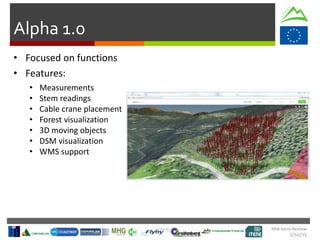
Alpha 1.0
• Focused on functions
• Features:
• Measurements
• Stem readings
• Cable crane placement
• Forest visualization
• 3D moving objects
• DSM visualization
• WMS support
Mid-term Review
2/Jul/15
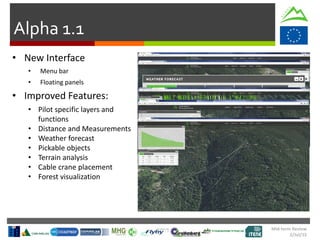
Alpha 1.1
• New Interface
• Menu bar
• Floating panels
• Improved Features:
• Pilot specific layers and
functions
• Distance and Measurements
• Weather forecast
• Pickable objects
• Terrain analysis
• Cable crane placement
• Forest visualization
Mid-term Review
2/Jul/15
Demo
Mid-term Review
2/Jul/15
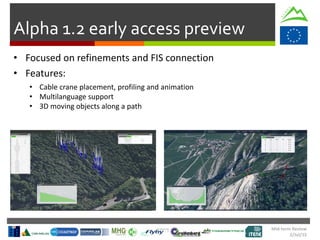
Alpha 1.2 early access preview
• Features:
• Cable crane placement, profiling and animation
• Multilanguage support
• 3D moving objects along a path
• Focused on refinements and FIS connection
Mid-term Review
2/Jul/15
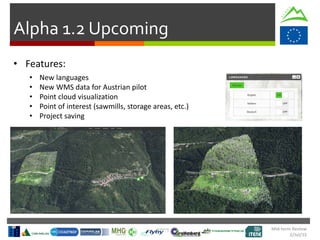
Alpha 1.2 Upcoming
• Features:
• New languages
• New WMS data for Austrian pilot
• Point cloud visualization
• Point of interest (sawmills, storage areas, etc.)
• Project saving
Mid-term Review
2/Jul/15
Conclusions and FutureWork
• Web platform in a good shape
• Many functionalities not connected with the FIS
• Mobile devices
• Cable crane
• Truck control units
Next Steps:
• First validation
• Connect missing components to the FIS
• Fill the database with real-time data
• Expose all the available data throught the 3D Viewer
Mid-term Review
2/Jul/15
Contact info
Daniele Magliocchetti: daniele.magliocchetti@graphitech.it
Michele Andreolli: michele.andreolli@graphitech.it
Federico Devigili: federico.devigili@graphitech.it
Thank you for your attention

Mid-term Review Meeting - WP6

  • 1.
    Project SLOPE 1 WP 6– System integration
  • 2.
    Project SLOPE Mid-term Review 2/Jul/2015 T6.1–Definition of the integration steps Brussels, July 2nd, 2015
  • 3.
    Task Overview Mid-term Review 2/Jul/2015 •Status: Completed (100%) • Length: 7 Months (From M10 to M16) • 5 Involved Partners • Leader: GraphiTech • Participants: COMPOLAB, MHG, FLY, ITENE • Aim: Achieve a complete integration of the different components that are part of the SLOPE platform to be tested on pilot areas • Output: • D.6.01 System integration and validation plan
  • 4.
    Mid-term Review 2/Jul/15 Work Packagekey aspects • Build a working system • Ready for pilots and on-the-field testing • 3 Main tasks: • First Integration - Forest Inventory & Harvesting System • Second Integration - Forest Management • Third Integration – System Validation • Technical and Economical Analysis • Overall solution costs • Social impacts • Environmental impacts T.6.2 T.6.3 T.6.4
  • 5.
    Mid-term Review 2/Jul/15 Process • Evaluateexisting software development processes • Definition of the integration strategy • Enrich each integration task (6.2, 6.3, 6.4) with the chosen strategy
  • 6.
    Mid-term Review 2/Jul/15 SW Developmentprocesses evaluation • Different processes studied and evaluated: • Heavyweight: • Waterfall • Unified process • Spiral • Lightweight (AGILE): • Extreme programming • Scrum • Conclusions: • Best choice: AGILE (but not enough) • Too many development teams • Mix waterfall and Agile
  • 7.
    Mid-term Review 2/Jul/15 Integration Strategy Waterfall+ agile like approach • 3 major loops of integration and lab validation • 4 minor loops of iterative evolution • Bug fixing and integration at high frequency • Parallel support for real use case pilots T.6.2 T.6.3 T.6.4
  • 8.
    Mid-term Review 2/Jul/15 Integration Strategy Foreach main integration step: • Definition of the involved components • Timeline with integration steps, milestones, telcos, days for testing • One testing scenario based on the use case • Recognize Involved actors • Definition of required HW and SW • Functional requirements • defining a function • Non-functional requirements • defining a criteria for an operation • Testing approach
  • 9.
    Mid-term Review 2/Jul/15 Step 1(T6.02) - Components
  • 10.
    Mid-term Review 2/Jul/15 Step 1(T6.02) -Timeline • 4 agile-like integration sprints (bimonthly) • 2 sprint overlapping with step 2 • 1 monitoring meeting every 2 weeks • 1 Round of testing at the end of each sprint • Incremental built of D.6.02.1 System Integration Report I • Incremental build of D.6.04.1 Techno-economic evaluation I
  • 11.
    Mid-term Review 2/Jul/15 Step 1(T6.02) – Integration 1. Connection of the 3D modelling for harvesting planning (T.2.4) with the FIS 2. Connection of handheld devices (e.g. RFID UHF readers) with the FIS 3. Connection of cable crane and processor head enhanced HW with the FIS 4. Connection of truck control units with the FIS 5. Connection of planning and editing functionalities already available in the 3D modelling for harvesting planning system with the FIS
  • 12.
    Mid-term Review 2/Jul/15 Step 1(T6.02) – Actors, HW and SW • Actors: • Forest Planner • Forest operator • On-field harvesting operator • Forestry expert • Cableway Operator • Hardware: • RFID Handheld (Tablet / Smartphone) • GPS Sensor (integrated inside the handheld or external) • Industrial PC installed inside the harvesting machine • CompactRIO Custom system • Desktop Computer • Wifi/3G connectivity • Software: • 3D Planning for Harvesting software • Forest Information System (Web Services and Database) • Web Mapping Service (GeoServer)
  • 13.
    Mid-term Review 2/Jul/15 Step 1(T6.02) – Functional Requirements 3 Analytics 3.1 Show satellite imagery HIGH 3.2 Toggle aerial imagery visualization of the stand HIGH 3.3 Toggle NIR imagery visualization of the stand HIGH 3.4 Toggle open data visualization MEDIUM 3.5 Toggle digital surface model visualization HIGH 3.6 Distance measurement HIGH 3.7 Area measurement HIGH 3.8 Terrain profiling HIGH 3.9 Point of interest visualization MEDIUM 4.0 Toggle roads visualization HIGH 4 Operation 4.1 Cableway planning HIGH 4.1.1 Add/Remove pillars HIGH 4.1.2 Show harvesting area HIGH 4.1.3 Show cable information (angles, height from terrain, length) HIGH 4.1.4 Show cable line profile MEDIUM 4.2 Working area setup 4.2.1 Draw working area HIGH 4.2.2 Place harvesting machines HIGH 4.2.3 Place other resources HIGH 4.2.4 Plan routes MEDIUM 4.3 Track felling activities MEDIUM 4.4 Toggle building and terminals visualization MEDIUM 4.5 Track logistics MEDIUM 4.5.1 Show truck movements MEDIUM 4.5.2 Track wood storage areas MEDIUM 4.5.3 Track sawmills MEDIUM 4.5.4 Show logs inventory MEDIUM 4.6 Track harvesting progress HIGH 4.6.1 Real-time updates and statistics MEDIUM 4.7 Show weather conditions and forecast HIGH 5 Forest 5.1 Toggle stand visualization HIGH 5.2 Toggle simple tree models visualization (from UAV) HIGH 5.3 Toggle complex tree models visualization (from TLS) HIGH 5.4 Single tree selection and inspection HIGH 5.5 Single tree virtual marking HIGH 5.5.1 Issue a report MEDIUM 5.5.2 Update tree properties (Quality indices, status, etc.) HIGH 5.6 Retrieve forest area information MEDIUM
  • 14.
    Mid-term Review 2/Jul/15 Step 1(T6.02) – Non-Functional Requirements Forest Information System (FIS) 1 User friendliness HIGH 2 Compatibility with all the desktop browsers HIGH 3 Compatibility with mobile browsers MEDIUM 4 Cross platform HIGH 5 Dynamic interface MEDIUM Mobile scenario 6 Easy identification of virtually marked trees on the field HIGH 7 GPS signal should work in the forest MEDIUM 8 Offline fault tolerance MEDIUM In-vehicle scenario 8 Offline fault tolerance MEDIUM
  • 15.
    Mid-term Review 2/Jul/15 Step 1(T6.03) –Testing • One validation every 2 months • 2-3 days of work • Test of each requirement in laboratory conditions • Based on functional test case • Incremental document • Threshold to be reached 70% Test N° Test case Description Expected result Obtained Result Anomaly Performed Passed 1 … … … … YES/NO YES/NO 1
  • 16.
    Mid-term Review 2/Jul/15 Step 2(T6.03) - Components
  • 17.
    Mid-term Review 2/Jul/15 Step 2(T6.03) -Timeline • 4 agile-like integration sprints (bimonthly) • 2 sprint overlapping with step 3 • 1 Virtual meeting every 2 weeks • 1 Round of testing at the end of each sprint • Incremental built of D.6.02.2 System Integration Report II • Incremental build of D.6.04.2 Techno-economic evaluation II
  • 18.
    Mid-term Review 2/Jul/15 Step 2(T6.03) – Integration 1. Refinement of already existing Web services to access the FIS 2. Development of new Web Services functions to cope with online purchasing/invoicing, real-time operation control and logistic optimization 3. Connection of purchasing/invoicing system with the FIS 4. Connection of real-time operation control system with the FIS
  • 19.
    Mid-term Review 2/Jul/15 Step 2(T6.03) – Actors, HW and SW • Actors: • Forest Planner • Forestry expert • Truck Operator • Hardware: • In-vehicle GPS System • Software: • Real-time enterprise resource planning system • Online selling and auction system • MHG Mobile app
  • 20.
    Mid-term Review 2/Jul/15 Step 2(T6.03) – Functional Requirements 4 Operation 4.8 Schedule operations and give work orders MEDIUM 7 Purchasing 7.1 Online auction MEDIUM 7.2 Direct selling MEDIUM 8 Business Analytics 8.1 Harvesting cost estimation HIGH 8.2 Income estimation HIGH 9 Resource inspection 9.1 Staff monitoring MEDIUM 9.1.2 Update human resource usage MEDIUM 9.2 Machinery monitoring MEDIUM 9.2.1 Update machine status MEDIUM 9.3 Terminals monitoring MEDIUM 9.3.1 Update terminal status MEDIUM 9.3.2 Documentation with mobile app MEDIUM 9.3.3 Biomass quality monitoring MEDIUM 9.3.4 Road side storage monitoring MEDIUM 9.3.5 Transport monitoring & reports (delivery notes) MEDIUM
  • 21.
    Mid-term Review 2/Jul/15 Step 2(T6.03) –Testing • One validation every 2 months • 2-3 days of work • Test of each requirement in laboratory conditions • Based on functional test case • Incremental document • Threshold to be reached 80% Test N° Test case Description Expected result Obtained Result Anomaly Performed Passed 1 … … … … YES/NO YES/NO 1
  • 22.
    Mid-term Review 2/Jul/15 Step 3(T6.04) - Components
  • 23.
    Mid-term Review 2/Jul/15 Step 3(T6.04) -Timeline • 4 agile-like integration sprints (bimonthly) • 1 Virtual meeting every 2 weeks • 1 Round of testing at the end of each sprint • Incremental built of D.6.023 • Actors, requirements and test case as union of the first two steps • Threshold to be reached 90%
  • 24.
    Mid-term Review 2/Jul/15 Conclusions • Guidelinesfor efficient and continuous integration • 4 sprints with validation and reporting per task • Regular monitoring meetings • Incremental testing phase • Ready for changing requirements • Partners • Forestry Actors
  • 25.
    Mid-term Review 2/Jul/15 Contact info DanieleMagliocchetti: daniele.magliocchetti@graphitech.it Thank you for your attention
  • 26.
    Project SLOPE Mid-term Review 2/Jul/2015 T6.2–First Integration Forest Inventory & Harvesting System Brussels, July 2nd, 2015
  • 27.
    Task Overview Mid-term Review 2/Jul/2015 •Status: In progress (20%) • Length: 14 Months (From M14 to M27) • 8 Involved Partners • Leader: GraphiTech • Participants: COMPOLAB, MHG, FLY, GRE, TRE, ITENE, CNR • Aim: • Integration of forest information system (FIS) with harvesting measurement systems and software components • Output: • D.6.21 System integration report I • D.6.41 SLOPE System Techno-Economic Evaluation Report I
  • 28.
    Mid-term Review 2/Jul/15 Task Overview 1.Connection of the 3D modelling for harvesting planning (T.2.4) with the FIS 2. Connection of handheld devices (e.g. RFID UHF readers) with the FIS 3. Connection of cable crane and processor head enhanced HW with the FIS 4. Connection of truck control units with the FIS 5. Connection of planning and editing functionalities already available in the 3D modelling for harvesting planning system with the FIS
  • 29.
    Mid-term Review 2/Jul/15 Task Overview •Currently at M18 • Major effort spent on: • Interface improvements • Alpha 1.0 • Alpha 1.1 • Alpha 1.2 Early Access Preview • DB and Webservices improvements • Connection of viewer with DB and Webservices • First Integration and validation planned after review
  • 30.
    Mid-term Review 2/Jul/15 Alpha 1.0 •Focused on functions • Features: • Measurements • Stem readings • Cable crane placement • Forest visualization • 3D moving objects • DSM visualization • WMS support
  • 31.
    Mid-term Review 2/Jul/15 Alpha 1.1 •New Interface • Menu bar • Floating panels • Improved Features: • Pilot specific layers and functions • Distance and Measurements • Weather forecast • Pickable objects • Terrain analysis • Cable crane placement • Forest visualization
  • 32.
  • 33.
    Mid-term Review 2/Jul/15 Alpha 1.2early access preview • Features: • Cable crane placement, profiling and animation • Multilanguage support • 3D moving objects along a path • Focused on refinements and FIS connection
  • 34.
    Mid-term Review 2/Jul/15 Alpha 1.2Upcoming • Features: • New languages • New WMS data for Austrian pilot • Point cloud visualization • Point of interest (sawmills, storage areas, etc.) • Project saving
  • 35.
    Mid-term Review 2/Jul/15 Conclusions andFutureWork • Web platform in a good shape • Many functionalities not connected with the FIS • Mobile devices • Cable crane • Truck control units Next Steps: • First validation • Connect missing components to the FIS • Fill the database with real-time data • Expose all the available data throught the 3D Viewer
  • 36.
    Mid-term Review 2/Jul/15 Contact info DanieleMagliocchetti: daniele.magliocchetti@graphitech.it Michele Andreolli: michele.andreolli@graphitech.it Federico Devigili: federico.devigili@graphitech.it Thank you for your attention