TASK 1.3
Human Machine Interface (HMI)
definition
Work Package 1: Definition of requirements and
system analysis
Work Package 1: Definition of Requirements and
System Analysis
Starting : January 2014
Ending: June 2014
Objectives
• Identify the targeted users and specifically their needs and requirements.
• Define state of the art processes for planning, managing and assessing harvesting
operations and supply chains in mountainous areas.
• Define a comprehensive set of information to support the implementation of more
timely decisions, and improve the quality of decisions
• Detail the data and metadata model covering the use of SLOPE
• Define the hardware, equipment, sensors and mobile devices to be used
• Define the HMI requirements, especially for the on-field devices and machines
• Define and document the system architecture to be used
• Define the project technicalities and technical requirements such as use case special
conditions
Work Package 1: Definition of Requirements and
System Analysis
Starting : January 2014
Ending: June 2014
Objectives
• Identify the targeted users and specifically their needs and requirements.
• Define state of the art processes for planning, managing and assessing harvesting
operations and supply chains in mountainous areas.
• Define a comprehensive set of information to support the implementation of more
timely decisions, and improve the quality of decisions
• Detail the data and metadata model covering the use of SLOPE
• Define the hardware, equipment, sensors and mobile devices to be used
• Define the HMI requirements, especially for the on-field devices and machines
• Define and document the system architecture to be used
• Define the project technicalities and technical requirements such as use case special
conditions
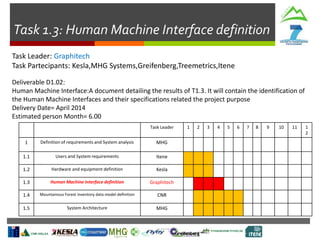
Task 1.3: Human Machine Interface definition
Task Leader: Graphitech
Task Partecipants: Kesla,MHG Systems,Greifenberg,Treemetrics,Itene
Deliverable D1.02:
Human Machine Interface:A document detailing the results of T1.3. It will contain the identification of
the Human Machine Interfaces and their specifications related the project purpose
Delivery Date= April 2014
Estimated person Month= 6.00
Task Leader 1 2 3 4 5 6 7 8 9 10 11 1
2
1 Definition of requirements and System analysis MHG
1.1 Users and System requirements Itene
1.2 Hardware and equipment definition Kesla
1.3 Human Machine Interface definition Graphitech
1.4 Mountainous Forest Inventory data model definition CNR
1.5 System Architecture MHG
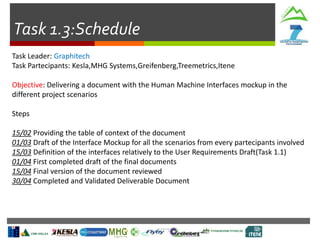
Task 1.3:Schedule
Task Leader: Graphitech
Task Partecipants: Kesla,MHG Systems,Greifenberg,Treemetrics,Itene
Objective: Delivering a document with the Human Machine Interfaces mockup in the
different project scenarios
Steps
15/02 Providing the table of context of the document
01/03 Draft of the Interface Mockup for all the scenarios from every partecipants involved
15/03 Definition of the interfaces relatively to the User Requirements Draft(Task 1.1)
01/04 First completed draft of the final documents
15/04 Final version of the document reviewed
30/04 Completed and Validated Deliverable Document
Task 1.3:Partecipants
Task Leader: Graphitech
Task Partecipants: Kesla,MHG Systems,Greifenberg,Treemetrics,Itene
Graphitech: Project leader, will coordinate all the partecipants to this task and in particular will define
the interfaces for on field in vehicle devices considering easyness of use.
MHG and Treemetrics: will define the web and mobile interfaces for forestry data analysis
Kesla: provide expertise and product components mainly harvester head technology, will support the
definition of the interfaces in the context of useness for harvesting expert operators
Greifenberg: with its device, Tecno, a totally autonomous remote controlled self propellled motor
carriage, will help to define the requirements of human machine interface for on field operation
Itene: is in charge for the activity of traceability of the wood, and assisted in interface definition for tree
marking.
T1.3 Objectives
The objective of this task is to define user interface for the whole
SLOPE system:
• Specify user interface needs (offline devices, web)
• Specify web user interface requirements
• Specify user interface in-vehicle and on field devices
Detailed investigation of the possible interactions and of the design
of the different machine interfaces should be performed specially
in terms of views and usability
T1.3 Objectives
Consider different types of scenario:
• Office planning
• Harvesting on field
• Post Harvesting Resource Planning
..with different types of devices:
• Mobile
• Web
• Desktop PC
• In vehicle unit or embedded systems
Particular attention will be paid to the mobile and on vehicle interface for ease of access
and usability into on-field conditions (Graphitech).
The mobile and web interface will be designed by MHG and TreeMetrics to allow forestry
data analysis and synthesis using charts, diagrams and maps on specific database views
Forest Operation Planning
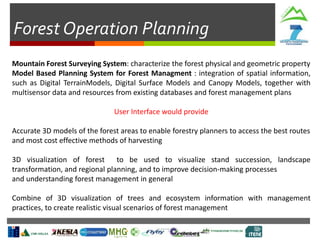
Mountain Forest Surveying System: characterize the forest physical and geometric property
Model Based Planning System for Forest Managment : integration of spatial information,
such as Digital TerrainModels, Digital Surface Models and Canopy Models, together with
multisensor data and resources from existing databases and forest management plans
User Interface would provide
Accurate 3D models of the forest areas to enable forestry planners to access the best routes
and most cost effective methods of harvesting
3D visualization of forest to be used to visualize stand succession, landscape
transformation, and regional planning, and to improve decision-making processes
and understanding forest management in general
Combine of 3D visualization of trees and ecosystem information with management
practices, to create realistic visual scenarios of forest management
Forest Operation Planning
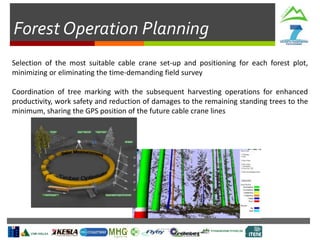
Selection of the most suitable cable crane set-up and positioning for each forest plot,
minimizing or eliminating the time-demanding field survey
Coordination of tree marking with the subsequent harvesting operations for enhanced
productivity, work safety and reduction of damages to the remaining standing trees to the
minimum, sharing the GPS position of the future cable crane lines
Harvesting on Field
Dedicated Human Machine Interfaces will ensure easier and safer use of harvesting
machines, particularly by providing an increased control of machine interactions
• Cable Crane Carriage will operate with high degree of automation but the operator will
be informed by a set of sensors integrated in the machine to constantly monitor its
conditions or any critical event.
• in the Cable Crane and in the Processor Head equipment Intelligent Systems will be
included, in order to support automatic/continuous acquisition of all available resource
characteristics that will be saved as information data forwarded to external servers.
Harvesting on Field
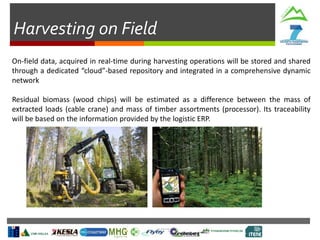
On-field data, acquired in real-time during harvesting operations will be stored and shared
through a dedicated “cloud”-based repository and integrated in a comprehensive dynamic
network
Residual biomass (wood chips) will be estimated as a difference between the mass of
extracted loads (cable crane) and mass of timber assortments (processor). Its traceability
will be based on the information provided by the logistic ERP.
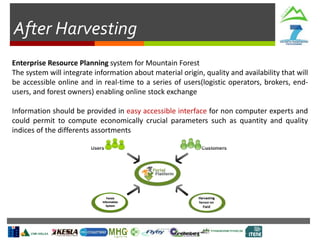
After Harvesting
Enterprise Resource Planning system for Mountain Forest
The system will integrate information about material origin, quality and availability that will
be accessible online and in real-time to a series of users(logistic operators, brokers, end-
users, and forest owners) enabling online stock exchange
Information should be provided in easy accessible interface for non computer experts and
could permit to compute economically crucial parameters such as quantity and quality
indices of the differents assortments
Forest
Information
System

Task 1.3 – human machine interface (hmi) definition. (by graphitech)

  • 1.
    TASK 1.3 Human MachineInterface (HMI) definition Work Package 1: Definition of requirements and system analysis
  • 2.
    Work Package 1:Definition of Requirements and System Analysis Starting : January 2014 Ending: June 2014 Objectives • Identify the targeted users and specifically their needs and requirements. • Define state of the art processes for planning, managing and assessing harvesting operations and supply chains in mountainous areas. • Define a comprehensive set of information to support the implementation of more timely decisions, and improve the quality of decisions • Detail the data and metadata model covering the use of SLOPE • Define the hardware, equipment, sensors and mobile devices to be used • Define the HMI requirements, especially for the on-field devices and machines • Define and document the system architecture to be used • Define the project technicalities and technical requirements such as use case special conditions
  • 3.
    Work Package 1:Definition of Requirements and System Analysis Starting : January 2014 Ending: June 2014 Objectives • Identify the targeted users and specifically their needs and requirements. • Define state of the art processes for planning, managing and assessing harvesting operations and supply chains in mountainous areas. • Define a comprehensive set of information to support the implementation of more timely decisions, and improve the quality of decisions • Detail the data and metadata model covering the use of SLOPE • Define the hardware, equipment, sensors and mobile devices to be used • Define the HMI requirements, especially for the on-field devices and machines • Define and document the system architecture to be used • Define the project technicalities and technical requirements such as use case special conditions
  • 4.
    Task 1.3: HumanMachine Interface definition Task Leader: Graphitech Task Partecipants: Kesla,MHG Systems,Greifenberg,Treemetrics,Itene Deliverable D1.02: Human Machine Interface:A document detailing the results of T1.3. It will contain the identification of the Human Machine Interfaces and their specifications related the project purpose Delivery Date= April 2014 Estimated person Month= 6.00 Task Leader 1 2 3 4 5 6 7 8 9 10 11 1 2 1 Definition of requirements and System analysis MHG 1.1 Users and System requirements Itene 1.2 Hardware and equipment definition Kesla 1.3 Human Machine Interface definition Graphitech 1.4 Mountainous Forest Inventory data model definition CNR 1.5 System Architecture MHG
  • 5.
    Task 1.3:Schedule Task Leader:Graphitech Task Partecipants: Kesla,MHG Systems,Greifenberg,Treemetrics,Itene Objective: Delivering a document with the Human Machine Interfaces mockup in the different project scenarios Steps 15/02 Providing the table of context of the document 01/03 Draft of the Interface Mockup for all the scenarios from every partecipants involved 15/03 Definition of the interfaces relatively to the User Requirements Draft(Task 1.1) 01/04 First completed draft of the final documents 15/04 Final version of the document reviewed 30/04 Completed and Validated Deliverable Document
  • 6.
    Task 1.3:Partecipants Task Leader:Graphitech Task Partecipants: Kesla,MHG Systems,Greifenberg,Treemetrics,Itene Graphitech: Project leader, will coordinate all the partecipants to this task and in particular will define the interfaces for on field in vehicle devices considering easyness of use. MHG and Treemetrics: will define the web and mobile interfaces for forestry data analysis Kesla: provide expertise and product components mainly harvester head technology, will support the definition of the interfaces in the context of useness for harvesting expert operators Greifenberg: with its device, Tecno, a totally autonomous remote controlled self propellled motor carriage, will help to define the requirements of human machine interface for on field operation Itene: is in charge for the activity of traceability of the wood, and assisted in interface definition for tree marking.
  • 7.
    T1.3 Objectives The objectiveof this task is to define user interface for the whole SLOPE system: • Specify user interface needs (offline devices, web) • Specify web user interface requirements • Specify user interface in-vehicle and on field devices Detailed investigation of the possible interactions and of the design of the different machine interfaces should be performed specially in terms of views and usability
  • 8.
    T1.3 Objectives Consider differenttypes of scenario: • Office planning • Harvesting on field • Post Harvesting Resource Planning ..with different types of devices: • Mobile • Web • Desktop PC • In vehicle unit or embedded systems Particular attention will be paid to the mobile and on vehicle interface for ease of access and usability into on-field conditions (Graphitech). The mobile and web interface will be designed by MHG and TreeMetrics to allow forestry data analysis and synthesis using charts, diagrams and maps on specific database views
  • 9.
    Forest Operation Planning MountainForest Surveying System: characterize the forest physical and geometric property Model Based Planning System for Forest Managment : integration of spatial information, such as Digital TerrainModels, Digital Surface Models and Canopy Models, together with multisensor data and resources from existing databases and forest management plans User Interface would provide Accurate 3D models of the forest areas to enable forestry planners to access the best routes and most cost effective methods of harvesting 3D visualization of forest to be used to visualize stand succession, landscape transformation, and regional planning, and to improve decision-making processes and understanding forest management in general Combine of 3D visualization of trees and ecosystem information with management practices, to create realistic visual scenarios of forest management
  • 10.
    Forest Operation Planning Selectionof the most suitable cable crane set-up and positioning for each forest plot, minimizing or eliminating the time-demanding field survey Coordination of tree marking with the subsequent harvesting operations for enhanced productivity, work safety and reduction of damages to the remaining standing trees to the minimum, sharing the GPS position of the future cable crane lines
  • 11.
    Harvesting on Field DedicatedHuman Machine Interfaces will ensure easier and safer use of harvesting machines, particularly by providing an increased control of machine interactions • Cable Crane Carriage will operate with high degree of automation but the operator will be informed by a set of sensors integrated in the machine to constantly monitor its conditions or any critical event. • in the Cable Crane and in the Processor Head equipment Intelligent Systems will be included, in order to support automatic/continuous acquisition of all available resource characteristics that will be saved as information data forwarded to external servers.
  • 12.
    Harvesting on Field On-fielddata, acquired in real-time during harvesting operations will be stored and shared through a dedicated “cloud”-based repository and integrated in a comprehensive dynamic network Residual biomass (wood chips) will be estimated as a difference between the mass of extracted loads (cable crane) and mass of timber assortments (processor). Its traceability will be based on the information provided by the logistic ERP.
  • 13.
    After Harvesting Enterprise ResourcePlanning system for Mountain Forest The system will integrate information about material origin, quality and availability that will be accessible online and in real-time to a series of users(logistic operators, brokers, end- users, and forest owners) enabling online stock exchange Information should be provided in easy accessible interface for non computer experts and could permit to compute economically crucial parameters such as quantity and quality indices of the differents assortments Forest Information System

Editor's Notes

  • #4 We ve already seen in the past presentation the main objectives of wp1, which are identify the user requirements, understand the state of art processes in planning and assesing harvesting, in a way of imporving a model for decision support,define the harddware equipment to be used and the systemn archicture.This task is mainly anout the definition of HMI..
  • #6 Reach, follow this steps
  • #7 TreeMetrics = Forest analysis and management
  • #8 Reach accomplished
  • #9 -On the other hand
  • #12 In order to
  • #13 furthermore