PLANTS & US
PLANTS & US
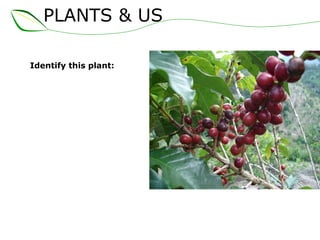
Identify this plant:
PLANTS & US
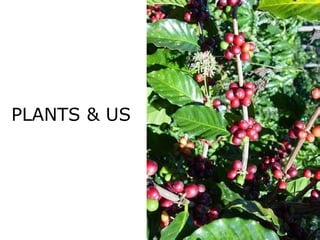
This is a coffee plant
-Coffee plants are
evergreen shrubs or
small trees that grow
in shaded areas
-Coffee “beans” are
actually the seeds of
coffee berries
-Coffee plants are
native to Africa
PLANTS & US
Coffee is the second
most-valuable-traded
commodity in the
world (second only to
petroleum)
Its demand has
resulted in the mass
development of coffee
plantations.
PLANTS & US
Coffee plantations:
-Damage the environment
(and animal habitats)
through the mass clearing
of land in order to create
plantations
-Are monocultures, which
lack diversity and are more
susceptible to disease and
pests
-As a result, a number of
pest control methods are
necessary to protect the
crops
PLANTS & US
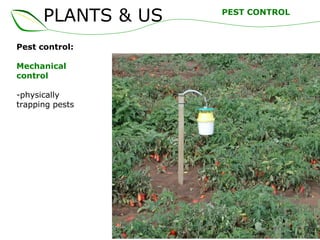
Pest control:
Mechanical
control
-physically
trapping pests
PEST CONTROL
PLANTS & US
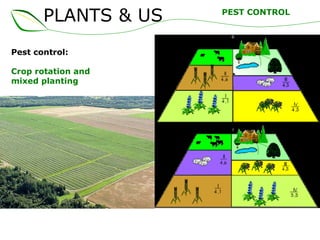
Pest control:
Crop rotation and
mixed planting
-When farmers do not
grow monocultures in
the same location year
after year, pest
populations do not have
the same opportunities
to establish and prosper
PEST CONTROL
PLANTS & US
Pest control:
Crop rotation and
mixed planting
PEST CONTROL
PLANTS & US
Pest control:
Biological control
-Predatory insects,
mites, and disease-
causing micro-organisms
prey on and infect pest
species
(i.e. parasitic wasps and
lady bugs)
PEST CONTROL
PLANTS & US
Pest control:
Baiting pest
-Pheromone baits can be
used to confuse mating
insects
-can be used for trapping
too
PEST CONTROL
PLANTS & US
Pest control:
Chemical control
- Using chemicals (i.e.
pesticides) to remove
pests
PEST CONTROL
PLANTS & US
Pest control:
Chemical control -
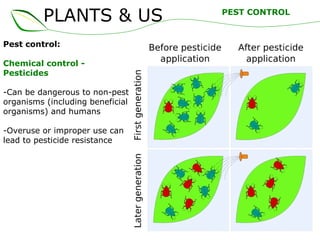
Pesticides
-Can be dangerous to non-pest
organisms (including beneficial
organisms) and humans
-Overuse or improper use can
lead to pesticide resistance
PEST CONTROL
PLANTS & US
Pest control can also be managed through growing plants
without relying on fields and soil
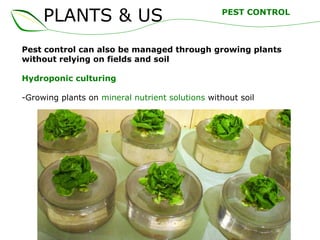
Hydroponic culturing
-Growing plants on mineral nutrient solutions without soil
PEST CONTROL
PLANTS & US
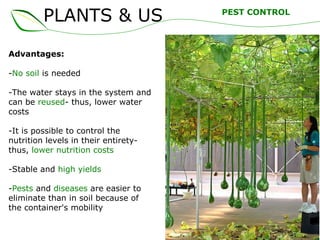
Advantages:
-No soil is needed
-The water stays in the system and
can be reused- thus, lower water
costs
-It is possible to control the
nutrition levels in their entirety-
thus, lower nutrition costs
-Stable and high yields
-Pests and diseases are easier to
eliminate than in soil because of
the container's mobility
PEST CONTROL
PLANTS & US
Disadvantages:
-Creates an environment which
encourages salmonella bacteria
growth
-Some plants cannot grow
effectively (and may begin to wilt)
due to the constant high moisture
levels
-Gases do not dissolve very well in
the water solution, so gas
exchange where the plants contact
water is limited
PEST CONTROL
PLANTS & US
Aeroponic culturing
-roots are continuously
or discontinuously kept
in an environment
saturated with fine drops
(a mist or aerosol) of
nutrient solution
-More plant species can
grow with this method
because water exposure
is catered to the needs of
the plant, and air can
reach more parts of the
plant
PEST CONTROL
PLANTS & US
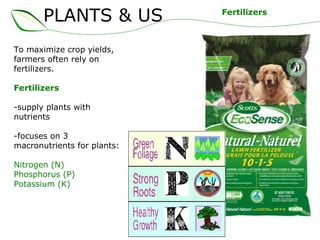
To maximize crop yields,
farmers often rely on
fertilizers.
Fertilizers
-supply plants with
nutrients
-focuses on 3
macronutrients for plants:
Nitrogen (N)
Phosphorus (P)
Potassium (K)
Fertilizers
PLANTS & US
Fertilizers
-the overuse of fertilizers
can result in the drying of
roots and damage to the
plant
-plants that have received
too much fertilizer exhibit
“fertilizer burn”
Fertilizers
PLANTS & US
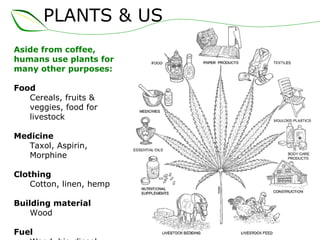
Aside from coffee,
humans use plants for
many other purposes:
Food
Cereals, fruits &
veggies, food for
livestock
Medicine
Taxol, Aspirin,
Morphine
Clothing
Cotton, linen, hemp
Building material
Wood
Fuel
PLANTS & US
Plants as Food
PLANTS & US
Plants as Medicine
Some plants contain
chemicals that protect the
plant by partially
debilitating the herbivores
that ate them.
These chemicals are
psychotropic (they alter
perception, emotion, or
behaviour).
Ex. Marijuana contains
tetrahydrocannabinol
(THC) which has been used
in medicine to increase
appetite, decrease nausea,
and reduce muscle spasms
PLANTS & US
Plants for Clothing
Cotton Hemp
PLANTS & US
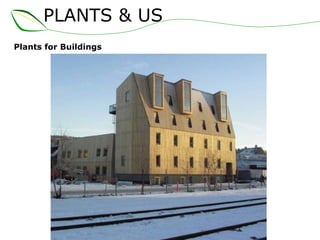
Plants for Buildings
PLANTS & US
Plants for Fuel
PLANTS & US
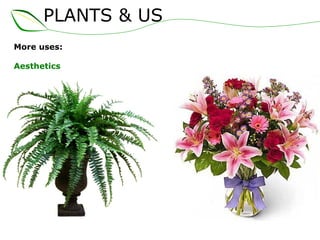
More uses:
Aesthetics
PLANTS & US
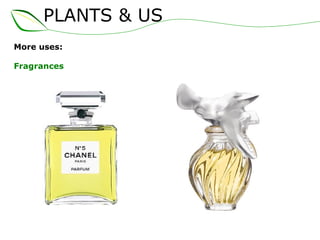
More uses:
Fragrances
PLANTS & US
More uses:
Gardens
PLANTS & US
More uses:
Gardens:
Plants have tropisms that
enable gardeners to achieve
various “looks” for their
garden
Tropism = A directional
growth response to unequal
stimulation from the
external environment.
PLANTS & US
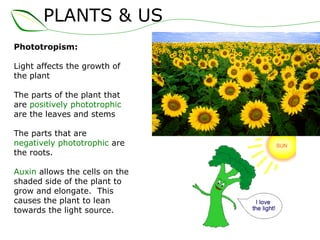
Phototropism:
Light affects the growth of
the plant
The parts of the plant that
are positively phototrophic
are the leaves and stems
The parts that are
negatively phototrophic are
the roots.
Auxin allows the cells on the
shaded side of the plant to
grow and elongate. This
causes the plant to lean
towards the light source.
PLANTS & US
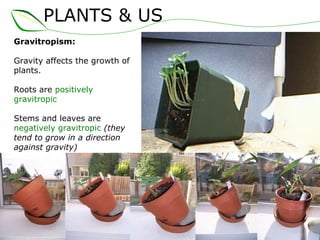
Gravitropism:
Gravity affects the growth of
plants.
Roots are positively
gravitropic
Stems and leaves are
negatively gravitropic (they
tend to grow in a direction
against gravity)
PLANTS & US
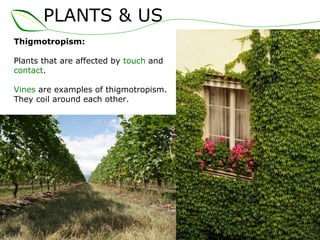
Thigmotropism:
Plants that are affected by touch and
contact.
Vines are examples of thigmotropism.
They coil around each other.

03 plants and us

  • 1.
  • 2.
  • 3.
    PLANTS & US Thisis a coffee plant -Coffee plants are evergreen shrubs or small trees that grow in shaded areas -Coffee “beans” are actually the seeds of coffee berries -Coffee plants are native to Africa
  • 4.
    PLANTS & US Coffeeis the second most-valuable-traded commodity in the world (second only to petroleum) Its demand has resulted in the mass development of coffee plantations.
  • 5.
    PLANTS & US Coffeeplantations: -Damage the environment (and animal habitats) through the mass clearing of land in order to create plantations -Are monocultures, which lack diversity and are more susceptible to disease and pests -As a result, a number of pest control methods are necessary to protect the crops
  • 6.
    PLANTS & US Pestcontrol: Mechanical control -physically trapping pests PEST CONTROL
  • 7.
    PLANTS & US Pestcontrol: Crop rotation and mixed planting -When farmers do not grow monocultures in the same location year after year, pest populations do not have the same opportunities to establish and prosper PEST CONTROL
  • 8.
    PLANTS & US Pestcontrol: Crop rotation and mixed planting PEST CONTROL
  • 9.
    PLANTS & US Pestcontrol: Biological control -Predatory insects, mites, and disease- causing micro-organisms prey on and infect pest species (i.e. parasitic wasps and lady bugs) PEST CONTROL
  • 10.
    PLANTS & US Pestcontrol: Baiting pest -Pheromone baits can be used to confuse mating insects -can be used for trapping too PEST CONTROL
  • 11.
    PLANTS & US Pestcontrol: Chemical control - Using chemicals (i.e. pesticides) to remove pests PEST CONTROL
  • 12.
    PLANTS & US Pestcontrol: Chemical control - Pesticides -Can be dangerous to non-pest organisms (including beneficial organisms) and humans -Overuse or improper use can lead to pesticide resistance PEST CONTROL
  • 13.
    PLANTS & US Pestcontrol can also be managed through growing plants without relying on fields and soil Hydroponic culturing -Growing plants on mineral nutrient solutions without soil PEST CONTROL
  • 14.
    PLANTS & US Advantages: -Nosoil is needed -The water stays in the system and can be reused- thus, lower water costs -It is possible to control the nutrition levels in their entirety- thus, lower nutrition costs -Stable and high yields -Pests and diseases are easier to eliminate than in soil because of the container's mobility PEST CONTROL
  • 15.
    PLANTS & US Disadvantages: -Createsan environment which encourages salmonella bacteria growth -Some plants cannot grow effectively (and may begin to wilt) due to the constant high moisture levels -Gases do not dissolve very well in the water solution, so gas exchange where the plants contact water is limited PEST CONTROL
  • 16.
    PLANTS & US Aeroponicculturing -roots are continuously or discontinuously kept in an environment saturated with fine drops (a mist or aerosol) of nutrient solution -More plant species can grow with this method because water exposure is catered to the needs of the plant, and air can reach more parts of the plant PEST CONTROL
  • 17.
    PLANTS & US Tomaximize crop yields, farmers often rely on fertilizers. Fertilizers -supply plants with nutrients -focuses on 3 macronutrients for plants: Nitrogen (N) Phosphorus (P) Potassium (K) Fertilizers
  • 18.
    PLANTS & US Fertilizers -theoveruse of fertilizers can result in the drying of roots and damage to the plant -plants that have received too much fertilizer exhibit “fertilizer burn” Fertilizers
  • 19.
    PLANTS & US Asidefrom coffee, humans use plants for many other purposes: Food Cereals, fruits & veggies, food for livestock Medicine Taxol, Aspirin, Morphine Clothing Cotton, linen, hemp Building material Wood Fuel
  • 20.
  • 21.
    PLANTS & US Plantsas Medicine Some plants contain chemicals that protect the plant by partially debilitating the herbivores that ate them. These chemicals are psychotropic (they alter perception, emotion, or behaviour). Ex. Marijuana contains tetrahydrocannabinol (THC) which has been used in medicine to increase appetite, decrease nausea, and reduce muscle spasms
  • 22.
    PLANTS & US Plantsfor Clothing Cotton Hemp
  • 23.
    PLANTS & US Plantsfor Buildings
  • 24.
  • 25.
    PLANTS & US Moreuses: Aesthetics
  • 26.
    PLANTS & US Moreuses: Fragrances
  • 27.
    PLANTS & US Moreuses: Gardens
  • 28.
    PLANTS & US Moreuses: Gardens: Plants have tropisms that enable gardeners to achieve various “looks” for their garden Tropism = A directional growth response to unequal stimulation from the external environment.
  • 29.
    PLANTS & US Phototropism: Lightaffects the growth of the plant The parts of the plant that are positively phototrophic are the leaves and stems The parts that are negatively phototrophic are the roots. Auxin allows the cells on the shaded side of the plant to grow and elongate. This causes the plant to lean towards the light source.
  • 30.
    PLANTS & US Gravitropism: Gravityaffects the growth of plants. Roots are positively gravitropic Stems and leaves are negatively gravitropic (they tend to grow in a direction against gravity)
  • 31.
    PLANTS & US Thigmotropism: Plantsthat are affected by touch and contact. Vines are examples of thigmotropism. They coil around each other.

Editor's Notes

  • #10 http://www.youtube.com/watch?v=rLtUk-W5Gpk&feature=related http://www.youtube.com/watch?v=vMG-LWyNcAs&feature=channel
  • #11 http://www.youtube.com/user/NationalGeographic#p/search/3/m2H-uTg51_c
  • #30 http://www.youtube.com/watch?v=HvZJqWSdMMk http://www.youtube.com/watch?v=Ze8NV7cvW8k
  • #31 http://www.youtube.com/watch?v=I7TmX0rrNRM
  • #32 http://www.youtube.com/watch?v=H9MV5CgPgIQ http://www.youtube.com/watch?v=UCUtpmwacoE&NR=1