Hydrotropism
• By
• Slide_Maker4u
• (Abhishek Sharma)
Introduction
• Hydrotropism (hydro- "water";
tropism "involuntary orientation
by an organism, that involves
turning or curving as a positive or
negative response to a
stimulus")[1] is a plant's growth
response in which the direction
of growth is determined by a
stimulus or gradient in water
concentration. A common
example is a plant root growing in
humid air bending toward a
higher relative humidity level.
• This is of biological significance as
it helps to increase efficiency of
the plant in its ecosystem.
 The process of hydrotropism is started by the root cap sensing water
and sending a signal to the elongating part of the root. Hydrotropism
is difficult to observe in underground roots, since the roots are not
readily observable, and root gravitropism is usually more influential
than root hydrotropism.[2] Water readily moves in soil and soil water
content is constantly changing so any gradients in soil moisture are
not stable.
 This qs, root hydrotropism research has mainly been a laboratory
phenomenon for roots grown in humid air rather than soil. Its
ecological significance in soil-grown roots is unclear because so little
hydrotropism research has examined soil-grown roots. Recent
identification of a mutant plant that lacks a hydrotropic response may
help to elucidate its role in nature.[3] Hydrotropism may have
importance for plants grown in space, where it may allow roots to
orient themselves in a microgravity environment.[4]
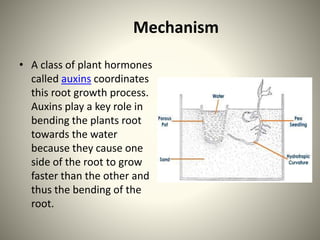
Mechanism
• A class of plant hormones
called auxins coordinates
this root growth process.
Auxins play a key role in
bending the plants root
towards the water
because they cause one
side of the root to grow
faster than the other and
thus the bending of the
root.
 The greater growth of roots in
moist soil zones than in dry soil
zones is not usually a result of
hydrotropism.[5] Hydrotropism
requires a root to bend from a
drier to a wetter soil zone. Roots
require water to grow so roots that
happen to be in moist soil will grow
and branch much more than those
in dry soil.
 Roots cannot sense water inside
intact pipes via hydrotropism and
break the pipes to obtain the
water.
 Roots cannot sense water several
feet away via hydrotropism and
grow toward it. At best
hydrotropism probably operates
over distances of a couple
millimeters.
Misconceptions
 Why is being Hydrotropic so
Important for Plants?
This ability to bend and grow the root towards a moisture
gradient is essential because plants need water to grow.
Water, together with soluble mineral nutrients, is taken up by
the root hairs. Then, in vascular plants (also called higher
plants or tracheophytes), water and minerals are transported
to all parts of a plant through a lignified transport system
called xylem.
The second transport system in vascular plants is called
phloem. The phloem also carries water, not with soluble
minerals, but mainly with soluble organic nutrients instead.
These organic nutrients are delivered by photosynthesis and
are called photosynthate.
 Actually, this plant growth
response is not easy to study.
Studies are conducted in labs and
not in the natural environment. Yet,
more and more is learned about
the complex nature of this plant
growth process. Popular plants to
study this effect are: pea plant
(Pisum sativum), corn plant (Zea
mays) and thale cress
(Arabidopsis thaliana).
 A study showed that a gene in the
roots is essential for the ability to
detect water. Plant mutants that
lack this gene, showed no
response to moisture.
Studies
 Actually, this plant growth response is not easy to
study. Studies are conducted in labs and not in the
natural environment. Yet, more and more is learned
about the complex nature of this plant growth process.
Popular plants to study this effect are: pea plant
(Pisum sativum), corn plant (Zea mays) and thale
cress (Arabidopsis thaliana).
 A study showed that a gene in the roots is essential for
the ability to detect water. Plant mutants that lack this
gene, showed no response to moisture.
 Scientists are also interested in
the interaction between hydro-
and gravitropism.The findings
are important to understand
how plants grow in space and
therefore zero gravity. Here on
earth, generally spoken, root
growth direction is the result of
positive hydrotropism and
negative gravitropism, yet other
environmental stimuli
(tropisms) may interfere and
interact as well.
 These processes simply need to be more
studied. Every scientific study will
increase our understanding of these
complex mechanisms.
Hydrotropism

Hydrotropism

  • 1.
  • 2.
    Introduction • Hydrotropism (hydro-"water"; tropism "involuntary orientation by an organism, that involves turning or curving as a positive or negative response to a stimulus")[1] is a plant's growth response in which the direction of growth is determined by a stimulus or gradient in water concentration. A common example is a plant root growing in humid air bending toward a higher relative humidity level. • This is of biological significance as it helps to increase efficiency of the plant in its ecosystem.
  • 3.
     The processof hydrotropism is started by the root cap sensing water and sending a signal to the elongating part of the root. Hydrotropism is difficult to observe in underground roots, since the roots are not readily observable, and root gravitropism is usually more influential than root hydrotropism.[2] Water readily moves in soil and soil water content is constantly changing so any gradients in soil moisture are not stable.  This qs, root hydrotropism research has mainly been a laboratory phenomenon for roots grown in humid air rather than soil. Its ecological significance in soil-grown roots is unclear because so little hydrotropism research has examined soil-grown roots. Recent identification of a mutant plant that lacks a hydrotropic response may help to elucidate its role in nature.[3] Hydrotropism may have importance for plants grown in space, where it may allow roots to orient themselves in a microgravity environment.[4]
  • 4.
    Mechanism • A classof plant hormones called auxins coordinates this root growth process. Auxins play a key role in bending the plants root towards the water because they cause one side of the root to grow faster than the other and thus the bending of the root.
  • 5.
     The greatergrowth of roots in moist soil zones than in dry soil zones is not usually a result of hydrotropism.[5] Hydrotropism requires a root to bend from a drier to a wetter soil zone. Roots require water to grow so roots that happen to be in moist soil will grow and branch much more than those in dry soil.  Roots cannot sense water inside intact pipes via hydrotropism and break the pipes to obtain the water.  Roots cannot sense water several feet away via hydrotropism and grow toward it. At best hydrotropism probably operates over distances of a couple millimeters. Misconceptions
  • 7.
     Why isbeing Hydrotropic so Important for Plants? This ability to bend and grow the root towards a moisture gradient is essential because plants need water to grow. Water, together with soluble mineral nutrients, is taken up by the root hairs. Then, in vascular plants (also called higher plants or tracheophytes), water and minerals are transported to all parts of a plant through a lignified transport system called xylem. The second transport system in vascular plants is called phloem. The phloem also carries water, not with soluble minerals, but mainly with soluble organic nutrients instead. These organic nutrients are delivered by photosynthesis and are called photosynthate.
  • 8.
     Actually, thisplant growth response is not easy to study. Studies are conducted in labs and not in the natural environment. Yet, more and more is learned about the complex nature of this plant growth process. Popular plants to study this effect are: pea plant (Pisum sativum), corn plant (Zea mays) and thale cress (Arabidopsis thaliana).  A study showed that a gene in the roots is essential for the ability to detect water. Plant mutants that lack this gene, showed no response to moisture. Studies
  • 9.
     Actually, thisplant growth response is not easy to study. Studies are conducted in labs and not in the natural environment. Yet, more and more is learned about the complex nature of this plant growth process. Popular plants to study this effect are: pea plant (Pisum sativum), corn plant (Zea mays) and thale cress (Arabidopsis thaliana).  A study showed that a gene in the roots is essential for the ability to detect water. Plant mutants that lack this gene, showed no response to moisture.
  • 10.
     Scientists arealso interested in the interaction between hydro- and gravitropism.The findings are important to understand how plants grow in space and therefore zero gravity. Here on earth, generally spoken, root growth direction is the result of positive hydrotropism and negative gravitropism, yet other environmental stimuli (tropisms) may interfere and interact as well.
  • 11.
     These processessimply need to be more studied. Every scientific study will increase our understanding of these complex mechanisms.