Basic Computer Network
WeeSan Lee weesan@cs.ucr.edu
Bandwidth
 Data rate measured in bits (not bytes) per
seconds
 Kbps (Kilobits per seconds)
 125 chars/sec
 Mbps (Megabits per seconds)
 1,250 chars/sec
 Gbps (Gigabits per seconds)
 12,500 chars/sec
Connecting to the Internet
 Requirement
 A computer or PDA or cell phone
 An account with an ISP (Internet Service Provider)
 A modem (modulator/demodulator) for dial-up
services or a NIC (Network Interface Card) for
DSL/Cable services
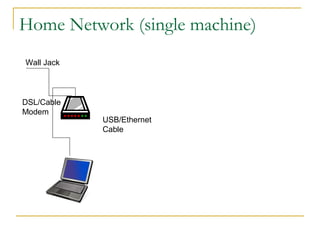
Home Network (single machine)
USB/Ethernet
Cable
DSL/Cable
Modem
Wall Jack
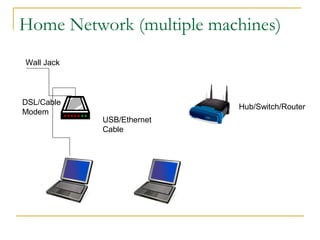
Home Network (multiple machines)
USB/Ethernet
Cable
DSL/Cable
Modem
Wall Jack
Hub/Switch/Router
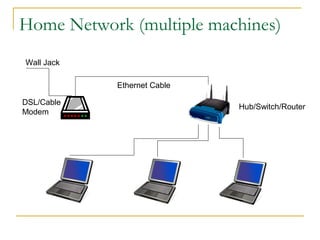
Home Network (multiple machines)
Ethernet Cable
DSL/Cable
Modem
Wall Jack
Hub/Switch/Router
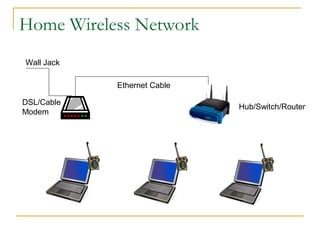
Home Wireless Network
Ethernet Cable
DSL/Cable
Modem
Wall Jack
Hub/Switch/Router
Connection Types
 LAN
 WLAN
 Dial-up Services
 Broadband Services
 WAN
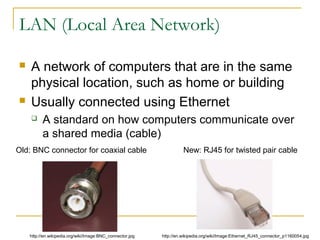
LAN (Local Area Network)
 A network of computers that are in the same
physical location, such as home or building
 Usually connected using Ethernet
 A standard on how computers communicate over
a shared media (cable)
http://en.wikipedia.org/wiki/Image:Ethernet_RJ45_connector_p1160054.jpghttp://en.wikipedia.org/wiki/Image:BNC_connector.jpg
Old: BNC connector for coaxial cable New: RJ45 for twisted pair cable
LAN (Local Area Network)
 Ethernet Standard
 10BaseT
 10Mbps (Mega bits per second)
 100BaseT
 100Mbps
 1000BaseT
 1000Mbps or 1Gbps
 Correction from the book (pg. 10)
 Why do we get faster connection at work or on
campus than at home?
LAN (Local Area Network)
 Question: Can 2 computers communicate by
connecting each other using an Ethernet
cable back-to-back?
WLAN (Wireless LAN)
 Wi-Fi (Wireless Fidelity)
 A wireless technology that connects computers without
cables
 Access Point (AP)
 A device (base station) that connects wireless devices
together
 Usually connected to a wired-network
 ESSID (Extended Service Set ID)
 A “name” for the AP, eg. mobilenet
 Hotspot
 The area covered by wireless access points
WLAN (Wireless LAN)
 Standard
 802.11b - 11Mbps
 802.11g - 54Mbps
 802.11a - 54Mbps
 Security
 WEP (Wired Equivalen Privacy)
 WPA (Wi-Fi Protected Access)
 To prevent wardriving
2.4G
5G
Dial-up Services
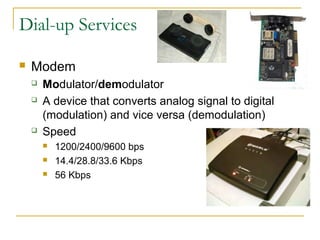
 Modem
 Modulator/demodulator
 A device that converts analog signal to digital
(modulation) and vice versa (demodulation)
 Speed
 1200/2400/9600 bps
 14.4/28.8/33.6 Kbps
 56 Kbps
Dial-up Services
 ISDN
 Integrated Services Digital Network
 2 data channel (56K each)
 1 voice channel
Broadband Services
 xDSL (Digital Subscriber Line)
 A technology that provides digital data transmission over
unused frequencies on traditional telephone lines
 For example, ADSL (Asymmetric DSL): DL > UL
 Speed
 Downlink
 128Kbps - 4Mbps
 Uplink
 64Kbps - 800Kbps
 Need a DSL modem
 Splitters are needed to separate the voice and data
signal
Broadband Services
 Cable
 A technology that provides digital data transmission over
cable TV infrastructure
 Speed
 Downlink
 128Kbps - 3~5Mbps
 Uplink
 64Kbps - 128Kbps~1Mbps
 Need a cable modem
Broadband Services
 Satellite
 A technology that provide digital data transmission over
satellites
 Speed
 Downlink
 500Kbps - 1Mbps
 Uplink
 50Kbps - 100Kbps
 Need a satellite dish
WAN (Wide Area Network)
 A LAN spans a large geographic area,
such as connections between cities
 Usually connected using leased line
 T1 (1.5Mbps)
 T3 (45Mbps)
 OC3 (155Mbps)
 OC12 (622Mbps)
 OC48 (2.4Gbps)
Fiber optic lines
Telecommunication lines
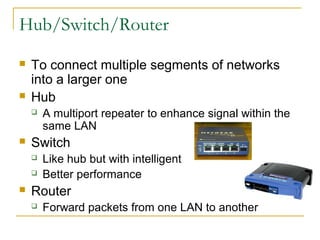
Hub/Switch/Router
 To connect multiple segments of networks
into a larger one
 Hub
 A multiport repeater to enhance signal within the
same LAN
 Switch
 Like hub but with intelligent
 Better performance
 Router
 Forward packets from one LAN to another
Intranet vs. Internet
 Intranet
 A private network that is contained within an
enterprise
 Could be LANs and WANs
 Internet
 A public network of networks
 Both are using TCP/IP
TCP/IP
 A family of protocols that makes the Internet
works
 The Robustness Principle
 “Be liberal in what you accept, and conservative in
what you send” - Jon Postel
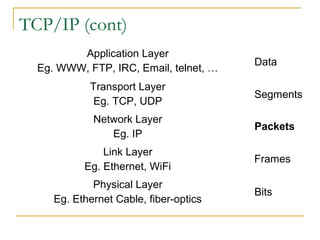
TCP/IP (cont)
Application Layer
Eg. WWW, FTP, IRC, Email, telnet, …
Transport Layer
Eg. TCP, UDP
Network Layer
Eg. IP
Link Layer
Eg. Ethernet, WiFi
Physical Layer
Eg. Ethernet Cable, fiber-optics
Segments
Packets
Frames
Bits
Data
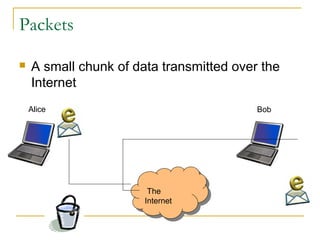
Packets
 A small chunk of data transmitted over the
Internet
Alice
The
Internet
The
Internet
Bob
VPN (Virtual Private Network)
 A secure tunnel to a private network through
a public network
 Once established, local node appears to be a
node in the private network in a secure
manner
 Correction from the book (pg. 11):
 VPN does not mean using telephone line
connection!!!
Host & IP Address
 Correction from the book:
 “A host is a computer connected directly to the
Internet”
“You home computer is not a host”
 Each host needs an IP address
 IP address
 A 32-bit number, arranged in 4 numbers
seperated by “.”
 Eg. 74.125.19.147
DNS (Domain Name System)
 Domain name to IP address conversion
 Eg. www.google.com → ??.???.??.??
 Domain name or IP address lookup
 http://cqcounter.com/whois/
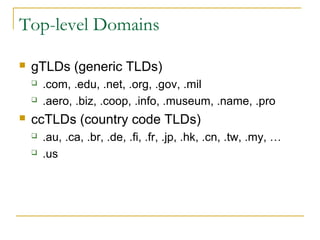
Top-level Domains
 gTLDs (generic TLDs)
 .com, .edu, .net, .org, .gov, .mil
 .aero, .biz, .coop, .info, .museum, .name, .pro
 ccTLDs (country code TLDs)
 .au, .ca, .br, .de, .fi, .fr, .jp, .hk, .cn, .tw, .my, …
 .us
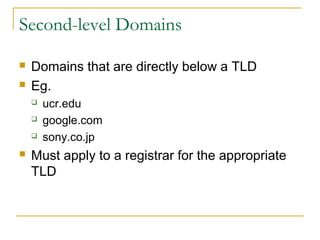
Second-level Domains
 Domains that are directly below a TLD
 Eg.
 ucr.edu
 google.com
 sony.co.jp
 Must apply to a registrar for the appropriate
TLD
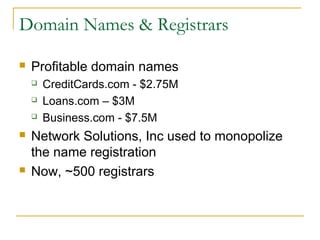
Domain Names & Registrars
 Profitable domain names
 CreditCards.com - $2.75M
 Loans.com – $3M
 Business.com - $7.5M
 Network Solutions, Inc used to monopolize
the name registration
 Now, ~500 registrars
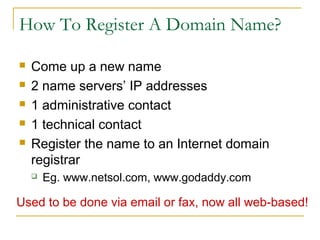
How To Register A Domain Name?
 Come up a new name
 2 name servers’ IP addresses
 1 administrative contact
 1 technical contact
 Register the name to an Internet domain
registrar
 Eg. www.netsol.com, www.godaddy.com
Used to be done via email or fax, now all web-based!
Policies
 AUP (Acceptable Use Policies)
 A legal document, written to protect the ISP from
unlawful use of its service, and outlines prohibited
uses of the service and possible consequences of
misuse
 Privacy Policies
 A document describes an ISP’s policy for
protecting users’ information
Conclusion
 Described how to get connected to the
Internet
 Talked about the related network
technologies and components
References
 Internet Effectively (Ch 1-2)
 Modem
 http://en.wikipedia.org/wiki/Modem
 DSL
 http://en.wikipedia.org/wiki/Digital_subscriber_line
 How DSL works?
 http://electronics.howstuffworks.com/dsl.htm
 VPN
 http://en.wikipedia.org/wiki/Vpn
References (cont)
 RFC1122: Requirements for Internet Hosts
 ftp://ftp.rfc-editor.org/in-notes/rfc1122.txt
 Domain Names
 http://www.icann.org/topics/new-gtld-strategy-
faq.htm
 http://www.iana.org/root-whois/index.html
Homework 2
 Read “Stealing your neighbor's Net”
 http://money.cnn.com/2005/08/08/technology/personaltech/
internet_piracy/index.htm
 Read “Is stealing wireless wrong?”
 http://news.bbc.co.uk/2/hi/uk_news/magazine/6960304.stm
 Post your own comment in 100-150 words to
“Homework 2 Forum” by next Mon (10/8) @
23:55pm
 Reply one of the comments from others by next Tue
(10/9) @ 23:55pm.

03 basic computer_network

  • 1.
    Basic Computer Network WeeSanLee weesan@cs.ucr.edu
  • 2.
    Bandwidth  Data ratemeasured in bits (not bytes) per seconds  Kbps (Kilobits per seconds)  125 chars/sec  Mbps (Megabits per seconds)  1,250 chars/sec  Gbps (Gigabits per seconds)  12,500 chars/sec
  • 3.
    Connecting to theInternet  Requirement  A computer or PDA or cell phone  An account with an ISP (Internet Service Provider)  A modem (modulator/demodulator) for dial-up services or a NIC (Network Interface Card) for DSL/Cable services
  • 4.
    Home Network (singlemachine) USB/Ethernet Cable DSL/Cable Modem Wall Jack
  • 5.
    Home Network (multiplemachines) USB/Ethernet Cable DSL/Cable Modem Wall Jack Hub/Switch/Router
  • 6.
    Home Network (multiplemachines) Ethernet Cable DSL/Cable Modem Wall Jack Hub/Switch/Router
  • 7.
    Home Wireless Network EthernetCable DSL/Cable Modem Wall Jack Hub/Switch/Router
  • 8.
    Connection Types  LAN WLAN  Dial-up Services  Broadband Services  WAN
  • 9.
    LAN (Local AreaNetwork)  A network of computers that are in the same physical location, such as home or building  Usually connected using Ethernet  A standard on how computers communicate over a shared media (cable) http://en.wikipedia.org/wiki/Image:Ethernet_RJ45_connector_p1160054.jpghttp://en.wikipedia.org/wiki/Image:BNC_connector.jpg Old: BNC connector for coaxial cable New: RJ45 for twisted pair cable
  • 10.
    LAN (Local AreaNetwork)  Ethernet Standard  10BaseT  10Mbps (Mega bits per second)  100BaseT  100Mbps  1000BaseT  1000Mbps or 1Gbps  Correction from the book (pg. 10)  Why do we get faster connection at work or on campus than at home?
  • 11.
    LAN (Local AreaNetwork)  Question: Can 2 computers communicate by connecting each other using an Ethernet cable back-to-back?
  • 12.
    WLAN (Wireless LAN) Wi-Fi (Wireless Fidelity)  A wireless technology that connects computers without cables  Access Point (AP)  A device (base station) that connects wireless devices together  Usually connected to a wired-network  ESSID (Extended Service Set ID)  A “name” for the AP, eg. mobilenet  Hotspot  The area covered by wireless access points
  • 13.
    WLAN (Wireless LAN) Standard  802.11b - 11Mbps  802.11g - 54Mbps  802.11a - 54Mbps  Security  WEP (Wired Equivalen Privacy)  WPA (Wi-Fi Protected Access)  To prevent wardriving 2.4G 5G
  • 14.
    Dial-up Services  Modem Modulator/demodulator  A device that converts analog signal to digital (modulation) and vice versa (demodulation)  Speed  1200/2400/9600 bps  14.4/28.8/33.6 Kbps  56 Kbps
  • 15.
    Dial-up Services  ISDN Integrated Services Digital Network  2 data channel (56K each)  1 voice channel
  • 16.
    Broadband Services  xDSL(Digital Subscriber Line)  A technology that provides digital data transmission over unused frequencies on traditional telephone lines  For example, ADSL (Asymmetric DSL): DL > UL  Speed  Downlink  128Kbps - 4Mbps  Uplink  64Kbps - 800Kbps  Need a DSL modem  Splitters are needed to separate the voice and data signal
  • 17.
    Broadband Services  Cable A technology that provides digital data transmission over cable TV infrastructure  Speed  Downlink  128Kbps - 3~5Mbps  Uplink  64Kbps - 128Kbps~1Mbps  Need a cable modem
  • 18.
    Broadband Services  Satellite A technology that provide digital data transmission over satellites  Speed  Downlink  500Kbps - 1Mbps  Uplink  50Kbps - 100Kbps  Need a satellite dish
  • 19.
    WAN (Wide AreaNetwork)  A LAN spans a large geographic area, such as connections between cities  Usually connected using leased line  T1 (1.5Mbps)  T3 (45Mbps)  OC3 (155Mbps)  OC12 (622Mbps)  OC48 (2.4Gbps) Fiber optic lines Telecommunication lines
  • 20.
    Hub/Switch/Router  To connectmultiple segments of networks into a larger one  Hub  A multiport repeater to enhance signal within the same LAN  Switch  Like hub but with intelligent  Better performance  Router  Forward packets from one LAN to another
  • 21.
    Intranet vs. Internet Intranet  A private network that is contained within an enterprise  Could be LANs and WANs  Internet  A public network of networks  Both are using TCP/IP
  • 22.
    TCP/IP  A familyof protocols that makes the Internet works  The Robustness Principle  “Be liberal in what you accept, and conservative in what you send” - Jon Postel
  • 23.
    TCP/IP (cont) Application Layer Eg.WWW, FTP, IRC, Email, telnet, … Transport Layer Eg. TCP, UDP Network Layer Eg. IP Link Layer Eg. Ethernet, WiFi Physical Layer Eg. Ethernet Cable, fiber-optics Segments Packets Frames Bits Data
  • 24.
    Packets  A smallchunk of data transmitted over the Internet Alice The Internet The Internet Bob
  • 25.
    VPN (Virtual PrivateNetwork)  A secure tunnel to a private network through a public network  Once established, local node appears to be a node in the private network in a secure manner  Correction from the book (pg. 11):  VPN does not mean using telephone line connection!!!
  • 26.
    Host & IPAddress  Correction from the book:  “A host is a computer connected directly to the Internet” “You home computer is not a host”  Each host needs an IP address  IP address  A 32-bit number, arranged in 4 numbers seperated by “.”  Eg. 74.125.19.147
  • 27.
    DNS (Domain NameSystem)  Domain name to IP address conversion  Eg. www.google.com → ??.???.??.??  Domain name or IP address lookup  http://cqcounter.com/whois/
  • 28.
    Top-level Domains  gTLDs(generic TLDs)  .com, .edu, .net, .org, .gov, .mil  .aero, .biz, .coop, .info, .museum, .name, .pro  ccTLDs (country code TLDs)  .au, .ca, .br, .de, .fi, .fr, .jp, .hk, .cn, .tw, .my, …  .us
  • 29.
    Second-level Domains  Domainsthat are directly below a TLD  Eg.  ucr.edu  google.com  sony.co.jp  Must apply to a registrar for the appropriate TLD
  • 30.
    Domain Names &Registrars  Profitable domain names  CreditCards.com - $2.75M  Loans.com – $3M  Business.com - $7.5M  Network Solutions, Inc used to monopolize the name registration  Now, ~500 registrars
  • 31.
    How To RegisterA Domain Name?  Come up a new name  2 name servers’ IP addresses  1 administrative contact  1 technical contact  Register the name to an Internet domain registrar  Eg. www.netsol.com, www.godaddy.com Used to be done via email or fax, now all web-based!
  • 32.
    Policies  AUP (AcceptableUse Policies)  A legal document, written to protect the ISP from unlawful use of its service, and outlines prohibited uses of the service and possible consequences of misuse  Privacy Policies  A document describes an ISP’s policy for protecting users’ information
  • 33.
    Conclusion  Described howto get connected to the Internet  Talked about the related network technologies and components
  • 34.
    References  Internet Effectively(Ch 1-2)  Modem  http://en.wikipedia.org/wiki/Modem  DSL  http://en.wikipedia.org/wiki/Digital_subscriber_line  How DSL works?  http://electronics.howstuffworks.com/dsl.htm  VPN  http://en.wikipedia.org/wiki/Vpn
  • 35.
    References (cont)  RFC1122:Requirements for Internet Hosts  ftp://ftp.rfc-editor.org/in-notes/rfc1122.txt  Domain Names  http://www.icann.org/topics/new-gtld-strategy- faq.htm  http://www.iana.org/root-whois/index.html
  • 36.
    Homework 2  Read“Stealing your neighbor's Net”  http://money.cnn.com/2005/08/08/technology/personaltech/ internet_piracy/index.htm  Read “Is stealing wireless wrong?”  http://news.bbc.co.uk/2/hi/uk_news/magazine/6960304.stm  Post your own comment in 100-150 words to “Homework 2 Forum” by next Mon (10/8) @ 23:55pm  Reply one of the comments from others by next Tue (10/9) @ 23:55pm.