World Journal of Pharmaceutical Sciences
ISSN (Print): 2321-3310; ISSN (Online): 2321-3086
Published by Atom and Cell Publishers © All Rights Reserved
Available online at: http://www.wjpsonline.com/
Research Article

Synthesis, spectral characterization and bioactivity studies of some S-substituted
derivatives of 5-(4-chlorophenyl)-1,3,4-Oxadiazol-2-thiol
Muhammad A. Abbasia,*, Babar Shahzada, Aziz-ur-Rehmana, Khadija Nafeesaa, Shahid
Rasoola, Muhammad Ashrafb, Syeda Abida Ejazc, Hammad Ismaild and Bushra Mirzad
a

Department of Chemistry, Government College University, Lahore, 54000, Pakistan
Department of Biochemistry and Biotechnology; cDepartment of Pharmacy, The Islamia
University of Bahawalpur, Bahawalpur, 63100, Pakistan
d
Department of Biochemistry, Quaid-i-Azam University, Islamabad, 45320, Pakistan
b

Received: 23-10-2013 / Revised: 06-11-2013 / Accepted: 14-12-2013

ABSTRACT
A new series of 5-(4-Chlorophenyl)-1,3,4-Oxadiazol-2-thiol derivatives was prepared from 4-chlorobenzoic
acid (1) by converting it successively into corresponding ester (2), carbohydrazide (3) and 5-(4-Chlorophenyl)1,3,4-Oxadiazol-2-thiol (4). Finally the target compounds, 6a-l, were synthesized by stirring 4 with different
electrophiles, 5a-l, in DMF using NaH as weak base and activator. The proposed structures of newly
synthesized compounds were confirmed by spectroscopic techniques such as 1H-NMR, 13C-NMR, HR-MS and
EI-MS. All synthesized compounds were evaluated for their anti-bacterial, antifungal, cytotoxicity and enzyme
inhibition activities. The compounds, 6e and 6g exhibited significant inhibition activity against acetyl
cholinesterase enzyme (AChE) and 6j moderate activity against butyryl cholinesterase enzyme (BChE). The
molecule, 4 exhibited good MIC (minimum inhibitory concentration) value against all the bacterial and fungal
strains taken into account.
Key Words: 1,3,4-Oxadiazole, 4-Chlorobenzoic acid, Antimicrobial activity, Cytotoxicity, Enzyme inhibition

INTRODUCTION
1,3,4-Oxadiazoles belong to an important class of
five membered heterocyclic ring and are present in
a number of biologically active molecules [1].
They undergo a variety of organic reactions such as
electrophilic substitution, nucleophilic substitution,
thermal and photochemical reactions; and hence
medicinal backbone on which a number of valuable
molecules have been constructed. This class
possesses a wide spectrum of biological activities
such as antimicrobial [2], anticancer [3],
anticonvulsive [4], anti-inflammatory [5, 6],
antitubercular [7], cytotoxic [8], fungicidal [9],
hypoglycemic [10], insecticidal [11] and antihypertensive agents [12]. Generally acyl hydrazides
are used as starting materials for the synthesis of
1,3,4-Oxadiazoles [13].
Cholinesterases are well-known enzymes, present
in cholinergic and non-cholinergic tissues as well
as in the plasma and other body fluids of animals

[14]. These enzymes are divided into two classes
on the basis of their specificity for different
substrate molecules and inhibitors, acetyl
cholinesterase (AChE) or “true cholinesterase” and
butyryl cholinesterase (BChE) or pseudo
cholinesterase. AChE is commonly found in brain,
muscles and erythrocyte membrane whereas BChE
is present in liver, intestine, heart, kidneys and
lungs [15]. The function of AChE is the hydrolysis
of the neurotransmitter acetylcholine at cholinergic
synapses [16] and BChE hydrolyzes estercontaining drugs and scavenges cholinesterase
inhibitors including potent organo-phosphorus
nerve agents before reaching the synaptic targets
[17]. It has been reported that the acetylcholine
deficiency is associated with Alzheimer’s disease
[18] which involves selective loss of cholinergic
neurons in the central nervous system. At present,
one of the major therapeutic strategies to treat
Alzheimer’s disease is to inhibit the biological
activity of AChE. Organophosphates and
carbamates are among the most commonly used

*Corresponding Author Address: Dr. Muhammad Athar Abbasi, Department of Chemistry, Government College University, Lahore,
54000, Pakistan; E-mail: atrabbasi@yahoo.com; atrabbasi@hotmail.com
Abbasi et al., World J Pharm Sci 2014; 2(1): 32-40

AChE inhibitors and are also employed as
insecticides [19].

(20 mL) in a 250 mL RB flask, hydrazine hydrate
(2.5 mL, 0.050 mol) was added drop wise and
mixture was allowed to stir at room temperature for
8 hours. The reaction progress was observed by
TLC using n-hexane and ethyl acetate solvent
system (40:60). After complete reaction, excess of
solvent was evaporated and ice cold water was
added along with shaking till precipitation. White
colored precipitates of carbohydrazide 3 were
filtered and washed with cold distilled water.

Hence, it is important to synthesize such
pharmacological inhibitors of cholinestrases which
are important to control such type of diseases
which involve impaired acetylcholine mediated
neurotransmission. In protraction of our previous
work [20, 21], an attempt has been made to
synthesize titled compounds and screen them for
their antimicrobial and enzyme inhibition potential.

Synthesis of 5-(4-chlorophenyl)-1,3,4-Oxadiazol2-thiol (4): 4-Chlorobenzohydrazide (3; 4g, 0.024
mol) was dissolved in C2H5OH (20 mL) in a 250
mL RB flask at 28 oC and then solid KOH (1.34g,
0.024 mol) was dissolved on reflux. Carbon
disulphide (3.70 mL, 0.048 mol) was poured into
the reaction mixture drop wise at 28 oC and was
allowed to reflux again for 6 hours. At the end of
reaction, observed by TLC using n-hexane and
ethyl acetate solvent system (70:30), excess of
ethanol was evaporated. Excess of ice cold distilled
water was added followed by addition of dilute
HCl till constant pH of 4-5. Light peach colored
precipitates of 4 were filtered and washed with
distilled water.

MATERIAL AND METHODS
General: All the chemical reagents were purchased
from Alfa Aesar, Merck and Sigma Aldrich
through local suppliers. The solvents were of
analytical grade and used without further
purification. The reaction completion and purity
were confirmed by TLC performed on aluminum
plates coated with silica gel G-25-UV254, run by
EtOAc and n-hexane solvent system and visualized
under UV at 254 nm. Melting points were recorded
on Griffin-George melting point apparatus by using
open capillary tubes and were uncorrected. 1HNMR spectra were recorded at 400 MHz by Bruker
NMR spectrometers in CDCl3, demonstrating
chemical shifts in ppm values. 13C-NMR spectrum
was recorded at 100 MHz by Bruker NMR
spectrometer in CD3OD. EI-MS spectra were taken
by using JMS-HX-110 spectrometer, with data
system.

General procedure for the synthesis of Ssubstituted derivatives of 5-(4-chlorophenyl)1,3,4-Oxadiazol-2-thiol (6a-l): The compound 5(4-chlorophenyl)-1,3,4-Oxadiazol-2-thiol (4; 0.1g,
0.00047 mol) was dissolved in N,N-dimethyl
formamide (DMF, 5-10 mL) in a 100 mL RB flask.
Solid NaH (0.005g) was added and mixture was
stirred for half an hour. Then different
electrophiles, alkyl/aralkyl halides, 5a-l, were
added in equimolar ratios and further stirred for 3-5
hours. The reaction was monitored by TLC using
n-hexane and ethyl acetate solvent system (80:20).
After complete reaction, ice cold distilled water
was added and the products were collected by
filtration or solvent extraction.

Procedure for the synthesis of ethyl 4chlorobenzoate (2): 4-Chlorobenzoic acid (1; 5g,
0.032 mol) was taken in a 250 mL round bottom
(RB) flask and dissolved in absolute C2H5OH (20
mL). 1.0 mL of concentrated H2SO4 was added
gradually into the reaction mixture and set to reflux
for 5 hours. The reaction was supervised by thin
layer chromatography (TLC) using n-hexane and
ethyl acetate as solvent system (80:20). At maximal
completion of reaction, because of reversibility of
reaction, excess of ethanol was evaporated and
reaction mixture was poured into a separating
funnel containing 50 mL distilled water. Sodium
carbonate solution was added to remove free acid
from the mixture by setting pH=8-10. Diethyl ether
(10 mL) was added to the separating funnel
followed by vigorous shaking and allowed to stand
till the appearance of two separate layers. The
lower aqueous layer was removed and discarded
while the upper layer of ether containing ethyl 4chlorobenzoate (2) was collected. Diethyl ether was
distilled off to collect liquid ester.

Spectral Characterization of the synthesized
compounds: Physical characteristics of the
synthesized derivates, 6a-l, are mentioned in table
1 while the NMR and EI-MS spectral data of the
molecules is given below.
5-(4-Chlorophenyl)-1,3,4-Oxadiazol-2-thiol (4):
1
H-NMR (CDCl3, 400 MHz): δ (ppm) 7.88 (brd, J
= 8.8 Hz, 2H, H-2' & H-6'), 7.55 (brd, J = 8.8 Hz,
2H, H-3' & H-5'); 13C-NMR (CD3OD, 100 MHz): δ
(ppm) 180.1 (C-2), 161.5 (C-5), 139.3 (C-4'), 130.6
(C-3' & C-5'), 128.7 (C-2' & C-6'), 123.0 (C-1');
HR-MS: [M]+ 212.6257 (Cacld for C8H5ClN2OS;
212.6698); EI-MS (m/z): 214 [M+2]+, 212 [M]+,
139 [C7H4ClO]+, 111 [C6H4Cl]+, 76 [C6H4]+.

Procedure for the preparation of 4chlorobenzohydrazide (3): To a solution of ethyl
4-chlorobenzoate (2; 5 mL, 0.025 mol) in methanol
33
Abbasi et al., World J Pharm Sci 2014; 2(1): 32-40

[M+4]+,
338
[M+2]+,
336
[M]+,
211
+
+
[C8H5ClN2OS] , 139 [C7H4ClO] , 125 [C7H6Cl]+,
111 [C6H4Cl]+, 76 [C6H4]+.
5-(4-Chlorophenyl)-2-((3-chlorobenzyl)thio)1,3,4-Oxadiazole (6g): 1H-NMR (CDCl3, 400
MHz): δ (ppm) 7.90 (d, J = 8.8 Hz, 2H, H-2' & H6'), 7.45 (d, J = 8.4 Hz, 2H, H-3' & H-5'), 7.34-7.24
(m, 4H, H-2", H-4" to H-6"), 4.46 (s, 1H, H-7");
HR-MS: [M]+ 337.2247 (Cacld for C15H10Cl2N2OS;
337.2775); EI-MS (m/z): 340 [M+4]+, 338 [M+2]+,
336 [M]+, 211 [C8H5ClN2OS]+, 139 [C7H4ClO]+,
125 [C7H6Cl]+, 111 [C6H4Cl]+, 76 [C6H4]+.
5-(4-Chlorophenyl)-2-((4-chlorobenzyl)thio)1,3,4-Oxadiazole (6h): 1H-NMR (CDCl3, 400
MHz): δ (ppm) 7.89 (d, J = 8.4 Hz, 2H, H-2' & H6'), 7.45 (d, J = 8.8 Hz, 2H, H-3' & H-5'), 7.39 (d, J
= 8.4 Hz, 2H, H-3" & H-5"), 7.29 (d, J = 8.4 Hz,
2H, H-2" & H-6"), 4.46 (s, 1H, H-7"); HR-MS:
[M]+ 337.2247 (Cacld for C15H10Cl2N2OS;
337.2775); EI-MS (m/z): 340 [M+4]+, 338 [M+2]+,
336 [M]+, 211 [C8H5ClN2OS]+, 139 [C7H4ClO]+,
125 [C7H6Cl]+, 111 [C6H4Cl]+, 76 [C6H4]+.
5-(4-Chlorophenyl)-2-((4-bromobenzyl)thio)1,3,4-Oxadiazole (6i): 1H-NMR (CDCl3, 400
MHz): δ (ppm) 7.89 (d, J = 8.4 Hz, 2H, H-2' & H6'), 7.46 (d, J = 8.8 Hz, 2H, H-3' & H-5'), 7.43 (d, J
= 8.8 Hz, 2H, H-3" & H-5"), 7.32 (d, J = 8.4 Hz,
2H, H-2" & H-6"), 4.44 (s, 1H, H-7"); HR-MS:
[M]+ 381.6764 (Cacld for C15H10ClBrN2OS;
381.6989); EI-MS (m/z): 385 [M+4]+, 383 [M+2]+,
381 [M]+, 211 [C8H5ClN2OS]+, 170 [C7H6Br]+, 139
[C7H4ClO]+, 111 [C6H4Cl]+, 76 [C6H4]+.
5-(4-Chlorophenyl)-2-((4-fluorobenzyl)thio)1,3,4-Oxadiazole (6j): 1H-NMR (CDCl3, 400
MHz): δ (ppm) 7.90 (d, J = 8.8 Hz, 2H, H-2' & H6'), 7.45 (d, J = 8.8 Hz, 2H, H-3' & H-5'), 7.42 (d, J
= 8.4 Hz, 2H, H-3" & H-5"), 7.00 (d, J = 8.4 Hz,
2H, H-2" & H-6"), 4.47 (s, 1H, H-7"); HR-MS:
[M]+ 320.7786 (Cacld for C15H10ClFN2OS;
320.7815); EI-MS (m/z): 322 [M+2]+, 320 [M]+,
211 [C8H5ClN2OS]+, 139 [C7H4ClO]+, 111
[C6H4Cl]+,109 [C7H6F]+, 76 [C6H4]+.
5-(4-Chlorophenyl)-2-((2-phenylethyl)thio)1,3,4-Oxadiazole (6k): 1H-NMR (CDCl3, 400
MHz): δ (ppm) 7.92 (d, J = 8.4 Hz, 2H, H-2' & H6'), 7.46 (d, J = 8.4 Hz, 2H, H-3' & H-5'), 7.32-7.22
(m, 5H, H-2" to H-6"), 3.52 (t, J = 7.2 Hz, 2H, H8"), 3.15 (t, J = 7.2 Hz, 2H, H-7"); HR-MS: [M]+
316.8062 (Cacld for C16H13ClN2OS; 316.8698); EIMS (m/z): 318 [M+2]+, 316 [M]+, 211
[C8H5ClN2OS]+, 139 [C7H4ClO]+, 111 [C6H4Cl]+,
105 [C8H9]+, 76 [C6H4]+.
5-(4-Chlorophenyl)-2-((3-phenylpropyl)thio)1,3,4-Oxadiazole (6l): 1H-NMR (CDCl3, 400
MHz): δ (ppm) 7.91 (d, J = 8.8 Hz, 2H, H-2' & H6'), 7.45 (d, J = 8.8 Hz, 2H, H-3' & H-5'), 7.28-7.25
(m, 3H, H-3" to H-5"), 7.19 (d, J = 7.6 Hz, 2H, H2" & H-6"), 3.28 (t, J = 7.6 Hz, 2H, H-9"), 2.79 (t,
J = 7.6 Hz, 2H, H-7"), 2.17 (quin, J = 7.6 Hz, 2H,

5-(4-Chlorophenyl)-2-(ethylthio)-1,3,4Oxadiazole (6a): 1H-NMR (CDCl3, 400 MHz): δ
(ppm) 7.92 (d, J = 8.8 Hz, 2H, H-2' & H-6'), 7.45
(d, J = 8.4 Hz, 2H, H-3' & H-5'), 3.30 (q, J = 7.2
Hz, 2H, H-1"), 1.50 (t, J = 7.2 Hz, 3H, H-2"); HRMS: [M]+ 240.7108 (Cacld for C10H9ClN2OS;
240.7668); EI-MS (m/z): 242 [M+2]+, 240 [M]+,
211 [C8H5ClN2OS]+, 139 [C7H4ClO]+, 111
[C6H4Cl]+, 76 [C6H4]+, 29 [C2H5]+.
5-(4-Chlorophenyl)-2-(isopropylthio)-1,3,4Oxadiazole (6b): 1H-NMR (CDCl3, 400 MHz): δ
(ppm) 7.93 (d, J = 8.4 Hz, 2H, H-2' & H-6'), 7.45
(d, J = 8.4 Hz, 2H, H-3' & H-5'), 3.96 (sep, J = 6.8
Hz, 1H, H-1"), 1.51 (d, J = 6.8 Hz, 6H, CH3-2" &
CH3-3"); HR-MS: [M]+ 254.7375 (Cacld for
C11H11ClN2OS; 254.7698); EI-MS (m/z): 256
[M+2]+, 254 [M]+, 211 [C8H5ClN2OS]+, 139
[C7H4ClO]+, 111 [C6H4Cl]+, 76 [C6H4]+, 43
[C3H7]+.
5-(4-Chlorophenyl)-2-(allylthio)-1,3,4Oxadiazole (6c): 1H-NMR (CDCl3, 400 MHz): δ
(ppm) 7.92 (d, J = 8.8 Hz, 2H, H-2' & H-6'), 7.45
(d, J = 8.4 Hz, 2H, H-3' & H-5'), 5.99-5.95 (m, 1H,
H-2"), 5.40 (brd, J = 17.2 Hz, 1H, Hb-3"), 5.21
(brd, J = 9.6 Hz, 1H, Ha-3"), 3.91 (d, J = 7.2 Hz,
2H, H-1"); HR-MS: [M]+ 252.72125 (Cacld for
C11H9ClN2OS; 252.798); EI-MS (m/z): 254
[M+2]+, 252 [M]+, 211 [C8H5ClN2OS]+, 139
[C7H4ClO]+, 111 [C6H4Cl]+, 76 [C6H4]+, 41
[C3H5]+.
5-(4-Chlorophenyl)-2-((2-bromoethyl)thio)1,3,4-Oxadiazole (6d): 1H-NMR (CDCl3, 400
MHz): δ (ppm) 7.92 (d, J = 8.8 Hz, 2H, H-2' & H6'), 7.45 (d, J = 8.4 Hz, 2H, H-3' & H-5'), 3.77 (brt,
J = 6.4 Hz, 2H, H-2"), 3.70 (brt, J = 6.4 Hz, 2H, H1"); HR-MS: [M]+ 319.6065 (Cacld for
C10H8BrClN2OS; 319.6987); EI-MS (m/z): 321
[M+4]+,
319
[M+2]+,
317
[M]+,
211
+
[C8H5ClN2OS] ,
139
[C7H4ClO]+,
111
[C6H4Cl]+,107 [C2H4Br]+, 76 [C6H4]+.
5-(4-Chlorophenyl)-2-((2-methylbenzyl)thio)1,3,4-Oxadiazole (6e): 1H-NMR (CDCl3, 400
MHz): δ (ppm) 7.91 (d, J = 8.4 Hz, 2H, H-2' & H6'), 7.45 (d, J = 8.4 Hz, 2H, H-3' & H-5'), 7.39 (brd,
J = 7.6 Hz, 1H, H-4"), 7.22-7.15 (m, 3H, H-3", H5" & H-6"), 4.54 (s, 2H, H-7"), 2.44 (s, 3H, CH31''); HR-MS: [M]+ 316.8063 (Cacld for
C16H13ClN2OS; 316.8675); EI-MS (m/z): 317
[M+2]+, 315 [M]+, 211 [C8H5ClN2OS]+, 139
[C7H4ClO]+, 111 [C6H4Cl]+, 105 [C8H9]+, 76
[C6H4]+.
5-(4-Chlorophenyl)-2-((2-chlorobenzyl)thio)1,3,4-Oxadiazol (6f): 1H-NMR (CDCl3, 400
MHz): δ (ppm) 7.90 (d, J = 8.4 Hz, 2H, H-2' & H6'), 7.61 (dd, J = 7.2, 2.0 Hz, 1H, H-3"), 7.44 (d, J
= 8.8 Hz, 2H, H-3' & H-5'), 7.39 (dd, J = 7.6, 1.6
Hz, 1H, H-6"), 7.23-7.19 (m, 2H, H-4" & H-5"),
4.61 (s, 1H, H-7"); HR-MS: [M]+ 337.2247 (Cacld.
for C15H10Cl2N2OS; 337.2775); EI-MS (m/z): 340
34
Abbasi et al., World J Pharm Sci 2014; 2(1): 32-40

H-8"); HR-MS: [M]+ 330.8335 (Cacld for
C17H15ClN2OS; 330.8675); EI-MS (m/z): 332
[M+2]+, 330 [M]+, 211 [C8H5ClN2OS]+, 139
[C7H4ClO]+, 119 [C9H11]+, 111 [C6H4Cl]+, 76
[C6H4]+.

Antibacterial assay: Test compounds were
screened to determine their antibacterial activity
against six bacterial strains; two gram positive
bacteria, Staphylococcus aureus (ATCC 6538) and
Micrococcus luteus (ATCC 10240) and four gram
negative bacteria, Escherichia coli (ATCC 15224),
Enterobacter aerogenes (ATCC 13048), Bordetella
bronchiseptica (ATCC 4617) and Salmonella typhi
(ATCC 14028) by using disc diffusion method [25,
26]. The organisms were cultured in nutrient broth
at 37 °C for 24 hours. One percent broth culture
containing approximately 106 colony-forming units
(CFU/ml) of test strain was added to nutrient agar
medium at 45 °C and poured into sterile petri
plates. The medium was allowed to solidify. Five
microliters of the test compound (40mg/mL in
DMSO) was poured on 4 mm sterile paper discs
and placed on nutrient agar plates respectively. In
each plate DMSO served as negative control and
standard antibacterial drugs Roxithromycin
(1mg/mL) and Cefexime (1mg/mL) served as
positive control. Triplicate plates of each bacterial
strain were prepared. The plates were incubated at
37 °C for 24 hours. The antibacterial activity was
determined by measuring the diameter of zones
showing complete inhibition (mm).

Cholinesterase assay: The AChE and BChE
inhibition activity was performed according to
Ellman method [22] with slight modifications.
Total volume of the reaction mixture was 100 µL.
It contained 60 µL Na2HPO4 buffer with
concentration of 50 mM and pH 7.7. 10 µL test
compound (0.5 mM well-1) was added, followed by
the addition of 10 µL (0.005 unit well-1 AChE or
0.5 unit well-1 BChE) enzyme. The contents were
mixed and pre-read at 405 nm. Then contents were
pre-incubated for 10 min at 37 ºC. The reaction was
initiated by the addition of 10 µL of 0.5 mM well-1
substrate (acetylthiocholine iodide for AChE or
butyrylthiocholine chloride for BChE), followed by
the addition of 10 µL DTNB (0.5 mM well-1). After
15 min of incubation at 37 ºC absorbance was
measured at 405 nm using 96-well plate reader
Synergy HT, Biotek, USA. All experiments were
carried out with their respective controls in
triplicate. Eserine (0.5 mM well-1) was used as a
positive control. The percent inhibition was
calculated by the help of following formula,

Antifungal assay: Antifungal activity of test
compounds was studied against five fungal strains;
Mucor species (FCBP 0300), Aspergillus niger
(FCBP 0198), Aspergillus flavus (FCBP 0064),
Aspergillus fumigatus (FCBP 66) and Fusarium
solani (FCBP 0291) by using disc diffusion method
[27-29]. The organisms were cultured on SDA at
28 °C for 24 hours. Autoclaved broth culture (3
mL) was allowed to cool down to 45 °C and poured
into sterile petri plates. The medium was allowed to
solidify. 5 µL of the test compound (40mg/mL in
DMSO) was poured on 4 mm sterile paper discs
and placed on SDA plates respectively. The discs
supplemented with DMSO were used as negative
and positive control, respectively. Plates were
incubated at 28 °C for seven days and fungal
growth was determined by measuring growth
diameter (mm) and growth inhibition was
calculated with reference to the negative control.

IC50 values were calculated using EZ–Fit Enzyme
kinetics software (Perrella Scientific Inc. Amherst,
USA).
Cytotoxicity assay: The cytotoxicity was studied
by the brine-shrimp cytotoxic assay method as
described earlier [23, 24]. Artificial sea water was
prepared using sea salt 34 gL-1. Brine shrimp
(Artemiasalina) eggs (Sera, Heidelberg, Germany)
were hatched in shallow rectangular dish (22x32
cm) under constant aeration for 48 hours at room
temperature. After hatching, active shrimps free
from eggs were collected from brighter portion of
the hatching chamber and used for the assay. Ten
shrimps were transferred to each vial using Pasteur
pipette vial containing 5 mL of artificial sea water
with 200, 20, 2 and 0.2 µgmL-1 final concentration
of test compound from their stock solution. The
vials were maintained under illumination at room
temperature 25 °C to 28 °C. After 24 hours, the
number of surviving shrimp was counted.
Experiment was performed in triplicate. Data was
analyzed with Finney computer program to
determine LD50 (Lethal Dose that killed 50% of
shrimps) values.

Statistical analysis: All the measurements were
executed in triplicate and statistical analysis was
performed by Microsoft Excel 2010. Results are
presented as mean ± sem.
RESULTS AND DISCUSSION
The designed S-substituted derivatives of 5-(4chlorophenyl)-1,3,4-Oxadiazol-2-thiol, 6a-l, were
synthesized in awesome amounts (scheme 1) and
evaluated for their antibacterial, antifungal, antienzymatic and cytotoxic activities. The reaction
35
Abbasi et al., World J Pharm Sci 2014; 2(1): 32-40

procedures with conditions and spectral
characterization of synthesized molecules are
discussed in detail in the experimental section.

relative to eserine, a reference standard, with IC50
value of 0.04±0.001 µmoles/L. The activity of 6e
might be attributed to the presence of methyl
substituted aralkyl group at ortho position in the
molecule while that of 6g to the electron
withdrawing chloro group at para position of Ssubstituted benzyl group. 5-(4-Chlorophenyl)-2(isopropylthio)-1,3,4-Oxadiazole (6b) found to be
lowest inhibitor having IC50 value of 220.15±0.08
µmoles/L relative to the reference standard.
Against butyryl cholinesterase (BChE) enzyme,
only 5-(4-chlorophenyl)-2-((4-fluorobenzyl)thio)1,3,4-Oxadiazole (6j) was the most potent inhibitor
having IC50 value of 145.11±0.14 µmoles/L,
relative to eserine, a reference standard, with IC50
value of 0.85±0.0001 µmoles/L, probably due to
the substitution of 4-fluorobenzyl group. The
molecule among the series, 5-(4-chlorophenyl)-2((3-phenylpropyl)thio)-1,3,4-Oxadiazole (6l) was
found to be the lowest inhibitor having IC50 value
of 256.22±0.08 µmoles/L. All other compounds
showed inhibitory potential against butyryl
cholinesterase between these two extreme values.

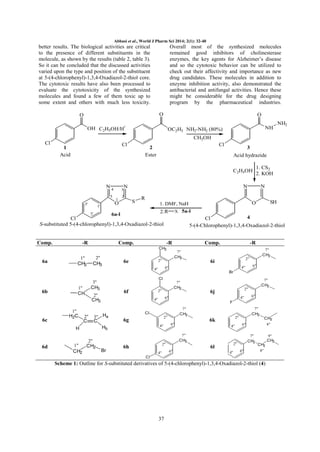
Chemistry: In the presented work, 4chlorobenzoic acid (1) was converted into ethyl 4chlorobenzoate (2) on reaction with ethanol in the
presence of concentrated sulfuric acid, which was
treated with hydrazine hydrate to form 4chlorobenzohydrazide (3). The cyclization of 3
with carbon disulfide in basic medium resulted into
5-(4-chlorophenyl)-1,3,4-Oxadiazol-2-thiol (4) and
finally its derivatives, 6a-l, were prepared by
reacting 4 with different alkyl halides, 5a-l, as
outlined in scheme 1. The parent molecule, 5-(4chlorophenyl)-1,3,4-Oxadiazol-2-thiol (4) was
synthesized in good yield with light peach color.
The molecular formula C8H5ClN2OS was
established with the help of EI-MS, by counting the
number of protons in 1H-NMR spectrum and by
13
C-NMR for the verification of quaternary
carbons. The EI-MS data showing molecular ion
peak at m/z 212, also gave a distinct peak at m/z
111 for the fragment [C6H4Cl]+ and the other
prominent fragment ion peak was observed at m/z
101 for 1,3,4-Oxadiazole ring. The mass
fragmentation pattern of 5-(4-chlorophenyl)-2-((2phenylethyl)thio)-1,3,4-Oxadiazole (6k) was also
sketched for further detail (figure 1). In its 1HNMR spectrum, the signals in aromatic region
appeared at δ 7.55 (d, J = 8.8 Hz, 2H, H-3' & H-5')
and 7.88 (d, J = 8.7 Hz, 2H, H-2' & H-6') which
were assigned to the protons of the di-substituted
ring derived from 4-chlorobenzoic acid. In its 13CNMR (BB and DEPT) spectrum, the signals
appeared at δ 180.1 (C-2) and 161.5 (C-5) for the
quaternary carbon atoms of the Oxadiazole ring.
Thus, the structure of parent 4 was established as 5(4-chlorophenyl)-1,3,4-Oxadiazol-2-thiol.
Similarly, on the basis of spectral evidences from
EI-MS and 1H-NMR, as described in experimental
section, the structures of other derivatives, 6a-l,
were elucidated. The physical characteristics of all
the synthesized molecules are given in table 1.

Cytotoxicity: The results of Brine Shrimp
cytotoxicity assay revealed that all tested
compounds ranged in LD50 values from 101.2 to
0.46 µgL-1. The compounds, 6a, 6b, 6c, 6i and 6k
showed highly significant cytotoxic activity with
LD50 values of 0.57, 0.46, 0.55, 0.67 and 0.50 µgL1
, respectively. The remaining molecules might be
further tested for their application in drug designing
program because of low toxicity.
Antibacterial activity: To study the antibacterial
activity of all the synthesized molecules, six
bacterial strains were taken into account, as
described in the assay and the results are presented
in the form of MIC values in table 3. The
compounds, 4 and 6d were found to possess
significant activity against all the six bacterial
strains. The molecules, 6c and 6f exhibited activity
against B. bronchiseptica & E. aerogenes; and 6b,
6e, 6h and 6i against E. aerogenes only.

Enzyme inhibition activity: The screening of
these synthesized compounds against acetyl
cholinesterase (AChE) and butyryl cholinesterase
(BChE) enzymes (cholinesterases) revealed that
these molecules exhibited variable inhibitory
potential as shown by their IC50 values (table 2).
The IC50 results against acetyl cholinesterase
(AChE) enzyme demonstrated that only two among
the synthesized molecules, 5-(4-chlorophenyl)-2((2-methylbenzyl)thio)-1,3,4-Oxadiazole (6e) and
5-(4-chlorophenyl)-2-((3-chlorobenzyl) thio)-1,3,4Oxadiazole (6g) were found to be the most potent
inhibitors having IC50 value of 64.61±0.07
µmoles/L and 66.81±0.34 µmoles/L respectively

Antifungal activity: The results of antifungal
activities in the form of MIC values are also
summarized in table 3. The compound 4 also
exhibited good antifungal activity against all the
tested fungal strains in addition to antibacterial
activity. Also the molecule, 6a executed significant
antifungal activity against A. fumigatus and F.
solani while 6b and 6d were found to be active
against A. flavus and F.solani, respectively.
CONCLUSION
All the molecules were synthesized in awesome
amounts and evaluated for biological activities with
36
Abbasi et al., World J Pharm Sci 2014; 2(1): 32-40

better results. The biological activities are critical
to the presence of different substituents in the
molecule, as shown by the results (table 2, table 3).
So it can be concluded that the discussed activities
varied upon the type and position of the substituent
at 5-(4-chlorophenyl)-1,3,4-Oxadiazol-2-thiol core.
The cytotoxic results have also been processed to
evaluate the cytotoxicity of the synthesized
molecules and found a few of them toxic up to
some extent and others with much less toxicity.

Overall most of the synthesized molecules
remained good inhibitors of cholinesterase
enzymes, the key agents for Alzheimer’s disease
and so the cytotoxic behavior can be utilized to
check out their affectivity and importance as new
drug candidates. These molecules in addition to
enzyme inhibition activity, also demonstrated the
antibacterial and antifungal activities. Hence these
might be considerable for the drug designing
program by the pharmaceutical industries.
O

O

O

OH C2H5OH/H+
Cl

NH

OC2H5 NH2-NH2 (80%)
CH3OH

Cl

1
Acid

Cl

2
Ester

3
Acid hydrazide
C2H5OH

N4
5
5'

3
1

2

S

O

1'

Comp.

-R

4
Cl
5-(4-Chlorophenyl)-1,3,4-Oxadiazol-2-thiol

Comp.

6c

1''
H2C

H

6d

1"
CH2

6''

4''

Br
7"
CH2

Br

7"
CH2

2''

6j
4''

6''

4''

3'' Ha
C
Hb

2"
CH2

7"
CH2

2''

6i

6''

2''

6f

2''
CH3

2''
C

-R

Cl

3''
CH3

1''
CH

7"
CH2

2''
4''

6b

5a-l

X

-R

6e

SH

O

1. DMF, NaH

Comp.
2"
CH3

N

R

CH3

1"
CH2

1. CS2
2. KOH

N

N

2. R
3'
6a-l
Cl
S-substituted 5-(4-chlorophenyl)-1,3,4-Oxadiazol-2-thiol

6a

NH2

6''

F
7"
CH2

Cl
2''

6g
4''

4''

4''
7"
CH2

2''

6h

2''

6k
6''

4''

CH2
8"

6''

7"
CH2

2''

6l
6''

7"
CH2

6''

CH2
8"

Cl

Scheme 1: Outline for S-substituted derivatives of 5-(4-chlorophenyl)-1,3,4-Oxadiazol-2-thiol (4)

37

9"
CH2
Abbasi et al., World J Pharm Sci 2014; 2(1): 32-40

N

N

Cl

S

CH2

O

CH2

[M]+ m/z = 316

C8H9S

N

C8H4ClN2O

C8H8

N

Cl

S

O
m/z = 179

CH2

CH2

m/z = 137

N

N

Cl

SH
O

CNO

HCHS

m/z = 212

Cl

C

N

CHN2S
m/z = 91

m/z = 137

CN

Cl

C

O

C2H2

m/z = 139

C2HCl
Cl
m/z = 111

m/z = 51

m/z = 65

Figure 1: Mass fragmentation pattern of 5-(4-Chlorophenyl)-2-((2-phenylethyl)thio)-1,3,4-Oxadiazole (6k)

Table 1: Physical data of the synthesized compounds, 6a-l

Compound
6a
6b
6c
6d
6e
6f
6g
6h
6i
6j
6k
6l

Physical
State
Solid
Solid
Solid
Solid
Solid
Solid
Solid
Solid
Solid
Solid
Solid
Solid

Color
Pistachio
Light Lemon
Ivory colour
Off white
Lemon yellow
Pistachio
Light green
Off white
Off white
Lemon yellow
Light yellow
Lemon yellow

Mol.
Mol. Weight
Formula
C10H9ClN2OS
240.0
C11H11ClN2OS
254.0
C11H9ClN2OS
252.0
C10H8BrClN2OS
318.0
C16H13ClN2OS
316.0
C15H10Cl2N2OS
336.0
C15H10Cl2N2OS
336.0
C15H10Cl2N2OS
336.0
C15H10BrClN2OS
380.0
C15H10ClFN2OS
320.0
C16H13ClN2OS
316.0
C17H15ClN2OS
330.0

38

Melting
Point (oC)
75-76
56.5-57.5
60-61
96-98
106-107
110-111
96-97
145-146
147-148
115-116
119-120
140-142

%
Yield
73%
78%
80%
78%
81%
73%
71%
77%
82%
72%
72%
71%
Abbasi et al., World J Pharm Sci 2014; 2(1): 32-40

Table 2: Enzyme inhibition and cytotoxicity of S-substituted derivatives of 4
AChE

BChE

Cytotoxicity
assay

Compound

Inhibition (%)
Inhibition (%)
IC50
IC50
Conc./well
Conc./well
LD50 (µg/ml)
(µM)
(µM)
(0.5 mM)
(0.5 mM)
49.13±0.52
55.91±0.56
>400
101.2
4
47.39±0.45
57.51±0.41
>400
0.57
6a
64.99±0.88
220.15±0.08
62.25±0.81
>400
0.46
6b
81.43±0.26
152.71±0.11
66.65±0.22
175.26±0.15
0.55
6c
52.03±0.31
>300
45.11±0.37
1.02
6d
95.94±0.16
64.61±0.07
66.39±0.11
172.11±0.07
1.16
6e
86.27±0.18
149.21±0.05
65.25±0.15
199.61±0.14
15.66
6f
94.97±0.11
66.81±0.34
64.42±0.14
188.11±0.34
8.53
6g
61.51±0.72
>300
54.89±0.71
>400
20.32
6h
59.57±0.71
>300
60.42±0.33
>400
0.5
6i
74.27±0.71
132.91±0.04
72.24±0.11
145.11±0.14
10.25
6j
54.55±0.41
>300
58.45±0.43
>400
0.67
6k
67.70±0.42
219.22±0.15
62.01±0.21
256.22±0.08
1.25
6l
Eserine
Eserine
Control
0.04±0.001
0.85±0.0001
91.29±1.17
82.82±1.09
Note: IC50 values (concentration at which there is 50% enzyme inhibition) of compounds were calculated using
EZ–Fit Enzyme kinetics software (Perella Scientific Inc. Amherst, USA).
AChE = Acetyl cholinesterase.
BChE = Butyryl cholinesterase
Table 3: Antimicrobial activity of S-substituted derivatives of 4
Antibacterial Activity
Antifungal Activity
MIC (µg/mL)
MIC (µg/mL)
Compound
S.
E.
B.
M.
S.
E.
F.
A.
A.
aureus
coli bronci
leuteus
typhi
aerogenes
solani
flavus
fumigatus
150
150
100
100
100
50
50
100
100
4
200
150
200
100
200
200
6a
100
200
6b
200
25
6c
200
200
200
200
200
200
6d
150
6e
150
150
6f
200
6g
100
6h
200
6i
6j
6k
6l
Note: The antibacterial activity was determined by measuring the diameter of zones showing complete
inhibition (mm).
MIC = Minimum Inhibitory Concentration
REFERENCES
1.

2.
3.

4.
5.

Renukadevi P, Birada JS. Synthesis and antimicrobial activity of 3,5-disubstituted-2-[1'-phenyl-5'-thioalkyl-s-triazol-2'yl]indoles and 3,5-disubstituted-2-[1'-substituted amino methyl-4'-phenyl-5',4'-phenyl-5'(4'H)-thion-S-triazol-3-yl]indoles. Indian
J Heterocy Ch 1999; 9: 107-12.
Zuhair M et al. Antimicrobial activity of some new Oxadiazole derivatives. Jordan J Chem 2008; 3: 233-43.
Jin L et al. Synthesis, structure, and bioactivity of N'-substituted benzylidene-3,4,5-trimethoxybenzohydrazide and 3-acetyl-2substituted phenyl-5-(3,4,5-trimethoxyphenyl)-2,3-dihydro-1,3,4-Oxadiazole derivatives. Bioorg Med Chem Lett 2006; 16(19):
5036-40.
Yar MS, Akhter MW. Synthesis and anticonvulsant activity of substituted Oxadiazole and Thiadiazole derivatives. Acta Pol
Pharm 2009; 66(4): 393-7.
Dewangan D et al. Synthesis of some novel 2,5-disubstituted-1,3,4-Oxadiazole and its analgesic, anti-Inflammatory, antibacterial and anti-tubercular activity. Int J ChemTech Res 2010; 2(3): 1397-412.

39
6.
7.
8.
9.
10.

11.
12.
13.
14.
15.
16.
17.
18.
19.
20.
21.
22.
23.
24.
25.

26.
27.
28.
29.

Abbasi et al., World J Pharm Sci 2014; 2(1): 32-40
Omar FA et al. Design, synthesis and anti-inflammatory activity of some 1,3,4-Oxadiazole derivatives. Eur J Med Chem 1996;
31(10): 819-25.
Ali MA, Shaharyar M. Oxadiazole mannich bases: synthesis and antimycobacterial activity. Bioorg Med Chem Lett 2007;
17(12): 3314-6.
Padmavath V et al. Synthesis, antimicrobial and cytotoxic activities of 1,3,4-Oxadiazoles, 1,3,4-thiadiazoles and 1,2,4-triazoles.
Eur J Med Chem 2009; 44(5): 2106-12.
Zou X et al. Synthesis and biological activity of 1,3,4-Oxadiazole-substituted pyridazinones. J Chem Res 2002; 5: 228-30.
Chrysiha ED et al. Kinetic and crystallographic studies on 2-(β-D-glucopyranosyl)-5-methyl-1,3,4-Oxadiazole, benzothiazole,
and benzimidazole, inhibitors of muscle glycogen phosphorylase b. Evidence for a new binding site. Protein Sci 2005; 14(4):
873-88.
Holla BS et al. Synthesis and insecticidal activity of some 1,3,4-Oxadiazoles derived from 2-chloropyridine-5-acetic acid. Ind J
Chem 2004; 43B: 864-8.
Almasirada A et al. Synthesis, anticonvulsant and muscle relaxant activities of substituted 1,3,4-Oxadiazole, 1,3,4-Thiadiazole
and 1,2,4-Triazole. Acta Chim Slov 2007; 54: 317-24.
Aydogan F et al. Synthesis and electronic structure of new aryl- and alkyl-substituted 1,3,4-Oxadiazole-2-thione derivatives.
Turk J Chem 2002; 26: 159-69.
Ryhanen RJ. Pseudocholinesterase activity in some human body fluids. Gen Pharmacol 1983; 14: 459-60.
Dave KR et al. Tissue Cholinesterases. A comparative study of their kinetic properties. Z Naturforsch 2000; 55c: 100-8.
Quinn DM. Acetylcholinesterase: enzyme structure, reaction dynamics and virtual transition states. Chem Rev 1987; 87: 955-79.
Silver A. The biology of cholinesterases; Elsevier Agricultural Research Council Institute: New York, pp 426-47, 1974.
Silman I, Sussman JL. Acetylcholinesterase: 'Classical' and 'Non-Classical' functions and pharmacology. Curr Opin Pharmacol
2005; 5: 293-302.
Aldridge WN. Some properties of specific cholinesterase with particular reference to the mechanism of inhibition by diethyl pnitrophenylthiophosphate (E 605) and analogues. Biochem J 1950; 46: 451-60.
Aziz-ur-Rehman et al. Synthesis, antibacterial screening and hemolytic activity of S-substituted derivatives of 5-benzyl-1,3,4Oxadiazole-2-thiol. Int J Pharm Pharm Sci 2012; 4(2): 676-80.
Aziz-ur-Rehman et al. Synthesis, characterisation and biological activity of S-substituted derivatives of 5-(4-nitrophenyl)-1,3,4Oxadiazole-2-thiol. Asian J Pharm Hea Sci 2012; 2(3): 370-6.
Ellman GL et al. A new and rapid colorimetric determination of cholinesterase activity. Bio Pharm 1961; 7: 88-95.
Bibi G et al. Antitumor, cytotoxic and antioxidant potential of Aster thomsonii extracts. Afr J Pharm Pharmacol 2011; 5(2): 2528.
Fatima N et al. Biological activities of Rumexdentatus L: evaluation of methanol and hexane extracts. Afr J Biotech 2009; 8(24):
6945-51.
Felten A et al. Evaluation of three techniques for detection of low-level methicillin-resistant Staphylococcus aureus (MRSA): a
disk diffusion method with cefoxitin and moxalactam, the Vitek 2, and the MRSA-screen latex agglutination test. J Clin
Microbiol 2002; 40(8): 2766-71.
Arikan S et al. Comparative evaluation of disk diffusion with microdilution assay in susceptibility testing of caspofungin against
Aspergillus and Fusarium isolates. Antimicrob Agents Ch 2002; 46(9): 3084-7.
Inayatullah S et al. Bioprospecting traditional Pakistani medicinal plants for potent antioxidants. Food Chem 2012; 132(1): 2229.
Hanif M et al. In vitro biological studies and structural elucidation of organotin (IV) derivatives of 6-nitropiperonylic acid:
Crystal structure of {[(CH2O2C6H2(o-NO2)COO)SnBu2](2)O} (2). Polyhedron 2010; 29(1): 613-9.
Zaheer M et al. Synthesis, characterization, electrochemistry and evaluation of biological activities of some ferrocenyl Schiff
bases. Appl Organomet Chem 2011; 25(1): 61-9.

40

Synthesis, spectral characterization and bioactivity studies of some S-substituted derivatives of 5-(4-chlorophenyl)-1,3,4-Oxadiazol-2-thiol

  • 1.
    World Journal ofPharmaceutical Sciences ISSN (Print): 2321-3310; ISSN (Online): 2321-3086 Published by Atom and Cell Publishers © All Rights Reserved Available online at: http://www.wjpsonline.com/ Research Article Synthesis, spectral characterization and bioactivity studies of some S-substituted derivatives of 5-(4-chlorophenyl)-1,3,4-Oxadiazol-2-thiol Muhammad A. Abbasia,*, Babar Shahzada, Aziz-ur-Rehmana, Khadija Nafeesaa, Shahid Rasoola, Muhammad Ashrafb, Syeda Abida Ejazc, Hammad Ismaild and Bushra Mirzad a Department of Chemistry, Government College University, Lahore, 54000, Pakistan Department of Biochemistry and Biotechnology; cDepartment of Pharmacy, The Islamia University of Bahawalpur, Bahawalpur, 63100, Pakistan d Department of Biochemistry, Quaid-i-Azam University, Islamabad, 45320, Pakistan b Received: 23-10-2013 / Revised: 06-11-2013 / Accepted: 14-12-2013 ABSTRACT A new series of 5-(4-Chlorophenyl)-1,3,4-Oxadiazol-2-thiol derivatives was prepared from 4-chlorobenzoic acid (1) by converting it successively into corresponding ester (2), carbohydrazide (3) and 5-(4-Chlorophenyl)1,3,4-Oxadiazol-2-thiol (4). Finally the target compounds, 6a-l, were synthesized by stirring 4 with different electrophiles, 5a-l, in DMF using NaH as weak base and activator. The proposed structures of newly synthesized compounds were confirmed by spectroscopic techniques such as 1H-NMR, 13C-NMR, HR-MS and EI-MS. All synthesized compounds were evaluated for their anti-bacterial, antifungal, cytotoxicity and enzyme inhibition activities. The compounds, 6e and 6g exhibited significant inhibition activity against acetyl cholinesterase enzyme (AChE) and 6j moderate activity against butyryl cholinesterase enzyme (BChE). The molecule, 4 exhibited good MIC (minimum inhibitory concentration) value against all the bacterial and fungal strains taken into account. Key Words: 1,3,4-Oxadiazole, 4-Chlorobenzoic acid, Antimicrobial activity, Cytotoxicity, Enzyme inhibition INTRODUCTION 1,3,4-Oxadiazoles belong to an important class of five membered heterocyclic ring and are present in a number of biologically active molecules [1]. They undergo a variety of organic reactions such as electrophilic substitution, nucleophilic substitution, thermal and photochemical reactions; and hence medicinal backbone on which a number of valuable molecules have been constructed. This class possesses a wide spectrum of biological activities such as antimicrobial [2], anticancer [3], anticonvulsive [4], anti-inflammatory [5, 6], antitubercular [7], cytotoxic [8], fungicidal [9], hypoglycemic [10], insecticidal [11] and antihypertensive agents [12]. Generally acyl hydrazides are used as starting materials for the synthesis of 1,3,4-Oxadiazoles [13]. Cholinesterases are well-known enzymes, present in cholinergic and non-cholinergic tissues as well as in the plasma and other body fluids of animals [14]. These enzymes are divided into two classes on the basis of their specificity for different substrate molecules and inhibitors, acetyl cholinesterase (AChE) or “true cholinesterase” and butyryl cholinesterase (BChE) or pseudo cholinesterase. AChE is commonly found in brain, muscles and erythrocyte membrane whereas BChE is present in liver, intestine, heart, kidneys and lungs [15]. The function of AChE is the hydrolysis of the neurotransmitter acetylcholine at cholinergic synapses [16] and BChE hydrolyzes estercontaining drugs and scavenges cholinesterase inhibitors including potent organo-phosphorus nerve agents before reaching the synaptic targets [17]. It has been reported that the acetylcholine deficiency is associated with Alzheimer’s disease [18] which involves selective loss of cholinergic neurons in the central nervous system. At present, one of the major therapeutic strategies to treat Alzheimer’s disease is to inhibit the biological activity of AChE. Organophosphates and carbamates are among the most commonly used *Corresponding Author Address: Dr. Muhammad Athar Abbasi, Department of Chemistry, Government College University, Lahore, 54000, Pakistan; E-mail: atrabbasi@yahoo.com; atrabbasi@hotmail.com
  • 2.
    Abbasi et al.,World J Pharm Sci 2014; 2(1): 32-40 AChE inhibitors and are also employed as insecticides [19]. (20 mL) in a 250 mL RB flask, hydrazine hydrate (2.5 mL, 0.050 mol) was added drop wise and mixture was allowed to stir at room temperature for 8 hours. The reaction progress was observed by TLC using n-hexane and ethyl acetate solvent system (40:60). After complete reaction, excess of solvent was evaporated and ice cold water was added along with shaking till precipitation. White colored precipitates of carbohydrazide 3 were filtered and washed with cold distilled water. Hence, it is important to synthesize such pharmacological inhibitors of cholinestrases which are important to control such type of diseases which involve impaired acetylcholine mediated neurotransmission. In protraction of our previous work [20, 21], an attempt has been made to synthesize titled compounds and screen them for their antimicrobial and enzyme inhibition potential. Synthesis of 5-(4-chlorophenyl)-1,3,4-Oxadiazol2-thiol (4): 4-Chlorobenzohydrazide (3; 4g, 0.024 mol) was dissolved in C2H5OH (20 mL) in a 250 mL RB flask at 28 oC and then solid KOH (1.34g, 0.024 mol) was dissolved on reflux. Carbon disulphide (3.70 mL, 0.048 mol) was poured into the reaction mixture drop wise at 28 oC and was allowed to reflux again for 6 hours. At the end of reaction, observed by TLC using n-hexane and ethyl acetate solvent system (70:30), excess of ethanol was evaporated. Excess of ice cold distilled water was added followed by addition of dilute HCl till constant pH of 4-5. Light peach colored precipitates of 4 were filtered and washed with distilled water. MATERIAL AND METHODS General: All the chemical reagents were purchased from Alfa Aesar, Merck and Sigma Aldrich through local suppliers. The solvents were of analytical grade and used without further purification. The reaction completion and purity were confirmed by TLC performed on aluminum plates coated with silica gel G-25-UV254, run by EtOAc and n-hexane solvent system and visualized under UV at 254 nm. Melting points were recorded on Griffin-George melting point apparatus by using open capillary tubes and were uncorrected. 1HNMR spectra were recorded at 400 MHz by Bruker NMR spectrometers in CDCl3, demonstrating chemical shifts in ppm values. 13C-NMR spectrum was recorded at 100 MHz by Bruker NMR spectrometer in CD3OD. EI-MS spectra were taken by using JMS-HX-110 spectrometer, with data system. General procedure for the synthesis of Ssubstituted derivatives of 5-(4-chlorophenyl)1,3,4-Oxadiazol-2-thiol (6a-l): The compound 5(4-chlorophenyl)-1,3,4-Oxadiazol-2-thiol (4; 0.1g, 0.00047 mol) was dissolved in N,N-dimethyl formamide (DMF, 5-10 mL) in a 100 mL RB flask. Solid NaH (0.005g) was added and mixture was stirred for half an hour. Then different electrophiles, alkyl/aralkyl halides, 5a-l, were added in equimolar ratios and further stirred for 3-5 hours. The reaction was monitored by TLC using n-hexane and ethyl acetate solvent system (80:20). After complete reaction, ice cold distilled water was added and the products were collected by filtration or solvent extraction. Procedure for the synthesis of ethyl 4chlorobenzoate (2): 4-Chlorobenzoic acid (1; 5g, 0.032 mol) was taken in a 250 mL round bottom (RB) flask and dissolved in absolute C2H5OH (20 mL). 1.0 mL of concentrated H2SO4 was added gradually into the reaction mixture and set to reflux for 5 hours. The reaction was supervised by thin layer chromatography (TLC) using n-hexane and ethyl acetate as solvent system (80:20). At maximal completion of reaction, because of reversibility of reaction, excess of ethanol was evaporated and reaction mixture was poured into a separating funnel containing 50 mL distilled water. Sodium carbonate solution was added to remove free acid from the mixture by setting pH=8-10. Diethyl ether (10 mL) was added to the separating funnel followed by vigorous shaking and allowed to stand till the appearance of two separate layers. The lower aqueous layer was removed and discarded while the upper layer of ether containing ethyl 4chlorobenzoate (2) was collected. Diethyl ether was distilled off to collect liquid ester. Spectral Characterization of the synthesized compounds: Physical characteristics of the synthesized derivates, 6a-l, are mentioned in table 1 while the NMR and EI-MS spectral data of the molecules is given below. 5-(4-Chlorophenyl)-1,3,4-Oxadiazol-2-thiol (4): 1 H-NMR (CDCl3, 400 MHz): δ (ppm) 7.88 (brd, J = 8.8 Hz, 2H, H-2' & H-6'), 7.55 (brd, J = 8.8 Hz, 2H, H-3' & H-5'); 13C-NMR (CD3OD, 100 MHz): δ (ppm) 180.1 (C-2), 161.5 (C-5), 139.3 (C-4'), 130.6 (C-3' & C-5'), 128.7 (C-2' & C-6'), 123.0 (C-1'); HR-MS: [M]+ 212.6257 (Cacld for C8H5ClN2OS; 212.6698); EI-MS (m/z): 214 [M+2]+, 212 [M]+, 139 [C7H4ClO]+, 111 [C6H4Cl]+, 76 [C6H4]+. Procedure for the preparation of 4chlorobenzohydrazide (3): To a solution of ethyl 4-chlorobenzoate (2; 5 mL, 0.025 mol) in methanol 33
  • 3.
    Abbasi et al.,World J Pharm Sci 2014; 2(1): 32-40 [M+4]+, 338 [M+2]+, 336 [M]+, 211 + + [C8H5ClN2OS] , 139 [C7H4ClO] , 125 [C7H6Cl]+, 111 [C6H4Cl]+, 76 [C6H4]+. 5-(4-Chlorophenyl)-2-((3-chlorobenzyl)thio)1,3,4-Oxadiazole (6g): 1H-NMR (CDCl3, 400 MHz): δ (ppm) 7.90 (d, J = 8.8 Hz, 2H, H-2' & H6'), 7.45 (d, J = 8.4 Hz, 2H, H-3' & H-5'), 7.34-7.24 (m, 4H, H-2", H-4" to H-6"), 4.46 (s, 1H, H-7"); HR-MS: [M]+ 337.2247 (Cacld for C15H10Cl2N2OS; 337.2775); EI-MS (m/z): 340 [M+4]+, 338 [M+2]+, 336 [M]+, 211 [C8H5ClN2OS]+, 139 [C7H4ClO]+, 125 [C7H6Cl]+, 111 [C6H4Cl]+, 76 [C6H4]+. 5-(4-Chlorophenyl)-2-((4-chlorobenzyl)thio)1,3,4-Oxadiazole (6h): 1H-NMR (CDCl3, 400 MHz): δ (ppm) 7.89 (d, J = 8.4 Hz, 2H, H-2' & H6'), 7.45 (d, J = 8.8 Hz, 2H, H-3' & H-5'), 7.39 (d, J = 8.4 Hz, 2H, H-3" & H-5"), 7.29 (d, J = 8.4 Hz, 2H, H-2" & H-6"), 4.46 (s, 1H, H-7"); HR-MS: [M]+ 337.2247 (Cacld for C15H10Cl2N2OS; 337.2775); EI-MS (m/z): 340 [M+4]+, 338 [M+2]+, 336 [M]+, 211 [C8H5ClN2OS]+, 139 [C7H4ClO]+, 125 [C7H6Cl]+, 111 [C6H4Cl]+, 76 [C6H4]+. 5-(4-Chlorophenyl)-2-((4-bromobenzyl)thio)1,3,4-Oxadiazole (6i): 1H-NMR (CDCl3, 400 MHz): δ (ppm) 7.89 (d, J = 8.4 Hz, 2H, H-2' & H6'), 7.46 (d, J = 8.8 Hz, 2H, H-3' & H-5'), 7.43 (d, J = 8.8 Hz, 2H, H-3" & H-5"), 7.32 (d, J = 8.4 Hz, 2H, H-2" & H-6"), 4.44 (s, 1H, H-7"); HR-MS: [M]+ 381.6764 (Cacld for C15H10ClBrN2OS; 381.6989); EI-MS (m/z): 385 [M+4]+, 383 [M+2]+, 381 [M]+, 211 [C8H5ClN2OS]+, 170 [C7H6Br]+, 139 [C7H4ClO]+, 111 [C6H4Cl]+, 76 [C6H4]+. 5-(4-Chlorophenyl)-2-((4-fluorobenzyl)thio)1,3,4-Oxadiazole (6j): 1H-NMR (CDCl3, 400 MHz): δ (ppm) 7.90 (d, J = 8.8 Hz, 2H, H-2' & H6'), 7.45 (d, J = 8.8 Hz, 2H, H-3' & H-5'), 7.42 (d, J = 8.4 Hz, 2H, H-3" & H-5"), 7.00 (d, J = 8.4 Hz, 2H, H-2" & H-6"), 4.47 (s, 1H, H-7"); HR-MS: [M]+ 320.7786 (Cacld for C15H10ClFN2OS; 320.7815); EI-MS (m/z): 322 [M+2]+, 320 [M]+, 211 [C8H5ClN2OS]+, 139 [C7H4ClO]+, 111 [C6H4Cl]+,109 [C7H6F]+, 76 [C6H4]+. 5-(4-Chlorophenyl)-2-((2-phenylethyl)thio)1,3,4-Oxadiazole (6k): 1H-NMR (CDCl3, 400 MHz): δ (ppm) 7.92 (d, J = 8.4 Hz, 2H, H-2' & H6'), 7.46 (d, J = 8.4 Hz, 2H, H-3' & H-5'), 7.32-7.22 (m, 5H, H-2" to H-6"), 3.52 (t, J = 7.2 Hz, 2H, H8"), 3.15 (t, J = 7.2 Hz, 2H, H-7"); HR-MS: [M]+ 316.8062 (Cacld for C16H13ClN2OS; 316.8698); EIMS (m/z): 318 [M+2]+, 316 [M]+, 211 [C8H5ClN2OS]+, 139 [C7H4ClO]+, 111 [C6H4Cl]+, 105 [C8H9]+, 76 [C6H4]+. 5-(4-Chlorophenyl)-2-((3-phenylpropyl)thio)1,3,4-Oxadiazole (6l): 1H-NMR (CDCl3, 400 MHz): δ (ppm) 7.91 (d, J = 8.8 Hz, 2H, H-2' & H6'), 7.45 (d, J = 8.8 Hz, 2H, H-3' & H-5'), 7.28-7.25 (m, 3H, H-3" to H-5"), 7.19 (d, J = 7.6 Hz, 2H, H2" & H-6"), 3.28 (t, J = 7.6 Hz, 2H, H-9"), 2.79 (t, J = 7.6 Hz, 2H, H-7"), 2.17 (quin, J = 7.6 Hz, 2H, 5-(4-Chlorophenyl)-2-(ethylthio)-1,3,4Oxadiazole (6a): 1H-NMR (CDCl3, 400 MHz): δ (ppm) 7.92 (d, J = 8.8 Hz, 2H, H-2' & H-6'), 7.45 (d, J = 8.4 Hz, 2H, H-3' & H-5'), 3.30 (q, J = 7.2 Hz, 2H, H-1"), 1.50 (t, J = 7.2 Hz, 3H, H-2"); HRMS: [M]+ 240.7108 (Cacld for C10H9ClN2OS; 240.7668); EI-MS (m/z): 242 [M+2]+, 240 [M]+, 211 [C8H5ClN2OS]+, 139 [C7H4ClO]+, 111 [C6H4Cl]+, 76 [C6H4]+, 29 [C2H5]+. 5-(4-Chlorophenyl)-2-(isopropylthio)-1,3,4Oxadiazole (6b): 1H-NMR (CDCl3, 400 MHz): δ (ppm) 7.93 (d, J = 8.4 Hz, 2H, H-2' & H-6'), 7.45 (d, J = 8.4 Hz, 2H, H-3' & H-5'), 3.96 (sep, J = 6.8 Hz, 1H, H-1"), 1.51 (d, J = 6.8 Hz, 6H, CH3-2" & CH3-3"); HR-MS: [M]+ 254.7375 (Cacld for C11H11ClN2OS; 254.7698); EI-MS (m/z): 256 [M+2]+, 254 [M]+, 211 [C8H5ClN2OS]+, 139 [C7H4ClO]+, 111 [C6H4Cl]+, 76 [C6H4]+, 43 [C3H7]+. 5-(4-Chlorophenyl)-2-(allylthio)-1,3,4Oxadiazole (6c): 1H-NMR (CDCl3, 400 MHz): δ (ppm) 7.92 (d, J = 8.8 Hz, 2H, H-2' & H-6'), 7.45 (d, J = 8.4 Hz, 2H, H-3' & H-5'), 5.99-5.95 (m, 1H, H-2"), 5.40 (brd, J = 17.2 Hz, 1H, Hb-3"), 5.21 (brd, J = 9.6 Hz, 1H, Ha-3"), 3.91 (d, J = 7.2 Hz, 2H, H-1"); HR-MS: [M]+ 252.72125 (Cacld for C11H9ClN2OS; 252.798); EI-MS (m/z): 254 [M+2]+, 252 [M]+, 211 [C8H5ClN2OS]+, 139 [C7H4ClO]+, 111 [C6H4Cl]+, 76 [C6H4]+, 41 [C3H5]+. 5-(4-Chlorophenyl)-2-((2-bromoethyl)thio)1,3,4-Oxadiazole (6d): 1H-NMR (CDCl3, 400 MHz): δ (ppm) 7.92 (d, J = 8.8 Hz, 2H, H-2' & H6'), 7.45 (d, J = 8.4 Hz, 2H, H-3' & H-5'), 3.77 (brt, J = 6.4 Hz, 2H, H-2"), 3.70 (brt, J = 6.4 Hz, 2H, H1"); HR-MS: [M]+ 319.6065 (Cacld for C10H8BrClN2OS; 319.6987); EI-MS (m/z): 321 [M+4]+, 319 [M+2]+, 317 [M]+, 211 + [C8H5ClN2OS] , 139 [C7H4ClO]+, 111 [C6H4Cl]+,107 [C2H4Br]+, 76 [C6H4]+. 5-(4-Chlorophenyl)-2-((2-methylbenzyl)thio)1,3,4-Oxadiazole (6e): 1H-NMR (CDCl3, 400 MHz): δ (ppm) 7.91 (d, J = 8.4 Hz, 2H, H-2' & H6'), 7.45 (d, J = 8.4 Hz, 2H, H-3' & H-5'), 7.39 (brd, J = 7.6 Hz, 1H, H-4"), 7.22-7.15 (m, 3H, H-3", H5" & H-6"), 4.54 (s, 2H, H-7"), 2.44 (s, 3H, CH31''); HR-MS: [M]+ 316.8063 (Cacld for C16H13ClN2OS; 316.8675); EI-MS (m/z): 317 [M+2]+, 315 [M]+, 211 [C8H5ClN2OS]+, 139 [C7H4ClO]+, 111 [C6H4Cl]+, 105 [C8H9]+, 76 [C6H4]+. 5-(4-Chlorophenyl)-2-((2-chlorobenzyl)thio)1,3,4-Oxadiazol (6f): 1H-NMR (CDCl3, 400 MHz): δ (ppm) 7.90 (d, J = 8.4 Hz, 2H, H-2' & H6'), 7.61 (dd, J = 7.2, 2.0 Hz, 1H, H-3"), 7.44 (d, J = 8.8 Hz, 2H, H-3' & H-5'), 7.39 (dd, J = 7.6, 1.6 Hz, 1H, H-6"), 7.23-7.19 (m, 2H, H-4" & H-5"), 4.61 (s, 1H, H-7"); HR-MS: [M]+ 337.2247 (Cacld. for C15H10Cl2N2OS; 337.2775); EI-MS (m/z): 340 34
  • 4.
    Abbasi et al.,World J Pharm Sci 2014; 2(1): 32-40 H-8"); HR-MS: [M]+ 330.8335 (Cacld for C17H15ClN2OS; 330.8675); EI-MS (m/z): 332 [M+2]+, 330 [M]+, 211 [C8H5ClN2OS]+, 139 [C7H4ClO]+, 119 [C9H11]+, 111 [C6H4Cl]+, 76 [C6H4]+. Antibacterial assay: Test compounds were screened to determine their antibacterial activity against six bacterial strains; two gram positive bacteria, Staphylococcus aureus (ATCC 6538) and Micrococcus luteus (ATCC 10240) and four gram negative bacteria, Escherichia coli (ATCC 15224), Enterobacter aerogenes (ATCC 13048), Bordetella bronchiseptica (ATCC 4617) and Salmonella typhi (ATCC 14028) by using disc diffusion method [25, 26]. The organisms were cultured in nutrient broth at 37 °C for 24 hours. One percent broth culture containing approximately 106 colony-forming units (CFU/ml) of test strain was added to nutrient agar medium at 45 °C and poured into sterile petri plates. The medium was allowed to solidify. Five microliters of the test compound (40mg/mL in DMSO) was poured on 4 mm sterile paper discs and placed on nutrient agar plates respectively. In each plate DMSO served as negative control and standard antibacterial drugs Roxithromycin (1mg/mL) and Cefexime (1mg/mL) served as positive control. Triplicate plates of each bacterial strain were prepared. The plates were incubated at 37 °C for 24 hours. The antibacterial activity was determined by measuring the diameter of zones showing complete inhibition (mm). Cholinesterase assay: The AChE and BChE inhibition activity was performed according to Ellman method [22] with slight modifications. Total volume of the reaction mixture was 100 µL. It contained 60 µL Na2HPO4 buffer with concentration of 50 mM and pH 7.7. 10 µL test compound (0.5 mM well-1) was added, followed by the addition of 10 µL (0.005 unit well-1 AChE or 0.5 unit well-1 BChE) enzyme. The contents were mixed and pre-read at 405 nm. Then contents were pre-incubated for 10 min at 37 ºC. The reaction was initiated by the addition of 10 µL of 0.5 mM well-1 substrate (acetylthiocholine iodide for AChE or butyrylthiocholine chloride for BChE), followed by the addition of 10 µL DTNB (0.5 mM well-1). After 15 min of incubation at 37 ºC absorbance was measured at 405 nm using 96-well plate reader Synergy HT, Biotek, USA. All experiments were carried out with their respective controls in triplicate. Eserine (0.5 mM well-1) was used as a positive control. The percent inhibition was calculated by the help of following formula, Antifungal assay: Antifungal activity of test compounds was studied against five fungal strains; Mucor species (FCBP 0300), Aspergillus niger (FCBP 0198), Aspergillus flavus (FCBP 0064), Aspergillus fumigatus (FCBP 66) and Fusarium solani (FCBP 0291) by using disc diffusion method [27-29]. The organisms were cultured on SDA at 28 °C for 24 hours. Autoclaved broth culture (3 mL) was allowed to cool down to 45 °C and poured into sterile petri plates. The medium was allowed to solidify. 5 µL of the test compound (40mg/mL in DMSO) was poured on 4 mm sterile paper discs and placed on SDA plates respectively. The discs supplemented with DMSO were used as negative and positive control, respectively. Plates were incubated at 28 °C for seven days and fungal growth was determined by measuring growth diameter (mm) and growth inhibition was calculated with reference to the negative control. IC50 values were calculated using EZ–Fit Enzyme kinetics software (Perrella Scientific Inc. Amherst, USA). Cytotoxicity assay: The cytotoxicity was studied by the brine-shrimp cytotoxic assay method as described earlier [23, 24]. Artificial sea water was prepared using sea salt 34 gL-1. Brine shrimp (Artemiasalina) eggs (Sera, Heidelberg, Germany) were hatched in shallow rectangular dish (22x32 cm) under constant aeration for 48 hours at room temperature. After hatching, active shrimps free from eggs were collected from brighter portion of the hatching chamber and used for the assay. Ten shrimps were transferred to each vial using Pasteur pipette vial containing 5 mL of artificial sea water with 200, 20, 2 and 0.2 µgmL-1 final concentration of test compound from their stock solution. The vials were maintained under illumination at room temperature 25 °C to 28 °C. After 24 hours, the number of surviving shrimp was counted. Experiment was performed in triplicate. Data was analyzed with Finney computer program to determine LD50 (Lethal Dose that killed 50% of shrimps) values. Statistical analysis: All the measurements were executed in triplicate and statistical analysis was performed by Microsoft Excel 2010. Results are presented as mean ± sem. RESULTS AND DISCUSSION The designed S-substituted derivatives of 5-(4chlorophenyl)-1,3,4-Oxadiazol-2-thiol, 6a-l, were synthesized in awesome amounts (scheme 1) and evaluated for their antibacterial, antifungal, antienzymatic and cytotoxic activities. The reaction 35
  • 5.
    Abbasi et al.,World J Pharm Sci 2014; 2(1): 32-40 procedures with conditions and spectral characterization of synthesized molecules are discussed in detail in the experimental section. relative to eserine, a reference standard, with IC50 value of 0.04±0.001 µmoles/L. The activity of 6e might be attributed to the presence of methyl substituted aralkyl group at ortho position in the molecule while that of 6g to the electron withdrawing chloro group at para position of Ssubstituted benzyl group. 5-(4-Chlorophenyl)-2(isopropylthio)-1,3,4-Oxadiazole (6b) found to be lowest inhibitor having IC50 value of 220.15±0.08 µmoles/L relative to the reference standard. Against butyryl cholinesterase (BChE) enzyme, only 5-(4-chlorophenyl)-2-((4-fluorobenzyl)thio)1,3,4-Oxadiazole (6j) was the most potent inhibitor having IC50 value of 145.11±0.14 µmoles/L, relative to eserine, a reference standard, with IC50 value of 0.85±0.0001 µmoles/L, probably due to the substitution of 4-fluorobenzyl group. The molecule among the series, 5-(4-chlorophenyl)-2((3-phenylpropyl)thio)-1,3,4-Oxadiazole (6l) was found to be the lowest inhibitor having IC50 value of 256.22±0.08 µmoles/L. All other compounds showed inhibitory potential against butyryl cholinesterase between these two extreme values. Chemistry: In the presented work, 4chlorobenzoic acid (1) was converted into ethyl 4chlorobenzoate (2) on reaction with ethanol in the presence of concentrated sulfuric acid, which was treated with hydrazine hydrate to form 4chlorobenzohydrazide (3). The cyclization of 3 with carbon disulfide in basic medium resulted into 5-(4-chlorophenyl)-1,3,4-Oxadiazol-2-thiol (4) and finally its derivatives, 6a-l, were prepared by reacting 4 with different alkyl halides, 5a-l, as outlined in scheme 1. The parent molecule, 5-(4chlorophenyl)-1,3,4-Oxadiazol-2-thiol (4) was synthesized in good yield with light peach color. The molecular formula C8H5ClN2OS was established with the help of EI-MS, by counting the number of protons in 1H-NMR spectrum and by 13 C-NMR for the verification of quaternary carbons. The EI-MS data showing molecular ion peak at m/z 212, also gave a distinct peak at m/z 111 for the fragment [C6H4Cl]+ and the other prominent fragment ion peak was observed at m/z 101 for 1,3,4-Oxadiazole ring. The mass fragmentation pattern of 5-(4-chlorophenyl)-2-((2phenylethyl)thio)-1,3,4-Oxadiazole (6k) was also sketched for further detail (figure 1). In its 1HNMR spectrum, the signals in aromatic region appeared at δ 7.55 (d, J = 8.8 Hz, 2H, H-3' & H-5') and 7.88 (d, J = 8.7 Hz, 2H, H-2' & H-6') which were assigned to the protons of the di-substituted ring derived from 4-chlorobenzoic acid. In its 13CNMR (BB and DEPT) spectrum, the signals appeared at δ 180.1 (C-2) and 161.5 (C-5) for the quaternary carbon atoms of the Oxadiazole ring. Thus, the structure of parent 4 was established as 5(4-chlorophenyl)-1,3,4-Oxadiazol-2-thiol. Similarly, on the basis of spectral evidences from EI-MS and 1H-NMR, as described in experimental section, the structures of other derivatives, 6a-l, were elucidated. The physical characteristics of all the synthesized molecules are given in table 1. Cytotoxicity: The results of Brine Shrimp cytotoxicity assay revealed that all tested compounds ranged in LD50 values from 101.2 to 0.46 µgL-1. The compounds, 6a, 6b, 6c, 6i and 6k showed highly significant cytotoxic activity with LD50 values of 0.57, 0.46, 0.55, 0.67 and 0.50 µgL1 , respectively. The remaining molecules might be further tested for their application in drug designing program because of low toxicity. Antibacterial activity: To study the antibacterial activity of all the synthesized molecules, six bacterial strains were taken into account, as described in the assay and the results are presented in the form of MIC values in table 3. The compounds, 4 and 6d were found to possess significant activity against all the six bacterial strains. The molecules, 6c and 6f exhibited activity against B. bronchiseptica & E. aerogenes; and 6b, 6e, 6h and 6i against E. aerogenes only. Enzyme inhibition activity: The screening of these synthesized compounds against acetyl cholinesterase (AChE) and butyryl cholinesterase (BChE) enzymes (cholinesterases) revealed that these molecules exhibited variable inhibitory potential as shown by their IC50 values (table 2). The IC50 results against acetyl cholinesterase (AChE) enzyme demonstrated that only two among the synthesized molecules, 5-(4-chlorophenyl)-2((2-methylbenzyl)thio)-1,3,4-Oxadiazole (6e) and 5-(4-chlorophenyl)-2-((3-chlorobenzyl) thio)-1,3,4Oxadiazole (6g) were found to be the most potent inhibitors having IC50 value of 64.61±0.07 µmoles/L and 66.81±0.34 µmoles/L respectively Antifungal activity: The results of antifungal activities in the form of MIC values are also summarized in table 3. The compound 4 also exhibited good antifungal activity against all the tested fungal strains in addition to antibacterial activity. Also the molecule, 6a executed significant antifungal activity against A. fumigatus and F. solani while 6b and 6d were found to be active against A. flavus and F.solani, respectively. CONCLUSION All the molecules were synthesized in awesome amounts and evaluated for biological activities with 36
  • 6.
    Abbasi et al.,World J Pharm Sci 2014; 2(1): 32-40 better results. The biological activities are critical to the presence of different substituents in the molecule, as shown by the results (table 2, table 3). So it can be concluded that the discussed activities varied upon the type and position of the substituent at 5-(4-chlorophenyl)-1,3,4-Oxadiazol-2-thiol core. The cytotoxic results have also been processed to evaluate the cytotoxicity of the synthesized molecules and found a few of them toxic up to some extent and others with much less toxicity. Overall most of the synthesized molecules remained good inhibitors of cholinesterase enzymes, the key agents for Alzheimer’s disease and so the cytotoxic behavior can be utilized to check out their affectivity and importance as new drug candidates. These molecules in addition to enzyme inhibition activity, also demonstrated the antibacterial and antifungal activities. Hence these might be considerable for the drug designing program by the pharmaceutical industries. O O O OH C2H5OH/H+ Cl NH OC2H5 NH2-NH2 (80%) CH3OH Cl 1 Acid Cl 2 Ester 3 Acid hydrazide C2H5OH N4 5 5' 3 1 2 S O 1' Comp. -R 4 Cl 5-(4-Chlorophenyl)-1,3,4-Oxadiazol-2-thiol Comp. 6c 1'' H2C H 6d 1" CH2 6'' 4'' Br 7" CH2 Br 7" CH2 2'' 6j 4'' 6'' 4'' 3'' Ha C Hb 2" CH2 7" CH2 2'' 6i 6'' 2'' 6f 2'' CH3 2'' C -R Cl 3'' CH3 1'' CH 7" CH2 2'' 4'' 6b 5a-l X -R 6e SH O 1. DMF, NaH Comp. 2" CH3 N R CH3 1" CH2 1. CS2 2. KOH N N 2. R 3' 6a-l Cl S-substituted 5-(4-chlorophenyl)-1,3,4-Oxadiazol-2-thiol 6a NH2 6'' F 7" CH2 Cl 2'' 6g 4'' 4'' 4'' 7" CH2 2'' 6h 2'' 6k 6'' 4'' CH2 8" 6'' 7" CH2 2'' 6l 6'' 7" CH2 6'' CH2 8" Cl Scheme 1: Outline for S-substituted derivatives of 5-(4-chlorophenyl)-1,3,4-Oxadiazol-2-thiol (4) 37 9" CH2
  • 7.
    Abbasi et al.,World J Pharm Sci 2014; 2(1): 32-40 N N Cl S CH2 O CH2 [M]+ m/z = 316 C8H9S N C8H4ClN2O C8H8 N Cl S O m/z = 179 CH2 CH2 m/z = 137 N N Cl SH O CNO HCHS m/z = 212 Cl C N CHN2S m/z = 91 m/z = 137 CN Cl C O C2H2 m/z = 139 C2HCl Cl m/z = 111 m/z = 51 m/z = 65 Figure 1: Mass fragmentation pattern of 5-(4-Chlorophenyl)-2-((2-phenylethyl)thio)-1,3,4-Oxadiazole (6k) Table 1: Physical data of the synthesized compounds, 6a-l Compound 6a 6b 6c 6d 6e 6f 6g 6h 6i 6j 6k 6l Physical State Solid Solid Solid Solid Solid Solid Solid Solid Solid Solid Solid Solid Color Pistachio Light Lemon Ivory colour Off white Lemon yellow Pistachio Light green Off white Off white Lemon yellow Light yellow Lemon yellow Mol. Mol. Weight Formula C10H9ClN2OS 240.0 C11H11ClN2OS 254.0 C11H9ClN2OS 252.0 C10H8BrClN2OS 318.0 C16H13ClN2OS 316.0 C15H10Cl2N2OS 336.0 C15H10Cl2N2OS 336.0 C15H10Cl2N2OS 336.0 C15H10BrClN2OS 380.0 C15H10ClFN2OS 320.0 C16H13ClN2OS 316.0 C17H15ClN2OS 330.0 38 Melting Point (oC) 75-76 56.5-57.5 60-61 96-98 106-107 110-111 96-97 145-146 147-148 115-116 119-120 140-142 % Yield 73% 78% 80% 78% 81% 73% 71% 77% 82% 72% 72% 71%
  • 8.
    Abbasi et al.,World J Pharm Sci 2014; 2(1): 32-40 Table 2: Enzyme inhibition and cytotoxicity of S-substituted derivatives of 4 AChE BChE Cytotoxicity assay Compound Inhibition (%) Inhibition (%) IC50 IC50 Conc./well Conc./well LD50 (µg/ml) (µM) (µM) (0.5 mM) (0.5 mM) 49.13±0.52 55.91±0.56 >400 101.2 4 47.39±0.45 57.51±0.41 >400 0.57 6a 64.99±0.88 220.15±0.08 62.25±0.81 >400 0.46 6b 81.43±0.26 152.71±0.11 66.65±0.22 175.26±0.15 0.55 6c 52.03±0.31 >300 45.11±0.37 1.02 6d 95.94±0.16 64.61±0.07 66.39±0.11 172.11±0.07 1.16 6e 86.27±0.18 149.21±0.05 65.25±0.15 199.61±0.14 15.66 6f 94.97±0.11 66.81±0.34 64.42±0.14 188.11±0.34 8.53 6g 61.51±0.72 >300 54.89±0.71 >400 20.32 6h 59.57±0.71 >300 60.42±0.33 >400 0.5 6i 74.27±0.71 132.91±0.04 72.24±0.11 145.11±0.14 10.25 6j 54.55±0.41 >300 58.45±0.43 >400 0.67 6k 67.70±0.42 219.22±0.15 62.01±0.21 256.22±0.08 1.25 6l Eserine Eserine Control 0.04±0.001 0.85±0.0001 91.29±1.17 82.82±1.09 Note: IC50 values (concentration at which there is 50% enzyme inhibition) of compounds were calculated using EZ–Fit Enzyme kinetics software (Perella Scientific Inc. Amherst, USA). AChE = Acetyl cholinesterase. BChE = Butyryl cholinesterase Table 3: Antimicrobial activity of S-substituted derivatives of 4 Antibacterial Activity Antifungal Activity MIC (µg/mL) MIC (µg/mL) Compound S. E. B. M. S. E. F. A. A. aureus coli bronci leuteus typhi aerogenes solani flavus fumigatus 150 150 100 100 100 50 50 100 100 4 200 150 200 100 200 200 6a 100 200 6b 200 25 6c 200 200 200 200 200 200 6d 150 6e 150 150 6f 200 6g 100 6h 200 6i 6j 6k 6l Note: The antibacterial activity was determined by measuring the diameter of zones showing complete inhibition (mm). MIC = Minimum Inhibitory Concentration REFERENCES 1. 2. 3. 4. 5. Renukadevi P, Birada JS. Synthesis and antimicrobial activity of 3,5-disubstituted-2-[1'-phenyl-5'-thioalkyl-s-triazol-2'yl]indoles and 3,5-disubstituted-2-[1'-substituted amino methyl-4'-phenyl-5',4'-phenyl-5'(4'H)-thion-S-triazol-3-yl]indoles. Indian J Heterocy Ch 1999; 9: 107-12. Zuhair M et al. Antimicrobial activity of some new Oxadiazole derivatives. Jordan J Chem 2008; 3: 233-43. Jin L et al. Synthesis, structure, and bioactivity of N'-substituted benzylidene-3,4,5-trimethoxybenzohydrazide and 3-acetyl-2substituted phenyl-5-(3,4,5-trimethoxyphenyl)-2,3-dihydro-1,3,4-Oxadiazole derivatives. Bioorg Med Chem Lett 2006; 16(19): 5036-40. Yar MS, Akhter MW. Synthesis and anticonvulsant activity of substituted Oxadiazole and Thiadiazole derivatives. Acta Pol Pharm 2009; 66(4): 393-7. Dewangan D et al. Synthesis of some novel 2,5-disubstituted-1,3,4-Oxadiazole and its analgesic, anti-Inflammatory, antibacterial and anti-tubercular activity. Int J ChemTech Res 2010; 2(3): 1397-412. 39
  • 9.
    6. 7. 8. 9. 10. 11. 12. 13. 14. 15. 16. 17. 18. 19. 20. 21. 22. 23. 24. 25. 26. 27. 28. 29. Abbasi et al.,World J Pharm Sci 2014; 2(1): 32-40 Omar FA et al. Design, synthesis and anti-inflammatory activity of some 1,3,4-Oxadiazole derivatives. Eur J Med Chem 1996; 31(10): 819-25. Ali MA, Shaharyar M. Oxadiazole mannich bases: synthesis and antimycobacterial activity. Bioorg Med Chem Lett 2007; 17(12): 3314-6. Padmavath V et al. Synthesis, antimicrobial and cytotoxic activities of 1,3,4-Oxadiazoles, 1,3,4-thiadiazoles and 1,2,4-triazoles. Eur J Med Chem 2009; 44(5): 2106-12. Zou X et al. Synthesis and biological activity of 1,3,4-Oxadiazole-substituted pyridazinones. J Chem Res 2002; 5: 228-30. Chrysiha ED et al. Kinetic and crystallographic studies on 2-(β-D-glucopyranosyl)-5-methyl-1,3,4-Oxadiazole, benzothiazole, and benzimidazole, inhibitors of muscle glycogen phosphorylase b. Evidence for a new binding site. Protein Sci 2005; 14(4): 873-88. Holla BS et al. Synthesis and insecticidal activity of some 1,3,4-Oxadiazoles derived from 2-chloropyridine-5-acetic acid. Ind J Chem 2004; 43B: 864-8. Almasirada A et al. Synthesis, anticonvulsant and muscle relaxant activities of substituted 1,3,4-Oxadiazole, 1,3,4-Thiadiazole and 1,2,4-Triazole. Acta Chim Slov 2007; 54: 317-24. Aydogan F et al. Synthesis and electronic structure of new aryl- and alkyl-substituted 1,3,4-Oxadiazole-2-thione derivatives. Turk J Chem 2002; 26: 159-69. Ryhanen RJ. Pseudocholinesterase activity in some human body fluids. Gen Pharmacol 1983; 14: 459-60. Dave KR et al. Tissue Cholinesterases. A comparative study of their kinetic properties. Z Naturforsch 2000; 55c: 100-8. Quinn DM. Acetylcholinesterase: enzyme structure, reaction dynamics and virtual transition states. Chem Rev 1987; 87: 955-79. Silver A. The biology of cholinesterases; Elsevier Agricultural Research Council Institute: New York, pp 426-47, 1974. Silman I, Sussman JL. Acetylcholinesterase: 'Classical' and 'Non-Classical' functions and pharmacology. Curr Opin Pharmacol 2005; 5: 293-302. Aldridge WN. Some properties of specific cholinesterase with particular reference to the mechanism of inhibition by diethyl pnitrophenylthiophosphate (E 605) and analogues. Biochem J 1950; 46: 451-60. Aziz-ur-Rehman et al. Synthesis, antibacterial screening and hemolytic activity of S-substituted derivatives of 5-benzyl-1,3,4Oxadiazole-2-thiol. Int J Pharm Pharm Sci 2012; 4(2): 676-80. Aziz-ur-Rehman et al. Synthesis, characterisation and biological activity of S-substituted derivatives of 5-(4-nitrophenyl)-1,3,4Oxadiazole-2-thiol. Asian J Pharm Hea Sci 2012; 2(3): 370-6. Ellman GL et al. A new and rapid colorimetric determination of cholinesterase activity. Bio Pharm 1961; 7: 88-95. Bibi G et al. Antitumor, cytotoxic and antioxidant potential of Aster thomsonii extracts. Afr J Pharm Pharmacol 2011; 5(2): 2528. Fatima N et al. Biological activities of Rumexdentatus L: evaluation of methanol and hexane extracts. Afr J Biotech 2009; 8(24): 6945-51. Felten A et al. Evaluation of three techniques for detection of low-level methicillin-resistant Staphylococcus aureus (MRSA): a disk diffusion method with cefoxitin and moxalactam, the Vitek 2, and the MRSA-screen latex agglutination test. J Clin Microbiol 2002; 40(8): 2766-71. Arikan S et al. Comparative evaluation of disk diffusion with microdilution assay in susceptibility testing of caspofungin against Aspergillus and Fusarium isolates. Antimicrob Agents Ch 2002; 46(9): 3084-7. Inayatullah S et al. Bioprospecting traditional Pakistani medicinal plants for potent antioxidants. Food Chem 2012; 132(1): 2229. Hanif M et al. In vitro biological studies and structural elucidation of organotin (IV) derivatives of 6-nitropiperonylic acid: Crystal structure of {[(CH2O2C6H2(o-NO2)COO)SnBu2](2)O} (2). Polyhedron 2010; 29(1): 613-9. Zaheer M et al. Synthesis, characterization, electrochemistry and evaluation of biological activities of some ferrocenyl Schiff bases. Appl Organomet Chem 2011; 25(1): 61-9. 40