World Journal of Pharmaceutical Sciences
ISSN (Print): 2321-3310; ISSN (Online): 2321-3086
Published by Atom and Cell Publishers © All Rights Reserved
Available online at: http://www.wjpsonline.com/
Research Article

A quantitative determination of penbutolol and its metabolite in plasma by liquid
chromatography tandem mass and its application to pharmacokinetic studies
Venkata Kumar Ch*a, Nagamalleswara Rao Kb, Madhuri K a, Anil Kumar Chc and Kesava
Rao T KVa
a

Pharmaceutical Analysis Division, Teegala Ramreddy College of Pharmacy, Hyderabad –
500079, AP., India
b
Department of Chemistry, College of Sciences, Acharya Nagarjuna University, Nagarjuna
Nagar – 522510 ,AP., India
c
Department of Microbiology, Maha Raja P. G. College, Poolbaugh, Vizianagaram – 535002,
AP., India
Received: 28-12-2013 / Revised: 10-01-2014 / Accepted: 04-02-2014

ABSTRACT
A Simple sensitive and specific tandem mass spectrometric (LC-MS/MS) method for the determination of
penbutolol (PEN) and its metabolite 4-Hydroxy penbutolol (4HPEN) in human plasma was developed and
validated. The detection of the analytes was achieved in positive ion in selected reaction monitoring (SRM)
mode. The deuterated compounds of the analytes were used as internal standards (IS). The extraction procedure
involved solid phase extraction of PEN, 4HPEN and IS from plasma by using Strata-X cartridges. The
chromatographic separation of PEN, 4HPEN and IS was carried out on a Chromatopak C 18 column with 5mM
ammonium acetate (pH 4.5) buffer and acetonitrile (15:85, v/v) as the mobile phase under isocratic conditions at
a flow rate of 0.6 mL/min. The nominal retention times obtained for PEN, 4HPEN, DPEN and D4HPEN were
2.42, 1.98, 2.40 and 2.00 minutes respectively. The lower limit of quantification for PEN and 4HPEN were 0.2
and 0.1 ng/mL respectively. The standard curves were linear (r 2>0.99) over the concentration range of 0.2-302.7
ng/mL for PEN and 0.1-30.0 ng/mL for HPEN. Method validation was performed as per FDA guidelines and
the obtained results met the acceptance criteria. The proposed method was found to be acceptable to a
pharmacokinetic study in human volunteers.
Keywords: Penbutolol, 4-Hydroxy Penbutalol LC-MS/MS, Human plasma and Pharmacokinetics.

INTRODUCTION
Penbutolol1-2 is a beta-blocker class drug used to
treat hypertension. Penbutolol binds both beta-1
and beta-2 adrenergic receptors, rendering it a nonselective beta-blocker. Penbutolol can act as a
partial agonist at beta adrenergic receptors, since it
is a sympathomimetric drug. Penbutolol also
demonstrates high binding affinity to the 5hydroxytryptamine receptor 1A with antagonistic
effects. This binding characteristic of penbutolol is
being investigated for its implications in
Antidepressant
Therapy.
Penbutolol
is
contraindicated in patients with cardiogenic shock,
sinus bradycardia, second and third degree
atrioventricular conduction block, bronchial
asthma, and those with known hypersensitivity.

Penbutolol acts on the β1 adrenergic receptors in
both the heart and the kidney. When β1 receptors
are activated by catechoPENines, they stimulate a
coupled G protein that leads to the conversion of
adenosine triphosphate (ATP) to cyclic adenosine
monophosphate (cAMP). The increase in cAMP
leads to activation of protein kinase A (PKA),
which alters the movement of calcium ions in heart
muscle and increases the heart rate. Penbutolol
blocks the catechoPENine activation of β1
adrenergic receptors and decreases heart rate,
which lowers blood pressure. It metabolized in the
liver by hydroxylation and glucuroconjugation
forming a glucuronide metabolite and a semi-active
4-hydroxy metabolite3. Literature survey reveals
quite a few methods have been reported for the
determination of Penbutolol and 4-Hydroxy

*Corresponding Author Address: Dr. Venkata Kumar Chintaluri, HOD, Pharmaceutical Analysis Division, Teegala Ramreddy College of
Pharmacy, Email: chintaluri.in@gmail.com
Venkat et al., World J Pharm Sci 2014; 2(2): 149-160

Penbutolol in various body fluids such as urine and
plasma by using spectro photometry4, HPLC5, 6 and
GC-MS7.
The authors now propose a fast,
sensitive, accurate and precise tandem mass
spectroscopic method for the determination of
Penbutolol and 4-Hydroxy Penbutolol in human
plasma. The entire results obtained in the present
study comply with the acceptance criteria of
regulatory requirements8, 9.

carried out in MRM mode, by monitoring the ion
transition pairs of m/z 292.1 → 236.1 for
Penbutolol, 308.1 → 252.1 for 4-Hydroxy
Penbutolol, 301.1 → 237.1 for Penbutolol D9 and
317.1 → 253.1 for 4-Hydroxy Penbutolol D9. The
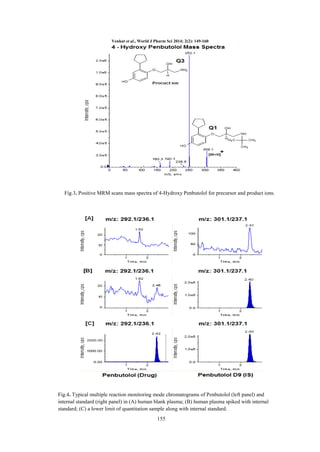
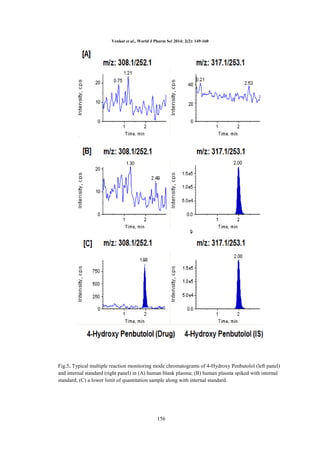
Positive MRM scan mass spectra of Penbutolol and
4-Hydroxy Penbutolol for precursor and product
ions were shown in Fig.2, 3. Both the quadrupoles
Q1 and Q3 were set at unit resolution. The
retention times obtained for the analytes PEN,
4HPEN & IS DPEN, D4HPEN were 2.42 ± 0.3,
1.98 ± 0.3 min & 2.40 ± 0.3, 2.00 ± 0.3
respectively over a total run time of 3.0 minutes.
The analysis data obtained was processed by using
Analyst Software™ (Version 1.4.2).

EXPERIMENTAL
Chemicals and materials: The reference standards
of Penbutolol, 4-Hydroxy Penbutolol, Penbutolol
D9 and 4-Hydroxy Penbutolol D9 procured from
Splendid Labs; Pune, India. HPLC grade methanol
and acetonitrile were obtained from J.T Baker®
(Phillipsburg, USA). Analytical- grade ammonium
acetate and formic acid were obtained from Merck ®
Ltd; Mumbai, India. The water used for the
analysis was prepared by Milli-Q® water
purification system (Bangalore, India). The blank
(drug free) human plasmas were procured from
Jeevan-dhara blood bank; Hyderabad, India. The
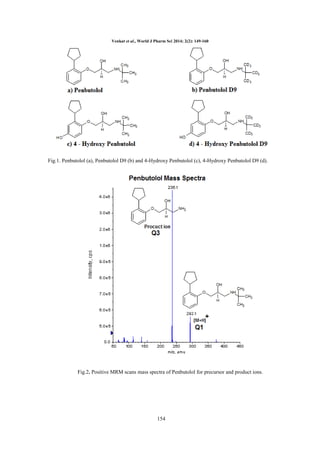
chemical structures of analytes and the internal
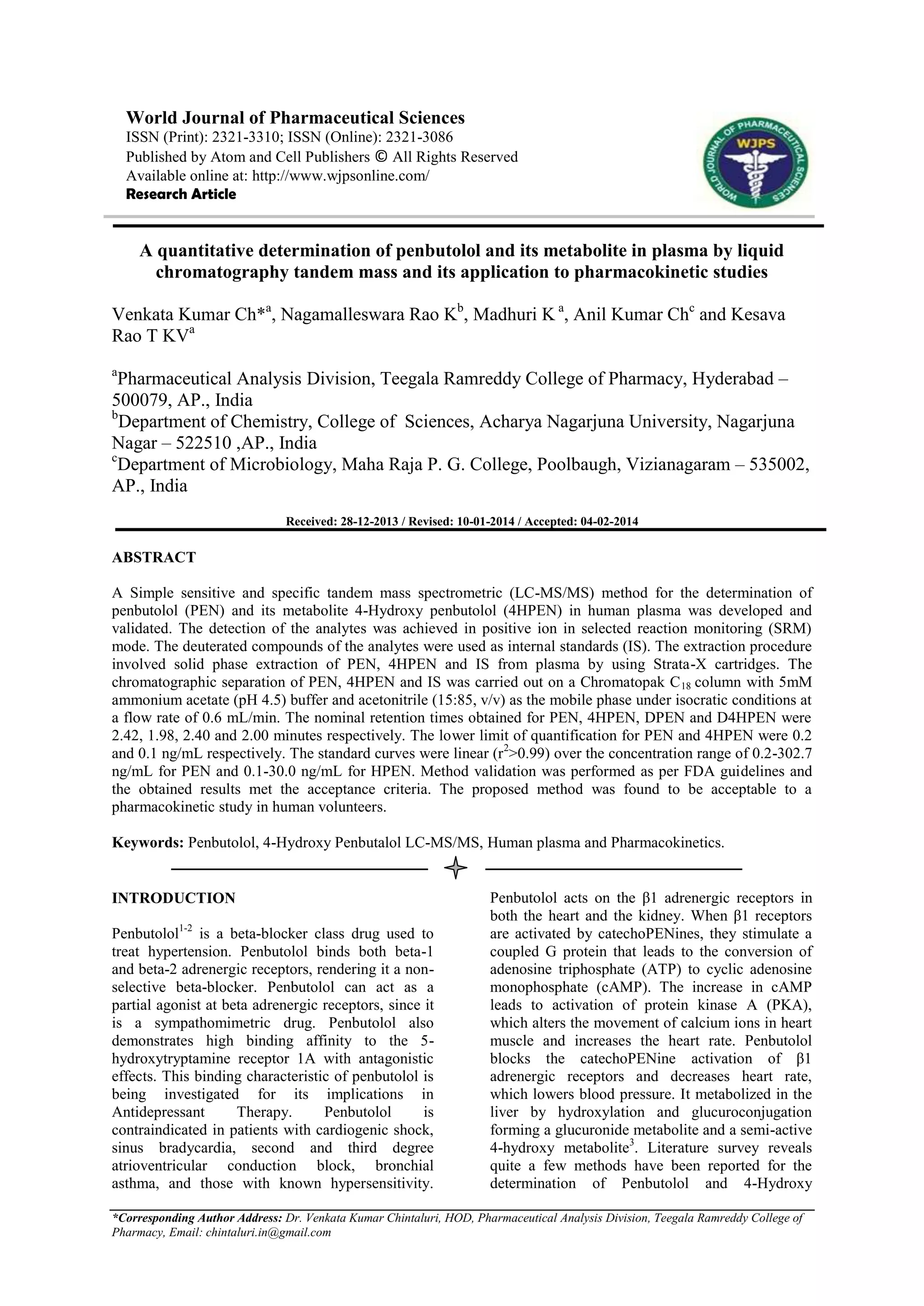
standards were shown in Fig.1.

Preparation of calibration curve standards and
quality control samples: Primary stock solutions
of PEN and 4HPEN for preparation of standards
(CC) and quality control (QC) samples were
prepared from separate weighing. The primary
stock solutions about 1.0 mg/mL of PEN, 4HPEN
were prepared in methanol and stored 1-10oC; they
were found to be stable for 16.25 days (data not
shown). Appropriate dilutions for calibration curve
were made from primary stock of CC using a 80:20
v/v mixture of methanol and water as a diluent to
produce the CC spiking solutions containing
concentrations (from Standard-8 to Standard-1) of
30273.89, 12012.68, 50082.73, 10016.55, 2504.14,
500.83, 20.01, 10.01 ng/mL for PEN and 3005.16,
1192.45, 655.85, 250.53, 50.11, 25.05, 10.02, 5.01
ng/mL for 4HPEN. Similarly QC spiking solutions
were made by using primary stock of QC. These
concentrations (DIQC, HQC, MQC, LQC & LLOQ
QC) were 30146.14, 11515.83, 6333.71, 29.64 &
10.07 ng/mL and 2977.58, 1143.39, 628.87, 14.97
& 5.06 ng/mL for PEN and 4HPEN respectively.
The primary stock solutions of Penbutolol D9 and
4-Hydroxy Penbutolol D9 about 1.0 mg/mL were
prepared in methanol. Working dilution of DPEN
and D4HPEN was prepared at concentration of
1000 ng/mL by using the above diluent. These
ISTD primary stock solutions were stored at 110oC.

Instrumentation
and
optimized
chromatographic conditions: The HPLC system
(Shimadzu®, Kyoto, Japan) consisting of two LC20AD prominence pump, an auto sampler (SILHTc), CTO 10 ASvp column oven, a solvent
degasser (DGU-20A3) and connected with a
Chromatopak C18 column (100 mm X 4.6 mm,
5µm ID) were used for the chromatographic
separation. 10µL of the sample volumes were
injected into the column, which was maintained at
40oC in the column oven. The optimized isocratic
mobile phase consists a mixture of 5mM
ammonium acetate and acetonitrile (15:85 v/v)
with a flow rate of 0.6 mL/min into the ionization
chamber of mass spectrometer. The quantitation
was achieved with daughter ion detection in
positive ion polarity with multiple reaction
monitoring (MRM) mode for both analytes and
internal standards using a MDS Sciex® API-4000
mass spectrometer (Foster City, CA, USA)
equipped with a Turbo Ion Spray TM interface at
400oC. The ion spray voltage was set at 5000 Volts.
The source parameters viz. the nebulizer gas,
curtain gas, auxillary gas and collision gas were set
at 40, 45, 45 and 5 pressure per square inch (psi)
respectively. The compound parameters viz. the declustering potential (DP), entrance potential (EP),
collision energy (CE), Collision Cell Entrance
Potential (CEP) and collision cell exit potential
(CXP) were 29.0, 10.0, 20.0, 18.35 & 5.0 Volts for
Penbutolol; 40.0, 10.0, 23.0, 18.88 & 5.0 Volts for
4-Hydroxy Penbutolol. Detection of the ions were

The plasma calibration curve and quality control
samples were prepared by spiking individually
PEN & 4HPEN each 20 µL into 960µL of screened
plasma. Calibration curve standard for PEN and
4HPEN were made at concentration of 0.200,
0.400, 1.000, 5.053, 25.265, 132.139, 240.254,
302.739 ng/mL and 0.100, 0.200, 0.501, 1.002,
5.011, 13.117, 23.849, 30.052 ng/mL respectively.
Similarly quality control (LLOQ QC, LQC, MQC,
HQC & DIQC) samples for PEN and 4HPEN were
prepared at concentration of 0.201, 0.593, 126.674,
230.317 & 602.923 and 0.101, 0.299, 12.577,
22.868 & 59.552 ng/mL.
150
Venkat et al., World J Pharm Sci 2014; 2(2): 149-160

Extraction process of plasma samples: Two
hundred micro liters of the spiked plasma
calibration curve standards and the quality control
samples were transferred into a set of pre-labeled
polypropylene tubes containing 50 µL of internal
standard dilution (approx.100ng/mL of PEN &
4HPEN). The tubes were added 100 µL of 0.5%
formic acid solution in water and vortexed for well
mixing. The Strata-X 30mg/1CC cartridges placed
on the solid phase extraction (SPE) chamber were
conditioned with 1 mL of methanol followed by
equilibrating with 1 mL of Milli-Q water. The
above samples were loaded on to the cartridges and
the cartridges were washed with 1 mL of Milli-Q
water followed by 1 mL of 10% methanol in water.
The cartridges were dried for approximately 1 min
and eluted with 1 mL of methanol. The eluents
were evaporated in a stream of nitrogen at 500C
and the residues in the dried tubes were
reconstituted with 300µL of the mobile phase.
These tubes were vortexed and transferred into
auto-sampler vials and loaded. An aliquot of 10μL
of the sample was drawn each time from the loaded
vials and then analyzed by LC-MS/MS.

the back-calculated concentrations was ± 15%
except for LLOQ, where it was ± 20%. For a
calibration run to be accepted at least 75% of the
standards, including the LLOQ and ULOQ, were
required to meet the acceptance criteria and no two
consecutive standards should fail, otherwise the
calibration curve was rejected. Five replicate
analyses were performed on each calibration
standard. The samples were run in the order from
low to high concentration. Intra-assay precision and
accuracy were determined by analyzing six
replicates at four (H, M, L, LLOQ) different QC
levels on five different runs. The acceptance
criteria included accuracy within ± 15% deviation
from the nominal values, except the LLOQ, where
it should be ± 20%, and a precision of ≤ 15% coefficient variance or relative standard deviation
(%CV or RSD), except for LLOQ, where it should
be ≤ 20%. Recovery of the analytes from the
extraction procedure was determined by comparing
the areas of the analytes in spiked plasma (six each
of low, medium and high QCs) with the those of
the analytes in samples prepared by spiking the
extracted drug-free plasma with the same amounts
of the analytes at the step immediately prior to
chromatography. Similarly, recovery of the IS was
determined by comparing the mean peak areas of
the extracted QC (H, M & L) samples (n=18) with
those of the IS in samples prepared by spiking the
extracted drug-free plasma samples with the same
amounts of IS at the step immediately prior to
chromatography. The dilution integrity exercise
was performed with the aim of validating the
dilution test to be carried out on higher analyte
concentrations above the upper limit of quantitation
(ULOQ) during real-time analysis of unknown
subject samples. The dilution integrity experiment
was carried out at 2.0 times the ULOQ (Higher
Standard) concentration for both analytes. Six
replicates each of quarter concentrations were
prepared and their concentrations were calculated
by applying the dilution factor 4.These dilution
integrity quality control (DIQC) samples were
included in the precision and accuracy batch as
DIQC samples. The acceptances of these samples
were similar to QC samples. Stability tests were
conducted to evaluate the analyte stability in stock
solutions and in plasma samples under different
conditions. The stock solution stability at room
temperature and refrigerated conditions (1-10oC)
was determined by comparing area response of the
analytes (stability samples) with the response of the
sample prepared from fresh stock solution. Benchtop stability for 10.33 hours, auto sampler
(processed sample) stability for 48.66 hours, freeze
thaw stability for six cycles and long term stability
for 50.0 days were tested at LQC and HQC levels
using six replicates at each level. Samples were
considered to be stable if assay values were within

Method Validation: A through validation of the
method was carried out as per the USFDA
guidelines17. The method was validated for
selectivity, matrix effect, linearity, precision,
accuracy, recovery, dilution integrity and various
stability studies. Selectivity of the method was
assessed by analyzing eight blank human plasma
matrixes which includes each one lot of hemolytic
& lipemic plasma. The responses of the interfering
substances or background noises at the retention
time of the PEN and 4HPEN are acceptable if they
are less than 20% of the response of the lowest
standard curve point or LLOQ. The responses of
the interfering substances or background noise at
the retention time of the internal standard are
acceptable if they are less than 5 % of the mean
response of internal standard in selectivity LLOQ
samples. Matrix effect was investigated to ensure
that precision, selectivity and sensitivity were not
compromised by the matrix. The matrix effect was
checked with eight different lots of EDTA plasma
which inclusive of hemolytic & lipemic plasma
lots. Triplicate samples each of LQC and HQC
were prepared from different lots of plasma (48 QC
samples in total). Linearity was tested for PEN and
4HPEN in the concentration ranges 0.200-302.739
and 0.100-30.052 ng/mL respectively. For the
determination of linearity, standard calibration
curves containing at least eight points (nonzero
standards) were plotted and checked. In addition,
blank plasma samples were also analyzed to
confirm the absence of direct interferences, but
these data were not used to construct the calibration
curve. The acceptance limit of accuracy for each of
151
Venkat et al., World J Pharm Sci 2014; 2(2): 149-160

the acceptance limits of accuracy ± 15% for their
nominal values and precision ≤15% CV.

ionization mode. To get a good chromatographic
separation with the desired response, it was
observed that mobile phase as well as selection of
column was an important criterion. It was found
that an isocratic mobile phase system consisting of
5mM ammonium acetate and acetonitrile (15:85,
v/v) achieves good reproducible response, which
was finally adopted. The retention times of PEN,
4HPEN, DPEN and D4HPEN were 2.42, 1.98, 2.40
and 2.00 min respectively. A flow rate of 0.6
mL/min produced good peak shapes and permitted
a run time of 3.00 min. A good internal standard
must mimic the analytes during extraction and
compensate for any analyte on the column,
especially with LC-MS/MS analysis, where matrix
effects can lead to poor analytical results. In the
initial stages of this work, several compounds were
investigated to find a suitable internal standard and
finally deuterated compounds of both the interested
analytes were found to be best available for the
present purpose. Clean samples are essential for
minimizing ion suppression or enhancement in LCMS/MS technique to reduce matrix effect. Hence,
solid phase extraction was used for the sample
preparation in this work. Other extraction technique
like LLE and PPT were also tried, but SPE was
found to be optimal; it can produce a clean
chromatogram for a blank sample and yields good
reproducible recovery for analytes from the plasma.

Pharmacokinetic
study
design:
A
pharmacokinetic study was performed in healthy
(n=6) male subjects. Blood samples were collected
following oral administration of Penbutolol (20
mg) and 4-Hydroxy Penbutolol (300 mg) pre-dose
at 0.00, 0.33, 0.67, 1.00, 1.33, 1.67, 2.00, 2.33,
2.67, 3.00, 3.50, 4.00, 6.00, 8.00, 10.00, 12.00,
16.00, 24.00, 36.00, 48.00 and 72.00 hours in K2
EDTA vacutainer collection tubes (BD, Franklin,
NJ, USA). The tubes were centrifuged at 3200 rpm
for 20 min at 40C and the separated plasma was
collected in new labeled tubes. The collected
plasma samples were stored at -70 ± 100C until
their use. Plasma samples were spiked with IS and
processed as per extraction method described
above. Along with clinical samples, QC samples at
low, medium and high concentrations were assayed
minimum of two sets or 5% QC samples when
calculated against unknown clinical samples which
were distributed among the unknown samples in
the analytical run; not more than 33% of the QC
samples were greater than ±15 of the nominal
concentration and minimum 50% at each individual
QC’s should pass. Time profile of Penbutolol and
4-Hydroxy Penbutolol was analyzed by noncompartmental method using WinNonlin® version
5.2 (Pharsight Corporation, Mountain View, CA,
USA).

Selectivity: The degree of interference by
endogenous plasma constituents with the analyte
and IS was assessed by inspection of
chromatograms derived from a processed blank
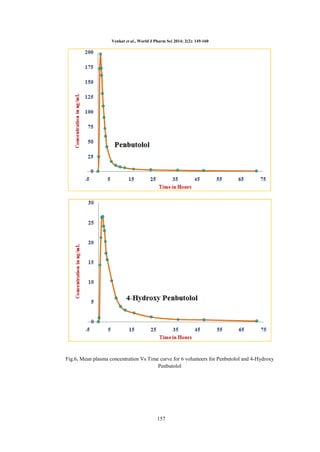
plasma sample (pure blank & IS added blank). As
shown in Fig.4, 5. for individual analyte PEN and
4HPEN respectively, no significant interference in
the processed blank plasma samples were observed
at the retention times of the analyte and internal
standard.

RESULTS
Method development: As both the drug and its
metabolite were containing acidic as well as basic
functional groups in their chemical structures, the
mass spectrometric parameters were tuned in both
positive and negative polarity ionization modes.
Good and reproducible responses were achieved in
positive ionization mode. Data from the MRM
mode were considered to obtain selectivity. The
protonated form of each analyte and IS, the [M +
H]+ ion, was the parent ion in the Q1 spectrum and
was used as precursor ion to obtain Q3 product ion
spectra. The most sensitive mass transition was
monitored from m/z 292.1 → 236.1 for PEN, from
m/z 308.1 → 252.1 for 4HPEN, from m/z 301.1 →
237.1 for DPEN (IS) and from m/z 317.1 → 253.1
for D4HPEN (IS). We aimed to develop a simple
chromatographic method with a lesser run time.
Separation was tried using various combinations of
methanol and buffer with varying contents of each
component on a variety of columns, such as C8 and
C18 of different makes like Kromosil, Ace, Intersil,
Hypersil, Hypurity Advance, Zorbax, Discovery
and Chromatopak. The use of ammonium acetate
buffer at concentration of 5mM helped to achieve a
good response for MS detection in the positive

Sensitivity: The lowest limit of reliable
quantification for the analyte was set at the
concentration of the LLOQ. The precision and
accuracy at LLOQ concentration was found to be
5.3 CV & 103.7% for PEN and 6.9 CV & 101.7%
for 4HPEN.
Extraction efficiency: A simple solid phase
extraction with strata-X cartridges were found to be
rugged and provided the cleanest samples. The
recoveries of the analytes and internal standards
were good and reproducible. The overall mean
recoveries with precision range of Penbutolol and
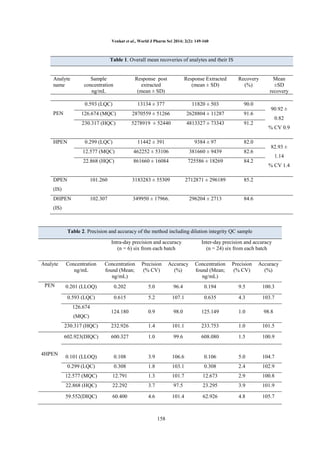
4-Hydroxy Penbutolol was presented in Table.1.
Matrix effect: There was no significant matrix
effect was observed in all the eight lots of human
plasma for the analyte at low and high QC level
152
Venkat et al., World J Pharm Sci 2014; 2(2): 149-160

concentrations. The precision and accuracy for
PEN & 4HPEN at LQC was 4.6, 5.4 CV & 99.5,
106.3%. Similarly at HQC was 7.1, 3.8 CV &
102.7, 100.2% respectively for PEN & 4HPEN.

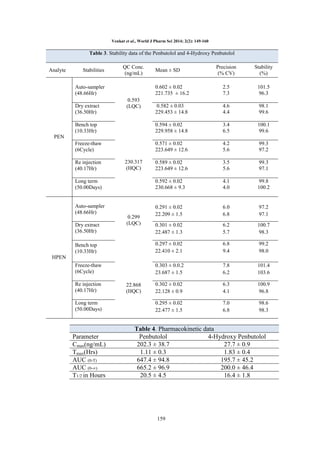
in plasma, 202.3ng/mL for PEN and 27.7 ng/mL
for 4HPEN was attained at 1.11 and 1.83 Hours
(Tmax) for PEN and 4HPEN respectively. The
plasma concentration verses time curve from zero
hour to the last measurable concentration (AUC0-t)
& area under the plasma concentration-time curve
from zero hour to infinity (AUC0-∞) for PEN were
647.4 & 665.2 ng.h/mL and for 4HPEN were 195.7
and 200.0 ng.h/mL. These results were given in
Table. 4. which matches with the published data10.

Linearity: The eight-point calibration curve was
found to be linear over the concentration range of
0.200-302.739 ng/mL for PEN and 0.100-30.052
for 4HPEN. After comparing the weighting factor
models at none, 1/X and 1/X2, the regression
equation with weighting factor 1/X2 of the analytes
to the internal standards concentration was found to
be the best fit in plasma samples. The mean, where
n = 4; correlation coefficient (r) of the calibration
curves generated in the validation was 0.999 for
both PEN and 4HPEN.

DISCUSSION
So far no published methods are available to
determine at this lower level for the quantification
of PEN and HPEN in human plasma samples with
tandem mass detection. Highly sensitive methods
are essential for the determination of PEN and
HPEN concentrations in human plasma for
bioequivalence studies. To the best of our
knowledge, this is the first time determination in
the plasma without compromising on the reported
sensitivity for drug and the metabolite with
pharmacokinetic data. The proposed method is
specific, sensitive, rugged and rapid owing to the
utilization of a shorter run time of 3 minutes. Here
we have developed a method for the determination
of PEN and HPEN in human plasma with good
sensitivity (0.200-302.739 ng/mL for PEN &
0.100-30.052 for 4HPEN). The method uses
deuterated internal standards with solid phase
extraction technique provides best clean sample for
mass spectrometry analysis.

Precision and accuracy: Precision and accuracy
data for intra, inter day samples for all the analytes
were presented in Table. 2. The results obtained in
both the criteria were well within acceptance limits.
Stability studies: The different stability
experiments carried out, viz. bench-top stability for
10.33 hours, auto-sampler stability for 48.66 hours,
repeated freeze-thaw cycles for 6 cycles, reinjection stability for 40.17 hours, dry extract
stability for 36.50 hours at 1-10oC and long-term
stability in matrix at -70oC for 50.0 days. The mean
percentage nominal values of the analytes were
found to be within ± 15% of the predicted
concentrations for the analyte at their LQC and
HQC levels. Thus, the results shown in Table. 3
were found to be within the acceptable limits
during the entire validation.

CONCLUSION

Application to a pharmacokinetic study: In order
to verify the sensitivity and selectivity of this
method in a real-time analysis, the present method
was used to test for Penbutolol in human plasma
samples collected from healthy male volunteers
(n=6) in between the age 18-45 years. Institutional
review board approval was obtained before study
start and all subjects given written informed
consent before participation. Each subject received
single oral dose of penbutolol 20 mg tablets and
plasma samples obtained were analysed for
Penbutolol and 4-Hydroxy Penbutolol. The mean
plasma concentration verses time profiles of PEN
and 4HPEN are shown in Fig. 6. Following oral
administration the maximum concentration (Cmax)

In summary, we have developed and validated a
highly sensitive, specific, reproducible and highthroughput LC-MS/MS method to quantify of
Penbutolol and 4-Hydroxy Penbutolol. The
outcome of all the validation parameters obtained
with good quality, thereby we can conclude that the
developed method can be useful for BA/BE studies
and routine therapeutic drug monitoring with the
desired precision and accuracy.
ACKNOWLEDGEMENTS
The authors gratefully acknowledge Star-Tech
laboratories (Hyderabad), for providing the
necessary facilities for carrying out this study.

153
Venkat et al., World J Pharm Sci 2014; 2(2): 149-160

Fig.1. Penbutolol (a), Penbutolol D9 (b) and 4-Hydroxy Penbutolol (c), 4-Hydroxy Penbutolol D9 (d).

Fig.2. Positive MRM scans mass spectra of Penbutolol for precursor and product ions.

154
Venkat et al., World J Pharm Sci 2014; 2(2): 149-160

Fig.3. Positive MRM scans mass spectra of 4-Hydroxy Penbutolol for precursor and product ions.

Fig.4. Typical multiple reaction monitoring mode chromatograms of Penbutolol (left panel) and
internal standard (right panel) in (A) human blank plasma; (B) human plasma spiked with internal
standard; (C) a lower limit of quantitation sample along with internal standard.
155
Venkat et al., World J Pharm Sci 2014; 2(2): 149-160

Fig.5. Typical multiple reaction monitoring mode chromatograms of 4-Hydroxy Penbutolol (left panel)
and internal standard (right panel) in (A) human blank plasma; (B) human plasma spiked with internal
standard; (C) a lower limit of quantitation sample along with internal standard.

156
Venkat et al., World J Pharm Sci 2014; 2(2): 149-160

Fig.6. Mean plasma concentration Vs Time curve for 6 volunteers for Penbutolol and 4-Hydroxy
Penbutolol

157
Venkat et al., World J Pharm Sci 2014; 2(2): 149-160

Table 1. Overall mean recoveries of analytes and their IS

Analyte
name

Response Extracted
(mean ± SD)

Recovery
(%)

13134 ± 377

11820 ± 503

90.0

126.674 (MQC)

2870559 ± 51266

2628804 ± 11287

91.6

230.317 (HQC)

5278919 ± 52440

4813327 ± 73343

91.2

0.299 (LQC)

11442 ± 391

9384 ± 97

82.0

12.577 (MQC)

462252 ± 53106

381660 ± 9439

82.6

22.868 (HQC)

861660 ± 16084

725586 ± 18269

84.2

101.260

HPEN

Response post
extracted
(mean ± SD)

0.593 (LQC)
PEN

Sample
concentration
ng/mL

3183283 ± 55309

2712871 ± 296189

85.2

102.307

349950 ± 17966.

296204 ± 2713

84.6

DPEN

Mean
±SD
recovery
90.92 ±
0.82
% CV 0.9

82.93 ±
1.14
% CV 1.4

(IS)
DHPEN
(IS)

Table 2. Precision and accuracy of the method including dilution integrity QC sample
Intra-day precision and accuracy
(n = 6) six from each batch

Inter-day precision and accuracy
(n = 24) six from each batch

Analyte

Concentration
ng/mL

Concentration
found (Mean;
ng/mL)

Precision
(% CV)

Accuracy
(%)

Concentration
found (Mean;
ng/mL)

Precision
(% CV)

Accuracy
(%)

PEN

0.201 (LLOQ)

0.202

5.0

96.4

0.194

9.5

100.3

0.593 (LQC)

0.615

5.2

107.1

0.635

4.3

103.7

124.180

0.9

98.0

125.149

1.0

98.8

230.317 (HQC)

232.926

1.4

101.1

233.753

1.0

101.5

602.923(DIQC)

600.327

1.0

99.6

608.080

1.5

100.9

0.101 (LLOQ)

0.108

3.9

106.6

0.106

5.0

104.7

0.299 (LQC)

0.308

1.8

103.1

0.308

2.4

102.9

12.577 (MQC)

12.791

1.3

101.7

12.673

2.9

100.8

22.868 (HQC)

22.292

3.7

97.5

23.295

3.9

101.9

59.552(DIQC)

60.400

4.6

101.4

62.926

4.8

105.7

126.674
(MQC)

4HPEN

158
Venkat et al., World J Pharm Sci 2014; 2(2): 149-160

Table 3. Stability data of the Penbutolol and 4-Hydroxy Penbutolol
Precision
(% CV)

Stability
(%)

0.602 ± 0.02
221.735 ± 16.2

2.5
7.3

101.5
96.3

0.582 ± 0.03
229.453 ± 14.8

4.6
4.4

98.1
99.6

Bench top
(10.33Hr)

0.594 ± 0.02
229.958 ± 14.8

3.4
6.5

100.1
99.6

Freeze-thaw
(6Cycle)

0.571 ± 0.02
223.649 ± 12.6

4.2
5.6

99.3
97.2

0.589 ± 0.02
223.649 ± 12.6

3.5
5.6

99.3
97.1

Long term
(50.00Days)

0.592 ± 0.02
230.668 ± 9.3

4.1
4.0

99.8
100.2

Auto-sampler
(48.66Hr)

0.291 ± 0.02
22.209 ± 1.5

6.0
6.8

97.2
97.1

0.301 ± 0.02
22.487 ± 1.3

6.2
5.7

100.7
98.3

Bench top
(10.33Hr)

Analyte

0.297 ± 0.02
22.410 ± 2.1

6.8
9.4

99.2
98.0

Freeze-thaw
(6Cycle)

0.303 ± 0.0.2
23.687 ± 1.5

7.8
6.2

101.4
103.6

0.302 ± 0.02
22.128 ± 0.9

6.3
4.1

100.9
96.8

0.295 ± 0.02
22.477 ± 1.5

7.0
6.8

98.6
98.3

Stabilities

QC Conc.
(ng/mL)

Auto-sampler
(48.66Hr)
Dry extract
(36.50Hr)

0.593
(LQC)

Mean ± SD

PEN

Re injection
(40.17Hr)

Dry extract
(36.50Hr)

230.317
(HQC)

0.299
(LQC)

HPEN

Re injection
(40.17Hr)
Long term
(50.00Days)

Parameter
Cmax(ng/mL)
Tmax(Hrs)
AUC (0-T)
AUC (0-∞)
(ng.h/mL)
T1/2 in Hours
(ng.h/mL)

22.868
(HQC)

Table 4. Pharmacokinetic data
Penbutolol
4-Hydroxy Penbutolol
202.3 ± 38.7
27.7 ± 0.9
1.11 ± 0.3
1.83 ± 0.4
647.4 ± 94.8
195.7 ± 45.2
665.2 ± 96.9
200.0 ± 46.4
20.5 ± 4.5
16.4 ± 1.8

159
Venkat et al., World J Pharm Sci 2014; 2(2): 149-160

REFERENCES
1
2
3
4
5
6
7
8
9
10

http://www.drugbank.ca/drugs/DB01359
http://www.rxlist.com/levatol-drug.htm
http://www.cachesyn.com/compound.php?cat_num=CSTP125003
Aquirre C et al. Plasma protein binding of penbutolol in pregnancy. Eur J Drug Metab Pharmacokinet 1988; 13: 23-6.
Miner DJ et al. Liquid-chromatographic determination of penbutolol and its principal metabolites in plasma and urine. Clin
Chem 1984; 30: 717-23.
Lehr KH et al. Direct assay of conjugates of penbutolol and its metabolites in urine. Arzneimittelforschung 1987; 37: 1373-5.
Shen L et al. Analysis of penbutolol and its metabolites in human body fluid by gas chromatography--mass spectrometry.
PubMed PMID 8701746 1995; 30: 702-5
http://bebac.at/Guidelines.htm#
http://www.fda.gov/downloads/Drugs/GuidanceComplianceRegulatoryInformation/Guidiances/ ucm070124.pdf
http://www.accessdata.fda.gov/drugsatfda_docs/label/2011/018976s012lbl.pdf

160

020203 ps0096

  • 1.
    World Journal ofPharmaceutical Sciences ISSN (Print): 2321-3310; ISSN (Online): 2321-3086 Published by Atom and Cell Publishers © All Rights Reserved Available online at: http://www.wjpsonline.com/ Research Article A quantitative determination of penbutolol and its metabolite in plasma by liquid chromatography tandem mass and its application to pharmacokinetic studies Venkata Kumar Ch*a, Nagamalleswara Rao Kb, Madhuri K a, Anil Kumar Chc and Kesava Rao T KVa a Pharmaceutical Analysis Division, Teegala Ramreddy College of Pharmacy, Hyderabad – 500079, AP., India b Department of Chemistry, College of Sciences, Acharya Nagarjuna University, Nagarjuna Nagar – 522510 ,AP., India c Department of Microbiology, Maha Raja P. G. College, Poolbaugh, Vizianagaram – 535002, AP., India Received: 28-12-2013 / Revised: 10-01-2014 / Accepted: 04-02-2014 ABSTRACT A Simple sensitive and specific tandem mass spectrometric (LC-MS/MS) method for the determination of penbutolol (PEN) and its metabolite 4-Hydroxy penbutolol (4HPEN) in human plasma was developed and validated. The detection of the analytes was achieved in positive ion in selected reaction monitoring (SRM) mode. The deuterated compounds of the analytes were used as internal standards (IS). The extraction procedure involved solid phase extraction of PEN, 4HPEN and IS from plasma by using Strata-X cartridges. The chromatographic separation of PEN, 4HPEN and IS was carried out on a Chromatopak C 18 column with 5mM ammonium acetate (pH 4.5) buffer and acetonitrile (15:85, v/v) as the mobile phase under isocratic conditions at a flow rate of 0.6 mL/min. The nominal retention times obtained for PEN, 4HPEN, DPEN and D4HPEN were 2.42, 1.98, 2.40 and 2.00 minutes respectively. The lower limit of quantification for PEN and 4HPEN were 0.2 and 0.1 ng/mL respectively. The standard curves were linear (r 2>0.99) over the concentration range of 0.2-302.7 ng/mL for PEN and 0.1-30.0 ng/mL for HPEN. Method validation was performed as per FDA guidelines and the obtained results met the acceptance criteria. The proposed method was found to be acceptable to a pharmacokinetic study in human volunteers. Keywords: Penbutolol, 4-Hydroxy Penbutalol LC-MS/MS, Human plasma and Pharmacokinetics. INTRODUCTION Penbutolol1-2 is a beta-blocker class drug used to treat hypertension. Penbutolol binds both beta-1 and beta-2 adrenergic receptors, rendering it a nonselective beta-blocker. Penbutolol can act as a partial agonist at beta adrenergic receptors, since it is a sympathomimetric drug. Penbutolol also demonstrates high binding affinity to the 5hydroxytryptamine receptor 1A with antagonistic effects. This binding characteristic of penbutolol is being investigated for its implications in Antidepressant Therapy. Penbutolol is contraindicated in patients with cardiogenic shock, sinus bradycardia, second and third degree atrioventricular conduction block, bronchial asthma, and those with known hypersensitivity. Penbutolol acts on the β1 adrenergic receptors in both the heart and the kidney. When β1 receptors are activated by catechoPENines, they stimulate a coupled G protein that leads to the conversion of adenosine triphosphate (ATP) to cyclic adenosine monophosphate (cAMP). The increase in cAMP leads to activation of protein kinase A (PKA), which alters the movement of calcium ions in heart muscle and increases the heart rate. Penbutolol blocks the catechoPENine activation of β1 adrenergic receptors and decreases heart rate, which lowers blood pressure. It metabolized in the liver by hydroxylation and glucuroconjugation forming a glucuronide metabolite and a semi-active 4-hydroxy metabolite3. Literature survey reveals quite a few methods have been reported for the determination of Penbutolol and 4-Hydroxy *Corresponding Author Address: Dr. Venkata Kumar Chintaluri, HOD, Pharmaceutical Analysis Division, Teegala Ramreddy College of Pharmacy, Email: chintaluri.in@gmail.com
  • 2.
    Venkat et al.,World J Pharm Sci 2014; 2(2): 149-160 Penbutolol in various body fluids such as urine and plasma by using spectro photometry4, HPLC5, 6 and GC-MS7. The authors now propose a fast, sensitive, accurate and precise tandem mass spectroscopic method for the determination of Penbutolol and 4-Hydroxy Penbutolol in human plasma. The entire results obtained in the present study comply with the acceptance criteria of regulatory requirements8, 9. carried out in MRM mode, by monitoring the ion transition pairs of m/z 292.1 → 236.1 for Penbutolol, 308.1 → 252.1 for 4-Hydroxy Penbutolol, 301.1 → 237.1 for Penbutolol D9 and 317.1 → 253.1 for 4-Hydroxy Penbutolol D9. The Positive MRM scan mass spectra of Penbutolol and 4-Hydroxy Penbutolol for precursor and product ions were shown in Fig.2, 3. Both the quadrupoles Q1 and Q3 were set at unit resolution. The retention times obtained for the analytes PEN, 4HPEN & IS DPEN, D4HPEN were 2.42 ± 0.3, 1.98 ± 0.3 min & 2.40 ± 0.3, 2.00 ± 0.3 respectively over a total run time of 3.0 minutes. The analysis data obtained was processed by using Analyst Software™ (Version 1.4.2). EXPERIMENTAL Chemicals and materials: The reference standards of Penbutolol, 4-Hydroxy Penbutolol, Penbutolol D9 and 4-Hydroxy Penbutolol D9 procured from Splendid Labs; Pune, India. HPLC grade methanol and acetonitrile were obtained from J.T Baker® (Phillipsburg, USA). Analytical- grade ammonium acetate and formic acid were obtained from Merck ® Ltd; Mumbai, India. The water used for the analysis was prepared by Milli-Q® water purification system (Bangalore, India). The blank (drug free) human plasmas were procured from Jeevan-dhara blood bank; Hyderabad, India. The chemical structures of analytes and the internal standards were shown in Fig.1. Preparation of calibration curve standards and quality control samples: Primary stock solutions of PEN and 4HPEN for preparation of standards (CC) and quality control (QC) samples were prepared from separate weighing. The primary stock solutions about 1.0 mg/mL of PEN, 4HPEN were prepared in methanol and stored 1-10oC; they were found to be stable for 16.25 days (data not shown). Appropriate dilutions for calibration curve were made from primary stock of CC using a 80:20 v/v mixture of methanol and water as a diluent to produce the CC spiking solutions containing concentrations (from Standard-8 to Standard-1) of 30273.89, 12012.68, 50082.73, 10016.55, 2504.14, 500.83, 20.01, 10.01 ng/mL for PEN and 3005.16, 1192.45, 655.85, 250.53, 50.11, 25.05, 10.02, 5.01 ng/mL for 4HPEN. Similarly QC spiking solutions were made by using primary stock of QC. These concentrations (DIQC, HQC, MQC, LQC & LLOQ QC) were 30146.14, 11515.83, 6333.71, 29.64 & 10.07 ng/mL and 2977.58, 1143.39, 628.87, 14.97 & 5.06 ng/mL for PEN and 4HPEN respectively. The primary stock solutions of Penbutolol D9 and 4-Hydroxy Penbutolol D9 about 1.0 mg/mL were prepared in methanol. Working dilution of DPEN and D4HPEN was prepared at concentration of 1000 ng/mL by using the above diluent. These ISTD primary stock solutions were stored at 110oC. Instrumentation and optimized chromatographic conditions: The HPLC system (Shimadzu®, Kyoto, Japan) consisting of two LC20AD prominence pump, an auto sampler (SILHTc), CTO 10 ASvp column oven, a solvent degasser (DGU-20A3) and connected with a Chromatopak C18 column (100 mm X 4.6 mm, 5µm ID) were used for the chromatographic separation. 10µL of the sample volumes were injected into the column, which was maintained at 40oC in the column oven. The optimized isocratic mobile phase consists a mixture of 5mM ammonium acetate and acetonitrile (15:85 v/v) with a flow rate of 0.6 mL/min into the ionization chamber of mass spectrometer. The quantitation was achieved with daughter ion detection in positive ion polarity with multiple reaction monitoring (MRM) mode for both analytes and internal standards using a MDS Sciex® API-4000 mass spectrometer (Foster City, CA, USA) equipped with a Turbo Ion Spray TM interface at 400oC. The ion spray voltage was set at 5000 Volts. The source parameters viz. the nebulizer gas, curtain gas, auxillary gas and collision gas were set at 40, 45, 45 and 5 pressure per square inch (psi) respectively. The compound parameters viz. the declustering potential (DP), entrance potential (EP), collision energy (CE), Collision Cell Entrance Potential (CEP) and collision cell exit potential (CXP) were 29.0, 10.0, 20.0, 18.35 & 5.0 Volts for Penbutolol; 40.0, 10.0, 23.0, 18.88 & 5.0 Volts for 4-Hydroxy Penbutolol. Detection of the ions were The plasma calibration curve and quality control samples were prepared by spiking individually PEN & 4HPEN each 20 µL into 960µL of screened plasma. Calibration curve standard for PEN and 4HPEN were made at concentration of 0.200, 0.400, 1.000, 5.053, 25.265, 132.139, 240.254, 302.739 ng/mL and 0.100, 0.200, 0.501, 1.002, 5.011, 13.117, 23.849, 30.052 ng/mL respectively. Similarly quality control (LLOQ QC, LQC, MQC, HQC & DIQC) samples for PEN and 4HPEN were prepared at concentration of 0.201, 0.593, 126.674, 230.317 & 602.923 and 0.101, 0.299, 12.577, 22.868 & 59.552 ng/mL. 150
  • 3.
    Venkat et al.,World J Pharm Sci 2014; 2(2): 149-160 Extraction process of plasma samples: Two hundred micro liters of the spiked plasma calibration curve standards and the quality control samples were transferred into a set of pre-labeled polypropylene tubes containing 50 µL of internal standard dilution (approx.100ng/mL of PEN & 4HPEN). The tubes were added 100 µL of 0.5% formic acid solution in water and vortexed for well mixing. The Strata-X 30mg/1CC cartridges placed on the solid phase extraction (SPE) chamber were conditioned with 1 mL of methanol followed by equilibrating with 1 mL of Milli-Q water. The above samples were loaded on to the cartridges and the cartridges were washed with 1 mL of Milli-Q water followed by 1 mL of 10% methanol in water. The cartridges were dried for approximately 1 min and eluted with 1 mL of methanol. The eluents were evaporated in a stream of nitrogen at 500C and the residues in the dried tubes were reconstituted with 300µL of the mobile phase. These tubes were vortexed and transferred into auto-sampler vials and loaded. An aliquot of 10μL of the sample was drawn each time from the loaded vials and then analyzed by LC-MS/MS. the back-calculated concentrations was ± 15% except for LLOQ, where it was ± 20%. For a calibration run to be accepted at least 75% of the standards, including the LLOQ and ULOQ, were required to meet the acceptance criteria and no two consecutive standards should fail, otherwise the calibration curve was rejected. Five replicate analyses were performed on each calibration standard. The samples were run in the order from low to high concentration. Intra-assay precision and accuracy were determined by analyzing six replicates at four (H, M, L, LLOQ) different QC levels on five different runs. The acceptance criteria included accuracy within ± 15% deviation from the nominal values, except the LLOQ, where it should be ± 20%, and a precision of ≤ 15% coefficient variance or relative standard deviation (%CV or RSD), except for LLOQ, where it should be ≤ 20%. Recovery of the analytes from the extraction procedure was determined by comparing the areas of the analytes in spiked plasma (six each of low, medium and high QCs) with the those of the analytes in samples prepared by spiking the extracted drug-free plasma with the same amounts of the analytes at the step immediately prior to chromatography. Similarly, recovery of the IS was determined by comparing the mean peak areas of the extracted QC (H, M & L) samples (n=18) with those of the IS in samples prepared by spiking the extracted drug-free plasma samples with the same amounts of IS at the step immediately prior to chromatography. The dilution integrity exercise was performed with the aim of validating the dilution test to be carried out on higher analyte concentrations above the upper limit of quantitation (ULOQ) during real-time analysis of unknown subject samples. The dilution integrity experiment was carried out at 2.0 times the ULOQ (Higher Standard) concentration for both analytes. Six replicates each of quarter concentrations were prepared and their concentrations were calculated by applying the dilution factor 4.These dilution integrity quality control (DIQC) samples were included in the precision and accuracy batch as DIQC samples. The acceptances of these samples were similar to QC samples. Stability tests were conducted to evaluate the analyte stability in stock solutions and in plasma samples under different conditions. The stock solution stability at room temperature and refrigerated conditions (1-10oC) was determined by comparing area response of the analytes (stability samples) with the response of the sample prepared from fresh stock solution. Benchtop stability for 10.33 hours, auto sampler (processed sample) stability for 48.66 hours, freeze thaw stability for six cycles and long term stability for 50.0 days were tested at LQC and HQC levels using six replicates at each level. Samples were considered to be stable if assay values were within Method Validation: A through validation of the method was carried out as per the USFDA guidelines17. The method was validated for selectivity, matrix effect, linearity, precision, accuracy, recovery, dilution integrity and various stability studies. Selectivity of the method was assessed by analyzing eight blank human plasma matrixes which includes each one lot of hemolytic & lipemic plasma. The responses of the interfering substances or background noises at the retention time of the PEN and 4HPEN are acceptable if they are less than 20% of the response of the lowest standard curve point or LLOQ. The responses of the interfering substances or background noise at the retention time of the internal standard are acceptable if they are less than 5 % of the mean response of internal standard in selectivity LLOQ samples. Matrix effect was investigated to ensure that precision, selectivity and sensitivity were not compromised by the matrix. The matrix effect was checked with eight different lots of EDTA plasma which inclusive of hemolytic & lipemic plasma lots. Triplicate samples each of LQC and HQC were prepared from different lots of plasma (48 QC samples in total). Linearity was tested for PEN and 4HPEN in the concentration ranges 0.200-302.739 and 0.100-30.052 ng/mL respectively. For the determination of linearity, standard calibration curves containing at least eight points (nonzero standards) were plotted and checked. In addition, blank plasma samples were also analyzed to confirm the absence of direct interferences, but these data were not used to construct the calibration curve. The acceptance limit of accuracy for each of 151
  • 4.
    Venkat et al.,World J Pharm Sci 2014; 2(2): 149-160 the acceptance limits of accuracy ± 15% for their nominal values and precision ≤15% CV. ionization mode. To get a good chromatographic separation with the desired response, it was observed that mobile phase as well as selection of column was an important criterion. It was found that an isocratic mobile phase system consisting of 5mM ammonium acetate and acetonitrile (15:85, v/v) achieves good reproducible response, which was finally adopted. The retention times of PEN, 4HPEN, DPEN and D4HPEN were 2.42, 1.98, 2.40 and 2.00 min respectively. A flow rate of 0.6 mL/min produced good peak shapes and permitted a run time of 3.00 min. A good internal standard must mimic the analytes during extraction and compensate for any analyte on the column, especially with LC-MS/MS analysis, where matrix effects can lead to poor analytical results. In the initial stages of this work, several compounds were investigated to find a suitable internal standard and finally deuterated compounds of both the interested analytes were found to be best available for the present purpose. Clean samples are essential for minimizing ion suppression or enhancement in LCMS/MS technique to reduce matrix effect. Hence, solid phase extraction was used for the sample preparation in this work. Other extraction technique like LLE and PPT were also tried, but SPE was found to be optimal; it can produce a clean chromatogram for a blank sample and yields good reproducible recovery for analytes from the plasma. Pharmacokinetic study design: A pharmacokinetic study was performed in healthy (n=6) male subjects. Blood samples were collected following oral administration of Penbutolol (20 mg) and 4-Hydroxy Penbutolol (300 mg) pre-dose at 0.00, 0.33, 0.67, 1.00, 1.33, 1.67, 2.00, 2.33, 2.67, 3.00, 3.50, 4.00, 6.00, 8.00, 10.00, 12.00, 16.00, 24.00, 36.00, 48.00 and 72.00 hours in K2 EDTA vacutainer collection tubes (BD, Franklin, NJ, USA). The tubes were centrifuged at 3200 rpm for 20 min at 40C and the separated plasma was collected in new labeled tubes. The collected plasma samples were stored at -70 ± 100C until their use. Plasma samples were spiked with IS and processed as per extraction method described above. Along with clinical samples, QC samples at low, medium and high concentrations were assayed minimum of two sets or 5% QC samples when calculated against unknown clinical samples which were distributed among the unknown samples in the analytical run; not more than 33% of the QC samples were greater than ±15 of the nominal concentration and minimum 50% at each individual QC’s should pass. Time profile of Penbutolol and 4-Hydroxy Penbutolol was analyzed by noncompartmental method using WinNonlin® version 5.2 (Pharsight Corporation, Mountain View, CA, USA). Selectivity: The degree of interference by endogenous plasma constituents with the analyte and IS was assessed by inspection of chromatograms derived from a processed blank plasma sample (pure blank & IS added blank). As shown in Fig.4, 5. for individual analyte PEN and 4HPEN respectively, no significant interference in the processed blank plasma samples were observed at the retention times of the analyte and internal standard. RESULTS Method development: As both the drug and its metabolite were containing acidic as well as basic functional groups in their chemical structures, the mass spectrometric parameters were tuned in both positive and negative polarity ionization modes. Good and reproducible responses were achieved in positive ionization mode. Data from the MRM mode were considered to obtain selectivity. The protonated form of each analyte and IS, the [M + H]+ ion, was the parent ion in the Q1 spectrum and was used as precursor ion to obtain Q3 product ion spectra. The most sensitive mass transition was monitored from m/z 292.1 → 236.1 for PEN, from m/z 308.1 → 252.1 for 4HPEN, from m/z 301.1 → 237.1 for DPEN (IS) and from m/z 317.1 → 253.1 for D4HPEN (IS). We aimed to develop a simple chromatographic method with a lesser run time. Separation was tried using various combinations of methanol and buffer with varying contents of each component on a variety of columns, such as C8 and C18 of different makes like Kromosil, Ace, Intersil, Hypersil, Hypurity Advance, Zorbax, Discovery and Chromatopak. The use of ammonium acetate buffer at concentration of 5mM helped to achieve a good response for MS detection in the positive Sensitivity: The lowest limit of reliable quantification for the analyte was set at the concentration of the LLOQ. The precision and accuracy at LLOQ concentration was found to be 5.3 CV & 103.7% for PEN and 6.9 CV & 101.7% for 4HPEN. Extraction efficiency: A simple solid phase extraction with strata-X cartridges were found to be rugged and provided the cleanest samples. The recoveries of the analytes and internal standards were good and reproducible. The overall mean recoveries with precision range of Penbutolol and 4-Hydroxy Penbutolol was presented in Table.1. Matrix effect: There was no significant matrix effect was observed in all the eight lots of human plasma for the analyte at low and high QC level 152
  • 5.
    Venkat et al.,World J Pharm Sci 2014; 2(2): 149-160 concentrations. The precision and accuracy for PEN & 4HPEN at LQC was 4.6, 5.4 CV & 99.5, 106.3%. Similarly at HQC was 7.1, 3.8 CV & 102.7, 100.2% respectively for PEN & 4HPEN. in plasma, 202.3ng/mL for PEN and 27.7 ng/mL for 4HPEN was attained at 1.11 and 1.83 Hours (Tmax) for PEN and 4HPEN respectively. The plasma concentration verses time curve from zero hour to the last measurable concentration (AUC0-t) & area under the plasma concentration-time curve from zero hour to infinity (AUC0-∞) for PEN were 647.4 & 665.2 ng.h/mL and for 4HPEN were 195.7 and 200.0 ng.h/mL. These results were given in Table. 4. which matches with the published data10. Linearity: The eight-point calibration curve was found to be linear over the concentration range of 0.200-302.739 ng/mL for PEN and 0.100-30.052 for 4HPEN. After comparing the weighting factor models at none, 1/X and 1/X2, the regression equation with weighting factor 1/X2 of the analytes to the internal standards concentration was found to be the best fit in plasma samples. The mean, where n = 4; correlation coefficient (r) of the calibration curves generated in the validation was 0.999 for both PEN and 4HPEN. DISCUSSION So far no published methods are available to determine at this lower level for the quantification of PEN and HPEN in human plasma samples with tandem mass detection. Highly sensitive methods are essential for the determination of PEN and HPEN concentrations in human plasma for bioequivalence studies. To the best of our knowledge, this is the first time determination in the plasma without compromising on the reported sensitivity for drug and the metabolite with pharmacokinetic data. The proposed method is specific, sensitive, rugged and rapid owing to the utilization of a shorter run time of 3 minutes. Here we have developed a method for the determination of PEN and HPEN in human plasma with good sensitivity (0.200-302.739 ng/mL for PEN & 0.100-30.052 for 4HPEN). The method uses deuterated internal standards with solid phase extraction technique provides best clean sample for mass spectrometry analysis. Precision and accuracy: Precision and accuracy data for intra, inter day samples for all the analytes were presented in Table. 2. The results obtained in both the criteria were well within acceptance limits. Stability studies: The different stability experiments carried out, viz. bench-top stability for 10.33 hours, auto-sampler stability for 48.66 hours, repeated freeze-thaw cycles for 6 cycles, reinjection stability for 40.17 hours, dry extract stability for 36.50 hours at 1-10oC and long-term stability in matrix at -70oC for 50.0 days. The mean percentage nominal values of the analytes were found to be within ± 15% of the predicted concentrations for the analyte at their LQC and HQC levels. Thus, the results shown in Table. 3 were found to be within the acceptable limits during the entire validation. CONCLUSION Application to a pharmacokinetic study: In order to verify the sensitivity and selectivity of this method in a real-time analysis, the present method was used to test for Penbutolol in human plasma samples collected from healthy male volunteers (n=6) in between the age 18-45 years. Institutional review board approval was obtained before study start and all subjects given written informed consent before participation. Each subject received single oral dose of penbutolol 20 mg tablets and plasma samples obtained were analysed for Penbutolol and 4-Hydroxy Penbutolol. The mean plasma concentration verses time profiles of PEN and 4HPEN are shown in Fig. 6. Following oral administration the maximum concentration (Cmax) In summary, we have developed and validated a highly sensitive, specific, reproducible and highthroughput LC-MS/MS method to quantify of Penbutolol and 4-Hydroxy Penbutolol. The outcome of all the validation parameters obtained with good quality, thereby we can conclude that the developed method can be useful for BA/BE studies and routine therapeutic drug monitoring with the desired precision and accuracy. ACKNOWLEDGEMENTS The authors gratefully acknowledge Star-Tech laboratories (Hyderabad), for providing the necessary facilities for carrying out this study. 153
  • 6.
    Venkat et al.,World J Pharm Sci 2014; 2(2): 149-160 Fig.1. Penbutolol (a), Penbutolol D9 (b) and 4-Hydroxy Penbutolol (c), 4-Hydroxy Penbutolol D9 (d). Fig.2. Positive MRM scans mass spectra of Penbutolol for precursor and product ions. 154
  • 7.
    Venkat et al.,World J Pharm Sci 2014; 2(2): 149-160 Fig.3. Positive MRM scans mass spectra of 4-Hydroxy Penbutolol for precursor and product ions. Fig.4. Typical multiple reaction monitoring mode chromatograms of Penbutolol (left panel) and internal standard (right panel) in (A) human blank plasma; (B) human plasma spiked with internal standard; (C) a lower limit of quantitation sample along with internal standard. 155
  • 8.
    Venkat et al.,World J Pharm Sci 2014; 2(2): 149-160 Fig.5. Typical multiple reaction monitoring mode chromatograms of 4-Hydroxy Penbutolol (left panel) and internal standard (right panel) in (A) human blank plasma; (B) human plasma spiked with internal standard; (C) a lower limit of quantitation sample along with internal standard. 156
  • 9.
    Venkat et al.,World J Pharm Sci 2014; 2(2): 149-160 Fig.6. Mean plasma concentration Vs Time curve for 6 volunteers for Penbutolol and 4-Hydroxy Penbutolol 157
  • 10.
    Venkat et al.,World J Pharm Sci 2014; 2(2): 149-160 Table 1. Overall mean recoveries of analytes and their IS Analyte name Response Extracted (mean ± SD) Recovery (%) 13134 ± 377 11820 ± 503 90.0 126.674 (MQC) 2870559 ± 51266 2628804 ± 11287 91.6 230.317 (HQC) 5278919 ± 52440 4813327 ± 73343 91.2 0.299 (LQC) 11442 ± 391 9384 ± 97 82.0 12.577 (MQC) 462252 ± 53106 381660 ± 9439 82.6 22.868 (HQC) 861660 ± 16084 725586 ± 18269 84.2 101.260 HPEN Response post extracted (mean ± SD) 0.593 (LQC) PEN Sample concentration ng/mL 3183283 ± 55309 2712871 ± 296189 85.2 102.307 349950 ± 17966. 296204 ± 2713 84.6 DPEN Mean ±SD recovery 90.92 ± 0.82 % CV 0.9 82.93 ± 1.14 % CV 1.4 (IS) DHPEN (IS) Table 2. Precision and accuracy of the method including dilution integrity QC sample Intra-day precision and accuracy (n = 6) six from each batch Inter-day precision and accuracy (n = 24) six from each batch Analyte Concentration ng/mL Concentration found (Mean; ng/mL) Precision (% CV) Accuracy (%) Concentration found (Mean; ng/mL) Precision (% CV) Accuracy (%) PEN 0.201 (LLOQ) 0.202 5.0 96.4 0.194 9.5 100.3 0.593 (LQC) 0.615 5.2 107.1 0.635 4.3 103.7 124.180 0.9 98.0 125.149 1.0 98.8 230.317 (HQC) 232.926 1.4 101.1 233.753 1.0 101.5 602.923(DIQC) 600.327 1.0 99.6 608.080 1.5 100.9 0.101 (LLOQ) 0.108 3.9 106.6 0.106 5.0 104.7 0.299 (LQC) 0.308 1.8 103.1 0.308 2.4 102.9 12.577 (MQC) 12.791 1.3 101.7 12.673 2.9 100.8 22.868 (HQC) 22.292 3.7 97.5 23.295 3.9 101.9 59.552(DIQC) 60.400 4.6 101.4 62.926 4.8 105.7 126.674 (MQC) 4HPEN 158
  • 11.
    Venkat et al.,World J Pharm Sci 2014; 2(2): 149-160 Table 3. Stability data of the Penbutolol and 4-Hydroxy Penbutolol Precision (% CV) Stability (%) 0.602 ± 0.02 221.735 ± 16.2 2.5 7.3 101.5 96.3 0.582 ± 0.03 229.453 ± 14.8 4.6 4.4 98.1 99.6 Bench top (10.33Hr) 0.594 ± 0.02 229.958 ± 14.8 3.4 6.5 100.1 99.6 Freeze-thaw (6Cycle) 0.571 ± 0.02 223.649 ± 12.6 4.2 5.6 99.3 97.2 0.589 ± 0.02 223.649 ± 12.6 3.5 5.6 99.3 97.1 Long term (50.00Days) 0.592 ± 0.02 230.668 ± 9.3 4.1 4.0 99.8 100.2 Auto-sampler (48.66Hr) 0.291 ± 0.02 22.209 ± 1.5 6.0 6.8 97.2 97.1 0.301 ± 0.02 22.487 ± 1.3 6.2 5.7 100.7 98.3 Bench top (10.33Hr) Analyte 0.297 ± 0.02 22.410 ± 2.1 6.8 9.4 99.2 98.0 Freeze-thaw (6Cycle) 0.303 ± 0.0.2 23.687 ± 1.5 7.8 6.2 101.4 103.6 0.302 ± 0.02 22.128 ± 0.9 6.3 4.1 100.9 96.8 0.295 ± 0.02 22.477 ± 1.5 7.0 6.8 98.6 98.3 Stabilities QC Conc. (ng/mL) Auto-sampler (48.66Hr) Dry extract (36.50Hr) 0.593 (LQC) Mean ± SD PEN Re injection (40.17Hr) Dry extract (36.50Hr) 230.317 (HQC) 0.299 (LQC) HPEN Re injection (40.17Hr) Long term (50.00Days) Parameter Cmax(ng/mL) Tmax(Hrs) AUC (0-T) AUC (0-∞) (ng.h/mL) T1/2 in Hours (ng.h/mL) 22.868 (HQC) Table 4. Pharmacokinetic data Penbutolol 4-Hydroxy Penbutolol 202.3 ± 38.7 27.7 ± 0.9 1.11 ± 0.3 1.83 ± 0.4 647.4 ± 94.8 195.7 ± 45.2 665.2 ± 96.9 200.0 ± 46.4 20.5 ± 4.5 16.4 ± 1.8 159
  • 12.
    Venkat et al.,World J Pharm Sci 2014; 2(2): 149-160 REFERENCES 1 2 3 4 5 6 7 8 9 10 http://www.drugbank.ca/drugs/DB01359 http://www.rxlist.com/levatol-drug.htm http://www.cachesyn.com/compound.php?cat_num=CSTP125003 Aquirre C et al. Plasma protein binding of penbutolol in pregnancy. Eur J Drug Metab Pharmacokinet 1988; 13: 23-6. Miner DJ et al. Liquid-chromatographic determination of penbutolol and its principal metabolites in plasma and urine. Clin Chem 1984; 30: 717-23. Lehr KH et al. Direct assay of conjugates of penbutolol and its metabolites in urine. Arzneimittelforschung 1987; 37: 1373-5. Shen L et al. Analysis of penbutolol and its metabolites in human body fluid by gas chromatography--mass spectrometry. PubMed PMID 8701746 1995; 30: 702-5 http://bebac.at/Guidelines.htm# http://www.fda.gov/downloads/Drugs/GuidanceComplianceRegulatoryInformation/Guidiances/ ucm070124.pdf http://www.accessdata.fda.gov/drugsatfda_docs/label/2011/018976s012lbl.pdf 160