HAMED, Sulaimon Adekunle
MATRIC NO:139073005
SUPERVISOR: DR. I. A. OLASUPO
BY
1
Synthesis and Characterization of New
Schiff base Ligands derived from
substituted and benzylated benzaldehyde
and their Metal Complexes
Presentation Outline
Introduction
Review of literature
Aim and Objectives
Methodology
Results and Discussion
Conclusion
2
Introduction
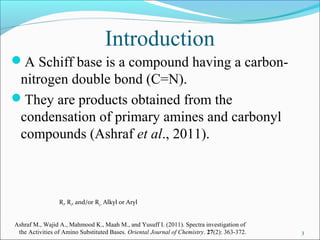
A Schiff base is a compound having a carbon-
nitrogen double bond (C=N).
They are products obtained from the
condensation of primary amines and carbonyl
compounds (Ashraf et al., 2011).
R1, R2, and/or R3 = Alkyl or Aryl
Ashraf M., Wajid A., Mahmood K., Maah M., and Yusuff I. (2011). Spectra investigation of
the Activities of Amino Substituted Bases. Oriental Journal of Chemistry. 27(2): 363-372. 3
4
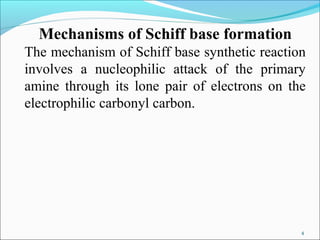
Mechanisms of Schiff base formation
The mechanism of Schiff base synthetic reaction
involves a nucleophilic attack of the primary
amine through its lone pair of electrons on the
electrophilic carbonyl carbon.
5
Schiff base Synthesis
Four common methods that vary in
reaction time, product, and percentage yield
have been reported for the synthesis of Schiff
bases. These methods include:
• Microwave method
• Room temperature method
• Grindstone method
• Reflux method
Applications of Schiff bases
Schiff bases derived from aromatic and
aliphatic amines and aldehydes show a lot of
biological importance as well as wide range of
applications (Kumar et al., 2009). These
includes:
Application in medicine and pharmacy
Application in synthesis and chemical analysis
Agricultural applications
Application in coordination chemistry
Kumar, S., Dhar, D. N., and Saxena, P. N. (2009). Applications of metal complexes of
Schiff bases-a review. Journal of scientific and industrial research. 68(3): 181 - 187. 6
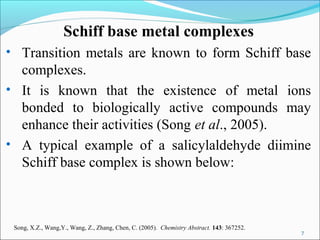
Schiff base metal complexes
• Transition metals are known to form Schiff base
complexes.
• It is known that the existence of metal ions
bonded to biologically active compounds may
enhance their activities (Song et al., 2005).
• A typical example of a salicylaldehyde diimine
Schiff base complex is shown below:
7
Song, X.Z., Wang,Y., Wang, Z., Zhang, Chen, C. (2005). Chemistry Abstract. 143: 367252.
Review of Literature
Fasina et al., (2012) synthesized and characterized a
Schiff base derived from o-phenylenediamine and 5-
bromosalicylaldehyde and of its metal complexes
The IR spectrum absorption bands of the ligand at
1602(C=N) and 1270cm-1
(C-O) appeared at lower
frequency.
8
Fasina, T. M., Ogundele, F. N., Ejiah, and Dueke-Eze, C. U. (2012). Biological Activity of copper(II), cobalt(II), and nickel(II) complexes
of Schiff base derived from o-phenylenediamine and 5-bromosalicylaldehyde. International Journal of Biological Chemistry. 6(1): 24-30.
9
• Sobola et al., (2014) synthesized and
characterized copper(II) complexes of some ortho-
substituted aniline Schiff bases.
• The imine (C=N) functional group shifted from
1612-1615cm-1
to 1602-1606cm-1
• C-O functional group shifted from 1280–1273cm-1
to 1336–1325cm-1
.
Sobola, A. O., Watkins, G. M., & Van Brecht, B. (2014). Synthesis, characterization and antimicrobial activity of copper
(II) complexes of some ortho-substituted aniline Schiff bases; crystal structure of bis (2-methoxy-6-imino) methylphenol
copper (II) complex. South African Journal of Chemistry. 67: 45-51.
10
• Mounika et al., (2010) reported the synthesis and
characterization of a Schiff base derived from 3-Ethoxy
Salicylaldehyde with 2-Amino Benzoic acid and their
complexes
•The imine (C=N) functional group shifted from
1622cm-1
to 1592-1556cm-1
)
• C=O functional group shifted from 1692cm-1
to 1654–
1586cm-1
.
Mounika, K., Pragathi, A., and Gyanakumari, C. (2010). Synthesis characterization and biological activity of a Schiff
base derived from 3-ethoxy salicylaldehyde and 2-amino benzoic acid and its transition metal complexes. Journal of
Scientific Research. 2(3): 513 -528.
Aim and Objectives
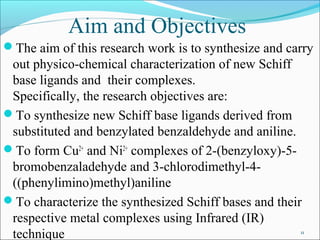
The aim of this research work is to synthesize and carry
out physico-chemical characterization of new Schiff
base ligands and their complexes.
Specifically, the research objectives are:
To synthesize new Schiff base ligands derived from
substituted and benzylated benzaldehyde and aniline.
To form Cu2+
and Ni2+
complexes of 2-(benzyloxy)-5-
bromobenzaladehyde and 3-chlorodimethyl-4-
((phenylimino)methyl)aniline
To characterize the synthesized Schiff bases and their
respective metal complexes using Infrared (IR)
technique 11
Methodology
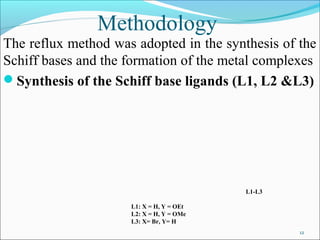
The reflux method was adopted in the synthesis of the
Schiff bases and the formation of the metal complexes
Synthesis of the Schiff base ligands (L1, L2 &L3)
L1-L3
L1: X = H, Y = OEt
L2: X = H, Y = OMe
L3: X= Br, Y= H
12
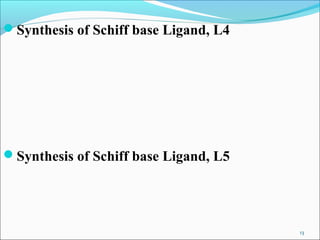
Synthesis of Schiff base Ligand, L4
Synthesis of Schiff base Ligand, L5
13
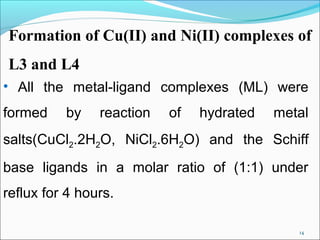
14
Formation of Cu(II) and Ni(II) complexes of
L3 and L4
• All the metal-ligand complexes (ML) were
formed by reaction of hydrated metal
salts(CuCl2.2H2O, NiCl2.6H2O) and the Schiff
base ligands in a molar ratio of (1:1) under
reflux for 4 hours.
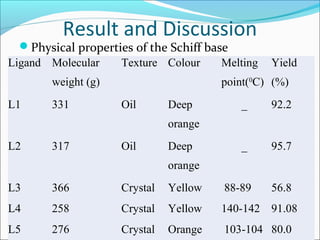
Result and Discussion
Physical properties of the Schiff base
15
Ligand Molecular
weight (g)
Texture Colour Melting
point(0
C)
Yield
(%)
L1 331 Oil Deep
orange
_ 92.2
L2 317 Oil Deep
orange
_ 95.7
L3 366 Crystal Yellow 88-89 56.8
L4 258 Crystal Yellow 140-142 91.08
L5 276 Crystal Orange 103-104 80.0
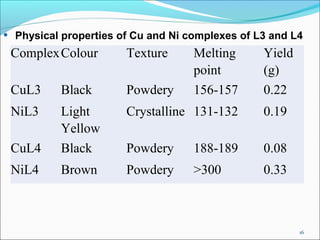
16
ComplexColour Texture Melting
point
Yield
(g)
CuL3 Black Powdery 156-157 0.22
NiL3 Light
Yellow
Crystalline 131-132 0.19
CuL4 Black Powdery 188-189 0.08
NiL4 Brown Powdery >300 0.33
• Physical properties of Cu and Ni complexes of L3 and L4
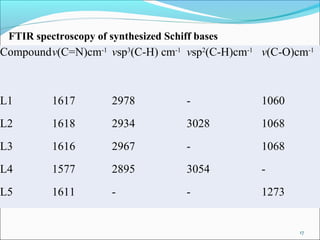
17
Compoundv(C=N)cm-1
vsp3
(C-H) cm-1
vsp2
(C-H)cm-1
v(C-O)cm-1
L1 1617 2978 - 1060
L2 1618 2934 3028 1068
L3 1616 2967 - 1068
L4 1577 2895 3054 -
L5 1611 - - 1273
FTIR spectroscopy of synthesized Schiff bases
18
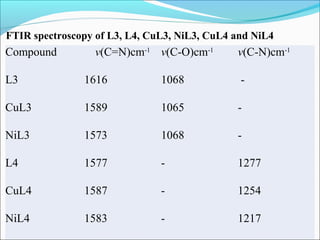
Compound v(C=N)cm-1
v(C-O)cm-1
v(C-N)cm-1
L3 1616 1068 -
CuL3 1589 1065 -
NiL3 1573 1068 -
L4 1577 - 1277
CuL4 1587 - 1254
NiL4 1583 - 1217
FTIR spectroscopy of L3, L4, CuL3, NiL3, CuL4 and NiL4
Conclusion
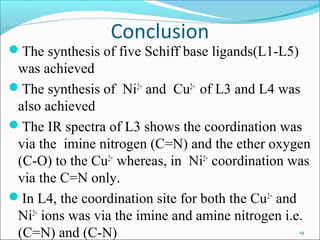
The synthesis of five Schiff base ligands(L1-L5)
was achieved
The synthesis of Ni2+
and Cu2+
of L3 and L4 was
also achieved
The IR spectra of L3 shows the coordination was
via the imine nitrogen (C=N) and the ether oxygen
(C-O) to the Cu2+
whereas, in Ni2+
coordination was
via the C=N only.
In L4, the coordination site for both the Cu2+
and
Ni2+
ions was via the imine and amine nitrogen i.e.
(C=N) and (C-N) 19
20
THANKS FOR LISTENING

PresentationS

  • 1.
    HAMED, Sulaimon Adekunle MATRICNO:139073005 SUPERVISOR: DR. I. A. OLASUPO BY 1 Synthesis and Characterization of New Schiff base Ligands derived from substituted and benzylated benzaldehyde and their Metal Complexes
  • 2.
    Presentation Outline Introduction Review ofliterature Aim and Objectives Methodology Results and Discussion Conclusion 2
  • 3.
    Introduction A Schiff baseis a compound having a carbon- nitrogen double bond (C=N). They are products obtained from the condensation of primary amines and carbonyl compounds (Ashraf et al., 2011). R1, R2, and/or R3 = Alkyl or Aryl Ashraf M., Wajid A., Mahmood K., Maah M., and Yusuff I. (2011). Spectra investigation of the Activities of Amino Substituted Bases. Oriental Journal of Chemistry. 27(2): 363-372. 3
  • 4.
    4 Mechanisms of Schiffbase formation The mechanism of Schiff base synthetic reaction involves a nucleophilic attack of the primary amine through its lone pair of electrons on the electrophilic carbonyl carbon.
  • 5.
    5 Schiff base Synthesis Fourcommon methods that vary in reaction time, product, and percentage yield have been reported for the synthesis of Schiff bases. These methods include: • Microwave method • Room temperature method • Grindstone method • Reflux method
  • 6.
    Applications of Schiffbases Schiff bases derived from aromatic and aliphatic amines and aldehydes show a lot of biological importance as well as wide range of applications (Kumar et al., 2009). These includes: Application in medicine and pharmacy Application in synthesis and chemical analysis Agricultural applications Application in coordination chemistry Kumar, S., Dhar, D. N., and Saxena, P. N. (2009). Applications of metal complexes of Schiff bases-a review. Journal of scientific and industrial research. 68(3): 181 - 187. 6
  • 7.
    Schiff base metalcomplexes • Transition metals are known to form Schiff base complexes. • It is known that the existence of metal ions bonded to biologically active compounds may enhance their activities (Song et al., 2005). • A typical example of a salicylaldehyde diimine Schiff base complex is shown below: 7 Song, X.Z., Wang,Y., Wang, Z., Zhang, Chen, C. (2005). Chemistry Abstract. 143: 367252.
  • 8.
    Review of Literature Fasinaet al., (2012) synthesized and characterized a Schiff base derived from o-phenylenediamine and 5- bromosalicylaldehyde and of its metal complexes The IR spectrum absorption bands of the ligand at 1602(C=N) and 1270cm-1 (C-O) appeared at lower frequency. 8 Fasina, T. M., Ogundele, F. N., Ejiah, and Dueke-Eze, C. U. (2012). Biological Activity of copper(II), cobalt(II), and nickel(II) complexes of Schiff base derived from o-phenylenediamine and 5-bromosalicylaldehyde. International Journal of Biological Chemistry. 6(1): 24-30.
  • 9.
    9 • Sobola etal., (2014) synthesized and characterized copper(II) complexes of some ortho- substituted aniline Schiff bases. • The imine (C=N) functional group shifted from 1612-1615cm-1 to 1602-1606cm-1 • C-O functional group shifted from 1280–1273cm-1 to 1336–1325cm-1 . Sobola, A. O., Watkins, G. M., & Van Brecht, B. (2014). Synthesis, characterization and antimicrobial activity of copper (II) complexes of some ortho-substituted aniline Schiff bases; crystal structure of bis (2-methoxy-6-imino) methylphenol copper (II) complex. South African Journal of Chemistry. 67: 45-51.
  • 10.
    10 • Mounika etal., (2010) reported the synthesis and characterization of a Schiff base derived from 3-Ethoxy Salicylaldehyde with 2-Amino Benzoic acid and their complexes •The imine (C=N) functional group shifted from 1622cm-1 to 1592-1556cm-1 ) • C=O functional group shifted from 1692cm-1 to 1654– 1586cm-1 . Mounika, K., Pragathi, A., and Gyanakumari, C. (2010). Synthesis characterization and biological activity of a Schiff base derived from 3-ethoxy salicylaldehyde and 2-amino benzoic acid and its transition metal complexes. Journal of Scientific Research. 2(3): 513 -528.
  • 11.
    Aim and Objectives Theaim of this research work is to synthesize and carry out physico-chemical characterization of new Schiff base ligands and their complexes. Specifically, the research objectives are: To synthesize new Schiff base ligands derived from substituted and benzylated benzaldehyde and aniline. To form Cu2+ and Ni2+ complexes of 2-(benzyloxy)-5- bromobenzaladehyde and 3-chlorodimethyl-4- ((phenylimino)methyl)aniline To characterize the synthesized Schiff bases and their respective metal complexes using Infrared (IR) technique 11
  • 12.
    Methodology The reflux methodwas adopted in the synthesis of the Schiff bases and the formation of the metal complexes Synthesis of the Schiff base ligands (L1, L2 &L3) L1-L3 L1: X = H, Y = OEt L2: X = H, Y = OMe L3: X= Br, Y= H 12
  • 13.
    Synthesis of Schiffbase Ligand, L4 Synthesis of Schiff base Ligand, L5 13
  • 14.
    14 Formation of Cu(II)and Ni(II) complexes of L3 and L4 • All the metal-ligand complexes (ML) were formed by reaction of hydrated metal salts(CuCl2.2H2O, NiCl2.6H2O) and the Schiff base ligands in a molar ratio of (1:1) under reflux for 4 hours.
  • 15.
    Result and Discussion Physicalproperties of the Schiff base 15 Ligand Molecular weight (g) Texture Colour Melting point(0 C) Yield (%) L1 331 Oil Deep orange _ 92.2 L2 317 Oil Deep orange _ 95.7 L3 366 Crystal Yellow 88-89 56.8 L4 258 Crystal Yellow 140-142 91.08 L5 276 Crystal Orange 103-104 80.0
  • 16.
    16 ComplexColour Texture Melting point Yield (g) CuL3Black Powdery 156-157 0.22 NiL3 Light Yellow Crystalline 131-132 0.19 CuL4 Black Powdery 188-189 0.08 NiL4 Brown Powdery >300 0.33 • Physical properties of Cu and Ni complexes of L3 and L4
  • 17.
    17 Compoundv(C=N)cm-1 vsp3 (C-H) cm-1 vsp2 (C-H)cm-1 v(C-O)cm-1 L1 16172978 - 1060 L2 1618 2934 3028 1068 L3 1616 2967 - 1068 L4 1577 2895 3054 - L5 1611 - - 1273 FTIR spectroscopy of synthesized Schiff bases
  • 18.
    18 Compound v(C=N)cm-1 v(C-O)cm-1 v(C-N)cm-1 L3 16161068 - CuL3 1589 1065 - NiL3 1573 1068 - L4 1577 - 1277 CuL4 1587 - 1254 NiL4 1583 - 1217 FTIR spectroscopy of L3, L4, CuL3, NiL3, CuL4 and NiL4
  • 19.
    Conclusion The synthesis offive Schiff base ligands(L1-L5) was achieved The synthesis of Ni2+ and Cu2+ of L3 and L4 was also achieved The IR spectra of L3 shows the coordination was via the imine nitrogen (C=N) and the ether oxygen (C-O) to the Cu2+ whereas, in Ni2+ coordination was via the C=N only. In L4, the coordination site for both the Cu2+ and Ni2+ ions was via the imine and amine nitrogen i.e. (C=N) and (C-N) 19
  • 20.