Zebrafish based strategy for the identification of a
potential pharmacophore for apoptosis: a greener
CuAAC approach for novel 1,2,3-triazoles derived
from mefenamic acid†
P. Vijaya Babu,ab
Soumita Mukherjee,a
Dhilli Rao Gorja,a
Swapna Yellanki,ac
Raghavender Medisetti,ac
Pushkar Kulkarni,ac
K. Mukkantib
and Manojit Pal*a
Prompted by the potential of a screening strategy in zebrafish for the
identification of valuable pharmacophores, a series of triazole
substituted mefenamic acid derivatives were designed and synthe-
sized via a CuAAC under green conditions. A variety of terminal alkynes
were reacted with the azide obtained from mefenamic acid to give the
expected products in good to excellent yields. When screened for
apoptosis, teratogenicity and hepatotoxicity in zebrafish embryos, one
of these compounds showed encouraging apoptotic properties and
safety profiles and seemed to have medicinal value.
The synthesis of a library of novel small molecules and their
screening in zebrash for early indications of their possible
utility in therapeutic regimes and potential toxic side-effects is
of immense importance. Apart from identifying useful chemical
probes, this strategy can also help in identifying valuable
pharmacophores for the design and discovery of potential drugs
to combat deadly diseases.
Zebrash (or Danio rerio), a small pet-shop sh, has attracted
considerable interest as an emerging model for understanding
human biology and is being pursued as a tool for enhancing
interdisciplinary studies in biology and chemistry as well as in
drug discovery.1
For example, zebrash provide an inexpensive,
reliable and efficient rst-level screening model for testing
toxicity, efficacy, and tissue-targeting for a large number of new
chemical entities (NCEs). The use of zebrash embryos is also
being considered as a one-step strategy to perform develop-
mental screens to identify compounds with bioactivities rele-
vant to vertebrates.2,3
Indeed, pharmacologically active African
plant extracts and subsequently their active components, pos-
sessing anti-angiogenic properties, were identied using this
strategy.4
The structure activity relationship (SAR) studies
centered on pharmacologically active scaffolds have also been
reported using zebrash embryos.5
Our continued interest6–11
in
zebrash as a screening model for NCEs prompted us to design
and synthesise a library of triazole based small organic mole-
cules derived from mefenamic acid to assess their potential
pharmacological effects in zebrash and/or their embryos.
Triazoles, one of the extensively studied 5-membered
nitrogen heterocycles, have found a wide range of applications
especially as drugs and agrochemicals. Besides anti-HIV,12
antiallergic,13
antifungal,14
and antimicrobial15
activities, the
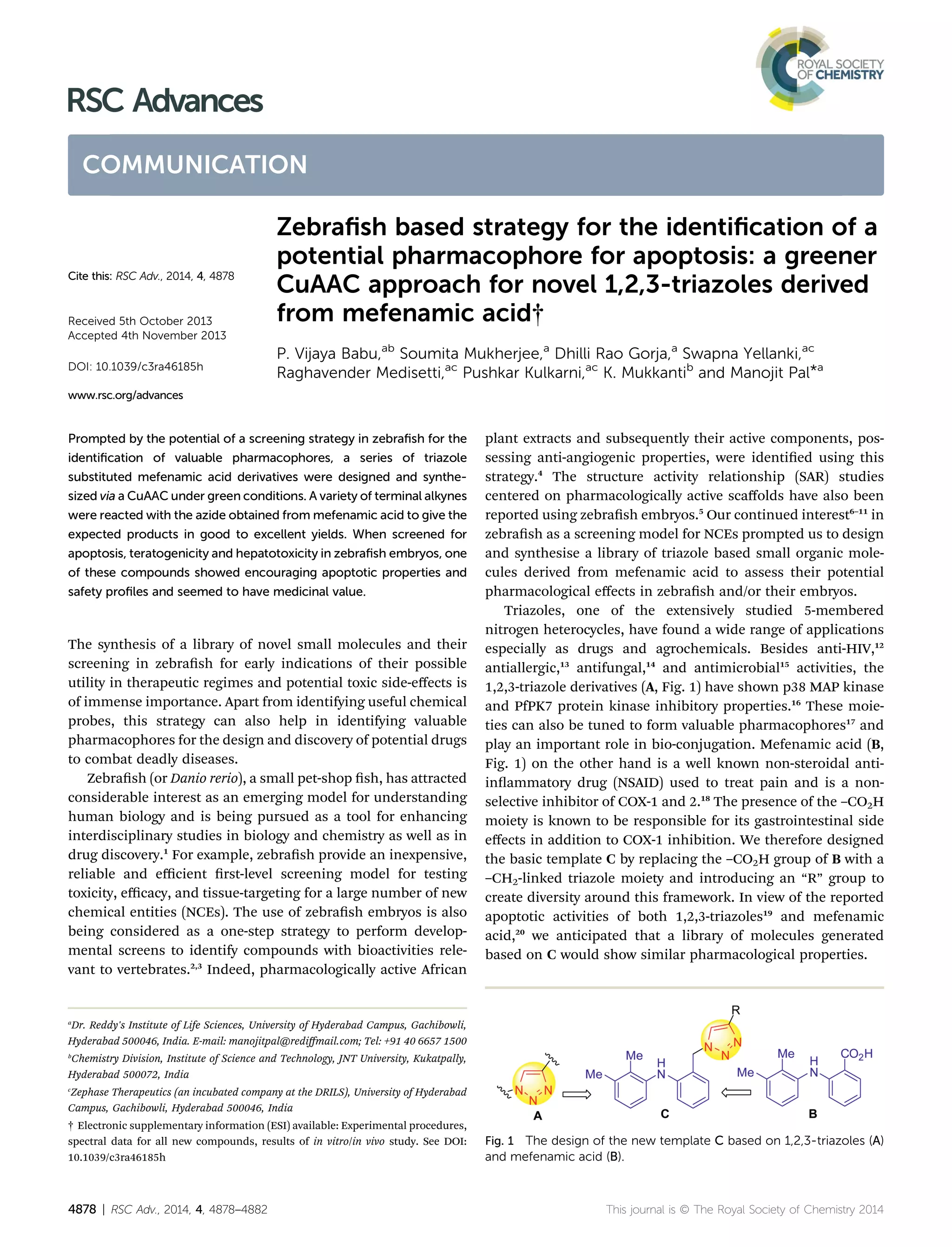
1,2,3-triazole derivatives (A, Fig. 1) have shown p38 MAP kinase
and PfPK7 protein kinase inhibitory properties.16
These moie-
ties can also be tuned to form valuable pharmacophores17
and
play an important role in bio-conjugation. Mefenamic acid (B,
Fig. 1) on the other hand is a well known non-steroidal anti-
inammatory drug (NSAID) used to treat pain and is a non-
selective inhibitor of COX-1 and 2.18
The presence of the –CO2H
moiety is known to be responsible for its gastrointestinal side
effects in addition to COX-1 inhibition. We therefore designed
the basic template C by replacing the –CO2H group of B with a
–CH2-linked triazole moiety and introducing an “R” group to
create diversity around this framework. In view of the reported
apoptotic activities of both 1,2,3-triazoles19
and mefenamic
acid,20
we anticipated that a library of molecules generated
based on C would show similar pharmacological properties.
Fig. 1 The design of the new template C based on 1,2,3-triazoles (A)
and mefenamic acid (B).
a
Dr. Reddy's Institute of Life Sciences, University of Hyderabad Campus, Gachibowli,
Hyderabad 500046, India. E-mail: manojitpal@rediffmail.com; Tel: +91 40 6657 1500
b
Chemistry Division, Institute of Science and Technology, JNT University, Kukatpally,
Hyderabad 500072, India
c
Zephase Therapeutics (an incubated company at the DRILS), University of Hyderabad
Campus, Gachibowli, Hyderabad 500046, India
† Electronic supplementary information (ESI) available: Experimental procedures,
spectral data for all new compounds, results of in vitro/in vivo study. See DOI:
10.1039/c3ra46185h
Cite this: RSC Adv., 2014, 4, 4878
Received 5th October 2013
Accepted 4th November 2013
DOI: 10.1039/c3ra46185h
www.rsc.org/advances
4878 | RSC Adv., 2014, 4, 4878–4882 This journal is © The Royal Society of Chemistry 2014
RSC Advances
COMMUNICATION
1,2,3-Triazoles are generally prepared using a click chemistry
approach due to its specicity, efficiency, simple reaction
workup procedure, and quantitative yield of products.21,22
We
adopted a similar but greener approach to prepare our target
compounds C (or 5, Scheme 1).
The key starting material i.e. the azide 3 was prepared via the
reduction of the carboxylic acid moiety of mefenamic acid (1) to
the corresponding alcohol 2, which was then converted to the
azide 3 (Scheme 1). The Cu-catalysed azide–alkyne cycloaddi-
tion (CuAAC) of the azide 3 and alkyne 4a was performed
initially with a catalytic amount of CuI in the presence of dii-
sopropyl ethyl amine (DIPEA) in DMF. Aer 2 h, the desired
triazole 5a was obtained in 95% yield (entry 1, Table 1). The use
of an inorganic base e.g. K2CO3 (entry 2, Table 1) decreased the
product yield. The reaction did not proceed in the absence of
CuI (entry 3, Table 1) or DIPEA (entry 4, Table 1), indicating the
key role played by the catalyst and the base. The reaction
however proceeded well in the presence of other copper
catalysts e.g. CuCl (entry 5, Table 1) or CuBr (entry 6, Table 1).
While all these reactions were performed in DMF, the use of
other solvents such as 1,4-dioxane, acetonitrile, DMSO and
PEG400 were also successful (entries 7–10, Table 1). To make
this method more economic, we replaced PEG with 1 : 1
PEG400–H2O (entry 11, Table 1) and to make it more environ-
mentally benign we replaced DIPEA with K2CO3 (entry 12,
Table 1). To our delight 5a was obtained in 96 and 95% yield in
both the cases. In order to avoid the use of hazardous organic
amine bases we opted for the reaction conditions of entry 12 of
Table 1 to perform further reactions.
We then prepared a range of 1,2,3-triazole derivatives (5)
using this greener methodology (Table 2). A variety of terminal
alkynes containing alkyl, hydroxyl alkyl, aryl, cyclic alkyl and
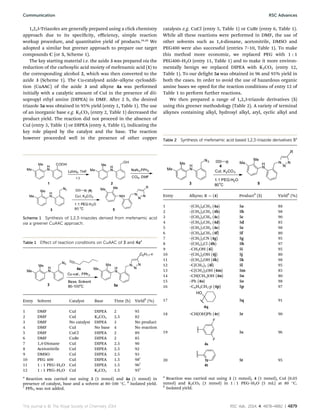
Scheme 1 Synthesis of 1,2,3-triazoles derived from mefenamic acid
via a greener CuAAC approach.
Table 1 Effect of reaction conditions on CuAAC of 3 and 4aa
Entry Solvent Catalyst Base Time (h) Yieldb
(%)
1 DMF CuI DIPEA 2 95
2 DMF CuI K2CO3 2.5 82
3 DMF No catalyst DIPEA 3 No product
4 DMF CuI No base 4 No reaction
5 DMF CuCl DIPEA 2 89
6 DMF CuBr DIPEA 2 85
7 1,4-Dioxane CuI DIPEA 2.5 90
8 Acetonitrile CuI DIPEA 2.5 92
9 DMSO CuI DIPEA 2.5 93
10 PEG 400 CuI DIPEA 1.5 98c
11 1 : 1 PEG–H2O CuI DIPEA 1.5 96c
12 1 : 1 PEG–H2O CuI K2CO3 1.5 95c
a
Reaction was carried out using 3 (1 mmol) and 4a (1 mmol) in
presence of catalyst, base and a solvent at 80–100 
C. b
Isolated yield.
c
PPh3 was not added.
Table 2 Synthesis of mefenamic acid based 1,2,3-triazole derivatives 5a
Entry Alkyne; R ¼ (4) Productb
(5) Yieldb
(%)
1 –(CH2)4CH3 (4a) 5a 88
2 –(CH2)2CH3 (4b) 5b 98
3 –(CH2)3CH3 (4c) 5c 90
4 –(CH2)5CH3 (4d) 5d 85
5 –(CH2)7CH3 (4e) 5e 98
6 –(CH2)9CH3 (4f) 5f 80
7 –(CH2)3CN (4g) 5g 95
8 –(CH2)3Cl (4h) 5h 97
9 –CH2OH (4i) 5i 95
10 –(CH2)2OH (4j) 5j 80
11 –(CH2)3OH (4k) 5k 98
12 –C(CH3)3 (4l) 5l 95
13 –C(CH3)2OH (4m) 5m 85
14 –CH(CH3)OH (4n) 5n 80
15 –Ph (4o) 5o 98
16 –C6H4CH3-p (4p) 5p 97
17 5q 91
18 –CH(OH)Ph (4r) 5r 90
19 5s 96
20 5t 95
a
Reaction was carried out using 3 (1 mmol), 4 (1 mmol), CuI (0.05
mmol) and K2CO3 (3 mmol) in 1 : 1 PEG–H2O (5 mL) at 80 
C.
b
Isolated yield.
This journal is © The Royal Society of Chemistry 2014 RSC Adv., 2014, 4, 4878–4882 | 4879
Communication RSC Advances
heterocyclic moieties were reacted with the azide 3 to give the
corresponding products 5 in good to excellent yields.
All the mefenamic acid based 1,2,3-triazole derivatives 5
prepared were characterized using NMR, IR and MS spectros-
copy. In most cases the appearance of a singlet at 7.40 d (this
singlet was merged with another aromatic proton in some
cases) in the 1
H NMR and a signal at 122.6 ppm in the 13
C NMR
conrmed the presence of a triazole ring.
These compounds (only solids) were tested for their
apoptotic activities initially at 30 mM using zebrash embryos.
Apoptosis23
is an ordered and orchestrated cellular process that
occurs under physiological and pathological conditions. Its
complex mechanism involves many pathways. Defects in
apoptotic pathways are thought to contribute to a number of
human diseases, ranging from neurodegenerative disorders to
malignancy.23
For example, cancer is associated with a lower
degree of apoptosis and most cytotoxic anticancer agents are
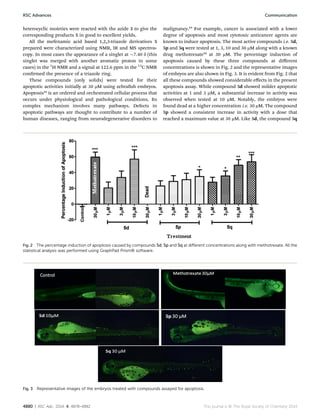
known to induce apoptosis. The most active compounds i.e. 5d,
5p and 5q were tested at 1, 3, 10 and 30 mM along with a known
drug methotrexate24
at 30 mM. The percentage induction of
apoptosis caused by these three compounds at different
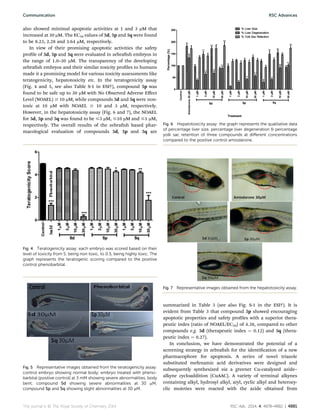
concentrations is shown in Fig. 2 and the representative images
of embryos are also shown in Fig. 3. It is evident from Fig. 2 that
all these compounds showed considerable effects in the present
apoptosis assay. While compound 5d showed milder apoptotic
activities at 1 and 3 mM, a substantial increase in activity was
observed when tested at 10 mM. Notably, the embryos were
found dead at a higher concentration i.e. 30 mM. The compound
5p showed a consistent increase in activity with a dose that
reached a maximum value at 30 mM. Like 5d, the compound 5q
Fig. 2 The percentage induction of apoptosis caused by compounds 5d, 5p and 5q at different concentrations along with methotrexate. All the
statistical analysis was performed using GraphPad Prism® software.
Fig. 3 Representative images of the embryos treated with compounds assayed for apoptosis.
4880 | RSC Adv., 2014, 4, 4878–4882 This journal is © The Royal Society of Chemistry 2014
RSC Advances Communication
also showed minimal apoptotic activities at 1 and 3 mM that
increased at 30 mM. The EC50 values of 5d, 5p and 5q were found
to be 8.23, 2.28 and 3.64 mM, respectively.
In view of their promising apoptotic activities the safety
prole of 5d, 5p and 5q were evaluated in zebrash embryos in
the range of 1.0–30 mM. The transparency of the developing
zebrash embryos and their similar toxicity proles to humans
made it a promising model for various toxicity assessments like
teratogenicity, hepatotoxicity etc. In the teratogenicity assay
(Fig. 4 and 5, see also Table S-1 in ESI†), compound 5p was
found to be safe up to 30 mM with No Observed Adverse Effect
Level (NOAEL) $ 10 mM, while compounds 5d and 5q were non-
toxic at 10 mM with NOAEL $ 10 and 3 mM, respectively.
However, in the hepatotoxicity assay (Fig. 6 and 7), the NOAEL
for 5d, 5p and 5q was found to be #3 mM, #10 mM and #1 mM,
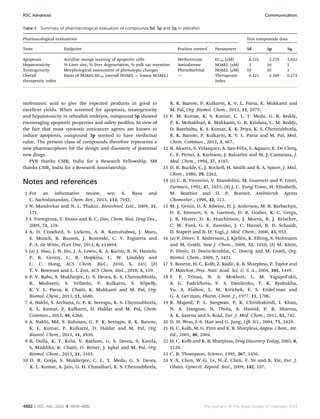
respectively. The overall results of the zebrash based phar-
macological evaluation of compounds 5d, 5p and 5q are
summarized in Table 3 (see also Fig. S-1 in the ESI†). It is
evident from Table 3 that compound 5p showed encouraging
apoptotic properties and safety proles with a superior thera-
peutic index (ratio of NOAEL/EC50) of 4.38, compared to other
compounds e.g. 5d (therapeutic index ¼ 0.12) and 5q (thera-
peutic index ¼ 0.27).
In conclusion, we have demonstrated the potential of a
screening strategy in zebrash for the identication of a new
pharmacophore for apoptosis. A series of novel triazole
substituted mefenamic acid derivatives were designed and
subsequently synthesized via a greener Cu-catalyzed azide–
alkyne cycloaddition (CuAAC). A variety of terminal alkynes
containing alkyl, hydroxyl alkyl, aryl, cyclic alkyl and heterocy-
clic moieties were reacted with the azide obtained from
Fig. 4 Teratogenicity assay: each embryo was scored based on their
level of toxicity from 5, being non toxic, to 0.5, being highly toxic. The
graph represents the teratogenic scoring compared to the positive
control phenobarbital.
Fig. 5 Representative images obtained from the teratogenicity assay:
control embryo showing normal body; embryo treated with pheno-
barbital (positive control) at 3 mM showing severe abnormalities, body
bent; compound 5d showing severe abnormalities at 30 mM;
compound 5p and 5q showing slight abnormalities at 30 mM.
Fig. 6 Hepatotoxicity assay: the graph represents the qualitative data
of percentage liver size, percentage liver degeneration  percentage
yolk sac retention of three compounds at different concentrations
compared to the positive control amiodarone.
Fig. 7 Representative images obtained from the hepatotoxicity assay.
This journal is © The Royal Society of Chemistry 2014 RSC Adv., 2014, 4, 4878–4882 | 4881
Communication RSC Advances
mefenamic acid to give the expected products in good to
excellent yields. When screened for apoptosis, teratogenicity
and hepatotoxicity in zebrash embryos, compound 5p showed
encouraging apoptotic properties and safety proles. In view of
the fact that most cytotoxic anticancer agents are known to
induce apoptosis, compound 5p seemed to have medicinal
value. The present class of compounds therefore represents a
new pharmacophore for the design and discovery of potential
new drugs.
PVB thanks CSIR, India for a Research Fellowship. SM
thanks CSIR, India for a Research Associateship.
Notes and references
1 For an informative review, see: S. Basu and
C. Sachidanandan, Chem. Rev., 2013, 113, 7952.
2 N. Mandrekar and N. L. Thakur, Biotechnol. Lett., 2009, 31,
171.
3 I. Torregroza, T. Evans and B. C. Das, Chem. Biol. Drug Des.,
2009, 73, 339.
4 A. D. Crawford, S. Liekens, A. R. Kamuhabwa, J. Maes,
S. Munck, R. Busson, J. Rozenski, C. V. Esguerra and
P. A. de Witte, PLoS One, 2011, 6, e14694.
5 (a) J. Hao, J. N. Ho, J. A. Lewis, K. A. Karim, R. N. Daniels,
P. R. Gentry, C. R. Hopkins, C. W. Lindsley and
C. C. Hong, ACS Chem. Biol., 2010, 5, 245; (b)
T. V. Bowman and L. I. Zon, ACS Chem. Biol., 2010, 5, 159.
6 P. V. Babu, S. Mukherjee, G. S. Deora, K. S. Chennubhotla,
R. Medisetti, S. Yellanki, P. Kulkarni, S. Sripelly,
K. V. L. Parsa, K. Chatti, K. Mukkanti and M. Pal, Org.
Biomol. Chem., 2013, 11, 6680.
7 A. Nakhi, S. Archana, G. P. K. Seerapu, K. S. Chennubhotla,
K. L. Kumar, P. Kulkarni, D. Haldar and M. Pal, Chem.
Commun., 2013, 49, 6268.
8 A. Nakhi, Md. S. Rahman, G. P. K. Seerapu, R. K. Banote,
K. L. Kumar, P. Kulkarni, D. Haldar and M. Pal, Org.
Biomol. Chem., 2013, 11, 4930.
9 B. Dulla, K. T. Kirla, V. Rathore, G. S. Deora, S. Kavela,
S. Maddika, K. Chatti, O. Reiser, J. Iqbal and M. Pal, Org.
Biomol. Chem., 2013, 11, 3103.
10 D. R. Gorja, S. Mukherjee, C. L. T. Meda, G. S. Deora,
K. L. Kumar, A. Jain, G. H. Chaudhari, K. S. Chennubhotla,
R. K. Banote, P. Kulkarni, K. V. L. Parsa, K. Mukkanti and
M. Pal, Org. Biomol. Chem., 2013, 11, 2075.
11 P. M. Kumar, K. S. Kumar, C. L. T. Meda, G. R. Reddy,
P. K. Mohakhud, K. Mukkanti, G. R. Krishna, C. M. Reddy,
D. Rambabu, K. S. Kumar, K. K. Priya, K. S. Chennubhotla,
R. K. Banote, P. Kulkarni, K. V. L. Parsa and M. Pal, Med.
Chem. Commun., 2012, 3, 667.
12 R. Alvarez, S. Vel´azquez, A. San-F´elix, S. Aquaro, E. De Clerq,
C. F. Perno, A. Karlsson, J. Balzarini and M. J. Camarasa, J.
Med. Chem., 1994, 37, 4185.
13 D. R. Buckle, C. J. Rockell, H. Smith and B. A. Spicer, J. Med.
Chem., 1986, 29, 2262.
14 (a) C. B. Vicentini, V. Brandolini, M. Guarneri and P. Giori,
Farmaco, 1992, 47, 1021; (b) J. C. Fung-Tomc, H. Elizabeth,
M. Beatrice and D. P. Bonner, Antimicrob. Agents
Chemother., 1998, 42, 313.
15 M. J. Genin, D. A. Allwine, D. J. Anderson, M. R. Barbachyn,
D. E. Emmert, S. A. Garmon, D. R. Graber, K. C. Grega,
J. B. Hester, D. K. Hutchinson, J. Morris, R. J. Reischer,
C. W. Ford, G. E. Zurenko, J. C. Hamel, R. D. Schaadt,
D. Stapert and B. H. Yagi, J. Med. Chem., 2000, 43, 953.
16 (a) P. Diner, T. Andersson, J. Kjell´en, K. Elbing, S. Hohmann
and M. Grøtli, New J. Chem., 2009, 33, 1010; (b) M. Klein,
P. Din´er, D. Dorin-Semblat, C. Doerig and M. Grøtli, Org.
Biomol. Chem., 2009, 7, 3421.
17 Y. Bourne, H. C. Kolb, Z. Radi´c, K. B. Sharpless, P. Taylor and
P. Marchot, Proc. Natl. Acad. Sci. U. S. A., 2004, 101, 1449.
18 F. P. Trinus, N. A. Mokhort, L. M. Yagupol'skii,
A. G. Fadeicheva, V. S. Danilenko, T. K. Ryabukha,
Yu. A. Fialkov, L. M. Kirichek, ´E. S. Endel'man and
G. A. Get'man, Pharm. Chem. J., 1977, 11, 1706.
19 R. Majeed, P. L. Sangwan, P. K. Chinthakindi, I. Khan,
N. A. Dangroo, N. Thota, A. Hamid, P. R. Sharma,
A. K. Saxena and S. Koul, Eur. J. Med. Chem., 2013, 63, 782.
20 D. H. Woo, I.-S. Han and G. Jung, Life Sci., 2004, 75, 2439.
21 H. C. Kolb, M. G. Finn and K. B. Sharpless, Angew. Chem., Int.
Ed., 2001, 40, 2004.
22 H. C. Kolb and K. B. Sharpless, Drug Discovery Today, 2003, 8,
1128.
23 C. B. Thompson, Science, 1995, 267, 1456.
24 Y.-X. Chen, W.-G. Lv, H.-Z. Chen, F. Ye and X. Xie, Eur. J.
Obstet. Gynecol. Reprod. Biol., 2009, 142, 107.
Table 3 Summary of pharmacological evaluation of compounds 5d, 5p and 5q in zebrafish
Pharmacological evaluations Test compounds data
Tests Endpoint Positive control Parameters 5d 5p 5q
Apoptosis Acridine orange staining of apoptotic cells Methotrexate EC50 (mM) 8.231 2.278 3.642
Hepatotoxicity % Liver size, % liver degeneration, % yolk sac retention Amiodarone NOAEL (mM) 1 10 1
Teratogenicity Morphological assessment of phenotypic changes Phenobarbital NOAEL (mM) 10 10 3
Overall
therapeutic index
Ratio of NOAEL/EC50 (overall NOAEL ¼ lowest NOAEL) — Therapeutic
index
0.121 4.389 0.274
4882 | RSC Adv., 2014, 4, 4878–4882 This journal is © The Royal Society of Chemistry 2014
RSC Advances Communication

Rsc advance -2014

  • 1.
    Zebrafish based strategyfor the identification of a potential pharmacophore for apoptosis: a greener CuAAC approach for novel 1,2,3-triazoles derived from mefenamic acid† P. Vijaya Babu,ab Soumita Mukherjee,a Dhilli Rao Gorja,a Swapna Yellanki,ac Raghavender Medisetti,ac Pushkar Kulkarni,ac K. Mukkantib and Manojit Pal*a Prompted by the potential of a screening strategy in zebrafish for the identification of valuable pharmacophores, a series of triazole substituted mefenamic acid derivatives were designed and synthe- sized via a CuAAC under green conditions. A variety of terminal alkynes were reacted with the azide obtained from mefenamic acid to give the expected products in good to excellent yields. When screened for apoptosis, teratogenicity and hepatotoxicity in zebrafish embryos, one of these compounds showed encouraging apoptotic properties and safety profiles and seemed to have medicinal value. The synthesis of a library of novel small molecules and their screening in zebrash for early indications of their possible utility in therapeutic regimes and potential toxic side-effects is of immense importance. Apart from identifying useful chemical probes, this strategy can also help in identifying valuable pharmacophores for the design and discovery of potential drugs to combat deadly diseases. Zebrash (or Danio rerio), a small pet-shop sh, has attracted considerable interest as an emerging model for understanding human biology and is being pursued as a tool for enhancing interdisciplinary studies in biology and chemistry as well as in drug discovery.1 For example, zebrash provide an inexpensive, reliable and efficient rst-level screening model for testing toxicity, efficacy, and tissue-targeting for a large number of new chemical entities (NCEs). The use of zebrash embryos is also being considered as a one-step strategy to perform develop- mental screens to identify compounds with bioactivities rele- vant to vertebrates.2,3 Indeed, pharmacologically active African plant extracts and subsequently their active components, pos- sessing anti-angiogenic properties, were identied using this strategy.4 The structure activity relationship (SAR) studies centered on pharmacologically active scaffolds have also been reported using zebrash embryos.5 Our continued interest6–11 in zebrash as a screening model for NCEs prompted us to design and synthesise a library of triazole based small organic mole- cules derived from mefenamic acid to assess their potential pharmacological effects in zebrash and/or their embryos. Triazoles, one of the extensively studied 5-membered nitrogen heterocycles, have found a wide range of applications especially as drugs and agrochemicals. Besides anti-HIV,12 antiallergic,13 antifungal,14 and antimicrobial15 activities, the 1,2,3-triazole derivatives (A, Fig. 1) have shown p38 MAP kinase and PfPK7 protein kinase inhibitory properties.16 These moie- ties can also be tuned to form valuable pharmacophores17 and play an important role in bio-conjugation. Mefenamic acid (B, Fig. 1) on the other hand is a well known non-steroidal anti- inammatory drug (NSAID) used to treat pain and is a non- selective inhibitor of COX-1 and 2.18 The presence of the –CO2H moiety is known to be responsible for its gastrointestinal side effects in addition to COX-1 inhibition. We therefore designed the basic template C by replacing the –CO2H group of B with a –CH2-linked triazole moiety and introducing an “R” group to create diversity around this framework. In view of the reported apoptotic activities of both 1,2,3-triazoles19 and mefenamic acid,20 we anticipated that a library of molecules generated based on C would show similar pharmacological properties. Fig. 1 The design of the new template C based on 1,2,3-triazoles (A) and mefenamic acid (B). a Dr. Reddy's Institute of Life Sciences, University of Hyderabad Campus, Gachibowli, Hyderabad 500046, India. E-mail: manojitpal@rediffmail.com; Tel: +91 40 6657 1500 b Chemistry Division, Institute of Science and Technology, JNT University, Kukatpally, Hyderabad 500072, India c Zephase Therapeutics (an incubated company at the DRILS), University of Hyderabad Campus, Gachibowli, Hyderabad 500046, India † Electronic supplementary information (ESI) available: Experimental procedures, spectral data for all new compounds, results of in vitro/in vivo study. See DOI: 10.1039/c3ra46185h Cite this: RSC Adv., 2014, 4, 4878 Received 5th October 2013 Accepted 4th November 2013 DOI: 10.1039/c3ra46185h www.rsc.org/advances 4878 | RSC Adv., 2014, 4, 4878–4882 This journal is © The Royal Society of Chemistry 2014 RSC Advances COMMUNICATION
  • 2.
    1,2,3-Triazoles are generallyprepared using a click chemistry approach due to its specicity, efficiency, simple reaction workup procedure, and quantitative yield of products.21,22 We adopted a similar but greener approach to prepare our target compounds C (or 5, Scheme 1). The key starting material i.e. the azide 3 was prepared via the reduction of the carboxylic acid moiety of mefenamic acid (1) to the corresponding alcohol 2, which was then converted to the azide 3 (Scheme 1). The Cu-catalysed azide–alkyne cycloaddi- tion (CuAAC) of the azide 3 and alkyne 4a was performed initially with a catalytic amount of CuI in the presence of dii- sopropyl ethyl amine (DIPEA) in DMF. Aer 2 h, the desired triazole 5a was obtained in 95% yield (entry 1, Table 1). The use of an inorganic base e.g. K2CO3 (entry 2, Table 1) decreased the product yield. The reaction did not proceed in the absence of CuI (entry 3, Table 1) or DIPEA (entry 4, Table 1), indicating the key role played by the catalyst and the base. The reaction however proceeded well in the presence of other copper catalysts e.g. CuCl (entry 5, Table 1) or CuBr (entry 6, Table 1). While all these reactions were performed in DMF, the use of other solvents such as 1,4-dioxane, acetonitrile, DMSO and PEG400 were also successful (entries 7–10, Table 1). To make this method more economic, we replaced PEG with 1 : 1 PEG400–H2O (entry 11, Table 1) and to make it more environ- mentally benign we replaced DIPEA with K2CO3 (entry 12, Table 1). To our delight 5a was obtained in 96 and 95% yield in both the cases. In order to avoid the use of hazardous organic amine bases we opted for the reaction conditions of entry 12 of Table 1 to perform further reactions. We then prepared a range of 1,2,3-triazole derivatives (5) using this greener methodology (Table 2). A variety of terminal alkynes containing alkyl, hydroxyl alkyl, aryl, cyclic alkyl and Scheme 1 Synthesis of 1,2,3-triazoles derived from mefenamic acid via a greener CuAAC approach. Table 1 Effect of reaction conditions on CuAAC of 3 and 4aa Entry Solvent Catalyst Base Time (h) Yieldb (%) 1 DMF CuI DIPEA 2 95 2 DMF CuI K2CO3 2.5 82 3 DMF No catalyst DIPEA 3 No product 4 DMF CuI No base 4 No reaction 5 DMF CuCl DIPEA 2 89 6 DMF CuBr DIPEA 2 85 7 1,4-Dioxane CuI DIPEA 2.5 90 8 Acetonitrile CuI DIPEA 2.5 92 9 DMSO CuI DIPEA 2.5 93 10 PEG 400 CuI DIPEA 1.5 98c 11 1 : 1 PEG–H2O CuI DIPEA 1.5 96c 12 1 : 1 PEG–H2O CuI K2CO3 1.5 95c a Reaction was carried out using 3 (1 mmol) and 4a (1 mmol) in presence of catalyst, base and a solvent at 80–100 C. b Isolated yield. c PPh3 was not added. Table 2 Synthesis of mefenamic acid based 1,2,3-triazole derivatives 5a Entry Alkyne; R ¼ (4) Productb (5) Yieldb (%) 1 –(CH2)4CH3 (4a) 5a 88 2 –(CH2)2CH3 (4b) 5b 98 3 –(CH2)3CH3 (4c) 5c 90 4 –(CH2)5CH3 (4d) 5d 85 5 –(CH2)7CH3 (4e) 5e 98 6 –(CH2)9CH3 (4f) 5f 80 7 –(CH2)3CN (4g) 5g 95 8 –(CH2)3Cl (4h) 5h 97 9 –CH2OH (4i) 5i 95 10 –(CH2)2OH (4j) 5j 80 11 –(CH2)3OH (4k) 5k 98 12 –C(CH3)3 (4l) 5l 95 13 –C(CH3)2OH (4m) 5m 85 14 –CH(CH3)OH (4n) 5n 80 15 –Ph (4o) 5o 98 16 –C6H4CH3-p (4p) 5p 97 17 5q 91 18 –CH(OH)Ph (4r) 5r 90 19 5s 96 20 5t 95 a Reaction was carried out using 3 (1 mmol), 4 (1 mmol), CuI (0.05 mmol) and K2CO3 (3 mmol) in 1 : 1 PEG–H2O (5 mL) at 80 C. b Isolated yield. This journal is © The Royal Society of Chemistry 2014 RSC Adv., 2014, 4, 4878–4882 | 4879 Communication RSC Advances
  • 3.
    heterocyclic moieties werereacted with the azide 3 to give the corresponding products 5 in good to excellent yields. All the mefenamic acid based 1,2,3-triazole derivatives 5 prepared were characterized using NMR, IR and MS spectros- copy. In most cases the appearance of a singlet at 7.40 d (this singlet was merged with another aromatic proton in some cases) in the 1 H NMR and a signal at 122.6 ppm in the 13 C NMR conrmed the presence of a triazole ring. These compounds (only solids) were tested for their apoptotic activities initially at 30 mM using zebrash embryos. Apoptosis23 is an ordered and orchestrated cellular process that occurs under physiological and pathological conditions. Its complex mechanism involves many pathways. Defects in apoptotic pathways are thought to contribute to a number of human diseases, ranging from neurodegenerative disorders to malignancy.23 For example, cancer is associated with a lower degree of apoptosis and most cytotoxic anticancer agents are known to induce apoptosis. The most active compounds i.e. 5d, 5p and 5q were tested at 1, 3, 10 and 30 mM along with a known drug methotrexate24 at 30 mM. The percentage induction of apoptosis caused by these three compounds at different concentrations is shown in Fig. 2 and the representative images of embryos are also shown in Fig. 3. It is evident from Fig. 2 that all these compounds showed considerable effects in the present apoptosis assay. While compound 5d showed milder apoptotic activities at 1 and 3 mM, a substantial increase in activity was observed when tested at 10 mM. Notably, the embryos were found dead at a higher concentration i.e. 30 mM. The compound 5p showed a consistent increase in activity with a dose that reached a maximum value at 30 mM. Like 5d, the compound 5q Fig. 2 The percentage induction of apoptosis caused by compounds 5d, 5p and 5q at different concentrations along with methotrexate. All the statistical analysis was performed using GraphPad Prism® software. Fig. 3 Representative images of the embryos treated with compounds assayed for apoptosis. 4880 | RSC Adv., 2014, 4, 4878–4882 This journal is © The Royal Society of Chemistry 2014 RSC Advances Communication
  • 4.
    also showed minimalapoptotic activities at 1 and 3 mM that increased at 30 mM. The EC50 values of 5d, 5p and 5q were found to be 8.23, 2.28 and 3.64 mM, respectively. In view of their promising apoptotic activities the safety prole of 5d, 5p and 5q were evaluated in zebrash embryos in the range of 1.0–30 mM. The transparency of the developing zebrash embryos and their similar toxicity proles to humans made it a promising model for various toxicity assessments like teratogenicity, hepatotoxicity etc. In the teratogenicity assay (Fig. 4 and 5, see also Table S-1 in ESI†), compound 5p was found to be safe up to 30 mM with No Observed Adverse Effect Level (NOAEL) $ 10 mM, while compounds 5d and 5q were non- toxic at 10 mM with NOAEL $ 10 and 3 mM, respectively. However, in the hepatotoxicity assay (Fig. 6 and 7), the NOAEL for 5d, 5p and 5q was found to be #3 mM, #10 mM and #1 mM, respectively. The overall results of the zebrash based phar- macological evaluation of compounds 5d, 5p and 5q are summarized in Table 3 (see also Fig. S-1 in the ESI†). It is evident from Table 3 that compound 5p showed encouraging apoptotic properties and safety proles with a superior thera- peutic index (ratio of NOAEL/EC50) of 4.38, compared to other compounds e.g. 5d (therapeutic index ¼ 0.12) and 5q (thera- peutic index ¼ 0.27). In conclusion, we have demonstrated the potential of a screening strategy in zebrash for the identication of a new pharmacophore for apoptosis. A series of novel triazole substituted mefenamic acid derivatives were designed and subsequently synthesized via a greener Cu-catalyzed azide– alkyne cycloaddition (CuAAC). A variety of terminal alkynes containing alkyl, hydroxyl alkyl, aryl, cyclic alkyl and heterocy- clic moieties were reacted with the azide obtained from Fig. 4 Teratogenicity assay: each embryo was scored based on their level of toxicity from 5, being non toxic, to 0.5, being highly toxic. The graph represents the teratogenic scoring compared to the positive control phenobarbital. Fig. 5 Representative images obtained from the teratogenicity assay: control embryo showing normal body; embryo treated with pheno- barbital (positive control) at 3 mM showing severe abnormalities, body bent; compound 5d showing severe abnormalities at 30 mM; compound 5p and 5q showing slight abnormalities at 30 mM. Fig. 6 Hepatotoxicity assay: the graph represents the qualitative data of percentage liver size, percentage liver degeneration percentage yolk sac retention of three compounds at different concentrations compared to the positive control amiodarone. Fig. 7 Representative images obtained from the hepatotoxicity assay. This journal is © The Royal Society of Chemistry 2014 RSC Adv., 2014, 4, 4878–4882 | 4881 Communication RSC Advances
  • 5.
    mefenamic acid togive the expected products in good to excellent yields. When screened for apoptosis, teratogenicity and hepatotoxicity in zebrash embryos, compound 5p showed encouraging apoptotic properties and safety proles. In view of the fact that most cytotoxic anticancer agents are known to induce apoptosis, compound 5p seemed to have medicinal value. The present class of compounds therefore represents a new pharmacophore for the design and discovery of potential new drugs. PVB thanks CSIR, India for a Research Fellowship. SM thanks CSIR, India for a Research Associateship. Notes and references 1 For an informative review, see: S. Basu and C. Sachidanandan, Chem. Rev., 2013, 113, 7952. 2 N. Mandrekar and N. L. Thakur, Biotechnol. Lett., 2009, 31, 171. 3 I. Torregroza, T. Evans and B. C. Das, Chem. Biol. Drug Des., 2009, 73, 339. 4 A. D. Crawford, S. Liekens, A. R. Kamuhabwa, J. Maes, S. Munck, R. Busson, J. Rozenski, C. V. Esguerra and P. A. de Witte, PLoS One, 2011, 6, e14694. 5 (a) J. Hao, J. N. Ho, J. A. Lewis, K. A. Karim, R. N. Daniels, P. R. Gentry, C. R. Hopkins, C. W. Lindsley and C. C. Hong, ACS Chem. Biol., 2010, 5, 245; (b) T. V. Bowman and L. I. Zon, ACS Chem. Biol., 2010, 5, 159. 6 P. V. Babu, S. Mukherjee, G. S. Deora, K. S. Chennubhotla, R. Medisetti, S. Yellanki, P. Kulkarni, S. Sripelly, K. V. L. Parsa, K. Chatti, K. Mukkanti and M. Pal, Org. Biomol. Chem., 2013, 11, 6680. 7 A. Nakhi, S. Archana, G. P. K. Seerapu, K. S. Chennubhotla, K. L. Kumar, P. Kulkarni, D. Haldar and M. Pal, Chem. Commun., 2013, 49, 6268. 8 A. Nakhi, Md. S. Rahman, G. P. K. Seerapu, R. K. Banote, K. L. Kumar, P. Kulkarni, D. Haldar and M. Pal, Org. Biomol. Chem., 2013, 11, 4930. 9 B. Dulla, K. T. Kirla, V. Rathore, G. S. Deora, S. Kavela, S. Maddika, K. Chatti, O. Reiser, J. Iqbal and M. Pal, Org. Biomol. Chem., 2013, 11, 3103. 10 D. R. Gorja, S. Mukherjee, C. L. T. Meda, G. S. Deora, K. L. Kumar, A. Jain, G. H. Chaudhari, K. S. Chennubhotla, R. K. Banote, P. Kulkarni, K. V. L. Parsa, K. Mukkanti and M. Pal, Org. Biomol. Chem., 2013, 11, 2075. 11 P. M. Kumar, K. S. Kumar, C. L. T. Meda, G. R. Reddy, P. K. Mohakhud, K. Mukkanti, G. R. Krishna, C. M. Reddy, D. Rambabu, K. S. Kumar, K. K. Priya, K. S. Chennubhotla, R. K. Banote, P. Kulkarni, K. V. L. Parsa and M. Pal, Med. Chem. Commun., 2012, 3, 667. 12 R. Alvarez, S. Vel´azquez, A. San-F´elix, S. Aquaro, E. De Clerq, C. F. Perno, A. Karlsson, J. Balzarini and M. J. Camarasa, J. Med. Chem., 1994, 37, 4185. 13 D. R. Buckle, C. J. Rockell, H. Smith and B. A. Spicer, J. Med. Chem., 1986, 29, 2262. 14 (a) C. B. Vicentini, V. Brandolini, M. Guarneri and P. Giori, Farmaco, 1992, 47, 1021; (b) J. C. Fung-Tomc, H. Elizabeth, M. Beatrice and D. P. Bonner, Antimicrob. Agents Chemother., 1998, 42, 313. 15 M. J. Genin, D. A. Allwine, D. J. Anderson, M. R. Barbachyn, D. E. Emmert, S. A. Garmon, D. R. Graber, K. C. Grega, J. B. Hester, D. K. Hutchinson, J. Morris, R. J. Reischer, C. W. Ford, G. E. Zurenko, J. C. Hamel, R. D. Schaadt, D. Stapert and B. H. Yagi, J. Med. Chem., 2000, 43, 953. 16 (a) P. Diner, T. Andersson, J. Kjell´en, K. Elbing, S. Hohmann and M. Grøtli, New J. Chem., 2009, 33, 1010; (b) M. Klein, P. Din´er, D. Dorin-Semblat, C. Doerig and M. Grøtli, Org. Biomol. Chem., 2009, 7, 3421. 17 Y. Bourne, H. C. Kolb, Z. Radi´c, K. B. Sharpless, P. Taylor and P. Marchot, Proc. Natl. Acad. Sci. U. S. A., 2004, 101, 1449. 18 F. P. Trinus, N. A. Mokhort, L. M. Yagupol'skii, A. G. Fadeicheva, V. S. Danilenko, T. K. Ryabukha, Yu. A. Fialkov, L. M. Kirichek, ´E. S. Endel'man and G. A. Get'man, Pharm. Chem. J., 1977, 11, 1706. 19 R. Majeed, P. L. Sangwan, P. K. Chinthakindi, I. Khan, N. A. Dangroo, N. Thota, A. Hamid, P. R. Sharma, A. K. Saxena and S. Koul, Eur. J. Med. Chem., 2013, 63, 782. 20 D. H. Woo, I.-S. Han and G. Jung, Life Sci., 2004, 75, 2439. 21 H. C. Kolb, M. G. Finn and K. B. Sharpless, Angew. Chem., Int. Ed., 2001, 40, 2004. 22 H. C. Kolb and K. B. Sharpless, Drug Discovery Today, 2003, 8, 1128. 23 C. B. Thompson, Science, 1995, 267, 1456. 24 Y.-X. Chen, W.-G. Lv, H.-Z. Chen, F. Ye and X. Xie, Eur. J. Obstet. Gynecol. Reprod. Biol., 2009, 142, 107. Table 3 Summary of pharmacological evaluation of compounds 5d, 5p and 5q in zebrafish Pharmacological evaluations Test compounds data Tests Endpoint Positive control Parameters 5d 5p 5q Apoptosis Acridine orange staining of apoptotic cells Methotrexate EC50 (mM) 8.231 2.278 3.642 Hepatotoxicity % Liver size, % liver degeneration, % yolk sac retention Amiodarone NOAEL (mM) 1 10 1 Teratogenicity Morphological assessment of phenotypic changes Phenobarbital NOAEL (mM) 10 10 3 Overall therapeutic index Ratio of NOAEL/EC50 (overall NOAEL ¼ lowest NOAEL) — Therapeutic index 0.121 4.389 0.274 4882 | RSC Adv., 2014, 4, 4878–4882 This journal is © The Royal Society of Chemistry 2014 RSC Advances Communication