Downloaded 20 times
![World Journal of Pharmaceutical Sciences
ISSN (Print): 2321-3310; ISSN (Online): 2321-3086
Published by Atom and Cell Publishers © All Rights Reserved
Available online at: http://www.wjpsonline.com/
Research Article
Molecular docking studies of gloriosa superba for anti cancer and anti tuberculosis
M.S.Kumaran1, R. Ananthi2, T. Vimala2 and P.Sivaselvi2
1
Gensilico Bio Solution, West Tambaram, Chennai-45, 2Department of Bioinformatics, Sri
Krishna Arts and Science College, Coimbatore, India
Received: 15-02-2014 / Revised: 26-02-2014 / Accepted: 28-02-2014
ABSTRACT
Gloriosa superba is a medicinal plant generally found in western parts of Tamilnadu and kerala in India.
Gloriosa superba having the medicinal property of anticancer, antibacterial, antifungal, anti Tuberculosis and
mutagenic activities. In this studies we are going to analysis the anti cancer and anti tuberculosis property of
Gloriosa superba by using molecular docking studies. Cancer is a major cause of death and the number of new
cases, as well as the number of individuals living with cancer, is expanding continuously. Cervical cancer is one
of the most common cancers among women worldwide . Tuberculosis is a common and often deadly infectious
disease caused by mycobacteria , usually Mycobacterium tuberculosis in humans. Tuberculosis usually attacks
the lungs but can also affect other parts of the body. The phytochemicals of Gloriosa superba are analysed and
optimized with the Arguslab to investigate the interactions between the target compounds and the amino acid
residues of the E7 and DAHP. All the compound have shown binding pose between from – 3.25 to -7.95 and 7.95 into -11.40 out of ten compound .Chrysophanic acid with E7 protein and Colchicine with DAHP protein
show best ligand energy -9.52049 and -7.47679Kcal/mol with 1 and 3 hydrogen bond of distance is 2.3 and
2.2,2.9 and 3.2 respectively .
Keywords: Gloriosa superba, Docking, Cervical cancer and Tuberculosis, Argus lab, E7, DAHP
INTRODUCTION
Gloriosa superba derives its name Gloriosa from
the word “Glorious”, which means handsome and
superba from the word “superb “Means splendid or
majestic kind. This plant has been a source of
medicine right from the ancient time. This plant in
Liliaceae family.The taxonomic Description of this
plant is Erect perennial, tuberous, scandent or
climbing herbs; grasp with tendrils formed at the
tip of the leaves. Ingestion of Gloriosa superba
tubers causes severe and potentially fatal toxic
effects. It is very tolerant of nutrient-poor soils.
Gloriosa Superba is generally found in western
parts of Tamilnadu and Kerela India.[1] The
methanolic, aqueous and petroleum ether extracts
of the root tubers of Gloriosa superb having
antibacterial, antifungal and mutagenic activities.
The tubers of G. superba were found to possess
mutagenic properties by Ames Salmonella
mutagenicity test due to the presence of the
colchicines. The tuberous roots are useful in curing
inflammation, ulcers, scrofula, bleeding piles,
white discharge, skin diseases, leprosy, indigestion,
helminthiasis, snake bites, baldness, intermittent
fever and debility. The tubers contain colchicines,
benzoic and salicylic acid, sterols and
resinoussubstances-colchicines,
3-demethyl
colchicine, 1,2-didemethyl colchicine, 2,3didemethyl colchicine, N-formyl, N-deacetyl
colchicines, colchicocide, gloriosine,
tannins and superbine. [2].
Tuberculosis is presently regarded as the most
dangerous infective diseases worldwide. And it is
one of the leading causes of death due to a single
infectious pathogen. Approximately one-third of
the world’s population has been infected with the
causative pathogens Mycobacteriumtuberculosis
(M.TB). Eight billion people fall sick with TB
every year and globally it accountsfor almost three
deaths annually(3) M. tuberculosis is a host
pathogen which cannot survive outside the
environment.
The treatment of TB remains
unsatisfactory. The resurgence of this disease has
primarily been due to the emergence of drug
resistant tubercle, especially to the most effective
drug, isoniazid and rifampicin(4)Every year, more
*Corresponding Author Address: M.S. Kumaran, Gensilico Bio Solution, West Tambaram, Chennai-45, Tamil Nadu, India; Email:
gensilico@gmail.com](https://image.slidesharecdn.com/020307-ps0116-140301092028-phpapp02/85/Molecular-docking-studies-of-gloriosa-superba-for-anti-cancer-and-anti-tuberculosis-1-320.jpg)
![World Journal of Pharmaceutical Sciences
ISSN (Print): 2321-3310; ISSN (Online): 2321-3086
Published by Atom and Cell Publishers © All Rights Reserved
Available online at: http://www.wjpsonline.com/
Research Article
Molecular docking studies of gloriosa superba for anti cancer and anti tuberculosis
M.S.Kumaran1, R. Ananthi2, T. Vimala2 and P.Sivaselvi2
1
Gensilico Bio Solution, West Tambaram, Chennai-45, 2Department of Bioinformatics, Sri
Krishna Arts and Science College, Coimbatore, India
Received: 15-02-2014 / Revised: 26-02-2014 / Accepted: 28-02-2014
ABSTRACT
Gloriosa superba is a medicinal plant generally found in western parts of Tamilnadu and kerala in India.
Gloriosa superba having the medicinal property of anticancer, antibacterial, antifungal, anti Tuberculosis and
mutagenic activities. In this studies we are going to analysis the anti cancer and anti tuberculosis property of
Gloriosa superba by using molecular docking studies. Cancer is a major cause of death and the number of new
cases, as well as the number of individuals living with cancer, is expanding continuously. Cervical cancer is one
of the most common cancers among women worldwide . Tuberculosis is a common and often deadly infectious
disease caused by mycobacteria , usually Mycobacterium tuberculosis in humans. Tuberculosis usually attacks
the lungs but can also affect other parts of the body. The phytochemicals of Gloriosa superba are analysed and
optimized with the Arguslab to investigate the interactions between the target compounds and the amino acid
residues of the E7 and DAHP. All the compound have shown binding pose between from – 3.25 to -7.95 and 7.95 into -11.40 out of ten compound .Chrysophanic acid with E7 protein and Colchicine with DAHP protein
show best ligand energy -9.52049 and -7.47679Kcal/mol with 1 and 3 hydrogen bond of distance is 2.3 and
2.2,2.9 and 3.2 respectively .
Keywords: Gloriosa superba, Docking, Cervical cancer and Tuberculosis, Argus lab, E7, DAHP
INTRODUCTION
Gloriosa superba derives its name Gloriosa from
the word “Glorious”, which means handsome and
superba from the word “superb “Means splendid or
majestic kind. This plant has been a source of
medicine right from the ancient time. This plant in
Liliaceae family.The taxonomic Description of this
plant is Erect perennial, tuberous, scandent or
climbing herbs; grasp with tendrils formed at the
tip of the leaves. Ingestion of Gloriosa superba
tubers causes severe and potentially fatal toxic
effects. It is very tolerant of nutrient-poor soils.
Gloriosa Superba is generally found in western
parts of Tamilnadu and Kerela India.[1] The
methanolic, aqueous and petroleum ether extracts
of the root tubers of Gloriosa superb having
antibacterial, antifungal and mutagenic activities.
The tubers of G. superba were found to possess
mutagenic properties by Ames Salmonella
mutagenicity test due to the presence of the
colchicines. The tuberous roots are useful in curing
inflammation, ulcers, scrofula, bleeding piles,
white discharge, skin diseases, leprosy, indigestion,
helminthiasis, snake bites, baldness, intermittent
fever and debility. The tubers contain colchicines,
benzoic and salicylic acid, sterols and
resinoussubstances-colchicines,
3-demethyl
colchicine, 1,2-didemethyl colchicine, 2,3didemethyl colchicine, N-formyl, N-deacetyl
colchicines, colchicocide, gloriosine,
tannins and superbine. [2].
Tuberculosis is presently regarded as the most
dangerous infective diseases worldwide. And it is
one of the leading causes of death due to a single
infectious pathogen. Approximately one-third of
the world’s population has been infected with the
causative pathogens Mycobacteriumtuberculosis
(M.TB). Eight billion people fall sick with TB
every year and globally it accountsfor almost three
deaths annually(3) M. tuberculosis is a host
pathogen which cannot survive outside the
environment.
The treatment of TB remains
unsatisfactory. The resurgence of this disease has
primarily been due to the emergence of drug
resistant tubercle, especially to the most effective
drug, isoniazid and rifampicin(4)Every year, more
*Corresponding Author Address: M.S. Kumaran, Gensilico Bio Solution, West Tambaram, Chennai-45, Tamil Nadu, India; Email:
gensilico@gmail.com](https://image.slidesharecdn.com/020307-ps0116-140301092028-phpapp02/75/Molecular-docking-studies-of-gloriosa-superba-for-anti-cancer-and-anti-tuberculosis-1-2048.jpg)
![Kumaran et al., World J Pharm Sci 2014; 2(3): 247-252
than 8 million people develop an active form of the
disease, which subsequently claims the lives of
nearly 2 million. This translates to over 4,900
deaths per day, and more than 95% of these are in
developing countries(5) In 2002, the WHO
estimated that if the worldwide spread of
tuberculosis was left unchecked, then the disease
would be responsible for approximately 36 million
more deaths by the year 2020. Despite the current
global situation, anti-tubercular drugs have
remained largely unchanged over the last four
decades(6) Moreover the emergence of TB has also
been accompanied by the appearance of SingleDrug-Resistant (SDR) and Multi-Drug-Resistant
(MDR) is particularly alarming(7)
cancer cases [13].The persistent expression of
HPV16 E6 and E7 oncoproteins has been shown to
be necessary to transform primary human
keratinocytes in vitro [14]. Oncoprotein E6 is
essential for oncogenesis induced by (HPV). The
structure of HPV16- E6 C-terminal domain reveals
a zinc binding fold. A model of full-length E6 is
proposed and analyzed in the context of HPV
evolution. E6 appears as a chameleon protein
combining a conserved structural scaffold with
highly variable surfaces participating in generic or
specialized HPV functions The E6 proteins from
high-risk HPV types bind to p53 in conjunction
with aubiquitin-ligase known as E6-AP or ubiquitin
protein ligase. The ubiquitination of p53 that
occurs as a result of complex formation targets this
protein for proteasome- mediated degradation, and
significantly reduces the half-life of p53. The
decrease in p53 levels brought about by E6 is
thought to be important for viral replication; An
analysis of a small number of cervical tumours and
normal controls has suggested that the presence of
the p53-R72 allele can be a risk factor in HPVinduced cancer [14].
It has been shown that the shikimate biosynthetic
pathway of Mt, where the 3-deoxy-darabinoheptulosonate-7-phosphate (DAHP) is
converted to chorismate, is essential for the
synthesis of all aromatic amino acids, folic acid and
ubiquinone [8].The Shikimate pathway is an
attractive target for herbicides and antimicrobial
agents because it isessential in microbes and plants
but absent in animals. The 3-deoxy-D-arabinoheptulosonate 7-phosphatesynthase (DAHPS) is the
first enzyme of this pathway, which is involved in
the condensation of phosphoenolpyruvate (PEP)
and D-erythrose 4-phosphate (E4P) to produce 3deoxy-D-arabino-heptulosonate7-phosphate
(DAHP).shikimate 3-phosphotransferase catalyzes
the fifth chemical reaction of shikimate pathway.
This metabolic route is responsible for the
production of chorismate, a precursor of aromatic
amino acids. This especially interesting enzymatic
step is indispensable for the survival of the
etiological agent of tuberculosis and not found in
animals. Therefore the enzyme ATP: shikimate 3phosphotransferase has been classified as a target
for
chemotherapeutic
development
of
antitubercular drugs.(9) Cancer is a major cause of
death and the number of new cases, as well as the
number of individuals living with cancer, is
expanding continuously. Cervical cancer is one of
the most common cancers among women worldwid
,Its mortality exemplifies health inequity, as its
rates are higher in low & middle income countries
[10]. The human papilloma virus (HPV) is the main
causative agent for cervical cancer. The viral DNA
from specific group of HPV can be detected in 90%
of all cervical cancer[11]. Cervical cancer risk
seems to be influenced by other variables too, like
smoking
and
immunodeficiency.
Infection
withother sexually transmitted viruses seems to act
as a cofactor in the development of cervical cancer
(12). Cervical cancer is caused by infection of high
risk human papillomavirus (HPVs) .Two high risk
types of HPVs, HPV16 and HPV18 are the
causative agent for virtually over 95% of cervical
MATERIALS AND METHODS
Swiss Prot Database: Swiss-Prot is a manually
curated biological database of protein sequences.
Swiss-Prot strives to provide reliable protein
sequences associated with a high level of
annotation, a minimal level of redundancy and high
level of integration with other databases.
Active site prediction: After obtaining the final
model, the possible binding sites of short
neurotoxin were searched using Computed Atlas of
Surface Topography of Proteins (CASTp). These
include pockets located on protein surfaces and
voids buried in the interior of proteins. CASTp
includes a graphical user interface, flexible
interactive visualization, as well as on-the-fly
calculation for user uploaded structures [17]
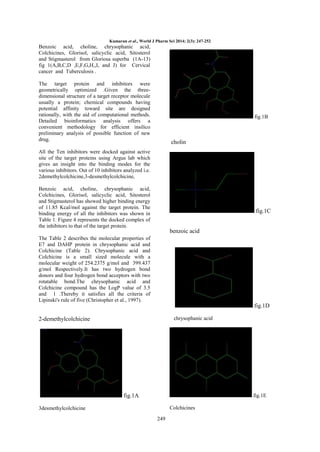
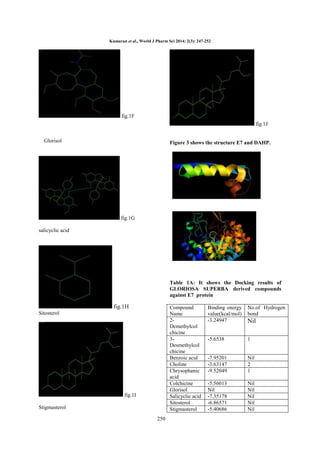
Docking: Docking the inhibitors against the active
site of the E7 and Dahp Docking is a computational
technique that samples conformations of small
molecules in protein binding sites; scoring
functions are used to assess which of these
conformations best complements the protein
binding site[18].The inhibitor and target protein
was geometrically optimized and docked using
docking engine Argus Dock.
RESULTS AND DISCUSSION
Molecular modeling (docking) study was carried
out
for
compound
like
from
2demethylcolchicine,3-desmethylcolchicine,
248](https://image.slidesharecdn.com/020307-ps0116-140301092028-phpapp02/85/Molecular-docking-studies-of-gloriosa-superba-for-anti-cancer-and-anti-tuberculosis-2-320.jpg)
![Kumaran et al., World J Pharm Sci 2014; 2(3): 247-252
Table 2A: Molecular property of chrysophanic
acid
Table 1B: It shows the Docking results of
GLORIOSA SUPERBA derived compounds
against DAHP protein
s.no
Compound
Name
Binding energy
value(kcal/mol)
1
2Demethylcol
chicine
3Desmethylcol
chicine
Benzoic acid
Choline
Chrysophanic
acid
Colchicine
Glorisol
Salicyclic
acid
Sitosterol
Stigmastero
-7.95243
2
3
4
5
6
7
8
9
10
S.no
1
2
-8.32373
-8.78842
-3.73865
-8.86378
-7.47679
Nill
-8.22659
7
Nill
2
-11.4016
-11.8419
Nill
Nill
No. of hydrogen 2
donors
6
7
3
7
Nill
A logp
No.
of
acceptors
5
2
PROPERTY
Molecular formula
Formula weight
3
4
No.of
Hydrogen
bond
2
Density
Monoisotopic mass
hydrogen
VALUE
C15H10O4
254.2375
[g/mol]
3.5
4
481-74-3
254.057907
Table 2B: Molecular property of Colchicines
S.no
1
2
3
4
5
Docking complex of E7 and DAHP protein
6
7
PROPERTY
Molecular formula
Formula weight
A logp
No.
of
hydrogen
acceptors
No.
of
hydrogen
donors
Density
Monoisotopic mass
VALUE
C22H25NO6
399.437
1
6
1
106
399.168188
CONCLUSIONS:
The present study indicates that analysis
the property herbal plant Gloriosa superba can be
used in the treatment of cervical cancer and
tuberclousis which shows a strong binding affinity
towards E7 and DAHP protein . This brings a
strong focus towards these plant that, when
administered during the treatment of cancer and
tuberclousis may block E7 & DAHP. Gloriosa
superba showed the highest affinity towards E7
and DAHP compared to other compounds. This
creates a strong hypothesis that the effects of
complex formation by E7 and DAHP and Gloriosa
superba contribute towards combating against
Cancer and Tuberculosis. Hence, Gloriosa superba
may become a prospective target for inhibition of
cancer and Tuberculosis and may unlock a strong
initiative in developing novel ligand which is
specified towards it. Hence the compound specified
in this work can undergo certain specification to
improve its drug properties and could act as a best
drug for cancer and Tuberculosis . The mechanism
of action of Gloriosa superba inhibit the activity
of E7 and DAHP that is involved Causing tumor
and Tuberculosis hence Glorsia superba having
both property of anti cancer and anti Tuberculosis.
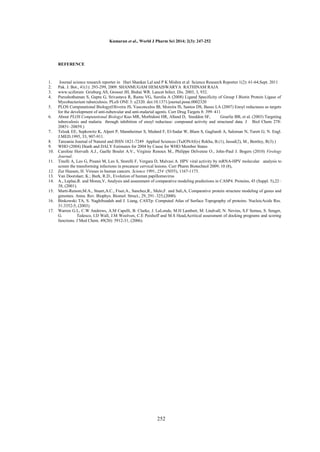
E7 protein with chrysophanic acid
DAHP protein with Colchicine
Fig. 4: Represents the Docked Complex of the
Inhibitors to that of the Target Protein.
251](https://image.slidesharecdn.com/020307-ps0116-140301092028-phpapp02/85/Molecular-docking-studies-of-gloriosa-superba-for-anti-cancer-and-anti-tuberculosis-5-320.jpg)

The document presents research on the molecular docking studies of Gloriosa superba, a medicinal plant known for its anticancer and antituberculosis properties. The study identifies various phytochemicals from G. superba that demonstrate strong binding affinities to proteins associated with cervical cancer (e7) and tuberculosis (dahp), suggesting their potential as therapeutic agents. The findings highlight the efficacy of G. superba in inhibiting cancer and tuberculosis, paving the way for the development of novel drug candidates.


