Bases and
Criteria
for the
Curriculum
Reporter:
Albornoz, Rudolf Jeremy
H.
MEM 648: Curriculum Theories, Principles, and Instructional Designs
Bases of Curriculum
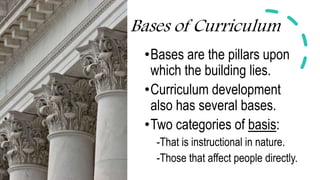
•Bases are the pillars upon
which the building lies.
•Curriculum development
also has several bases.
•Two categories of basis:
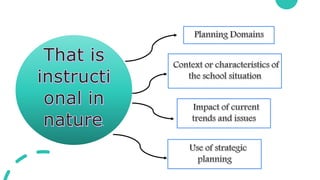
-That is instructional in nature.
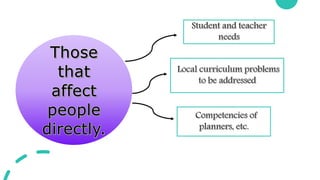
-Those that affect people directly.
.
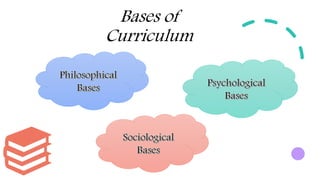
Bases of
Curriculum
Bases of Curriculum• Educational
philosophy of people
directly involved in
the process of
curriculum
development.
• Philosophy
determines the goal
of life and education
tries to achieve that
goal.
Bases of Curriculum
• Curriculum is positively
correlated with the
needs and requirements
of society.
• Philosophy provides
curriculum specialists
with a framework for
broad issues and tasks,
in general, what
Bases of Curriculum
• Society influences
the school
curriculum.
• Every society,
community or nation
has an essential
social obligation to
arrange the
education of
children.
Bases of Curriculum
1)It provides a way of
carrying out changes in
the behavior of the
students as per the
needs and demands of
the society or nation.
2)To make education as
an instrument of social
changes and progress.
3)To preserve the culture
and transmit it to young
Bases of
Curriculum • Education is for the child.
• Efforts are made for
bringing desirable changes
in the behavior of the
learners.
• Psychology as a science of
behavior is linked with the
process of imparting
education.
• It helps curriculum
developers in deciding
Bases of
Curriculum
• Curriculum could be
developed according to the
children in a particular
grade and their needs.
• Curriculum should have
enough variety and
elasticity to allow
individual differences,
needs, and interests.
• Curriculum development is
Curriculum
Criteria
-are guidelines
on standard for
curriculum
decision
making.
1) Have the goals of the
curriculum or teaching plan
been clearly stated; and are
they used by the teachers
and students in choosing
the content, materials and
activities for learning?
2) Have the teachers and
students engaged in
teacher-student planning in
defining the goals and in
determining how they will
be implemented?
4.) Do some of the planned
goals relate to the individual
learner and his or her
needs, purposes, interest
and abilities?
5.) Are the planned goals used
as criteria in selecting and
developing learning
materials for instruction?
6.) Are the planned goals used
as criteria in evaluating
learning achievement and in
1. The curriculum is continuously
evolving.
2. The curriculum is based on
the needs of the people.
3. The curriculum is
democratically conceived.
4. The curriculum is the result of
a long-term effort.
5. The curriculum is a complex
of details.
6. The curriculum provides for
the logical sequence of subject
matter.
7. The curriculum complements
1. A good curriculum is
systematically planned and
evaluated.
2. A good curriculum reflects
adequately the aims of the
school.
3. A good curriculum
maintains balance among all
aims of the school.
4. A god curriculum promotes
continuity of experience.
5. A good curriculum arranges
learning opportunities
flexibly for adaptation to
particular situations and
individuals.
6. A good curriculum utilizes
the most effective learning
experiences and resources
available.
7. A good curriculum makes
maximum provision for the
development of each
Curriculum
Goals
•Broad descriptions of
purposes or ends
stated in general
terms without criteria
of achievement or
mastery.
•They relate to educational
aims of philosophy
•They refer to the
accomplishments of a
group.
•They are always stated in
general terms that provide
directions for curriculum
development.
•They are broad enough that
lead to specific curriculum
objectives.
Bases and Criteria.pptx

Bases and Criteria.pptx

  • 1.
    Bases and Criteria for the Curriculum Reporter: Albornoz,Rudolf Jeremy H. MEM 648: Curriculum Theories, Principles, and Instructional Designs
  • 2.
    Bases of Curriculum •Basesare the pillars upon which the building lies. •Curriculum development also has several bases. •Two categories of basis: -That is instructional in nature. -Those that affect people directly.
  • 3.
  • 5.
  • 6.
    Bases of Curriculum•Educational philosophy of people directly involved in the process of curriculum development. • Philosophy determines the goal of life and education tries to achieve that goal.
  • 7.
    Bases of Curriculum •Curriculum is positively correlated with the needs and requirements of society. • Philosophy provides curriculum specialists with a framework for broad issues and tasks, in general, what
  • 8.
    Bases of Curriculum •Society influences the school curriculum. • Every society, community or nation has an essential social obligation to arrange the education of children.
  • 9.
    Bases of Curriculum 1)Itprovides a way of carrying out changes in the behavior of the students as per the needs and demands of the society or nation. 2)To make education as an instrument of social changes and progress. 3)To preserve the culture and transmit it to young
  • 10.
    Bases of Curriculum •Education is for the child. • Efforts are made for bringing desirable changes in the behavior of the learners. • Psychology as a science of behavior is linked with the process of imparting education. • It helps curriculum developers in deciding
  • 11.
    Bases of Curriculum • Curriculumcould be developed according to the children in a particular grade and their needs. • Curriculum should have enough variety and elasticity to allow individual differences, needs, and interests. • Curriculum development is
  • 12.
  • 13.
    -are guidelines on standardfor curriculum decision making.
  • 14.
    1) Have thegoals of the curriculum or teaching plan been clearly stated; and are they used by the teachers and students in choosing the content, materials and activities for learning? 2) Have the teachers and students engaged in teacher-student planning in defining the goals and in determining how they will be implemented?
  • 15.
    4.) Do someof the planned goals relate to the individual learner and his or her needs, purposes, interest and abilities? 5.) Are the planned goals used as criteria in selecting and developing learning materials for instruction? 6.) Are the planned goals used as criteria in evaluating learning achievement and in
  • 16.
    1. The curriculumis continuously evolving. 2. The curriculum is based on the needs of the people. 3. The curriculum is democratically conceived. 4. The curriculum is the result of a long-term effort. 5. The curriculum is a complex of details. 6. The curriculum provides for the logical sequence of subject matter. 7. The curriculum complements
  • 17.
    1. A goodcurriculum is systematically planned and evaluated. 2. A good curriculum reflects adequately the aims of the school. 3. A good curriculum maintains balance among all aims of the school. 4. A god curriculum promotes continuity of experience.
  • 18.
    5. A goodcurriculum arranges learning opportunities flexibly for adaptation to particular situations and individuals. 6. A good curriculum utilizes the most effective learning experiences and resources available. 7. A good curriculum makes maximum provision for the development of each
  • 19.
  • 20.
    •Broad descriptions of purposesor ends stated in general terms without criteria of achievement or mastery.
  • 21.
    •They relate toeducational aims of philosophy •They refer to the accomplishments of a group. •They are always stated in general terms that provide directions for curriculum development. •They are broad enough that lead to specific curriculum objectives.