PROBABILITY
INTRODUCTION
People use the term probability many times each day.
For example, physician says that a patient has a 50-50
chance of surviving a certain operation. Another
physician may say that she is 95% certain that a
patient has a particular disease.
PROBABILITY
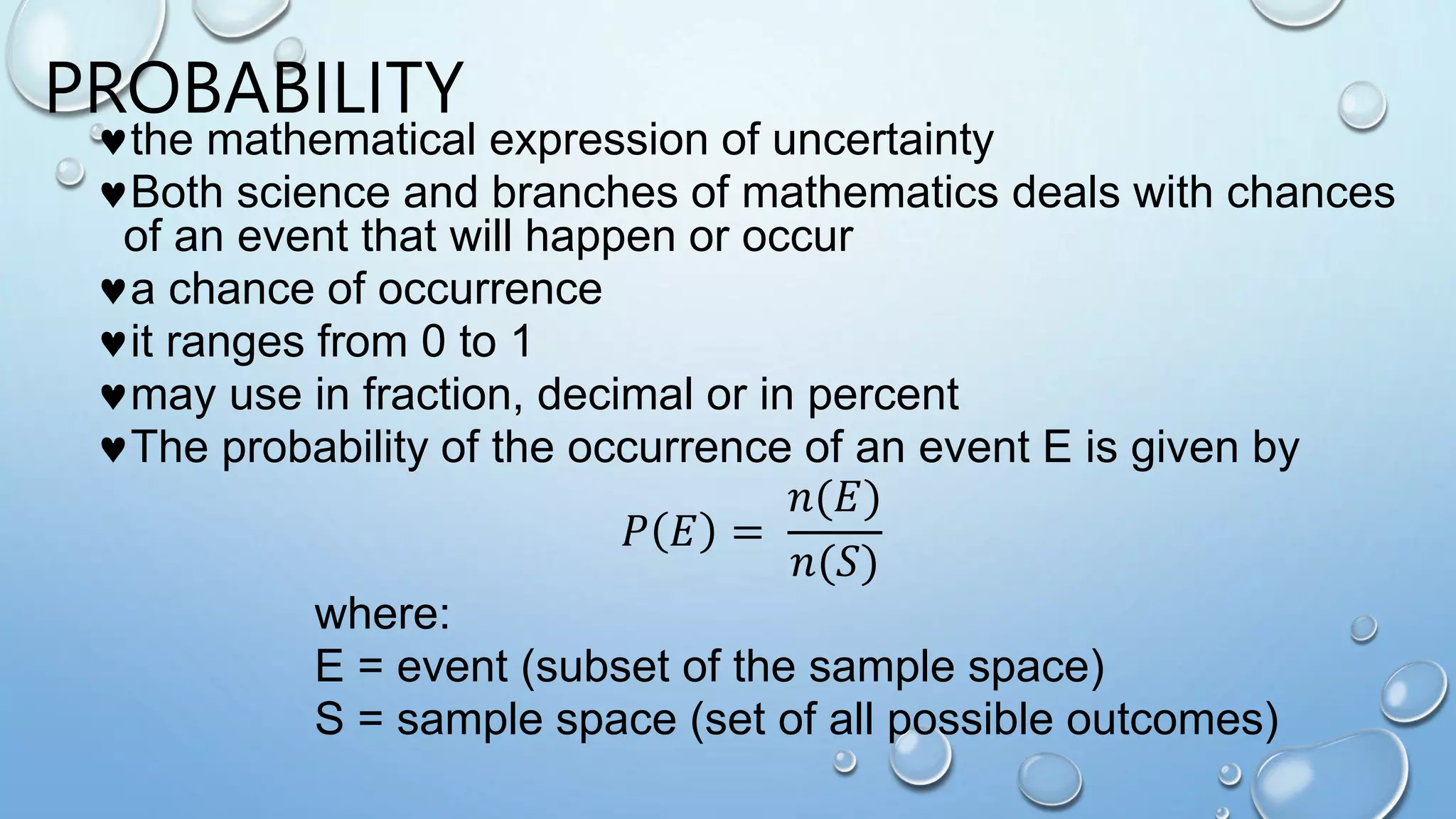
the mathematical expression of uncertainty
Both science and branches of mathematics deals with chances
of an event that will happen or occur
a chance of occurrence
it ranges from 0 to 1
may use in fraction, decimal or in percent
The probability of the occurrence of an event E is given by
𝑃 𝐸 =
𝑛(𝐸)
𝑛(𝑆)
where:
E = event (subset of the sample space)
S = sample space (set of all possible outcomes)
TERMS IN PROBABILITY
Events
 A set of possible outcomes resulting from a particular experiment.
 A subset of a sample space of an experiment.
 Any subset E of the sample space
For example, a possible event when a single six-sided die is rolled is {5, 6}, that is, the roll could
be a 5 or a 6.
In general, an event is any subset of a sample space (including the possibility of an empty set).
Experiment
activities such as rolling a die, tossing a coin, or randomly choosing a ball from a box which
could be repeated over and over again and which have well-defined results
a process by which an outcome is obtained, i.e., rolling a die.
any activity or process that has a number of outcomes.
any planned process of data collection. It consists of a number of trials (replications) under the
same condition.
TERMS IN PROBABILITY
Outcome
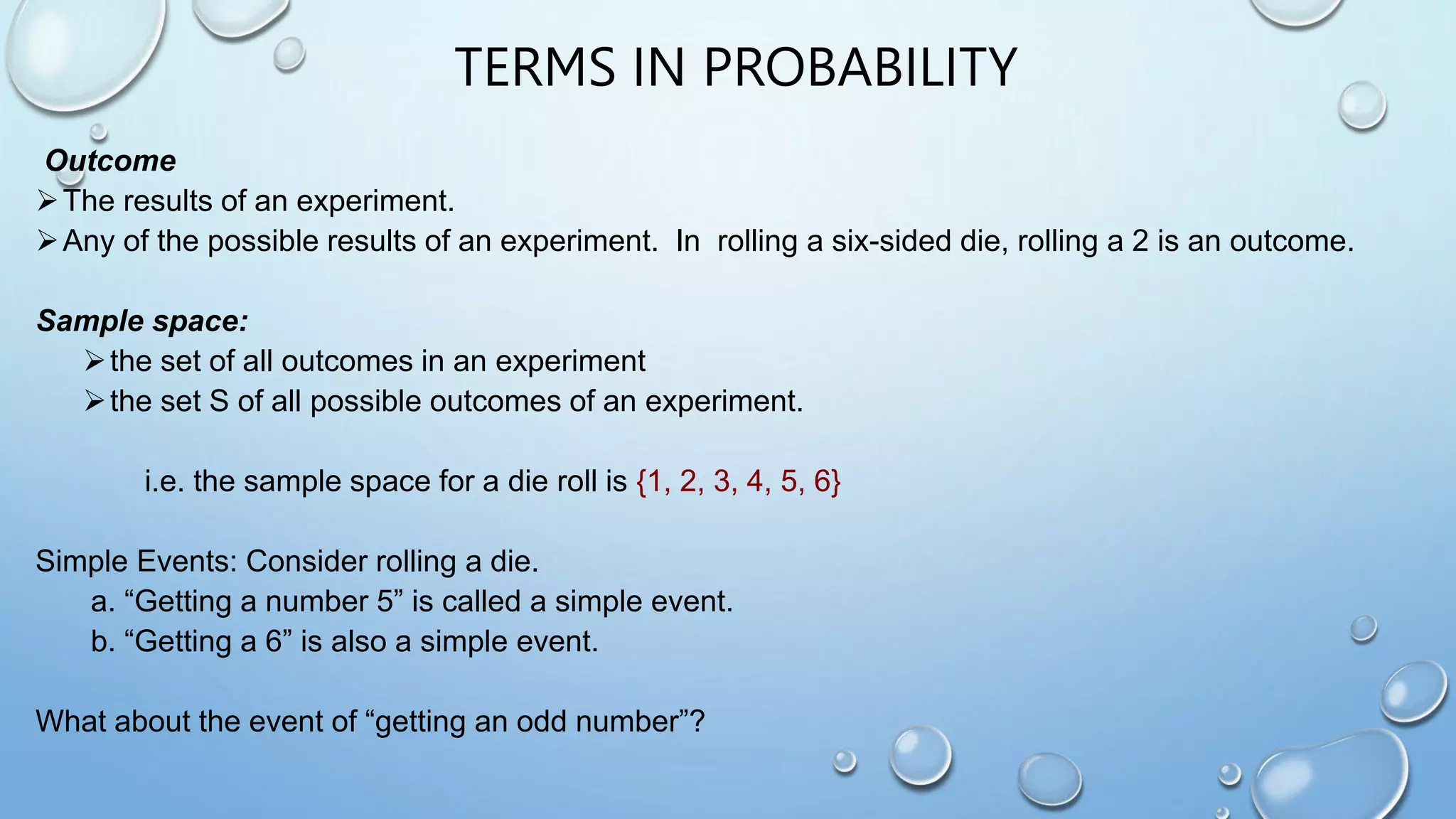
The results of an experiment.
Any of the possible results of an experiment. In rolling a six-sided die, rolling a 2 is an outcome.
Sample space:
the set of all outcomes in an experiment
the set S of all possible outcomes of an experiment.
i.e. the sample space for a die roll is {1, 2, 3, 4, 5, 6}
Simple Events: Consider rolling a die.
a. “Getting a number 5” is called a simple event.
b. “Getting a 6” is also a simple event.
What about the event of “getting an odd number”?
Example
1. Consider the activity of a rolling die.
This activity has 6 possible outcomes.
S = sample space
1, 2, 3, 4, 5, 6  outcomes/sample points
n(S) = 6
2. Tossing a coin
This activity has 2 possible outcomes.
S = sample space
H, T  outcomes/sample points
n(S) = 2
3. Deck of cards
SAMPLE SPACE
Example
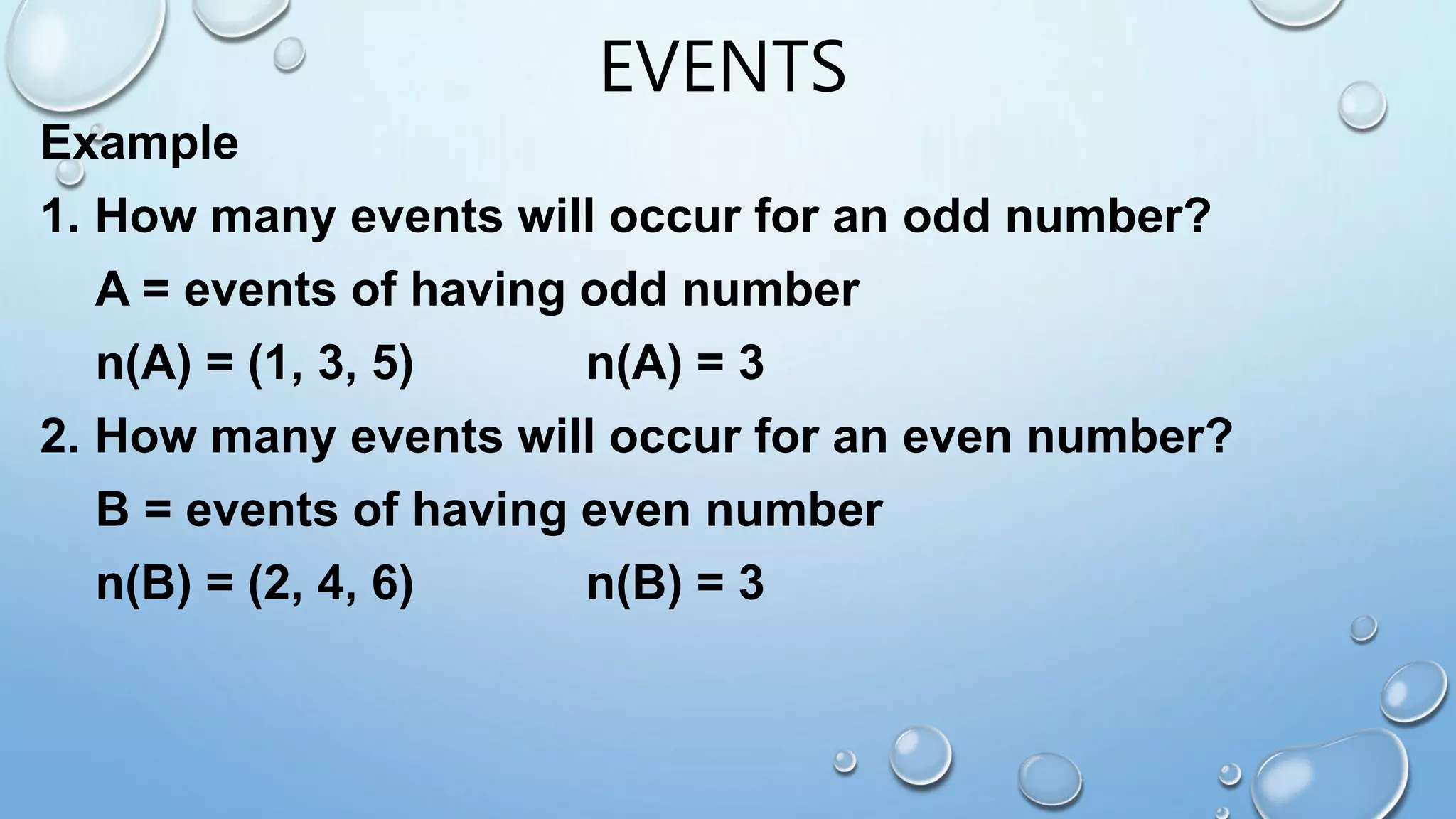
1. How many events will occur for an odd number?
A = events of having odd number
n(A) = (1, 3, 5) n(A) = 3
2. How many events will occur for an even number?
B = events of having even number
n(B) = (2, 4, 6) n(B) = 3
EVENTS
PROBABILITY RULES
1. The probability of any event is a number (either a fraction, a decimal or a
percent) from 0 to 1.
Example: the weather forecast shows a 75% rain
P (rain) = 75%
2. If an event will never happen, then its probability is 0.
Example: when a single die is rolled, find the probability of getting a 9.
Since the sample space consists of 1, 2, 3, 4, 5, and 6, it is impossible to get
a 9. Hence, P(9) =
0
9
= 0.
3. If an event is sure to happen, then the probability is 1.
Example: When a single die is rolled, what is the probability of getting a number
less than 7?
Since all the outcomes {1, 2, 3, 4, 5, 6} are less than 7,
P (number less than 7) =
6
6
= 1
4. The sum of the probabilities of all the outcomes in the sample space is 1.
Example:
In rolling a fair die, each outcome in the sample space has a probability of
1
6
.
Hence, the sum of the probabilities of the outcomes is 1.
If a fair coin is flipped, P (T) =
1
2
and P(H) =
1
2
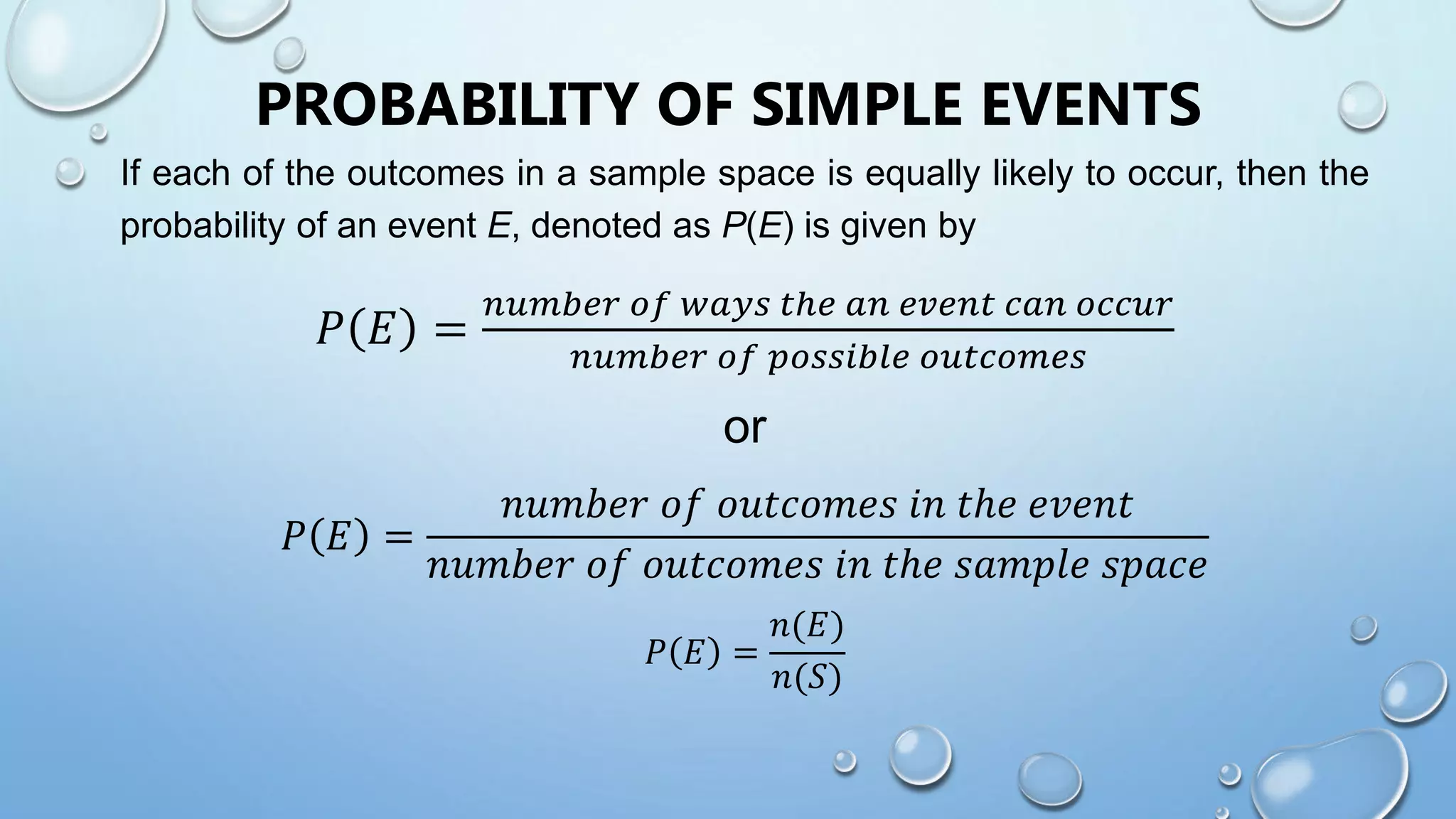
PROBABILITY OF SIMPLE EVENTS
If each of the outcomes in a sample space is equally likely to occur, then the
probability of an event E, denoted as P(E) is given by
𝑃 𝐸 =
𝑛𝑢𝑚𝑏𝑒𝑟 𝑜𝑓 𝑤𝑎𝑦𝑠 𝑡ℎ𝑒 𝑎𝑛 𝑒𝑣𝑒𝑛𝑡 𝑐𝑎𝑛 𝑜𝑐𝑐𝑢𝑟
𝑛𝑢𝑚𝑏𝑒𝑟 𝑜𝑓 𝑝𝑜𝑠𝑠𝑖𝑏𝑙𝑒 𝑜𝑢𝑡𝑐𝑜𝑚𝑒𝑠
or
𝑃 𝐸 =
𝑛𝑢𝑚𝑏𝑒𝑟 𝑜𝑓 𝑜𝑢𝑡𝑐𝑜𝑚𝑒𝑠 𝑖𝑛 𝑡ℎ𝑒 𝑒𝑣𝑒𝑛𝑡
𝑛𝑢𝑚𝑏𝑒𝑟 𝑜𝑓 𝑜𝑢𝑡𝑐𝑜𝑚𝑒𝑠 𝑖𝑛 𝑡ℎ𝑒 𝑠𝑎𝑚𝑝𝑙𝑒 𝑠𝑝𝑎𝑐𝑒
𝑃 𝐸 =
𝑛(𝐸)
𝑛(𝑆)
EXAMPLES
1. If a basket contains 1 pink marble, 1 yellow marble and 1 black, find the
probability that if you pick a marble, it will be a pink marble.
𝑃 𝐸 =
𝑛(𝐸)
𝑛(𝑆)
=
1
3
= 0.3333 = 33.33%
2. If a die is cast, find the probability that it falls
a. 3 face up
3. If a coin is tossed, what is the probability of getting a tail?
PROBABILITY OF
COMPOUND EVENTS
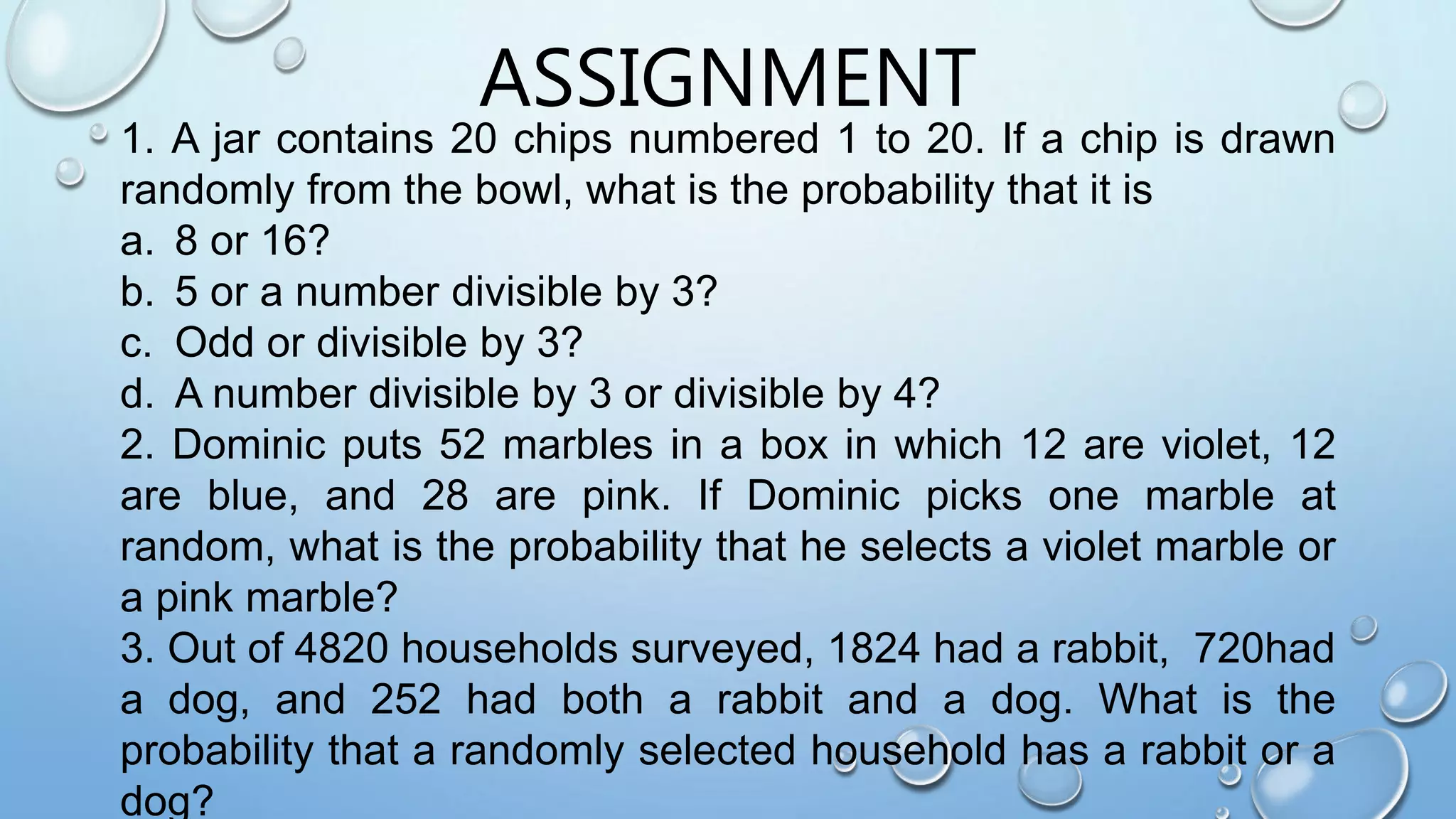
ASSIGNMENT
1. A jar contains 20 chips numbered 1 to 20. If a chip is drawn
randomly from the bowl, what is the probability that it is
a. 8 or 16?
b. 5 or a number divisible by 3?
c. Odd or divisible by 3?
d. A number divisible by 3 or divisible by 4?
2. Dominic puts 52 marbles in a box in which 12 are violet, 12
are blue, and 28 are pink. If Dominic picks one marble at
random, what is the probability that he selects a violet marble or
a pink marble?
3. Out of 4820 households surveyed, 1824 had a rabbit, 720had
a dog, and 252 had both a rabbit and a dog. What is the
probability that a randomly selected household has a rabbit or a
dog?
PROBABILITY.pptx

PROBABILITY.pptx

  • 1.
  • 2.
    INTRODUCTION People use theterm probability many times each day. For example, physician says that a patient has a 50-50 chance of surviving a certain operation. Another physician may say that she is 95% certain that a patient has a particular disease.
  • 3.
    PROBABILITY the mathematical expressionof uncertainty Both science and branches of mathematics deals with chances of an event that will happen or occur a chance of occurrence it ranges from 0 to 1 may use in fraction, decimal or in percent The probability of the occurrence of an event E is given by 𝑃 𝐸 = 𝑛(𝐸) 𝑛(𝑆) where: E = event (subset of the sample space) S = sample space (set of all possible outcomes)
  • 4.
    TERMS IN PROBABILITY Events A set of possible outcomes resulting from a particular experiment.  A subset of a sample space of an experiment.  Any subset E of the sample space For example, a possible event when a single six-sided die is rolled is {5, 6}, that is, the roll could be a 5 or a 6. In general, an event is any subset of a sample space (including the possibility of an empty set). Experiment activities such as rolling a die, tossing a coin, or randomly choosing a ball from a box which could be repeated over and over again and which have well-defined results a process by which an outcome is obtained, i.e., rolling a die. any activity or process that has a number of outcomes. any planned process of data collection. It consists of a number of trials (replications) under the same condition.
  • 5.
    TERMS IN PROBABILITY Outcome Theresults of an experiment. Any of the possible results of an experiment. In rolling a six-sided die, rolling a 2 is an outcome. Sample space: the set of all outcomes in an experiment the set S of all possible outcomes of an experiment. i.e. the sample space for a die roll is {1, 2, 3, 4, 5, 6} Simple Events: Consider rolling a die. a. “Getting a number 5” is called a simple event. b. “Getting a 6” is also a simple event. What about the event of “getting an odd number”?
  • 6.
    Example 1. Consider theactivity of a rolling die. This activity has 6 possible outcomes. S = sample space 1, 2, 3, 4, 5, 6  outcomes/sample points n(S) = 6 2. Tossing a coin This activity has 2 possible outcomes. S = sample space H, T  outcomes/sample points n(S) = 2 3. Deck of cards SAMPLE SPACE
  • 7.
    Example 1. How manyevents will occur for an odd number? A = events of having odd number n(A) = (1, 3, 5) n(A) = 3 2. How many events will occur for an even number? B = events of having even number n(B) = (2, 4, 6) n(B) = 3 EVENTS
  • 8.
    PROBABILITY RULES 1. Theprobability of any event is a number (either a fraction, a decimal or a percent) from 0 to 1. Example: the weather forecast shows a 75% rain P (rain) = 75% 2. If an event will never happen, then its probability is 0. Example: when a single die is rolled, find the probability of getting a 9. Since the sample space consists of 1, 2, 3, 4, 5, and 6, it is impossible to get a 9. Hence, P(9) = 0 9 = 0.
  • 9.
    3. If anevent is sure to happen, then the probability is 1. Example: When a single die is rolled, what is the probability of getting a number less than 7? Since all the outcomes {1, 2, 3, 4, 5, 6} are less than 7, P (number less than 7) = 6 6 = 1 4. The sum of the probabilities of all the outcomes in the sample space is 1. Example: In rolling a fair die, each outcome in the sample space has a probability of 1 6 . Hence, the sum of the probabilities of the outcomes is 1. If a fair coin is flipped, P (T) = 1 2 and P(H) = 1 2
  • 10.
    PROBABILITY OF SIMPLEEVENTS If each of the outcomes in a sample space is equally likely to occur, then the probability of an event E, denoted as P(E) is given by 𝑃 𝐸 = 𝑛𝑢𝑚𝑏𝑒𝑟 𝑜𝑓 𝑤𝑎𝑦𝑠 𝑡ℎ𝑒 𝑎𝑛 𝑒𝑣𝑒𝑛𝑡 𝑐𝑎𝑛 𝑜𝑐𝑐𝑢𝑟 𝑛𝑢𝑚𝑏𝑒𝑟 𝑜𝑓 𝑝𝑜𝑠𝑠𝑖𝑏𝑙𝑒 𝑜𝑢𝑡𝑐𝑜𝑚𝑒𝑠 or 𝑃 𝐸 = 𝑛𝑢𝑚𝑏𝑒𝑟 𝑜𝑓 𝑜𝑢𝑡𝑐𝑜𝑚𝑒𝑠 𝑖𝑛 𝑡ℎ𝑒 𝑒𝑣𝑒𝑛𝑡 𝑛𝑢𝑚𝑏𝑒𝑟 𝑜𝑓 𝑜𝑢𝑡𝑐𝑜𝑚𝑒𝑠 𝑖𝑛 𝑡ℎ𝑒 𝑠𝑎𝑚𝑝𝑙𝑒 𝑠𝑝𝑎𝑐𝑒 𝑃 𝐸 = 𝑛(𝐸) 𝑛(𝑆)
  • 11.
    EXAMPLES 1. If abasket contains 1 pink marble, 1 yellow marble and 1 black, find the probability that if you pick a marble, it will be a pink marble. 𝑃 𝐸 = 𝑛(𝐸) 𝑛(𝑆) = 1 3 = 0.3333 = 33.33% 2. If a die is cast, find the probability that it falls a. 3 face up 3. If a coin is tossed, what is the probability of getting a tail?
  • 12.
  • 13.
    ASSIGNMENT 1. A jarcontains 20 chips numbered 1 to 20. If a chip is drawn randomly from the bowl, what is the probability that it is a. 8 or 16? b. 5 or a number divisible by 3? c. Odd or divisible by 3? d. A number divisible by 3 or divisible by 4? 2. Dominic puts 52 marbles in a box in which 12 are violet, 12 are blue, and 28 are pink. If Dominic picks one marble at random, what is the probability that he selects a violet marble or a pink marble? 3. Out of 4820 households surveyed, 1824 had a rabbit, 720had a dog, and 252 had both a rabbit and a dog. What is the probability that a randomly selected household has a rabbit or a dog?