Japanese Art Before 1392 Jackie Duhl, Thiara Dutra, Meghan Mcgovern
 
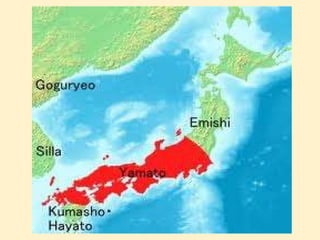
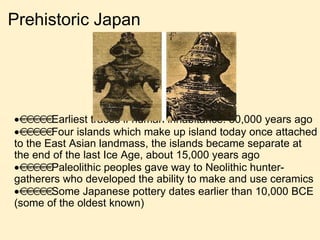
Prehistoric Japan  Earliest traces if human inhabitance: 30,000 years ago  Four islands which make up island today once attached to the East Asian landmass, the islands became separate at the end of the last Ice Age, about 15,000 years ago  Paleolithic peoples gave way to Neolithic hunter-gatherers who developed the ability to make and use ceramics  Some Japanese pottery dates earlier than 10,000 BCE (some of the oldest known)
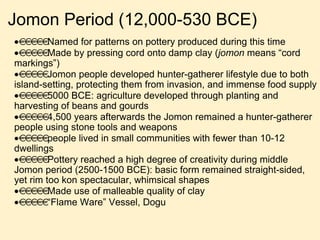
Jomon Period (12,000-530 BCE)  Named for patterns on pottery produced during this time  Made by pressing cord onto damp clay ( jomon  means “cord markings”)  Jomon people developed hunter-gatherer lifestyle due to both island-setting, protecting them from invasion, and immense food supply  5000 BCE: agriculture developed through planting and harvesting of beans and gourds  4,500 years afterwards the Jomon remained a hunter-gatherer people using stone tools and weapons  people lived in small communities with fewer than 10-12 dwellings  Pottery reached a high degree of creativity during middle Jomon period (2500-1500 BCE): basic form remained straight-sided, yet rim too kon spectacular, whimsical shapes  Made use of malleable quality of clay  “ Flame Ware” Vessel, Dogu
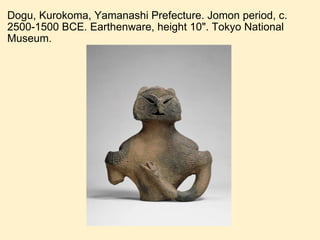
Dogu, Kurokoma, Yamanashi Prefecture. Jomon period, c. 2500-1500 BCE. Earthenware, height 10". Tokyo National Museum. 
Small clay figure (10") Distorted humanoid animal figurines Made during the late Jomon period   Dogu tend to have large faces,small arms/hands and compact bodies Some appear to have round goggles over their eyes or heart-shaped faces This Dogu is the Kurokama: its face is                                  extremely similar to that of a cat The slit eyes and mouth come off as                                      haunting marks on face, neck, and shoulders suggest tattooing (engraved with a bamboo stick) Purpose: unknown; theory exists that one could transfer an unhappy emotion or illness to a dogu and then smash it, destroying the evil
Yayoi Period (300 BCE – 300 CE)  ·      The shift from hunting and gathering to agriculture brought immense social changes ·      Larger permanent settlements established, division of labor into agricultural and non-agricultural tasks, hierarchal social organization, more centralized government ·      Emergence of class structure during Yayoi period as metal technology emerged ·      Bronze weaponry and ceremonial objects (bells) ·      Iron metallurgy later emerged replacing stone tools in everyday life ·      Houses were thatched with sunken floors; food stored in raised granaries ·      Drawings of these found on bronze artifacts, bearing a resemblance to the architectural design of shrines in later periods Sensitive use of wood and thatch in Yayoi shrines would suggest an early origin of the Japanese appreciation of natural materials 
Kofun Period (300 – 552 CE)   “ Old tombs” period: named for the large royal tombs built during this time  Emergence of more complex social order allowed for veneration of leaders: beginnings of an imperial system  Emperor equated with deities such as the sun goddess (this system is still in effect in Japan)  Chamber tombs constructed following Korean examples upon death of emperor  Religious treasures placed in graves such as potter (to please the spirits of the dead and serve them in their next life)  In many ways like Egyptian pyramids and burial chambers  Many tombs constructed in shape of large keyholes; surrounded by moats dug for protection of spirits  Fifth-century potters gained knowledge of finishing techniques in pottery; improved kilns, allowing the beginnings of a high-fired ceramic ware  Stoneware technology and earthenware
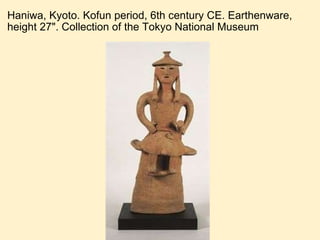
Haniwa, Kyoto. Kofun period, 6th century CE. Earthenware, height 27". Collection of the Tokyo National Museum
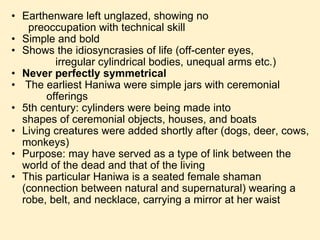
Earthenware left unglazed, showing no                     preoccupation with technical skill Simple and bold Shows the idiosyncrasies of life (off-center eyes,                              irregular cylindrical bodies, unequal arms etc.) Never perfectly symmetrical   The earliest Haniwa were simple jars with ceremonial                   offerings 5th century: cylinders were being made into                     shapes of ceremonial objects, houses, and boats Living creatures were added shortly after (dogs, deer, cows, monkeys) Purpose: may have served as a type of link between the world of the dead and that of the living This particular Haniwa is a seated female shaman (connection between natural and supernatural) wearing a robe, belt, and necklace, carrying a mirror at her waist
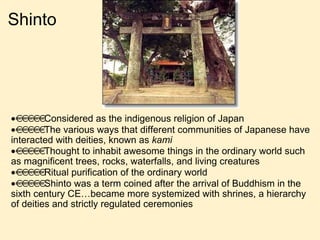
Shinto  Considered as the indigenous religion of Japan  The various ways that different communities of Japanese have interacted with deities, known as  kami  Thought to inhabit awesome things in the ordinary world such as magnificent trees, rocks, waterfalls, and living creatures  Ritual purification of the ordinary world  Shinto was a term coined after the arrival of Buddhism in the sixth century CE…became more systemized with shrines, a hierarchy of deities and strictly regulated ceremonies  
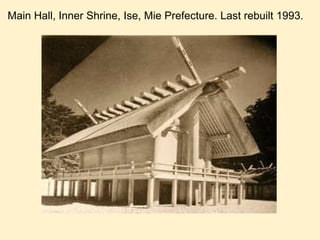
Main Hall, Inner Shrine, Ise, Mie Prefecture. Last rebuilt 1993.
 Dedicated to sun goddess Amaterasu-o-mi-kami, the legendary progenitor of Japan’s imperial family  Ritually rebuilt for over 2,000 years on two adjoining sites at twenty-year intervals  Most recently in 1992  Builders are carpenters who train for the task from childhood  Accurately preserves features of Yayoi-era granaries which was its original prototype  Paragon of Shinto architecture: wooden piles raiding the building off the ground  Thatched roof held in place by horizontal logs  Use of unpainted cypress wood  Overall feeling of natural simplicity rather than overwhelming size or adornation  Only one member of the imperial family and a few Shinto priests allowed within the fourfold enclosure surrounding the shrine  Stores the three sacred Shinto symbols: a sword, a mirror, a jewel  
New philosophy, city planning, arts, medicine, clothing, agriculture, architecture from Korea and China Buddhism, centralized governmental structure, and system of writing were the three most important introductions Buddhism reached Japan in Mahayana form with many buddhas and bodhisattvas; adopted as state religion by imperial family Represented different Shinto gods, yet instead of focusing on imposing natural areas, focused on temples Chinese-influenced architecture and elaborate iconography would contrast acutely with Japanese simplicity and naturalism New cosmology and teachings of meditation and enlightenment would be accompanied by new methods of painting and sculpture like that of artist Tori Busshi Asuka Pariod (552-645CE)
Tori Busshi  Sculptor active in the late 6th and early 7th century  Father and grandfather were saddle-makers, exposing Tori to metal casting, laquer, and wood-carving  First known work is a bronze Shaka image of Asuka-dera from 606 CE; the work made a favorable impression on Empress Suiko, granting Tori lands and rank equivalent to those of someone of the later fifth grade  The Yakushi Nyorai (Buddha of Healing) from Wakakusa-dera is attributed to Tori  Completed 607 under the commission of Emperor Yomei and Prince Shōtoku for the newly established Wakakusadera  The Shaka Triad of Horyuji is considered Tori’s greatest work: piece was intended to either help speed the recovery of Prince Shōtoku in his illness or ease the rebirth of the souls of two dead noblewomen into paradise  Works exemplify Japanese Buddhist art during the Asuka period, deriving the style from the 4 th -6 th  century Chinese Wei kingdom  Conveys peace and gentleness while using rigid stock poses and geometrical figures  Buddhas sculpted upright with crossed legs and robes dropping downwards in well-defined folds  Buddha’s right hand raised with palm towards viewer (power to aid others), and left hand palm up on left leg (ability to lead viewer along path to end all suffering)  Each Buddha’s head is stylized and elongated, topped with curls known as shogo, indicating the Buddha’s perfection  Faces even more stylized with flat planes holding slitlike eyes, eyebrows, and nostrils
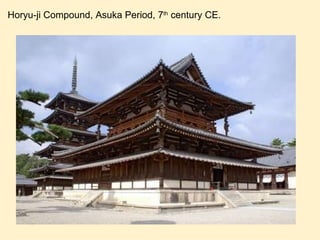
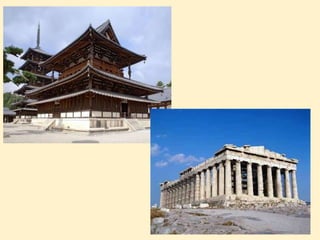
Horyu-ji Compound, Asuka Period, 7 th  century CE.
 Located on Japan’s central plains not far from Nara  Founded in 607 CE by Prince Shotoku (574-622 CE) who became the most influential early proponent of Buddhism  Rebuilt after a fire in 670-oldest wooden temple in the world  Just proportions, human scale, perfect monument to early Buddhist faith in Japan  Main compound contains rectangular courtyard surrounded by covered corridors  Two buildings within compound: kondo (golden hall) and five-story pagoda  Asymmetrical layout, yet large kondo balanced by tall, thin pagoda  Kondo filled with Buddhist images and used for worship and ceremonies  Pagoda serves as a reliquary and is not entered  Excess monastery buildings outside main compound (outer gate, lecture hall, repository for sacred texts, belfry (bell tower), dormitories for monks)  Holds a shrine decorated with paintings in lacquer known as Tamamushi Shrine (tamamushi beetle’s iridescent wings were originally placed on the shrine to make it glitter)  Disagreement about origins of shrine (Japan or Korea), but the more important point is that Buddhism was so international that at the time that matters of nationality were irrelevant  
 
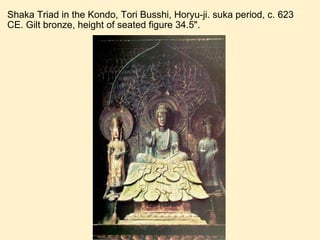
Shaka Triad in the Kondo, Tori Busshi, Horyu-ji. suka period, c. 623 CE. Gilt bronze, height of seated figure 34.5".
Shaka=Shakyamuni, historical Buddha Reflects the strong influence of Chinese art of the Northern Wei dynasty  Frontal pose, outsized face/hands,and the linear treatment of drapery suggest Tori's awareness of earlier continental models Fine bronze casting illuminatesTori's advanced technical skill Reveals rapid growth of Buddhist art as an important feature of Japanese culture Buddha's robes flow down the front of the figure, adding a heaviness to the statue   Flaming halo surrounds his head in which are seated the  Seven Buddhas of the Past   Flames upon a lotus blossom appear above the Buddha's head, symbolizing wisdom Figure as the 32 physical attributes of a Buddha: bulge on top of head (ushnisha), a spot of hair between the eyebrows (urna), elongated earlobes
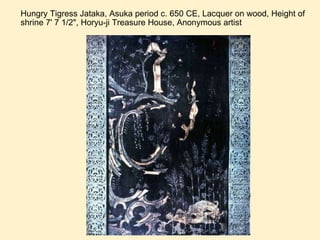
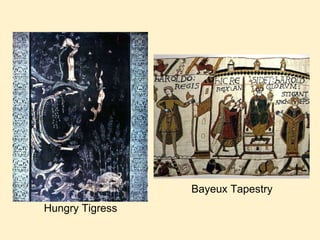
Hungry Tigress Jataka, Asuka period c. 650 CE, Lacquer on wood, Height of shrine 7' 7 1/2", Horyu-ji Treasure House, Anonymous artist
Illustrate the  Jataka Tales Stories about the former lives of the Buddha. Buddha nobly sacrifices his life to feed a starving tigress and her cubs The tigress was too weak, so Buddha had to through himself off a cliff to break his skin open A full narrative within one frame Buddha hangs shirt on a tree before diving down to his rocky doom to be devoured by the starving animals Uses the  Buddhist style Slender figure, abstract treatment of the cliff, trees, and bamboo Also used in China and Korea  
Hungry Tigress Bayeux Tapestry
Nara Period (645-794 CE) First permanent capital established in Nara with population of 200,000  Imperial system solidified into a government that could hold up against dominant aristocratic families of the previous political arena Construction of majestic Buddhist temples suchas Horyu-ji Buddhism and Shinto coexisted harmoniously, Buddhism seeking enlightenment and Shinto purification Shinto becomes more formalized while Buddhism spreads and becomes the most significant aspect of Japanese culture Existed through sacred texts called  sutras  believed to be so magical that a single letter could be cut and worn as a sacred amulet Nobility worshipped by copying the words of the Buddha, familiarizing the upper class with the Chinese writing system First collection of Japanese poetry compiled called the  Manyoshu  (many are secular love songs) Golden Age of Buddhist painting (many on walls of Horyu-ji) embracing Tang Dynasty in China and Unified Silla period in Korea
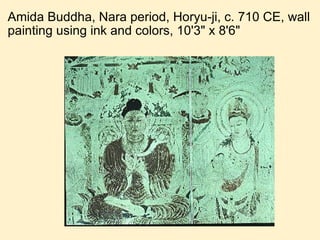
Amida Buddha, Nara period, Horyu-ji, c. 710 CE, wall painting using ink and colors, 10'3" x 8'6"
Thought to be Amida, the Buddha of the Western Paradise Placed in the walls of Horyu-ji. Made of iron-wire lines (thin,even brushstrokes) Amida's body is round, his face is serene, and his hands form the  dharmachakra  (the gesture of teaching, setting the  chakra  (wheel) of the  dharma  (law/doctrine) in motion) mudra. Hands are at chest level= mudra . More emphasis on realistic details and body weight Parallel folds of the drapery show the influence of the Grandhara style (present in India 500 years earlier) Face is completely East Asian
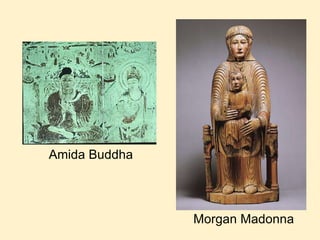
Amida Buddha Morgan Madonna
Heian Period (794-1185 CE) Last division of classic Japanese history Capital relocated to Heian (now known as Kyoto) New era of self-reliance due to elongated period of peace Imperial gov't severs ties to China in 9th century; relies on aristocratic families Rise of vernacular literature such as Lady Mursaki's  The Tale of Genji Real power was in the hands of the Fujiwara clan When the rise of the Samurai class (which would eventaully take power and start the feudal period) Military class rose in status Buddhism really began to flourish through two major sects Esoteric Buddhism Pure Land Buddhism You had to be cosmetically beautiful to be considered a "good" person Ultimately weakened the Japanese economy and led to poverty for most of its inhabitants
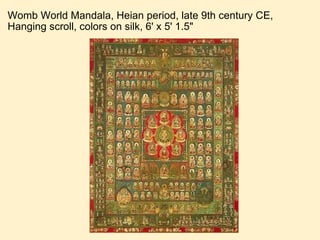
Womb World Mandala, Heian period, late 9th century CE, Hanging scroll, colors on silk, 6' x 5' 1.5"
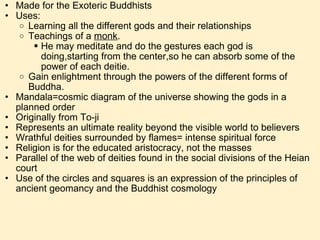
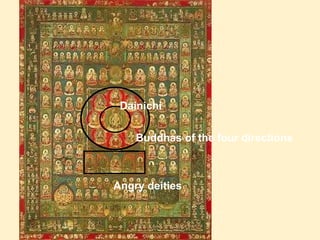
Made for the Exoteric Buddhists Uses: Learning all the different gods and their relationships Teachings of a  monk . He may meditate and do the gestures each god is doing,starting from the center,so he can absorb some of the power of each deitie. Gain enlightment through the powers of the different forms of Buddha. Mandala=cosmic diagram of the universe showing the gods in a planned order Originally from To-ji Represents an ultimate reality beyond the visible world to believers Wrathful deities surrounded by flames= intense spiritual force Religion is for the educated aristocracy, not the masses Parallel of the web of deities found in the social divisions of the Heian court Use of the circles and squares is an expression of the principles of ancient geomancy and the Buddhist cosmology
Dainichi Buddhas of the four directions Angry deities
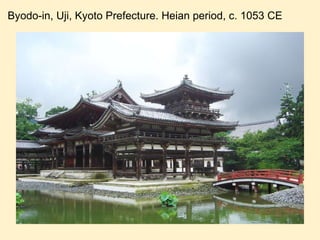
Byodo-in, Uji, Kyoto Prefecture. Heian period, c. 1053 CE
 Located in Uji mountains not far from Kyoto  One of the most beautiful temples of Pure Land Buddhism  Originally a secular palace created to suggest the palace of Amida (Buddha of Everlasting Light) in the Western Paradise  Built for a member of the Fujiwara family who served as the leading counselor to the emperor  Converted into a temple after the counselor’s death in 1052  Often called Pheonix Hall for the pair of phoenix images on its roof and the shape of the building  Slender columns give a sense of airiness as if temple could rise through the sky to Amida’s Western Paradise  Hall rests in front of an artificial pond created in the shape of the Sanskrit letter A (sacred symbol for Amida)
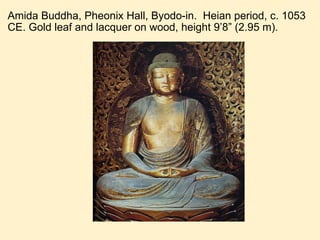
Amida Buddha, Pheonix Hall, Byodo-in.  Heian period, c. 1053 CE. Gold leaf and lacquer on wood, height 9’8” (2.95 m).
 Carved by master sculptor Jocho  Central image of Amida within Byodo-in palace  Exemplifies serenity and compassion of the Buddha who welcomes the soul of all believers to his paradise  Seems to shimmer when reflected in the water of the pond before it  Carved from several blocks of wood in Jocho’s joined-wood method of construction  Allowed sculptors to create larger but lighter portrayals of Buddhas and bodhisattvas for the temples constructed for the Pure Land faith  Reflects Japanese love of wood (major medium for sculpture during Heian period)  Surrounded by smaller wooden figures of bodhisattvas and angels playing musical instruments  Suggests the paradise awaiting the believer after death
Jocho Busshi  Sculptor of the Heian period  Trained at the Kofuku-ji, a temple in Nara  Fujiwara no Michinaga, the greatest of the Fujiwara royals of the Heian period, commissioned him to decorate the Hojoji temple  His work earned him the title Hokkyo (Master of the Dharma Bridge) in 1022 CE  Worked on sculpture for the Kōfukuji, earning him an even higher title, Hōgen (Master of the Dharma Eye)  Michinaga's son, Fujiwara no Yorimichi, commissioned Jocho to create an Amida statue for the Pheonix Hall of the Byodo-in  Piece completed in 1052 BCE: the earliest of Jōchō's works to have survived to the present day  Japanese guild-like inheritance: Jōchō's techniques were passed on to his son, Kakujo, his grandsons Injo and Raijo, his great-grandson Kojo, and ultimately Kokei   Popularized the  yosegi  technique of sculpting a single figure out of many pieces of wood  allowed several assistants to work on the sculpture at once, greatly speeding the process, refining the final product, and leading to specific proportions  New canon of proportions: based measurements on a unit equal to the distance between the sculpted figure's chin and hairline, distance between each knee=distance between hair and bottoms of legs  These leveled knees form the base of a triangular design: feeling of stability and peace  Intricately detailed halos, featuring fire and clouds  Style imitated for the next 150 years
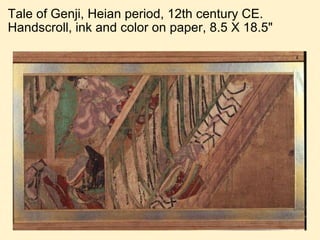
Tale of Genji, Heian period, 12th century CE. Handscroll, ink and color on paper, 8.5 X 18.5"
One of the earliest, still existing, nonreligious paintings from Japan "Women's Hand" style: delicate lines,strong (sometimes muted) colors, asymmetrical compositions, usually with a bird's eye view Emotionless faces; focus instead on colors, poses, total composition (big picture rather than intricate detail) A blossoming cherry tree represents happiness Unkept weeds show loneliness Each scroll was produced by a team of artists. Calligrapher: usually a member of the nobility Master painter: outlined two or three illustrations per chapter, indicated color scheme, applied finishing touches after colorists Colorists: applied colors, built up patterns and textures. Undercurrents of irony and sorrow in a seemingly joyous scene: Genji is the illegitimate son of an emperor and holding the illegitimate child of his adulterous wife
Kose Kanaoka  巨勢 金岡 Ninth century Japanese artist  Set precedent for the styles of the Tang Dynasty of China Originally of the Yamato-e school, founder of the Kose-ryu school in Kyoto Very few of his works survived Founded the Kose school of art (oldest school of painting in Japan) Sparked individual style in landscape painting Portraits of Confucian scholars and Buddhist subjects
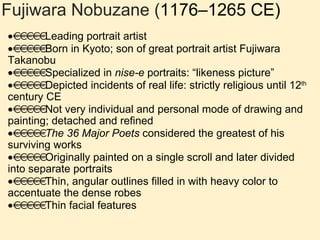
Fujiwara Nobuzane ( 1176–1265 CE)  Leading portrait artist  Born in Kyoto; son of great portrait artist Fujiwara Takanobu  Specialized in  nise-e  portraits: “likeness picture”  Depicted incidents of real life: strictly religious until 12 th  century CE  Not very individual and personal mode of drawing and painting; detached and refined  The 36 Major Poets  considered the greatest of his surviving works  Originally painted on a single scroll and later divided into separate portraits  Thin, angular outlines filled in with heavy color to accentuate the dense robes   Thin facial features
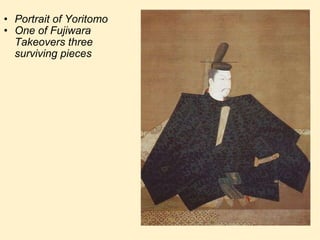
Portrait of Yoritomo One of Fujiwara Takeovers three surviving pieces
Fujiwara Takeover  (1142-1205 CE) Leading Japanese Portraiture artist Born in Kyoto Half brother of Fujiwara Sadaie (one of Japan's greatest poets) Specialty was  nise-e Popular in the courts and intellectual circles of Japan's Kamakura period Court officials, poets and intellectuals, and other prominent figures portrayed so as to capture the essence and personality of the individual with few brushstrokes Only painted on scrolls that were over a meter in height No small paintings
Kamakura Period (1185-1333 CE) Samurais ruled Minamoto Yoritomo  was the  shogun  (General-in-chief) Kept military and political power to himself Set a tradition of  shogun  ruling until 1868 Minamoto and Taira were the two warrior clans that fought to get power Gone was the era of poetic refinement Early Kamakura period- Pure Land Buddhism  was the most influential religion. Used chants to reach Buddha.   Believed that if one sincerely chanted the sacred chant, one would go to the Western Paradise.
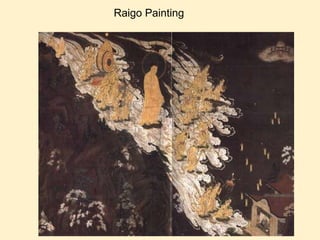
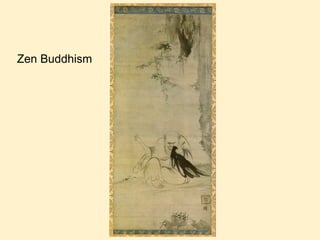
Raigo paintings: Paintings of Amida Buddha and bodhisattvas coming down to earth to bring the soul of a dying believer to the Western Paradise.   It has golden cords attached to it. A dying person can hold on to those cords and hope that Amida would usher him to paradise. Portraiture was more realistic Late Kamakura- Zen Buddhism:  last major form of Buddhism to arrive to Japan Resembles original teachings of Buddhism Enlightment was achieved through meditation, without mandalas or chants Samurais liked it more Their temples were built in mountains   Their Monks did their own chores; rank didn't matter Art style: rough and simple ink painting Around the 14th century,Zen's spirit of self-reliance dominated many aspects of Japanese culture.
Raigo Painting
Zen Buddhism
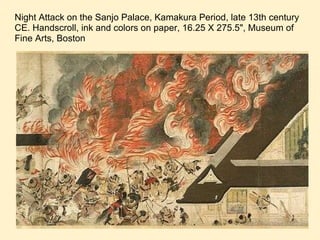
Night Attack on the Sanjo Palace, Kamakura Period, late 13th century CE. Handscroll, ink and colors on paper, 16.25 X 275.5", Museum of Fine Arts, Boston
1160 CE- 500 Minamoto rebels who did not approve of retired emperor Go-Shirakawa attack Sanjo Palace Emperor abducted, extremely bloody raid, palace burnt to the ground 1185 CE- Minamoto heirs to the rebels would finally defeat the Taira clan Seems like an eyewitness account  Refined brushstrokes like  Th e  Tale of Genji  scrolls  Brisk linework of  Frolicking Animals Flames overtake the scene as horses and warriors charge head-on into the conflagration Energy and violence from power Samurai world dominates secular arts
Kaikei  快慶  Japanese Busshi ( Buddha sculptor from)  Member of the "kei" school Anna Miyou stye, known for being intelligent, pictorial, and delightful The majortity of his works were over three  shakus  high One  shaku  = one foot   Many of his works are still around today Sculpted for the temples of Kōfuku and Tōdai in Nara Well known sculpture of Hachiman, Japanese goddess of war Developed unique style named Annami: realism combined with delicate grace in sculpting Earned Hokkyo and Hogen rank: high titles bestowed on artists at the time  
Unkei  運慶  (1164-1223 CE).  Sculptor and brother of Kaikei. Leader of the Kei School.   Sculptors showed realism, heroic spirit, power, passion, muscular bodies, rounded faces, and vibrant strength. Commissioned by the new military overlords in Shizuoka and Kanagawa Prefectures to carve Buddhist statuary for various temple projects. Exposed to warrior class early in live, immensely influencing his later work. Most of his work still exists today. Worked in Nara, Kyoto, and Kamakura. Became the most influential artist of his time, gaining the highest rank of Ho-in. Most widely known Buddhist sculptor in Japan today.
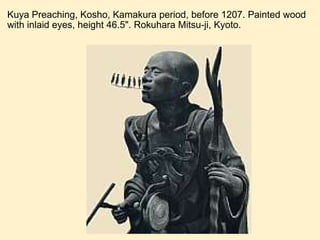
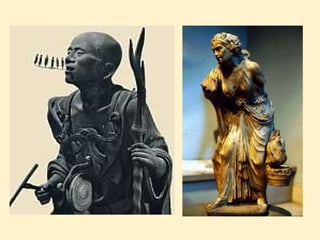
Kuya Preaching, Kosho, Kamakura period, before 1207. Painted wood with inlaid eyes, height 46.5". Rokuhara Mitsu-ji, Kyoto.
Kuya (903-72 CE) was a monk who helped in the spread of the practice of chanting Traveling clothes, small gong, staff with mounted deer horns symbolizing his slaying of a deer and conversion to Buddhism identifies Kuya Passionate and radiant expression gives sculpture a welcoming demeanor Six small Buddhas coming from Kuya's mouth, representing the six syllables  of Na-Mu-A-mi-da-buts(u) (Pure Land chant) Pure Land Buddhism expressed in naturalism of figure; emphasis on realism defining the Kamakura era Use of crystal eyes in sculpture Kosho conquered difficulty of representing Kuya and his chant (symbolized by 6 monks) in 3-D
 
Kōkei  康慶  ( active 1177-1200 CE) Sculptor Son of  Jōchō    Kōkei's canon of proportions are the same as his father's Spread legs,triangular figure and square-shaped face Organizer of the Kei school Led the teams that reconstructed the Tōdai-ji and Kōfuku-ji temples in Nara (1188–1189) Uses crystal inlays More realistic looking More attention paid to details such as inlaid hair and details on face and drapery
Tankei  湛慶  (1173-1256 CE) Sculptor of the Kei School Eldest son of Unkei Honored with the top three ranks available to Buddhist sculptors(Ho-in  法印 , Hogen  法眼 , and Hokkyo  法橋 ).  Helped restore the Tōdaiji Temple, Kōfukuji Temple, and remake the  Rengeōin Temple . Sculpted the central figure of the seated Senju Kannon and nine smaller versions of the deity Statues distinguished by his gentle and sophisticated realism Suppressed plump faces and busy details Often assisted by nephews Kosei and Koen
Nambokucho (Period of Rival Northern and Southern) (1336-1392 CE) 1333: Emperor Go-Daigo and supporters take down Kamakura regimen. 1336: Ashikaga Takauji (member of a branch family of the Minamoto clan) takes over Kyoto and drives Go-Daigo out of power Takauji begins rivalry, establishing new military government in Kyoto (Northern Court). Go-Daigo goes South, taking over Yoshino (Southern Court) Confrontation between Northern and Southern Court for over 60 years.   "Nan"=South; "Boku"=North; "Cho"=Imperial Court   Revival of poetry:  Renga becomes popular.   Writing focused on the wars and main events that occured at the time.   Tea, used before only as a medicine, becomes a popular beverage.
Bibliography    &quot;Chapter Nine: Buddhist Iconography.&quot;  East-Asian-History Home . Web. 29 Nov. 2010. <http://www.east-asian-history.net/textbooks/480/ch9_main.htm>.  &quot;Fujiwara Nobuzane.&quot;  Encyclopædia Britannica . 2010. Encyclopædia Britannica Online. 29 Nov. 2010 < http://www.britannica.com/EBchecked/topic/221598/Fujiwara-Nobuzane >.  Hooker, Richard. &quot;Yayoi and Jomon.&quot;  Washington State University - Pullman, Washington . Richard Hines, 06 June 1999. Web. 29 Nov. 2010. <http://www.wsu.edu:8080/~dee/ANCJAPAN/YAYOI.HTM>.  &quot;The Japanese Nanboku-cho Period.&quot;  ELanguage . Web. 29 Nov. 2010. <http://learnjapanese.elanguageschool.net/japanese-nanboku-cho-period>.  &quot;Kamakura and Nanbokucho Periods (1185–1392) | Thematic Essay | Heilbrunn Timeline of Art History | The Metropolitan Museum of Art.&quot;  The Metropolitan Museum of Art, New York: Metmuseum.org . Web. 29 Nov. 2010. <http://www.metmuseum.org/toah/hd/kana/hd_kana.htm>.  Keally, Charles T. &quot;Kofun Culture.&quot;  Japanese Archaeology . Web. 29 Nov. 2010. <http://www.t-net.ne.jp/~keally/kofun.html>.  &quot;Kōkei.&quot;  Academic Dictionaries and Encyclopedias . Web. 29 Nov. 2010. <http://en.academic.ru/dic.nsf/enwiki/1933976>.  &quot;Nanbokucho & Muromachi Period.&quot;  EMuseum . Web. 29 Nov. 2010. <http://www.mnsu.edu/emuseum/prehistory/japan/muromachi/muromachi-p.htm>.  &quot;nise-e.&quot;  Encyclopædia Britannica . 2010. Encyclopædia Britannica Online. 29 Nov. 2010 < http://www.britannica.com/EBchecked/topic/415968/nise-e >.   010. <http://www.onmarkproductions.com/html/busshi-buddha-sculptor-unkei-japan.html>.
Bibliography Continued  Noma, Seiroku. The Arts of Japan: Ancient and Medieval. New York: Kodansha, 1966. Print.  Parrish, Don. &quot;Visit to Normandy in 2003.&quot; Don Parrish's Home Page. Web. 29 Nov. 2010. <http://www.donparrish.com/Normandy.html>.  Robinson, B. A. &quot;SHINTO.&quot; ReligiousTolerance.org. Ontario Consultants on Religious Tolerance, 25 Oct. 2010. Web. 29 Nov. 2010. <http://www.religioustolerance.org/shinto.htm>.  Ruby, Laura. &quot;Art 115 Introduction to 2-Dimensional Composition.&quot; University of Hawaii System. Web. 29 Nov. 2010. <http://www.hawaii.edu/lruby/art115/2d.htm>.  Schumacher, Mark. &quot;Japanese Busshi (Sculptors), Asuka Period, Who Made Japan's Buddha Statues?&quot; Onmark Productions Web Designs & Buddhist Shinto Photo Dictionary of Japanese Deities. Web. 29 Nov. 2010. <http://www.onmarkproductions.com/html/busshi-buddha-sculptors-asuka-era-japan.html>.  Schumacher, Mark. &quot;Japanese Busshi (Sculptors), Kamakura Period, Who Made Japan's Buddha Statues?&quot; Onmark Productions Web Designs & Buddhist Shinto Photo Dictionary of Japanese Deities. Web. 29 Nov. 2010. <http://www.onmarkproductions.com/html/busshi-buddha-sculptors-kamakura-era-japan.html#tankei>.  Schumacher, Mark. &quot;Jocho Busshi, Heian Era, One of Japan's Most Acclaimed Sculptors of Buddha Statues.&quot; Onmark Productions Web Designs & Buddhist Shinto Photo Dictionary of Japanese Deities. Web. 29 Nov. 2010. <http://www.onmarkproductions.com/html/busshi-buddha-sculptor-jocho-japan.html>.  Schumacher, Mark. &quot;Unkei Busshi, Kamakura Era, One of Japan's Most Acclaimed Sculptors of Buddha Statues.&quot; Onmark Productions Web Designs & Buddhist Shinto Photo Dictionary of Japanese Deities. Web. 29 Nov. 2  

Japanese art before_1392

  • 1.
    Japanese Art Before1392 Jackie Duhl, Thiara Dutra, Meghan Mcgovern
  • 2.
  • 3.
    Prehistoric Japan Earliest traces if human inhabitance: 30,000 years ago  Four islands which make up island today once attached to the East Asian landmass, the islands became separate at the end of the last Ice Age, about 15,000 years ago  Paleolithic peoples gave way to Neolithic hunter-gatherers who developed the ability to make and use ceramics  Some Japanese pottery dates earlier than 10,000 BCE (some of the oldest known)
  • 4.
    Jomon Period (12,000-530BCE)  Named for patterns on pottery produced during this time  Made by pressing cord onto damp clay ( jomon means “cord markings”)  Jomon people developed hunter-gatherer lifestyle due to both island-setting, protecting them from invasion, and immense food supply  5000 BCE: agriculture developed through planting and harvesting of beans and gourds  4,500 years afterwards the Jomon remained a hunter-gatherer people using stone tools and weapons  people lived in small communities with fewer than 10-12 dwellings  Pottery reached a high degree of creativity during middle Jomon period (2500-1500 BCE): basic form remained straight-sided, yet rim too kon spectacular, whimsical shapes  Made use of malleable quality of clay  “ Flame Ware” Vessel, Dogu
  • 5.
    Dogu, Kurokoma, YamanashiPrefecture. Jomon period, c. 2500-1500 BCE. Earthenware, height 10&quot;. Tokyo National Museum. 
  • 6.
    Small clay figure(10&quot;) Distorted humanoid animal figurines Made during the late Jomon period   Dogu tend to have large faces,small arms/hands and compact bodies Some appear to have round goggles over their eyes or heart-shaped faces This Dogu is the Kurokama: its face is                                  extremely similar to that of a cat The slit eyes and mouth come off as                                      haunting marks on face, neck, and shoulders suggest tattooing (engraved with a bamboo stick) Purpose: unknown; theory exists that one could transfer an unhappy emotion or illness to a dogu and then smash it, destroying the evil
  • 7.
    Yayoi Period (300BCE – 300 CE)  ·      The shift from hunting and gathering to agriculture brought immense social changes ·      Larger permanent settlements established, division of labor into agricultural and non-agricultural tasks, hierarchal social organization, more centralized government ·      Emergence of class structure during Yayoi period as metal technology emerged ·      Bronze weaponry and ceremonial objects (bells) ·      Iron metallurgy later emerged replacing stone tools in everyday life ·      Houses were thatched with sunken floors; food stored in raised granaries ·      Drawings of these found on bronze artifacts, bearing a resemblance to the architectural design of shrines in later periods Sensitive use of wood and thatch in Yayoi shrines would suggest an early origin of the Japanese appreciation of natural materials 
  • 8.
    Kofun Period (300– 552 CE)   “ Old tombs” period: named for the large royal tombs built during this time  Emergence of more complex social order allowed for veneration of leaders: beginnings of an imperial system  Emperor equated with deities such as the sun goddess (this system is still in effect in Japan)  Chamber tombs constructed following Korean examples upon death of emperor  Religious treasures placed in graves such as potter (to please the spirits of the dead and serve them in their next life)  In many ways like Egyptian pyramids and burial chambers  Many tombs constructed in shape of large keyholes; surrounded by moats dug for protection of spirits  Fifth-century potters gained knowledge of finishing techniques in pottery; improved kilns, allowing the beginnings of a high-fired ceramic ware  Stoneware technology and earthenware
  • 9.
    Haniwa, Kyoto. Kofunperiod, 6th century CE. Earthenware, height 27&quot;. Collection of the Tokyo National Museum
  • 10.
    Earthenware left unglazed,showing no                     preoccupation with technical skill Simple and bold Shows the idiosyncrasies of life (off-center eyes,                              irregular cylindrical bodies, unequal arms etc.) Never perfectly symmetrical   The earliest Haniwa were simple jars with ceremonial                   offerings 5th century: cylinders were being made into                     shapes of ceremonial objects, houses, and boats Living creatures were added shortly after (dogs, deer, cows, monkeys) Purpose: may have served as a type of link between the world of the dead and that of the living This particular Haniwa is a seated female shaman (connection between natural and supernatural) wearing a robe, belt, and necklace, carrying a mirror at her waist
  • 11.
    Shinto  Consideredas the indigenous religion of Japan  The various ways that different communities of Japanese have interacted with deities, known as kami  Thought to inhabit awesome things in the ordinary world such as magnificent trees, rocks, waterfalls, and living creatures  Ritual purification of the ordinary world  Shinto was a term coined after the arrival of Buddhism in the sixth century CE…became more systemized with shrines, a hierarchy of deities and strictly regulated ceremonies  
  • 12.
    Main Hall, InnerShrine, Ise, Mie Prefecture. Last rebuilt 1993.
  • 13.
     Dedicated tosun goddess Amaterasu-o-mi-kami, the legendary progenitor of Japan’s imperial family  Ritually rebuilt for over 2,000 years on two adjoining sites at twenty-year intervals  Most recently in 1992  Builders are carpenters who train for the task from childhood  Accurately preserves features of Yayoi-era granaries which was its original prototype  Paragon of Shinto architecture: wooden piles raiding the building off the ground  Thatched roof held in place by horizontal logs  Use of unpainted cypress wood  Overall feeling of natural simplicity rather than overwhelming size or adornation  Only one member of the imperial family and a few Shinto priests allowed within the fourfold enclosure surrounding the shrine  Stores the three sacred Shinto symbols: a sword, a mirror, a jewel  
  • 14.
    New philosophy, cityplanning, arts, medicine, clothing, agriculture, architecture from Korea and China Buddhism, centralized governmental structure, and system of writing were the three most important introductions Buddhism reached Japan in Mahayana form with many buddhas and bodhisattvas; adopted as state religion by imperial family Represented different Shinto gods, yet instead of focusing on imposing natural areas, focused on temples Chinese-influenced architecture and elaborate iconography would contrast acutely with Japanese simplicity and naturalism New cosmology and teachings of meditation and enlightenment would be accompanied by new methods of painting and sculpture like that of artist Tori Busshi Asuka Pariod (552-645CE)
  • 15.
    Tori Busshi Sculptor active in the late 6th and early 7th century  Father and grandfather were saddle-makers, exposing Tori to metal casting, laquer, and wood-carving  First known work is a bronze Shaka image of Asuka-dera from 606 CE; the work made a favorable impression on Empress Suiko, granting Tori lands and rank equivalent to those of someone of the later fifth grade  The Yakushi Nyorai (Buddha of Healing) from Wakakusa-dera is attributed to Tori  Completed 607 under the commission of Emperor Yomei and Prince Shōtoku for the newly established Wakakusadera  The Shaka Triad of Horyuji is considered Tori’s greatest work: piece was intended to either help speed the recovery of Prince Shōtoku in his illness or ease the rebirth of the souls of two dead noblewomen into paradise  Works exemplify Japanese Buddhist art during the Asuka period, deriving the style from the 4 th -6 th century Chinese Wei kingdom  Conveys peace and gentleness while using rigid stock poses and geometrical figures  Buddhas sculpted upright with crossed legs and robes dropping downwards in well-defined folds  Buddha’s right hand raised with palm towards viewer (power to aid others), and left hand palm up on left leg (ability to lead viewer along path to end all suffering)  Each Buddha’s head is stylized and elongated, topped with curls known as shogo, indicating the Buddha’s perfection  Faces even more stylized with flat planes holding slitlike eyes, eyebrows, and nostrils
  • 16.
    Horyu-ji Compound, AsukaPeriod, 7 th century CE.
  • 17.
     Located onJapan’s central plains not far from Nara  Founded in 607 CE by Prince Shotoku (574-622 CE) who became the most influential early proponent of Buddhism  Rebuilt after a fire in 670-oldest wooden temple in the world  Just proportions, human scale, perfect monument to early Buddhist faith in Japan  Main compound contains rectangular courtyard surrounded by covered corridors  Two buildings within compound: kondo (golden hall) and five-story pagoda  Asymmetrical layout, yet large kondo balanced by tall, thin pagoda  Kondo filled with Buddhist images and used for worship and ceremonies  Pagoda serves as a reliquary and is not entered  Excess monastery buildings outside main compound (outer gate, lecture hall, repository for sacred texts, belfry (bell tower), dormitories for monks)  Holds a shrine decorated with paintings in lacquer known as Tamamushi Shrine (tamamushi beetle’s iridescent wings were originally placed on the shrine to make it glitter)  Disagreement about origins of shrine (Japan or Korea), but the more important point is that Buddhism was so international that at the time that matters of nationality were irrelevant  
  • 18.
  • 19.
    Shaka Triad inthe Kondo, Tori Busshi, Horyu-ji. suka period, c. 623 CE. Gilt bronze, height of seated figure 34.5&quot;.
  • 20.
    Shaka=Shakyamuni, historical BuddhaReflects the strong influence of Chinese art of the Northern Wei dynasty  Frontal pose, outsized face/hands,and the linear treatment of drapery suggest Tori's awareness of earlier continental models Fine bronze casting illuminatesTori's advanced technical skill Reveals rapid growth of Buddhist art as an important feature of Japanese culture Buddha's robes flow down the front of the figure, adding a heaviness to the statue   Flaming halo surrounds his head in which are seated the Seven Buddhas of the Past   Flames upon a lotus blossom appear above the Buddha's head, symbolizing wisdom Figure as the 32 physical attributes of a Buddha: bulge on top of head (ushnisha), a spot of hair between the eyebrows (urna), elongated earlobes
  • 21.
    Hungry Tigress Jataka,Asuka period c. 650 CE, Lacquer on wood, Height of shrine 7' 7 1/2&quot;, Horyu-ji Treasure House, Anonymous artist
  • 22.
    Illustrate the Jataka Tales Stories about the former lives of the Buddha. Buddha nobly sacrifices his life to feed a starving tigress and her cubs The tigress was too weak, so Buddha had to through himself off a cliff to break his skin open A full narrative within one frame Buddha hangs shirt on a tree before diving down to his rocky doom to be devoured by the starving animals Uses the Buddhist style Slender figure, abstract treatment of the cliff, trees, and bamboo Also used in China and Korea  
  • 23.
  • 24.
    Nara Period (645-794CE) First permanent capital established in Nara with population of 200,000  Imperial system solidified into a government that could hold up against dominant aristocratic families of the previous political arena Construction of majestic Buddhist temples suchas Horyu-ji Buddhism and Shinto coexisted harmoniously, Buddhism seeking enlightenment and Shinto purification Shinto becomes more formalized while Buddhism spreads and becomes the most significant aspect of Japanese culture Existed through sacred texts called sutras believed to be so magical that a single letter could be cut and worn as a sacred amulet Nobility worshipped by copying the words of the Buddha, familiarizing the upper class with the Chinese writing system First collection of Japanese poetry compiled called the Manyoshu  (many are secular love songs) Golden Age of Buddhist painting (many on walls of Horyu-ji) embracing Tang Dynasty in China and Unified Silla period in Korea
  • 25.
    Amida Buddha, Naraperiod, Horyu-ji, c. 710 CE, wall painting using ink and colors, 10'3&quot; x 8'6&quot;
  • 26.
    Thought to beAmida, the Buddha of the Western Paradise Placed in the walls of Horyu-ji. Made of iron-wire lines (thin,even brushstrokes) Amida's body is round, his face is serene, and his hands form the dharmachakra (the gesture of teaching, setting the chakra (wheel) of the dharma (law/doctrine) in motion) mudra. Hands are at chest level= mudra . More emphasis on realistic details and body weight Parallel folds of the drapery show the influence of the Grandhara style (present in India 500 years earlier) Face is completely East Asian
  • 27.
  • 28.
    Heian Period (794-1185CE) Last division of classic Japanese history Capital relocated to Heian (now known as Kyoto) New era of self-reliance due to elongated period of peace Imperial gov't severs ties to China in 9th century; relies on aristocratic families Rise of vernacular literature such as Lady Mursaki's The Tale of Genji Real power was in the hands of the Fujiwara clan When the rise of the Samurai class (which would eventaully take power and start the feudal period) Military class rose in status Buddhism really began to flourish through two major sects Esoteric Buddhism Pure Land Buddhism You had to be cosmetically beautiful to be considered a &quot;good&quot; person Ultimately weakened the Japanese economy and led to poverty for most of its inhabitants
  • 29.
    Womb World Mandala,Heian period, late 9th century CE, Hanging scroll, colors on silk, 6' x 5' 1.5&quot;
  • 30.
    Made for theExoteric Buddhists Uses: Learning all the different gods and their relationships Teachings of a monk . He may meditate and do the gestures each god is doing,starting from the center,so he can absorb some of the power of each deitie. Gain enlightment through the powers of the different forms of Buddha. Mandala=cosmic diagram of the universe showing the gods in a planned order Originally from To-ji Represents an ultimate reality beyond the visible world to believers Wrathful deities surrounded by flames= intense spiritual force Religion is for the educated aristocracy, not the masses Parallel of the web of deities found in the social divisions of the Heian court Use of the circles and squares is an expression of the principles of ancient geomancy and the Buddhist cosmology
  • 31.
    Dainichi Buddhas ofthe four directions Angry deities
  • 32.
    Byodo-in, Uji, KyotoPrefecture. Heian period, c. 1053 CE
  • 33.
     Located inUji mountains not far from Kyoto  One of the most beautiful temples of Pure Land Buddhism  Originally a secular palace created to suggest the palace of Amida (Buddha of Everlasting Light) in the Western Paradise  Built for a member of the Fujiwara family who served as the leading counselor to the emperor  Converted into a temple after the counselor’s death in 1052  Often called Pheonix Hall for the pair of phoenix images on its roof and the shape of the building  Slender columns give a sense of airiness as if temple could rise through the sky to Amida’s Western Paradise  Hall rests in front of an artificial pond created in the shape of the Sanskrit letter A (sacred symbol for Amida)
  • 34.
    Amida Buddha, PheonixHall, Byodo-in.  Heian period, c. 1053 CE. Gold leaf and lacquer on wood, height 9’8” (2.95 m).
  • 35.
     Carved bymaster sculptor Jocho  Central image of Amida within Byodo-in palace  Exemplifies serenity and compassion of the Buddha who welcomes the soul of all believers to his paradise  Seems to shimmer when reflected in the water of the pond before it  Carved from several blocks of wood in Jocho’s joined-wood method of construction  Allowed sculptors to create larger but lighter portrayals of Buddhas and bodhisattvas for the temples constructed for the Pure Land faith  Reflects Japanese love of wood (major medium for sculpture during Heian period)  Surrounded by smaller wooden figures of bodhisattvas and angels playing musical instruments  Suggests the paradise awaiting the believer after death
  • 36.
    Jocho Busshi Sculptor of the Heian period  Trained at the Kofuku-ji, a temple in Nara  Fujiwara no Michinaga, the greatest of the Fujiwara royals of the Heian period, commissioned him to decorate the Hojoji temple  His work earned him the title Hokkyo (Master of the Dharma Bridge) in 1022 CE  Worked on sculpture for the Kōfukuji, earning him an even higher title, Hōgen (Master of the Dharma Eye)  Michinaga's son, Fujiwara no Yorimichi, commissioned Jocho to create an Amida statue for the Pheonix Hall of the Byodo-in  Piece completed in 1052 BCE: the earliest of Jōchō's works to have survived to the present day  Japanese guild-like inheritance: Jōchō's techniques were passed on to his son, Kakujo, his grandsons Injo and Raijo, his great-grandson Kojo, and ultimately Kokei  Popularized the yosegi technique of sculpting a single figure out of many pieces of wood  allowed several assistants to work on the sculpture at once, greatly speeding the process, refining the final product, and leading to specific proportions  New canon of proportions: based measurements on a unit equal to the distance between the sculpted figure's chin and hairline, distance between each knee=distance between hair and bottoms of legs  These leveled knees form the base of a triangular design: feeling of stability and peace  Intricately detailed halos, featuring fire and clouds  Style imitated for the next 150 years
  • 37.
    Tale of Genji,Heian period, 12th century CE. Handscroll, ink and color on paper, 8.5 X 18.5&quot;
  • 38.
    One of theearliest, still existing, nonreligious paintings from Japan &quot;Women's Hand&quot; style: delicate lines,strong (sometimes muted) colors, asymmetrical compositions, usually with a bird's eye view Emotionless faces; focus instead on colors, poses, total composition (big picture rather than intricate detail) A blossoming cherry tree represents happiness Unkept weeds show loneliness Each scroll was produced by a team of artists. Calligrapher: usually a member of the nobility Master painter: outlined two or three illustrations per chapter, indicated color scheme, applied finishing touches after colorists Colorists: applied colors, built up patterns and textures. Undercurrents of irony and sorrow in a seemingly joyous scene: Genji is the illegitimate son of an emperor and holding the illegitimate child of his adulterous wife
  • 39.
    Kose Kanaoka  巨勢金岡 Ninth century Japanese artist  Set precedent for the styles of the Tang Dynasty of China Originally of the Yamato-e school, founder of the Kose-ryu school in Kyoto Very few of his works survived Founded the Kose school of art (oldest school of painting in Japan) Sparked individual style in landscape painting Portraits of Confucian scholars and Buddhist subjects
  • 40.
    Fujiwara Nobuzane (1176–1265 CE)  Leading portrait artist  Born in Kyoto; son of great portrait artist Fujiwara Takanobu  Specialized in nise-e portraits: “likeness picture”  Depicted incidents of real life: strictly religious until 12 th century CE  Not very individual and personal mode of drawing and painting; detached and refined  The 36 Major Poets considered the greatest of his surviving works  Originally painted on a single scroll and later divided into separate portraits  Thin, angular outlines filled in with heavy color to accentuate the dense robes  Thin facial features
  • 41.
    Portrait of YoritomoOne of Fujiwara Takeovers three surviving pieces
  • 42.
    Fujiwara Takeover  (1142-1205 CE)Leading Japanese Portraiture artist Born in Kyoto Half brother of Fujiwara Sadaie (one of Japan's greatest poets) Specialty was nise-e Popular in the courts and intellectual circles of Japan's Kamakura period Court officials, poets and intellectuals, and other prominent figures portrayed so as to capture the essence and personality of the individual with few brushstrokes Only painted on scrolls that were over a meter in height No small paintings
  • 43.
    Kamakura Period (1185-1333CE) Samurais ruled Minamoto Yoritomo was the shogun (General-in-chief) Kept military and political power to himself Set a tradition of shogun ruling until 1868 Minamoto and Taira were the two warrior clans that fought to get power Gone was the era of poetic refinement Early Kamakura period- Pure Land Buddhism  was the most influential religion. Used chants to reach Buddha.   Believed that if one sincerely chanted the sacred chant, one would go to the Western Paradise.
  • 44.
    Raigo paintings: Paintingsof Amida Buddha and bodhisattvas coming down to earth to bring the soul of a dying believer to the Western Paradise.   It has golden cords attached to it. A dying person can hold on to those cords and hope that Amida would usher him to paradise. Portraiture was more realistic Late Kamakura- Zen Buddhism:  last major form of Buddhism to arrive to Japan Resembles original teachings of Buddhism Enlightment was achieved through meditation, without mandalas or chants Samurais liked it more Their temples were built in mountains   Their Monks did their own chores; rank didn't matter Art style: rough and simple ink painting Around the 14th century,Zen's spirit of self-reliance dominated many aspects of Japanese culture.
  • 45.
  • 46.
  • 47.
    Night Attack onthe Sanjo Palace, Kamakura Period, late 13th century CE. Handscroll, ink and colors on paper, 16.25 X 275.5&quot;, Museum of Fine Arts, Boston
  • 48.
    1160 CE- 500Minamoto rebels who did not approve of retired emperor Go-Shirakawa attack Sanjo Palace Emperor abducted, extremely bloody raid, palace burnt to the ground 1185 CE- Minamoto heirs to the rebels would finally defeat the Taira clan Seems like an eyewitness account  Refined brushstrokes like Th e Tale of Genji scrolls  Brisk linework of Frolicking Animals Flames overtake the scene as horses and warriors charge head-on into the conflagration Energy and violence from power Samurai world dominates secular arts
  • 49.
    Kaikei  快慶  JapaneseBusshi ( Buddha sculptor from)  Member of the &quot;kei&quot; school Anna Miyou stye, known for being intelligent, pictorial, and delightful The majortity of his works were over three shakus high One shaku = one foot   Many of his works are still around today Sculpted for the temples of Kōfuku and Tōdai in Nara Well known sculpture of Hachiman, Japanese goddess of war Developed unique style named Annami: realism combined with delicate grace in sculpting Earned Hokkyo and Hogen rank: high titles bestowed on artists at the time  
  • 50.
    Unkei 運慶 (1164-1223 CE). Sculptor and brother of Kaikei. Leader of the Kei School.   Sculptors showed realism, heroic spirit, power, passion, muscular bodies, rounded faces, and vibrant strength. Commissioned by the new military overlords in Shizuoka and Kanagawa Prefectures to carve Buddhist statuary for various temple projects. Exposed to warrior class early in live, immensely influencing his later work. Most of his work still exists today. Worked in Nara, Kyoto, and Kamakura. Became the most influential artist of his time, gaining the highest rank of Ho-in. Most widely known Buddhist sculptor in Japan today.
  • 51.
    Kuya Preaching, Kosho,Kamakura period, before 1207. Painted wood with inlaid eyes, height 46.5&quot;. Rokuhara Mitsu-ji, Kyoto.
  • 52.
    Kuya (903-72 CE)was a monk who helped in the spread of the practice of chanting Traveling clothes, small gong, staff with mounted deer horns symbolizing his slaying of a deer and conversion to Buddhism identifies Kuya Passionate and radiant expression gives sculpture a welcoming demeanor Six small Buddhas coming from Kuya's mouth, representing the six syllables  of Na-Mu-A-mi-da-buts(u) (Pure Land chant) Pure Land Buddhism expressed in naturalism of figure; emphasis on realism defining the Kamakura era Use of crystal eyes in sculpture Kosho conquered difficulty of representing Kuya and his chant (symbolized by 6 monks) in 3-D
  • 53.
  • 54.
    Kōkei 康慶 ( active 1177-1200 CE) Sculptor Son of Jōchō    Kōkei's canon of proportions are the same as his father's Spread legs,triangular figure and square-shaped face Organizer of the Kei school Led the teams that reconstructed the Tōdai-ji and Kōfuku-ji temples in Nara (1188–1189) Uses crystal inlays More realistic looking More attention paid to details such as inlaid hair and details on face and drapery
  • 55.
    Tankei 湛慶 (1173-1256 CE) Sculptor of the Kei School Eldest son of Unkei Honored with the top three ranks available to Buddhist sculptors(Ho-in  法印 , Hogen  法眼 , and Hokkyo  法橋 ). Helped restore the Tōdaiji Temple, Kōfukuji Temple, and remake the Rengeōin Temple . Sculpted the central figure of the seated Senju Kannon and nine smaller versions of the deity Statues distinguished by his gentle and sophisticated realism Suppressed plump faces and busy details Often assisted by nephews Kosei and Koen
  • 56.
    Nambokucho (Period ofRival Northern and Southern) (1336-1392 CE) 1333: Emperor Go-Daigo and supporters take down Kamakura regimen. 1336: Ashikaga Takauji (member of a branch family of the Minamoto clan) takes over Kyoto and drives Go-Daigo out of power Takauji begins rivalry, establishing new military government in Kyoto (Northern Court). Go-Daigo goes South, taking over Yoshino (Southern Court) Confrontation between Northern and Southern Court for over 60 years.   &quot;Nan&quot;=South; &quot;Boku&quot;=North; &quot;Cho&quot;=Imperial Court   Revival of poetry:  Renga becomes popular.   Writing focused on the wars and main events that occured at the time.   Tea, used before only as a medicine, becomes a popular beverage.
  • 57.
    Bibliography   &quot;Chapter Nine: Buddhist Iconography.&quot; East-Asian-History Home . Web. 29 Nov. 2010. <http://www.east-asian-history.net/textbooks/480/ch9_main.htm>.  &quot;Fujiwara Nobuzane.&quot; Encyclopædia Britannica . 2010. Encyclopædia Britannica Online. 29 Nov. 2010 < http://www.britannica.com/EBchecked/topic/221598/Fujiwara-Nobuzane >.  Hooker, Richard. &quot;Yayoi and Jomon.&quot; Washington State University - Pullman, Washington . Richard Hines, 06 June 1999. Web. 29 Nov. 2010. <http://www.wsu.edu:8080/~dee/ANCJAPAN/YAYOI.HTM>.  &quot;The Japanese Nanboku-cho Period.&quot; ELanguage . Web. 29 Nov. 2010. <http://learnjapanese.elanguageschool.net/japanese-nanboku-cho-period>.  &quot;Kamakura and Nanbokucho Periods (1185–1392) | Thematic Essay | Heilbrunn Timeline of Art History | The Metropolitan Museum of Art.&quot; The Metropolitan Museum of Art, New York: Metmuseum.org . Web. 29 Nov. 2010. <http://www.metmuseum.org/toah/hd/kana/hd_kana.htm>.  Keally, Charles T. &quot;Kofun Culture.&quot; Japanese Archaeology . Web. 29 Nov. 2010. <http://www.t-net.ne.jp/~keally/kofun.html>.  &quot;Kōkei.&quot; Academic Dictionaries and Encyclopedias . Web. 29 Nov. 2010. <http://en.academic.ru/dic.nsf/enwiki/1933976>.  &quot;Nanbokucho & Muromachi Period.&quot; EMuseum . Web. 29 Nov. 2010. <http://www.mnsu.edu/emuseum/prehistory/japan/muromachi/muromachi-p.htm>.  &quot;nise-e.&quot; Encyclopædia Britannica . 2010. Encyclopædia Britannica Online. 29 Nov. 2010 < http://www.britannica.com/EBchecked/topic/415968/nise-e >.   010. <http://www.onmarkproductions.com/html/busshi-buddha-sculptor-unkei-japan.html>.
  • 58.
    Bibliography Continued Noma, Seiroku. The Arts of Japan: Ancient and Medieval. New York: Kodansha, 1966. Print.  Parrish, Don. &quot;Visit to Normandy in 2003.&quot; Don Parrish's Home Page. Web. 29 Nov. 2010. <http://www.donparrish.com/Normandy.html>.  Robinson, B. A. &quot;SHINTO.&quot; ReligiousTolerance.org. Ontario Consultants on Religious Tolerance, 25 Oct. 2010. Web. 29 Nov. 2010. <http://www.religioustolerance.org/shinto.htm>.  Ruby, Laura. &quot;Art 115 Introduction to 2-Dimensional Composition.&quot; University of Hawaii System. Web. 29 Nov. 2010. <http://www.hawaii.edu/lruby/art115/2d.htm>.  Schumacher, Mark. &quot;Japanese Busshi (Sculptors), Asuka Period, Who Made Japan's Buddha Statues?&quot; Onmark Productions Web Designs & Buddhist Shinto Photo Dictionary of Japanese Deities. Web. 29 Nov. 2010. <http://www.onmarkproductions.com/html/busshi-buddha-sculptors-asuka-era-japan.html>.  Schumacher, Mark. &quot;Japanese Busshi (Sculptors), Kamakura Period, Who Made Japan's Buddha Statues?&quot; Onmark Productions Web Designs & Buddhist Shinto Photo Dictionary of Japanese Deities. Web. 29 Nov. 2010. <http://www.onmarkproductions.com/html/busshi-buddha-sculptors-kamakura-era-japan.html#tankei>.  Schumacher, Mark. &quot;Jocho Busshi, Heian Era, One of Japan's Most Acclaimed Sculptors of Buddha Statues.&quot; Onmark Productions Web Designs & Buddhist Shinto Photo Dictionary of Japanese Deities. Web. 29 Nov. 2010. <http://www.onmarkproductions.com/html/busshi-buddha-sculptor-jocho-japan.html>.  Schumacher, Mark. &quot;Unkei Busshi, Kamakura Era, One of Japan's Most Acclaimed Sculptors of Buddha Statues.&quot; Onmark Productions Web Designs & Buddhist Shinto Photo Dictionary of Japanese Deities. Web. 29 Nov. 2