Essential Question:
What helped trigger a second Red Scare
during the middle of the 20th Century?
The Growing Fear of Communism

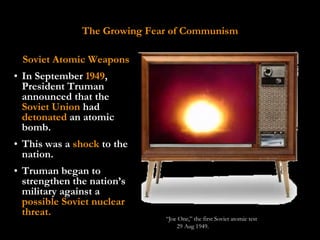
 Soviet Atomic Weapons
• In September 1949,
  President Truman
  announced that the
  Soviet Union had
  detonated an atomic
  bomb.
• This was a shock to the
  nation.
• Truman began to
  strengthen the nation’s
  military against a
  possible Soviet nuclear
  threat.
                              “Joe One,” the first Soviet atomic test
                                  29 Aug 1949.
The Growing Fear of Communism

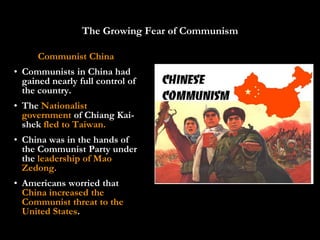
      Communist China
• Communists in China had
  gained nearly full control of
  the country.
• The Nationalist
  government of Chiang Kai-
  shek fled to Taiwan.
• China was in the hands of
  the Communist Party under
  the leadership of Mao
  Zedong.
• Americans worried that
  China increased the
  Communist threat to the
  United States.
Fighting Communism at Home

    The Smith Act                                                     The McCarran Act
• Truman charged                                                   • This act required
  several leaders of the                                             Communist
  Communist Party in                                                 organizations to
  the United States                                                  register with the
  under this act.                                                    government.
• The act made it a                                                • It established a
  crime to call for the                                              special board to
  overthrow of the U.S.                                              investigate
  government.                                                        Communist
                                                                     involvement.
• The leaders were
  convicted and their                                              • Made it illegal to plan
  convictions were                                                   a totalitarian
  upheld in Dennis v.                                                dictatorship.
  United States.
                                                                   • Prevented
                                                                     Communists from
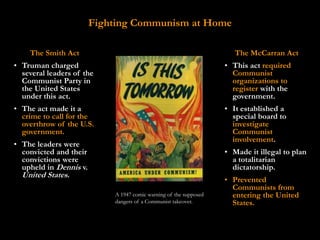
                            A 1947 comic warning of the supposed     entering the United
                            dangers of a Communist takeover.         States.
Fighting Communism at Home


       Spy Cases
• Alger Hiss —
  convicted of being a
  spy for the Soviets.
• Klaus Fuchs —a
  Manhattan Project
  scientist who gave
  atomic bomb
  information to the
  Soviets.
• Ethel and Julius
  Rosenberg —
  convicted of passing
  secrets to the Soviets
  and executed.


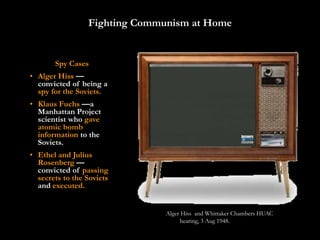
                               Alger Hiss and Whittaker Chambers HUAC
                                    hearing, 3 Aug 1948.
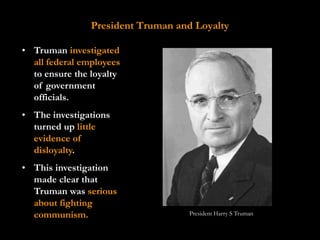
President Truman and Loyalty

• Truman investigated
  all federal employees
  to ensure the loyalty
  of government
  officials.
• The investigations
  turned up little
  evidence of
  disloyalty.
• This investigation
  made clear that
  Truman was serious
  about fighting
  communism.                       President Harry S Truman
Joseph McCarthy and the Second Red Scare
• Joseph McCarthy was a
  senator who claimed that
  there were 205 known
  Communists working for
  the U.S. Department of
  State.
• Truman dismissed him as
  a “ballyhoo artist.”
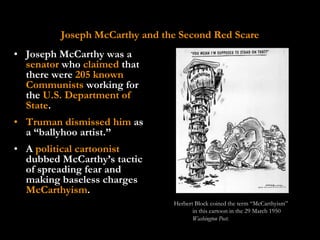
• A political cartoonist
  dubbed McCarthy’s tactic
  of spreading fear and
  making baseless charges
  McCarthyism.
                               Herbert Block coined the term “McCarthyism”
                                      in this cartoon in the 29 March 1950
                                      Washington Post.
Joseph McCarthy and the Second Red Scare
• McCarthy’s claims were
  rarely backed up with any
  evidence, but this didn’t
  stop him from gaining a
  reputation as being the
  nation’s top Communist
  fighter.
• McCarthy succeeded when
  he made a special effort to
  defeat Maryland senator
  Millard Tydings.
• McCarthyism spread
  beyond the Senate into
  other branches of
  government, into
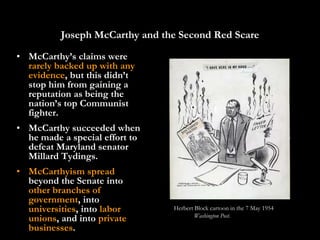
  universities, into labor      Herbert Block cartoon in the 7 May 1954
                                        Washington Post.
  unions, and into private
  businesses.
Investigating Hollywood
• The House Un-American
  Activities Committee
  (HUAC) explored the
  possible Communist
  influence in the American
  film industry.
• The Hollywood Ten refused
  to answer HUAC questions
  about their beliefs or those
  of their colleagues.
• Many others in Hollywood
  did testify, for if they didn’t
  their names were placed on
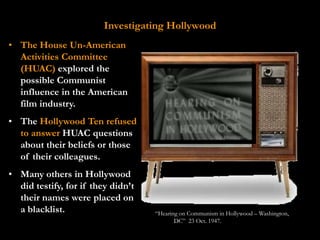
  a blacklist.                      “Hearing on Communism in Hollywood – Washington,
                                           DC” 23 Oct. 1947.
McCarthy’s Fall


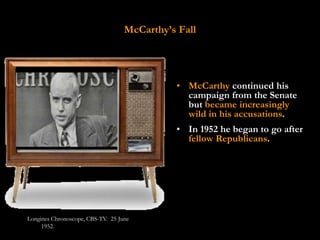
                                             • McCarthy continued his
                                               campaign from the Senate
                                               but became increasingly
                                               wild in his accusations.
                                             • In 1952 he began to go after
                                               fellow Republicans.


Longines Chronoscope, CBS-TV. 25 June
     1952.
McCarthy’s Fall


In 1954 McCarthy attacked
   the U.S. Army, claiming
   that it was protecting
   Communists.


                                 Army-McCarthy Hearings – Washington, DC. 9 June 1954
McCarthy’s Fall


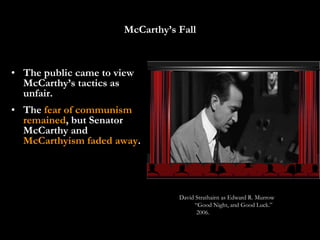
• The public came to view
  McCarthy’s tactics as
  unfair.
• The fear of communism
  remained, but Senator
  McCarthy and
  McCarthyism faded away.


                                 David Strathairn as Edward R. Murrow
                                       “Good Night, and Good Luck.”
                                        2006.

Second Red Scare

  • 1.
    Essential Question: What helpedtrigger a second Red Scare during the middle of the 20th Century?
  • 2.
    The Growing Fearof Communism Soviet Atomic Weapons • In September 1949, President Truman announced that the Soviet Union had detonated an atomic bomb. • This was a shock to the nation. • Truman began to strengthen the nation’s military against a possible Soviet nuclear threat. “Joe One,” the first Soviet atomic test 29 Aug 1949.
  • 3.
    The Growing Fearof Communism Communist China • Communists in China had gained nearly full control of the country. • The Nationalist government of Chiang Kai- shek fled to Taiwan. • China was in the hands of the Communist Party under the leadership of Mao Zedong. • Americans worried that China increased the Communist threat to the United States.
  • 4.
    Fighting Communism atHome The Smith Act The McCarran Act • Truman charged • This act required several leaders of the Communist Communist Party in organizations to the United States register with the under this act. government. • The act made it a • It established a crime to call for the special board to overthrow of the U.S. investigate government. Communist involvement. • The leaders were convicted and their • Made it illegal to plan convictions were a totalitarian upheld in Dennis v. dictatorship. United States. • Prevented Communists from A 1947 comic warning of the supposed entering the United dangers of a Communist takeover. States.
  • 5.
    Fighting Communism atHome Spy Cases • Alger Hiss — convicted of being a spy for the Soviets. • Klaus Fuchs —a Manhattan Project scientist who gave atomic bomb information to the Soviets. • Ethel and Julius Rosenberg — convicted of passing secrets to the Soviets and executed. Alger Hiss and Whittaker Chambers HUAC hearing, 3 Aug 1948.
  • 6.
    President Truman andLoyalty • Truman investigated all federal employees to ensure the loyalty of government officials. • The investigations turned up little evidence of disloyalty. • This investigation made clear that Truman was serious about fighting communism. President Harry S Truman
  • 7.
    Joseph McCarthy andthe Second Red Scare • Joseph McCarthy was a senator who claimed that there were 205 known Communists working for the U.S. Department of State. • Truman dismissed him as a “ballyhoo artist.” • A political cartoonist dubbed McCarthy’s tactic of spreading fear and making baseless charges McCarthyism. Herbert Block coined the term “McCarthyism” in this cartoon in the 29 March 1950 Washington Post.
  • 8.
    Joseph McCarthy andthe Second Red Scare • McCarthy’s claims were rarely backed up with any evidence, but this didn’t stop him from gaining a reputation as being the nation’s top Communist fighter. • McCarthy succeeded when he made a special effort to defeat Maryland senator Millard Tydings. • McCarthyism spread beyond the Senate into other branches of government, into universities, into labor Herbert Block cartoon in the 7 May 1954 Washington Post. unions, and into private businesses.
  • 9.
    Investigating Hollywood • TheHouse Un-American Activities Committee (HUAC) explored the possible Communist influence in the American film industry. • The Hollywood Ten refused to answer HUAC questions about their beliefs or those of their colleagues. • Many others in Hollywood did testify, for if they didn’t their names were placed on a blacklist. “Hearing on Communism in Hollywood – Washington, DC” 23 Oct. 1947.
  • 10.
    McCarthy’s Fall • McCarthy continued his campaign from the Senate but became increasingly wild in his accusations. • In 1952 he began to go after fellow Republicans. Longines Chronoscope, CBS-TV. 25 June 1952.
  • 11.
    McCarthy’s Fall In 1954McCarthy attacked the U.S. Army, claiming that it was protecting Communists. Army-McCarthy Hearings – Washington, DC. 9 June 1954
  • 12.
    McCarthy’s Fall • Thepublic came to view McCarthy’s tactics as unfair. • The fear of communism remained, but Senator McCarthy and McCarthyism faded away. David Strathairn as Edward R. Murrow “Good Night, and Good Luck.” 2006.