
Quick Write – April 21/20
From April - July 1994, the Hutu-led military in
Rwanda killed about 800,000 Tutsis and Hutu
moderates in the Rwandan genocide. According to
classified documents made available in March
2004, President Bill Clinton and his administration
knew that Rwanda was being engulfed by genocide
in April 1994 but chose not to get involved.
Why would President Clinton choose not to
intervene in Rwanda even though he had
intelligence reports of the “final solution to
eliminate all Tutsis”?
Political Rise of Bill Clinton
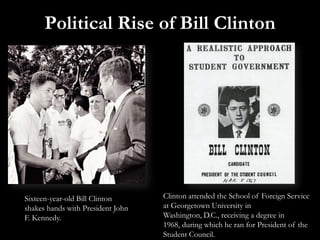
16 year old Clinton attended the School of Foreign Service
at Georgetown University in
Washington, D.C., receiving a degree in
1968, during which he ran for President of the
Student Council.
Sixteen-year-old Bill Clinton
shakes hands with President John
F. Kennedy.
Political Rise of Bill Clinton
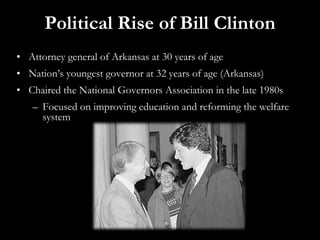
• Attorney general of Arkansas at 30 years of age
• Nation’s youngest governor at 32 years of age (Arkansas)
• Chaired the National Governors Association in the late 1980s
– Focused on improving education and reforming the welfare
system
Political Rise of Bill Clinton
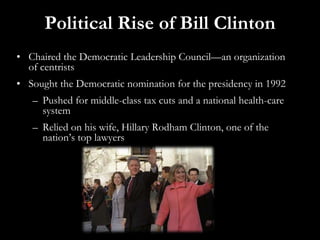
• Chaired the Democratic Leadership Council—an organization
of centrists
• Sought the Democratic nomination for the presidency in 1992
– Pushed for middle-class tax cuts and a national health-care
system
– Relied on his wife, Hillary Rodham Clinton, one of the
nation’s top lawyers
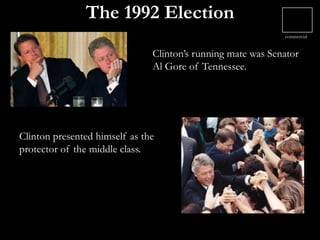
The 1992 Election
Clinton presented himself as the
protector of the middle class.
Clinton’s running mate was Senator
Al Gore of Tennessee.
commercial
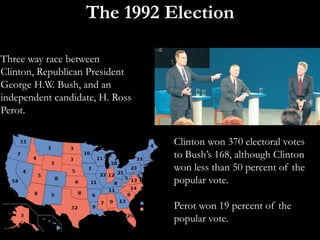
Three way race between
Clinton, Republican President
George H.W. Bush, and an
independent candidate, H. Ross
Perot.
Clinton won 370 electoral votes
to Bush’s 168, although Clinton
won less than 50 percent of the
popular vote.
Perot won 19 percent of the
popular vote.
The 1992 Election
Domestic Policy Issues
The 1994 Election
• Clinton failed to deliver on his
campaign promises, such as tax
cuts and a health care plan.
• Discontent helped contribute to
a major Republican victory in
the mid-term elections.
• Republicans campaigned with a
document called the Contract
with America.
• The Contract had a plan to
balance the budget, fight
crime, and provide tax cuts.
• Republicans gained 54 seats in
the House and 8 seats in the
Senate—this gave them control
of both houses.
What to do about welfare?
• The Contract with America
called for changes to the
welfare system.
• Clinton proposed his own
welfare-reform plan.
• It limited the amount of time
people could receive benefits.
• It required most recipients to
find work within two years of
getting benefits.
• Congress approved this plan.
What to do about health care?
• Health care costs were rising
and tens of millions of
Americans had little or no
health insurance.
• Hillary Clinton headed a special
task force which proposed a
government-sponsored
program of health care.
• The plan was defeated after
months of debate.
Domestic Policy Issues
Oslo Accords
• Clinton hosted the
signing of a peace
agreement
between Israel
and the
Palestinians.
• Agreed to self-
rule for
Palestinians in
return for the
Palestinians
recognizing
Israel’s right to
exist
• Never fully
realized
Somalia
• Bush sent troops to
help the UN
distribute food to
victims of the civil
war.
• UN forces also
worked to end the
fighting.
• After a number of
Americans
died, Clinton
withdrew the
remaining soldiers.
• Stopped U.S. from
sending help to
Rwanda.
Foreign Policy Challenges
Haiti
• Clinton pledged
the use of
American troops
to lead a UN
mission to remove
a military dictator.
• The presence of
UN forces helped
bring about a
generally peaceful
change in
government.
Former Yugoslavia
• Violence raged between the
new countries formed from
the breakup of Yugoslavia.
• Clinton helped broker the
Dayton Accords to end
fighting in Bosnia and
Herzegovina.
• He urged NATO to act
against Serbia.
• The Serb army was forcing
ethnic Albanians from the
Serbian region of Kosovo.
International Trade
• Under NAFTA, the United
States, Mexico, and Canada
became a free-trade zone.
• Clinton needed to win
congressional approval of the
agreement.
• Critics thought NAFTA
would cost American jobs.
• Proponents believed
increasing trade would help
the economy.
• Clinton also helped create the
World Trade Organization.
Foreign Policy Challenges
Scandal and Impeachment
• Whitewater real estate deal
– Kenneth Starr led an investigation into a failed real estate
investment the Clintons were involved in during the 1970s.
• Paula Jones sexual harassment case
– Jones sued Clinton for sexual harassment while he was
governor of Arkansas and she was a state employee.
– Information emerged suggesting that Clinton had an
improper relationship with a White House intern, Monica
Lewinsky.
• Monica Lewinsky case
– Clinton accused of lying under oath about Monica
Lewinsky.
– House approved two articles of impeachment but the
Senate did not have the two-thirds majority necessary to
convict Clinton.

President Bill Clinton

  • 1.
    Quick Write –April 21/20 From April - July 1994, the Hutu-led military in Rwanda killed about 800,000 Tutsis and Hutu moderates in the Rwandan genocide. According to classified documents made available in March 2004, President Bill Clinton and his administration knew that Rwanda was being engulfed by genocide in April 1994 but chose not to get involved. Why would President Clinton choose not to intervene in Rwanda even though he had intelligence reports of the “final solution to eliminate all Tutsis”?
  • 2.
    Political Rise ofBill Clinton 16 year old Clinton attended the School of Foreign Service at Georgetown University in Washington, D.C., receiving a degree in 1968, during which he ran for President of the Student Council. Sixteen-year-old Bill Clinton shakes hands with President John F. Kennedy.
  • 3.
    Political Rise ofBill Clinton • Attorney general of Arkansas at 30 years of age • Nation’s youngest governor at 32 years of age (Arkansas) • Chaired the National Governors Association in the late 1980s – Focused on improving education and reforming the welfare system
  • 4.
    Political Rise ofBill Clinton • Chaired the Democratic Leadership Council—an organization of centrists • Sought the Democratic nomination for the presidency in 1992 – Pushed for middle-class tax cuts and a national health-care system – Relied on his wife, Hillary Rodham Clinton, one of the nation’s top lawyers
  • 5.
    The 1992 Election Clintonpresented himself as the protector of the middle class. Clinton’s running mate was Senator Al Gore of Tennessee. commercial
  • 6.
    Three way racebetween Clinton, Republican President George H.W. Bush, and an independent candidate, H. Ross Perot. Clinton won 370 electoral votes to Bush’s 168, although Clinton won less than 50 percent of the popular vote. Perot won 19 percent of the popular vote. The 1992 Election
  • 7.
    Domestic Policy Issues The1994 Election • Clinton failed to deliver on his campaign promises, such as tax cuts and a health care plan. • Discontent helped contribute to a major Republican victory in the mid-term elections. • Republicans campaigned with a document called the Contract with America. • The Contract had a plan to balance the budget, fight crime, and provide tax cuts. • Republicans gained 54 seats in the House and 8 seats in the Senate—this gave them control of both houses. What to do about welfare? • The Contract with America called for changes to the welfare system. • Clinton proposed his own welfare-reform plan. • It limited the amount of time people could receive benefits. • It required most recipients to find work within two years of getting benefits. • Congress approved this plan.
  • 8.
    What to doabout health care? • Health care costs were rising and tens of millions of Americans had little or no health insurance. • Hillary Clinton headed a special task force which proposed a government-sponsored program of health care. • The plan was defeated after months of debate. Domestic Policy Issues
  • 9.
    Oslo Accords • Clintonhosted the signing of a peace agreement between Israel and the Palestinians. • Agreed to self- rule for Palestinians in return for the Palestinians recognizing Israel’s right to exist • Never fully realized Somalia • Bush sent troops to help the UN distribute food to victims of the civil war. • UN forces also worked to end the fighting. • After a number of Americans died, Clinton withdrew the remaining soldiers. • Stopped U.S. from sending help to Rwanda. Foreign Policy Challenges Haiti • Clinton pledged the use of American troops to lead a UN mission to remove a military dictator. • The presence of UN forces helped bring about a generally peaceful change in government.
  • 10.
    Former Yugoslavia • Violenceraged between the new countries formed from the breakup of Yugoslavia. • Clinton helped broker the Dayton Accords to end fighting in Bosnia and Herzegovina. • He urged NATO to act against Serbia. • The Serb army was forcing ethnic Albanians from the Serbian region of Kosovo. International Trade • Under NAFTA, the United States, Mexico, and Canada became a free-trade zone. • Clinton needed to win congressional approval of the agreement. • Critics thought NAFTA would cost American jobs. • Proponents believed increasing trade would help the economy. • Clinton also helped create the World Trade Organization. Foreign Policy Challenges
  • 11.
    Scandal and Impeachment •Whitewater real estate deal – Kenneth Starr led an investigation into a failed real estate investment the Clintons were involved in during the 1970s. • Paula Jones sexual harassment case – Jones sued Clinton for sexual harassment while he was governor of Arkansas and she was a state employee. – Information emerged suggesting that Clinton had an improper relationship with a White House intern, Monica Lewinsky. • Monica Lewinsky case – Clinton accused of lying under oath about Monica Lewinsky. – House approved two articles of impeachment but the Senate did not have the two-thirds majority necessary to convict Clinton.