By: Melanie Hawes, Robert Cheetham,
    Jake Fernandes, and Matt Begley
 AfterWWII
 During the 1940s and 1950s
 In June of 1940, Congress passed the Alien
  Registration Act in an attempt to undermine
  the power of the American Communist Party.
  Congress decided to put the House of Un-
  American Activities Committee (HUAC), in
  charge of the investigation of people
  suspected of unpatriotic behavior and
  discover if people were trying to overthrow
  the government. In 1949, leaders of the
  party began to be arrested; they were
  charged with advocating an attempt to
  overthrow the government.
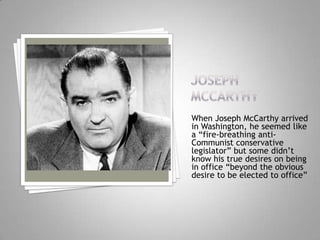
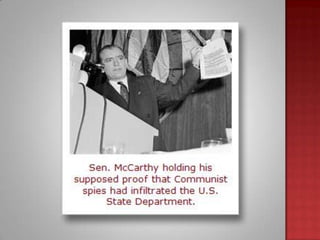
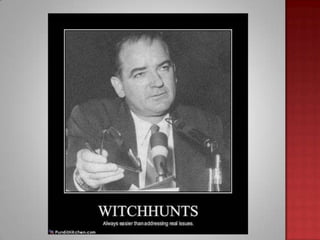
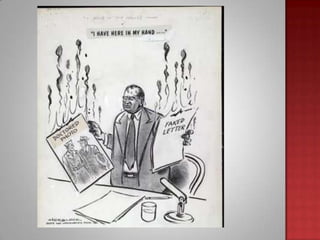
When Joseph McCarthy arrived
in Washington, he seemed like
a “fire-breathing anti-
Communist conservative
legislator” but some didn’t
know his true desires on being
in office “beyond the obvious
desire to be elected to office”
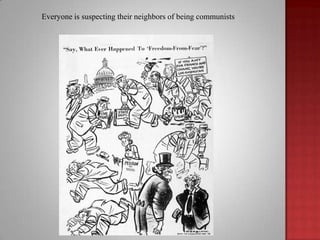
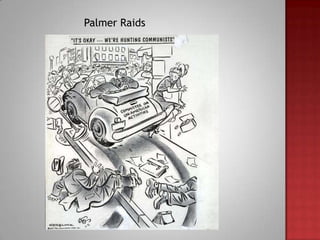
Everyone is suspecting their neighbors of being communists
 After WWII the Red Scare was still occurring
 in the U.S. and caused many Americans to be
 paranoid about the threat of Communism.
 Joseph McCarthy took advantage of this
 paranoia and developed a list of about 200
 communist men who had “ supposedly”
 infiltrated the government.
Palmer Raids
 Joseph
       McCarthy, Vincent Harnett, Edward
 Dmytryk,

 Victimswho were being accused of being
 communists, accused other people in order
 to help clear their own name.
 Joseph   McCarthy, J. Edgar Hoover

 Roy   Cohn- McCarthy’s wingman

 Main   Target of McCarthy: Secretary of State
 Dean Acheson

 David   Schine- McCarthy’s main fear

 John   Henry Faulk- Helped end the
 blacklisting
 Government    officials (mostly democrats and
 a few republicans), business leaders, writers,
 and entertainers.
 Their   careers were ruined if their names
 were mentioned on the list. Some had their
 passports taken away, others were jailed.
 They were labeled communist sympathizers
 and could not return back to work.
 The    press failed to stand up and speak out
 for the innocent victims.

 Also   some of the government officials that
 weren’t persecuted stood by and watched
 Paranoia
 Hysteria
 Those  who were accused lost their jobs
 Distrust in the government
 McCarthyism begins to die out by 1954.
 McCarthy died in 1957 from acute Hepatitis
 Learn from the past
 Shows how quickly people are willing to turn
  on one another for the sake of clearing their
  own name
 This experience shows how susceptible the
  country is to suspicion and one
  man’s/woman’s bold move to accuse certain
  government officials
   Cohen, Daniel. Joseph McCarthy: the Misuse of Political Power. Brookfield
    (Conn.): Millbrook, 1996. Print.

   "Joseph McCarthy: quote on McCarthyism." American History. ABC-CLIO,
    2011. Web. 15 Dec. 2011.

   Sparknotes. "SparkNotes: The Cold War (1945–1963): Key People &
    Terms." SparkNotes: Today's Most Popular Study Guides. Sparknotes. Web.
    15 Dec. 2011.
    <http://www.sparknotes.com/history/american/coldwar/terms.html>.

   Spartacus Education. "McCarthyism." Spartacus Educational. Spartacus
    Education. Web. 15 Dec. 2011.
    <http://www.spartacus.schoolnet.co.uk/USAmccarthyism.htm>.

   PBS. "Arthur Miller - McCarthyism | American Masters | PBS." PBS: Public
    Broadcasting Service. PBS. Web. 15 Dec. 2011.
    <http://www.pbs.org/wnet/americanmasters/episodes/arthur-
    miller/mccarthyism/484/>.

McCarthyism

  • 1.
    By: Melanie Hawes,Robert Cheetham, Jake Fernandes, and Matt Begley
  • 2.
     AfterWWII  Duringthe 1940s and 1950s
  • 3.
     In Juneof 1940, Congress passed the Alien Registration Act in an attempt to undermine the power of the American Communist Party. Congress decided to put the House of Un- American Activities Committee (HUAC), in charge of the investigation of people suspected of unpatriotic behavior and discover if people were trying to overthrow the government. In 1949, leaders of the party began to be arrested; they were charged with advocating an attempt to overthrow the government.
  • 4.
    When Joseph McCarthyarrived in Washington, he seemed like a “fire-breathing anti- Communist conservative legislator” but some didn’t know his true desires on being in office “beyond the obvious desire to be elected to office”
  • 6.
    Everyone is suspectingtheir neighbors of being communists
  • 7.
     After WWIIthe Red Scare was still occurring in the U.S. and caused many Americans to be paranoid about the threat of Communism. Joseph McCarthy took advantage of this paranoia and developed a list of about 200 communist men who had “ supposedly” infiltrated the government.
  • 8.
  • 9.
     Joseph McCarthy, Vincent Harnett, Edward Dmytryk,  Victimswho were being accused of being communists, accused other people in order to help clear their own name.
  • 11.
     Joseph McCarthy, J. Edgar Hoover  Roy Cohn- McCarthy’s wingman  Main Target of McCarthy: Secretary of State Dean Acheson  David Schine- McCarthy’s main fear  John Henry Faulk- Helped end the blacklisting
  • 12.
     Government officials (mostly democrats and a few republicans), business leaders, writers, and entertainers.  Their careers were ruined if their names were mentioned on the list. Some had their passports taken away, others were jailed. They were labeled communist sympathizers and could not return back to work.
  • 13.
     The press failed to stand up and speak out for the innocent victims.  Also some of the government officials that weren’t persecuted stood by and watched
  • 14.
     Paranoia  Hysteria Those who were accused lost their jobs  Distrust in the government
  • 16.
     McCarthyism beginsto die out by 1954.  McCarthy died in 1957 from acute Hepatitis
  • 17.
     Learn fromthe past  Shows how quickly people are willing to turn on one another for the sake of clearing their own name  This experience shows how susceptible the country is to suspicion and one man’s/woman’s bold move to accuse certain government officials
  • 19.
    Cohen, Daniel. Joseph McCarthy: the Misuse of Political Power. Brookfield (Conn.): Millbrook, 1996. Print.  "Joseph McCarthy: quote on McCarthyism." American History. ABC-CLIO, 2011. Web. 15 Dec. 2011.  Sparknotes. "SparkNotes: The Cold War (1945–1963): Key People & Terms." SparkNotes: Today's Most Popular Study Guides. Sparknotes. Web. 15 Dec. 2011. <http://www.sparknotes.com/history/american/coldwar/terms.html>.  Spartacus Education. "McCarthyism." Spartacus Educational. Spartacus Education. Web. 15 Dec. 2011. <http://www.spartacus.schoolnet.co.uk/USAmccarthyism.htm>.  PBS. "Arthur Miller - McCarthyism | American Masters | PBS." PBS: Public Broadcasting Service. PBS. Web. 15 Dec. 2011. <http://www.pbs.org/wnet/americanmasters/episodes/arthur- miller/mccarthyism/484/>.